Article Contents:
- History of wooden balustrades: from antiquity to the present day
- Origins of balustrades in the ancient world
- Middle Ages and Renaissance: birth of wooden balustrades
- Baroque and Rococo: era of luxury
- Classicism and Empire: return to origins
- Eclecticism and Modernism: experiments with form
- Contemporary: traditions and innovations
- Anatomy of a wooden balustrade: main elements and their functions
- Balusters – the heart of the balustrade
- Stringer and treads – foundation of construction
- Handrail – functionality and comfort
- Supporting posts – reliability and expressiveness
- Base baluster – foundation of construction
- Decorative elements – individuality and character
- Wood species for balustrades: choosing the ideal material
- Oak – king among species
- Beech – elegance and practicality
- Ash – strength and flexibility
- Larch – natural protection
- Spruce – accessibility and practicality
- Exotic species – luxury and uniqueness
- Combined solutions – play of contrasts
- Styles of wooden balustrades: from classicism to avant-garde
- Classic style – timeless and beyond fashion
- Baroque and Rococo – luxury and theatricality
- Gothic style – reaching upward
- Modern (Art Nouveau) – natural motifs
- Country and Provence – coziness and naturalness
- Minimalism – functionality and clean lines
- High-tech and futurism – innovations and experiments
- Wooden balustrade manufacturing technologies
- Material preparation – the foundation of quality
- Traditional Processing Methods
- Modern manufacturing technologies
- Final finishing – protection and aesthetics
- Design and calculations – the foundation of success
- Preparatory work – guarantee of quality installation
- Methods of baluster attachment – the basis of reliability
- Installation sequence – step by step to perfection
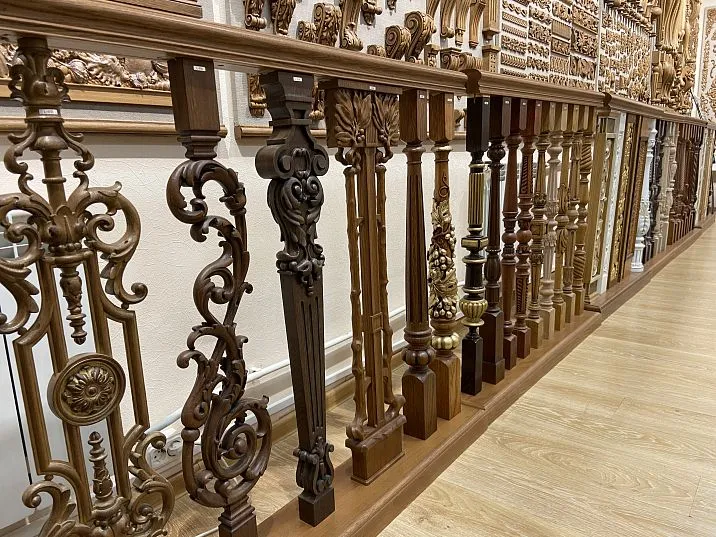
Grand mansions, luxurious estates, elegant country houses... What unites these architectural masterpieces? One detail that instantly transforms any building, giving it a unique charm and nobility – wooden balustradeThis architectural element, originating from ancient times, is experiencing a true revival today, becoming not just a functional railing, but a key accent in the design of modern homes.
Imagine: you ascend a majestic staircase, your hand glides over perfectly polished handrails, and your gaze involuntarily lingers on the elegant turned balusters, creating a unique rhythmic pattern. Every detail of the wooden balustrade is the result of meticulous craftsmanship, embodying centuries-old woodworking traditions and modern technological solutions.
In this article, we will dive into the wonderful world of wooden balustrades, reveal the secrets of their manufacturing, discuss the variety of styles and forms, and share practical recommendations for choosing and caring for these elegant structures. Ready to embark on an exciting journey into the world of architectural perfection? Then get comfortable – we’re starting!


History of wooden balustrades: from antiquity to the present day
To truly appreciate the beauty and significance of the wooden balustrade in modern architecture, a brief excursion into history is necessary. After all, this architectural element underwent a long evolutionary journey before acquiring the forms we are familiar with today.




Origins of balustrades in the ancient world
Amazingly, the earliest prototypes of balustrades appeared in ancient Assyria and Persia around the 13th century BCE. Archaeological findings indicate that palaces and temples were already adorned with decorative railings featuring repeating elements. Of course, these were stone structures, but they laid the foundation for the future development of balustrades.
Ancient Greeks and Romans refined this idea, creating more elegant structures. In classical architecture, balustrades were primarily used as decorative elements, emphasizing the status and grandeur of buildings. Interestingly, the word 'balustrade' has Latin roots and derives from 'balaustium' – the flower of the wild pomegranate, whose shape early balusters resembled.
Our factory also produces:



Middle Ages and Renaissance: birth of wooden balustrades
The Middle Ages brought a new phase in the development of balustrades. During this period, wood began to be actively used as a material for their construction. Gothic cathedrals and castles were adorned with carved wooden railings, although these still bore little resemblance to classical balustrades.
A true breakthrough occurred during the Renaissance. It was precisely in the 15th-16th centuries that balustrades appeared in their modern understanding. The great Michelangelo, working on projects for Roman palaces, created the classic baluster form – a turned post with a distinctive silhouette resembling a vase or goblet. This form proved so successful that, with minor variations, it has survived to this day.
Renaissance masters quickly recognized the potential of wood as a material for balustrades. It was more affordable than marble or stone, allowed for more complex and elegant forms, and provided ample room for artistic carving. Thus, the classical wooden balustrade – an elegant railing with turned balusters connected by a handrail on top and a base below.
Get Consultation
Baroque and Rococo: the era of luxury
The 17th-18th centuries – the golden age of baroque and rococo styles – became the golden age for wooden balustrades. Masters of this period created true masterpieces: lavish, ornamented structures with ornate balusters, adorned with carving, gilding, and inlays.
Balustrades of this period were distinguished by particular theatricality and drama. They did not merely serve as railings but became an important element of architectural composition, setting the tone for the entire interior. European aristocratic palaces competed in the luxury of their balustrades, which were often crafted from rare woods and adorned with incredible sophistication.
Classicism and Empire: Returning to Origins
The end of the 18th – beginning of the 19th centuries marked a return to classical forms. The styles of classicism and empire, inspired by antiquity, brought more rigorous and concise balustrades. The wooden newels of this period had clear proportions based on mathematical calculations, minimal decoration, and noble simplicity of lines.
Interestingly, it was precisely during this period wooden balustrade that balustrades became not only an element of palaces and mansions, but also began to penetrate into homes of the middle class. Of course, in a more modest execution, but retaining the basic proportions and elegance of forms.
Eclecticism and Modernism: Experiments with Form
The second half of the 19th – beginning of the 20th centuries – a time of bold experiments in architecture. Eclecticism mixed various styles, while modernism sought inspiration in natural forms. Wooden balustrades of this period exhibited incredible diversity: from neo-Gothic with pointed forms to flowing, fluid lines in the Art Nouveau style.
Balustrades in the modern style are especially interesting – asymmetrical, with plant motifs, seemingly growing organically and naturally from the stairs. Masters of this period virtuosically utilized the plastic possibilities of wood, creating unique, unparalleled constructions.
Contemporary: Traditions and Innovations
Today wooden balustrade experiences a true renaissance. Modern woodworking technologies allow creating items of incredible precision and complexity, while preserving the warmth and naturalness of the material.
Today we observe two main directions in the development of wooden balustrades:
- Return to historical styles – neoclassicism, neobaroque, neo-Gothic. These balustrades reproduce historical samples with remarkable accuracy, using traditional woodworking techniques.
- Modern minimalism – concise, functional constructions with clean lines and minimal decoration. Such balustrades fit perfectly into modern interiors, highlighting their elegance and thoughtful design.
Whatever the modern client chooses – a historical replica or avant-garde construction – wooden balustrade remains a symbol of status, taste, and attention to detail. It is still capable of transforming any space, giving it a special charm and nobility.
Anatomy of a Wooden Balustrade: Basic Elements and Their Functions
To properly select, install, and use a wooden balustrade, it is necessary to understand from which elements it consists and what role each of them plays. Let us examine the anatomy of this structure so that you can communicate effectively with craftsmen and make informed decisions.
Newels – the Heart of the Balustrade
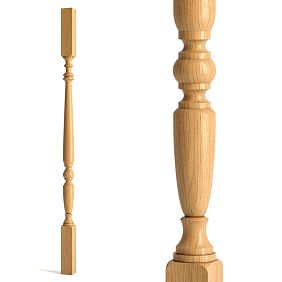
Newels are vertical posts that are the main decorative element of a balustrade. It is precisely they that create the characteristic silhouette and define the style of the entire structure. A classical newel has a symmetrical shape with expansion in the middle (so-called "vase" or "cup" shape), but modern variants may have the most diverse outlines.
The standard height of newels for staircases is 80–90 cm, and for terraces and balconies – 100–110 cm. The distance between newels is usually no more than 15 cm (this is a safety requirement, especially important if there are children in the house).
Newels can be:
- Turned (have a round cross-section)
- Flat (have a rectangular cross-section)
- Carved (decorated with relief or flat carving)
- Combined (combine different processing techniques)
The choice of newel type depends on the interior style, budget, and personal preferences of the client. Turned newels are considered a classic option and suit most interiors, from classic to modern country.
Stringer and Risers – the Foundation of the Structure
Stringer is a sloping beam to which newels are attached in a staircase balustrade. It bears the main load and ensures the rigidity of the entire structure. Depending on the type of staircase and method of balustrade installation, the stringer may be visible or hidden.
Risers are vertical elements that cover the space between steps. They not only serve a decorative function but also strengthen the staircase structure, making it more rigid and secure.
Handrail – functionality and comfort
Handrail (or balustrade rail) – the upper horizontal element of the balustrade, which people hold onto when ascending or descending stairs. It is not only a functional but also an important decorative detail, completing the balustrade composition.
The handrail's shape should be comfortable for gripping. The optimal width is 6–8 cm, and the height is 4–6 cm. The handrail surface is carefully sanded and coated with protective finishes to ensure a pleasant tactile feel and durability.
There are many handrail profiles – from simple rectangular to complex ornamental shapes. The choice depends on the balustrade style and the overall interior design.
Supporting posts – reliability and expressiveness
Supporting posts (or railing posts) are installed at the beginning and end of the stair run, as well as at stair turns. They perform an important structural function, ensuring the rigidity of the entire balustrade, and simultaneously serve as expressive decorative accents.
Posts usually have a more substantial form than balusters and are often adorned with decorative elements – carved appliqués, turned spheres, pyramids, etc. The post height should exceed the handrail height by 10–15 cm to create a visual accent at the start and end of the stairs.
Baluster base – foundation of the structure
Baluster base (or base) – a horizontal element to which the lower ends of balusters are attached. It ensures the stability of the entire structure and creates a visual completion of the balustrade from below.
In stair balustrades, the baluster base may be mounted directly onto the treads or stringer. In terrace and balcony balustrades, it is mounted onto the floor surface or parapet.
Decorative elements – individuality and character
Besides the main structural elements, wooden balustrade may include various decorative details that give it individuality and character:
- Attached rosettes and medallions
- Carved brackets
- Decorative inserts between balusters
- Turned spheres and pyramids for finishing posts
- Carved panels for stair risers
These elements do not bear structural loads, but play an important role in creating a cohesive artistic image of the balustrade, emphasizing its style and character.
Wood species for balustrades: choosing the ideal material
Choosing the wood species is one of the key points when ordering of the wooden balustradeIt affects not only the appearance of the structure but also its durability, strength, resistance to mechanical impacts, and changes in humidity. Let’s consider the main wood species used for making balustrades, their characteristics, and areas of application.
Oak – king among species
Oak is rightfully considered the best material for making balustrades. Its unique properties make it the ideal choice for load-bearing structures:
- Exceptional strength and hardness – an oak balustrade will last for decades without losing its qualities
- Expressive texture with a distinctive grain pattern
- Elegant color – from light golden to dark brown
- Resistance to moisture – oak contains natural tannins that protect it from rotting
- Dimensional stability – minimally reacts to changes in humidity and temperature
Oak balustrades are ideal for classic interiors, country houses in English style, as well as for rooms with high humidity (e.g., pools or saunas).
The only drawback of oak can be considered its high cost, but this is fully compensated by the material’s longevity and prestige.
Beech – elegance and practicality
Beech – another excellent species for making balustrades:
- Uniform dense structure allows creating items with clear, clean lines
- Light, warm tone with a slight pink or reddish hue
- Excellent workability – beech easily turns, mills, and polishes
- Accepts stains and dyes well, allowing imitation of more expensive species
Beech balustrades look great in modern interiors, Scandinavian style, as well as in spaces where visual expansion is needed through light tones.
It should be noted that beech is less resistant to moisture than oak, so for rooms with high humidity, it should be carefully treated with protective compounds.
Ash – strength and flexibility
Ash combines the strength of oak and the elegance of beech:
- High strength and elasticity – ash is not accidentally used for sports equipment
- Beautiful texture with an expressive grain
- Light color with a slight yellow or pinkish tone
- Excellent workability – easily turns and carves
- Easy to bend – ideal for curved balustrade elements
Ash balustrades are especially good in modern interiors, as well as in contemporary minimalist spaces, where naturalness and eco-friendliness are valued.
Larch – natural protection
Larch – a unique species with natural resistance to moisture and decay:
- High resin content provides natural protection against moisture and pests
- Beautiful amber tone that develops a noble patina over time
- High density and strength comparable to oak
- Dimensional stability even with significant humidity fluctuations
Larch balustrades are ideal for exterior structures – terraces, verandas, garden stairs, as well as for rooms with high humidity.
Spruce – accessibility and practicality
Spruce – the most accessible material for making balustrades:
- Low cost compared to hardwoods
- Easy to process due to soft structure
- Pleasant light color with distinct annual rings
- Accepts stains and protective compounds well
Spruce balustrades – an excellent choice for country houses, interiors in country or Provence style, as well as for budget projects where cost savings are important without significant loss of quality.
It should be noted that pine is a relatively soft wood, so railings made of it are more susceptible to mechanical damage and require more careful protection from moisture.
Exotic woods – luxury and uniqueness
For especially prestigious projects, exotic wood species are used:
- Merbau – dark brown wood with a reddish tint, exceptionally strong and resistant to moisture
- Wenge – almost black wood with contrasting grain, a symbol of luxury and status
- Teak – golden-brown wood with a high oil content, making it practically impervious to moisture
- Padauk – wood with a rich color palette ranging from purplish-brown to almost black
Railings made of exotic woods are not just functional elements, but true works of art, highlighting the owner's status and impeccable taste.
Combined solutions – play of contrasts
Modern masters often use combinations of different wood species to create expressive, memorable railings:
- Dark support posts made of oak or wenge combined with light balusters made of ash or maple
- Handrails made of redwood against light beech balusters
- Inlay of exotic woods against the main material
Such combined solutions allow creating unique, personalized railings that perfectly fit a specific interior and reflect the owner's individuality.
Styles of wooden railings: from classic to avant-garde
Style of the wooden balustrade should harmonize with the overall architectural solution of the house and interior design. Modern manufacturers offer a wide range of stylistic solutions – from exact historical replicas to avant-garde designer concepts. Let's consider the main styles of wooden railings and their distinctive features.
Classic style – timeless and unfashionable
Classic railings are an embodiment of harmony, proportionality, and elegance. Their main features:
- Symmetrical balusters with a characteristic "vase" or "cup" shape
- Clear proportions based on classical architectural canons
- Moderate decoration – fluting (vertical grooves), ovals (ornament in the shape of eggs), acanthus leaves
- Luxurious wood species – oak, walnut, redwood
- Natural wood tones or white finish for especially formal interiors
Classic railings fit perfectly into interiors in the styles of classicism, empire, and neorenaissance. They create an atmosphere of nobility and respectability, highlighting the homeowner's status.
Interesting fact: the proportions of classic balusters are not random – they are based on mathematical calculations dating back to the works of the ancient Roman architect Vitruvius and developed by Renaissance masters.
Baroque and Rococo – luxury and theatricality
Railings in the Baroque and Rococo styles are a true celebration of decoration and refinement:
- Complex, often asymmetrical baluster shapes
- Abundance of carved details – flowers, leaves, shells, scrolls
- Gilding or patination to emphasize the relief's volume
- Complex handrail profiles with multiple curves and protrusions
- Richly decorated support columns with carved capitals
Such balustrades become the central element of the interior, attracting attention and creating an atmosphere of palace luxury. They are ideally suited for large rooms with high ceilings and rich decoration.
Gothic style – upward aspiration
Gothic balustrades are distinguished by particular expressiveness and drama:
- Slender, elongated balusters with pointed forms
- Delicate carving with motifs of trinity, four-leaf, and "flame" gothic
- Dark wood species, often with matte finish
- Decorative elements with pointed arches
- Vertical lines emphasizing upward aspiration
Gothic balustrades create an atmosphere of a medieval castle, adding mystery and romance to the interior. They harmonize well with stone elements, stained glass, and wrought iron details.
Modern (Art Nouveau) – natural motifs
Balustrades in the modern style are a manifestation of natural plasticity and organic forms:
- Smooth, flowing lines reminiscent of plant stems
- Asymmetrical compositions with plant motifs
- Combination of turned and carved elements
- Integration of other materials – metal, glass, ceramics
- Natural wood tones with emphasized texture
Such balustrades become not just a functional element, but a true work of art, seamlessly integrated into the space. They are ideally suited for modern-style interiors, as well as eclectic spaces where individuality and artistic expressiveness are valued.
Country and Provence – coziness and naturalness
Balustrades in rustic styles are characterized by simplicity and functionality:
- Simple, minimalist baluster shapes – often turned posts with minimal decoration
- Natural wood tones or light pastel shades
- Light artificial aging – scratches, cracks
- Simple handrail profiles, easy to grip
- Minimal decorative elements
Such balustrades create an atmosphere of coziness and informality, perfectly fitting into country homes and cottages. They harmonize well with other natural materials – stone, brick, wrought iron elements.
Minimalism – functionality and purity of lines
Modern minimalist balustrades are a manifestation of functionality and simplicity:
- Simple geometric baluster shapes – often simply rectangular or square in cross-section posts
- Clean lines without decorative elements
- Natural wood tones with matte finish
- Combining with other materials – glass, metal
- Focus on material quality and craftsmanship
Minimalist balustrades fit perfectly into modern interiors where space, light, and functionality are valued. They do not draw excessive attention but highlight the quality of finish and thoughtful design.
High-tech and futurism – innovations and experiments
The most modern styles offer a revolutionary approach to balustrade design:
- Unusual, asymmetrical baluster shapes
- Combining wood with high-tech materials – carbon, acrylic, stainless steel
- Integration of LED lighting
- Modular constructions allowing configuration changes
- Experimental wood processing methods – laser cutting, 3D milling
Such balustrades become not just functional elements, but true art objects, demonstrating an innovative approach to design and technology.
Wooden balustrade manufacturing technologies
Creating quality of the wooden balustrade – is a complex technological process requiring both traditional craftsmanship and modern equipment. Let’s consider the main production stages and technologies used by modern craftsmen.
Material preparation – the foundation of quality
The process of creating a balustrade begins with careful selection and preparation of wood:
- Selection of lumber – boards without knots, cracks, or other defects, with uniform structure and color.
- Drying – a critically important stage. Wood must have a moisture content of 8–12%, achieved through natural drying (1 to 3 years depending on species and thickness) or kiln drying (2–4 weeks in specialized drying chambers with controlled parameters).
- Planing – boards are planed to identical thickness and width, ensuring precision for subsequent processing.
- Gluing – for creating large elements (supporting posts, wide handrails), boards are glued into panels using special water-resistant adhesives under pressure.
The quality of material preparation directly affects the durability and aesthetic characteristics of the finished balustrade. Insufficiently dried wood may warp after installation, leading to distortion of the entire structure’s geometry.
Traditional finishing methods
Despite technological advancements, many elements of the wooden balustrade are still created using traditional methods:
- Hand turning – creating balusters on a lathe manually. The craftsman, using special cutters, gives the blank the desired shape, visually and tactilely controlling the process. This method allows creating unique, one-of-a-kind elements with individual character.
- Hand carving – creating decorative elements using chisels and gouges. This process requires high skill and artistic taste. Carved elements can be standalone details or part of balusters or support posts.
- Joinery – creating strong and aesthetically pleasing connections between balustrade elements without visible fasteners. Traditional methods include mortise and tenon joints, dovetail joints, and others.
Items created using traditional methods are distinguished by special warmth and individuality. They carry the energy of the craftsman and become not just functional elements, but true works of art.
Modern manufacturing technologies
Modern production of wooden balustrades actively uses innovative technologies that allow increasing the accuracy, speed, and quality of manufacturing:
- CNC machining (Computer Numerical Control) – creating balustrade elements on special computer-controlled machines. The process begins with creating a 3D model in specialized software, which is then converted into a machine control program. CNC machining ensures the highest precision and repeatability, allowing the creation of complex shapes and identical elements.
- Laser cutting and engraving – creating decorative elements using a laser beam. This technology allows creating incredibly precise and detailed patterns, inaccessible to traditional carving methods.
- 5D milling – processing a blank with a milling cutter moving simultaneously along five axes. This technology allows creating complex three-dimensional forms, for example, sculptural balustrade elements.
- Automatic sanding – processing the surface of elements on special sanding machines, ensuring a perfectly smooth surface without manual labor.
- Robotic coating – applying lacquer and paint materials using robotic manipulators, ensuring uniform coverage and ideal surface quality.
Modern technologies allow creating balustrades of the highest quality in the shortest time, ensuring precise adherence to the project and perfect geometry of all elements.
Finishing – protection and aesthetics
Finishing – the most important stage of creation of the wooden balustrade, from which not only its appearance, but also its durability, depends:
- Sanding – a multi-stage process in which the wood surface is processed with abrasive materials of gradually decreasing grit. Quality sanding ensures a perfectly smooth surface, pleasant to the touch, and ready for applying finishing coatings.
- Staining – imparting the desired shade to wood using stains, dyes, or tinting oils. This process allows highlighting the natural beauty of the wood texture or imitating more expensive species.
- Protective coatings – application of materials protecting wood from moisture, ultraviolet radiation, mechanical damage, and biological factors. Modern manufacturers use various types of coatings:
- Lacquers (polyurethane, acrylic, alkyd) – create a strong protective film on the wood surface
- Oils (tung, linseed, Danish) – penetrate into the wood structure, protecting it from within
- Waxes – create a water-repellent coating with a pleasant silky surface
- Combined formulations – combine the advantages of various types of coatings
- Patination – creating an aged effect using special compounds that highlight the wood’s relief and give the item a vintage character.
- Polishing – final surface treatment to impart a special gloss and smoothness.
Properly executed finishing not only protects wooden balustrade from negative influences, but also highlights the beauty of natural wood, making each element truly expressive and attractive.
Installation of wooden balustrades: from project to implementation
Installation of the wooden balustrade – a responsible process requiring precise calculations, special tools, and professional skills. The quality of installation affects not only the aesthetic appearance of the structure, but also its safety, reliability, and longevity. Let us consider the main stages of this process and important nuances that must be taken into account.
Design and calculations – the foundation of success
Any installation begins with careful design and calculations:
- Measurements – precise measurement of all parameters of the staircase or platform where the balustrade will be installed. Considered:
- Length and width of stair treads
- Height and depth of steps
- Angle of inclination of the staircase
- Configuration of turns and landings
- Design – creation of a detailed balustrade project taking into account:
- Interior or exterior style
- Ergonomic requirements (handrail height, distance between balusters)
- Safety normative requirements
- Features of staircase or landing construction
- Material calculation – determination of required quantities:
- Balusters (taking into account the recommended distance between them – no more than 15 cm)
- Support posts
- Handrails and baluster supports
- Fastening elements
- Decorative details
A quality project takes into account not only aesthetic, but also technical aspects: loads the structure will experience, features of attachment to various bases, possible temperature and humidity deformations of materials.
Preparatory work – guarantee of quality installation
Before installing the balustrade, a series of preparatory works must be performed:
- Material acclimatization – wooden elements must "adapt" to the conditions of the room where they will be installed. For this, they are unpacked and left in the room for at least 48 hours under normal temperature and humidity.
- Foundation preparation – checking and, if necessary, reinforcing surfaces to which the balustrade will be attached. Special attention is paid to:
- Strength of step edges
- Presence of anchor elements in concrete structures
- Condition of floor coverings on landings
- Marking – marking precise points for installing all balustrade elements:
- Locations for mounting support posts
- Baluster installation lines
- Handrail height
- Tool and material preparation – for professional installation, the following will be required:
- Power tools (drill, screwdriver, circular saw)
- Hand tools (chisels, planes, hammers)
- Measuring instruments (laser level, tape measure, square)
- Fastening elements (screws, anchors, adhesive)
- Materials for finishing joints and mounting locations
Thorough preparation helps avoid many problems during installation and ensures high-quality final results.
Ways of attaching balusters – the basis of reliability
There are several main methods of baluster mounting, each with its own characteristics:
- Mounting into grooves – classic and most reliable method:
- Grooves are cut into the handrail and sub-baluster according to the baluster size
- Balusters are inserted into grooves and secured with glue
- This method ensures maximum structural rigidity and hides mounting locations
- Mounting with dowels – convenient option for assembled structures:
- Holes are drilled at the ends of balusters and at mounting locations
- Balusters are connected to the handrail and sub-baluster using wooden or metal dowels (dowels)
- The connection is additionally reinforced with glue
- Mounting with metal fasteners – modern method ensuring quick assembly:
- Special metal elements (angles, plates, bolts) are used
- Fasteners can be visible or hidden
- This method allows for disassembling and replacing individual elements if necessary
- Combined methods – combination of different techniques to achieve optimal results:
- For example, support posts can be mounted on metal bolts, while balusters – into grooves
- This approach allows combining reliability with ease of installation
The choice of mounting method depends on the type of structure, material of the base, design of the balustrade, and requirements for its strength.
Installation sequence – step by step to perfection
Standard installation sequence of the wooden balustrade includes the following stages:
- Installation of support posts – they define the geometry of the entire structure and bear the main load. Posts must be perfectly vertical and securely fastened to the base.
- Installation of the sub-baluster – it is installed strictly horizontally (for platforms) or parallel to the stair line (for staircases). The accuracy of sub-baluster installation is critically important for the correct geometry of the entire balustrade.
- Marking and installation of balusters – they are placed at equal distances from each other (usually 10-15 cm between balusters). The end balusters are installed first, then a string is stretched between them to align intermediate elements.
- Installation of the handrail – it is mounted on the upper ends of balusters and support posts. The handrail must form a smooth line without breaks or steps, especially at junctions between straight sections and turns.
- Installation of decorative elements – after mounting the main structure, additional decorative details such as caps, rosettes, post ends, etc., are installed.
- Finishing – sanding joints, filling mounting locations, touch-up of possible damage, application of protective finish coating on joints.
Each stage requires precision, attention to detail, and a professional approach. Even minor errors can lead to serious problems later – from aesthetic defects to structural safety violations.