Article Contents:
- Types of Decorations: From Flat Backdrops to Three-Dimensional Pavilions
- Soft Decorations: Textile Space
- Hard Decorations: Structural Base
- Dynamic Decorations: Movement as an Expressive Tool
- Carved Decor: The Aristocracy of Stage Design
- Architectural carved elements
- Decorative Panels and Applied Elements
- Ornamental Motifs of Carved Decor
- Materials for Creating Theater Decorations
- Wood: Classic Theater Production
- Advantages of Wooden Decorations
- Stage Design Elements: Creating a Cohesive Image
- Architectural elements
- Object Decorations and Props
- Background Elements
- Design Styles: From Antiquity to Avant-Garde
- Historical Styles
- Conditional and Conceptual Solutions
- Psychological Impact of Decorations on the Audience
- Scale and proportions
- Color and Lighting
- Symbolism and Associations
- Technologies for Manufacturing Wooden Theater Decorations
- Design and modeling
- Wood Processing
- Finishing and Surface Treatment
- Frequently Asked Questions
- How Much Does It Cost to Manufacture Decorations for a Play?
- How long does it take to manufacture theater stage sets?
- Why Are Carved Wooden Decorations Better Than Other Materials?
- Do Wooden Decorations Require Special Treatment?
- Can the Same Decorations Be Used for Different Plays?
- How to Store Wooden Theater Decorations?
- What Theater Design Styles Exist?
- How Does Theater Props Differ from Stage Props?
- Do stage decorations affect the acoustics of a theater?
- Can one make stage decorations themselves for an amateur performance?
- Conclusion: STAVROS — masters of theatrical decoration

A theatrical performance begins long before the first actor's line. When the curtain rises, the audience first sees the visual space in which the action will unfold.Stage decorations for a performanceThese are not just backgrounds, but powerful tools for influencing perception, creating an emotional atmosphere, and immersing the audience in the artistic world of the production. Thoughtfully designed and crafted decorations can tell the time and place of action, the social status of characters, and the mood of the scene without a single word.
The visual design of the stage forms the first impression of the performance and maintains the audience's attention throughout the action. Theater psychologists note that decorations influence the subconscious: color palette, scale of elements, texture of materials, stylistic forms — all contribute to creating a unified artistic image. Bright saturated colors evoke feelings of joy and energy, dark muted tones create tension and drama, pastel shades immerse the viewer in a lyrical mood.
Modern theaters use a wide arsenal of tools: from traditional painted backdrops to high-tech projections and interactive elements. But classicaldecorations for stagingdecorations made from natural materials, especially wooden structures with artistic carving, retain enduring value. Wood possesses unique qualities: the warmth of natural material, the ability to undergo fine artistic processing, durability, and the nobility of its texture. Carved wooden decorations create a visual luxury and authenticity that cannot be imitated with synthetic materials.


Types of decorations: from flat backdrops to volumetric pavilions
Theatrical decorations are classified by construction features, functions, and interaction with actors. Understanding the typology helps the stage designer choose optimal solutions for a specific performance.




Soft decorations: textile space
Textile decorations are the oldest form of stage design. Canvas backdrops with painted images, draperies of velvet and velour, sheer tulle curtains create volume and depth of space with minimal weight. The main advantage of textile decorations is their mobility. A 20-30 square meter fabric can be rolled into a compact roll, weighs only a few kilograms, and can be installed within minutes.
Modern digital printing technologies on fabric have expanded the possibilities of textile design. Photorealistic images of landscapes, architecture, and fantasy worlds are printed on theatrical gabardine or molleskin. The print quality allows reproduction of the finest details. However, textile has limitations: it does not create a rigid architectural structure, sags, and sways in the air, and is unsuitable for elements that actors interact with.
Our factory also produces:





Hard decorations: structural base
Hard decorations form the material space of the stage. They can be flat (panels, frames, boards) or volumetric (columns, arches, architectural fragments, practice walls). Flat decorations are frames made of wooden beams, covered with plywood or MDF, painted or painted. They depict walls of rooms, facades of buildings, natural landscapes.
Volumetric hard decorations create a three-dimensional environment. Columns, pilasters, arches, balustrades, staircases, portals —elements of stage designthat form the architectural structure of the stage space. Volumetric decorations are divided into interactive and non-interactive. Interactive elements are those with which actors physically interact: climbing stairs, leaning on railings, passing through arches, opening doors. These elements require higher standards of strength and safety.
Non-interactive decorations serve as visual backgrounds, create depth of space, and set the stylistic tone. They can be lightweight since they do not experience physical loads. Proper combination of interactive and non-interactive elements optimizes the budget without sacrificing visual effect.
Get Consultation
Dynamic decorations: movement as an expressive tool
Dynamic decorations include moving elements that transform the space before the audience's eyes. Rotating circular panels, retracting walls, structures descending from cornices, rising practice walls — stage mechanics technologies allow changing decorations without closing the curtain, maintaining the continuity of the action.
Dynamics create visual spectacle and symbolic effects. A slowly descending grid symbolizes imprisonment, a retracting wall changes the location, a rotating circle shows different sides of a building. Moving decorations require precise mechanisms, reliable fastenings, and carefully planned choreography of movements, but the effect is worth the cost.
Carved decoration: aristocracy of stage design
Artistic wood carving — the pinnacle of decorative art applied in theater.decorations for stagingDecorations with carved elements create visual luxury, historical authenticity, and aesthetic pleasure. Carved decoration is indispensable for performances whose action takes place in palaces, temples, aristocratic interiors, where it is necessary to convey the atmosphere of luxury and grandeur.
Architectural carved elements
Capitals of columns — the upper decorative part crowning the shaft. Classical orders — Doric, Ionic, Corinthian — each has a characteristic carving pattern. The Doric capital is strict and minimalist, the Ionic is adorned with volutes (scrolls), the Corinthian is rich with acanthus leaves, grape clusters, rosettes. Carved capitals transform a simple column into a work of architectural art.
Cornices and friezes — horizontal decorative bands framing the space. Carved cornices with ornaments, modular units (brackets), and teeth create horizontal divisions of the stage, emphasizing scale. Friezes are decorated with floral ornaments, geometric patterns, and narrative compositions. The quality of cornice carving sets the level of the entire design.
Balustrades — decorative railings with turned or carved balusters. Balustrades of balconies, terraces, staircases — a classic element of palace and estate interiors. Balusters can be turned (made on a lathe) or carved (hand-carved). Carved balusters with complex relief, floral motifs, geometric patterns create high-artistic-value rhythmic compositions.
Portals and window frames — frames for door and window openings. A carved portal with pilasters, archivolt (profiled arch frame), and keystone transforms a simple opening into an architectural accent. Window frames with floral carving, rosettes, brackets create a recognizable style of the era.
Decorative panels and applied elements
Carved panels — flat or relief compositions decorating walls, doors, furniture. Panels may depict plant ornaments, geometric patterns, narrative scenes. The manufacturing technology depends on complexity: simple ornaments are milled on CNC machines, complex compositions are hand-carved by master carvers.
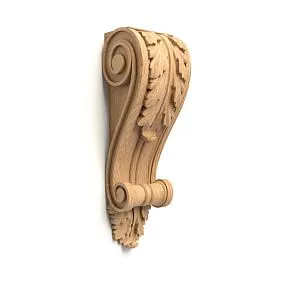
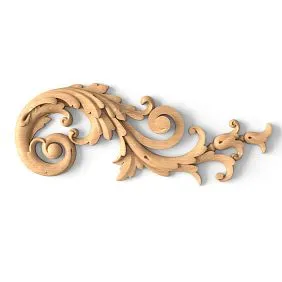
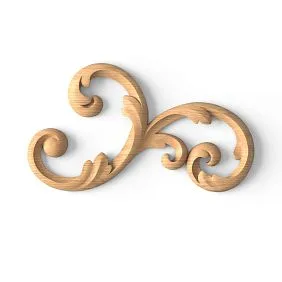
Applied carved elements — rosettes, cartouches, consoles, garlands, acanthus leaves, volutes — are attached to a base surface, enriching the decoration. The advantage of applied elements is the ability to create complex decoration using a simplified base structure. A flat panel adorned with carved appliqués looks no worse than a solid carved surface, but is faster and cheaper to produce.
Ornamental motifs of carved decoration
Plant ornaments — acanthus leaves, oak, laurel, grapevines with clusters, floral garlands — are classics of decorative carving. Plant motifs are associated with nature, life, fertility, and are suitable for any interior. The quality of carving plant forms is a measure of the carver’s skill: leaves must be lively, natural, and detailed down to the finest veins.
Geometric patterns — meanders, braids, rhombuses, rosettes, stars — strict mathematical forms creating rhythm and order. Geometry is characteristic of ancient, Byzantine, and Arabic ornaments. Geometric decoration is stricter than plant-based, suitable for formal, ceremonial spaces.
Zoomorphic motifs — lion masks, griffins, chimeras, birds — decoration featuring animals and fantastical creatures. Zoomorphism is characteristic of Baroque, Empire, and Eclecticism. Lion masks on consoles, griffins on cornices, eagles on capitals create symbolic richness and monumentality.
Materials for creating theatrical decorations
Material selection determines visual qualities, durability, manufacturability, and cost of decorations.Theatrical props made of woodpossesses unique advantages, making it preferable for high-quality productions.
Wood: classic of theatrical production
Solid wood — primary material for carved elements and structural details. Lime is classic for carving. Soft, uniform, without pronounced grain, lime is easy to carve, yields clean lines, ideal for fine artistic carving. Capitals, panels, ornaments, decorative appliqués are carved from lime. Oak is used for elements subjected to load: railings, steps, load-bearing structures. Oak is strong, durable, and has a pronounced grain.
Pine and spruce — coniferous species for frames, frames, structural elements. Light, strong, affordable, coniferous species are optimal for hidden load-bearing structures. Birch is used for turned details — balusters, turned columns, decorative round elements.
Fiberboard — layered material combining strength with geometric stability. Fiberboard does not warp, crack, or lose flatness with humidity changes. Birch fiberboard is standard for theatrical decorations. Thickness is selected based on purpose: 6–10 mm for covering structures, 12–18 mm for self-supporting panels.
MDF — pressed wood particles. Uniform material without knots or voids provides an ideally smooth surface, mills excellently on CNC machines, creating relief panels. MDF is used for ornamented panels, painting bases, flat decorative elements.
Advantages of wooden decorations
Ecological safety — natural wood is safe for humans, does not emit toxic substances, creates a healthy microclimate. In enclosed stage spaces where actors work, material ecological safety is critically important.
Technological feasibility — wood is easily processed with any tools: sawn, milled, turned, carved, glued. Processing capabilities allow creatingelements of stage designof any complexity.
Artistic expressiveness — wood texture, warmth of natural material, capability for fine carving, painting, patination, gilding — wood accepts any artistic treatment.
Durability — properly manufactured wooden decorations serve for decades. The Bolshoi and Mariinsky Theaters operate decorations of century-old age, retaining visual quality and functionality.
Repairability — damaged elements of wooden decorations are easily repaired: cracks are glued, chips are spackled, scratches are touched up. The lifespan of wooden decorations is extended through regular maintenance.
Stage design elements: creating a unified image
Stage design solution consists of many components, each performing a specific function, together creating a unified artistic organism.
Architectural elements
Columns — vertical dominants setting the scale and style of space. A column consists of a base (foundation), shaft (central part), and capital (top element). For theaters, lightweight hollow columns are manufactured: a wooden frame is covered with bent plywood, bases and capitals are made massive for stability. Height of theatrical columns ranges from 2.5 to 6–7 meters depending on the height of the stage mirror.
Arcs and portals — frame space, create passages, structure the stage. The shape of the arch determines the style: semicircular (Roman) classicism, pointed (Gothic) upward thrust, horseshoe (Moorish) Eastern exoticism. Arched vaults are made from bent plywood or assembled from radial segments.
Staircases — not only functional elements, but also powerful expressive tools. A palace’s grand staircase with carved balusters, wide steps, and rest platforms creates solemnity and monumentality. A spiral staircase of a tower — drama and vertical dynamics. A basement’s miserable staircase — oppression and poverty.
Balconies and galleries — create multi-level space. Action develops simultaneously on several levels, characters interact vertically. A balcony with carved balustrade — classic element of operatic and dramatic productions.
Object decorations and props
Theatrical props made of woodIncludes items that actors work with directly: furniture, tableware, weapons, musical instruments, decorative objects.
Furniture — tables, chairs, armchairs, thrones, cabinets, commodes — creates everyday or formal interiors. Theater furniture differs from household furniture: it is simplified (actors must move it), reinforced at critical points (withstands active use), and decoratively expressive (must be readable from a distance). Carved furniture for palace scenes — thrones with gilding, chairs with carved backs, tables with inlays — are works of applied art.
Decorative tableware — vases, boxes, candlesticks, picture frames, mirrors — details that create authenticity and richness of the environment. Carved wooden portrait frames, carved boxes with jewels, turned candlesticks — small details that form the overall image.
Architectural plastic — sculptural decorative elements. Busts on consoles, bas-reliefs on panels, statues in niches, masks on cornices — sculptural decoration enriches space, creates a cultural context, symbolic richness.
Background elements
Panels and shields — flat decorations depicting walls of rooms, building facades, landscapes. Panels are painted in base colors, decorated by artists, and embellished with applied carved elements. Carved moldings, rosettes, and pilasters transform flat panels into rich interiors.
Backdrops and curtains — soft or rigid side and upper stage frames. Backdrops (horizontal strips under the stage apron) hide lighting equipment; curtains (vertical strips on the sides) frame the performance space and conceal the backstage area. Carved rigid backdrops with ornamentation, gilded curtains create formal framing.
Backdrops — large-format canvases on the back, depicting skies, landscapes, architectural perspectives. Backdrops can be painted (canvas with painting) or printed (digital print on fabric). A combination of painted backdrops and three-dimensional wooden decorations in the foreground creates spatial depth.
Stylistic design: from antiquity to avant-garde
The choice of design style is determined by the era and location of the play, directorial concept, and artistic goals.
Historical styles
Classicism — strictness, symmetry, order system. Columns of classical orders, pediments, balustrades, restrained decoration. Color palette is noble: white marble, ochre, terracotta.decorations for stagingAncient tragedies, historical dramas set in classical antiquity require strict adherence to the canons of order architecture.
Baroque — opulence, dynamism, abundance of decoration. Twisted columns, complex cornices with modillions, carved cartouches, garlands, putti, abundance of gilding. Baroque decorations create a sense of luxury, theatricality, excess. Baroque opera productions require corresponding visual splendor.
Empire — imperial grandeur, monumentality, military symbolism. Strict columns, laurel wreaths, eagles, trophies, sphinxes. Color palette — gold on red, green, or blue backgrounds. Empire decorations create an atmosphere of imperial grandeur, suitable for historical dramas of the Napoleonic era.
Modern — flowing lines, botanical motifs, asymmetry, refinement. Stylized flowers, climbing stems, fluid forms. Modern creates a refined, aestheticized environment, suitable for psychological dramas of the early 20th century.
Conceptual and conditional solutions
Minimalism — extreme simplicity, rejection of ornamentation. A few key elements defining space: table, chair, door. Audience attention is focused on actors and text. But even minimalistelements of stage designmust be of high quality: simplicity does not mean primitiveness.
Abstraction — geometric forms, symbolic constructions, conditional spaces. Abstract decorations do not depict real locations but create a conceptual environment visualizing the play’s ideas. Wooden structures of abstract forms, painted in symbolic colors, create powerful visual statements.
Eclecticism — mixing of styles, eras, cultures. A Baroque column neighbors an industrial truss, an ancient statue beside a pop-art object. Eclecticism creates multi-layeredness, cultural allusions, play of meanings. Postmodern productions often use eclectic design.
Psychological impact of decorations on the audience
Visual design affects the perception of the play on both conscious and subconscious levels. Proper use of decorations enhances emotional impact, directs attention, and forms necessary associations.
Scale and proportions
Large monumental decorations overwhelm, creating a sense of grandeur or threat. High columns, massive arches make a person seem small and defenseless. This effect is used to convey power, strength, divine majesty. Small intimate decorations create intimacy, privacy, coziness. Low ceilings, narrow passages immerse the viewer in the atmosphere of a closed personal space.
Proportions of elements determine harmony or disharmony in space. Classical proportions (golden section, Modulor) create a sense of correctness, balance, calm. Disrupted proportions — overly elongated or squat forms — create tension, anxiety, a sense of 'something is wrong'.
Color and lighting
Color palette of decorations powerfully affects emotions. Warm colors (red, orange, yellow) excite, activate, warm. Cool (blue, green, purple) calm, cool, distance. Bright saturated colors are energetic and optimistic, muted pastels are lyrical and dreamy, dark tones are dramatic and tense.
Surface texture interacts with light. Smooth surfaces reflect light, creating highlights, gloss, coolness. Relief carved surfaces create play of light and shadow, depth, warmth. Theater spotlights directed at carved decoration reveal every detail, create dramatic chiaroscuro, enhance volume.
Symbolism and associations
Architectural elements carry cultural codes. Ancient columns are associated with classical culture, democracy, philosophy. Gothic arches — with religiosity, mysticism, the Middle Ages. Baroque gilding — with aristocracy, luxury, absolutism. Industrial structures — with modernity, urbanism, technology.
Stage decorations for a performanceThey work through the viewer's cultural memory. Recognizing style activates associations, sets a particular mood. The director and artist can play with expectations: confirm them or intentionally disrupt them, creating an artistic statement.
Wooden theater set construction technologies
QualityTheatrical wooden propsIt is determined by processing technologies, master qualifications, and control at every production stage.
Designing and modeling
The process begins with the designer's sketches. Sketches are converted into technical drawings with dimensions, detailing, and material specifications. For complex sets, 3D models are created, allowing to visualize the volumetric solution, check proportions, and identify structural issues.
Modeling — creating a miniature model at a 1:10 or 1:20 scale. The model allows the director and artist to evaluate the spatial solution and make adjustments before production begins. Modern technologies complement traditional modeling: 3D printing creates complex forms, and virtual reality allows "entering" the future set.
Wood processing
Cutting — the first operation. Sheet materials are cut on format-cutting machines, solid wood is milled with circular and panel saws. Cutting accuracy determines assembly quality.
CNC milling — creating relief elements on CNC machines. The ornament computer model is converted into a control program, the milling bit removes material layer by layer, reproducing the desired relief. CNC milling ensures precision, repeatability, and the ability to create complex forms.
Hand carving — final refinement, adding liveliness. The master carver refines details that the machine cannot create: fine trimming, small elements, individual nuances. Hand carving requires time, but creates the artistic value that automation cannot replace.
Turning — creating round elements. Balusters, columns, decorative turning elements are turned on turning machines. Copying or CNC turning machines ensure identical serial parts.
Finishing and finishing
Sanding removes tool marks, creating smoothness. Sequential sanding with decreasing grit (from P80 to P320) creates an ideally smooth surface for painting.
Priming seals wood pores, equalizes absorption, improves paint adhesion. Acrylic primer is the standard for theater sets.
Painting — applying base color. Acrylic paints dry quickly, are odorless, and provide vibrant colors. Paint is applied in 2-3 layers for evenness and depth of color.
Painting — artistic work. Imitating marble, wood, metal, applying ornaments and decorative elements. Theater painting requires special skills: the artist must understand how the set will appear under stage lights from a distance.
Patination creates an antique effect. Dark patina is applied into relief grooves, imitating dirt accumulation, oxidation, and natural aging.
Gilding — the pinnacle of decorative finishing. Leaf (gold imitation) or sheet gold is applied over glue-mordant, creating luster and luxury.
Frequently asked questions
How much does it cost to manufacture set decorations for a play?
Cost depends on scale, complexity, and materials. A simple set for a chamber play (5-7 elements) costs 100,000–250,000 rubles. A medium set for a full production with architectural elements — 400,000–800,000 rubles. Complex sets with carved decoration, painting, and gilding — from 1,000,000 rubles. An accurate estimate is calculated after creating sketches and technical specifications.
How long does it take to manufacture theater set decorations?
Simple decorations are manufactured in 4–6 weeks, medium-complexity ones — 8–12 weeks, complex ones with carving and fine finishing — 12–16 weeks. Ordering should be planned at least 3 months before the premiere, ideally 4–6 months in advance. Rush production is possible with an additional 30–50%, but is limited by technological processes.
What makes carved wooden set decorations better than other materials?
Wood possesses unique qualities: naturalness and eco-friendliness, suitability for fine artistic processing, durability with proper care, noble texture, and warmth of material. Carved decoration creates visual luxury and historical authenticity unattainable with synthetic materials. Plastic looks cheap under theater spotlights, polystyrene is fragile and short-lived — only wood provides the quality required by a professional stage.
Do wooden set decorations require special treatment?
Yes, fire-retardant treatment is mandatory. All wooden elements are impregnated or coated with fire-retardant compounds, reducing flammability to Class G1 (slightly flammable). Treatment is certified, and a passport is attached to the set. Without a fire safety certificate, a theater cannot operate the set. The treatment lasts 1–3 years, after which re-treatment is required.
Can one set of decorations be used for different plays?
Modular solutions are possible: universal base elements are supplemented with specific details for each play. Classic columns, arches, panels can be used in different productions, changing character through repainting, drapery, and applied elements. This optimizes investments: theaters purchase a basic set of quality decorations that can be adapted to different plays.
How to store wooden theater set decorations?
Store in a dry, ventilated room at 15–25°C and 40–60% humidity. Avoid damp basements or unheated warehouses — moisture deforms wood, peels paint, and causes mold. Store vertical elements (panels, boards) upright with support, not leaning against walls at an angle. Pack small parts in boxes with soft padding. Regularly inspect, and immediately repair any damage found.
What styles of theatrical design exist?
Main historical styles: Classicism (antiquity, strictness), Baroque (opulence, dynamism), Rococo (elegance, lightness), Empire (imperial solemnity), Modern (smooth lines, vegetation). Conceptual directions: Realism (authentic reproduction), Symbolism (generalized images), Expressionism (sharpness, grotesque), Minimalism (conciseness), Abstraction (conditionality). The choice depends on the era of action, directorial concept, and artistic goals.
How does theatrical props differ from stagecraft?
Props are real functional items used by actors: furniture, tableware, weapons, books. Stagecraft are imitations of objects without real function: food replicas, decorative weapons, books with blank pages. The boundary is conditional: a sword may be real (prop) or an imitation made of wood (stagecraft). For high-level productions, high-quality props made of natural materials are preferred — they create believability, and actors find it more comfortable working with real objects.
Do decorations affect the acoustics of a theater?
Hard, flat surfaces reflect sound, creating reverberation. Relief-carved surfaces scatter sound, improving acoustics. Soft fabric decorations absorb sound, reducing reverberation. Theater acoustics must consider decorations when setting up sound. Carved wooden decorations are acoustically favorable — wood does not resonate, relief scatters waves, creating natural, warm sound.
Can one make decorations for an amateur production themselves?
Simple decorations can be realistically made by oneself: flat plywood panels, painted or decorated, textile backdrops, basic furniture. However, high-quality decorations with carved details and complex finishes require professional production. Amateur self-made decorations look amateurish and spoil the impression of the performance. Even with a limited budget, it is better to order fewer high-quality elements than to make many primitive DIY items.
Conclusion: STAVROS — masters of theatrical decoration
Creating high-qualitydecorations for a stagerequires a combination of artistic taste, technical competencies, understanding of theatrical specifics, and craftsmanship in wood processing. Few manufacturers possess all the necessary qualities. Most either have the technical skills but lack artistic sensitivity, or possess artistic intuition but lack the production infrastructure to realize complex concepts.
In this situation, the company STAVROS represents a unique phenomenon in the market. It is a manufacturer for whom working with wood is not just a business, but a deep professional calling, based on years of experience, accumulated competencies, respect for the material, and understanding of responsibility toward art.
STAVROS specializes in manufacturing high-quality solid wood items. The company createselements of stage designwhich become not just functional decorations, but works of applied art. Each STAVROS item passes through the hands of masters for whom quality is an inner necessity, not merely a client’s requirement.
The company’s STAVROS experience includes participation in the most responsible projects. The reconstruction of the Alexandrovsky Palace — a museum-level project, where quality requirements are maximal, and every detail is checked by expert restorers — demonstrated the company’s capabilities. Reconstructing historical interiors of the 18th-19th centuries required not only technology but also deep understanding of the era’s styles, mastery of traditional woodworking techniques, and the ability to create items indistinguishable from historical originals.
This experience is directly applicable to creatingdecorations for productions. Historical productions set in palace interiors require the same authenticity, the same carving and finishing quality as museum reconstructions. STAVROS possesses all necessary competencies: the company’s carvers create museum-level ornamentation, artists-decorators master classical techniques of marble imitation painting, patination, and gilding, and designers create strong and ergonomic theatrical structures.
STAVROS’s production facility is equipped with modern equipment of the latest generation. CNC milling centers with working areas up to 3×2 meters create relief panels of any complexity. Multi-axis machining centers perform three-dimensional processing, inaccessible to conventional machines. CNC lathes create ideal round parts — balusters, columns, decorative elements. Laser systems cut delicate elements with jewel-like precision.
But STAVROS’s greatest wealth is its people. Carpenters with decades of experience, intuitively feeling wood. Carvers who master tools virtuosically, capable of creating the finest details. Artists-decorators who know all secrets of theatrical finishing. Technologists who control quality at every stage. For all of them, work is not just a job, but an opportunity to create something meaningful, to contribute to art.
STAVROS understands the specifics of theatrical decorations. The company knows that theatrical structures must combine visual perfection with strength, lightness, ease of assembly and disassembly. That carved decoration must be clearly visible from a distance, retain expressiveness under powerful spotlights. That premiere deadlines are sacred, and delays in decorations are catastrophic for the theater.
The STAVROS work process begins with careful study of the artistic concept. Company specialists meet with the stage designer, study sketches, discuss the concept, and propose technical solutions. STAVROS’s experience allows finding the optimal balance between artistic effect, technical feasibility, and budget constraints. Often, company specialists propose solutions the client did not even consider — how to achieve the desired effect more efficiently.
STAVROS’s design department creates detailed technical documentation: drawings with precise dimensions, structural detailing, material specifications, load and stability calculations. For complex projects, mock-ups are produced, allowing to visualize the spatial solution. Logistics is planned: how decorations will be transported, how they will be assembled on stage, how they will be stored between performances.
Production at STAVROS is organized as a quality conveyor. Incoming control rejects substandard materials. Operational control checks the result of each technological operation. Final inspection evaluates compliance with the technical specification, visual quality, and completeness. A multi-level control system guarantees that the client receives exactly what was ordered, without defects or compromises.
STAVROS’s artistic finishing is its strongest side. The company’s masters master the entire arsenal of classical theatrical decoration techniques: Carrara, verde antico, porphyry, malachite marble painting creates the illusion of natural stone; imitation of valuable wood species — oak, walnut, mahogany, rosewood — reproduces noble texture; multi-color patination creates depth of tonal transitions, illusion of ancient age; gilding with gold leaf or electrum followed by polishing gives brilliance and luxury.
Theatrical props made of woodSTAVROS’s items are not mass-produced, but individual pieces created specifically for each project. A carved throne for a king, a balcony balustrade for a tragedy, a carved palace door, decorative panels of a hall — each element is created with understanding of its role in the performance, its artistic function, its interaction with actors and lighting.
STAVROS offers a full cycle of services: from concept to stage installation. If a theater needs assistance at the development stage, STAVROS artists will create sketches, visualizations, mock-ups. Designers will calculate optimal solutions ensuring strength, lightness, and technological feasibility. Production will manufacture decorations on time with quality guarantee. Logistics will organize transportation to any point in Russia and abroad. The installation crew will install decorations on stage, train the theater’s technical staff on proper operation, and hand over installation schematics and maintenance recommendations.
STAVROS’s pricing policy is transparent and honest. The estimate is detailed, each element is evaluated separately, taking into account labor intensity, materials, and processing complexity. No hidden payments, vague formulations, unexpected additional charges. The client knows exactly what they are paying for. STAVROS’s prices correspond to quality — it is not the cheapest manufacturer, but the price-to-quality ratio is optimal. An investment in STAVROS decorations pays off through longevity, visual perfection, and absence of operational problems.
STAVROS works with theaters of different scales and statuses: state and private, capital and regional, dramatic and operatic, professional and amateur. The size of the order does not determine the attitude — a small project for a chamber theater is executed with the same care as a large order for a federal stage. For STAVROS, each project is an opportunity to create something meaningful, to help the theater realize its artistic concept, and contribute to culture.
STAVROS’s geographical scope covers all of Russia. The company ships items to Vladivostok and Kaliningrad, Murmansk and Sochi, to capitals and provinces. Experience in packaging fragile carved elements guarantees preservation during long-distance transportation. For large-scale projects, the installation crew can be dispatched to any city for professional installation and training.
STAVROS’s reputation is based on real achievements. The company’s works can be seen in the Alexandrovsky Palace, churches, private interiors, and theatrical productions. This is the best advertising — when the items speak for themselves, when quality is obvious, when clients recommend the manufacturer to colleagues.
Choosing STAVROS for creating the décor of your play, the theater chooses reliability, professionalism, and the highest level of craftsmanship. It chooses a company for which the success of your play is a professional pride, customer satisfaction is the highest reward, and creating beauty is the meaning of existence.
STAVROS is a synthesis of the traditions of Russian woodworking craftsmanship, passed down from generation to generation, and 21st-century technologies. It is respect for the material, love for craftsmanship, understanding of responsibility toward art. It is a team of professionals for whom creatingdecorations for a stage— is not work, but a calling.
Contact STAVROS, and your theatrical décor will become works of applied art worthy of great productions. Décor that will be remembered by audiences, delight critics, become the visual legend of the play. Décor created by masters for stage masters.
STAVROS — catalog of products— where each element is created so that your play becomes unforgettable.
STAVROS's extensive product range allows finding a solution for any production. Carved columns of all classical orders — from strict Doric to luxurious Corinthian. Balustrades with turned and carved balusters for balconies and staircases. Carved panels and wainscoting for wall decoration. Architectural elements — capitals, cornices, consoles, modular units, rosettes. Decorative furniture — thrones, chairs, tables, cabinets with artistic carving. Each item in the catalog is the result of years of experience, embodiment of craftsmanship, a sample of quality.
flexibility of production STAVROS allows working with both standard and individual solutions. Standard elements from the catalog are available in short timeframes and at fixed prices. Uniquedecorations for stagingare developed and manufactured according to an individual project. The company works equally comfortably in both formats: mass production of standard elements is perfected, while individual manufacturing of unique items is a zone of creative self-realization for the masters.
Cooperation with STAVROS is not just a commercial deal, but a partnership in creating art. The company's specialists are genuinely interested in the success of your play, understand the importance of your work, share responsibility for the outcome. STAVROS managers are always reachable, promptly respond to questions, regularly inform about the progress of work, resolve arising issues. Communication is professionally built and warmly human.
Working with STAVROS, the theater receives not only high-quality décor, but also confidence in the reliability of the supplier. Contractual obligations are fulfilled strictly. Deadlines are met with a buffer for unforeseen circumstances. Quality is controlled at every stage. Warranty obligations are fully fulfilled. The company values its reputation, understanding that in the professional community, reputation is the main asset.
STAVROS's ecological responsibility is demonstrated through the use of wood from sustainably managed forests, application of water-based paints and varnishes, minimization of waste, and disposal of production residues.Theatrical props made of woodfrom STAVROS — is not only beauty and quality, but also responsibility toward nature, contribution to sustainable development.
Post-sale service is an important part of STAVROS's work. After completing the project, the company does not disappear. Consultations on operation, recommendations for maintenance, assistance with repairs if needed — STAVROS remains by your side. If, years later, the theater requires restoration of décor, additional elements, or modification of structures — STAVROS will perform the work, preserving the original style and quality.
Investment inelements of stage designfrom STAVROS — is an investment in the long-term success of the theater. High-quality décor serves for decades, participates in dozens of productions, pays for itself many times over. Saving on décor leads to constant problems: repairs, replacements, disappointments. An investment in quality pays off with peace of mind, confidence, and professional results.
The theater is a temple of art, a place where beauty is created, where emotions are born, where the magic of transforming reality occurs.Stage decorations for a performance— are not just functional structures, but materialization of artistic concepts, visual poetry, spaces where the action unfolds. Creating such décor requires not just technology and materials, but the soul invested by the masters, love for craftsmanship, understanding of the high mission of theatrical art.
STAVROS possesses everything necessary to create décor of the highest level: production facilities, technologies, materials, experience. But most importantly — the company employs people for whom creating beauty is not work, but the meaning of life. People who cannot work poorly because it contradicts their nature. People who take pride in every created item, rejoice in the success of clients, live by the results of their labor.
STAVROS — masters
STAVROS — masterstheatrical décorcreating spaces for art. Entrust us with the embodiment of your artistic concept, and we will create décor that surpasses expectations. Because for STAVROS, every project — is not just an order, but an opportunity to contribute to the great art of theater.
Contact STAVROS today — and let's start creating beauty for your next play!