Article Contents:
- Revival of ancient art in modern realities
- Psychology of impact: why wood attracts
- Anatomy of craftsmanship: structure of decorative carving
- Classification by execution technique
- Morphology of ornaments
- Technological revolution: from chisel to laser
- Symbiosis of traditions and innovations
- Revolution of materials
- Stylistic kaleidoscope: from classicism to avant-garde
- Neoclassical renaissance
- Scandinavian minimalism in carving
- Russian style: return to roots
- Practical application: zoning by functionality
- Living spaces: creating atmosphere
- Public zones: representativeness and status
- Workspaces: balance of functionality and aesthetics
- Material science: from wood selection to finishing
- Wood Species: Characteristics and Applications
- Exotic species: expanding the palette
- Production technology: from sketch to installation
- Design: where beauty is born
- Production cycle: from blank to masterpiece
- Color Solutions: Play of Color and Texture
- Natural tones: beauty without embellishment
- Toning: Expanding Possibilities
- Patina: The Nobility of Time
- Installation and operation: secrets of longevity
- Installation technology
- Maintenance and care
- Economic Aspects: Investment in Beauty
- Cost Formation
- Investment profitability
- Development prospects: looking into the future
- Technological Innovations
- Ecological trends
- Personalization
- Conclusion: Choosing in Favor of Eternal Values
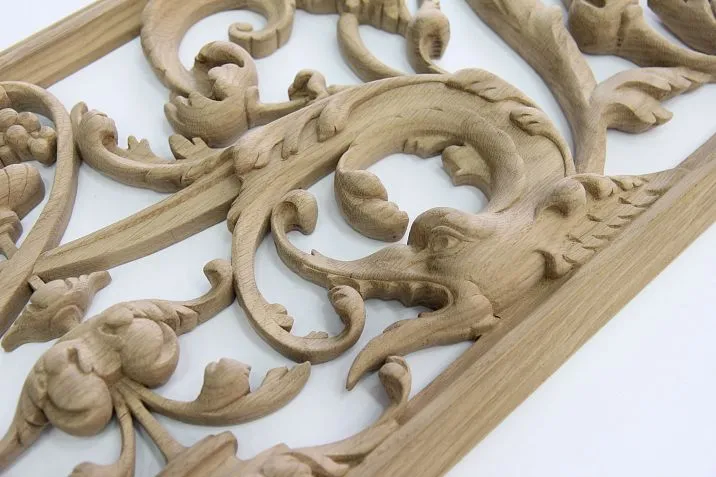
What can turn an ordinary home into a true treasure trove of aesthetics? How to create an atmosphere where every element breathes history and craftsmanship? The answer lies in the wonderful world of wooden carving. Decorative carved wooden decor becomes the key to transforming space, where functionality merges with high art, creating a symphony of beauty and practicality.






Revival of ancient art in modern realities
Humanity has always sought to surround itself with beauty. Even our distant ancestors adorned their homes with carved patterns, transforming simple wooden surfaces into works of art. Today, this tradition is experiencing a true renaissance, taking on new forms and possibilities.
Our factory also produces:

Psychology of attraction: why wood attracts
Modern neuropsychology explains the phenomenon of attraction to natural materials. Decorative veneers made of solid wood activate ancient programs in our brain associated with feelings of safety and harmony. The texture of wood, its scent, tactile sensations — all of this is subconsciously associated with home, protection, and stability.
Studies show: the presence of wooden elements in interior design reduces cortisol levels — the stress hormone — by 40-50%. This is especially relevant for residents of megacities, who experience daily information overload and require visual relief.
Get Consultation
Anatomy of craftsmanship: structure of decorative carved decoration
Classification by execution technique
The world of carved decoration is multifaceted, like nature itself. Each technique possesses unique characteristics and areas of application.
Low-relief carving creates images slightly raised above the background. The depth of relief is 2-8 mm, allowing for delicate, elegant compositions that do not disrupt the overall flatness of the piece.
Deep relief carving implies greater depth — from 8 to 25 mm. This technique creates expressive play of light and shadow, giving the piece volume and drama.
Cut-out carving completely removes the background, creating lace-like compositions. This technique requires special skill, as each element must be firmly integrated into the overall structure.
|
Type of carving |
Depth (mm) |
Complexity |
Time to manufacture |
|
Low-relief |
2-8 |
Medium |
3-8 hours |
|
Deep relief |
8-25 |
High |
8-20 hours |
|
Cut-out |
Through |
MDF with film |
15-40 hours |
|
Sculptural |
Up to 40 |
Extreme |
40-100 hours |
Morphology of ornaments
Wooden carved rosettes are one of the most common decorative elements. Their diameter ranges from miniature 60 mm to monumental 500 mm. Each rosette is a microcosm where geometry meets organic forms, creating harmonious compositions.
Centrally symmetrical rosettes embody the idea of cosmic order. Rays radiating from the center symbolize solar energy, life force, divine origin. Vegetal motifs in rosettes reflect the eternal cycle of nature — birth, bloom, decay, and rebirth.
Technological revolution: from chisel to laser
Symbiosis of traditions and innovations
Modern decorative production is a remarkable synthesis of ancient traditions and advanced technologies. Wood carving art today utilizes the entire arsenal of available tools: from traditional chisels to the latest generation of laser equipment.
5th-generation CNC machines can reproduce classical ornaments with micron-level precision. Software analyzes historical samples, creating accurate mathematical models for replication. At the same time, each item undergoes final hand finishing, acquiring that elusive soulfulness which distinguishes true art.
Revolution in materials
Modern adhesives and impregnations have radically changed the possibilities of using wooden decor. Polyurethane compositions provide moisture resistance up to 95%, allowing carved elements to be used even in rooms with high humidity.
Nanotechnology has enabled the creation of self-cleaning surfaces. Special coatings based on titanium dioxide break down organic contaminants under light exposure, maintaining the pristine cleanliness of decor for years.
Stylistic kaleidoscope: from classic to avant-garde
Neo-classical renaissance
Modern interpretations of classical motifs avoid literal copying, offering more concise, contemporary interior-adapted solutions. Carved interior elements in the neo-classical style are characterized by clear lines, moderate detailing, and noble restraint.
Acanthus leaves become more stylized, rosettes are simplified while retaining their basic structure. The color palette leans toward natural wood tones with light tinting or patination.
Scandinavian minimalism in carving
The Scandinavian school of design has contributed to the development of carved decor. The Scandinavian approach implies maximum functionality with minimal decorative means. Geometric forms, simple lines, natural colors — these are the main principles of this direction.
Russian style: returning to roots
Traditional Russian carving is experiencing a true revival. Modern masters study museum collections, recreating lost techniques and motifs. Vegetal ornaments, geometric patterns, zoomorphic images — the entire rich arsenal of folk art becomes accessible to modern consumers.
Practical application: zoning by function
Living spaces: creating atmosphere
Bedroom Decorative carved wooden decor should promote relaxation and rest. Soft botanical motifs, smooth lines, warm tones create an atmosphere of tranquility.
The headboard with a central carved composition becomes the focal point of the interior. Symmetrical appliqués on the sides create a sense of protection and intimacy in the space.
Nightstands with carved facades complement the overall composition. It is important to maintain stylistic unity — all elements should speak the same language.
Public zones: representation and status
The living room is the showcase of the home, where the taste and status of the owners are displayed. Here, more expressive, formal decorative forms are appropriate.
Carved appliqués on the fronts of display cabinets create a museum-like exhibition feel. Each item behind glass acquires special value, becoming part of a collection.
Coffee tables with carved aprons draw attention to the central zone. Decoration should be sufficiently expressive to become a subject of conversation, but not so detailed as to distract from communication.
Workspaces: balance of functionality and aesthetics
A home office requires a special approach to decoration. Here, it is important to create an atmosphere of concentration, without overloading the space with unnecessary details.
Carved appliqués on the ends of the work desk add solidity without distracting from work. Bookshelves with decorative elements create a library-like atmosphere, promoting intellectual activity.
Material science: from wood selection to final finishing
Wood species: characteristics and application
Oak remains the king among species for carved decor. Its density of 750-850 kg/m³ allows for the creation of the finest details without the risk of chipping. Tannins contained in the wood impart natural resistance to biological damage to the items.
European oak has a more uniform structure, which is important for fine detailing. American oak has a more contrasting texture, creating additional visual effects.
The beech wood with density 650-700 kg/m³ is ideal for creating smooth, curved forms. Its plasticity allows for complex spatial compositions.
Ash combines the strength of oak with the workability of beech. The contrasting texture with clearly visible growth rings creates additional decorative effects.
Exotic species: expanding the palette
The modern market offers a vast selection of exotic species, each with unique characteristics.
Teak, with its natural oiliness, is ideal for humid environments. The golden hue and pronounced texture give products a special warmth.
Mahogany — classic of luxury furniture. The reddish-brown color and silky surface create a sense of luxury and prestige.
Wenge — dark, almost black wood with contrasting veins. Perfect for creating modern minimalist compositions.
|
Species |
Density (kg/m³) |
Color |
Texture |
Application |
|
Oak |
750-850 |
Light brown |
Pronounced |
Classic decor |
|
Beech |
650-700 |
Pinkish |
Fine-grained |
Curved forms |
|
Ash |
650-750 |
Light |
Contrasting |
Modern style |
|
Teak |
600-700 |
Golden |
Oily |
Humid rooms |
|
Mahogany |
550-650 |
Red-brown |
Smooth |
Luxury Furniture |
|
Wenge |
850-950 |
Dark brown |
Striped |
Minimalism |
Production technology: from sketch to installation
Designing: where beauty is born
The decoration creation process begins with detailed design. Designers study the interior features, the client's stylistic preferences, and functional requirements.
3D modeling allows creating an accurate virtual copy of the future product. The client can see the result even before production begins, make necessary adjustments, and evaluate the harmony of the combination with existing interior elements.
Production cycle: from blank to masterpiece
Producing quality decor is a complex multi-stage process requiring high qualification and modern equipment.
Material preparation includes drying wood to 8-12% moisture, ensuring dimensional stability of the finished product. Chamber drying in automated units allows controlling all process parameters.
Blank cutting is performed considering the grain direction, presence of defects, and aesthetic features of the texture. Each blank undergoes individual selection.
Rough processing forms the main volumes of the item. CNC milling machines are used, ensuring high precision and repeatability.
Artistic carving is the most responsible stage, requiring the involvement of a skilled craftsman. Even when using automated equipment, the finishing is done manually.
Sanding and finishing give the item its final appearance. Sequential use of abrasives with different grits ensures an ideal surface smoothness.
Coloristic solutions: play of color and texture
Natural tones: beauty without embellishment
The natural color of wood remains the most popular choice. Transparent finishes highlight the material's natural beauty, preserve texture visibility, and create a sense of harmony with nature.
Different wood species offer a rich palette of natural shades — from nearly white birch to dark wenge. This natural variability allows selecting decor to match any interior color scheme.
Staining: expanding possibilities
Modern stains and tinting agents significantly expand the color options for wooden decor. It is possible to imitate exotic species, create unusual color effects, and adapt decor to specific design tasks.
Water-based stains ensure even dye penetration and maintain the ecological safety of the product. Alcohol-based compositions provide deeper, more saturated shades.
Patina: The nobility of time
Artificial aging gives new items the dignity of antiques. Patina is applied to recesses of the relief, emphasizing the composition's volume and creating an effect of long-term use.
Different types of patina provide various effects. Gold patina adds solemnity, silver — modernity, copper — warmth of a home hearth.
Installation and operation: secrets of longevity
Installation technology
Quality installation is the guarantee of decor longevity. The surface must be carefully prepared — cleaned, degreased, and leveled if necessary.
The choice of adhesive depends on the operating conditions. For dry rooms, PVA-based compositions are suitable; for humid areas — polyurethane adhesives.
Mechanical fastening is used for heavy elements. Hidden fastening ensures aesthetic appeal while providing maximum reliability.
Care and Maintenance
Proper care extends the life of decor for decades. Regular cleaning with a soft brush removes dust from relief recesses. Avoid aggressive cleaning agents — they may damage the protective coating.
Periodic renewal of the protective layer maintains the original appearance of items. Depending on operating conditions, this is required every 3-7 years.
Economic aspects: investment in beauty
Formation of cost
The price of decorative carved decor is determined by many factors. Ornament complexity is the main pricing factor. Simple geometric shapes cost 2-3 times less than complex floral compositions.
The wood species affects the cost by a factor of 1.5 to 5. Exotic species require special processing conditions, increasing the cost.
The size of the item determines material consumption and processing time. Large elements require special technological solutions.
Investment profitability
Quality wooden decor is an investment in long-term prospects. With proper care, items serve for decades without losing their initial appeal.
Antique value increases over time. Handmade items are especially valued by collectors and designers.
Development prospects: looking to the future
Technological Innovations
The development of additive technologies opens new opportunities for creating decor. 3D printing with wooden composites allows creating complex spatial forms unattainable by traditional methods.
Integration of electronic components turns decor into functional elements. Hidden lighting, wireless charging, sensors — all of this becomes part of decorative compositions.
Ecological trends
Growing attention to ecology stimulates the development of sustainable manufacturing technologies. Use of reclaimed wood, zero-waste technologies, eco-friendly finishes — these trends define the future of the industry.
Personalization
Modern consumers seek uniqueness. Custom projects designed specifically for a particular interior are becoming increasingly popular. Digital technologies make such personalization economically accessible.
Conclusion: Choosing in Favor of Eternal Values
In a world where technology develops at dizzying speed, Decorative carved wooden decor there remains an island of stability and beauty. This is the connection with traditions, respect for craftsmanship, investment in quality of life.
Each carved item carries a fragment of the master's soul, the warmth of human hands, the story of transforming a simple piece of wood into a work of art. Choosing such decor, we are not merely buying a beautiful object — we are investing in the atmosphere of the home, the emotional well-being of the family, and the connection with cultural traditions.
Modern technologies allow combining the best traditions of the past with innovative solutions of the present. The result — items that meet the most demanding requirements for quality, functionality, and aesthetics.
The world changes, but the need for beauty remains a constant in human existence. Wooden carved decor — this is a way to bring this beauty into everyday life, creating a space that will delight and inspire every day.
For more than fifty years, the company STAVROS has created works of wooden art, combining centuries-old craftsmanship traditions with advanced production technologies. Every STAVROS item is a guarantee of quality, embodiment of beauty, and pursuit of perfection that will remain relevant for many years.