Article Contents:
- What decorative slats can be purchased today
- Decorative Slats for Walls
- Slats for Furniture and Facades
- Slats for niches, portals, and accent zones
- Thin, wide, flat, and volumetric profiles
- When to buy decorative slats instead of other types of decor
- If you need an accent wall
- If you need rhythm and texture in the space
- If you need zoning
- If you need versatile decor for walls and furniture
- How to choose decorative slats before purchase
- By usage scenario
- By interior style
- By room size
- By material
- By shade and finish
- By installation type
- Which decorative slats to buy for walls: by room
- For accent wall in living room
- For TV zone
- for the bedroom
- For the hallway
- For Office
- For commercial interiors
- Which decorative slats to buy for furniture and facades
- For furniture inserts
- For cabinet and dresser fronts
- For decorative screens and partitions
- In combination with wall decor
- What material is best to buy decorative battens from
- Natural wood is the main argument
- Oak battens
- Beech battens
- What to choose for painting
- What to choose for tinting
- How material affects appearance and durability
- What size of decorative battens to choose
- Bat width: from 15 to 90 mm
- Bat thickness: from 5 to 23 mm
- Batten length: 2400 mm — standard for interiors
- Spacing between battens: the most important parameter
- How size affects perception
- When to choose thin, and when to choose massive
- Which decorative battens to buy for different styles
- Modern style
- Minimalism
- Neoclassicism
- Scandinavian interior
- Warm, natural interior
- Commercial spaces
- Ready-made decorative battens or custom order: how to choose
- When standard sizes are suitable
- When it's better to buy a ready-made solution
- When an individual order is needed
- When the right batch for the project matters
- When a special profile is needed
- What decorative slats can be purchased today
- Decorative Slats for Walls
- Slats for Furniture and Facades
- Slats for niches, portals, and accent zones
- Thin, wide, flat, and volumetric profiles
- When to buy decorative slats instead of other types of decor
- If you need an accent wall without major renovation
- If you need rhythm and texture in the space
- If you need zoning without partitions
- If you need universal decor for walls and furniture simultaneously
- How to choose decorative slats before purchase: six parameters
- By usage scenario
- By interior style
- By room size
- By material
- By shade and readiness for installation
- By installation type
- Which decorative battens
- If you need an accent wall without major renovation
- If you need rhythm and texture in the space
- If you need zoning without partitions
- If you need universal decor for walls and furniture simultaneously
- How to choose decorative slats before purchase: six parameters
- By usage scenario
- By interior style
- By room size
- By material
- By shade and readiness for installation
- By installation type
- Which decorative battens to buy for walls: room-by-room breakdown
- For accent wall in living room
- For TV zone
- for the bedroom
- For the hallway
- For Office
- For commercial spaces
- Which decorative slats to buy for furniture and facades
- For furniture inserts and cabinet doors
- For kitchen fronts
- For decorative screens and partitions
- In combination with wall decor
- What material is best to buy decorative battens from
- Natural wood - an argument without reservations
- Oak slats: character and durability
- Beech slats: purity and versatility
- What to choose for painting
- What to choose for tinting
- How material affects durability
- What size decorative slats to choose: full calculation
- Width: from 15 to 90 mm
- Thickness: from 5 to 23 mm
- Length: 2400 mm
- Spacing: key layout parameter
- How to calculate the number of slats - pre-purchase checklist
- When to choose thin, and when to choose massive
- Which decorative battens to buy for different interior styles
- Modern style
- Minimalism
- Neoclassicism
- Scandinavian interior
- Warm, natural interior
- Commercial spaces
- Ready-made decorative battens or custom-made: what to choose
- When standard sizes are suitable
- When it's better to buy a ready-made solution
- When an individual order is needed
- When the right batch for the project matters
- When a special profile is needed
- What affects the price of decorative battens
- Material: oak is more expensive than beech
- Size and profile: more material — higher price
- Availability or custom production
- Type of finish
- Purchase Volume
- Complexity of application
- How not to make a mistake when buying decorative battens: six rules
- Don't buy based on photos alone
- Consider the size of the wall or furniture
- Calculate the spacing between battens in advance
- Consider the interior style
- Compare not only price but also material
- Plan installation before purchase
- What questions to ask yourself before buying decorative battens
- Where it's especially advantageous to buy decorative battens from the manufacturer
- Wider selection and full range
- Ability to choose material and finish
- Supply according to project
- Precise fit for the interior task
- FAQ: common questions before buying decorative battens
- Conclusion

You've already decided: you need battens. Now it's time to figure out — which ones exactly. And this is where most people get stuck. Because 'decorative battens' aren't a single item in a catalog. They are dozens of options in width, thickness, material, finish, and application scenario. Buying the first thing you see means risking the wrong result: too thin, too bulky, the wrong tone, the wrong scale.
This article is a practical guide for those who want tobuy decorative battensconsciously: for a specific wall, for a specific style, for a specific budget. No fluff — only what you really need to know before buying.
What's inside: what types of battens exist, how they differ, how to choose the material, what sizes suit different tasks, when to buy ready-made and when to order custom — and what you absolutely must think through before placing your order.


What decorative battens you can buy today
The market for wooden decorative battens is divided into several clear categories. Understanding how they differ means you're already halfway to making the right choice.




Decorative wall battens
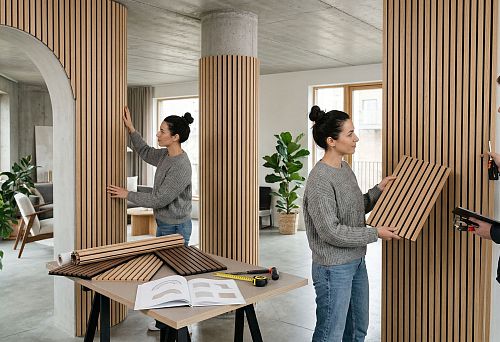
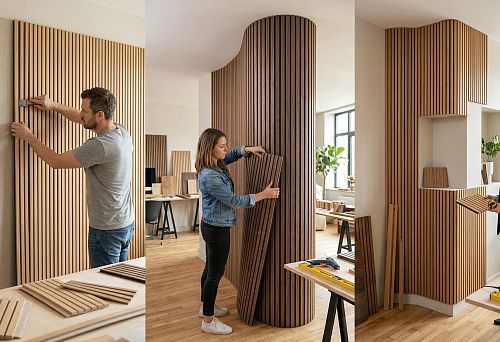
Wall battens — the most in-demand category. Mounted directly on the wall: on a painted surface, on drywall, on MDF panels. They create a vertical or horizontal rhythm, form an accent zone, and add texture.
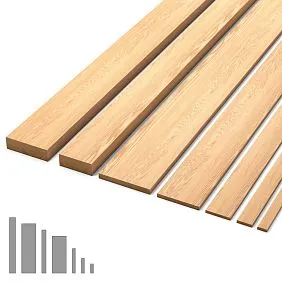
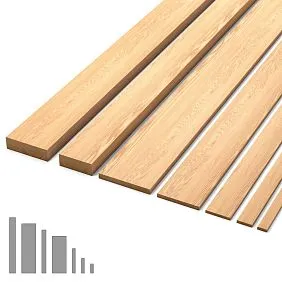
For walls, sections ranging from thin (15×5 mm, 24×5 mm) to large (70×7 mm, 90×10 mm) are relevant. Thin ones are delicate graphics, almost an architectural whisper. Wide ones are powerful relief with pronounced shadow. The RK-001 batten in seven sections with a uniform length of 2400 mm covers the entire range of wall tasks.
Our factory also produces:


Battens for furniture and facades
Furniture battens are the second most popular application. They are mounted on the fronts of cabinets, chests, and upper kitchen sections. They create vertical geometry and give furniture a 'handcrafted' detailing. Here, the key parameters are step precision and neat fastening: furniture is viewed up close.
For furniture, battens with sections of 24×5 and 40×5 mm are suitable — noticeable enough but not overloading the front.
Get Consultation
Battens for niches, portals, and accent zones
Large sections 60×23 and 80×23 mm are no longer background decor but architectural elements. Framing niches for appliances, door portals, vertical posts as part of decorative panels. These formats serve the function of framing and volumetric accent — where a substantial visual result is needed.
Thin, wide, flat, and volumetric profiles
Four types of profiles — four different tasks:
| Profile | Section | Effect |
|---|---|---|
| Thin flat | 15×5, 24×5 mm | Delicate graphics, light texture |
| Medium flat | 40×5 mm | Universal, works everywhere |
| Wide medium | 70×7, 90×10 mm | Noticeable relief, pronounced shadow |
| Massive volumetric | 60×23, 80×23 mm | Architectural accent, niches, portals |
When to buy decorative slats instead of another type of decor
This question is asked less often than it should be. Yet it is precisely this question that determines whether the result will be organic.
If you need an accent wall
A wooden slat accent wall is the gold standard of modern interior design. Simpler than patterned wallpaper. Looks more expensive than just paint. More durable than any fabric covering. And at the same time — the possibility of complete personalization: width, spacing, tone, wood species.
If you need rhythm and texture in a space
An empty flat wall is neutral. Sometimes neutrality is needed. But if the space seems 'unfinished,' too cold, or faceless — wooden slats add exactly what's missing: rhythm, warmth, a living surface.
If you need zoning
In studios and open-plan layoutsdecorative wall battens— it's one of the best tools for visual zoning. One wall with slats — and the space is 'divided' into zones without partitions, without losing light.
If you need a universal decor for walls and furniture
Unlike wallpaper or molding, wooden slats work simultaneously on walls and furniture. A single wood species, a single tone — and the interior gains a cohesiveness that cannot be bought with separate decorative elements.
How to choose decorative slats before purchase
This is the most important section. This is where most mistakes are made — buying 'what you like' rather than 'what fits'.
By usage scenario
First question: where are the slats going? On a living room wall? On kitchen fronts? In the hallway? On the ceiling? The scenario determines the size, material, and installation method. Slats for a tall TV wall and slats for a small cabinet front are fundamentally different items.
By interior style
Wooden slats are not neutral. Light beech in white enamel is modern classicism or Scandinavian style. Dark oak with rich staining is classic, neoclassical, study. Natural wood without coating is eco, Scandinavian, Japanese minimalism. Buy slats to match the style, not just 'in general'.
By room size
Small room — narrow slats with sparse spacing. Large room — wide slats with dense layout. A mistake in scale = a wall that 'doesn't work', even if technically everything is done correctly.
By material
Oak or beech is not just 'which wood', but a choice of texture, density, and behavior under finishing. Beech — for painting and enamel. Oak — for staining and varnish. This difference affects the final look of the wall as much as the choice of color.
By shade and finish
Before purchasing, determine: will you paint the slats yourself or do you want a ready-made finish? If yourself — take an unpainted beech option (the best base for enamel). If you need ready-made stained material — check the availability of the desired shade.
By installation type
Thin slats (5 mm) can be mounted with construction adhesive. For larger formats (10 mm and above) — mechanical fastening is mandatory. This affects what needs to be prepared even before the slats are delivered to the site.
Which decorative wall slats to buy: by room
For an accent wall in the living room
The living room is the main space in the apartment. An accent wall behind the sofa requires slats with 'weight': a cross-section of 70×7 or 90×10 mm, oak with a warm-toned stain, vertical layout with a spacing of 50–70 mm. With side lighting, such a wall creates deep relief with a lively play of shadows. This is precisely the kind of project that useswooden millwork in a modern stylefrom the STAVROS catalog.
For the TV zone
A TV wall is an architectural accent, not just a place for a television. Slats frame the screen, create a 'frame,' and add depth. Choose a cross-section of 70×7 or 90×10 mm. Layout — vertical. If LED backlighting is planned behind the slats — leave a gap between the slat and the wall for the strip. The slat field should extend beyond the television by at least 35–40 cm on each side.
For the bedroom
Behind the bed headboard — a delicate format. Slats 24×5 or 40×5 mm made of light beech with a spacing of 40–60 mm create a soft background rhythm. Here, a 'loud' slat is not needed — tranquility is needed. Color: neutral, tonal (close to the wall color) or slightly warmer.
For the hallway
In the hallway, slats serve both a decorative and a practical function: the lower part of the wall receives additional protection from mechanical damage. Format — 40×5 mm, vertical layout, height of the slat field — up to 120–150 cm from the floor (below the eye line). Visually — zoning the wall 'surface' into lower and upper registers.
For an office
A study requires weightiness. Oak with a walnut or dark tobacco stain, slats 70×7 mm, vertical layout, moderate spacing — this is a professional, serious space. Combined with wooden moldings and cornices, a 'study' system is created, which is associated with solidity.
For commercial interiors
Offices, meeting rooms, salons, showrooms — here wooden slats work to enhance the space's image. Natural material conveys quality and attention to detail. For commercial projects, custom batches with uniform processing are often used — to guarantee consistent tone throughout the entire space.
Which decorative slats to buy for furniture and facades
For furniture inserts
An insert of vertical slats on a cabinet or dresser door — this is 'handcrafted' furniture detailing. Spacing 20–40 mm, slats 24×5 mm — dense, textured layout. Spacing 50–70 mm, slats 40×5 mm — a more open, 'breathable' geometry.
For cabinet and dresser facades
For full facades, slats 24×5 and 40×5 mm are suitable. Important: all slats in one batch must be from the same material with a uniform tone. Color variation even within the same wood species can be noticeable — especially with matte finishes. When purchasing, clarify the batch uniformity conditions.
For decorative screens and partitions
Slats with spacing equal to the width of the slat itself create a 'grid' or 'lattice' — a decorative screen with gaps. This format is used for screening radiators, creating decorative partitions, inserts in door panels. The best material for such tasks is oak: it better withstands loads and does not deform with humidity changes.
In combination with wall decor
Furniture slats from the same wood species and in the same finish as the wall ones — this is perfect interior cohesion. The wall and furniture 'speak' the same language. That's precisely why it's important to buy slats for walls and for furniture from the same source — to guarantee color and texture matching.
What material is best to buy decorative battens from?
Natural wood is the main argument
Buy decorative battens made of wood— means getting a material that has no complete synthetic analogue. The texture of natural fibers, tonal transitions, tactile warmth — this is what distinguishes a wooden wall from any imitative coating. Wood "lives" differently in an interior: it absorbs light, creates shadow, "breathes" in rhythm with the space.
Oak battens
Oak is a dense, hard wood with a large, characteristic grain. Golden and honey-brown tones, noticeable fibers, "mirrors" in radial cut.oak slatsare recommended for tinting, oil, varnish — the open grain only benefits from semi-transparent coatings. High hardness makes oak battens an optimal choice for furniture and actively used surfaces.
Oak is less suitable for white enamel: the open pore requires additional priming and filling, otherwise the surface will be porous. For enamel — beech.
Beech battens
Beech is a fine-grained, uniform wood with a delicate warm tone and an almost silky surface texture. An ideal base for painting: enamel lays evenly, without pull-outs or voids.oak planks— the best choice for white, pastel, lavender, gray, and other subdued color schemes.
Beech is easier to machine, takes well to tinting in neutral shades. With proper finishing, beech battens can successfully 'imitate' ash, alder, maple.
What to choose for painting
Beech is the clear choice for enamel and painting in any color. Minimal preparation, maximally smooth surface after painting.
What to choose for tinting
Oak is for rich, expressive tinting where the grain should remain lively and readable. Beech is for neutral tinting 'without character'.
How material affects appearance and durability
| Parameter | Oak | Beech |
|---|---|---|
| Hardness | Very High | High |
| Texture | Coarse, pronounced | Fine, uniform |
| For enamel | Worse | Excellent |
| For tinting | Excellent | Good |
| Service life | Very high | High |
| Application | Walls, classic, furniture | Facades, light interiors |
What size of decorative battens to choose
The question of size is not a technical one, but a visual one. Size determines how the wall will look. Not approximately—but very specifically.
Slat width: from 15 to 90 mm
-
15 mm — the thinnest line, almost imperceptible from a distance of 3+ meters
-
24 mm — a thin stripe with good visibility
-
40 mm — a working format, equally suitable for any room
-
70 mm — a noticeable plank, requires area
-
90 mm — a large profile, for high walls and accent zones
Slat thickness: from 5 to 23 mm
Thickness is about relief and shadow. At 5 mm — an almost flat texture. At 23 mm — a volumetric profile with deep shadow. Most residential interiors work with a thickness of 5–10 mm. The 23 mm options are for niches, portals, and architectural structures.
Slat length: 2400 mm — standard for interiors
Reiki RK-001 from STAVROS are produced in a single standard length of 2400 mm. This is not by chance:
-
It exactly matches the standard room height — the rail covers the wall without a horizontal joint
-
A multiple of 600 mm — convenient for calculating consumption
-
Sufficient for horizontal layout on most walls
If the room height exceeds 2400 mm — extension with a neat joint is used.
Spacing between rails: the most important parameter
The spacing determines the 'density' of the visual pattern.
| Step | Feeling |
|---|---|
| 15–20 mm | Dense texture, almost solid surface |
| 30–50 mm | Balanced rhythm |
| 60–90 mm | Airy layout, plenty of 'white' space |
| 100+ mm | Sparse lines, maximum lightness |
Minimum rule: step always ≥ slat width.
How size affects perception
Wide slat in a small room → feels oppressive, narrows. Thin slat in a large hall → gets lost, doesn't work. The right size is the proportional correspondence between the slat and the plane.
When to choose thin, and when massive
Thin (15×5, 24×5 mm) — small rooms, delicate accent, Scandinavian and minimalist style.
Massive (90×10, 60×23, 80×23 mm) — large halls, niches, portals, zones with accent lighting.
Which decorative slats to buy for different styles
Modern style
Strict geometry, uniform rhythm, nothing superfluous. Beech slats 40×5 mm in white or light gray enamel, vertical layout with a step of 50–60 mm. No ornaments, no profiles. A clean line is the decoration itself.
Minimalism
Tonal decor: slats in the wall color, thin cross-section, wide step. The wall looks refined but 'doesn't shout'. Slats 15×5 or 24×5 mm in the background color — maximum delicacy with maximum surface quality.
Neoclassicism
Slats paired withmoldings, cornices, and baseboardsin one profile. Section 40×5 or 70×7 mm, walnut or golden oak tint, moderate spacing. The molding frames the slatted field — creating a wall panel system without heavy joinery. Exactly such kits are available inthe catalog of wooden moldings in classic stylefrom STAVROS.
Scandinavian interior
Light beech without coating or with transparent oil, narrow slats with sparse spacing. Honest material, no complex finishes. It is the naturalness of the texture that creates the desired atmosphere.
Warm natural interior
Oak with 'wheat' or 'walnut oil' tint, medium or wide slats. Warmth, coziness, natural tones. Combined with linen and wool textiles — perfect organic space.
Commercial spaces
For offices and public interiors, batch uniformity and compliance with the corporate palette are important. For such tasks, a custom batch is recommended — with a guarantee of uniform tone for all products.wooden millwork in stock in Moscowand St. Petersburg — for urgent projects without waiting.
Ready-made decorative slats or custom order: how to choose
When standard sizes are suitable
The RK-001 slat exists in seven sections with a length of 2400 mm — this is a wide range that covers most residential and commercial tasks. For standard interior projects, typical sizes are completely sufficient. A number of items are constantly in stock and ready for immediate shipment.
When is it better to buy a ready-made solution
-
Room height 2400 mm — slat 'exact fit'
-
One of the standard formats is needed (from 15×5 to 80×23 mm)
-
The project does not require special batch selection for a specific shade
-
Timing is important: ready-made items ship without waiting
When an individual order is needed
-
Non-standard room height requiring a different length
-
Special cross-section not provided in the standard range
-
Need to guarantee batch uniformity in shade (especially important for large projects)
-
Individual coating for a specific RAL or tint shade
STAVROS custom production — 5–10 business days. Delivery across Russia via SDEK.
When batch consistency for a project matters
For projects with large expanses of slatted surfaces — project orders with a complete kit and uniform finish. This safeguards against a 'non-uniform' batch, which is especially noticeable with matte enamels and homogeneous tints.
When a special profile is needed
If an architectural task requires non-standard geometry or length — this is a case for a production request with technical specifications. STAVROS works excellently with production partners from design bureaus and architectural studios. The actual URLs of the stavros.ru website pages have been collected. I am writing an article with a new structure, a new style — shifting from a direct, pragmatic tone to expert consulting. The article is commercial, focused on making a choice before purchase.
Decorative slats for sale: how to choose wooden slats for walls, furniture, and interiors
You've already decided. Not 'think about it,' not 'look into it later' — but specifically to buy decorative slats. Now there's only one question: which ones exactly and for what task? Because a mistake when buying slats isn't just money down the drain. It's an installed wall that then needs to be redone. Slats too narrow — they get lost in the space. Too wide — they feel oppressive. Wrong wood species — the color didn't match the furniture. Wrong profile — the relief didn't turn out as envisioned.
This article is written precisely for those who are on the verge of purchase and want to make the right choice the first time. Without rework, without returns, and without wasted time.form the architecture of walls and ceilings, creating a play of light and shadow.— is a serious interior material, and its selection should be taken seriously: with an understanding of dimensions, materials, styles, and application scenarios.
Let's break it all down in order.
What decorative battens you can buy today
The market for decorative slats is diverse today, but behind the external variety lies a simple classification based on several key parameters. Understanding them means narrowing the choice from 'endless' to specific.
Decorative wall battens
This is the widest and most popular segment. Wall battens create accent zones, set vertical or horizontal rhythm, work as a zoning element and as protective cladding for the lower part of the wall.
For walls, battens with a width of 24–90 mm and a thickness of 5–10 mm are most often chosen. The RK-001 batten from STAVROS covers this entire range: seven standard cross-sections from 15×5 to 90×10 mm with a uniform working length of 2400 mm — precisely matching the standard height of residential spaces.
Our factory also produces:
Battens for furniture and facades
On furniture fronts, battens create visual depth and texture. A wardrobe with vertical batten layout looks fundamentally different from the same wardrobe with a flat surface. Thin and medium formats — 15×5, 24×5, 40×5 mm — with a spacing from 20 to 50 mm are suitable for furniture. The result depends on the layout density: sparse creates geometry, dense creates texture.
Get Consultation
Battens for niches, portals, and accent zones
Large-format battens (60×23, 80×23 mm) are architectural in scale. They are used for framing niches, portals, door openings, and heavy decorative structures. This is not a 'strip on the wall', but a three-dimensional wooden profile with pronounced relief.
Thin, wide, flat, and volumetric profiles
| Batten Type | Section | Visual Result |
|---|---|---|
| Thin | 15×5, 24×5 mm | Graphic line, delicate rhythm |
| Medium | 40×5, 70×7 mm | Universal format, good readability |
| Wide | 90×10 mm | Pronounced profile, architectural accent |
| Massive | 60×23, 80×23 mm | Volumetric frame, framing, portal |
When to buy decorative slats instead of another type of decor
This question arises less often than it should. Many choose slats simply because 'they saw it somewhere'—and it works. But understanding the reason helps you choose correctly.
If you need an accent wall without major renovation
Tiling is a renovation that takes several days. Wallpaper with a textured pattern involves pasting, fitting, and bubbles. Decorative plaster requires layers, time, and skilled craftsmen. Wooden battens can be installed in just one day even on a large wall, don't require demolition of the existing base, and are easily removable if needed.
If you need rhythm and texture in a space
A space without texture is a space without depth. It's the wooden batten that provides what paint cannot: a living surface that changes under different lighting—morning, noon, and evening.
If you need zoning without partitions
In studio apartments and open-plan layoutsWall decorative slatsthey work as a zone marker: one wall with battens—and the space 'reads' as two separate rooms. Without losing light, without construction dust.
If you need a universal decor for walls and furniture simultaneously
Wooden battens are the only decorative element that works equally organically on a wall and on a furniture facade. One wood species, one tint—and the interior gains a unity that cannot be achieved with different decorative materials.
How to choose decorative battens before purchase: six parameters
This is the most important section of the article. This is where most mistakes are made—choosing 'what you like' rather than 'what fits'. Let's examine each parameter in essence.
By usage scenario
The first and main question: where are the battens going? On an accent wall in the living room? In a TV niche? On kitchen cabinet fronts? In the hallway? The answer to this question immediately narrows the choice down to two or three specific formats. Battens for a 2.7 m high TV wall and battens for a small cabinet front are fundamentally different items in terms of width, profile, and purchase volume.
By interior style
Style determines the color and finish of the batten. Light beech in white enamel — modern classicism, Scandinavian style, Provence. Oak with a walnut or tobacco tint — neoclassical, classic, study. Natural texture without coating — eco, Japanese minimalism, interiors with an emphasis on natural materials. Buying a batten 'in general', without reference to style, means getting an element that 'doesn't fit'.
By room size
Small room up to 12 m² — narrow battens with a wide spacing and light shades. Spacious living room 25+ m² — formats from 70×7 mm, denser layout is acceptable. A mistake in scale is immediately visible and is practically impossible to correct without dismantling.
By material
Beech or oak — this is not just a 'species', but a choice of the material's behavior under finishing. Beech — for painting and enamel of any color. Oak — for tinting and varnish with an open texture. Both are available in the RK-001 line. Decide on the finish — and the choice of material will make itself.
By shade and readiness for installation
If you will paint yourself — take an unpainted beech batten. If you need a ready-made tint — check the availability of the desired shade. Factory-applied finish guarantees uniformity, which is difficult to reproduce manually on-site when working with a large batch.
By installation type
Thin battens (5 mm) are attached with mounting adhesive or finish nails. Formats from 10 mm and above require mechanical fastening — dowel nails, screws, nailer. Large profiles (23 mm) — only rigid mechanical fastening. Find this out before purchase: the type of installation determines what needs to be prepared in advance.
What decorative battens
If you need an accent wall without major renovation
Tiling is a renovation that takes several days. Wallpaper with a textured pattern involves pasting, fitting, and bubbles. Decorative plaster requires layers, time, and skilled craftsmen. Wooden battens can be installed in just one day even on a large wall, don't require demolition of the existing base, and are easily removable if needed.
If you need rhythm and texture in a space
A space without texture is a space without depth. It's the wooden batten that provides what paint cannot: a living surface that changes under different lighting—morning, noon, and evening.
If you need zoning without partitions
In studio apartments and open-plan layoutsWall decorative slatsthey work as a zone marker: one wall with battens—and the space 'reads' as two separate rooms. Without losing light, without construction dust.
If you need a universal decor for walls and furniture simultaneously
Wooden battens are the only decorative element that works equally organically on a wall and on a furniture facade. One wood species, one tint—and the interior gains a unity that cannot be achieved with different decorative materials.
How to choose decorative battens before purchase: six parameters
This is the most important section of the article. This is where most mistakes are made—choosing 'what you like' rather than 'what fits'. Let's examine each parameter in essence.
By usage scenario
The first and main question: where are the battens going? On an accent wall in the living room? In a TV niche? On kitchen cabinet fronts? In the hallway? The answer to this question immediately narrows the choice down to two or three specific formats. Battens for a 2.7 m high TV wall and battens for a small cabinet front are fundamentally different items in terms of width, profile, and purchase volume.
By interior style
Style determines the color and finish of the batten. Light beech in white enamel — modern classicism, Scandinavian style, Provence. Oak with a walnut or tobacco tint — neoclassical, classic, study. Natural texture without coating — eco, Japanese minimalism, interiors with an emphasis on natural materials. Buying a batten 'in general', without reference to style, means getting an element that 'doesn't fit'.
By room size
Small room up to 12 m² — narrow battens with a wide spacing and light shades. Spacious living room 25+ m² — formats from 70×7 mm, denser layout is acceptable. A mistake in scale is immediately visible and is practically impossible to correct without dismantling.
By material
Beech or oak — this is not just a 'species', but a choice of the material's behavior under finishing. Beech — for painting and enamel of any color. Oak — for tinting and varnish with an open texture. Both are available in the RK-001 line. Decide on the finish — and the choice of material will make itself.
By shade and readiness for installation
If you will paint yourself — take an unpainted beech batten. If you need a ready-made tint — check the availability of the desired shade. Factory-applied finish guarantees uniformity, which is difficult to reproduce manually on-site when working with a large batch.
By installation type
Thin battens (5 mm) are attached with mounting adhesive or finish nails. Formats from 10 mm and above require mechanical fastening — dowel nails, screws, nailer. Large profiles (23 mm) — only rigid mechanical fastening. Find this out before purchase: the type of installation determines what needs to be prepared in advance.
What decorative battens to buy for walls: breakdown by rooms
For an accent wall in the living room
Living room — the main space of the apartment, and the choice of battens here must be approached with maximum seriousness. The wall behind the sofa is what everyone entering sees. Recommended cross-section: 70×7 or 90×10 mm. Species: oak with a tint to warm natural tones. Layout: vertical, spacing 50–70 mm. With accent side lighting, the battens provide deep relief and a lively play of shadows. For such projects, the STAVROS catalog has a special selection —modern wooden moldingswith current formats and finishes.
For the TV zone
A TV wall is not just a 'place for a TV'. It's the architectural axis of the entire living room or bedroom. Slats 70×7 or 90×10 mm, vertical layout, dark tint or contrasting color. The slatted field should extend beyond the TV by at least 35–40 cm on each side — otherwise the accent 'doesn't come together'. When integrating LED backlighting behind the slats, leave a gap between the back of the slat and the wall.
For the bedroom
The bedroom requires delicacy. Slats behind the headboard are a background rhythm, not a loud accent. Cross-section 24×5 or 40×5 mm, light beech, spacing 40–60 mm. Color — neutral, tonal with the wall background, or slightly warmer. The slatted field — only behind the bed, the other three walls remain neutral.
For the hallway
In the hallway, slats serve a dual role. Aesthetic: they create an accent in the first space from which the perception of the apartment begins. Practical: the lower part of the wall is protected from scratches, impacts, and shoe marks. The height of the slatted field is 100–150 cm from the floor. Format — 40×5 mm, vertical layout. Color: either tonal with the background, or slightly contrasting.
For an office
The study is a space that should work on the image. Oak slats with a walnut, dark tobacco, or coffee tint, cross-section 70×7 mm, vertical layout with medium spacing. Combined with wooden moldings and cornices, the study acquires that weightiness associated with experience and solidity.New wooden moldings in classic style— a current assortment for this type of project.
For commercial spaces
Offices, meeting rooms, showrooms, reception — here wooden slats work on the space's image. Natural material conveys quality without words. For commercial objects, batch uniformity is important: a single tone, a single texture across the entire area.wooden millwork in stock in Moscow— for urgent project tasks.
Which decorative slats to buy for furniture and facades
For furniture inserts and cabinet doors
Vertical slat inserts on cabinet or dresser fronts represent handcrafted detailing. Dense spacing (20–30 mm gap, 24×5 mm slat) creates a rich texture. Open spacing (50–70 mm gap, 40×5 mm slat) yields a light geometric pattern. All slats in one batch must be from the same material and tonal group—with matte finishes, color variation is noticeable even within the same wood species.
For kitchen fronts
Upper kitchen fronts with slat detailing are a popular technique in modern and neoclassical kitchens. Slats 24×5 mm or 40×5 mm, vertical layout. Material—beech under enamel for uniform color, oak—if pronounced texture is desired. Glue mounting with additional finish nails is the standard scheme for furniture assembly.
For decorative screens and partitions
Slats spaced at intervals equal to the slat width itself create a light 'grid' with gaps. This serves as a decorative radiator screen, an insert in a door panel, or a low partition in an open-plan layout. Oak is preferable here: it better withstands loads and deforms less with humidity fluctuations.
In combination with wall decor
Slats from the same wood species and in the same finish—both on the wall and on the furniture—is a principle that makes the interior cohesive. The wall 'converses' with the furniture: a unified material language. This is precisely why it's important to purchase everything from a single source—to eliminate tonal variation between batches.wooden interior rails from STAVROS are available in the same wood species and formats for both wall and furniture applications.
What material is best to buy decorative battens from?
Natural wood—an argument without reservations
Synthetic alternatives exist. But natural wood is a living texture that cannot be fully reproduced. Fibers, tonal transitions, tactile warmth—these are sensations that wood creates in a space uniquely. By purchasing natural wooden slats, you are investing in a material that does not age and does not 'go out of style'.
Oak Slats: Character and Durability
Oak is one of the densest and most durable hardwood species. It features a pronounced, large grain pattern with golden-brown tones and a warm sheen.oak slatsIdeal for translucent finishes: oil, varnish, stain. The texture remains vibrant and readable—this is what makes oak slats a valuable interior material. For furniture with heavy use, oak is stronger and more durable.
Beech Slats: Purity and Versatility
Beech is a fine-grained, uniform wood with a delicate pinkish or creamy-beige tone. It is the perfect base for painting: minimal pores, smooth sanding, and enamel applies flawlessly.oak planksThe choice for white, pastel, lavender, and any other 'delicate' color schemes. Beech works just as well under neutral stains.
What to choose for painting
Definitely beech. Its fine, uniform pores provide an even coating without preparatory work. Oak for painting requires additional priming and filling—otherwise, the surface will be porous.
What to choose for tinting
Oak is for rich stains with a vibrant texture. Beech is for neutral, 'featureless' stains that don't aim for expressiveness.
How the Material Affects Durability
| Parameter | Oak | Beech |
|---|---|---|
| Brinell hardness | ~3,7 | ~3,2 |
| For enamel | Requires primer | Excellent |
| For tinting | Excellent | Good |
| During Humidity Fluctuations | Stable | Responds a bit more actively |
| Durability | Very High | High |
| Optimal application | Walls, furniture, natural style | Facades, painting, light interiors |
What size of decorative battens to choose: full calculation
Width: from 15 to 90 mm
Batten width is how noticeable each plank is on the wall.
-
15 mm — almost a graphic line, invisible from a distance of 3 m
-
24 mm — thin stripe, clearly readable
-
40 mm — the working format for any room
-
70 mm — a noticeable profile, requires space
-
90 mm — a large accent, for tall and large walls
Thickness: from 5 to 23 mm
Thickness is relief, shadow, volume.
-
5 mm — light, almost flat texture
-
7–10 mm — moderate volume, good shadow with side lighting
-
23 mm — a massive profile, an architectural solution
Length: 2400 mm
All cross-sections of the RK-001 slat from STAVROS are produced in a standard length of 2400 mm. This is a format optimally calculated for standard heights of residential spaces. If the wall height exceeds 2400 mm, the slats are extended — joints are planned in a staggered pattern to avoid forming a horizontal line.
Step: key layout parameter
| Spacing between slats | Visual effect |
|---|---|
| 15–20 mm | Dense texture, almost solid surface |
| 30–50 mm | Balanced rhythm, classic option |
| 60–90 mm | Airy layout, plenty of 'white space' between slats |
| 100+ mm | Sparse lines, maximum lightness and spaciousness |
Rule: minimum spacing always equals slat width. If spacing is smaller — gaps visually disappear, the wall turns into a solid 'covered' plane that feels oppressive.
How to calculate the number of slats — pre-purchase checklist
-
Measure the height of the slat field (usually = room height, i.e., 2400 mm)
-
Measure the field width (wall or zone width)
-
Determine slat width and spacing
-
Calculate: field width ÷ (slat width + spacing) = number of slats
-
Add 10–15% for cutting and fitting
-
If the slat length does not match the room height — calculate the remainder and its use in another area
When to choose thin, and when massive
Thin slats (15×5, 24×5 mm) → small rooms, delicate decor, Scandinavian and minimalist style, furniture fronts with dense layout.
Massive (90×10, 60×23, 80×23 mm) → large halls, high ceilings, niches, portals, TV zones with accent lighting, commercial spaces.
Which decorative slats to buy for different interior styles
Modern style
Strict geometry, uniform spacing, nothing superfluous. 40×5 mm beech slats in white or light gray enamel, vertical layout. A style that values pure architectural line — here the slat is not a decoration, but a structure.
Minimalism
Tonal decor: slats in the wall color or one shade lighter. Thin cross-section (15×5 or 24×5 mm), wide spacing (70–100 mm). The wall looks detailed but 'doesn't announce itself' — exactly what minimalism needs.
Neoclassicism
Slats always work in tandem with moldings and cornices in the same wood species. The molding frames the slat field — creating a 'frame'. Cross-section 40×5 or 70×7 mm, walnut tint, matte varnish. From the catalog new wooden moldings in classic styleSTAVROS makes it easy to assemble such a system without searching for different suppliers.
Scandinavian interior
Light beech with transparent oil or without coating. Narrow slats with sparse spacing. Honest material without pretensions. It is the naturalness and slightly uneven texture that create the desired feeling of northern organic style.
Warm natural interior
Oak with 'wheat' or 'walnut oil' tinting, medium-section slats. Linen textiles, wooden furniture with live texture — and wooden slats fit organically into this warm, natural spatial story.
Commercial spaces
Offices, meeting rooms, reception areas — here slats work for the corporate image. For such tasks, batch uniformity is important: a single tone across the entire area.Wooden moldings in stock in Saint Petersburgand Moscow — for urgent project work without waiting for production.
Ready-made decorative slats or custom order: what to choose
When standard sizes are suitable
The RK-001 slat exists in seven cross-sections — this is a serious range that covers the vast majority of residential and commercial tasks. If standard formats are suitable, there's no point waiting for custom production: a number of items are always in stock and ready for immediate shipment.
When is it better to buy a ready-made solution
-
Room height about 2400 mm
-
One of seven standard formats is needed
-
The project does not require non-standard coating
-
Timing is important — finished products ship without waiting
When an individual order is needed
-
Non-standard room height — requires different length
-
Special cross-section not provided in the standard range
-
Large object order where tone uniformity across the entire batch is critical
-
Custom coating for specific RAL or author's tint
STAVROS custom production — 5–10 business days. Delivery across Russia via SDEK.
When batch consistency for a project matters
With large slatted surface areas — especially on commercial projects — a custom batch insures against tonal variation. With matte coatings and uniform tints, a 1–2 tone difference between batches is noticeable.
When a special profile is needed
If the architectural assignment requires non-standard geometry — this is a case for a production request with clear technical specifications. STAVROS works with design bureaus and architectural studios in exactly this format.
What affects the price of decorative slats
Before making a purchase, it's useful to understand: what makes up the price. Then you won't be surprised why one slat costs 410 rubles, and another — three times more.
Material: oak is more expensive than beech
The price difference between oak and beech with the same cross-section is about 40–60%. Reason: oak is denser, harder to process, and more expensive as a raw material. A beech batten 15×5×2400 mm starts from 410 rubles, an oak one — from 610 rubles. With larger cross-sections, the price gap increases proportionally.
Size and profile: more material — higher price
A 90×10 mm batten contains 12 times more material than a 15×5 mm batten of the same length. The price difference follows the volume. When choosing a larger cross-section, plan the corresponding budget.
Availability or custom production
Items in stock — immediate shipment without surcharge. Custom production — 5–10 days without a 'rush' surcharge in standard mode, but with non-standard parameters the cost may be higher.
Type of finish
Uncoated batten — base price. Batten with a ready-made coating (tinting, varnish, enamel) — more expensive, but saves time and the cost of a painter's work on site. For large batches, this is often more profitable than painting yourself.
Purchase volume
For serial orders of large batches, wholesale terms apply. For design studios, furniture manufacturers, and construction companies, this is a key financial argument.
Complexity of application
Simple vertical layout on a flat wall does not require special profiles. Corner joints, niches, portals with framing — require larger formats and greater material consumption.
How not to make a mistake when buying decorative battens: six rules
Don't buy based on photos alone
A photo on Instagram or Pinterest shows a slat in a specific space with specific lighting and specific proportions. In your room with different proportions and different lighting, the result can be fundamentally different. Always adapt the idea to the real parameters of your space.
Consider the size of the wall or furniture
The slat must match the scale of the surface it is applied to. The rule of scale correspondence has no exceptions: a small wall — a narrow slat, a large wall — a wide one.
Calculate the spacing between slats in advance
Spacing is a calculated parameter, not an intuitive one. Calculate the width of the field, the width of the slat, the desired spacing — and get the exact number of slats to order. Add 10–15% for trimming.
Consider the interior style
A slat does not exist on its own — it is part of the space. Its color, wood species, and cross-section should support the style, not conflict with it.
Compare not only price but also material
Cheaper doesn't mean worse — but the difference between oak and beech, between natural wood and synthetic alternatives, is real and visible to the naked eye. When buyingwooden interior railsfrom the array, you get material that lasts for decades and only improves with proper care.
Plan installation before purchase
Layout scheme, mounting method, base preparation, tool availability — all of this needs to be decided before the slats arrive on site. Surprises during installation cost more than an hour spent on planning in advance.
What questions to ask yourself before buying decorative slats
This is a quick checklist — six questions that replace half an hour of deliberation:
-
What are the slats for? — Wall, furniture, facade, niche, ceiling
-
What size is needed? — Width, thickness, length, spacing
-
Which material is suitable? — Oak for tinting or beech for painting
-
Is painting or tinting needed? — And who does it: you or ready-made coating is required
-
Do standard sizes work or is a custom order needed? — Seven standard RK-001 sections or non-standard
-
What volume? — Calculating footage using the formula above
Where is it especially advantageous to buy decorative battens from the manufacturer
Wider selection and full range
When buying from the manufacturer, you work with the full range: all seven cross-sections, both wood species, all finishing options. No limitations, which are inevitable with intermediaries having incomplete stock.
Ability to select material and finish
The manufacturer can advise on wood species selection for a specific task and match a ready-made finish to the required tone. This is a service that doesn't exist when buying at a random construction store.
Supply for the project
For project and serial orders, the manufacturer ensures batch uniformity in tone and texture — this is critically important on sites where battens cover a large area.
Precise match to the interior task
buy decorative battensWith the manufacturer — it's working with the source: clear technical specifications, predictable quality, documented dimensions. No 'approximately like this', no 'similar to what was there'.
FAQ: Popular Questions Before Buying Decorative Slats
Which decorative slats are best to buy for walls?
For walls, slats with a cross-section of 40×5 or 70×7 mm are optimal — universal formats that work in spaces of any scale. For large living rooms — 90×10 mm. For small rooms — 24×5 mm.
Which slats are suitable for furniture and facades?
For furniture facades — 24×5 or 40×5 mm. They are attached with a spacing of 20–50 mm depending on the desired density of the layout. Material — beech under enamel or oak under tinting.
What is better to buy for interior — oak or beech?
Oak — for tinting, varnish, open texture, and classic interiors. Beech — for painting, enamel, light and modern spaces. Both are available in the full range of cross-sections.
Which slats to choose for a TV zone?
Cross-section 70×7 or 90×10 mm, vertical layout, dark tinting or contrasting color. The slatted field should extend beyond the television by 35–40 cm on each side.
What sizes of decorative slats are considered universal?
40×5 mm is the most versatile format. It works equally well on walls, in hallways, accent areas, and medium-scale furniture.
When is it better to buy ready-made slats, and when to order custom ones?
Ready-made — if one of the seven standard cross-sections at 2400 mm length fits. Custom order — for non-standard parameters, large batches, or special finishing requirements. Production time — 5–10 business days.
Can decorative battens be purchased for a small room?
Yes. Choose narrow battens (15×5 or 24×5 mm), a light color, wide spacing (60–90 mm), vertical layout — and the battens will work for the space, not against it.
How to match the shade of battens to the floor and furniture?
One tonal group is the safest route. If the furniture is dark oak — battens also in dark oak. If the furniture is light beech — battens in the same light tone. A contrasting option (dark battens on a light wall) is bold but effective.
What is important to consider before installation?
Dry base (moisture up to 12%), even surface, primer, precise level marking, correct fastening method for the specific batten format.
Where is it better to buy decorative battens — from the catalog or custom order?
From the catalog — when standard formats fit and timing is important. Custom order — for non-standard parameters or large volumes with batch uniformity requirements.
Conclusion
Buying decorative battens is not a spontaneous decision 'at the counter.' It's a choice that determines how a wall, furniture, or the entire interior will look—and how long that result will be pleasing. Wooden battens don't forgive buying 'by eye': incorrect scale, unsuitable material, or an error in layout spacing—all of this is visible immediately after installation.
The correct purchasing logic is simple: first—the application scenario, then—material and finish, next—exact size and quantity calculation, and only after that—ordering. It's precisely this approach that yields a result you want to show off.
STAVROS is a Russian manufacturer of wooden decorative battens, moldings, cornices, baseboards, and millwork products made from solid oak and beech. The RK-001 batten is available in seven cross-sections (from 15×5 to 80×23 mm) with a standard length of 2400 mm—in beech and oak versions, for painting and for tinting. A range of items are in constant stock, custom production—5–10 business days. Delivery across Russia via SDEK, pickup in Moscow and Saint Petersburg. Full assortment ofwooden decorative battens and millwork products— on the official website stavros.ru.