Article Contents:
- What are decorative slat panels
- Panel format with slatted pattern
- How slat panels differ from regular smooth wall panels
- Why this format is in demand in interior design
- How decorative slat panels differ from individual decorative slats
- Ready-made geometry and rhythm
- Installation speed
- Visual integrity
- When panels are better, and when individual slats
- In which projects is the panel format especially convenient
- Where decorative slat panels are used
- For an accent wall
- For TV zone
- for the bedroom
- For the hallway
- living room
- For Office
- For commercial spaces
- For zoning a room
- What types of decorative slat panels exist
- With a vertical pattern
- With a horizontal pattern
- With a fine slat rhythm
- With a more pronounced profile
- Light, dark, and neutral solutions
- How to choose decorative slat panel material
- Natural wood: living surface
- MDF for painting
- Options for painting
- Options for tinting
- How material affects panel perception
- How to choose decorative slat panels by size
- Slat width in panel
- Panel height
- Thickness of slat
- Relief depth and lighting influence
- How to select format based on wall area
- How to avoid an overly heavy visual effect
- Vertical or horizontal slat panels: how to choose
- When to choose a vertical pattern
- When horizontal is suitable
- How direction changes perception
- How to choose slat panels to match the interior style
- Modern style
- Minimalism
- Neoclassicism
- Scandinavian interior
- Warm, natural interior
- Commercial and Public Spaces
- How to combine decorative slat panels with other interior elements
- With smooth walls
- With furniture and furniture fronts
- With Mouldings
- With lighting
- With doors and portals
- With textiles, flooring, and wooden surfaces
- When it's better to choose slat panels instead of individual slats
- If installation speed is important
- If uniform, repeatable geometry is needed
- If you need to quickly cover a large surface
- If there's no need to create a complex custom layout
- If curved surfaces are needed
- What affects the price of decorative slat panels
- Material: the main pricing factor
- Panel size and relief
- Finishing
- Order volume
- Ready-made solution or custom production
- Common mistakes when choosing decorative slat panels
- Choosing without considering wall size
- Unsuitable relief
- Too active a rhythm for a small space
- Mismatch with furniture and floor
- Error in pattern direction
- Choosing only by photo without understanding scale
- How to choose decorative slat panels for your task: checklist
- FAQ: answers to common questions about decorative slat panels
- Conclusion
There are two ways to achieve a slatted effect on a wall. The first is to install each slat manually, check the spacing, and level them. The second is to take a ready-madedecorative slatted paneland mount it as a single module. Both methods give a beautiful result. But these are different products, different labor costs, and different application scenarios.
This is where most people get confused: what are 'slat panels', how do they differ from individual slats, when to choose the panel format, and when to assemble them piece by piece. In this article, we break it all down in detail: what decorative slat panels are, where they are used, how to choose the right format for a specific task, and what mistakes to avoid from the start.



What are decorative slat panels
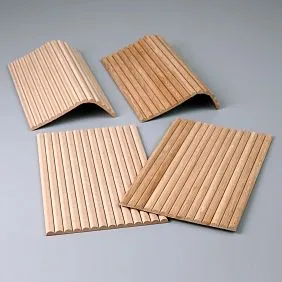
First and foremost — an answer to a question that is often vaguely formulated. A decorative slatted panel is not simply 'several slats together.' It is a full-fledged modular product with its own construction.




Panel format with a slatted pattern
A slatted panel is a structure of parallel slats of identical cross-section, fastened at equal intervals onto a backing or fabric base. The slats within the panel are already set with precise spacing and fixed — the user receives a ready-made geometry that only needs to be mounted on the wall.
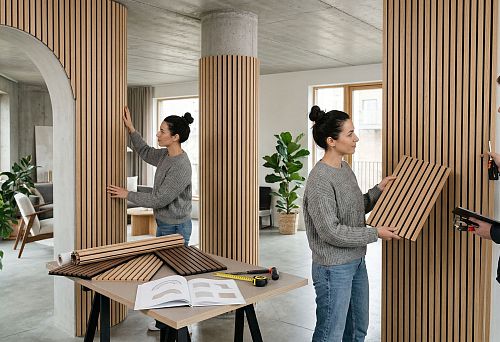
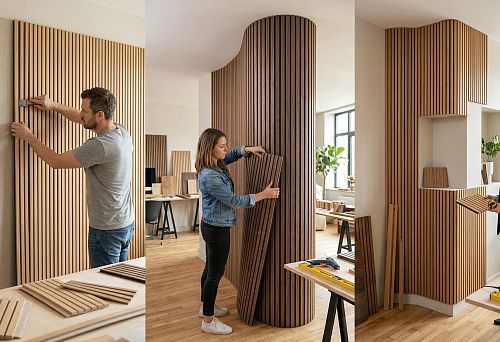
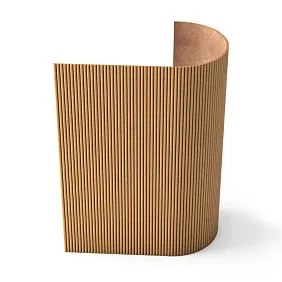
The backing can be fabric (for flexible panels that wrap around curved surfaces) or rigid. The slats are made of solid wood or paintable MDF.Slat panel PAN-001from STAVROS is produced in two versions: MDF for final painting and solid oak for tinting or varnishing. The flexible fabric base allows the panel to wrap around columns, arches, niches, and other curved surfaces without adjustment.
Our factory also produces:



How slatted panels differ from ordinary smooth wall panels
A smooth wall panel is a homogeneous plane. A slatted panel is a structured surface with a pronounced linear rhythm. The slats within the panel create relief: with side lighting — shadows, with frontal lighting — a graphic pattern. This is a fundamentally different visual effect. A smooth panel covers the wall. A slatted one creates architecture on it.
Get Consultation
Why this format is in demand in interior design
Three reasons explaining the popularity of slatted panels in modern residential and commercial design:
The first is geometric precision. In the panel, the spacing between slats is already calculated and fixed during production. There is no variation, no 'by eye' error. Module to module — and the wall looks perfectly even.
Second — acoustics. The slatted structure scatters sound waves, reducing reverberation. In living rooms, meeting rooms, offices with large open spaces — this is not a decorative, but a functional effect.
Third — format versatility. The same slatted panel works on flat walls, on columns, on curved surfaces. This is something a set of individual slats cannot do without special preparation.
How do decorative slatted panels differ from individual decorative slats?
This question is not trivial — the answer determines which product you order and what you get as a result.
Ready-made geometry and rhythm
With a set of individual slats, you determine the spacing yourself, mark the wall yourself, and level each plank yourself. In a slatted panel, all this is already done: the slats are fixed with precise and uniform spacing across the entire length of the module. Error is structurally eliminated.
This is especially important for large surface areas. On a 3×2.4 m wall, a 1–2 mm deviation in spacing from plank to plank — over 20–30 planks in a row — turns into a noticeable 'skew' in the pattern by the end. Panels prevent this.
Installation speed
Individual slats are installed one by one: marking, fastening, level check, next slat. A slatted panel is installed as a single module: adhesive or fastener, pressure, done. Installation speed is several times higher. For projects with large slatted surface areas and tight deadlines, this is crucial.
Visual integrity
Panel to panel is joined via a special connection system — seamlessly. The joints between modules are invisible. The wall looks like a single slatted plane. When installing individual slats, achieving a complete absence of visible transitions between 'sections' is significantly more difficult.
When panels are better, and when individual slats
| Criterion | Panel slats | Individual slats |
|---|---|---|
| Installation speed | High | Below |
| Geometric precision | Guaranteed | Depends on the craftsman |
| Non-standard sizes | Limited by format | Complete freedom |
| Curvilinear surfaces | Flexible panels — yes | Only with separate preparation |
| Individual layout | No | Yes |
| Serial projects | Ideally | Slower |
| Complex design solutions | Less flexible | Complete freedom |
The conclusion is simple: panels are for tasks requiring repeatability, speed, and a neat, predictable result. Individual rails are for custom design solutions with non-standard layouts.
In which projects the panel format is especially convenient
-
Offices and commercial interiors — large areas, serial installation
-
Corridors and hallways — long narrow surfaces
-
TV zones and niches — precise geometry is critical
-
Columns and arches — only flexible panels on a fabric base
-
Projects with a limited budget for installation work
Where are decorative slat panels used
For an accent wall
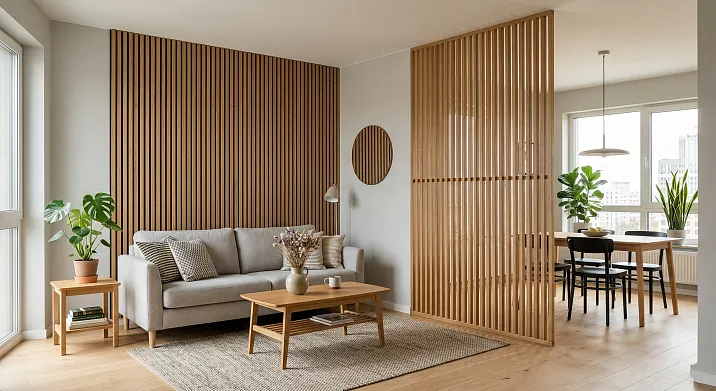
An accent wall is the classic and most common scenario. One wall behind the sofa, behind the bed, or opposite the entrance is covered with slat panels. The other three remain neutral. This is the basic rule of interior accenting, which works without exceptions.
The panel format here wins over individual slats precisely due to accuracy: an accent wall must look flawless. Any deviation in spacing is noticeable because the eye looks at it first.
For the TV zone
The TV wall is the focal point of the living room.Slatted panels for the TV areaThey create a 'frame' for the TV: the slatted background frames the screen, turning it from household appliance into part of the interior composition. With integrated LED backlighting behind the panel — an evening effect of warm glow from the depth of the pattern.
Calculation is important: the slatted field should extend beyond the TV by at least 35–40 cm on each side. Otherwise, the accent 'doesn't come together' — the screen looks large, and the slats look small.
For the bedroom
In the bedroom, slat panels are used in the headboard area. A delicate rhythm, a neutral or tonal color. A 'loud' texture is not needed here — a calm background is needed, which adds depth and warmth to the space.
Flexible slat panels work well on beds with curved headboards or in niches of non-standard shapes — where individual slats would require complex fitting.
For the hallway
In hallways, slat panels work on the lower part of the wall — serving as both a protective and decorative element simultaneously. A panel height of 90–120 cm from the floor — and the lower zone of the wall gains both texture and protection from mechanical damage. Combined with a console and a mirror — a full-fledged designer look for the hallway.
For the living room
In the living room, slatted panels are used in several scenarios: the wall behind the sofa, the TV wall, framing a fireplace or niche, a decorative partition between zones. For living rooms with high ceilings — large profiles, more pronounced relief. For standard apartments — medium and thin formats.
For an office
A study requires material with character. The dark oak tint in the slatted panel creates that atmosphere of solidity that distinguishes a workspace from just a 'room with a table'. In combination withmoldings and cornices from the same wood species— a study system that designers call the 'library effect'.
For commercial spaces
Offices, meeting rooms, reception areas, waiting zones, showrooms — here slatted panels work for the corporate environment. Serial installation, a homogeneous batch, predictable results. It is precisely for such tasks that the panel format is preferable to a set of individual slats.
For zoning a room
A slatted panel on one wall is already zoning. It 'marks' the zone visually, without partitions and without loss of light. In open-plan layouts, in studios — one of the most effective techniques for dividing space.
A separate scenario — a vertical slatted structure as a partition: the slats are fixed between the floor and ceiling, the gaps between them preserve visibility. A semi-transparent boundary that divides but does not close off.
What decorative slatted panels are available
With a vertical pattern
Vertical slats in panels are the most popular and versatile format. They draw the eye upward, visually increase the height of a room, and create a strict, cohesive geometry. They work in 90% of residential and commercial interiors.
With a horizontal pattern
Horizontal slats in panels are a rarer, non-standard option. They widen a room horizontally. They are suitable for narrow, tall spaces, bathrooms, and non-standard corridors with high ceilings. They require precision: the horizontal rhythm demands perfectly level installation—the slightest deviation is noticeable.
With a fine slat rhythm
Thin slats with tight spacing create a delicate, almost graphic texture. Good for small spaces, background solutions, and Scandinavian and minimalist styles. From a distance, it is perceived as a uniform 'ruled' surface.
With a more pronounced profile
Wide slats with generous spacing are an accent format. Each plank is read separately, shadows are deeper, and the relief is more noticeable. For large spaces, TV zones, and commercial interiors.
Light, dark, and neutral solutions
| Option | Character | Application |
|---|---|---|
| White enamel | Lightness, purity | Modern style, minimalism, small rooms |
| Pastel tones | Softness, coziness | Bedroom, Scandinavian interior |
| Natural oak | Warmth, naturalness | Eco, Scandinavian, modern |
| Dark tint | Strictness, status | Neoclassical, study, TV area |
| Gray neutral | Versatility | Any modern interiors |
How to choose the material for decorative slat panels
Material is the foundation. Everything else is built upon it.
Natural wood: a living surface
Solid oak in a slat panel is not just 'wood'. It is an open, large texture that interacts with light differently than any artificial counterpart. Golden-brown tones, live grain transitions, a distinctive pattern under side lighting.Solid oak slat panels— a choice for those who want not the 'effect of wood', but real wood.
Oak is one of the most durable hardwood species with a density of 700–750 kg/m³. Under tinting, oil, or semi-transparent varnish, its texture only benefits: the coating emphasizes the pattern, not hides it.
MDF for painting
MDF slats in a panel are a basic, universal option. A homogeneous surface without defects, an ideal base for painting. Any RAL enamel applies evenly. This is a format for those who want an exact color—be it white, gray, olive, or any other corporate or designer shade.
The cost of MDF panels is lower than oak ones. With equal geometry and finish—the result is indistinguishable from expensive solutions.
Options for painting
For painting—MDF without exception. Fine-dispersed homogeneous structure, minimal preparation, perfectly smooth final coating. When using water-based or alkyd enamels—the result is without pores or pull-outs.
Options for tinting
For tinting — solid oak. Semi-transparent coatings on natural wood create a vibrant, multi-layered result: the tone changes depending on the viewing angle and lighting. This is the effect that cannot be reproduced on MDF.
How the material affects the perception of the panel
| Material | Visual effect | Durability | Best application |
|---|---|---|---|
| Oak solid wood | Vibrant texture, depth | Very High | Walls, study, TV area, natural interior |
| MDF for enamel | Clean, smooth surface | High | Modern style, minimalism, commercial projects |
| MDF for tinting | Neutral, even tone | High | Bedroom, hallway, office |
How to choose decorative slat panels by size
Size is not a matter of taste. It's the physics of perception.
Slat width in a panel
The width of an individual slat within a panel determines the 'density' of the pattern. Thin slats (12–20 mm) create a delicate, almost lace-like rhythm. Wide slats (40–70 mm) create a pronounced, accent relief.
Rule: the smaller the room, the narrower the slat in the panel should be. In a small room, wide slats feel 'oppressive'. In a large hall, narrow ones get lost.
Panel height
The standard height of a slat panel is 2400 mm. This precisely matches the standard height of a residential space. No transverse joints, no horizontal seams — the wall looks solid. For rooms taller than 2400 mm — panels are extended, with joints planned in a staggered pattern.
Slat thickness
Thickness is the relief. With thin slats (5–8 mm) — the wall looks 'ruled'. With more massive ones (15–23 mm) — it's a three-dimensional architectural surface with pronounced shadows under side lighting.
For residential interiors — 8–15 mm is sufficient for most tasks. For commercial accent zones — using a larger profile is possible.
Relief depth and lighting influence
Relief depth (the difference between the substrate surface and the top point of the slat) is a key parameter when planning lighting. If an LED strip is planned behind the panel — the relief depth must be sufficient to accommodate the strip and create the desired effect of diffused glow.
How to choose a format based on wall area
| Area of the slatted field | Batten width | Step (gap) |
|---|---|---|
| Up to 3 m² | 12–20 mm | 15–25 mm |
| 3–8 m² | 20–40 mm | 25–40 mm |
| 8–15 m² | 40–60 mm | 40–60 mm |
| 15+ m² | 60–80 mm | 50–80 mm |
How to avoid an overly heavy visual effect
There is one rule: the ratio of 'slat width to gap' should not be less than 1:1. The slat should not be wider than the gap. If the gap between slats is smaller than the width of the slat itself, the wall 'closes up' and loses its lightness.
Vertical or horizontal slat panels: how to choose
When to choose vertical pattern
Vertical rhythm of battens is a standard in modern interiors. It lifts the gaze, creates a sense of height, and gives the space a slender appearance. Works in rooms of any scale. Especially effective in hallways, corridors, and apartments with low ceilings.
When horizontal is suitable
Horizontal pattern is a technique for non-standard situations. A narrow and tall room where ceilings feel oppressive due to their height, and the width seems insufficient. Here, horizontal battens 'expand' the space—working against elongated proportions.
Horizontal rhythm is also good in bathrooms and toilets: it creates a sense of a 'lowered', cozy zone.
How direction changes perception
| Direction | What happens to the space |
|---|---|
| Vertical | Ceiling visually rises |
| Horizontal | Room width visually increases |
| Mixed (corner) | Dynamics, movement—a rare authorial technique |
How to choose slat panels to match your interior style
Modern style
Clear geometry, uniform rhythm, no ornament. A slat panel in white enamel or dark tinting is modern style in its purest form. The slats aren't decoration—they are the interior itself. Slat width 30–50 mm, gap 30–50 mm, strict vertical alignment.
For such tasks—MDF slatted panels for painting—with a finish coating in the desired RAL. Precise color, even surface, predictable result.
Minimalism
Tonal slat panel—matching the wall color or one shade lighter. The wall is 'worked' but doesn't announce itself. Thin slats with wide gaps: more 'air', less pattern. Exactly what minimalism needs—structure without decoration.
Neoclassicism
In a neoclassical interior, a slat panel works in tandem withmoldings, cornices, and baseboardsfrom the same wood species. Moldings form a 'frame' around the slat field. A panel system is created where the slats are the central element, framed by classical profiles. Walnut tinting, matte varnish. Fromthe catalog of classic-style wooden millworkit's easy to select moldings for oak slat panels.
Scandinavian interior
Light solid oak with transparent oil or no coating, thin slats with airy gaps. Honest material, natural tone, no additional coatings. Scandinavian interiors value 'the honesty of wood'—and a solid wood slat panel provides exactly that.
Warm natural interior
Oak with wheat or walnut oil tint, medium-section slats. Linen textiles, wooden furniture with live texture — and the slatted panel fits organically into this natural story. Natural wood converses with other natural materials.
Commercial and public spaces
For commercial spaces, slatted panels are a material with dual value: aesthetic and acoustic. The dispersion of sound waves in the slatted structure is documented. In meeting rooms, conference halls, open-plan offices — this is a functional advantage beyond the visual.
How to combine decorative slatted panels with other interior elements
With smooth walls
A slatted panel on one wall, three smooth walls nearby — a classic ratio. The contrast of textured and neutral creates precisely the accent for which it was all conceived. The color of the smooth walls should support the panel's tone — not compete, but complement.
With furniture and furniture fronts
A slatted panel on the wall + slats or slatted inserts in furniture fronts in the same wood species and tone — this is the principle of material unity. It is precisely such a solution that creates an interior that feels designed, not assembled from random elements.
With moldings
Molding frames the slatted panel — creating a 'frame'. This is a transition from plane to architecture. The wall is divided into fields, each of which is an independent decorative unit. For neoclassical and transitional interiors — an essential technique.
With lighting
LED strip, hidden behind the slatted panel, is one of the most effective evening techniques in modern interiors. Warm light seeping through the gaps between the slats creates a feeling that the wall is 'breathing'. This requires planning at the installation stage: the gap between the panel backing and the wall must be provided in advance.
With doors and portals
The tone of the slatted panel should 'echo' the tone of the doors or door portals. Either match or be close in temperature. The 'panel/door' contrast works only with a conscious, bold design decision.
With textiles, flooring, and wooden surfaces
Natural materials enhance each other. Wooden slat panel + parquet from the same species + linen sofa — this is a formula that requires no additional effort: organic harmony arises naturally. The starting point when selecting the panel tone is always the floor.
When it's better to choose slat panels instead of individual slats
If installation speed is important
Panels are installed as modules — this is several times faster than piece-by-piece assembly. For commercial and object projects where every day counts, this is a fundamental advantage.
If uniform, repeatable geometry is needed
In serial projects — offices with several identical meeting rooms, retail chains, multi-unit residential complexes — slat panels guarantee identical results on every project. Individual slats do not.
If you need to quickly cover a large surface
A 3×2.4 m TV wall made from slat panels is installed in a few hours. From individual slats — a full workday minimum. With larger areas, the difference multiplies.
If there's no need to create complex custom layouts
If the interior task is not an authorial composition with variable spacing and custom inserts, but a neat, cohesive slatted background — panels are optimal. There's no point in complicating what's already solved.
If curved surfaces are needed
A flexible slatted panel on a fabric base wraps around columns, arches, niches without additional fitting. Individual slats for such surfaces require special cutting and non-standard fastening.
What affects the price of decorative slatted panels
Material: the main pricing factor
Solid oak — more expensive than MDF. This is objective: oak is harder, heavier, more expensive in harvesting and processing. With an equal cross-section, a slatted panel made of oak costs 2–3 times more than an MDF equivalent. But the result is fundamentally different: living texture, durability, tactility.
Panel size and relief
The larger the slat cross-section — the more material per linear meter. Wide and thick slats cost more for the same panel length. Deep relief — more complex milling — also increases the cost.
Finishing
Panel without coating — base price. Factory tinting — more expensive, but saves the cost of painting work on site. For large volumes, this is often more cost-effective than painting yourself: factory coating is more uniform and durable than manual painting.
Order volume
Standard principle: the larger the volume, the lower the unit cost. For serial project orders, STAVROS works on wholesale terms. For design studios and construction companies — this is a fundamental saving on large projects.
Ready-made solution or custom production
Items in stock — immediate shipment. Custom production — 5–10 business days, possibility for non-standard parameters and finishes. A surcharge for non-standard items is possible but often justified by exact compliance with project specifications.
Typical mistakes when choosing decorative slat panels
Choosing without considering wall size
A slat panel that works perfectly in a showroom interior may 'not work' in a small room. Always translate the chosen format to the actual dimensions of your wall — not to an inspiring photo.
Unsuitable relief
Deep relief in a small room — the wall 'rushes' at you. Subtle relief in a large hall — gets lost, doesn't read. The scale of the relief must match the scale of the space.
Too active a rhythm for a small room
Frequent spacing between slats + wide slat = a dense 'grid' that visually shrinks the space. In small rooms — only a light rhythm, wide gaps.
Mismatch with furniture and flooring
A slat panel tone that clashes with the floor or furniture color is a source of constant visual discomfort. Always select a panel while looking at both the floor and the main furniture simultaneously.
Mistake in pattern direction
Vertical slats in a room with an already too-high ceiling will visually add even more 'height,' which is already oppressive. Assess the actual proportions—and only then decide what's needed: more 'height' or, conversely, more 'width.'
Choosing based only on photos without understanding scale
A beautiful photograph doesn't convey the actual scale of the slat. A wide slat in a photo might turn out to be 'small' in your room, and vice versa. Always check the technical dimensions—and correlate them with the actual dimensions of your wall.
How to choose decorative slat panels for your task: a checklist
Six questions that replace half an hour of doubt:
-
Where are the panels going? — wall, niche, TV zone, partition, column
-
What needs to be created? — an accent or background, a strict pattern or a delicate texture
-
What is the surface area? — affects slat width and relief depth
-
What interior style? — determines the wood species, color, and profile
-
What color already dominates? — floor, furniture, doors — anchor points for the panel tone
-
What is more important — installation speed or maximum individuality? — panels or individual slats
FAQ: answers to common questions about decorative slat panels
What are decorative slat panels?
This is a modular interior product: slats of identical cross-section, fixed at equal intervals on a backing (rigid or flexible fabric). Ready-made geometry, quick installation, seamless connection of modules. Available in MDF for painting and solid oak for tinting.
How do slat panels differ from individual decorative slats?
A panel is a ready-made geometry. Spacing, rhythm, precision — everything is fixed during production. Individual slats offer complete layout freedom but require more time and skill during installation. Panels are for speed and repeatability, individual slats are for non-standard, custom solutions.
Where is it better to use slat panels in an interior?
Accent walls in living rooms, TV zones, bed headboards in bedrooms, hallways, offices, commercial areas. Flexible panels — on columns, arches, niches of non-standard shape.
Which slat panels are best for a TV zone?
Pronounced relief, dark tint, or contrasting color, vertical pattern. The slat field should extend beyond the TV by 35–40 cm on each side. Optionally — integration of LED backlighting behind the panel.
What is better for a small room — subtle or pronounced relief?
Subtle relief, light rhythm, wide spacing between slats, light tones. All this creates a sense of air and space, not 'crampedness'.
When is it better to choose panels rather than individual slats?
When speed of installation, repeatability of results, large surface area, curved surfaces, or a serial object project are important.
Are slat panels suitable for bedrooms and hallways?
Yes. In the bedroom — a tonal, delicate pattern in the headboard area. In the hallway — a protective and decorative format for the lower part of the wall up to 120 cm.
Can slat panels be used for zoning?
Yes. An accent wall with slat panels visually 'marks' a zone in an open layout. A vertical structure made of slat panels as a partition — a semi-transparent boundary between zones.
How to combine slatted panels with furniture and flooring?
The starting point is the floor tone. The panel is selected from the same tonal group or one shade lighter. Using the same wood species for both panels and furniture is a principle that makes the interior cohesive.
Which slat panels to choose for a modern interior?
MDF for enamel painting in white, gray, or dark tones. Vertical pattern, slat width 30–50 mm, moderate spacing. Strict geometry without ornaments.
Conclusion
Decorative slatted panels are not just a way to 'cover a wall with character.' They are a thoughtful interior tool with clear application logic. Where neat slatted rhythm, quick installation, predictable results, and precise geometry are needed, the panel format outperforms a set of individual slats in every aspect.
The right choice doesn't start with a beautiful photo, but with understanding the task: which area, what scale, what style, what material. A solid oak slatted panel offers living texture and durability. MDF for enamel painting provides precise color and versatility. A flexible panel is for curved surfaces without excessive fitting. Each format is for its own task.
STAVROS is a Russian manufacturer of slatted panels, decorative slats, moldings, cornices, and millwork products made from solid oak and MDF. The PAN-001 slatted panel is available in two versions: MDF for finish painting and solid oak for tinting. Flexible fabric backing is for columns, arches, and curved surfaces. Seamless module connection, simple glue-on installation. Some items are in constant stock, custom production takes 5–10 business days. Delivery across all of Russia. Full range ofslatted panels and decorative slats— on the official website stavros.ru.