Article Contents:
- Where to buy wooden decorative elements in Moscow and what to check before ordering
- What to check before ordering decorative elements
- What types of wooden decorative elements exist and where are they used
- Decor for moldings
- Decorative elements for walls
- Furniture decorative elements
- Decor for doors and facades
- How to choose decor for moldings so it doesn't look random
- Profile matching principle
- Corner element proportions
- Depth of relief and ornamental richness
- Symmetry and repetition
- When to use an accent and when a calm profile
- How to choose decorative elements for walls
- Scale of decor relative to the wall
- Vertical and horizontal compositions
- Combination with panels, moldings, and doors
- When a single accent, and when a repeating ornament
- How to choose wooden decor for furniture and facades
- Cabinet and kitchen facades
- Commodes and cabinets
- Beds and Headboards
- Classical and Neoclassical Solutions
- Decorative Elements for Classical and Neoclassical Interiors
- Classical: The Richness of the System
- Neoclassical: Structure Without Overload
- Modern classicism
- How Decorative Overlays, Carved Decor, and Molding Decor Differ
- Decorative appliqués
- Carved decoration
- Overlay Decor
- Decor for moldings
- Practical Summary
- Wooden Decorative Wall Patterns: When Ornament Becomes Architecture
- Wooden Molding: Why Molding Quality Defines Decor Quality
- Common mistakes when choosing decorative wooden elements
- Mistake 1: decor is too small for the surface
- Mistake 2: overloaded carved relief in a calm interior
- Mistake 3: mixing ornamental programs
- Mistake 4: lack of connection between the wall, molding, and furniture
- Mistake 5: decor chosen without considering the scale of the room
- Mistake 6: ignoring compatibility with molding
- FAQ: answers to common questions about wooden decorative elements
- Conclusion: wooden decor as a system, not a set of parts
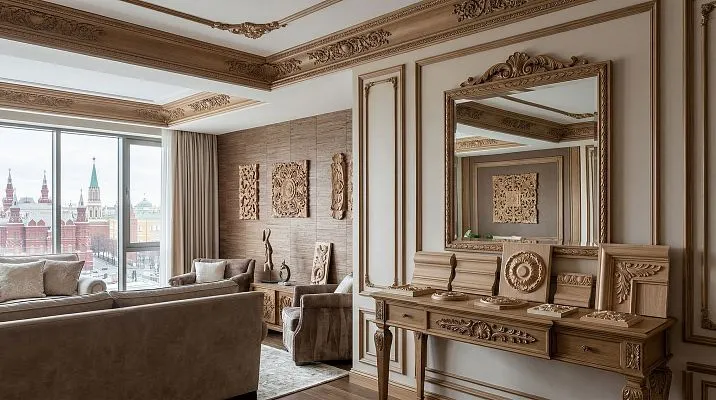
Moscow is a city where interior requirements have always been above average. When it comes to wooden decor, the Moscow buyer has long moved beyond 'something for the wall.' Today, the request sounds different: decorative wooden elements in Moscow for a specific task — moldings, wall framing systems, furniture fronts, door panels. Not just 'decorations,' but a conscious system of details that builds the stylistic language of the interior.
Buying decorative elements in Moscow is easy — the market is vast. The hard part is buying correctly: considering profile compatibility, scale relative to the room, ornamental logic, and stylistic affiliation. This is where most people make mistakes — and then redo everything.
This article provides a complete practical breakdown: what types ofdecorative elementswooden elements exist, where and how they are used, how to chooseDecor for Molding, walls and furniture, how overlays differ from carved decor, and which selection mistakes cost the most.


Where to buy wooden decorative elements in Moscow and what to check before ordering
Let's start with a practical question: what to look for when choosing a supplier of wooden decor in Moscow?
Buying wooden decorative elements for interiors is not the same as buying paint or putty. Here, every detail has a profile, size, ornament, compatibility with specific moldings, and stylistic affiliation. Blind selection — based on a picture without dimensions — leads to the delivered item not fitting the molding, looking disproportionate, or clashing in ornament.




What to check before ordering decorative elements
Completeness of the catalog by product types. A good wooden decor catalog is divided by application: decor for moldings separately, overlays for furniture separately, decor for walls and doors separately. If everything is mixed into one category — working with such a catalog is inconvenient and risky.
Exact dimensions of each product. Must include: width, height, relief depth, diameter (for round elements), length (for linear parts). Without these parameters, it is impossible to verify compatibility with a specific molding.
Compatibility with moldings. This is a key technical parameter for this type of decor. Corner elements must have a recess on the back side that exactly matches the profile of the molding. Without this, the element will 'float' — with a gap and a visual mismatch.
Clear collection logic. A professional supplier offers products united by an ornamental principle. A corner element and a central overlay from the same series guarantee they will create a unified ensemble, not a set of random parts.
Photographs in real interiors. A product in a catalog and a product on a wall are very different images. A supplier that shows wooden decor in live interiors helps make the right decision the first time.
Delivery in Moscow and Russia. Wooden decorative elements are fragile goods in terms of relief and fine details. Proper packaging and reliable logistics are not a trifle, but part of professional service.
Our factory also produces:




What types of wooden decorative elements exist and where are they used
Before moving on to selection — it is necessary to understand the typology. 'Wooden decor' is a very broad concept that unites fundamentally different products with different functions and areas of application.
Get Consultation
Decor for moldings
Decor for Molding— is a group of products created specifically to work in tandem with straight molding profiles. Without these elements, the molding frame system on the wall remains incomplete: there are lines, but no logic in the corners.
This group includes:
-
Corner elements — installed in the corners of rectangular frames. They receive the ends of two moldings, close the corner, and add an ornamental accent. They have a recess on the back side for the molding profile.
-
Central inserts — installed in the center of the frame field or in the center of a long molding run. They create an additional visual accent.
-
End caps — complete the molding line where it ends at an opening or wall edge.
Molding decor — the most technically specialized group of wooden decorative elements. Here, compatibility with the molding profile is most important. In the STAVROS catalog, each corner element has a series marking (MLD-001U, MLD-002U, MLD-003U, etc.) — it indicates which specific molding the part is suitable for.
How to correctly select decor for moldings, taking into account all parameters — proportions, ornament, and style — is discussed in detail below in a separate section.
Wall decorative elements
Wooden decorative wall elements — these are products that are attached directly to the wall surface and create a visual accent without the need for a molding system. These can be:
-
Single relief overlays — rosettes, cartouches, medallions
-
Horizontal wooden friezes
-
Vertical decorative inserts
-
Corner overlays for decorating external wall corners
Wooden wall decorworks as an independent ornamental element. It does not require a molding system — but can be organically incorporated into one.
Decorative wall elements in Moscow are especially in demand in classic interiors: there, frame systems with wall inserts are a sign of quality design, not excess.
Furniture Decorative Elements
decorative elements for furniture— these are overlay parts that are attached to cabinet fronts, dresser doors, bed headboards, furniture frame sides, and any other furniture surfaces.
Types of Furniture Decor:
-
Center Overlays — installed in the center of a door or front panel
-
Corner Overlays — decorate the corners of a furniture plane
-
Horizontal and Vertical Friezes — run along the perimeter of the front panel
-
Relief Inserts — large ornamental elements with deep relief
Wooden Furniture Decor — one of the most economical ways to turn a mass-produced furniture item into a custom piece. A few well-chosen overlays completely change the character of a cabinet or dresser.
Decor for Doors and Front Panels
Interior Door — a surface where wooden decor works especially effectively. Overlays along the perimeter of the door leaf, a central carved insert in the panel, corner elements — all of this turns a standard door into a piece with individuality.
How to decorate doors using overlays and moldings is described in detail in the article"Decor for interior doors and decorative door panels", as well as in the article"DIY door decor: moldings, overlays, framing".
How to choose decor for moldings so it doesn't look random
This is one of the most important questions in the topic of wooden decor. Decor for moldings chosen without a system is not decor, but a problem. Because it is here that small mistakes yield the most noticeable result.
The principle of profile matching
The first and absolute rule: the corner decorative element must match the profile of the molding at the joint. The recess on the back of the corner should replicate the cross-sectional shape of the molding. If the molding profile is semicircular—the recess should be semicircular. If trapezoidal—trapezoidal.
A profile mismatch creates a gap or a "hump" at the joint—and no putty can fix it. This is whyWooden moldingsand decorative elements for them are produced in coordinated series, where compatibility is structurally guaranteed.
Proportions of corner elements
The corner element should be visually larger than the molding at the corner point. This is not an aesthetic whim—it is a structural necessity. The corner of the frame is the point of greatest visual tension. A small corner element 'drowns' in the corner and does not create the necessary accent. One that is too large overloads the corner and disrupts the proportionality of the system.
Practical rule: the width of the square corner piece should be 1.5–2 times the width of the molding. With 30 mm molding — 50–60 mm corner. With 50 mm molding — 80–100 mm corner.
Depth of relief and ornamental richness
The relief of the decorative element must be coordinated with the relief of the molding. If the molding is flat, with a thin profile—a corner element with deep, complex relief will look foreign. If the molding has a pronounced volumetric profile—a corner element with rich ornamentation organically continues this logic.
Symmetry and repetition
All corner elements in a framing system must be identical. This is obvious, but this is precisely where errors occur when reordering: the profile series is discontinued, a new 'similar' one does not match the relief height—and the entire system visually falls apart. Solution: purchase the entire volume of decorative elements for moldings at once, with a small reserve.
When an accent is needed, and when a calm profile
If the interior is built on delicate classicism with soft profiles—choose corner elements with simplified ornamentation, without sharp details and deep carving. If it is rich classicism or baroque—corners can be large, with elaborate carving. In modern classicism and neoclassicism—geometric elements without ornamentation or with minimal relief.
How to choose decorative elements for walls
A wall is not just a surface. It is an architectural plane that either works for the interior or remains a neutral background. Wooden decorative elements for walls are a tool that transforms a neutral background into an active participant in the interior story.
Scale of the decor relative to the wall
First question: what is the area of your wall? This determines the permissible scale of the wooden decor.
-
Wall up to 6 sq. m — elements up to 150–200 mm wide. One or two central accents or a small frame system.
-
Wall 6–15 sq. m — a frame system of 2–3 rectangular fields with corner elements. Central medallions in each field — optional.
-
Wall over 15 sq. m — a full frame system, horizontal molding belt, decorative friezes. Large-scale decor is also appropriate here — cartouches, large rosettes.
The main rule: the larger the wall, the larger the decorative element can be. Small applied decor on a large wall disappears and creates a sense of incompleteness.
Vertical and horizontal compositions
Vertical frames on the wall visually raise the ceiling — this works with a standard height of 2.7–2.8 m. Horizontal frames 'expand' the wall — appropriate where the room is elongated and narrow. Square frames are a neutral, stable format that works in any room as an accent element.
Combination with panels, moldings, and doors
Wooden wall decor elements should be coordinated with other wooden details in the room. If the walls have slatted panels, the applied decor is chosen in the same tone and ornamental program. If there are wooden door trims, the ornament of the wall overlays should echo the trim ornament. A break in stylistic logic between walls and doors is one of the most common and painful mistakes.
When to use a single accent and when to use a repeating ornament
A single accent—a central medallion, a large overlay, a decorative panel—works on walls with a minimal number of details. This is a Scandinavian and modern approach: one powerful statement instead of a repeating rhythm.
A repeating ornament—a frame system, a horizontal frieze, rhythmic inserts—is a classic academic approach. It requires precise proportions but yields an incomparably richer result.
How to choose wooden decor for furniture and facades
to buy, which will allow you to transform your furniture using carved wooden elements. You can use the C-003-3 decor set to decorate furniture, walls, doors, or any other surface. The C-003-3 decor set is made of oak or beech, known for their strength, durability, and beauty. You can buy the C-003-3 decor set at the Stavros decor store, which specializes in producing and selling decorative elements and hardware for furniture and interiors. At the Stavros decor store, you will find a wide selection of decor sets of various shapes, sizes, and styles. You can choose—a separate and very rich topic. Here, questions of style, furniture construction, and fastening technology are combined.
Cabinet and kitchen fronts
Overlays on kitchen cabinet facades are one of the most popular scenarios for using furniture wooden decor. A central overlay in the lower third of the door, corner details around the perimeter—and a standard cabinet with an MDF facade visually transforms into furniture with character.
For the kitchen, choose overlays with clean, not too fine relief: fine carving in kitchen conditions quickly gets clogged with grease and is difficult to clean. Medium relief with clear contours is the optimal option.
Chests of drawers and cabinets
On a chest of drawers, wooden decor works differently: here there is usually less of it—one central accent or a frame around the perimeter of each door. It is important to maintain proportionality: the decorative element should not occupy more than 30–40% of the facade area.
Beds and Headboards
The bed headboard is one of the most advantageous places for carved furniture decor. A central cartouche, a frame around the perimeter of the headboard, corner accents—all of this creates a sense of richness and style without excess. For the bedroom, a more delicate, lighter relief is suitable.
Classical and neoclassical solutions
Carved furniture decorwith plant motifs—acanthus, laurels, grapevine scrolls—are classics in the full sense of the word. For neoclassicism, the ornament should be simpler: geometric inserts, clean reliefs without fine detailing.
Modern classic allows for minimal decor: a thin contour molding around the perimeter of the facade—and that is enough to turn a faceless facade into a stylish one.
Decorative elements for classic and neoclassical interiors
Classic and neoclassical are the two most common styles in Moscow apartments and houses for which wooden decorative elements are purchased. But there is a fundamental difference in their approach to decor.
Classic: richness of the system
Decorative elements for a classic interior are always a system. Not a separate corner and not a single wall overlay. It includes:
-
A cornice at the ceiling (if it's a wooden interior—made from the same wood as the entire system)
-
Molding frames on walls with corner elements and central inserts
-
Decorative overlays on furniture fronts with the same ornamental motif
-
Door trims and door leaf decor coordinated with the wall system
Ornament for classic style — floral, rich, detailed. Acanthus leaves, rosettes, garlands. Molding width — from 50 mm, corner elements — large, with pronounced relief.
Wooden decor for classic interiors made of solid oak — the most organic choice. Oak provides weightiness and nobility that match the classic spirit.
Neoclassicism: structure without overload
In neoclassicism, classical principles are preserved but implemented through simplification. Framing systems on walls — yes, but moldings are narrower, corner elements are more restrained, ornamentation is less fragmented. Overlays on furniture — exist, but without fine detailing.
Decorative elements for neoclassicism are often chosen from series with geometric ornamentation or simplified floral patterns. Beech is especially good here: its homogeneous structure provides clean carving lines.
The main principle of neoclassicism in wooden decor: 'classical structures — modern scale'.
Modern classic
Here decor works 'by suggestion'. A thin molding without ornament around the perimeter of the wall field — and structure is already present. A simple corner element with minimal relief — and the corner is framed. A flat overlay with geometric grooves on a cabinet front — and the furniture acquires an architectural character.
In modern classic design, no decorative element should 'shout'. Everything works as part of a system — quietly, convincingly, professionally.
What is the difference between decorative overlays, carved decor, and molding decor
This is a fundamental question that even experienced buyers often confuse. Three terms — three different groups of products with different application logic.
Decorative appliqués
Decorative Inserts— the broadest category. These are any flat or relief details that are overlaid on a surface (wall, furniture, door) and attached with glue or nails. Overlays can be:
-
With minimal relief (almost flat, creating only shape)
-
With medium relief (visible volume, but without deep carving)
-
With pronounced relief (volumetric form, readable from a distance)
Overlays are used everywhere: on walls, furniture, doors, panels. This is a universal tool.
Carved decor
Carved Decor— this is a subgroup of overlays with pronounced hand or machine carving. The main difference is the depth and detail of the relief. Carved wood decor is always recognizable: it gives shadows, volume, tactility. These are accent elements — fewer are used, but they work more powerfully.
Carved decor made from solid wood creates a living, 'breathing' surface feel. This is where the difference between wood and polyurethane is most noticeable: solid wood provides a depth of texture that synthetics cannot reproduce.
Applied decor
applied decor— a term often used as a synonym for 'decorative overlays'. In a broad sense, it refers to all applied elements — the opposite of 'integral' decor (milled grooves, embossing). Applied decor is added onto a finished surface — this is its main characteristic.
Get Consultation
Decor for moldings
But Decor for Molding— is a specialized group. Its fundamental difference from simple overlays:
-
Structural connection to molding: corner elements have a cutout for the molding profile
-
System function: elements of this group complete the molding frame system — they are not independent, but work in pairs
-
Limited application area: decor for moldings is used only in conjunction with moldings — installing it without moldings is impractical
Decorative overlays, unlike decor for moldings, can be used independently — without a molding system.
Practical summary
| Product type | Application area | Need moldings? | Main function |
|---|---|---|---|
| Decorative overlays | Everywhere | No | Ornamental accent |
| Carved decoration | Walls, furniture, doors | No | Accent relief |
| Overlay decor | Everywhere | No | Surface decor |
| Decor for moldings | Only in the molding system | Yes | Frame completion |
Wooden decorative wall patterns: when ornament becomes architecture
Separately, it is worth examining the topic of decorative wooden wall patterns — it deserves attention not only as an SEO topic but also as a design tool.
A wooden wall pattern is not just a 'picture made of wood'; it is a spatial structure that creates depth on a plane. A pattern made of wooden overlays is perceived completely differently from wallpaper designs or paint: it casts shadows, has tactility, and is readable under any lighting.
Decorative wooden patterns are used:
-
As an accent wall fragment — behind a sofa, at the head of a bed, above a fireplace
-
As an ornamental frieze around the perimeter of a room
-
As part of a framing system — inside a molding frame
To buy wooden wall patterns in Moscow means choosing a product with an ornament that is comprehensible on the scale of the wall. A pattern that is too small gets lost even up close. One that is too large can dominate the entire interior. The scale of the ornament is the first selection parameter.
Wooden molding: why the quality of the molding determines the quality of the decor
When discussing the topic of wooden decorative elements in Moscow, one cannot overlook the molding itself — the foundation of the entire framing system.
Wooden molding— is a shaped strip whose profile defines the character of the entire wall system. It determines:
-
How precisely will the corner decorative element fit
-
How will the frame read as a whole
-
What style will the entire system convey
Solid oak or beech wood molding is the most durable and noble option. It does not deform, holds its geometry precisely, and accepts any finish well. MDF molding is a more budget-friendly option for rooms without high loads.
Important: wood moldings and their decorative elements should be made from the same material or from species with similar characteristics. Oak to oak, beech to beech—this is not only about aesthetics but also about the material's behavior under changes in temperature and humidity.
Common mistakes when choosing decorative wood elements
This is a practical block—for those who want to avoid redoing work.
Mistake 1: decor is too small for the surface
An 80 mm wide overlay on a living room wall of 20 sq. m is invisible. When choosing wood decor for walls, always assess the scale relative to the surface area. A large room requires large or systematic decor.
Mistake 2: overloaded carved relief in a calm interior
Rich carved wood decor is beautiful — in the right context. In a light minimalist interior, it creates stylistic dissonance. Choose ornamentation that matches the overall 'weight' of the interior.
Mistake 3: mixing ornamental programs
Corner elements with floral ornamentation, a central overlay with geometric patterns, molding with a fluted profile — all of this in one frame creates visual conflict. There should be one ornamental program per room.
Mistake 4: lack of connection between the wall, molding, and furniture
Decorative elements for the walls were chosen in a 'classical' key, furniture overlays — in a 'Scandinavian' style, door trims — neutral. Three different stylistic languages in one space is not eclecticism, but confusion. The correct approach: first determine the stylistic program, then select all wooden decorative elements within its framework.
Mistake 5: decor chosen without considering the scale of the room
Monumental corner elements with large relief in a small room with a 2.6 m ceiling create a claustrophobic feeling. The scale of the decor should always correspond to the scale of the space.
Mistake 6: ignoring compatibility with molding
Buying a wooden corner decorative element without checking its compatibility with a specific molding is the most common and costly mistake. Always check the series and profile.
FAQ: answers to frequently asked questions about wooden decorative elements
Where to buy wooden decorative elements in Moscow?
The best option is a manufacturer or official supplier with a fully structured catalog, precise product dimensions, and decor available by application type: molding decor, furniture overlays, wall decor. This guarantees part compatibility and material uniformity.
Which wooden decorative elements are suitable for walls?
For walls, suitable elements include corner and central molding decor (in frame systems), decorative overlays (as standalone accents), and horizontal wooden friezes. The choice depends on interior style and wall area.
How to choose decor for moldings?
The main parameter is the compatibility of the corner notch with the molding profile. Then — scale (the corner should be 1.5–2 times wider than the molding), ornament (according to style), and series (the corner and molding should belong to the same production series).
How do decorative overlays differ from molding decor?
Overlays are standalone decorative elements used on any surfaces without being tied to moldings. Molding decor is a specialized group, structurally tied to the molding frame system: corner elements have a notch for the molding profile and do not function without it.
Which wooden decorative elements are suitable for furniture?
For furniture, central overlays (on the center of the facade), corner overlays (corner decoration), horizontal and vertical friezes (around the door perimeter) are used. For classic furniture — floral ornament. For neoclassical — geometric or simplified floral. For modern classic — minimal relief.
Is carved decor suitable for neoclassicism?
Yes, but in a simplified version. For neoclassicism, choose carved wood decor with clear, uncluttered ornaments—without fine detailing or overload. Oak or beech with a uniform structure is the optimal material.
How to choose wood decor for a classic interior?
Start by defining the ornamental program: botanical classics (acanthus, laurel, garlands) or geometric (Greek key, dentils). Then choose a system: moldings with corner elements for walls, overlays for furniture, and door decor—from the same series. Oak with a rich warm-toned finish is the most organic choice for classic style.
Can I buy wooden decorative elements individually?
Yes. In the STAVROS catalog, most items are available for order from one piece. This is important both for small projects and for reordering in case of loss or damage to a part.
Wood decor for a classic interior—oak or beech?
Oak is preferable for monumental details with a pronounced texture. Beech is for fine carving with detailed ornamentation. Both materials are appropriate in classic style; the choice depends on the character of the ornament and the finish.
How not to overload the interior with decorative elements?
Rule of 'one ornamental language': in one room, all wooden decorative elements—on walls, furniture, doors—should belong to one ornamental program. The quantity is limited by scale: one or two accents per wall in a small room, a framing system in a spacious one.
Conclusion: wood decor as a system, not a set of parts
Decorative wooden elements in Moscow are not bought because 'it's trendy.' They are bought because wood is the only material that gives interior liveliness, tactility, and temporal depth. Carved or applied, for moldings or furniture, made of oak or beech — each detail works as part of a system that either creates a cohesive spatial image or falls apart into beautiful but disconnected fragments.
The correct approach to selection is to first determine the task: moldings, walls, furniture, or doors. Then — the ornamental program and style. And only after that — specific products, checking their compatibility, scale, and belonging to a unified series.
The company STAVROS produces wooden decorative elements from solid oak and beech —Decor for Molding, decorative overlays for furniture and walls, Wooden moldingsand a full range of millwork. Over 4000 models in 39 product groups, production from properly dried wood in a controlled microclimate.
STAVROS provides delivery to Moscow, Russia, and CIS countries with orders from one piece — directly from the manufacturer, without intermediaries and overpayments.