Article Contents:
- What are decorative elements in interior design
- Where wooden decorative elements are used
- Walls
- Doors and door panels
- Furniture and facades
- Moldings
- Panels, partitions, niches
- Decorative elements for moldings: corner pieces, overlays, connecting decor
- Corner elements: why they are needed
- MLD-027U-1 and MLD-027U-2: two variations of one corner
- Connecting and central decorative elements
- How the molding decoration system works
- How to choose decorative elements to match the interior style
- Classic
- Neoclassicism
- Modern classicism
- Neoclassical and baroque
- How to combine decorative elements with walls, doors, and furniture
- The principle of repetition
- Scale and proportion
- Color and Staining
- Symmetry and Rhythm
- How to choose material: beech, oak, solid wood
- Oak
- Oak
- Why solid wood is better than MDF in decoration
- What to look for when choosing sizes, patterns, and proportions
- Size of corner elements
- Choosing an Ornament
- Proportions of Frame Compositions on Walls
- Mistakes When Choosing Decorative Elements
- Which Decorative Elements Suit Classic, Neoclassical, and Modern Classic Styles
- Classic
- Neoclassicism
- Modern classicism
- Where to Use Corner Elements and Carved Overlays
- Living Room
- Bedroom
- Office
- Corridor and Hall
- Furniture Fronts and Built-in Wardrobes
- Decorative Elements for Walls: 50 Application Ideas
- Wooden Decorative Wall Overlays: From Simple to Complex
- A Question to Ask Yourself Before Buying
- FAQ: Answers to Frequently Asked Questions
- Conclusion: style begins with detail
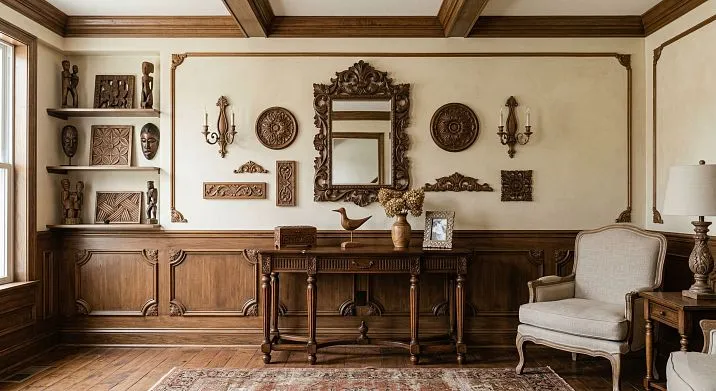
When you enter a room and immediately feel—there's something here, style lives here—behind this sensation almost always lies a detail. Not a huge chandelier or an expensive sofa. A finely drawn molding, a carved corner of a picture frame on the wall, an overlay on a dresser front. It is decorative wooden elements that turn an ordinary space into an interior with character. They work quietly, without pretension—and that's precisely why they are so convincing.
In this article, we will break down everything: what decorative elements for interiors are, where they are used, how corner details differ from connecting overlays, how to choose material, ornament, and proportions, how to correctly combine decor with moldings, walls, doors, and furniture—and under what conditions all of this works towards a result, not overload.


What are decorative elements in interior design
Decorative elements are applied, relief, or three-dimensional details that are attached to a surface and serve an artistic function. Unlike load-bearing or functional structures, they are created solely for aesthetics: to enrich a surface, place accents, create rhythm, and completeness.
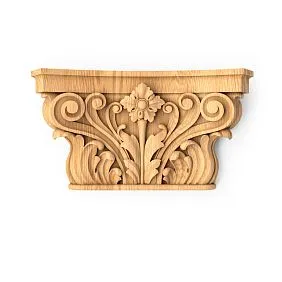
In a broad sense, decorative elements include moldings, cornices, baseboards, pilasters, rosettes, trims, overlays, and corner inserts. But speaking specifically—about what forms a decorative system in classical and neoclassical interiors—we are talking primarily about wooden decorative elements: carved overlays, corner details for moldings, connecting inserts, and central accents.
Wood holds a special place here. It provides warmth that cannot be achieved with polymer or plaster. It accepts varnish, stain, wax, paint—and at the same time retains its living texture. Solid oak or beech is not just a material; it is a carrier of the memory of nature. That is precisely whysolid wood decorative elementsremain in demand even when interior trends change three times a season.
A solid wood decorative element works in tandem with the surface: it does not hide within it but enters into a dialogue. Wood highlights form, adds volume, creates shadow—and it is precisely through this play of light and relief that a sense of spatial richness arises.




Where are decorative wooden elements used?
It's impossible to answer this question briefly because the scope of application is wide—and this is precisely the situation where versatility is an asset, not a lack of clarity.
Our factory also produces:




Walls
The wall is the main canvas for working with decor. This is where wooden decorative wall elements reveal their full beauty. The most common technique is creating framed compositions using moldings and corner elements. The wall is divided into rectangular fields, bordered by molding frames. Inside each frame—paint, wallpaper, or decorative plaster. Carved corner pieces are placed at the frame corners, giving the composition a finished look.
This approach literally 'architects' the wall: it ceases to be a flat surface and becomes an ordered system. This works in the living room, bedroom, and study—anywhere that needs expressiveness without extravagance.
Get Consultation
Doors and door panels
Interior doors are one of the main style carriers in a home. But most mass-produced doors look impersonal. Decorative overlays on door panels, corner elements around the perimeter, overlays in the center of the panel—all of this instantly transforms a standard door into a custom piece.Wooden decor for interior doors—is one of the most budget-friendly ways to elevate the level of an interior without changing the door itself.
Furniture and facades
Decorative elements for furniture are a separate and very rich topic. Carved overlays on kitchen cabinet fronts, corner details on a chest of drawers, a central overlay on a sliding wardrobe door, an overlay on a bed headboard—all of this belongs to one category: wooden furniture decor. It is especially valuable when furniture is made in a classic or neoclassical style and requires corresponding ornamental enrichment.
It's important to understand: a decorative element for furniture is not decoration for decoration's sake. It is a styling tool. It forms the stylistic affiliation of an item, creates a hierarchy of details, and sets the rhythm of the entire surface.
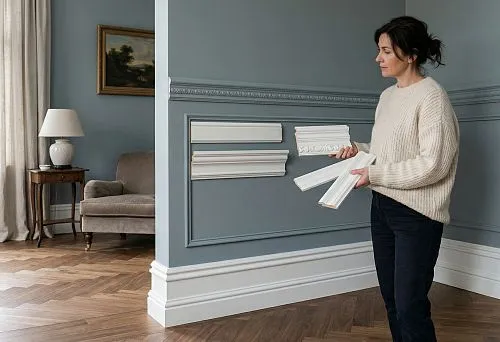
Moldings are linear profiles used to create framed compositions, zone walls, and frame openings. They come in various widths (from 20 to 150 mm) and relief complexity — from smooth to richly decorated.
Moldings themselves are already decor. But without corner elements, they remain unfinished. PreciselyDecor for Molding— corner details, connecting overlays, central accents — complete the system and make it whole. More about this — in a separate section below.
Panels, partitions, niches
Wall panels in a classic interior are never 'bare'. Wooden decorative elements for panels are what turn a simple slab into an architectural object. Perimeter overlays, corner details, central medallions — all this creates depth and visual complexity that cannot be achieved with paint alone.
Decorative elements for moldings: corner details, overlays, connecting decor
This is perhaps the most important part of the article for those who want to work with moldings professionally.
A molding is a strip with a profile. By itself, it is good. But when moldings form a frame on a wall, a problem inevitably arises in the corners: how to join two strips at a right angle beautifully? A 45° joint is one option. But it requires precision and still looks mechanical. The second, significantly more elegant option is a corner decorative element.
Corner elements: why they are needed
A corner element is a separate part that is installed in the corner of a frame and receives the ends of two straight moldings. No 45° cuts, no adjustments. Just a clean corner with carved ornamentation.
Aesthetically, corner elements do several things simultaneously:
-
Create an accent in every corner of the frame
-
Give the frame a 'jewelry-like' finish
-
Allow the use of moldings without precise corner fitting
-
Enrich the ornamental structure of the entire surface
The STAVROS catalog features a wide range of corner elements. Among them arecorner decorative elements MLD-001U, MLD-002U, MLD-003U, MLD-004U, as well as more richly ornamented corner details from the MLD-027U-1 and MLD-027U-2 series. All are made from solid beech or oak, with a recess on the back that precisely matches the molding profile—ensuring a perfect fit without gaps.
MLD-027U-1 and MLD-027U-2: two variations of one corner
Corner elementMLD-027U-1 features a more concise relief—it suits interiors in a modern classic style, where geometric clarity without excessive carving is desired.MLD-027U-2— a more ornamentally rich variant, oriented towards neoclassicism and classicism in the full sense of the word. Both are installed in combination with straight moldings and provide completeness for frame compositions on walls, doors, and furniture fronts.
Connecting and central decorative elements
In addition to corner pieces, the molding frame system uses:
-
Central overlays — installed in the center of a long straight molding or in the middle of a frame. They create an additional accent and break the monotony of long runs.
-
Finials with floral ornamentation — complete the molding line where it ends at an opening or wall edge.
-
Inserts in the center of the frame — elements of the MLD-1-1.1, MLD-4-1.1, MLD-2-1.1, MLD-3-1.1 series and similar. They are installed not in the corner, but in the center of the frame field, enhancing decorative density.
From a technical standpoint, all these elements have a recess on the back side that matches the molding's cross-section. This makes installation simple and precise: the piece fits onto the molding as if by template.
How the decorative system for moldings is structured
To understand how the entire system works as a whole, imagine a wall with a frame composition:
-
Marking is applied along the perimeter of the future frame.
-
Straight moldings are installed on all four sides of the rectangle.
-
A corner decorative element is placed in each corner — it covers the joint of the moldings and creates an ornamental accent.
-
If necessary, a connecting or central overlay is installed in the center of each straight molding.
-
A central medallion or overlay is attached to the middle of the frame field (optional).
The entire system works as a single ornamental ensemble — strict, proportionate, complete.
How to choose decorative elements to match the interior style
The question of style is the first question to be resolved before starting to choose the ornament and material. Wooden decorative elements are equally appropriate in classic, neoclassical, modern classic, and even eclectic styles — but each style has its own rules.
Classic
A classic interior requires a rich but strict ornament. Floral motifs — acanthus, laurel branches, grapevine scrolls. Frame proportions — vertically elongated or square. Moldings — with a pronounced profile. Corner elements — with rich carving, preferably larger than the width of the molding itself.Decorative elements made of oakOak is preferable here: it provides a noble texture and weightiness that corresponds to the classic spirit.
Neoclassicism
Neoclassicism is classicism reinterpreted through a modern lens. The ornament is less fragmented, the silhouettes are cleaner, the geometry is clearer. Here, corner elements with geometric ornament, frames made of medium-width moldings, and overlays without fine carving work well. Beech with bleached or light toning is the ideal material for this style.
Modern classic
Here minimalism meets academic tradition. Walls with moldings, but without excessive ornamentation. Frames are simple, corner details are laconic. The emphasis is not on carving, but on proportions and material quality.solid wood millworkcombined with simple corner elements — the perfect solution for this direction.
Neoclassical and Baroque
These are styles of maximum ornamental saturation. Here, the richest corner elements are appropriate — with multi-layered carving, large relief motifs, complex profiles. Decorative elements for interiors in the Baroque style should be noticeable — they set the tone for the entire space.
How to combine decorative elements with walls, doors, and furniture
One common mistake is to choose decor for each item separately, without thinking about the system. The result is a collection of beautiful things that don't come together as an interior. The correct approach is the opposite: first choose the system, then fill it with details.
The principle of repetition
If corner elements with floral ornamentation in the MLD-003U style are used on the walls, then the same motifs should be present on the furniture — in the form of overlays, handles, trims. This doesn't mean everything should be identical. But the ornamental language should be common.Carved decorative inserts for furnitureallow transferring motifs from walls to cabinet, dresser, and bed fronts — and thus create a unified stylistic code for the space.
Scale and proportionality
A decorative element should correspond to the scale of the surface. On a wide wall frame — a large corner element. On a narrow furniture front — a delicate overlay. Overloading a large surface with small details creates fragmentation. A large element on a small front — overwhelms and looks absurd.
Color and Staining
Wooden decorative elements can be stained, varnished, or painted. If the furniture is white with gold patina, the overlays are stained to match the same shade. If the walls are painted in warm gray, moldings and corner elements can be painted in the same color, creating a 'tone-on-tone' effect. This is a modern and very effective technique.
Symmetry and Rhythm
Walls with moldings require symmetry. If there are three frames on one wall, all three must be the same height. If corner elements are placed at every corner of the frame, they must be identical in size and ornament. Breaking symmetry is instantly noticeable and ruins the aesthetics.
This topic is covered in detail in the article aboutcarved overlays for furniture and interior decor: how to create a unified language of forms in the home through repetition of ornament, rhythm, and proportionality of details.
How to choose material: beech, oak, solid wood
Wooden decorative elements for interiors are made from different types of wood. In professional production focused on quality, priority is given to solid wood—primarily beech and oak. This is no coincidence: both species have properties that make them ideal for carved decor.
Oak
Oak is heavy, dense, and durable. Its texture is expressive and clearly visible in carved ornament. Staining applies deeply and evenly.Decorative elements made of oakOak is preferred where the material's weightiness is important: on monumental wall frames, doors, and furniture in a classical style. Oak does not warp over time and withstands temperature and humidity fluctuations well, provided basic operating conditions are met.
Beech
Beech is slightly lighter and softer than oak but has exceptional structural uniformity. This makes it ideal for fine carving: small details of the ornament come out clear and do not chip.Decorative Elements from BeechEspecially good for corner elements with rich botanical patterns — where precision of lines and detailing are needed. Beech accepts any coating well: varnish, paint, wax, oil.
Why solid wood is better than MDF in decor
MDF is a good material for straight-line molding and simple profiles. But for decorative elements with carving, it is not suitable: carving on MDF is either impossible or looks mass-produced and lacks depth. Solid wood provides a three-dimensional relief that cannot be imitated by milling a board. Therefore, for those who want real carved wood decor, the choice is clear — solid wood.
What to look for when choosing sizes, patterns, and proportions
Choosing a decorative element is not just a matter of 'like/dislike.' It is a task of proportionality with specific criteria.
Size of corner elements
A corner element should be wider than the molding it is placed against. If the molding is 30 mm wide — the corner element should be at least 50–60 mm on the side of the square. This rule ensures visual completeness of the corner: the detail does not 'sink' into the corner but creates an accent.
The higher the ceiling — the larger the frames and corner elements can be. In rooms with a 2.7 m ceiling, modest corner details are appropriate. With a height of 3.2 m and above — the size of corner elements can be increased while maintaining proportional balance.
Choosing a pattern
The pattern is chosen based on the interior style and the degree of ornamental richness you want to achieve. Several guidelines:
-
Geometric ornament — modern classic, neoclassical, minimalism
-
Floral ornament — classic, baroque, empire, French style
-
Woven ornament — ethnic styles, eclecticism, oriental motifs
-
Smoothed relief without ornament — Scandinavian style, laconic classicism
Proportions of frame compositions on walls
Classic rule: the height of the frame should be greater than the width. A ratio of 3:2 or 4:3 is considered the most harmonious. Square frames are appropriate in the center of the wall as a single accent. Elongated horizontal frames — above the sofa, along a low wall.
The distance from the frame to the ceiling, floor, and adjacent frame should be proportionate. Too small a gap — frames 'press' against the wall boundaries. Too large — the coherence of the composition is lost.
Mistakes when choosing decorative elements
Over many years of working with wooden decor, a list of mistakes that occur again and again has accumulated. It's better to know about them in advance.
Mistake 1: different ornaments in one space. If the corner elements on the wall have a floral ornament, and the overlays on the furniture have a geometric one, the interior falls apart into fragments. The ornamental theme should be consistent.
Error 2: Scale mismatch. Small corner elements on a large wall disappear. Large overlays on a small facade look absurd. Always correlate the size of the detail with the scale of the surface.
Error 3: Ignoring the sample. A corner element with a sample for the molding profile is mounted cleanly and without a gap. If the sample does not match the profile, a gap will appear. Always check the compatibility of a specific corner with a specific molding.
Error 4: Working without a preliminary mockup. Especially critical for wall frame compositions. Before gluing moldings and driving nails, draw a diagram on the wall with painter's tape. It will take an hour — and save a day of rework.
Error 5: Saving on material. Imitation wood made of polymer or MDF in carved details never gives the same result as solid wood. Surface texture, relief, reaction to light — all of this works differently. If the budget is limited, it's better to choose fewer decorative elements, but made of natural wood.
What decorative elements are suitable for classic, neoclassic, and modern classic styles
These three styles are the most common in Russian interiors, and it is for them that the main mass of wooden decor is produced. But despite all the aesthetic similarities, each style has its own logic.
Classic
Classic is characterized by a rich ornamental structure: acanthus leaves, rosettes, medallions, garlands, cartouches. Frame compositions on walls occupy a significant part of the surface. Corner elements are large, saturated with carving. Moldings are wide, with several profile divisions.
From the catalog ofdecoration for moldingsFor classic, the most suitable will be corner elements of the MLD-003U and MLD-003U-2.1 series — with rich ornamentation and large size. Central overlays of the MLD-3-2.1 series will provide saturation of the frame field.
Neoclassicism
Neoclassic allows for simplification of the ornament while preserving its semantic structure. Wall frames are a mandatory element, but moldings are thinner, corners are less fragmented. Corner elements of the MLD-001U or MLD-004U series — a clear silhouette without overload. Material — beech with a light tint under 'raw wood' or with white paint under patina.
Modern classic
Here, moldings and decorative elements rather 'hint' at classicism than reproduce it. Wall frames are simple rectangles. Corner elements are geometric, without carving or with minimal relief.Wooden trimis chosen with a clean profile. All emphasis is on proportions and material quality.
Where to appropriately use corner elements and carved overlays
This is an applied section — specific usage scenarios that will help understand where and how decorative elements work in real interiors.
Living Room
The main wall of the living room — behind the sofa or TV area — is the perfect place for a framed composition with moldings and corner elements. Several vertical frames, separated by neutral posts. In each corner — a corner element. The center of the wall can be accentuated with a central decorative element or a mirror in a molding frame. This creates the main visual axis of the entire room.
Bedroom
In the bedroom, framed compositions are especially effective on the headboard wall. Two or three vertical rectangles, aligned with the top edge of the bed. Corner elements add intimacy and coziness. Important: in the bedroom, it's worth choosing decorative elements with less saturated carving to avoid overstimulating the space.
Office
In the study, strict, geometric decor is appropriate. The lower wall panel, bounded by a horizontal molding, corner elements along the top — a clean but elegant system.Decorative Insertson the study furniture — on shelves, cabinet doors — complete the look.
Corridor and Hall
The corridor is the zone of first impression. This is exactly where a decorative accent should be made, setting the tone for the entire home. Framed compositions on the hall walls, carved door trims, corner elements on door panels — all this creates that very feeling of 'style lives here' mentioned at the beginning.
Furniture fronts and built-in wardrobes
A built-in wardrobe with carved overlays on the facades and corner details around the door perimeter ceases to be 'built-in'—it becomes part of the interior. This is especially important when furniture is custom-made in a classic style.Wooden decorative overlays for furniture facades—this is a tool that turns a wardrobe into furniture.
Decorative elements for walls: 50 application ideas
The topic of wooden wall decor is so rich that it deserves separate analysis. In the detailed material "50 ideas for interior decoration with wooden elements" specific techniques are collected: from accent walls with wooden panels to coffered ceilings, from carved rosettes to decorative beams. This is a practical foundation for those who want to move from theory to specific solutions.
Here we will note the key principles of applying wall decor:
-
Zoning without partitions: molding frames divide the wall into fields, defining the structure of the space
-
Vertical accents: narrow tall frames visually raise the ceiling
-
Horizontal belt: molding running along the perimeter at a height of 80–90 cm divides the wall into upper and lower zones—a classic technique that works in any style
-
Color play: a wall inside a frame is a contrasting or more saturated color than the wall outside
Wooden decorative wall overlays: from simple to complex
If corner elements are the finishing touch of a system, thendecorative wall overlaysare its enrichment. A wall overlay can be a standalone decoration—a small carved insert that creates a focal accent. Or part of a complex multi-level composition—where moldings, corner elements, overlays, and central medallions form an ornamental ensemble.
Several types of overlays are used for walls:
-
Horizontal overlays—installed in the center of a molding belt or along a horizontal run
-
Vertical overlays—accentuate the posts between frames
-
Central medallions—positioned in the middle of a framed field, creating a focal point
All of them are available in the catalogdecorative insertsin a wide range of patterns, sizes, and finishes.
A question to ask yourself before buying
Before ordering decorative elements — pause and answer four questions:
1. What interior style am I implementing? Not 'I like classic,' but specifically: classic, neoclassic, modern classic, baroque, empire? This determines the pattern choice.
2. On what surface will the decor be installed? Wall, door, furniture, molding? This determines the type of element.
3. What molding am I using? It's important to ensure the corner element is compatible with the specific molding profile. In the STAVROS catalog, each corner element is linked to a specific molding from the MLD series.
4. Will I paint or tint the decor? If yes — clarify how the chosen wood species behaves under the specific coating. Beech and oak behave differently: oak reveals an expressive texture, beech provides an even, almost neutral field.
FAQ: Answers to Frequently Asked Questions
What are decorative elements for moldings?
These are wooden corner, connecting, and central parts that are installed in combination with straight moldings to create complete frame compositions. They cover the corner joints of moldings and add an ornamental accent.
How do corner elements differ from decorative overlays?
The corner piece is installed strictly in the corner of the frame — it receives the ends of two moldings and finishes the corner. The decorative overlay is a more free-form element that can be installed on the center of a surface, on the center of a molding, or as a standalone decoration for a wall, door, or furniture.
How to choose a corner piece for a molding?
You need to know the profile (cross-sectional shape) of the molding. The corner pieces in the STAVROS catalog have a recess on the back that replicates the cross-section of a specific molding. For example, corner piece MLD-001U fits molding MLD-001, MLD-002U fits molding MLD-002, and so on.
Can wooden decorative elements be painted?
Yes, this is standard practice. Wooden decorative elements can be coated with varnish, paint, stain, oil, or wax. Before applying any coating, sanding with fine sandpaper (grit 180–240) is recommended.
How are wooden decorative elements attached?
With liquid nails or wood glue. For additional fixation of large elements — small finishing nails. Important: the surface must be clean, degreased, and even.
Which wood species is better — oak or beech?
It depends on the task. Oak is harder, with a pronounced texture, better for monumental details. Beech is more uniform, ideal for fine carving. Both materials are used in professional decorative production.
Can wooden decorative elements be used in a bathroom or kitchen?
With limitations. Solid wood decor is not recommended in rooms with constant high humidity. In the kitchen — acceptable provided a high-quality moisture-resistant varnish coating is applied. In the bathroom — undesirable.
How to choose decorative elements for walls in a small room?
In a small room, it's important not to overload the walls. One or two framed compositions with small corner elements are enough. The ornament should be concise. The color of the decor should match the walls so that the frames are perceived as relief, not as contrasting stripes.
What is connecting decor for moldings?
These are parts that are installed in the center of a long molding or at the junctions of individual runs. They hide the joints and simultaneously add an ornamental accent. Used on long walls where the molding runs in one continuous piece across the entire width.
Can decorative wooden elements be purchased individually?
Yes. In the STAVROS catalog, most items are available for order from one piece, which is especially important for spot projects or when there is a need to replace an individual element.
Conclusion: style begins with detail
Decorative wooden elements are not an expensive excess for rich interiors. They are a tool available in a wide price range and work equally effectively in both a small apartment and a large house. The main thing is to understand the principles of selection, maintain proportionality, and not violate the unity of the stylistic language.
Properly selected decorative elements for walls, doors, furniture, and moldings create that very depth of space which cannot be bought with a price tag on a sofa. This is subtle work with detail — and it is precisely in this that a true interior is born.
STAVROS specializes in manufacturing solid oak and beech wood decor with a professional approach to every detail. The catalog features over 4,000 models and 20,000 product modifications across 39 product groups. This includes decorative overlays, corner elements for moldings, carved inserts, wooden trim, architraves, pilasters, furniture legs, handles, and much more.
All STAVROS products are made from properly dried wood in a controlled microclimate—this ensures stability, precision manufacturing, and durability of the decor. You canbuy decorative wooden elementsfor moldings, walls, furniture, and doors online with delivery across Russia and CIS countries—from a single piece, directly from the manufacturer.