Article Contents:
- Why a narrow wall in the hallway often looks empty or overloaded
- What makes a wall architectural, not just decorated
- Verticality
- Rhythm
- Frame
- Accent
- Pause between elements
- When pilasters are appropriate in the hallway
- For one accent wall
- For symmetrical composition
- For high ceilings
- For mirror area, console or passage
- How to use wall molding in the hallway without overloading
- Thin frames instead of massive overlays
- Light profile
- Calm relief
- Combination with smooth wall
- Where molding should stop
- How to combine decorative elements and pilasters on a narrow wall
- One axis
- Two verticals
- Frame between pilasters
- Accent around the mirror
- Composition around the console
- How to decorate a hallway in neoclassical style without weighing down the space
- Light background
- Thin profiles
- Limited amount of decor
- Symmetry
- Connection with ceiling and floor
- What techniques help reduce visual heaviness
- Less relief depth
- Narrower profile
- More air
- Calm color
- One accent instead of many
- Ready-made narrow wall design schemes: five scenarios
- Scheme 1: Narrow wall with one mirror and two pilasters
- Scheme 2: Wall frame without pilasters
- Scheme 3: Light neoclassicism with thin molding
- Scheme 4: Hallway with vertical rhythm and minimal details
- Scheme 5: Composition around a console
- Mistakes that make a hallway seem cramped
- Too massive pilasters
- Too active molding relief
- Too many frames on a small wall
- Heavy color and active profile
- Lack of pauses between elements
- Decor without a compositional center
- What to look for in the catalog for such a wall
- FAQ: Answers to Key Questions
- Are pilasters suitable for a narrow hallway?
- How to use molding on a small wall?
- Which decorative elements do not weigh down the space?
- What is better for a hallway: pilasters or wall frames?
- Can pilasters and molding be combined in a small hallway?
- How to decorate the wall around a mirror without overloading it?
- Which profile to choose for light neoclassicism?
- How to make a hallway expressive but not heavy?
- About the company
The hallway is the first thing a person sees when entering a home. And the last thing they see when leaving. This space creates the first impression and sets the tone for the entire interior. But it is here that designers most often face a paradox: a narrow wall on which one wants to create something expressive, with the slightest excessdecorative elementsturns into a clutter of details that weigh down the space.
How to find balance? How to usepilastersandmoldingso that a narrow wall in the hallway looks architectural, slender, and light—not cramped and overloaded? This is exactly what this article is about. Without generalities. With specific techniques, diagrams, and answers to the questions everyone asks themselves when decorating a small hallway in a classical or neoclassical style.


Why a narrow wall in the hallway often looks empty or overloaded
A narrow wall is a surface with a width of 80 to 180 centimeters. That's not much. On such an area, it's difficult to arrange decor so that it looks organic: too little space for several elements, too much for one.
This is exactly why apartment owners fall into one of two traps.
The first trap is emptiness. The wall remains bare. Perhaps there's one painting or mirror hanging on it. The wall looks unfinished, random. It lacks architecture.
The second trap is overload. Everything that seemed beautiful individually is hung on a small area: frames, overlays, moldings of different sizes, a mirror with a heavy frame. The wall 'screams,' weighs down, and visually narrows the already small space.
Both problems share the same root: a lack of architectural logic. It's not the decor itself that weighs down the wall—it's decor without a system, without rhythm, without a hierarchy of elements. And conversely: a wall withstucco on walls, with two thinpilastersand a small mirror in the center can look light, elegant, and spacious—if everything is done according to the rules.




What makes a wall architectural, not just decorated
The difference between a 'decorated wall' and an 'architectural wall' is fundamental. A decorated wall is a wall on which something has been hung or glued. An architectural wall is a wall organized according to the laws of spatial composition.
What creates the architecture of a wall?
Our factory also produces:



Verticality
Vertical elements —Pilaster, molding, vertical frames—create direction. The gaze moves upward, the space 'grows.' It is verticality that makes a narrow hallway appear slimmer and taller visually.
Get Consultation
Rhythm
Rhythm is repetition. Two pilasters on either side of a mirror create symmetry and rhythm. The repeating step of wall frames forms a rhythmic sequence. When the eye catches the rhythm—it relaxes, the space is perceived as organized, not random.
Frame
Relief DecorationIt structures the wall plane in the form of frames. A frame creates a 'field'—an inner zone and an outer border. This is a classic technique that works on any area, including a narrow wall.
Accent
Every architectural composition has a focal point—a visual accent. This could be a mirror, a console, a decorative rosette. Everything else is subordinate to this center, enhances it, and creates context.
Pause between elements
The pause—the space between decorative details—is no less important than the details themselves. In an entryway with a narrow wall, the pause is especially critical: it creates 'air,' without which even light elements seem cluttered.
When pilasters are appropriate in an entryway
Pilaster—is a flat column projecting from the wall. In classical architecture, it bears structural or visual load: it articulates the wall, creates vertical rhythm, frames openings, zones. In an entryway interior, a pilaster solves the same tasks—only on a smaller scale.
But the question arises: won't a pilaster weigh down the already small space of the entryway? The answer is no, if the pilaster is chosen correctly.
For one accent wall
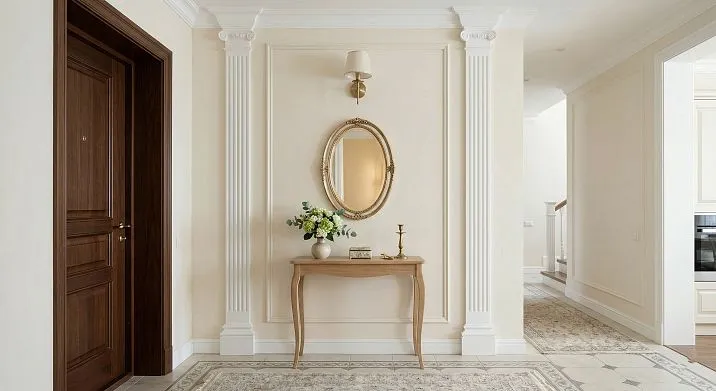
Classic scenario: the end wall of the entryway opposite the entrance. This is the 'backdrop'—the first thing a person sees when stepping over the threshold. Two symmetricalwooden pilastersalong the edges of this wall — and the wall immediately acquires an architectural character. A mirror or console can be placed between the pilasters, and the composition becomes complete.
The pilasters should not be massive: a width of 60–80 mm with a projection from the wall of 20–25 mm is enough to create shadow and relief without consuming space.
For a symmetrical composition
Symmetry is a powerful tool for small spaces. When two identical elements are placed symmetrically relative to the central axis on a narrow hallway wall, the brain automatically perceives the space as organized and spacious. That's why two pilasters are always better than one on a small wall: one creates randomness, two create order.
For a high ceiling
If the hallway has ceilings of 2.7 m or higher — pilasters are especially fitting. Their verticality emphasizes the height, creating a sense of grandeur proportionate to the scale of the room. With low ceilings (2.4 m and below), pilasters should be narrower and lighter to avoid 'lowering' the ceiling even further.
For a mirror, console, or passage area
Pilasters are natural 'guardians' of an area. They designate a place: something happens between them. This is a place for a mirror, for a console, for a small piece of art.Pilasters in the hallwaycreate a scene for the main object — and thereby give meaning to both the object itself and the wall.
How to use wall molding in an entryway without overloading it
Wall moldingsin an entryway — is a delicate task. Too much — and the narrow space becomes claustrophobic. Too little — and it's unclear why it's there at all.
Several key principles that help find the right balance.
Thin frames instead of massive overlays
For a narrow wall in an entryway, the best choice is profile frames made from thin molding. A profile 18–20 mm in width and 12–15 mm in relief height is enough to create shadow and volume, without 'eating up' space.
Molding on the Wallin the form of a single rectangular frame, occupying most of the wall — is a classic and elegant solution. The frame defines a field, giving the wall architectural structure without additional decorative elements.
Light profile
A profile with ornament and deep carving — for formal spaces, large areas, pompous interiors. In an entryway, especially a small one, a smooth or slightly convex profile without ornament works better. This isDecorative stuccoin minimal, yet sufficient expression.
Calm relief
The smaller the room — the shallower the relief of decorative elements should be. This is a direct correlation. In a spacious hall, a relief of 30–40 mm from the wall is appropriate. In a small hallway — a maximum of 15–18 mm. Otherwise, the decor literally "comes out" of the wall towards the person, narrowing an already tight passage.
Combination with a smooth wall
Not the entire wall should be decorated. Part of the wall — a smooth painted surface — is not a mistake, it's a design technique. Decor against a smooth wall reads more clearly and distinctly. The pause around a decorative element is its frame.
Where the molding should stop
On a narrow hallway wallwall moldingshould occupy no more than 60–70% of the wall surface. The rest — pauses, smooth zones, air. If the decor fills the entire wall from edge to edge — even the thinnest profiles begin to feel oppressive.
How to combine decorative elements and pilasters on a narrow wall
This is the main practical question. How exactly to arrangepilastersanddecorative elementson a small wall so that they work together, not compete?
One axis
The simplest and safest option: the entire composition is built on a single vertical axis. In the center of the wall is a mirror. On either side of it are two pilasters. On the axis, between the pilasters, is a thin frame made of moldings. Everything else is a smooth wall.
One axis means predictability in a good sense. The eye immediately understands where to look. The space does not scatter across multiple points of attention.
Two verticals
A more complex and expressive option: two vertical elements are created on the wall—for example, two narrow vertical frames made of stucco decoration with small pilaster-posts along their outer edges. Between the frames is a central zone with a mirror or console.
This option creates a richer composition but requires precise calculation of proportions: the distances between elements must be commensurate and coordinated.
Frame between pilasters
An elegant and classically correct solution: between two pilasters, a single rectangular frame made of polyurethane profile is placed. The frame occupies the space between the pilasters in width and height, leaving equal margins at the top and bottom. This is an architectural 'niche'—it can be used for decor, for a mirror, or simply left empty with a beautifully painted wall inside.
Accent around the mirror
A mirror in the hallway is a functional element that can easily be turned into a decorative one. The framing of the mirror withrelief decoration elements— corner overlays, a thin perimeter profile — creates a 'frame' without a separate frame. Add two thin pilasters on the sides — and the mirror area becomes a full-fledged architectural statement.
Composition around the console
A console in the hallway is the focal point. Everything surrounding it should work to accentuate it.wooden pilasterson the sides of the console create a vertical context. A frame above the console (with or without a mirror) — a horizontal one. The entire wall acquires a finished, solemn appearance.
How to decorate a hallway in neoclassical style without weighing down the space
Neoclassicism is a style where architecture is more important than decoration. This is precisely why it is so well-suited for small hallways: there is no excess, no pomposity for the sake of pomposity — there is clarity, proportion, and visual order.
But neoclassicism in the hallway requires special care: too literal adherence to classical models leads to a small space being 'dressed' in clothes that are too heavy.
Light background
A light-colored wall is a must for neoclassical style in a small hallway. White, cream, soft beige, light gray — these shades create a backdrop against whichMolding for wallspilasters stand out clearly and easily. A dark wall is not forbidden, but requires significant skill in arrangement and lighting.
Thin profiles
The thinner and lighter the profile, the more airy the result. In a hallway with neoclassical decor, there is no place for heavy Baroque profiles. At most, a restrained classical profile with one or two curves, without ornamentation or with minimal ornamentation.
Limited amount of decor
In a small hallway, the rule of 'one decorative layer' applies. This means: either pilasters + a frame, or molding + a mirror, but not everything at full force at once. Each additional element must pass the test: why is it here? What does it add to the existing composition?
Symmetry
Symmetry is architectural order in its most accessible form. In a small hallway, symmetrical placementof decorative wall elements— pilasters, frames, overlays — creates a sense of organization that literally 'expands' the space psychologically.
Connection to ceiling and floor
Neoclassical decor does not 'hang' in the air—it is connected to the horizontals: the ceiling cornice above and the baseboard below. Pilasters should start from the baseboard (or floor level) and end either at the cornice or at a mark aligned with its lower edge. Without this connection, pilasters look 'inserted' into the wall randomly.
What techniques help remove visual heaviness
This is an applied block. Specific tools for a specific result.
Less relief depth
We've already talked about this, but let's repeat: the depth of relief from the wall is the main tool for adjusting the 'weight' of the decor. Reduce the projection by half—and the decor will become visually twice as light. For a narrow hallway, the projection of the decorative profile should be no more than 15 mm.
Narrower profile
A pilaster width of 40–50 mm with a projection of 15–20 mm is a thin, almost graphic form. It creates a shadow, defines a vertical line, but literally does not take up space.Wall moldingwith a profile 16–18 mm wide—this is a delicate frame, not an architectural monument.
More air
In this context, air refers to the distance between decorative elements. There should be at least 80–100 mm of clear surface between the frame and the wall edge. Between a pilaster and an adjacent decorative element — no less than 60–80 mm. This is not wasted space — it's the necessary breathing room for the composition.
Calm color
Polyurethane Decorand wooden pilasters in the same color as the wall (matching or one or two shades lighter/darker) — this is 'quiet' decor. It creates texture, shadow, depth, but doesn't shout for attention. Using a contrasting color for decor on a wall in a small hallway is a risky technique that requires precise calculation.
One accent instead of many
A strong single accent — a large mirror, an expressive pilaster, a beautiful decorative rosette — has more impact than several medium-sized details. In a hallway with a narrow wall, the rule 'less but more precise' applies without exceptions.
Ready-made design schemes for a narrow wall: five scenarios
Scheme 1: Narrow wall with one mirror and two pilasters
Parameters: wall width 120–150 cm, ceiling height 2.7–3 m.
Solution:
-
Twowooden pilasters50 mm wide, 20 mm projection, height — from baseboard to ceiling cornice
-
Along the inner edge of the pilasters — a thin frame made from 18×12 mm profile
-
In the center of the frame is a mirror, occupying 70–80% of the field's height.
Result: a classically balanced, light, and solemn composition. Pilasters provide verticality, the mirror adds depth, and the frame brings order.
Nuance: pilasters are painted to match the wall color or one shade darker—to create shadow without contrast.
Scheme 2: Wall frame without pilasters
Parameters: wall width 80–100 cm, ceiling height 2.5–2.7 m.
Solution:
-
One rectangular frame made ofpolyurethane decor, profile 20×15 mm
-
The frame occupies 75% of the wall width and 70% of the height
-
Inside the frame is a smooth wall, in a slightly different shade or the same paint
Result: a minimalist architectural wall without pilasters. The frame structures the surface and gives it a finished look.
Scheme 3: Light neoclassicism with fine molding
Parameters: wall width 130–160 cm, ceiling height 2.7–3 m, contemporary neoclassicism.
Solution:
-
Two pilasters 40 mm wide, pure white
-
Between the pilasters — a vertical rectangular frame
-
In the upper part of the frame — a small decorative rosette made ofmoldings diameter 80–100 mm
-
Below — a mirror
Result: contemporary neoclassicism with a classical spirit. Subtle, refined, without heaviness.
Scheme 4: Entryway with vertical rhythm and minimal details
Parameters: very narrow wall 80–90 cm, ceilings 2.7 m.
Solution:
-
One central pilaster, 35 mm wide — not at the edges, but in the center of the wall
-
On both sides of the pilaster — symmetrical narrow vertical frames
-
No mirror is used — the wall remains in a decorative solution
Result: a non-standard composition with a central axis. Creates a sense of depth and slenderness even on a very narrow surface.
Scheme 5: Composition around a console
Parameters: wall width 140–180 cm, ceiling height from 2.7 m.
Solution:
-
Two pilasters at the edges of the wall
-
Between the pilasters — a console (at a height of 90–95 cm from the floor)
-
Above the console — a mirror in a frame made ofmoldings on the wall
-
Below the console — a lower horizontal frame
-
The entire system from baseboard to cornice creates a unified wall panel
Result: a full-fledged interior "iconostasis" for the hallway. Expressive, functional, architecturally complete.
Mistakes that make the hallway seem cramped
Knowing the rules is good. Knowing the anti-rules is equally important. Here is a list of mistakes most commonly encountered when working with a small hallway.
Too massive pilasters
A pilaster width of 120–150 mm on a wall 130 cm wide is almost a quarter of the wall width for each of the two pilasters. That leaves 50–60 cm for everything else. This is a scale error: the pilasters overwhelm the wall. For a small hallway — a maximum of 50–60 mm pilaster width.
Too active stucco relief
Applied ornamental elements with deep relief (rosettes 200 mm in diameter, cartouches, complex medallions) create an expressive impression in spacious rooms. In a hallway, they work differently: their scale 'breaks' the proportions of a small wall.Relief DecorationFor a hallway, it should be small and delicate — rosettes no larger than 80–100 mm.
Too many frames on a small wall
Three frames of different sizes on a 100 cm wide wall create visual chaos. The frames start to 'compete' for attention, overlapping rhythmically. One frame on a small wall is always better than three.
Heavy color and an active profile
A dark gray wall plus a contrasting white pilaster with an ornamental profile is a powerful visual impact. In a spacious hall, it might work. In a narrow hallway, it creates a feeling of being caged. Active color contrast in a small space should be used with extreme caution.
Lack of pauses between elements
Whendecorative elementsare placed right next to each other without gaps—they merge into a single spot. The readability of each element is lost, the rhythm disappears. The minimum distance between any two decorative details in a hallway is 60–80 mm.
Decor without a compositional center
A wall with a frame on the left, a mirror in the center, a pilaster on the right, and an overlay on top—all arranged randomly. The eye doesn't know where to look. Decor without a center is decor without meaning. Every wall composition should have one main element to which everything else is subordinate.
What to look for in the catalog for such a wall
When selecting elements for a hallway with a narrow wall, it's important to work with a single catalog where you can compare the scale, profile, and style of all details.
Decorative elements — solid wood overlaysWooden wall overlays, framing trims for zones, corner pieces. Selection by style and scale.
wooden pilastersWooden pilasters in various profiles and sizes — from minimalist to classic. Selection based on room height and wall width.
Pilasters — full sectionExpanded catalog of solid wood pilasters and columns.
Moldings — catalog of polyurethane productsComplete line of polyurethane decor for walls and ceilings.
Molding decor — polyurethane overlaysOverlay molding elements for wall frames, areas above doors, accent details.
Polyurethane moldings — trimProfile trim for creating wall frames, borders, horizontal bands.
Polyurethane decor — rosettesDecorative rosettes for ceilings and walls — accent elements for the center of a wall composition.
FAQ: Answers to Key Questions
Are pilasters suitable for a narrow hallway?
Yes — with the correct size selection.PilasterA width of 40–60 mm and a projection of 15–20 mm creates a vertical accent without losing space. The key condition: pilasters must be proportionate to the wall width — no more than 6–8% of the wall width each.
How to use molding on a small wall?
Thin frames from a profile 16–20 mm wide, calm relief up to 15 mm deep, one or two frames maximum.Decorative stuccoOn a small wall, it should create structure, not fill the surface.
Which decorative elements do not weigh down the space?
Thin profile frames, small overlay elements with low relief, narrow pilasters. Alldecorative elementsFor a small hallway, they should be chosen based on the principle of 'minimum scale with maximum readability'.
What is better for a hallway: pilasters or wall frames?
It depends on the width of the wall and the style. On a very narrow wall (up to 100 cm), wall frames work better—one large frame without pilasters. On a wall from 120 cm, a combination of pilasters and a frame gives the best result.
Can pilasters and molding be combined in a small hallway?
Yes, it's a classic system—provided that all elements belong to the same scale register. Light pilasters plus thinMolding on the Wall—this is an architectural system, not a decorative accident.
How to decorate the wall around a mirror without overloading it?
A thin perimeter profile around the mirror made ofpolyurethane decorplus corner overlays—that's enough. Add two narrow pilasters on the sides—and you'll get a complete architectural zone.
Which profile to choose for light neoclassicism?
Smooth or with minimal ornamentation, 16–22 mm wide, with a relief depth of 12–16 mm. A profile with a convex tempered edge and a straight lower step — a classic choice for neoclassicism without heaviness.
How to make an entrance hall expressive but not heavy?
One strong accent (mirror, console, pilasters) plus one decorative layer (frame or thin molding) — and nothing more. Pause, air, a light background — and the entrance hall will be expressive precisely because there isn't too much in it.
About the Company
When the task is to decorate a narrow wall in an entrance hall so that it becomes an architectural statement, not a random collection of details — it's important to find a manufacturer that has the full range of necessary products: both wooden pilasters, and molded decor, and linear profiles.
STAVROS — manufacturer of wooden and polyurethane architectural products for interiors: pilasters, applied decorative elements, moldings, cornices, solid wood baseboards, as well as polyurethane molded decor. All STAVROS products are designed with the architectural logic of classicism and neoclassicism in mind: coordinated profiles, scale, and style allow creating cohesive wall compositions from individual elements — be it a spacious hall or a narrow entrance hall where every millimeter counts.