Article Contents:
- Why an ordinary door opening often looks incomplete
- What is a door portal and what parts does it consist of
- Pilasters: the vertical structure of a portal
- Capital: the top accent of a pilaster
- Architrave: framing of the opening
- Moldings and cornice: horizontal architecture
- When decorative elements truly turn a wall into architecture
- Capital in a door portal: where it works best
- For classic interiors
- For neoclassical style
- For tall doors
- For wide portals and double doors
- For a portal without a door
- Wood or polyurethane: which material to choose for a door portal
- When solid wood is better
- When is polyurethane best
- Which is Easier to Install
- What looks more prestigious
- How to combine capital, architrave, molding, and stucco around a door
- Ready-made door portal schemes: five scenarios
- Narrow opening in an apartment (800–900 mm)
- High opening in a private house (from 2.4 m in height)
- Passage between the living room and dining room
- Portal around a double door
- Portal without a door in a small apartment
- Mistakes that make decor look heavy and cheap
- Oversized capital on small pilasters
- Thin trim under a massive cap
- Excessive ornamentation in small spaces
- Unrelated baseboard and portal
- Mismatched styles of wood and molding
- Subtle symmetry
- How to choose decorative elements to match the interior style
- Strict classicism
- Neoclassicism
- Palace interior and Empire style
- Calm modern classic
- What to see in the catalog for assembling a door portal
- FAQ: answers to popular questions about door portals
- What is better for a door portal: wood or polyurethane?
- Is a capital only needed for a classic interior?
- Can a doorway be decorated without a door?
- How to combine a portal with baseboards and moldings?
- Is molding suitable for a small apartment?
- Which decorative elements to choose for high ceilings?
- Can a capital be used without a pilaster?
- What type of architrave is needed for a classical door portal?
- About the company
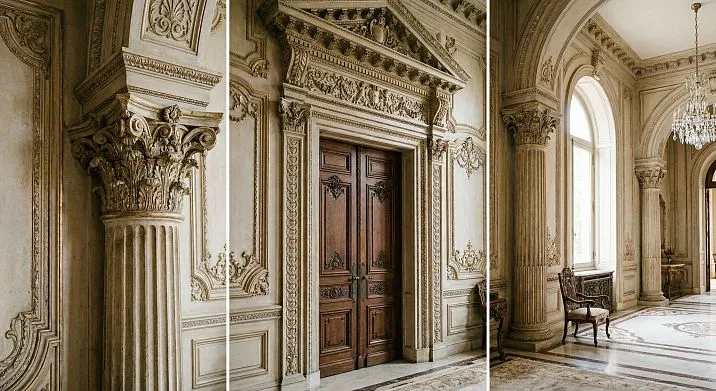
There are things that immediately catch the eye—and things that are felt but not consciously noticed. A door portal belongs to the second type. Enter any truly powerful interior, and you'll notice: the doors there aren't 'inserted into the wall.' They are designed. They are framed. They have a base, a vertical element, a top accent. And all of this together creates a sense of completeness that distinguishes architecture from mere renovation.
Preciselydecorative elements—capitals, pilasters, architraves, moldings, andMoldings—transform an ordinary rectangular door opening into a portal. Not metaphorically, but literally: into an architectural structure within the interior. This article provides a detailed breakdown of how this works, what parts make up a door portal, which material to choose, and what mistakes are best avoided.
We will talk aboutdoor decornot as decoration—but as an architectural tool, where each element has its place and performs a specific function. This is a fundamentally different conversation. And it's worth having.


Why does an ordinary door opening often look unfinished?
Ask yourself an honest question: how many interiors have you seen where a door opening simply 'exists'—without a frame, without a base, without an accent? Most likely, the majority. Because a casing as the only element of opening decoration is the minimum sufficient for functionality but insufficient for architecture.
A wall lives by its own laws. It has scale, proportions, horizontal and vertical rhythms. When a door opening is cut into it, it is always a break: the wall's vertical is interrupted, the rhythm is disrupted. The taskof door opening decorationis not just to 'close gaps,' but to restore this rhythm, make the break meaningful, and turn it into an architectural accent.
Why does this often not happen? Three main reasons:
-
Casing without a base—a vertical plank without a foundation looks as if it's leaning against the wall, not rooted in it.
-
Lack of a top accent—an opening that simply ends at the top with a straight horizontal line without a cornice or cap lacks completeness.
-
No connection with the rest of the wall—decorative elements around the door exist separately from the baseboard, moldings, and the overall rhythm of the room.
A door portal in the architectural sense is the answer to all three problems simultaneously. It is a system in which pilasters provide verticality, the base roots them in the floor, a cornice or cap completes the top, and moldings connect the portal with the rest of the wall.




What is a door portal and what parts does it consist of?
Portal is an architectural term, and it should be understood in its architectural sense. It is not just a 'beautiful architrave.' It is an independent architectural structure that frames the transition from one space to another, making this transition significant and visually complete.
A classic door portal consists of several elements, each serving its own purpose.
Our factory also produces:




Pilasters: the vertical structure of the portal
pilasters— these are the side vertical elements of the portal. They flank the doorway on both sides and define the entire vertical architecture. Without pilasters, the portal is flat; with pilasters—it is three-dimensional, it stands in space, it has mass.
Each pilaster consists of three parts: the base (the lower element, transitional from the floor), the shaft (the main vertical), and the capital (the upper accent, transitional to the cornice or cap). It is this three-part structure that makes the pilaster a full-fledged architectural element, not just a decoration.
wooden pilaster— for a door portal—is a solution that is both warm and monumental. Oak, beech, ash—each wood species gives the portal its own character. Oak—strict, solid, with an expressive structure. Beech—more calm and even, good for white painting. Ash—light, with fine fibers, suitable for lighter neoclassical interiors.
Get Consultation
Capital: the upper accent of the pilaster
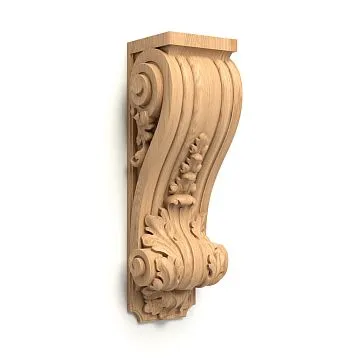
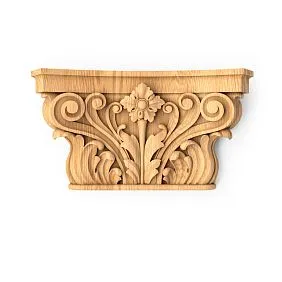
Capital— is the finishing element of the pilaster, its 'head.' It is the capital that determines the order type of the portal and sets its stylistic character. A simple geometric capital—Tuscan or Doric order, strict classicism. A capital with volutes and ornament—Ionic or Corinthian, rich and detailed classical style.
The architectural role of the capital in a door portal is twofold. On one hand, it completes the pilaster from above—creating a visual point. On the other—it serves as a transitional element between the vertical (the shaft of the pilaster) and the horizontal (the cornice or cap above the opening). Remove the capital—and this transition will be abrupt, rough. With the capital—it is smooth, logical, architecturally meaningful.
Casing: framing of the opening
Wooden casing— is an element that directly adjoins the door leaf and frame. In the minimal portal version, the casing acts as the sole framing element. In a full architectural system, it is part of a more complex structure: a wide profile casing becomes the base onto which moldings are applied, and pilasters are placed on the sides.
For a classical door portal, the casing should be wide — at least 80–100 mm — and have an expressive profile. A narrow, flat casing in a classical interior gets lost against the background of pilasters and capitals: it is too thin, too 'light' for the architectural task.
A wooden casing with a pattern or milled profile is a separate topic. SuchDoor Decorationincludes the casing as an artistic element: with a relief ornament, plant motifs, or geometric inserts that make the casing itself a work of art.
Moldings and cornice: horizontal architecture
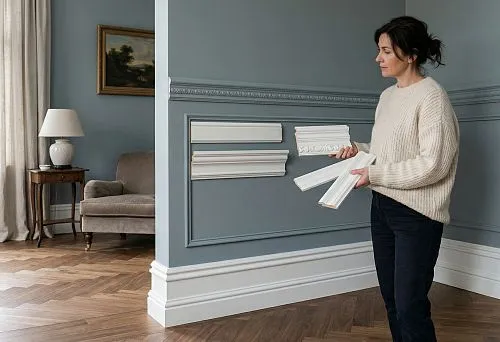
Moldingsabove the door portal perform several tasks. They create a horizontal 'cap' over the doorway — a visual roof that completes the portal. Through moldings, the wall stucco around the door is linked to the portal itself, creating a unified composition. And finally, moldings set the proportional scale for the entire portal: the more substantial the molding above the door, the weightier and more monumental the entire structure.
When decorative elements truly turn a wall into architecture
There is a fundamental difference between a 'decorated wall' and an 'architectural wall.' The first has decorative elements glued where it looks nice. The second is a system in which each element occupies its place according to the laws of architectural logic.
The door portal is the most illustrative place where this difference is visible. Because here the wall has a break, and this break is either played up architecturally or simply covered with casing. The second option is functional. The first — turns the wall into something you want to look at.
Continuing the article from the break point and completing it fully:
Molding on the Wallaround the door frame works exactly like this: it creates relief, shadow, visual depth. Decorative molding above the architrave—the horizontal element above the opening—turns a simple horizontal line into a developed cornice with profiles, projections, and shadows. Frame-like moldings on the side surfaces of the wall around the door extend the logic of the portal across the entire wall plane—and at this moment, the main transformation occurs: the door opening ceases to be a 'hole in the wall' and becomes the architectural core of the entire plane.
Three laws by which decorative elements turn a wall into architecture:
Law of symmetry. A door portal works only when symmetry is maintained. Pilasters on both sides must be identical in height, width, and profile character. Moldings on the side surfaces must be mirrored. Even a slight misalignment destroys the sense of order and makes the wall unsettling.
Law of verticality. Everything on the wall around the door must follow the logic of verticality. The pilaster is the main vertical. Moldings, stucco belts, architraves—they either enhance this vertical or create horizontal accents that are subordinate to it. No diagonal elements, no arbitrary fragments of stucco.
Law of proportions. The height of the portal, the width of the pilaster, the size of the capital, and the scale of the cornice above the opening—all must relate according to classical proportions. No element should be noticeably larger or smaller than what is logical given the ceiling height and opening width.wall moldingaround the door is no exception: the size of ornamental elements on the moldings and the portal's pediment must be proportionate to the scale of the pilasters.
Capital in a door portal: where it works best
This is one of the most practical questions that arise when designing a door portal.Capital—an element with a pronounced stylistic character, and its choice sets the tone for the entire structure. Let's break it down by specific scenarios.
For a classic interior
In strict classicism, the capital must be architecturally defined—that is, it must belong to one of the five orders. The Doric or Tuscan variant is the most restrained: a smooth slab (abacus) and simple decoration without ornaments. The Ionic capital with volutes is the next level of detail. The Corinthian is the most elaborate, with acanthus leaves, suitable for formal living rooms, studies, and halls with high ceilings.
Rule for classicism:wooden capitalin natural wood or for painting looks most convincing with a ceiling height from 3 meters. In rooms with ceilings of 2.6–2.8 meters, it is better to choose more laconic capitals without elaborate ornamentation—otherwise, they will visually 'pull' the ceiling down.
For neoclassical style
Neoclassical interior is classicism freed from excessive ornamentation. Here, the capital often represents a simplified geometric form: a small projection with a rectilinear or minimally profiled abacus. Suchbuy a capital—laconic and precise—works perfectly in modern apartments with ceiling heights of 3–3.5 meters, where decor should be strict and not overload the space.
For tall doors
With a door leaf height from 2.3 meters and above (often in private houses and apartments with ceilings from 3.5 m), the capital for the door portal can be more elaborate. Composite capitals are appropriate here—with several zones: a lower abacus, a middle band with ornamentation, and an upper projection. Such a capital is large-scale; it holds the space and does not get lost at great heights.
For wide portals and double doors
A wide door opening requires more powerful pilasters and, accordingly, wider capitals. The principle is simple: the width of the capital should slightly exceed the width of the pilaster shaft—by approximately 20–30%. This creates a proper transition from the vertical to the horizontal element of the portal's cap.
For a portal without a door
A passage between the living room and dining room, between the living room and hallway without a door leaf is a special scenario. Heredecorative elementsand the capital work as an independent architectural accent. Without a door, the portal must be even more meticulously designed because nothing distracts the eye: only the bare architecture of the frame. Here, the completeness of the system is especially important: pilasters with bases, developed capitals, molding or an architrave in the upper part.
Wood or polyurethane: which material to choose for a door portal
This is the key question asked during the design phase. And the answer is not straightforward—it depends on the task, budget, interior style, and operating conditions.
When solid wood is better
Natural wood is materiality.wooden capitalA wooden pilaster, a wooden casing—upon touch, it's a different sensation, distinct from polyurethane. Warmth, weight, fiber texture, a living pattern. For interiors where wood is a consistent material—wooden floors, doors, furniture—a solid wood portal is organic and coherent. Solid oak, beech, or ash for tinting or clear varnish is a solution that will be appropriate in 20 years just as it is today.
Limitations of solid wood: it requires greater installation precision, reacts to humidity and temperature fluctuations, and complex ornamental forms in wood are more expensive than in polyurethane. Also, wood is harder to repaint white: the fiber texture may 'show through' the paint if preparation is insufficient.
When polyurethane is better
Polyurethane moldings—is primarily about precision and lightness. It is ideal for complex profile forms: developed cornices, ornamental capitals, multi-step moldings. Polyurethane does not crack, does not react to humidity, glues easily, and accepts any paint excellently—including white, cream, and gold patina.
Polyurethane ItemsSignificantly lighter than wood, which simplifies installation. For a door portal, this is especially important when working with upper elements—the architrave and cap—which are mounted above the opening.
Polyurethane Decor—rosettes, applied ornaments, corner elements—are indispensable where detailing is needed, which cannot be replicated in wood without a significant increase in cost.
What is easier to install
Polyurethane is mounted with adhesive (liquid nails, special polyurethane adhesive), joints are filled with acrylic, and the surface is painted. For non-professional installation—polyurethane is significantly easier. Wood requires more thorough surface and fastener preparation, especially for large pilasters.
What looks more prestigious
With the same quality of installation and painting, polyurethane and wooden portals look equally convincing—provided the geometry is precise, joints are neat, and the paint is applied correctly. The main difference is in the details during tactile contact and close inspection. Wood is always 'more alive.' Polyurethane is geometrically 'more correct.'
The optimal choice for most classic interiors: a wooden pilaster (solid wood),wooden casingand a polyurethane capital with polyurethane moldings in the upper area of the portal. This combination provides the warmth of wood at the bottom and the precision of molding at the top—exactly how the pairing of a wooden baseboard and polyurethane molding works in the overall wall system.
How to combine capital, casing, molding, and molding around the door
This is the most practical block because it is here that theory transitions into specific solutions. How exactly do these four elements work together—and in what order does the eye 'read' them?
The first thing that catches the eye when looking at a door portal is the verticals. Pilasters. They define the width of the portal and its scale. Then the gaze slides upward—to the capital and the lintel above the opening. This is the peak of architectural tension: here the vertical meets the horizontal. And finally, the gaze descends to the architrave—to the direct framing of the opening.
The logic of coordinating the four elements:
The architrave and pilaster must be from the same stylistic 'vocabulary'. If the pilaster is classical, with a profiled shaft and projections, the architrave should not be flat or geometrically neutral. Its width, profile, and projection from the wall plane should harmonize with the projection of the pilaster.
Moldings and the architrave create a system of frames around the opening.Wooden molding—whether plaster or polyurethane—its profile must be coordinated with the profile of the architrave. If the architrave has a scotia and a cavetto, the molding around the portal should use at least one of these elements.
The capital and the lintel (architrave) above the opening are a pair. The portal's lintel rests on the capitals of the pilasters. This is precisely why the width of the capital must correspond to the width of the lintel. If the lintel is a simple rectilinear molding, the capital can be laconic. If the lintel is a developed, multi-tiered cornice with profiles, the capital should be of corresponding complexity.
Stucco on the walls around the portal is an additional layer that connects the portal with the rest of the wall plane.Relief Decoration—in the form of molding frames on the sides of the pilasters, horizontal bands above the portal, or ornamental overlays—all of this extends the architectural logic of the portal across the entire wall. The result is not a 'door with decoration,' but a 'wall with architecture,' at the center of which is the door opening.
Ready-made door portal schemes: five scenarios
Real design begins with a specific scenario. The same set of elements—pilasters, capitals, moldings, architrave—works differently depending on the situation.
Narrow doorway in an apartment (800–900 mm)
This is the most common situation in city apartments with ceilings 2.7–2.8 meters high. Here it's important not to overload the portal: wide pilasters will squeeze an already small opening.
Recommended scheme:
-
Pilaster 60–80 mm wide with a smooth shaft
-
A laconic capital — of the Tuscan type or a simplified Ionic
-
Wide casing (100–120 mm) with a profiled edge
-
Simple molding-architrave above the opening without a cornice
The key rule for a narrow opening: the portal should emphasize the vertical, not the width. Therefore, pilasters are slender and tall, capitals are compact.
High doorway in a private house (from 2.4 m in height)
With a high door opening, the portal can be a full-fledged architectural one. Here are appropriate:
-
Pilasters with a developed shaft and bases
-
Corinthian or Ionic type capital with ornament
-
Wide architrave plus additional molding on top of it
-
Portal pediment — multi-stepped architrave with cornice
-
Wall moldingsAround: frame moldings on the sides of the pilasters
Passage between the living room and dining room
This is one of the best scenarios for a full-fledged door portal without a door. Here the portal functions not as a door frame, but as an independent architectural 'event' — a transition between two spaces.
Scheme features:
-
Pilasters are as tall as possible — from floor to ceiling or to the cornice
-
The capital transitions into the ceiling cornice — creating an arch-like impression
-
On the sides of the pilasters — molding frames that extend the 'portal zone' across the entire wall
Portal around a double-leaf door
A double-leaf door is a wide opening (from 1.4 meters). Here, the portal should be large-scale:
-
Pilasters at least 100–120 mm wide
-
Portal cap — a developed cornice, proportionate to the width of the opening
-
AdditionalDecorative Inserts in the form of a keystone above the architrave or ornamental overlays between pilasters
Portal without a door in a small apartment
When the opening is small (up to 900 mm) and the ceilings are standard, but you want to create a portal feel — a lightweight version is used. The minimum set: a wide casing with a profile, small corner rosettes, and an architrave in the form of a single molding above the opening. This door opening decor already creates a sense of design without overload.
Mistakes that make decor look heavy and cheap
Analyzing mistakes means giving the reader a negative outline: understanding what to avoid is no less useful than understanding what to strive for.
Too large a capital on small pilasters
This is the most typical mistake whendecorating doorswithout understanding proportions. The capital should be slightly wider than the pilaster shaft—by about 20–25%. If the capital is twice as wide as the shaft, it turns into a heavy 'head' on a thin 'neck' and ruins the entire vertical rhythm.
A thin casing under a massive cap
If the architrave above the opening is powerful and elaborate, while the side casing is thin, narrow, and flat—it creates a 'tadpole' effect: a heavy top on weak sides. For a massive cap, a casing at least 100–120 mm wide with an expressive profile is needed.
Excessive ornament in small rooms
An ornamental capital with acanthus leaves, richDecorative stuccoon the walls around the door, a complex multi-profile cornice—in a large hall, this is a triumph. In a 15–20 square meter room—it's an overload that makes the space oppressive and uncomfortable.
Unrelated baseboard and portal
This is an 'overall architecture' error: pilasters and trim in one style, but the baseboard is in a completely different one. The portal and baseboard must belong to the same stylistic vocabulary: if the portal is Doric, the baseboard should have a classical profile, not a geometric 'box'.
Mismatched style of wood and molding
Dark walnut with golden polyurethane molding in a classical pattern can work. But a light, unfinished pine trim with a Corinthian capital made of polyurethane painted white does not. Different materials must belong to the same tonality and style of finish.Capitals and overlaysmade of wood and polyurethane work well together precisely when a unified color and style code is established between them.
Weak symmetry
If the left pilaster is slightly closer to the opening than the right one, it's noticeable. If the capitals are at different levels, it's immediately visible. Symmetry in a door portal is not an option but a mandatory condition. A 5 mm error with an 80 mm pilaster width is already 6%, which is well perceived by the naked eye.
How to choose decorative elements to match the interior style
Interior style is not just a set of words in a project description. It's a specific set of forms, proportions, patterns, and materials. Let's examine how the choicedecorative elementsfor a portal changes from style to style.
Strict classicism
Greek and French classicism are order-based architecture, strict proportions, minimal ornamentation with maximum correctness of forms. For a door portal in this style:
-
Pilaster — smooth or with fluting, Tuscan or Doric order
-
Capital — laconic, without complex ornamentation
-
Architrave — wide, with rectilinear or simple profile framing
-
Wall stucco — bands and moldings without ornamentation, only profiles
Neoclassicism
Neoclassicism allows more freedom. Ionic capitals with volutes are possible here, moldings with egg-and-dart ornament (ovolo), light plant motifs on applied elements. The main thing is restraint: ornamentation is present but does not dominate.
In this stylemolding in interioraround the doorway often looks like thin frame moldings on the sides of the pilasters and a light ornamental frieze above the architrave.
Palace interior and Empire style
Maximum level of detailing. HereDoor Decorationincludes carved wooden panels, Corinthian capitals with developed foliate ornamentation, composite multi-step architraves with cornice and frieze, ornamental applied elements — medallions, garlands, masks. All this requires high ceilings (from 4 meters) and large spaces.
Calm modern classicism
The most in-demand scenario in real construction and renovation. Here you need:
-
Pilaster — without fluting, smooth, with clear geometric base and capital
-
Capital — simplified, 'cleaned' Ionic or simply a two-step transitional element
-
Architrave — wide, 100–130 mm, with one or two profile elements
-
Moldings — simple, rectangular frames without ornamentation
-
Decorative stucco— pointwise, only at key nodes (above the architrave, in corners)
What to look for in the catalog for assembling a door portal
When the concept is formed, the stage of selecting specific elements begins. Below are guidelines for the sections of the STAVROS catalog.
Capitals — a separate section featuring woodenCapitalscapitals of various shapes and sizes. Here you can select and purchase a capital for a specific portal type — from a laconic Tuscan to a more developed classical form.
Pilasters and columns — Wooden pilasters with bases and shafts. Selected by height, width, and profile type.
Wooden architraves — in the section casings profile wooden framings for doors and portals with different widths and profile characteristics are presented.
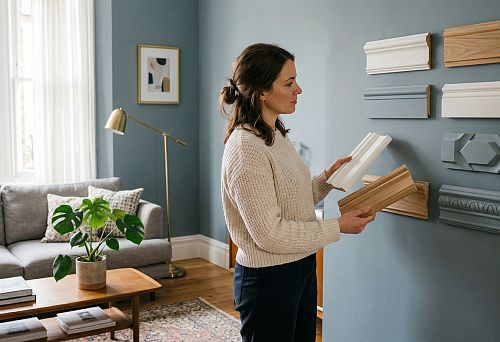
Moldings — Wooden moldings for the upper part of the portal, frame panels on the sides, and horizontal belts on the walls around the door.
Polyurethane stucco decor — for ornamental capitals, corner rosettes, architrave profiles, and wall stucco around the opening. Detailed catalog stucco decoration — right here.
Carved doors — solutions for door decorationwith overlay elements, moldings, and decorative details for the door leaf.
FAQ: answers to popular questions about door portals
What's better for a door portal: wood or polyurethane?
It depends on the task. If you need tactile warmth, connection with wooden floors and doors — solid wood. If precise geometry, rich ornamentation, and ease of installation are important —Polyurethane moldings. The best result is a combination: wood in the side verticals, polyurethane in the upper zone.
Is a capital only for classic interiors?
No. A capital in a simplified, geometric form is appropriate in modern classic, neoclassical, and interiors with Art Deco elements. An ornamental Corinthian capital is indeed strictly classical. But a laconic transitional element at the top of a pilaster is a 'capital' in the functional sense, and it is appropriate in a wide range of styles.
Can a doorway be decorated without a door?
You can and should. A portal without a door is one of the most effective ways to structure an open space. Pilasters on the sides,decorative elementsand moldings above the opening create a full architectural frame without a door leaf.
How to combine a portal with baseboards and moldings?
The portal and baseboard should belong to the same style. The profile of the baseboard and the profile of the pilaster base should echo each other. The moldings on the walls around the door should start and end at the verticals of the pilasters, not 'float' arbitrarily. All horizontal wall architecture is subordinate to the vertical accents.
Is stucco suitable for a small apartment?
Yes, with proper scaling. In small apartments with ceilings of 2.7–2.8 m, you needDecorative stuccosmall-scale elements: a thin molding above the door, a concise capital, a narrow ornament. You don't need to give up stucco due to a small space — you need to select the proportions.
What decorative elements to choose for high ceilings?
With ceiling heights from 3.5 meters, you can confidently use developed pilasters with full bases, rich capitals, composite architraves with cornices andmolding on wallsin the form of panel molding frames across the entire plane. A high ceiling requires large-scale decorative elements — otherwise the wall looks empty.
Can a capital be used without a pilaster?
Technically — yes. A capital can be installed as an independent corner or transitional element. But architecturally, this is a weak solution: without a pilaster, the capital loses its role as the completion of a vertical and turns into just a decorative overlay. The best result is always the pair 'pilaster + capital'. For more details on how wooden capitals and overlays work together, see the articleCapitals and Overlays: Architectural Harmony of Wood and Polyurethane.
What kind of casing is needed for a classic door portal?
Wide — at least 100 mm — with a classic profile, including a scotia, a cyma reversa, or a reverse curve. Flat and geometrically neutral casing looks out of place in a classic portal.wooden casingwith a shaped profile — a basic element of any full-fledged classic portal.
About the Company
When it comes to finding all the elements to assemble a complete door portal — from capitals and pilasters to moldings and casings — it's important that everything is in one place. Not from different suppliers, not from incompatible collections, but in a single catalog with coordinated proportions and style.
STAVROS is a manufacturer and catalog of wooden architectural elements and polyurethane moldings for classic interiors.carved doors, wooden pilasters, solid wood capitals, profiled casings, moldings, cornices, decorative overlays, and a full range of polyurethane moldings — all of this is available in a single catalog. STAVROS is the choice of those who design interiors as architecture: with an understanding of the system, respect for proportions, and attention to ensuring every element contributes to the result, rather than existing separately.