Article Contents:
- Psychology of upper space
- Architectural hierarchy in a modern home
- Material embodiment of beauty: modern decoration technologies
- Polyurethane: revolution in ceiling decoration
- Wood veneer: warmth and nobility
- MDF: democratic elegance
- Stylistic kaleidoscope of ceiling solutions
- Classicism: eternal elegance
- Baroque: theatricality and opulence
- Technological aspects of creating ceiling decoration
- Modernism: natural forms in architecture
- Minimalism: beauty of simplicity
- Design: from idea to realization
- Production: precision and craftsmanship
- Installation: the art of mounting
- Functional aspects of ceiling decoration
- Acoustic properties
- Concealment of utilities
- Lighting as part of the decorative concept
- Hidden backlighting of decorative elements
- Central fixtures and their framing
- Regional characteristics and cultural traditions
- Russian traditions of wooden architecture
- European influences in Russian interiors
- Economic aspects of ceiling decoration
- Technologies of the future in ceiling decoration
- Investment attractiveness
- Price-to-Quality Ratio
- Care and restoration of ceiling decoration
- Digital technologies in design
- New materials and technologies
- Conclusion: STAVROS — workshop of ceiling masterpieces
- Regular Maintenance
- Restoration and renewal
- Frequently Asked Questions
- Look up. What do you see? A plain white surface, a dull plane silently hanging above your head? What if I told you that right here, in this space overlooked by everyone, lies incredible potential for creating a true work of art?
Look up. What do you see? A plain white surface, a boring plane silently hanging over your head? What if I told you that right here, in this forgotten space, lies incredible potential for creating a true work of art? Ceiling decoration It's not just a designer whim — it's an opportunity to radically transform the interior, create an atmosphere that will inspire you every day.
The ceiling is the fifth wall of your home, often overlooked and undervalued. But imagine: you enter a room, and the first thing that catches your attention is exquisite molding above your head, elegant moldings creating a play of light and shadow, or luxurious rosettes framing the chandelier like a precious gem in a setting.
Why do most people ignore ceilings? Perhaps because they don't know the boundless possibilities that thoughtful decoration of this space offers. Perhaps they fear the complexity of installation or high cost. Or maybe they simply don't understand how radically the perception of the entire room can change when a true work of art appears above their heads.

Revolution of perception: how the ceiling becomes the main hero of the interior




Psychology of upper space
Have you ever wondered why ceilings in Gothic cathedrals reach upward, why palace halls impress with their ornate moldings precisely at the top? Human psychology is structured so that a gaze directed upward automatically evokes a sense of grandeur, solemnity, spiritual uplift.
Ceiling molding It works precisely on this principle. It doesn't just decorate space — it programs the emotional state of people within the room. A properly designed decorative ceiling can visually increase room height, expand space, create a sense of luxury and refinement.
Neuropsychological studies show: humans spend about 30% of their time looking upward. This means that the ceiling affects our mood and perception far more than we realize. A monotonous white surface causes boredom and apathy. A beautifully decorated ceiling, on the contrary, stimulates creative thinking, improves mood, creates a sense of comfort and security.
Our factory also produces:


Architectural hierarchy in a modern home
In classical architecture, there was a clear hierarchy: foundation, walls, ceiling, roof. Each element had its own significance and decorative solution. The ceiling was always considered the crown of architectural composition — the place where masters could fully demonstrate their art.
Modern architecture, unfortunately, has lost this tradition. Ceilings have become flat, faceless, functional. But today we are witnessing a revival of interest in decorative upper space design. Ceiling molding elements They return to our homes, bringing beauty, refinement, and individuality.
Get Consultation
Material embodiment of beauty: modern decoration technologies
Polyurethane: revolution in ceiling decoration
If, in the past, molding was a privilege of palaces and mansions, modern technologies have made it accessible to everyone. Polyurethane decorative elements combine the beauty of classical forms with the practicality of modern materials.
What makes polyurethane an ideal material for ceiling decoration? First and foremost, its incredible lightness. Polyurethane elements weigh several times less than gypsum analogs, simplifying installation and reducing load on load-bearing structures. At the same time, the detailing and quality of ornamentation do not fall short of traditional materials.
Moisture resistance is another indisputable advantage. Polyurethane Ceiling Moldings It can be used even in rooms with high humidity — bathrooms, kitchens, pools. The material does not deform, crack, or lose its decorative properties.
Solid wood: warmth and nobility
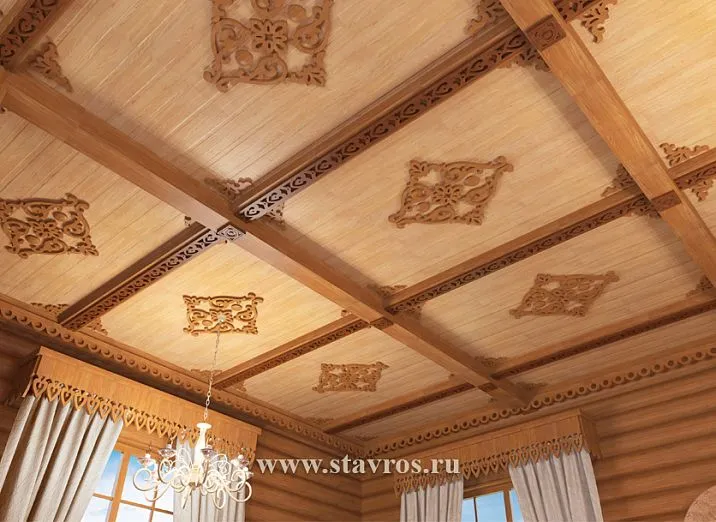
For lovers of natural materials, wood remains the unsurpassed choice. Wooden beams, cornices, coffered ceilings create a special atmosphere of warmth and coziness. Each wood species has its own character: oak impresses with its strength and solidity, beech delights with its soft hues, walnut captivates with its refined texture.
Modern woodworking technologies allow creating ceiling elements of any complexity. High-precision milling machines reproduce the finest ornament details, while skilled artisans add unique handcrafted touches.
MDF: democratic elegance
MDF has gained popularity due to its optimal price-to-quality ratio. The uniform structure of the material allows creating complex reliefs and fine details. At the same time, the cost of MDF elements is significantly lower than solid wood items.
Modern MDF panels meet the strictest ecological standards. E1 emission class guarantees safe use in residential spaces. The ability to repaint multiple times makes MDF decoration especially practical for those who like to periodically refresh their interiors.
Stylistic kaleidoscope of ceiling solutions
Classicism: eternal elegance
The classical style of ceiling decoration is based on principles developed by ancient masters and refined by Renaissance architects. Symmetry, proportionality, use of order systems create an atmosphere of solemnity and respectability.
ceiling rosettes In the classical style, they represent complex multi-tiered compositions with floral motifs, geometric ornaments, sometimes — with depictions of mythological figures. The central rosette under the chandelier becomes the compositional center of the entire ceiling, from which other decorative elements radiate.
Classical cornices feature multi-tiered profiles. Each tier has its own purpose: creating a play of light and shadow, emphasizing the transition from wall to ceiling, serving as a base for additional decoration. A properly designed classical cornice can visually increase room height by 20–30 centimeters.
Baroque: theatricality and opulence
Baroque ceilings are true theatrical decorations. Here, the boldest decorative solutions are appropriate: abundance of gilding, complex floral compositions, dynamic forms that create an impression of movement.
A feature of baroque decoration is asymmetry as an artistic technique. While classicism is strictly symmetrical, baroque allows and even welcomes violations of symmetry, creating an effect of spontaneity and liveliness.
The color palette of baroque ceilings is rich and diverse. White and gold remain a classic combination, but pastel tones — pink, blue, salad green — are often used. Such color solutions create a sense of festivity and luxury.
Modern: natural forms in architecture
The modern style revolutionized decorative art, abandoning the copying of historical motifs and turning to nature for inspiration. Ceilings in the modern style impress with the naturalness and dynamism of their forms.
Plant motifs here are not stylized to unrecognizability, as in classical styles, but are maximally close to natural models. Curves of branches, petals of flowers, silhouettes of leaves — nature becomes an inexhaustible source of decorative ideas.
Asymmetry in modern design is not a random violation of rules, but a deliberate artistic technique reflecting the naturalness and unpredictability of natural forms. Such ceilings create an impression of movement, growth, and life.
Minimalism: the beauty of simplicity
A minimalist approach to ceiling decoration seems contradictory — how can one decorate while rejecting ornamentation? But this is precisely the skill: to create an expressive composition with minimal means.
Minimalist ceiling decoration is based on the play of geometric forms, contrast of textures, subtle color nuances. A simple cornice with perfectly proportioned dimensions can make an impression no less powerful than an elaborate baroque composition.
Technological aspects of creating ceiling decoration
Technological aspects of creating ceiling decoration
Design: from idea to realization
Creation decorative ceiling ornamentation begins with a detailed analysis of the room. Ceiling height, room dimensions, window and door placement, existing interior style — all these factors influence the choice of decorative elements.
Modern design uses computer 3D modeling. This allows to see the future ceiling within the interior before starting work, evaluate proportions, calculate material quantities, and prevent errors.
Special attention is paid to the interaction of decorative elements with lighting systems. Ceiling molding under a chandelier should not merely beautifully frame the fixture, but also enhance its decorative effect, creating proper lighting accents.
Production: precision and craftsmanship
Modern production technologies for ceiling decoration combine automation with manual craftsmanship. High-precision CNC milling machines ensure ideal geometry of products, dimensional accuracy down to fractions of a millimeter.
But machines cannot replace humans in creating the soul of a product. Final finishing, meticulous attention to minute details, imparting individuality to elements — all of this remains the domain of experienced craftsmen.
Quality control at every stage of production guarantees that finished products meet the highest standards. Each element undergoes visual inspection, dimensional verification, and testing of fastener strength.
Installation: the art of mounting
Quality installation of ceiling decoration requires professional skills and specialized tools. Marking, surface preparation, precise fitting of elements, concealed fastening — each stage is critically important for the final result.
Installing at height presents particular difficulty. Working with ceiling elements requires not only technical knowledge but also physical fitness, the ability to work on ladders and scaffolds.
Modern adhesive compositions allow attaching lightweight polyurethane elements without additional mechanical fasteners. This simplifies installation and eliminates visible fastener marks on the finished product.
Functional aspects of ceiling decoration
Acoustic properties
Ceiling decoration can significantly improve the acoustic characteristics of a room. Recessed surfaces break up sound waves, prevent echoes, and create a more comfortable acoustic environment.
This is especially relevant for rooms with high ceilings — living rooms, dining rooms, offices. A properly designed ceiling decoration can reduce noise levels by 3–5 decibels, significantly enhancing comfort within the space.
Coved ceilings were traditionally used in libraries and concert halls precisely due to their excellent acoustic properties. Modern decorative solutions allow adapting this principle for residential spaces.
Concealment of utilities
Modern homes are filled with engineering utilities: electrical wiring, air conditioning systems, fire alarms, smart home systems. Ceiling decor allows elegantly hiding all these technical elements.
Crown moldings can conceal curtain tracks, hidden lighting systems, ventilation grilles. Decorative beams conceal structural elements, pipes, cable runs. At the same time, access to utilities for maintenance remains possible.
Integration with smart home systems opens new possibilities. Motion sensors hidden within decorative elements, automated lighting systems built into crown moldings, acoustic systems disguised as moldings — technologies serve beauty while remaining invisible.
Lighting as part of the decorative concept
Hidden lighting of decorative elements
Proper lighting can transform ceiling decor beyond recognition. Hidden LED lighting, built into crown moldings and moldings, creates soft ambient light, highlights the relief of decorative elements, and creates play of light and shadow.
Modern LED lighting systems allow creating dynamic lighting scenarios. Colored lighting can change the mood of a room depending on time of day or events. Warm yellow light creates coziness in the evening, cool white light energizes in the morning, colored lighting transforms an ordinary room into a festive hall.
Controlling lighting through smart home systems makes using decorative lighting maximally comfortable. Voice commands, mobile apps, lighting scenes — all of this becomes part of the decorative concept.
Central chandeliers and their framing
A traditional chandelier centered on the ceiling gains new resonance when framed by decorative molding. Buy ceiling molding Framing a chandelier — this is an investment in creating a compositional center for the entire room.
The size and complexity of the ceiling molding should correspond to the scale of the room and the style of the chandelier. A miniature molding will be lost on a high ceiling of a large room. An overly large and complex molding will overwhelm a small space.
Modern designers often abandon the traditional central placement of chandeliers, creating asymmetrical compositions with multiple light sources. In such cases, each light fixture may have its own decorative framing, creating a rhythmic composition.
Regional characteristics and cultural traditions
Russian traditions of wooden architecture
Russia has rich traditions of wooden construction, reflected in ceiling decor. Wooden beams, painted ceilings, carved elements — all of this constitutes a unique heritage of Russian decorative art.
Modern interpretations of traditional motifs allow creating ceilings that harmoniously combine historical authenticity with modern requirements of comfort and functionality. Beams styled to look antique but made from modern materials, stencil-painted murals imitating traditional patterns — all of these are ways to adapt historical heritage to modern realities.
European influences in Russian interiors
Peter's reforms opened Russia to European influences in architecture and decorative arts. Baroque and classical ceilings of Russian palaces did not fall short of the best European examples, and often surpassed them in refinement of execution.
Modern Russian masters continue this tradition of synthesis. Italian elegance, French refinement, English restraint — all these influences are creatively reworked and adapted to Russian conditions and tastes.
Economic aspects of ceiling decor
Investment Appeal
Well-executed ceiling decor is a long-term investment in real estate. A beautiful ceiling increases the attractiveness of property to potential buyers or renters, and may increase property value by 5-15%.
The service life of quality decorative elements is measured in decades. Polyurethane molding can last 20-30 years without losing its appearance. Wooden elements, with proper care, are practically eternal — ceilings in European castles have survived for centuries.
Price-to-quality ratio
The cost of ceiling decor can vary within very wide limits depending on materials, complexity of execution, and volume of work. Simple polyurethane crown moldings cost several hundred rubles per linear meter. Exclusive handcrafted items may cost tens of thousands per square meter.
A proper approach to budget planning — determine priorities and find the optimal price-to-quality ratio. It is better to use several quality elements than many cheap, questionable-quality details.
Technologies of the future in ceiling decor
Digital Technologies in Design
Virtual and augmented reality revolutionize the process of designing ceiling decor. The client can "walk through" their future interior even before work begins, evaluate different decor options, and make adjustments.
Artificial intelligence helps optimize decorative solutions, select elements according to architectural features of the room, interior style, and project budget.
New materials and technologies
3D printing opens incredible possibilities for creating unique decorative elements. Complex shapes that are impossible to achieve with traditional methods become reality.
Composite materials of the new generation combine the lightness of polymers with the strength of metals, the durability of ceramics with the flexibility of rubber. This opens new horizons for ceiling decoration.
Smart materials can change their properties depending on external conditions. Decorative elements that change color with temperature, react to sound, glow in the dark — all of this is no longer science fiction, but reality.
Ceiling decoration maintenance and restoration
Regular Maintenance
Ceiling decoration requires periodic care to maintain its appearance. Dust is the main enemy of decorative elements. It accumulates in recessed areas, gradually clogging ornamental details.
Dry cleaning with soft brushes is the primary method of caring for ceiling decoration. For hard-to-reach areas, telescopic brushes are used, allowing access to the highest elements.
Wet cleaning is possible only for elements with moisture-resistant coatings. Neutral cleaning agents are used, excluding damage to the decorative finish.
Restoration and renewal
Even high-quality ceiling decoration may require periodic updates. Repainting, replacing damaged elements, restoring gilding — all of this allows maintaining the decoration in ideal condition.
Modern restoration technologies allow restoring even severely damaged elements. Laser cleaning, nanocoatings, conservation — the restorer’s arsenal is constantly expanding.
Frequently asked questions
Can ceiling decoration be installed in an apartment with low ceilings?
Yes, there are special solutions for rooms with limited height. Thin moldings, small rosettes, properly chosen proportions can visually increase ceiling height. The key is to avoid bulky elements and complex multi-level compositions.
How long does it take to install ceiling decoration?
Installation time depends on project complexity. Simple elements — cornices, moldings — can be installed in one day. Complex compositions with multiple elements may require a week of work. It is important not to rush — quality matters more than speed.
Can ceiling decoration be used in a bathroom?
Yes, but moisture-resistant materials must be chosen. Polyurethane elements are ideal for humid environments. Wooden details require special treatment with moisture-resistant compounds.
How to choose the style of ceiling decoration?
The style should match the overall interior concept. Traditional elements with rich ornamentation suit classic interiors. Modern interiors require more minimalist solutions. It is important to maintain proportion — the ceiling should not overwhelm the rest of the interior.
Which material is better to choose — polyurethane or wood?
The choice depends on budget, interior style, and usage conditions. Polyurethane is cheaper, easier to install, and resistant to moisture. Wood is more expensive but creates a unique atmosphere of warmth and coziness. For humid areas, polyurethane is better; for formal rooms, wood is preferable.
Can different materials be combined in one composition?
Yes, a thoughtful combination of different materials can create very interesting effects. For example, wooden beams combined with polyurethane molding, metal inserts with classic elements. The key is to maintain stylistic unity and proportions.
How to care for gilded elements?
Gilding requires especially delicate care. Only dry cleaning with soft brushes is used. No abrasive agents, solvents, or aggressive chemicals. In case of damage to gilding, it is better to consult professional restorers.
Does ceiling decoration affect room lighting?
Yes, decorative elements can either improve or worsen lighting. Light elements reflect light, dark ones absorb it. Recessed surfaces create play of light and shadow. When designing, it is important to consider the interaction of decoration with light sources.
Conclusion: STAVROS — workshop of ceiling masterpieces
In a world where every square meter of living space becomes increasingly valuable, it is especially important to maximize the use of every surface to create beauty and comfort. The ceiling is a huge underutilized resource in most interiors, an area of boundless creative and self-expression potential.
STAVROS has been a recognized leader in ceiling decoration for many years, transforming ordinary ceilings into works of art. Our philosophy is based on the belief that beauty should not be a privilege of the chosen few — quality decoration should be accessible to anyone who wishes to make their home special.
STAVROS’s production facilities are equipped with the most modern European equipment, enabling the creation of decorative elements of any complexity with unparalleled quality of execution. However, technology is merely a tool. The company’s greatest asset is a team of talented designers, experienced technicians, and master craftsmen, for whom each project is an opportunity to create something unique and beautiful.
STAVROS offers a full cycle of services: from initial consultation and design project to production of elements and professional installation. We work with private clients as well as designers, architects, and construction companies, always striving to exceed expectations and create results worthy of pride.
Our products adorn thousands of homes and apartments throughout Russia, and each completed project confirms the correctness of the chosen path. Investing in ceiling decoration from STAVROS is not just investing in the beauty of your home, but in daily emotions of joy and pride that decorated ceilings will bring you for many years.
194.75 $