Article Contents:
- The history of the question: from utility to art
- Psychology of perception: how panels affect our subconscious
- Vertical compositions and the feeling of height
- Rhythm and harmony in interior design
- Technical specifications: science behind the beauty
- Structure of MDF and its advantages
- Ecological safety of modern MDF
- Design Solutions: From Classic to Avant-Garde
- Scandinavian Philosophy of Simplicity
- Modern classicism: traditions in a new interpretation
- Industrial chic: brutality and elegance
- Practical Aspects of Application
- Zoning of open spaces
- Hiding engineering utilities
- Installation technologies: from planning to implementation
- Preparation stage
- Mounting systems
- Joint and corner processing
- Installation technologies: from preparation to perfection
- Monochromatic Elegance
- Imitation of natural materials
- Modern effects
- Acoustic properties and comfort
- Sound Absorption and Sound Diffusion
- Impact on microclimate
- Economic aspects and budget planning
- Cost analysis for project implementation
- Long-Term Economic Efficiency
- Comparison with alternative solutions
- Innovative Development Directions
- Integration of smart technologies
- Ecological innovations
- Regional application specifics
- Adaptation to Climatic Conditions
- Accounting for construction traditions
- Conclusion
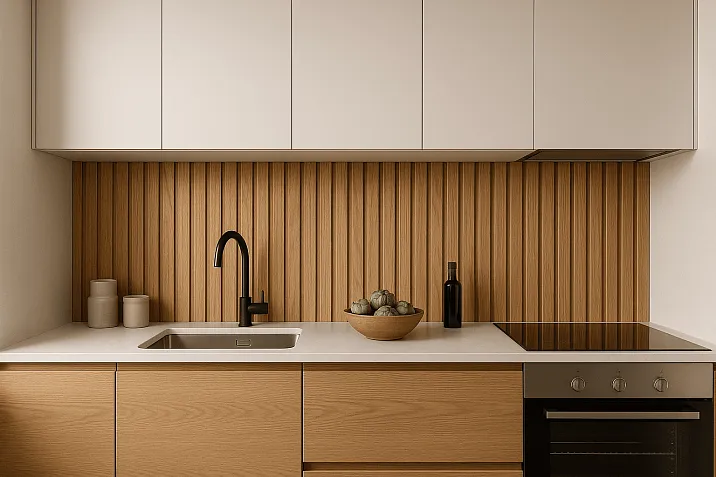
Imagine the moment when an ordinary wall transforms into a work of architectural art. When a flat surface acquires depth, rhythm, and character. That is precisely the magic of decorative MDF panel for walls – a material that has become a true revolution in the world of interior design in recent years.
But what makes this material so special? Why are leading designers around the world increasingly turning to panel structures, creating interiors that become objects of admiration and imitation? The answer lies in the unique combination of technical advantages, aesthetic possibilities, and practical suitability.


The history of the question: from utility to art
The path of decorative panels from a simple construction material to a tool of high design was long and interesting. Initially, panels were used exclusively for utilitarian purposes – for frames, lattices, temporary structures. However, over time, designers began to notice their aesthetic potential.
The turning point was the emergence of MDF technology, which allowed creating panels with perfect geometry and diverse decorative finishes. Suddenly, what was previously hidden behind finishes became the finish itself – a vivid example of how technical innovation gives rise to a new aesthetic.
Today MDF panels for walls are used in the most prestigious projects around the world. From private residences to large commercial buildings – everywhere where beauty and functionality are valued.




Psychology of perception: how panels affect our subconscious
Our factory also produces:


Vertical compositions and the feeling of height
The human eye is structured in such a way that vertical lines automatically create an illusion of increased space height. This effect is based on the characteristics of visual perception and subconscious associations. When we see Decorative MDF rails, arranged vertically, our brain interprets this as movement upward.
Studies in neuroarchitecture show that rooms with vertical decorative elements are perceived 15-20% larger than their actual size. This makes lath paneling especially valuable for rooms with low ceilings or complex proportions.
Get Consultation
Rhythm and harmony in interior design
Evenly spaced laths create a visual rhythm that calms the nervous system and promotes concentration. This effect is used not only in residential interiors but also in office spaces, where maintaining a productive mindset is important.
The mathematical basis of beauty, known since ancient times, is reflected in the proportions of lath structures. Ratios based on the golden section create a sense of natural harmony that humans intuitively perceive.
Technical characteristics: the science behind beauty
MDF (Medium Density Fiberboard) is the result of a high-tech wood processing process. Unlike standard particleboard, MDF is made from ultrafine wood fibers, ensuring uniform structure and superior physical and mechanical properties.
Material density of 650-850 kg/m³ ensures an optimal balance between strength and workability. The moisture content of the finished product stabilizes at 6-9%, guaranteeing dimensional stability during use.
The density of the material 650-850 kg/m³ ensures an optimal balance between strength and workability. The moisture content of the finished product stabilizes at a level of 6-9%, guaranteeing dimensional stability during operation.
Ecological safety of modern MDF
Modern MDF interior planks Produced using E0 or E1 grade adhesives, meaning minimal formaldehyde emissions. E0 grade matches natural wood emission levels, making the material completely safe for health.
The production process excludes the use of heavy metals, phenols, and other toxic substances. This is confirmed by appropriate certifications and allows the use of laths in children's facilities and medical facilities.
Design solutions: from classic to avant-garde
Scandinavian philosophy of simplicity
In Scandinavian design decorative MDF panel for walls becomes an embodiment of the "lagom" philosophy – the concept of balance and moderation. Light tones, clean lines, and natural textures create an atmosphere of calm and harmony.
A typical Scandinavian solution involves using white or light-gray laths with a matte finish. Gaps between elements are 15-25 mm, creating a delicate play of light and shadow without excessive drama. This approach is especially effective in bedrooms and children's rooms, where a relaxing atmosphere is important.
Modern classicism: traditions in a new interpretation
Neoclassical interiors use lath structures to create a modern interpretation of traditional panels and moldings. Profiles with more complex shapes and routed elements imitate classical architectural detailing at significantly lower cost and installation complexity.
The color palette leans toward noble tones – dark oak, American walnut, redwood. Using gilded or patinated elements adds luxury and emphasizes the status of the interior.
Industrial chic: brutality and elegance
Loft interiors find in lath structures a way to add order to the chaos of industrial aesthetics. Dark laths from MDF material contrast with rough brick and concrete textures, creating an interesting play of opposites.
Horizontal lath placement emphasizes the extent of space and creates associations with industrial architecture. Integration of metallic elements – steel profiles, rivets, patinated hardware – enhances the authenticity of the style.
Practical aspects of application
Zoning of open spaces
One of the most effective applications of MDF lath wall finishing is zoning large open spaces. In studio apartments, lofts, and open-plan offices, lath structures allow creating psychological boundaries between functional zones without erecting permanent partitions.
Changing the direction of laths – from vertical to horizontal – creates a visual transition between zones. Different density of element placement can also serve as a zoning tool: denser areas create a sense of privacy, while sparser areas suggest openness.
Hiding engineering communications
Lath structures are ideal for aesthetically hiding engineering communications. Behind decorative cladding, one can place electrical cables, ventilation ducts, and air conditioning system components. Removable laths ensure access for maintenance and repair.
Integrating lighting into rail systems allows creating striking light compositions. LED strips installed between rails provide even backlighting, while spotlights form accent lighting.
Installation technologies: from planning to implementation
Preparation stage
Quality installation decorative MDF rails for walls It begins with careful planning and preparation. The wall surface must be perfectly flat—deviations exceeding 2 mm per linear meter are not permitted.
Marking is performed using a laser level and chalk line. When creating complex geometric compositions, it is recommended to make a full-scale cardboard mock-up to verify calculations and visually assess the result.
Mounting systems
The choice of mounting system depends on the type of base, weight of the structure, and requirements for disassembly. Adhesive methods are suitable for permanent installations on perfectly flat surfaces. Polyurethane adhesives provide connection strength up to 12 MPa and retain elasticity.
Mechanical fastening with self-tapping screws is used on uneven bases or when disassembly is required. Pre-drilling holes prevents MDF cracking and ensures even load distribution.
Clamp systems allow creating surfaces without visible fasteners. This method is especially effective for creating solid monolithic compositions, where visual continuity is crucial.
Joint and corner processing
The quality of element joints determines the overall impression of the finished structure. End joints require meticulous precision—the gap must not exceed 0.3 mm. Using saws with fine teeth ensures a clean cut without chipping.
Corner joints are made at a 45° angle and then adjusted on-site. Joint quality is checked with a metal ruler—any gap is unacceptable. Manual tools may be used for fine-tuning if necessary.
Color solutions and decorative finishes
Monochromatic elegance
Monochromatic solutions in light tones create a sense of spaciousness and purity. White rails reflect maximum light, visually enlarging the room. Various shades of white—from cream to Arctic—allow creating subtle nuances.
Gray palette provides a neutral base for bright accents. MDF planks In gray tones, they do not attract excessive attention, creating a calm background for furniture and decorative elements.
Imitation of natural materials
Modern printing technologies allow creating photorealistic imitations of any wood species. Oak, ash, walnut, wenge—each species has a distinctive grain and color palette, accurately reproduced on MDF surfaces.
Texture plays no less important role than color. Embossing creates not only visual, but also tactile imitation of natural wood. Upon touch, the material conveys sensations indistinguishable from real wood.
Modern effects
Metallic finishes create a patina metal effect. Copper, bronze, brass, steel—each metal has a characteristic sheen and color temperature. Powder coatings with metallic pigments create realistic imitation.
Fluorescent additives accumulate daylight energy and softly glow in darkness. This effect is especially interesting in children's rooms and hallways, creating delicate navigation lighting without additional energy sources.
Acoustic properties and comfort
Sound Absorption and Sound Diffusion
MDF has natural sound-absorbing properties due to its fibrous structure. The sound absorption coefficient is 0.2–0.3 in the speech frequency range, noticeably improving room acoustic comfort.
Rail structures additionally scatter sound waves, preventing standing waves and echoes. This is especially important in rooms with hard finishing materials—concrete, stone, glass.
Perforated rails with acoustic backing can achieve a sound absorption coefficient of 0.8–0.9, comparable to specialized acoustic panels. At the same time, they retain all decorative functions of standard rails.
Influence on microclimate
Natural wood fibers can regulate air humidity, absorbing excess moisture at high humidity and releasing it when deficient. This effect, known as hygroscopicity, contributes to maintaining a comfortable microclimate.
Surface quality of MDF wall rails Does not accumulate static electricity, preventing dust attraction and creating a healthier indoor atmosphere.
Economic aspects and budget planning
Cost analysis for project implementation
The cost of materials accounts for only 20-30% of the total cost of implementing a lath-and-beam finish project. The main expenses are for design, preparatory work, installation, and finishing. Understanding this structure helps properly plan the budget.
Savings on materials often result in significant additional costs for defect correction and redoing work. High-quality laths deliver the desired result from the start, whereas cheaper alternatives may require complete replacement.
Long-term Economic Efficiency
The service life of quality MDF laths in interior conditions is 20-25 years. Annual depreciation is 4-5%, which is significantly lower than most alternative finishing materials.
The possibility of partial updating — repainting individual elements or replacing damaged sections — extends the service life and allows adapting the interior to changing needs without major renovation.
Comparison with alternative solutions
Natural wooden planks cost 3-5 times more decorative MDF laths at comparable visual effect. Maintenance requirements are significantly higher due to susceptibility to warping, cracking, and biological degradation.
Plastic panels are 30-40% cheaper, but they lag behind in aesthetic and tactile qualities. Their service life is 2-2.5 times shorter, which, when converted into years of use, makes MDF a more cost-effective investment.
Innovative development directions
Integration of smart technologies
Built-in motion and light sensors can automatically adjust lighting intensity based on human presence and natural light levels. This not only enhances comfort but also saves electricity.
Climate control systems integrated into lath structures allow creating localized comfort zones. Hidden ventilation channels and heating elements make walls active participants in forming the microclimate.
Ecological Innovations
Biodegradable binders based on plant components gradually replace synthetic resins. These materials fully decompose under composting conditions, leaving no harmful residues.
Incorporating recycled materials into MDF composition aligns with circular economy principles. Using waste from furniture production, paper, and other secondary resources reduces the environmental footprint of production.
Regional application specifics
Adaptation to climatic conditions
In humid regions, special hydrophobic impregnations are used, reducing the material's water absorption. This prevents deformation and extends the service life of lath structures.
Special frost-resistant compositions have been developed for northern regions, maintaining elasticity at low temperatures. Special additives prevent the binder from cracking at temperatures down to -40°C.
Consideration of construction traditions
In regions with well-developed wooden architecture traditions MDF laths for interior Often imitate local wood species and traditional processing methods. This allows preserving cultural continuity while using modern materials.
Color preferences also vary depending on the region. Northern areas tend toward light tones, while southern areas prefer more saturated and warm shades.
Conclusion
Journey into the world of decorative MDF laths opens up an amazing panorama of modern design possibilities. decorative MDF panel for walls Has transformed from a simple building material into a powerful tool for creating emotionally rich spaces capable of influencing our mood, well-being, and perception of the surrounding world.
The technological evolution of MDF demonstrates how scientific achievements serve beauty and comfort for humans. From early experiments with wood fibers to modern high-tech production — every step was aimed at creating a material that surpasses natural analogs in property stability while retaining their aesthetic appeal.
The psychological impact of lath structures confirms an ancient truth: architecture shapes people. A properly designed environment can improve quality of life, enhance productivity, and create an atmosphere of harmony and tranquility.
The diversity of design solutions demonstrates the versatility of the material. From restrained Scandinavian elegance to luxurious neoclassicism, from brutalist loft to high-tech — MDF laths find their place in any stylistic concept.
Practical advantages — ease of installation, durability, integration of engineering systems — make this material not just aesthetically pleasing, but also functionally justified for modern interiors.
Economic efficiency is evident both in reasonable pricing and long-term operational prospects. Minimal maintenance costs and the ability to replace individual elements ensure an excellent price-to-quality ratio.
Innovative development directions promise even more opportunities in the future. Integration of smart technologies, eco-friendly production processes, new functional properties — all this defines the industry’s development vector for decades ahead.
The company STAVROS, combining traditions of quality craftsmanship with innovative technologies, continues to remain a leader in creating materials that not only decorate space but also enrich people’s lives. Every STAVROS product is the result of deep understanding of modern design needs and relentless pursuit of perfection in every detail.