Article Contents:
- Philosophy of Scale in Staircase Architecture
- Psychology of Perception of Large Elements
- Historical Tradition of Monumentality
- Constructive Features of Large-Scale Balusters
- Dimensional Scale and Proportions
- Constructive Strength
- Material Science: Selection of Wood for Large-Scale Projects
- Requirements for Raw Material Quality
- Wood Species for Monumental Elements
- Exotic species
- Design solutions and stylistic directions
- Classical Monumentality
- Baroque opulence
- Modern interpretation
- Technological aspects of production
- Material preparation
- Machine Processing
- Hand Finishing
- Installation of Large-Scale Elements
- Special Features of Fastening
- Transportation and logistics
- Accuracy of Installation
- Aesthetic Aspects and Visual Impact
- Creating Architectural Rhythm
- Color solutions
- Coordination with other elements
- Functional Advantages
- Enhanced Strength
- Increased Span
- Safety
- Economic Aspects
- Manufacturing Cost
- Long-Term Economic Efficiency
- Exclusivity and Status
- Modern Trends and Innovations
- New Processing Technologies
- Ecological Aspects
- Customization
- Conclusion
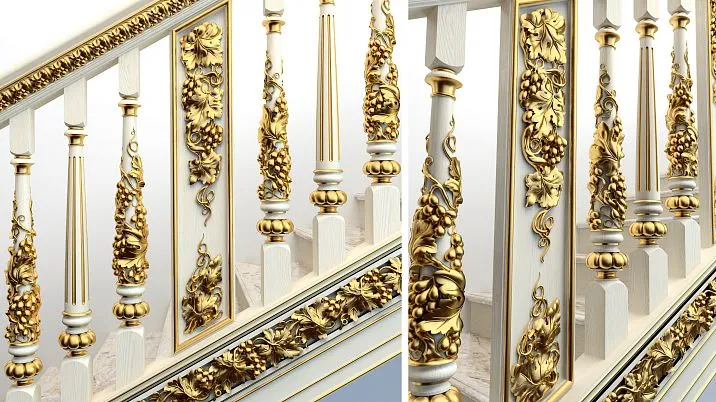
When architectural thought strives for grandeur, when design concepts demand scale and expressiveness, grand balusters emerge grand balusters — elements capable of transforming an ordinary staircase into a majestic architectural composition. These imposing vertical supports not only serve as railings but also create rhythm, establish scale, and define the character of the entire space.
Imagine a palace or mansion's grand staircase, where each step leads to a new level of aesthetic perception. It is precisely large-scale balusters that become those architectural accents that transform a functional structure into a work of art. Their monumentality does not overwhelm but elevates, creating a sense of stability, reliability, and aristocratic refinement.


Philosophy of Scale in Staircase Architecture




Psychology of Perception of Large Elements
Human perception is structured such that large architectural elements automatically associate with importance, status, and longevity. Grand balusters affect the subconscious, creating a sense of monumentality and solidity. They seem to say: 'Here live people who value quality, beauty, and tradition.'
Size matters not only aesthetically but also psychologically. Massive balusters slow down the perception of time, compel one to pause and feel the weight and significance of the moment. This is especially important in interiors where the staircase is a central compositional element.
Our factory also produces:


Architectural history knows numerous examples of using large balusters in significant buildings. Baroque palaces, neoclassical mansions, aristocratic residences — everywhere where it was necessary to emphasize status and grandeur, architects turned to monumental solutions.
Modern architecture reinterprets these traditions, adapting classical principles to new realities. Large balusters today are not only a tribute to tradition but also a means of creating a unique, memorable interior.
Modern architecture reinterprets these traditions, adapting classical principles to new realities. Large balusters today are not only a tribute to tradition but also a way to create a unique, memorable interior.
Get Consultation
Constructive Features of Large Balusters
Size Scale and Proportions
Large balusters begin where standard sizes end. If ordinary elements have a cross-section of 50×50 or 60×60 millimeters, large variants start from 80×80 millimeters and can reach impressive 150×150 millimeters and more. The height of such elements varies from 1000 to 1500 millimeters, creating a truly majestic appearance.
The proportions of large balusters require special attention to details. Each element must be mathematically precise to avoid the impression of bulkiness or disproportion. The golden ratio rule works especially clearly here — the ratio of different parts of the baluster should create a harmonious whole.
Constructive Strength
Increasing the size of balusters automatically increases their constructive strength. Massive elements can withstand significantly greater loads, which is especially important for staircases with intensive use. The moment of resistance to bending increases proportionally to the cube of linear dimensions, making large balusters exceptionally reliable.
This property allows using large balusters in projects where enhanced fence strength is required: public buildings, commercial structures, staircases with large spans between support columns.
Wood Science: Choosing Wood for Large-Scale Projects
Requirements for Raw Material Quality
Manufacturing large balusters imposes special requirements on the quality of the raw material. Large elements require wood of the highest grades, practically free of defects. Any defect — knot, crack, uneven structure — in a large element becomes critical and may lead to the destruction of the item.
The moisture content of wood for large balusters must be stabilized especially carefully. Uneven drying may lead to internal stresses that manifest as cracks or deformations even after installation. Optimal moisture content is 8–10% with a deviation of no more than 2%.
Tree Species for Monumental Elements
Oak remains the undisputed leader for manufacturing large balusters. Its density, strength, and noble texture are ideally suited for creating monumental elements. Large oak balusters can serve for centuries, gradually acquiring a special patina that only enhances their beauty.
Ash offers an interesting alternative to oak. Its light-colored wood with expressive texture creates a sense of lightness even in large elements. High strength and elasticity of ash make it an ideal material for balusters with complex shapes.
Larch holds a special place among coniferous species due to its high density and natural resistance to moisture. Large larch balusters are especially suitable for country houses, where connection with nature is important.
Exotic species
Exotic wood species are used for exclusive projects. Teak, with its golden hue and oily texture, creates a sense of luxury. Wenge, with its dark-chocolate color and contrasting veins, adds a modern elegance to interiors.
Redwood (mahogany) is traditionally associated with classical luxury. Large mahogany balusters become central interior elements, attracting admiring glances.
Design Solutions and Stylistic Directions
Classic Monumentality
Classic style implies strict proportions and noble simplicity of forms. Large balusters in classic style often have the form of miniature ancient columns, with clearly defined bases, shafts, and capitals. Grooves — vertical channels — add additional expressiveness to elements and create play of light and shadow.
Classic large balusters require special attention to details. Each element must be executed with jewel-like precision, since any inaccuracy in a large element becomes noticeable. Profiles must be clean, transitions — smooth, surfaces — perfectly finished.
Baroque opulence
Baroque style allows fully revealing the potential of large balusters. Here, complex forms, rich decoration, and multiple profiles are appropriate. Baroque balusters may resemble stacked vases, adorned with carved garlands, mascarons, and plant ornaments.
Creating large baroque balusters is the pinnacle of joinery craftsmanship. Each element requires an individual approach, manual detailing, and the artist's touch of the master. The result justifies the effort — such balusters become true works of art.
Modern Interpretation
Modern design reinterprets traditional forms, creating new interpretations of classical elements. Large balusters in modern style may have simplified geometric shapes, contrasting texture combinations, and unusual proportions.
Minimalism in large elements requires special craftsmanship. Simplicity of form does not mean simplicity of execution — on the contrary, every line must be precise, every surface — perfectly finished. Beauty lies in the perfection of proportions and material quality.
Technological aspects of production
Material Preparation
Production of large balusters begins with careful preparation of the material. Roughs must be selected especially carefully — any defect in a large element may become critical. Drying is performed in special chambers with precise temperature and humidity control.
Stabilization of stresses in wood is the most important stage of preparation. Large blanks are held in production conditions for no less than two weeks to achieve equilibrium moisture and relieve internal stresses.
Machine Processing
Manufacturing large balusters requires powerful and precise equipment. Turning machines must have sufficient power to process large blanks and high precision to create complex profiles. CNC milling machines allow creating elements of the most complex shapes with repeatability down to the micron.
Special attention is paid to the quality of cutting tools. A dull or poor-quality tool may leave marks on the surface, which will be especially noticeable on large elements. Regular sharpening and replacement of tools are a mandatory condition for quality work.
Manual Finishing
Even with the use of the most modern equipment, large balusters require manual finishing. The master carpenter goes over the entire surface of the element, eliminating the smallest defects and perfecting the profiles. This is meticulous work requiring high skill and artistic taste.
Polishing large balusters is a special art. Starting with coarse grit sandpaper, the craftsman gradually moves to finer grits, achieving a mirror-smooth surface. The quality of polishing directly affects the appearance of the finished product and the durability of the finish.
Installation and Mounting of Large Elements
Mounting Features
Installing large balusters requires a special approach to mounting. The increased weight and dimensions of the elements impose higher requirements on the strength of connections. Standard mounting methods may be insufficient — reinforced mounting systems are required.
Through mounting through treads remains the most reliable method for large balusters. Powerful threaded rods with a diameter of 12-16 millimeters are used, ensuring the necessary strength of the connection. Mounting locations are carefully masked with decorative caps or putty.
Transportation and Logistics
Large balusters create certain logistical challenges. Their size and weight require special packaging and careful transportation. Each element is individually packaged in protective materials to prevent damage during transit.
Unloading and lifting large balusters to their installation location also require a special approach. It may be necessary to use lifting equipment or special devices for safely moving heavy elements.
Installation Accuracy
Installing large balusters requires special accuracy. Any deviation from vertical or uneven spacing between elements in large balusters becomes especially noticeable. Precision measuring tools — laser levels, digital protractors, accurate tape measures — are used.
Pre-marking is performed with special care. Templates and fixtures are created to ensure accurate positioning of each element. Quality control of installation is performed at every stage of work.
Aesthetic Aspects and Visual Impact
Creating Architectural Rhythm
Large balusters create a powerful architectural rhythm that defines the character of the entire space. Their measured repetition creates a sense of grandeur and majesty. The distance between large elements must be carefully calibrated — too frequent installation creates a sense of confinement, too sparse installation disrupts the rhythm.
The play of light and shadow on the surface of large balusters creates additional visual effects. Relief elements, grooves, carved details — all of this contributes to creating an expressive light-and-shadow pattern that changes throughout the day.
Color Solutions
Choosing a color scheme for large balusters requires special attention. Dark tones emphasize monumentality and create a sense of solidity. Light shades visually lighten massive elements, making them less dominant in the interior.
Contrasting solutions — dark balusters on a light background or vice versa — create striking accents and draw attention to the staircase. Monochromatic solutions contribute to creating a calm, harmonious atmosphere.
Combining with other elements
Large balusters must harmoniously complement other elements of the staircase structure. Handrails, support posts, treads — everything must be coordinated in a unified style and scale. Disproportion between different elements may ruin the overall composition.
Special attention is paid to the coordination with the architecture of the room. Large balusters must match the scale of the space — in small rooms they may appear inappropriate, in spacious halls — conversely, they may become lost.
Functional Advantages
Increased Strength
The main functional advantage of large balusters is their exceptional strength. Increased cross-section provides high resistance to mechanical loads. Such balusters can withstand significantly greater forces without deformation or damage.
This is especially important in public buildings, where staircases are subjected to intensive use. Large balusters ensure the longevity of the structure and minimal maintenance costs.
Increased Spans
The high strength of large balusters allows increasing the distances between support posts. This provides additional freedom in staircase layout and enables creating more elegant structures with fewer massive supports.
The ability to create large spans is especially valuable in modern architecture, where there is a desire for maximum openness and freedom of space.
Safety
Massive balusters provide increased safety for stair railings. They are harder to damage by accidental impact and more resistant to vandalism. In households with children, this is especially important — large balusters withstand active use without losing strength.
Economic Aspects
Manufacturing Cost
Large balusters require significantly higher manufacturing costs compared to standard elements. Increased material consumption, more complex processing, higher quality requirements — all of this affects the final price.
The price of a large baluster may be 3-5 times higher than that of a standard element. However, these costs are justified by the unique aesthetic and functional qualities the customer receives.
Long-term economic efficiency
Investments in large balusters are recouped through their longevity and minimal maintenance costs. Well-crafted large elements can serve for centuries without requiring replacement or major repairs.
The increase in property value due to the installation of elite stair elements should also be considered when evaluating economic efficiency. A home with a monumental staircase has a higher market value.
Exclusivity and Status
Large balusters are elements of exclusivity that highlight the owner's status. In an era of mass production, individual solutions become increasingly valuable. Handcrafted large balusters are an investment in uniqueness and the irreplaceable character of the interior.
Modern trends and innovations
New processing technologies
Advancements in technology open new possibilities for creating large balusters. CNC machines of the latest generation allow for the creation of elements of incredible complexity with the highest precision. Laser engraving enables the application of delicate ornaments onto the surface of large elements.
3D modeling technologies allow for the creation of virtual prototypes of future balusters, optimizing their shape and conducting strength calculations even during the design stage.
Ecological aspects
Modern production of large balusters increasingly focuses on ecological aspects. Using wood from certified forests, applying eco-friendly coatings, minimizing waste — these principles are becoming industry standards.
Waste recycling technologies allow even the offcuts from large baluster production to be used for manufacturing other items, reducing the overall environmental impact.
Customization
The trend toward individualization also affects the production of large balusters. Customers increasingly demand unique solutions reflecting their personal preferences and lifestyle. Modern technologies make such individualization economically feasible.
Conclusion
grand balusters They represent the pinnacle of carpentry art, where functionality combines with monumental beauty. These elements can transform any staircase, turning it from a simple functional structure into an architectural work of art.
Choosing large balusters is choosing quality, longevity, and exclusivity. Such elements create a unique atmosphere in the home, highlight the owner's status, and become objects of admiration for many years.
Modern production technologies allow for the creation of large balusters of any complexity, embodying the boldest design ideas. From classic forms to avant-garde solutions — possibilities are limited only by the customer's imagination and the craftsman's skill.
Investments in quality large balusters are investments in beauty, reliability, and uniqueness of your home. Each element, crafted with love for craftsmanship and attention to detail, will serve not just one generation, preserving and enhancing its value over time.
For many years, STAVROS has remained a recognized leader in producing high-quality wooden items, including exclusive large balusters. By combining traditional woodworking methods with modern technologies, STAVROS creates items that become true works of art. Choosing STAVROS means choosing unparalleled quality, individualized service, and a warranty of longevity proven by time and thousands of satisfied customers.