












































































Article Contents:
- Architectural evolution: from function to art
- Historical heritage in modern interpretation
- Psychology of Perceiving Stair Space
- Material revolution in production
- Natural wood: classic in modern processing
- Innovative composite materials
- Metal constructions: strength and elegance
- Technological innovations in production
- Precision machining with CNC
- Robotized assembly systems
- Design concepts and stylistic solutions
- Neoclassicism: Revival of Traditions
- Minimalism: beauty of simplicity
- High-tech: technologies of the future
- Engineering aspects of design
- Load Calculations and Strength Characteristics
- Optimization of structural solutions
- Installation and mounting technologies
- Preparatory work
- Technological features of installation
- Quality control systems
- Incoming material inspection
- Production operational control
- Economic aspects of selection
- Lifecycle Cost Analysis
- Pricing factors
- Trends in development and prospects
- Ecological innovations
- Digital technologies
- Conclusion
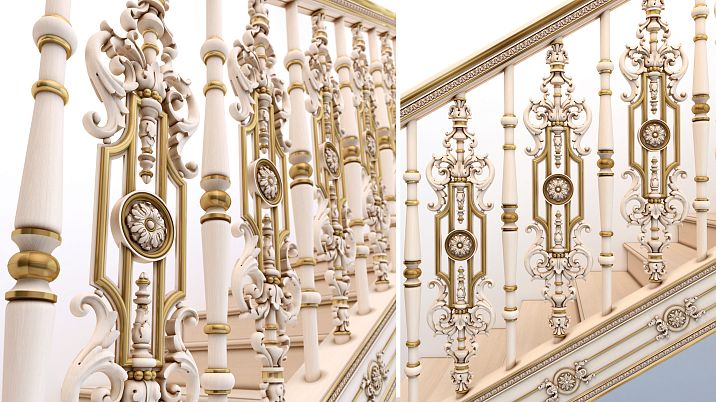
When it comes to creating a safe and aesthetically perfect staircase space, railing with balusters becomes a central element defining the character of the entire interior. These elegant vertical posts transform an ordinary staircase into an architectural masterpiece, where every detail contributes to creating a harmonious and functional space. In today's world of construction and design, balustrades have ceased to be mere protective structures—they have become symbols of status, taste, and understanding of architectural beauty.
The art of creating staircase railings requires a deep understanding not only of technical aspects of safety, but also of aesthetic perception nuances. Each baluster in the railing composition plays its role in creating visual rhythm, maintaining structural integrity, and ensuring comfort of staircase use.


Architectural evolution: from function to art




Historical heritage in modern interpretation
Balustrades have undergone an incredible evolutionary journey—from simple protective structures of ancient civilizations to sophisticated architectural elements of modernity. The earliest references to decorative stair railings appear in Assyrian reliefs, depicting majestic palaces with elegant balustrades. Ancient Greece and Rome developed this tradition, creating classical proportions and forms that continue to inspire architects around the world.
The Renaissance brought a new understanding of the role of decorative elements in architecture. Italian masters created balustrades that amazed with their perfection of form and elegance of execution. Each baluster became a miniature column, carrying echoes of great architectural traditions. Baroque added opulence and theatricality, while classicism returned strictness and mathematical precision of proportions.
Modern architecture reinterpreted traditional approaches, creating new forms and materials for stair railings. Minimalism simplified forms to geometric purity, high-tech introduced technological sophistication and innovative materials, while eclecticism allowed bold combinations of different styles and eras within a single project.
Our factory also produces:




Psychology of staircase space perception
A staircase in a home is not merely a means of moving between floors—it is a space that daily influences the mood and well-being of residents. A properly designed railing creates a sense of safety and comfort, while its aesthetic qualities shape the first impression of the home and its owners.
The rhythm of balusters affects the perception of movement along the staircase. Frequent placement creates a sense of security, but may visually weigh down the structure. Sparse placement adds lightness, but requires special attention to safety. Professional designers find the golden mean, considering the specific characteristics of the space and the needs of users.
The color solution of the railing also plays an important role in the perception of the staircase space. Light tones visually expand the space and add airiness, dark tones create a sense of solidity and stability. Contrasting combinations attract attention and can become an accent element of the interior.
Get Consultation
Material revolution in production
Natural wood: classic in modern processing
Wood remains the most popular material for creating stair railings due to its unique combination of strength, beauty, and eco-friendliness. Modern processing technologies allow to fully unleash the potential of each species, creating products of exceptional quality and longevity.
Oak continues to hold leading positions among hardwoods. Its density of 700-800 kg/m³ ensures exceptional strength, while its expressive texture with clearly defined growth rings creates a unique decorative effect. Modern drying methods allow reducing moisture content to 6-8%, guaranteeing dimensional stability of finished products for decades.
Ash attracts designers with its contrasting structure and high impact resistance. This species allows creating elements of complex curved shapes without the risk of cracking. The natural elasticity of ash makes it an ideal material for making handrails that must withstand significant dynamic loads.
Beech is characterized by a uniform fine-pored structure, making it an excellent material for turning. Balusters made of beech are perfectly smooth, with clear profiles and flawless geometry. Beech's neutral color opens up wide possibilities for staining and creating any color solutions.
Innovative composite materials
Wood-polymer composites represent a new generation of materials for stair railings. They combine the natural beauty of wood with improved performance characteristics. Moisture resistance, resistance to temperature fluctuations, and biological damage make composites an ideal choice for demanding operating conditions.
Modern composites are produced using natural wood fibers and environmentally safe binders. Extrusion technology allows creating profiles of any complexity with precision down to fractions of a millimeter. The surface can imitate the texture of various wood species or have a smooth modern finish.
Fiberglass-reinforced composites have exceptional strength at minimal weight. They are not susceptible to corrosion, require no special maintenance, and retain their original appearance throughout their service life. The ability to color them in bulk ensures color stability even with surface mechanical damage.
Metal structures: strength and elegance
Stainless steel opens up limitless possibilities for creating modern stair railings. Various surface treatments — from mirror polishing to matte satin — allow achieving any aesthetic effect. Stainless steel's corrosion resistance guarantees the structure's longevity under any operating conditions.
Aluminum alloys combine lightness with sufficient strength for stair railings. Anodizing the surface not only protects the metal from corrosion but also allows obtaining a wide palette of colors and textures. The ability to create complex profiles using extrusion opens new horizons for design creativity.
Forged elements remain a symbol of luxury and individuality. Hand-forging allows creating unique artistic compositions where every detail bears the mark of the blacksmith's skill. Modern protective coating technologies ensure the longevity of forged items and preserve their original beauty.
Technological innovations in production
CNC Precision Machining
CNC machines have revolutionized the production of stair elements. Processing accuracy down to hundredths of a millimeter ensures perfect geometry for each part and flawless assembly quality. Programmable cycles allow reproducing the most complex profiles with absolute repeatability.
Multi-axis machining centers can create volumetric compositions of any complexity in a single setup. This eliminates accumulated errors and ensures the highest quality of finished products. Automatic tool change allows performing the entire processing cycle without operator involvement.
Laser cutting opens new possibilities for creating intricate elements and complex decorative compositions. The precision of the laser beam allows cutting the finest details without mechanical impact on the material. Absence of tool wear ensures stable processing quality throughout the entire production cycle.
Robotic Assembly Systems
Industrial robots ensure high precision and repeatability in assembling stair railings. Programmable motion trajectories guarantee correct positioning of parts and quality of connections. Vision systems monitor each assembly stage and eliminate the possibility of defects.
Automated material handling systems optimize the production process and reduce the influence of human factors on product quality. Robotic painting ensures uniform coating application and eliminates defects related to uneven layer thickness.
Integrating production systems into a single digital platform allows tracking each product from the design stage to finished goods. Quality control systems automatically detect deviations and adjust technological parameters in real time.
Design Concepts and Stylistic Solutions
Neoclassicism: revival of traditions
Modern interpretations of classical forms bring a sense of stability and respectability to interiors. Baluster Railings In the neoclassical style, traditional proportions are combined with modern materials and manufacturing technologies.
Characteristic features of neoclassical balusters include clear geometric forms, symmetrical composition, and restrained decoration. The base and capital are resolved as simple profiled elements, while the baluster body may have a slight entasis — a barely noticeable thickening in the middle, creating an optical illusion of perfect straightness.
Color solutions for neoclassical railings tend toward natural tones — from light oak to dark wenge. Patination can be used to create an effect of noble antiquity. Contrasting combinations of dark wood with gold accents emphasize the status and sophistication of the interior.
Minimalism: the beauty of simplicity
Minimalist railings are characterized by extreme simplicity of forms and absence of decorative excesses. Each element performs its function without compromise, and beauty is achieved through perfect proportions and quality execution.
Minimalist balusters have simple geometric cross-sections — square, rectangular, or cylindrical. Surfaces remain smooth, highlighting the natural beauty of the material. Connections are made in a concealed manner, not disrupting the purity of lines.
The color palette is limited to neutral tones — white, gray, black, or natural wood shades. Contrasts are created through combinations of different materials — wood with metal, glass with stone. Lighting plays an important role in perceiving minimalist railings, emphasizing the geometry of forms and creating expressive play of light and shadow.
High-Tech: Technologies of the Future
The high-tech style brings to stair railings a spirit of technological progress and innovation. Use of modern materials — stainless steel, aluminum, glass — creates a sense of belonging to the future.
Characteristic features of high-tech railings include clear geometric forms, shiny surfaces, and visible mounting elements that become part of the decorative composition. Cable systems, glass panels, LED lighting — all these elements emphasize the technological and modern nature of the solution.
Integration of smart technologies transforms stair railings into interactive systems. Motion sensors automatically activate lighting, climate control systems maintain comfortable handrail temperatures, and structural condition monitoring ensures safe operation.
Engineering Aspects of Design
Load Calculation and Strength Characteristics
The design of stair railings begins with a careful analysis of the loads the structure will bear during operation. Regulatory documents establish minimum strength requirements for railings, but practice shows that significant safety factors are necessary to ensure durability and safety.
Horizontal loads on the handrail constitute the main part of the load on the railing. For residential buildings, the normative load is 0.8 kN/m, for public buildings — 1.5 kN/m. However, actual loads may significantly exceed normative values, especially with intensive use of the stairs.
Dynamic effects occur due to sudden movements of people, impacts, and vibrations from operating equipment. The dynamic coefficient for stair railings is taken as 1.4, meaning that calculated loads are increased by 40% compared to static loads.
Structural Optimization
Modern calculation methods allow optimizing the railing structure according to criteria of strength, stiffness, and economy. Finite element modeling enables analyzing the stress-strain state of each element and identifying the most heavily loaded zones.
Topological optimization helps find the optimal material distribution in the structure, minimizing weight while maintaining required strength characteristics. This is especially relevant for metal railings, where material savings directly affect the product cost.
Parametric design allows quickly adapting standard solutions to specific project conditions. Changing one parameter automatically recalculates the entire structure, significantly speeding up the design process and reducing the likelihood of errors.
Installation technologies and methods
Preparation Work
Quality installation of railings begins with careful preparation of the foundation and precise marking of element installation locations. Geodetic measurements ensure correct geometry of the structure and compliance with project dimensions.
Preparation of mounting holes requires special precision, as any deviations will disrupt the railing's geometry. Using guides and templates ensures correct hole positioning and eliminates accumulated errors.
Foundation quality control includes checking strength, flatness, and compliance with project elevations. If necessary, surface leveling and reinforcement of weak areas are performed.
Installation Technology Features
Installation of wooden railings requires special attention to humidity conditions. Elements must be acclimatized to installation conditions to prevent deformation after installation. Glued joints are performed at temperatures not lower than +15°C and relative air humidity of 50–60%.
Metal railings are installed using welded or bolted connections. Welding is performed by qualified specialists following technological procedures. Bolted connections allow adjusting the position of elements and, if necessary, dismantling the structure.
Glass elements require special care during transportation and installation. Using vacuum suction cups and special clamps prevents surface damage. Sealing joints ensures protection against moisture and creates an aesthetically pleasing appearance.
Quality Control Systems
Incoming material inspection
The quality of the finished railing largely depends on the quality of the initial materials. Incoming inspection includes checking geometric dimensions, wood moisture content, metal strength characteristics, and quality of protective coatings.
Modern non-destructive testing methods allow identifying hidden material defects without damaging the products. Ultrasonic testing detects internal cracks and voids, while X-ray inspection reveals foreign inclusions and structural defects.
Material certification confirms compliance with established standards and technical specifications. The presence of quality certificates guarantees stable characteristics and safe use of materials.
Production Process Control
Control of technological processes is carried out at every stage of production. Automated monitoring systems track processing parameters and signal when limits are exceeded.
Statistical quality control methods allow identifying trends in product characteristic changes and taking preventive measures to avoid defects. Control charts show process stability and help optimize technological regimes.
Sampling inspection of finished products includes checking geometric dimensions, surface quality, and joint strength. Statistical processing of inspection results provides an objective assessment of product quality.
Economic aspects of selection
Life Cycle Cost Analysis
When selecting railings, it is important to consider not only the initial cost but also operating expenses over the entire service life. High-quality materials and professional manufacturing require higher initial investments but ensure significant savings on maintenance.
Maintenance costs include expenses for regular cleaning, coating renewal, replacement of worn elements, and repair of damage. For wooden railings, main expenses are related to repainting every 3–5 years. Metal structures require periodic inspection and renewal of anti-corrosion coatings.
The residual value of the railing at the end of its service life also affects the economic efficiency of the selection. High-quality materials retain value and can be reused or recycled to obtain secondary raw materials.
Pricing Factors
The cost of railings consists of multiple factors — materials, manufacturing complexity, batch size, and order delivery time. Individual projects always cost more than standard solutions due to the need to develop special technology and manufacture unique fixtures.
Production automation reduces labor costs and improves product quality, but requires significant investment in equipment. These costs are recouped at high production volumes and allow offering competitive prices.
Logistical expenses can constitute a significant portion of the total railing cost, especially when delivering to remote regions. Optimizing packaging and selecting the optimal transportation method help minimize these expenses.
Trends and prospects
Ecological Innovations
Growing attention to environmental issues stimulates the development of new materials and production technologies for stair railings. Use of renewable raw materials, waste minimization, and application of non-hazardous coatings are becoming important competitive advantages.
Bio-composites based on natural fibers and biopolymers combine environmental friendliness with high performance characteristics. They fully degrade under natural conditions and do not harm the environment.
Closed production cycles eliminate waste formation through complete recycling of all by-products. Wood shavings are used to produce fuel briquettes, and metal shavings are melted down into new products.
Digital technologies
The Internet of Things transforms stair railings into intelligent systems capable of autonomously monitoring their condition and interacting with other building systems. Load, vibration, and temperature sensors transmit data to the central control system.
Augmented reality helps clients visualize the future railing in the real interior even before production begins. Special applications allow real-time changes to materials, colors, and shapes of elements.
Blockchain technologies ensure full traceability of products from raw materials to finished goods. Each railing element receives a unique digital passport with information on material origins, manufacturing technology, and quality control results.
Conclusion
World balustrades with balusters Represents a remarkable blend of traditional craftsmanship and modern technologies, where each element plays its role in creating a safe, functional, and aesthetically perfect stair space. The evolution from simple protective structures to complex architectural compositions reflects the development of human civilization and the pursuit of beauty.
Modern materials and technologies open boundless opportunities for creative self-expression, enabling the creation of railings that become works of applied art. The integration of digital technologies and ecological innovations defines the industry's development vector over the next decades.
Investments in quality stair railings pay off not only in durability and safety, but also in the unique atmosphere of beauty and harmony they create in the home. Each railing crafted with understanding and love for the craft becomes part of a family's history, passed down from generation to generation.
The future of stair railings lies in personalization and individualized approaches to each project. The capabilities of modern production allow for the realization of the boldest design ideas, creating unique solutions for every client. Railings of the future will become even more functional, beautiful, and eco-friendly.
The company STAVROS embodies the finest traditions of carpentry craftsmanship, enhanced by advanced technologies and innovative materials. Our long-standing experience and deep understanding of client needs enable us to create stair railings that surpass the highest expectations in terms of quality, beauty, and functionality. Choosing STAVROS means investing in the future of your home, with a guarantee of quality and professional support at every stage of project implementation.





