Article Contents:
- Turning art: from blank to masterpiece
- Turner's toolset: precision in every movement
- Classification of turned balusters by stylistic directions
- Classic forms: heritage of centuries
- Baroque opulence in turning execution
- Modern interpretation of classicism
- Wood science: selection of wood for turning
- Hardwood species
- Coniferous species: accessibility and practicality
- Modern turning technologies
- Blank preparation: the foundation of quality
- Modern CNC turning machines
- Combined technologies
- Design solutions and decorative elements
- Classic profiles and their interpretations
- Modern decorative techniques
- Surface Texturing
- Technical Requirements and Quality Standards
- Geometric parameters
- Strength characteristics
- Methods of mounting and installation
- Traditional Joining Methods
- Modern Fastening Systems
- Surface treatment and protective coatings
- Polishing turned surfaces
- Protective Coatings
- Quality Control and Testing
- Geometric control
- Strength Testing
- Economic Aspects of Production
- Pricing factors
- Economic efficiency
- Trends and innovations
- New Processing Technologies
- Ecological innovations
- Conclusion
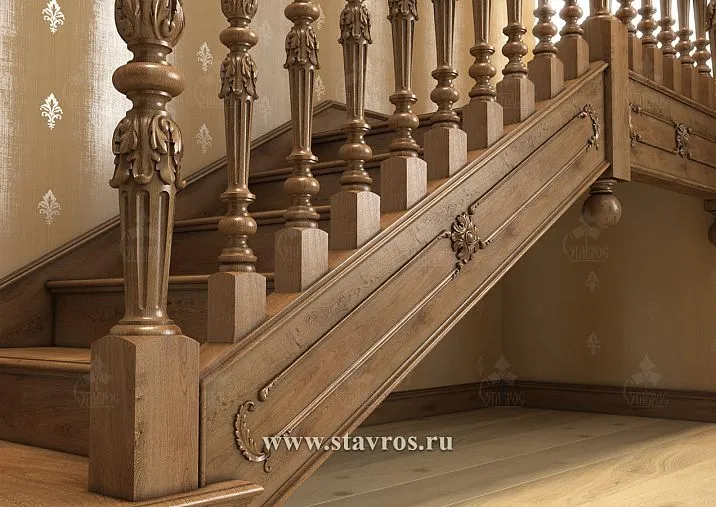
Turning craftsmanship is an ancient art that transforms an ordinary wooden block into an elegant architectural decoration. Turned balusters embodiment of the harmony between traditional craftsmanship and modern technologies, creating a unique atmosphere in any interior. These elegant supporting elements of stair railings not only perform a safety function — they become central design accents, demonstrating flawless mastery of turning art.
In the world of modern architecture, where every detail matters, turned balusters occupy a special place among decorative elements. Their rounded shapes and smooth transitions create visual softness, contrasting with the straight lines of modern interiors. Each turned baluster is the result of meticulous work by a master or a high-precision machine, where millimeter by millimeter, the ideal geometry is formed.
Turning balusters requires a deep understanding of wood properties, knowledge of technological processes, and artistic intuition. From selecting the blank to final finishing — each stage affects the quality of the finished product. Modern turned balusters combine classic proportions with innovative production technologies, creating products that meet the strictest quality and aesthetic requirements.


Turning art: from blank to masterpiece
Wood turning is a process that requires not only technical skills but also artistic vision. A master turner must feel the material, understand its structure and behavior under the cutting tool. The blank for turned balusters undergoes careful selection — the wood must be dry, free of knots and cracks, with the correct grain direction.
Blank centering is the first and critically important stage of turning. Even the slightest deviation from the axis of rotation will result in wobble and unevenness of the finished product. Experienced masters use special centers and faceplates to ensure perfect coaxiality. The rotation speed is individually selected for each wood species and blank diameter — too high may cause overheating and cracking, too low — poor surface quality.




Turner's toolset: precision in every movement
The gouge is the main tool for roughing, allowing quickly to give the blank an approximate shape. Its semicircular cutting edge effectively removes large volumes of material, creating the basis for further processing.
The parting tool is used for finishing and creating precise profiles. Its flat cutting edge allows forming straight sections, conical surfaces, and clear transitions between profile elements. The chisel is used for detailing small features, creating grooves and decorative elements. Each tool requires proper sharpening and skilled handling.
Profile cutters are specialized cutters for creating profiled surfaces. Their shape replicates the desired profile, allowing to create complex decorative elements in one pass. Modern masters use sets of profile cutters with different configurations, significantly expanding the possibilities of decorative processing.
Our factory also produces:


Classification of turned balusters by stylistic directions
Get Consultation
Classic Forms: Heritage of Centuries
Classic turned balusters are based on principles of ancient architecture, where each element has both functional and symbolic significance. The base — the lower supporting part, ensuring stable attachment to the step — traditionally has an expanded form for better load distribution.
The shaft — the central decorative part, where the main artistic elements are concentrated. A classic profile may include astragals — convex ring moldings, flutes — vertical grooves, entasis — a slight thickening in the middle, creating an optical illusion of perfect straightness.
The capital — the upper part of the baluster, serving to attach railings. In classic forms, it often repeats motifs of architectural orders — Doric, Ionic, or Corinthian. Proper proportions of all elements create a harmonious composition, pleasing to the eye.
Baroque Opulence in Turned Form
Baroque turned balusters are distinguished by complex forms and rich decorative elements. Dynamic profiles with alternating convex and concave sections create light and shadow play characteristic of this style. Multiple bands and rings of varying heights and diameters form a rhythmic composition.
A feature of baroque balusters is the asymmetry of some elements, creating a sense of movement and life. Spiral elements, produced on a lathe using special fixtures, add dynamism to the composition. Contrasting transitions between thin and thick sections emphasize the dramatic nature of the baroque style.
Modern Interpretation of Classicism
Modern turned balusters adapt classic forms to contemporary requirements. Simplified profiles retain the recognizability of traditional shapes but lack excessive ornamentation. Smooth transitions between elements create a sense of modernity and technological sophistication.
Minimalist solutions use simple geometric forms — cylinders, cones, spheres — creating concise yet expressive compositions. Turned Balusters in modern style often have monochromatic finishes, emphasizing the purity of form.
Wood Science: Choosing Wood for Turning
Hardwood Species
Oak remains the benchmark of quality for manufacturing turned balusters. Its density of 700-800 kg/m³ ensures excellent machinability on a lathe, allowing the creation of delicate details without risk of chipping. The fine-grained structure of oak after turning yields a perfectly smooth surface requiring minimal additional sanding.
Oak’s natural tannin content provides inherent protection against biological damage, which is especially important for elements subjected to intensive use. The color range of oak varies from light golden to rich brown tones, and over time, the wood develops a noble patina.
Ash attracts turners with its fibrous structure, which creates a distinctive pattern on turned surfaces. Density of 650-750 kg/m³ ensures excellent machinability while maintaining high strength. Ash’s contrasting texture is especially effective on cylindrical surfaces, where annual rings form beautiful concentric patterns.
Beech is distinguished by its uniform structure, making it an ideal material for creating turned balusters with complex profiles. Uniform density of 650-700 kg/m³ ensures consistent quality of machining along the entire length of the product. The small pores of beech after turning create a silk-like surface, pleasant to the touch.
Coniferous species: accessibility and practicality
Spruce is an optimal choice for manufacturing mass-produced turned balusters. Density of 400-500 kg/m³ ensures easy processing and low weight of finished products. Resinous structure provides natural protection against moisture and insects.
A feature of turning spruce is the need to account for resin pockets, which may create surface irregularities. Experienced turners use special processing techniques that allow them to turn these features into decorative elements. The contrast between light sapwood and dark heartwood creates a natural decorative effect.
Larch combines the advantages of coniferous and hardwood species. Density of 650-700 kg/m³ and high resin content ensure excellent machinability and durability. Natural resistance to moisture makes larch turned balusters ideal for use in variable humidity conditions.
Modern Turning Technologies
Blank Preparation: Foundation of Quality
The quality of turned balusters is established during the blank preparation stage. Wood drying must be conducted in specialized chambers with controlled temperature and humidity regimes. Final moisture content should not exceed 8-12% for internal structures and 15% for external ones.
Blank calibration is performed on a four-sided jointer, ensuring ideal geometry and surface smoothness. Dimensional accuracy at this stage is ±0.1 mm, which is critically important for subsequent centering on the lathe.
Blank end-cutting must ensure strictly perpendicular cuts without chips or scratches. Special end-cutting saws with fine-toothed discs are used for this purpose. Center marking is performed using special fixtures ensuring precise positioning of the blank on the machine.
Modern CNC Lathes
CNC lathes have revolutionized the production of turned balusters. They enable the creation of products with ideal geometry and absolute repeatability of parameters. Processing accuracy is ±0.05 mm, which is unattainable with manual turning.
The process begins with creating a control program based on the baluster’s drawing or 3D model. Modern CAM systems automatically generate tool movement trajectories, optimizing the processing process. Automatic tool change allows performing various operations without operator involvement.
CNC machine tools with built-in quality control systems continuously monitor the processing, automatically adjusting parameters when deviations occur. Vibration sensors prevent surface defects, while laser measuring devices control dimensions in real time.
Combined technologies
The highest quality turned balusters are created using combined technologies. Rough machining is performed on CNC machines, ensuring high productivity and geometric accuracy. Final finishing is done manually by skilled craftsmen.
This approach allows combining technological sophistication with traditional craftsmanship, creating products that are both flawless in quality and uniquely characterized. Manual finishing eliminates the tiniest defects and imparts individuality to the piece.
Design solutions and decorative elements
Classic profiles and their interpretations
Classic turned baluster profiles are based on mathematical proportions that create a harmonious perception. The golden ratio determines the relationship between main elements — base, shaft, and capital. Entasis — a slight thickening in the middle of the shaft — creates an optical illusion of perfect straightness.
Astyls — convex ring moldings of various diameters and heights — create a rhythmic composition. Their placement and proportions influence the overall perception of the baluster. Grooves — vertical channels — add play of light and shadow, enhancing the form's volume.
Transitional elements between main profile parts must be smooth and natural. Sharp transitions create stress concentrations and may lead to failure. Fillet radii are calculated based on strength requirements and aesthetic considerations.
Modern decorative techniques
Modern designers adapt classic techniques to today's requirements. Simplified profiles retain the recognizability of traditional forms but lack excessive ornamentation. Contrasting combinations of smooth and textured surfaces create interesting visual effects.
Asymmetric elements disrupt traditional symmetry, creating dynamic compositions. Spiral grooves, machined on a lathe, add movement to static forms. Modern turned balusters often use geometric motifs — rhombuses, triangles, polygons.
Surface texturing
Texturing turned surfaces opens new possibilities for decorative finishing. Longitudinal grooves of varying depths and widths create play of light and shadow. Transverse grooves add tactile quality to the surface.
Combining different types of textures on a single baluster creates complex decorative compositions. Polished and matte areas contrast with each other, emphasizing the product's shape. Patination of recesses creates an aged effect and highlights relief.
Technical requirements and quality standards
Geometric Parameters
Turned balusters must meet strict geometric requirements. The height of a standard baluster is 900 mm, ensuring comfortable railing height. The base diameter is usually within 50–80 mm, providing sufficient support area.
Alignment of all profile elements — a critical quality parameter. Deviation from the axis must not exceed 0.5 mm over the entire length of the baluster. Cylindrical sections are controlled using special gauges. Surface roughness after turning must not exceed Ra 3.2 μm.
Symmetry of decorative elements is ensured by precise lathe setup and use of quality tools. Transitions between profile elements must be smooth, without steps or irregularities.
Strength characteristics
Turned balusters must withstand significant loads. Calculated load is 100 kg/m for residential buildings and 150 kg/m for public buildings. Safety factor must be at least 2.5.
The resistance moment of a turned baluster depends on the minimum diameter in cross-section. This parameter is critically important for balusters with complex profiles, where thin sections may become stress concentration points. Bending tests are conducted for each production batch.
Fatigue strength is especially important for balusters subjected to dynamic loads. Cyclic tests simulate repeated loading during operation. High-quality turned balusters must withstand at least 100,000 cycles without signs of failure.
Methods of mounting and installation
Traditional connection methods
Dowel joint remains the most reliable method for attaching turned balusters. Wooden cylindrical dowels with a diameter of 8–12 mm provide strong connections without visible metal parts. Dowel depth must be at least 40 mm into each part.
Precise positioning of dowels along the axis of the baluster is especially important for turned balusters. Misalignment may cause structural misalignment. Adhesive bonding further strengthens the mechanical connection between elements. Wood glue PVA or polyurethane-based adhesives are used.
Dowel-and-slot joints require high manufacturing precision but provide maximum strength. Dowel dimensions are calculated based on baluster diameter and expected loads. Conical dowels ensure tight fit and compensate for wood shrinkage.
Modern fastening systems
Metallic threaded rods M8–M10 provide exceptional joint strength. They are especially effective for of turned balusters with large diameterswhere traditional methods may prove insufficient.
Threaded inserts allow creating disassemblable joints, simplifying transportation and installation. Concealed fastening ensures aesthetic joint appearance while maintaining high strength. Adjustable connectors allow compensating for minor geometric deviations in the structure.
Specialized hardware includes corner connectors that allow mounting balusters at various angles. This is especially important for spiral staircases and structures with complex geometry.
Surface treatment and protective coatings
Surface grinding of turned balusters
Grinding turned balusters requires a special approach due to profile complexity. Cylindrical sections are processed on specialized CNC grinders. Profiled elements are ground manually using special grinding blocks.
Abrasive grit gradually decreases from P120 to P320. Each grinding stage must completely remove traces of the previous one. Inter-stage dust cleaning is critically important for surface quality.
Grinding quality control is performed visually and with special feelers. Surface roughness of the finished surface must not exceed Ra 1.6 μm. Uniformity of processing is controlled along the entire length of the baluster.
Protective coatings
The choice of finish depends on usage conditions and aesthetic requirements. Transparent varnishes highlight the natural beauty of wood and the relief of carved surfaces. Polyurethane compositions provide maximum wear resistance.
Oil-based finishes provide natural protection by penetrating the wood structure. They are especially effective on carved surfaces, emphasizing the play of light and shadow. Wax-based compositions give surfaces a silky texture and pleasant tactile sensations.
Tinting compositions allow changing the color of wood, creating an aging effect or imitating valuable species. Patination of profile recesses creates an additional decorative effect.
Quality control and testing
Geometric control
Geometric control of carved balusters is performed at all production stages. Incoming inspection of blanks includes checking dimensions, moisture content, and absence of defects. Operational control is conducted after each technological stage.
Measuring tools include vernier calipers, micrometers, gauges, and templates. Coordinate measuring machines ensure high precision for controlling complex profiles. Optical systems allow controlling surface quality.
Statistical quality control allows identifying trends and preventing defects. Control charts are maintained for all critical parameters. Corrective actions are taken when the process exceeds established limits.
Strength Testing
Static tests are conducted on special stands. At the midpoint of the span, balusters fixed at both ends are loaded. Deflection must not exceed L/300, where L is the baluster length.
Dynamic tests simulate real operating conditions. Cyclic loading at 1 Hz is performed for a specified number of cycles. Fatigue strength is assessed by the absence of cracks and residual deformations.
Impact tests check resistance to random mechanical impacts. Impact energy is regulated depending on the baluster's purpose. Impact toughness is especially important for products made from hardwoods.
Economic Aspects of Production
Pricing Factors
The cost of carved balusters depends on many factors. Wood species is the primary pricing factor. Oak balusters cost 2-3 times more than pine ones, and exotic species cost 5-10 times more than domestic ones.
Profile complexity directly affects labor costs. Simple cylindrical balusters with minimal decoration are significantly cheaper than those with complex multi-element profiles. Processing accuracy also affects cost — furniture-grade products cost more than construction-grade ones.
Batch size significantly affects the cost per unit. Large orders allow optimizing equipment setup and reducing unit costs. Individual orders based on exclusive drawings cost significantly more than mass production.
Economic Efficiency
Long-term savings are achieved through the high quality of carved balusters. The service life of quality hardwood balusters is 50-100 years, significantly exceeding that of cheaper alternatives.
Maintenance cost of quality carved balusters is minimal. They require only periodic renewal of protective coatings and simple care. Repairability of wooden items allows restoring them upon local damage.
Impact on property value is an important factor in budget planning. Quality stair railings with carved balusters significantly increase a home's attractiveness to potential buyers.
Trends in development and innovation
New processing technologies
Laser processing opens new possibilities for decorating carved surfaces. A laser beam can create micro-relief unattainable by traditional methods. Process programmability allows creating unique patterns and textures.
Ultrasonic processing allows obtaining surfaces with ideal smoothness without abrasives. This is especially important for hardwoods, where traditional sanding may be difficult.
Plasma surface treatment improves adhesion of protective coatings and can alter the physical-chemical properties of the wood surface layer. Nanotechnologies in protective coatings provide a fundamentally new level of protection.
Ecological Innovations
Zero-waste technologies allow using all wood processing by-products. Shavings from turning go to producing wood panels, sawdust to fuel briquettes. Closed production cycles minimize environmental impact.
Biodegradable coatings based on vegetable oils and waxes replace synthetic compositions. Renewable energy in production reduces the product's carbon footprint. Local materials reduce transportation costs.
Conclusion
Carved balusters represent a unique combination of traditional craftsmanship and modern technologies. Their elegant forms and flawless quality can transform any space, turning an ordinary staircase into a work of architectural art. Carved balusters production requires deep knowledge, technical skill, and artistic sense.
Modern production technologies open new possibilities for creating unique items, but the foundation of quality remains understanding material properties and traditional turning art. Each carved baluster is the result of meticulous work, where every detail and each millimeter of profile matters.
Investments in quality carved balusters pay off through longevity, functionality, and aesthetic perfection. They become not just structural elements, but works of applied art that delight the eye and create a unique atmosphere in the home.
The future of carved balusters is linked to the development of new processing technologies, eco-friendly materials, and customized production. However, no matter how advanced the technologies, the foundation will remain the pursuit of beauty, quality, and perfection — principles that make carved balusters an indispensable part of architectural heritage.
STAVROS Company has specialized for many years in producing high-quality solid wood items, including exclusive carved balusters. Combining centuries-old turning craftsmanship with modern technologies, STAVROS creates items distinguished by flawless quality, original design, and durability. Each STAVROS carved baluster is the result of careful material selection, professional craftsmanship, and strict quality control at every production stage, making STAVROS products a benchmark in creating architectural elements capable of transforming any space and becoming a source of pride for their owners.