Article Contents:
- Technological Revolution in the World of Woodworking
- Evolution from Manual Labor to Digital Perfection
- File Formats and Their Characteristics
- Design Possibilities and Stylistic Directions
- Classic Motifs in Digital Execution
- Modern Interpretations of Traditional Forms
- Avant-Garde Solutions and Experimental Forms
- Technical Aspects of Creating and Processing STL Models
- Software for Modeling
- Model Optimization for Production
- Materials and Their Characteristics in CNC Machining
- Wood Species for Digital Production
- Composite and Alternative Materials
- Technological processes and equipment
- Modern CNC Machines for Woodworking
- Tooling Equipment
- Software for Production Preparation
- CAM Systems for Woodworking
- Simulation and Verification
- Quality Control and Post-Processing
- Measurement Technologies
- Final finishing
- Economic Aspects of Digital Production
- Cost Analysis
- Scaling Production
- Technology Development Prospects
- Artificial Intelligence in Design
- New materials and technologies
- Practical Recommendations for Working with STL Models
- Model Selection and Adaptation
- Production Process Optimization
- Conclusion
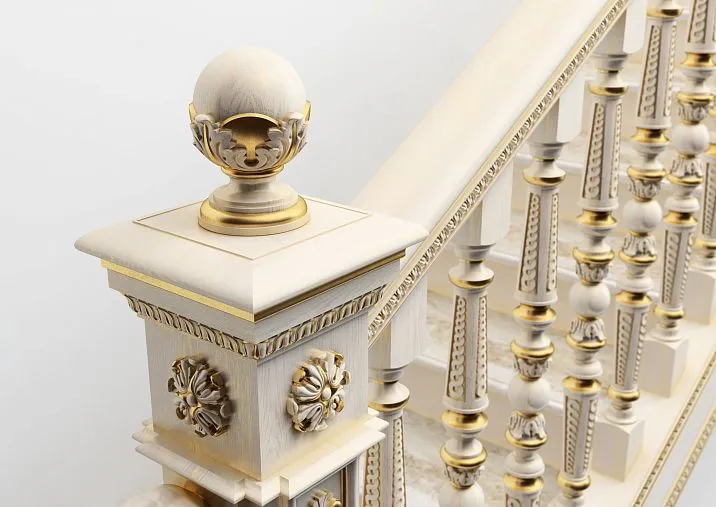
Imagine a world where every architectural fantasy can become reality with just one click. Where centuries-old craftsmanship traditions merge with cutting-edge technologies, creating incredible opportunities for creativity. STL Balusters open exactly such horizons — these are not just files, they are keys to an unlimited world of architectural perfection.
The modern era of digital production has fundamentally changed approaches to creating decorative elements. What once required months of meticulous manual labor can now be accomplished in hours with mathematical precision and artistic perfection. STL baluster models have become a bridge between virtual design and physical realization, opening new possibilities for architects, designers, and craftsmen around the world.


Technological Revolution in the World of Woodworking




Evolution from Manual Labor to Digital Perfection
Woodworking has undergone an incredible journey from primitive tools to high-tech computer numerical control machines. Each stage of this evolution brought new possibilities, but nothing compares to the revolution brought by STL technologies. These 3D models have turned the creation of complex decorative elements into an exact science, where every line and curve is calculated with mathematical precision.
CNC machines equipped with modern software can interpret STL files with incredible accuracy. Each polygon of the 3D model is converted into a toolpath, creating products that surpass even the work of the most skilled artisans of the past. Processing accuracy reaches hundredths of a millimeter, ensuring perfect repeatability and flawless quality of each item.
Multi-axis machining opens up possibilities for creating complex spatial forms. Modern 5-axis machines can machine a workpiece at any angle, creating undercutting, through holes, and complex reliefs that are impossible to achieve with traditional methods. This is especially important when manufacturing balusters with deep carving and intricate ornamentation.
Automation of processes allows producing series of identical items without operator involvement. Modern machines can operate autonomously for entire days, ensuring stable quality and high productivity. This fundamentally changes the economics of production, making complex decorative elements accessible to a broad range of consumers.
Our factory also produces:




File formats and their characteristics
The STL (STereoLithography) format has become the de facto standard for transmitting 3D geometry between different systems. Its simplicity and universality have ensured widespread adoption in the industry. Each surface of the model is represented by multiple triangular facets, allowing the description of any complexity with specified accuracy.
Model resolution is determined by the number of polygons per unit area of the surface. High resolution ensures accurate transmission of fine details, but increases file size and processing time. Optimal resolution for balusters is 0.1–0.2 mm, which ensures excellent quality with a reasonable file size.
The model's topology must be correct for successful CNC machining. The model must represent a closed volume without self-intersections or holes in the geometry. Modern CAM systems include tools for automatic checking and correction of topological errors.
Get Consultation
Design possibilities and stylistic directions
Classic motifs in digital execution
Classic architectural styles find new embodiment in STL baluster models. Each historical period left its unique mark on decorative art, and modern technologies allow recreating these masterpieces with incredible precision.
Baroque balusters impress with their opulence and ornamentation. Complex volutes, acanthus leaves, putti, and garlands—all these elements require the highest level of craftsmanship for manual execution. STL models allow recreating the entire complexity of Baroque decoration with mathematical precision, while preserving the liveliness and dynamism of the original works.
Neoclassicism introduced strict proportions and restrained decoration into architecture. Balusters in the classical style feature clear geometric forms, fluting, and minimalist capitals. STL models of classical balusters are ideal for creating interiors in the spirit of antiquity, where every detail adheres to strict canons of beauty.
Empire, with its imperial opulence, requires a special approach to decoration. Eagles, laurel wreaths, fasces, and other symbols of power must be executed with particular care. Digital models allow recreating the entire symbolism of Empire in minute details.
Modern interpretations of traditional forms
Modern design does not reject classical forms, but reinterprets them in a new context. STL baluster models allow creating unique interpretations of traditional motifs, adapted to modern interiors.
Minimalist forms require special attention to proportions and surface quality. The absence of decorative elements makes every imperfection noticeable, so STL models must be created with particular care. Modern technologies allow creating perfectly smooth surfaces with precise geometric transitions.
Parametric modeling opens new possibilities for creating unique forms. Algorithmic approaches to geometry generation allow creating balusters with mathematically precise proportions and organic forms inspired by natural objects.
Hybrid styles combine elements from different eras and directions, creating unique design solutions. STL technologies allow easily combining different decorative elements, creating original compositions.
Avant-garde solutions and experimental forms
Digital technologies open boundless possibilities for experimenting with form and decoration. Modern designers create balusters that could not be manufactured using traditional methods.
Topological optimization allows creating structures with minimal weight and maximum strength. Optimization algorithms analyze load distribution and create structures resembling natural forms—bones, shells, plants.
Fractal geometry introduces elements of self-similarity and infinite complexity into baluster design. Fractal ornaments create amazing visual effects that change depending on the scale of observation.
Voxel modeling allows creating objects with internal structure invisible from the outside. Such balusters may have hidden cavities, lighting channels, or complex internal constructions.
Technical aspects of creating and processing STL models
Software for modeling
Creating high-quality STL baluster models requires professional software and deep knowledge of 3D modeling principles. Different programs offer different approaches to creating complex geometry.
Parametric CAD systems such as SolidWorks, Inventor, or Fusion 360 are ideal for creating technically accurate models with the ability to subsequently edit parameters. These programs allow creating associative models, where changing one parameter automatically recalculates the entire geometry.
Polygonal editors such as 3ds Max, Maya, or Blender provide artists with tools for creating complex organic forms. These programs are especially effective when working with decorative elements and complex surfaces.
Specialized programs for wood carving, such as ArtCAM or ZBrush, offer unique tools for creating reliefs and decorative elements. These programs allow working with models as if with sculptural clay, creating organic forms.
Model optimization for production
Creating an STL model is only the first step. For successful production, the model must be optimized according to the characteristics of CNC machining.
Analyzing manufacturability allows identifying problematic areas of the model that may cause difficulties during processing. Deep grooves, sharp internal angles, thin walls — all these elements require special attention when planning the technological process.
Adding technological elements includes creating fixtures for holding the blank, machining allowances, and technological holes. These elements are not part of the final product but are critically important for successful production.
Dividing complex models into separate components can significantly simplify production. Complex balusters are often manufactured in several parts that are then glued or mechanically assembled.
Materials and their characteristics in CNC machining
Wood species for digital production
Material selection plays a critical role in successfully manufacturing balusters from STL models. Different wood species have their own characteristics that must be considered when programming the machine.
Hard hardwoods such as oak, beech, and maple provide excellent surface quality and allow creating fine details. High wood density requires using sharp cutters and optimal cutting parameters. Feed rate should be reduced to prevent chipping and ensure clean machining.
Soft coniferous species such as pine and spruce are easy to process but require special attention to grain direction. Resin content in some coniferous species may cause chip adhesion to the cutter, requiring frequent tool cleaning.
Exotic species offer unique aesthetic qualities but may have non-uniform structure, inclusions, and other features that complicate processing. Each exotic species requires an individual approach to selecting cutting parameters.
Composite and alternative materials
Modern technologies allow processing not only natural wood but also a wide range of composite materials.
Wood-polymer composites (WPC) combine the advantages of wood and polymers. They are resistant to rot, do not require protective treatment, and provide stable dimensions. WPC is easily machinable on CNC machines and allows creating fine details without chipping.
High-density MDF is an ideal material for creating prototypes and master models. Uniform structure ensures excellent surface quality and allows creating the finest details.
Plastics of various types open new possibilities for creating balusters with unique properties. Some plastics allow creating translucent or glowing elements, opening new design possibilities.
Technological processes and equipment
Modern CNC woodworking machines
The quality of the finished product directly depends on the characteristics of the equipment used. Modern CNC woodworking machines are high-tech complexes capable of performing complex operations.
3-axis milling machines remain the foundation of baluster production. Modern models provide positioning accuracy down to 0.01 mm and spindle speeds up to 24,000 rpm. Rigid machine base construction and precision guides ensure stable machining even under high loads.
4-axis machines with a rotating axis allow processing cylindrical blanks without repositioning. This is especially important for manufacturing balusters with complex shapes and circular ornaments. Synchronization of movement of all axes ensures smooth transitions and excellent surface quality.
5-axis machining centers represent the pinnacle of technological development. The ability to move simultaneously along five axes allows creating items of any complexity in a single setup. This is critically important for balusters with deep grooves and complex spatial geometry.
Tooling equipment
The quality of STL model processing largely depends on the correct selection of cutting tools. The modern industry offers a wide range of cutters for various operations.
End mills of various diameters provide roughing and finishing operations. The geometry of the cutting edge is optimized for wood — large cutting angles and polished surfaces minimize cutting forces and prevent chip adhesion.
Ball end mills are indispensable for processing complex curved surfaces. The spherical shape of the cutting edge allows creating smooth transitions and machining areas with small radii of curvature.
Specialized cutters for decorative carving have unique geometry optimized for creating specific types of ornamentation. V-shaped cutters create sharp lines, conical cutters — smooth transitions, and cutters with complex profiles allow creating finished decorative elements in a single pass.
Software for production preparation
CAM systems for woodworking
Converting an STL model into a machine control program is a complex technological process requiring specialized software.
Universal CAM systems such as Mastercam, PowerMill, or NX CAM offer powerful tools for programming complex machining operations. These systems allow creating optimal toolpaths taking into account the geometry of the part and equipment characteristics.
Specialized programs for woodworking, such as ArtCAM or Aspire, are optimized for working with decorative elements. They include libraries of ready-made machining strategies and tools for creating reliefs.
Cloud solutions are becoming increasingly popular due to their accessibility and ease of use. Such platforms allow you to upload an STL model and obtain a ready-to-use control program without needing to learn complex software.
Simulation and Verification
Modern CAM systems include powerful simulation tools that allow you to verify the correctness of the control program before starting actual machining.
Geometric simulation shows the tool's movement trajectory and allows you to identify potential collisions. This is especially important when machining complex models with deep undercuts.
Physical simulation takes into account the real properties of the material and tool, allowing you to predict surface quality and identify problematic areas. Such simulation helps optimize cutting parameters and minimize machining time.
Analysis of remaining material shows which parts of the model will not be machined due to tool or machine kinematic limitations. This allows you to adjust the machining strategy or divide the model into multiple operations.
Quality Control and Post-Processing
Measurement Technologies
Quality control of items manufactured from STL models requires modern measurement technologies capable of assessing the conformity of the finished product to the digital model.
Coordinate Measuring Machines (CMM) provide highly accurate measurements of geometric parameters. Modern CMMs are equipped with scanning heads, allowing them to quickly digitize the product's surface and compare it with the original STL model.
Optical scanners allow you to obtain a complete 3D model of the finished product within minutes. Comparing the scanned model with the original STL file reveals deviations and allows you to assess the quality of the machining.
Laser interferometers provide measurements accurate to fractions of a micrometer. Such precision is necessary for controlling critical dimensions and surfaces.
Final finishing
Items produced on CNC machines often require additional finishing operations to achieve the required surface quality.
Sanding remains the primary method of finishing wooden items. Modern sanding materials allow you to achieve a mirror-like surface finish when used correctly.
Polishing with special compounds creates a protective layer and highlights the natural beauty of wood. Different types of polishes provide matte, semi-gloss, or glossy finishes.
Staining and painting allow you to change the color of the item or emphasize the wood grain texture. Modern stains provide even coverage even on complex relief surfaces.
Economic Aspects of Digital Production
Cost Analysis
The adoption of STL technologies fundamentally changes the economics of baluster production. A proper analysis of all cost components allows you to make reasoned decisions about the feasibility of using digital technologies.
Equipment cost includes not only the purchase price of the machine but also installation, setup, and staff training expenses. Modern CNC machines require significant investments but provide high productivity and quality.
Operating expenses include the cost of electricity, consumables, and equipment maintenance. Energy-efficient machines and optimized machining programs allow you to minimize these costs.
The cost of STL models varies widely depending on complexity and uniqueness. Ready-made models are significantly cheaper than custom development, but they limit creative possibilities.
Mass Production Scaling
Digital technologies provide unique opportunities to scale production without proportionally increasing costs.
Batch production becomes economically viable even for small batches. The absence of need for special fixtures allows you to quickly switch from one model to another.
Product customization does not require additional production preparation costs. Changing dimensions or decorative elements is accomplished by simply editing the STL model.
Geographic distribution of production becomes possible due to the digital nature of STL files. One model can be simultaneously produced at various facilities around the world.
Prospects for technology development
Artificial intelligence in design
The development of artificial intelligence technologies opens new opportunities for automating the creation of STL baluster models.
Generative design uses machine learning algorithms to create optimal shapes based on specified criteria. AI can generate thousands of design variations and select the best ones in terms of aesthetics, functionality, and manufacturability.
Style transfer allows applying distinctive features of one style to the basic geometry of a baluster. Neural networks are trained on examples of historical styles and can create new interpretations of classical motifs.
Production optimization using AI includes automatic selection of optimal machining strategies, cutting parameters, and operation sequences. Machine learning allows accumulating experience and continuously improving production quality and efficiency.
New materials and technologies
Advancements in materials science open new possibilities for creating balusters with unique properties.
Next-generation composite materials combine the strength of metals, the lightness of plastics, and the aesthetics of wood. Such materials enable the creation of structures impossible with traditional materials.
Smart materials with changing properties can be used to create adaptive balusters. Materials that change color depending on temperature or lighting open up new design possibilities.
Hybrid technologies combine subtractive (milling) and additive (3D printing) manufacturing methods. This allows creating items with complex internal structures and embedded functional elements.
Practical recommendations for working with STL models
Model selection and adaptation
Successful Use STL Balusters requires a proper approach to selecting and adapting models to specific project requirements.
Analysis of technical requirements includes defining dimensions, material, surface quality requirements, and allowable deviations. These parameters determine the selection of an appropriate model and necessary modifications.
Checking compatibility with existing equipment is critically important for successful production. The size of the machine's working area, spindle power, available tools — all these factors affect the feasibility of manufacturing a specific model.
Scaling and modifying STL models requires an understanding of the format's characteristics. Simple scaling may result in distortion of small details' proportions, so more complex adaptation is often required.
Production Process Optimization
Effective use of STL technologies requires a comprehensive approach to organizing the production process.
Equipment loading planning must consider processing times for different models and opportunities for combining operations. Modern production management systems allow optimizing machine loading and minimizing downtime.
Model library management includes cataloging, versioning, and access control for STL files. Proper library organization significantly speeds up finding required models and prevents errors.
Standardizing processes ensures stable quality and allows easy scaling of production. Developing standard operating procedures for working with different types of models increases efficiency and reduces errors.
Conclusion
World 3D Balusters STL represents a remarkable intersection of tradition and innovation, where centuries-old woodworking craftsmanship meets advanced digital technologies. This revolution has not only changed production methods — it has fundamentally expanded the boundaries of what is possible, opening new horizons for creativity and self-expression.
Modern STL technologies have democratized access to complex decorative elements, making them available not only for elite projects but also for a broad range of consumers. The precision of digital manufacturing ensures quality surpassing the best handcrafted examples, while the speed of production enables the realization of the most ambitious projects in the shortest time.
The economic efficiency of STL technologies is evident not only in reducing production costs but also in the ability to create unique items without additional tooling expenses. This opens new business models and allows small enterprises to compete with large manufacturers.
The future of the industry lies in further development of artificial intelligence, new materials, and hybrid manufacturing technologies. Generative design, smart materials, integration with the Internet of Things — all of these are already changing our perception of what decorative elements of tomorrow’s world may look like.
Environmental aspects of digital manufacturing also deserve special attention. Precise material planning, waste minimization, and the possibility of using recycled materials — all of this makes STL technologies an important tool for sustainable industry development.
The educational component plays a key role in spreading new technologies. Modern masters must combine traditional woodworking skills with knowledge of digital technologies. This requires new approaches to education and continuous improvement of professional skills.
The quality of STL models remains a critical factor for success. Investments in professional models from reputable developers pay off multiple times due to the stable quality of finished products and absence of production issues.
STAVROS Company, understanding the importance of technological progress, actively implements advanced solutions in the production of wooden items. The combination of traditional craftsmanship with modern digital technologies allows creating products meeting the highest standards of quality and aesthetics. Every STAVROS product is the result of a harmonious blend of centuries-old traditions and innovative technologies, embodying the dream of perfection in every detail.