Article Contents:
- Natural Advantages of Siberian Larch
- Unique Wood Structure
- Climate Resistance
- Technical specifications and operational properties
- Strength characteristics
- Biological Durability
- Aesthetic qualities and design possibilities
- Natural Texture Beauty
- Possibilities of decorative finishing
- Technological aspects of production
- Raw Material Preparation and Drying
- Mechanical processing
- Design variants and stylistic solutions
- Classic Forms
- Modern Interpretations
- Installation and Mounting of Larch Balusters
- Preparatory work
- Installation technology
- Protective coatings and final processing
- Selection of Protective Compounds
- Application technology
- Operation and Maintenance
- Daily care guidelines
- Preventive maintenance
- Economic aspects of selection
- Cost Comparison
- Pricing factors
- Ecological advantages
- Sustainable forestry
- Impact on Room Microclimate
- Conclusion
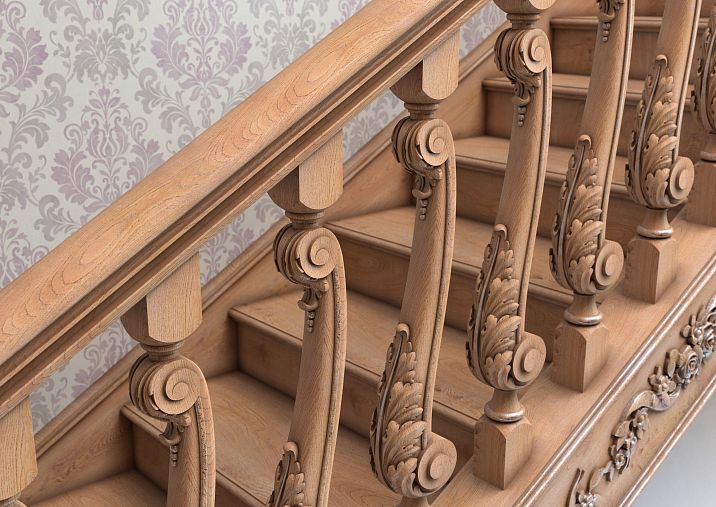
When it comes to creating stair railings capable of withstanding time and nature’s whims, attention inevitably turns to the northern forests of Siberia. It is there that this remarkable tree grows, whose wood rightfully ranks among the most valuable construction materials. Larch Balusters embodiment of Siberian nature’s power, combining unmatched strength with the refined beauty of natural wood.
What makes larch so special? The secret lies in its unique wood composition, rich in natural resins and tannins. These natural preservatives turn each baluster into a true bastion against moisture, mold, and insect pests. Larch density reaches 665 kg/m³, comparable to oak, yet the material retains excellent workability and aesthetic appeal.
Modern processing technologies allow us to fully unleash the potential of this remarkable material. Each baluster becomes a work of art, where the natural wood grain harmoniously combines with the precision of machine processing. The result exceeds all expectations — stair railing elements that will serve for decades, preserving their original beauty and functionality.


Natural Advantages of Siberian Larch




Unique Wood Structure
Siberian larch has formed over centuries in harsh climatic conditions, endowing its wood with exceptional properties. Slow growth in the short northern summer creates a dense structure with narrow annual rings. Such wood is characterized by high strength and dimensional stability.
The resin content in larch ranges from 12-18%, significantly exceeding that of other coniferous species. This resin contains arabinogalactan — a natural polysaccharide with antimicrobial properties. When exposed to moisture, the resin polymerizes, forming a protective barrier that prevents water from penetrating the wood structure.
The mineral composition of larch also deserves attention. High silicon content adds additional hardness to the wood, while tannins provide natural protection against biological damage. These substances not only protect the material but also impart a distinctive golden-amber hue, which becomes even more noble over time.
The fibrous structure of larch is distinguished by exceptional density and uniformity. The interweaving of fibers creates a natural reinforcement that prevents cracking and deformation of products. This is especially important for balusters, which experience various loads during operation.
Our factory also produces:


Climate Resistance
Larch’s ability to withstand extreme weather conditions makes it an ideal material for manufacturing stair components. The wood withstands temperature fluctuations from -60°C to +40°C without losing its performance properties. Larch’s coefficient of thermal expansion is minimal, preventing structural deformation during seasonal changes.
Larch’s moisture resistance exceeds that of most construction materials. Water absorption is only 2-3% when fully submerged, which is several times less than that of pine or spruce. This feature allows larch balusters to be used not only indoors but also on open terraces, balconies, and other areas with high humidity.
The material’s frost resistance has been proven over centuries of use in northern regions. Larch does not lose strength during multiple freeze-thaw cycles. Moreover, low temperatures contribute to additional compaction of the wood structure, enhancing its mechanical properties.
Ultraviolet radiation practically does not affect larch’s structure. The wood does not fade or lose color under sunlight. On the contrary, exposure to light causes a natural patina to form on the surface, giving the products a unique elegance and charm.
Get Consultation
Technical characteristics and operational properties
Strength Indicators
Larch’s mechanical properties place it alongside elite wood species. The compressive strength along the grain reaches 64 MPa, comparable to oak. At the same time, larch exhibits greater elasticity, enabling it to withstand dynamic loads without breaking.
Hardness by Brinell reaches 2.6 kN/mm², ensuring high wear resistance of products. Larch balusters do not develop dents or scratches under normal use. The surface retains its original smoothness and attractiveness for many years.
Larch’s modulus of elasticity is 13 GPa, characterizing the material as sufficiently rigid to withstand loads without significant deformation. Simultaneously, the wood retains a certain degree of flexibility, preventing brittle failure when exceeding calculated loads.
Larch’s impact toughness is 1.5 times higher than that of pine. This means the material can absorb impact energy without breaking. For stair structures, this is especially important, as they are subjected to various dynamic loads.
Biological Durability
Larch’s natural resistance to biological damage is unmatched among coniferous species. High content of extractive substances creates an unfavorable environment for the development of fungi, mold, and wood-boring insects. Larch’s biological resistance class is the highest, confirmed by numerous studies.
The antimicrobial properties of wood are due to the presence of dihydroquercetin — a powerful natural antioxidant. This substance not only protects the material from biological damage but also prevents oxidative processes that may lead to degradation of the wood structure.
Resistance to insects is especially important under modern construction conditions. Larch contains natural repellents that deter termites, bark beetles, and other pests. Even in tropical conditions, larch products are not attacked by insects.
The fungicidal properties of the material are manifested in its ability to suppress the development of various types of fungi. Spores cannot adhere to the surface of larch and germinate within its structure. This is especially important under high humidity conditions, where other wood species may quickly be affected by mold.
Aesthetic qualities and design possibilities
Natural beauty of texture
The visual appeal of larch lies in the unique combination of color and texture. The sapwood has a light yellow hue that gradually transitions into a golden-brown heartwood. The contrast between these zones creates an expressive pattern that cannot be artificially reproduced.
The annual rings of larch are distinct and uniform. Early wood is lighter than late wood, creating a characteristic striped appearance. Radial cutting produces a beautiful striped pattern, while tangential cutting yields wavy patterns reminiscent of brocade fabrics.
The resin canals in larch wood are small and evenly distributed, not disrupting the overall harmony of the texture. After processing, they create additional accents that emphasize the natural origin of the material. These features make each baluster unique and irreplaceable.
The color palette of larch varies from light yellow to dark brown with a reddish tint. Under the influence of light, a natural patina develops, deepening the color and giving the wood an elegant appearance. This process continues for years, continuously improving the appearance of finished products.
Decorative processing possibilities
Larch is exceptionally suitable for various types of mechanical processing. Turning on a lathe allows creating balusters with classic forms featuring smooth transitions and elegant profiles. The dense structure of the wood ensures clean processing without chips or scratches.
Milling opens up wide possibilities for creating decorative elements. Larch allows executing fine reliefs, spiral grooves, and complex ornaments. The high hardness of the material guarantees that fine details will not be damaged during use.
Carving larch requires certain skills due to the high density of the wood, but the result exceeds all expectations. The material allows creating extremely fine details with sharp edges and deep cuts. Carved elements retain clear forms for many years.
Sanding larch yields excellent results. The surface acquires a silky smoothness and pleasant gloss. The small pores of the wood create a unique tactile texture that emphasizes the natural origin of the material.
Technological aspects of production
Log preparation and drying
The quality of finished balusters largely depends on the proper preparation and processing of the raw material. Larch for producing stair elements is harvested during winter, when sap movement is minimal. This ensures dimensional stability and reduces the risk of cracking during drying.
Drying larch is a more complex process than processing other coniferous species. High density and resin content require a special temperature regime. Kiln drying is conducted at 45-55°C, gradually increasing to 70°C. The process takes 3-4 weeks to achieve a moisture content of 8-12%.
Stress stabilization in wood is achieved through intermediate steam treatment. This allows removing internal stresses that may lead to deformation of finished products. Properly dried larch practically does not change dimensions with fluctuations in air humidity.
Quality control during drying includes measuring moisture content at various points of the log. Uneven drying may lead to cracking and deformation. Modern technologies allow achieving uniform moisture content throughout the wood volume with deviation no more than 2%.
Mechanical processing
Processing larch requires using special tools with hard alloy cutting edges. High density and abrasiveness of the wood quickly dull ordinary steel cutters. Properly selected cutting modes ensure clean processing and extend tool life.
Turning larch is performed at reduced speeds with increased feed. This prevents overheating of the wood and resin exudation, which may clog the cutting tool. Cooling the cutting zone with compressed air improves processing quality.
Milling decorative elements requires special attention to tool sharpening. Cutting angles must be optimized for processing dense wood. Feed rate is selected depending on the complexity of the profile and cutting depth.
Sanding larch begins with coarse abrasives of 80-100 grit. Gradually move to finer grits — 150, 220, 320. Final finishing with 400-600 grit abrasive imparts a mirror-like smoothness to the surface.
Design variations and stylistic solutions
Classic Forms
Traditional Larch Balusters embodiment of centuries-old traditions of wooden architecture. Classic proportions with widening in the central part create a sense of stability and reliability. Smooth transitions between profile elements emphasize the plasticity of the material and the craftsmanship of execution.
Grooved balusters with vertical channels evoke classical architecture. Larch allows creating sharp edges without chips or scratches. Play of light and shadow on the relief surface creates additional decorative effects.
Twisted balusters fully demonstrate the material's capabilities. Spiral grooves require exceptional skill to manufacture, but the result impresses with elegance and dynamism of forms. Larch retains the clarity of the spiral throughout its service life.
Balusters with carved elements represent the pinnacle of decorative art. Floral ornaments, geometric patterns, stylized figures — all of this can be realized in larch. High hardness of the material guarantees preservation of the finest details.
Modern Interpretations
Minimalist balusters with square or rectangular cross-sections meet modern design requirements. Simplicity of forms highlights the natural beauty of larch. Absence of decorative elements draws attention to the texture and color of the wood.
Asymmetric forms create dynamic compositions in modern interiors. Larch allows implementing the most daring design ideas due to its strength and workability. Unusual profiles become accent elements of stair construction.
Combined solutions combine larch with other materials. Metal inserts, glass elements, stone details — all of this harmoniously combines with the warm texture of wood. Contrast of materials creates expressive compositions.
Perforated balusters with cut-out patterns demonstrate new possibilities for processing larch. Modern CNC machines allow creating complex lace-like compositions. Such items become true works of art.
Installing and mounting larch balusters requires careful preparation of the base. The stair surface must be perfectly level and cleaned of dust and debris. Marking the mounting locations is done with millimeter precision, as any deviations will be noticeable in the finished structure.
Preparation Work
The choice of fasteners depends on the staircase construction and expected loads. For larch, stainless steel fasteners are recommended, as they are corrosion-resistant and ensure long-lasting connections. The diameter of the fasteners should match the baluster dimensions.
Pre-drilling holes is mandatory when working with larch. High wood density may cause cracking when driving screws without prior preparation. The drill bit diameter should be 70-80% of the fastener diameter.
Treating mounting areas with antiseptic compounds provides additional protection against moisture and biological damage. Special attention is given to end surfaces, which are most susceptible to moisture penetration.
Baluster installation begins with mounting the end pieces, which serve as reference points for all others. Vertical alignment is checked with a level in two planes. Even minor deviations at this stage will result in visible defects throughout the entire structure.
Installation technology
Intermediate balusters are installed using a template or guide string. The distance between elements must be uniform along the entire length of the staircase. The standard spacing is 100-150 mm, depending on design and safety requirements.
Mounting to treads can be done in various ways. The most reliable method is through-bolting with decorative caps. An alternative is using long screws driven at an angle into the tread end.
Installing the handrail completes the guardrail assembly. The larch handrail is attached to the balusters using a handrail bracket or special connecting elements. All connections must be rigid and free of play.
Although larch has natural durability, additional protection extends the lifespan of the product and preserves its appearance. The choice of protective coating depends on usage conditions and aesthetic preferences. Water-based varnishes are suitable for indoor use, while alkyd or polyurethane coatings are recommended for outdoor applications.
Protective coatings and final finishing
Selection of protective compositions
Oil-based impregnations deeply penetrate the wood structure, enhancing its natural beauty. They do not form a surface film, preserving the tactile sensation of wood. Oils are easily repairable in case of localized damage.
Wax coatings provide a silky sheen and pleasant tactile texture. Wax protects against moisture and dirt while allowing the wood to "breathe". Such coatings are especially popular in eco-friendly interiors.
Varnish coatings provide maximum protection against mechanical damage and moisture. Modern water-based formulations have no odor and dry quickly. Matte varnishes preserve the natural wood appearance, while glossy varnishes accentuate texture and color.
Surface preparation before applying coating includes thorough sanding and dust removal. Larch must be dry — humidity should not exceed 12%. Room temperature and humidity must comply with the manufacturer’s recommendations for the coating.
Application Technology
The first coat is applied thinly and evenly. For larch, it is recommended to use primers that equalize the wood’s absorption capacity and improve the adhesion of the final coating. After the primer dries, the surface is lightly sanded with fine abrasive.
Finish coats are applied in 2-3 passes with intermediate drying. Each layer should be thinner than the previous one. Application direction is along the wood grain. The final layer determines the surface appearance and tactile properties.
Polishing the finish coating provides the surface with perfect smoothness and deep gloss. Special polishing pastes and soft cloths are used. The process requires patience and care, but the result exceeds all expectations.
Larch balusters require minimal maintenance due to the natural properties of the material. Regular dry cleaning with a soft cloth or vacuum cleaner with a soft attachment removes dust and maintains an attractive appearance. Wet cleaning is performed as needed with slightly damp cloth.
Operation and Maintenance
Daily Care Rules
Use of aggressive cleaning agents is not permitted. Alkaline and acidic compounds may damage the protective coating and alter the wood color. For removing stubborn stains, specialized wood care products are recommended.
Controlling indoor humidity helps prevent wood deformation. Optimal air humidity is 45-65%. Significant deviations may cause cracks or dimensional changes. Using humidifiers or dehumidifiers helps maintain a stable microclimate.
Protection from direct sunlight prevents uneven color changes in the wood. Although larch is resistant to UV radiation, prolonged exposure may cause fading in certain areas. Using curtains or blinds helps resolve this issue.
Periodic inspection of the structure allows early detection of potential problems. Special attention is given to connection points, where play or loosening of fasteners may occur. Prompt repair of minor defects prevents serious damage.
Preventive Maintenance
Protective coating renewal is performed as needed. Signs of coating wear include loss of gloss, matte spots, and surface roughness. Renewal frequency depends on usage intensity and initial coating quality.
Local repair of minor damage can be done independently. Scratches and dents are sanded with fine abrasive, followed by application of the appropriate coating. It is important to use the same type of coating as during the initial treatment.
Professional maintenance is recommended every 5-7 years. Specialists will perform a full structural diagnosis, tighten fasteners if necessary, renew the coating, and repair identified defects. This ensures the long-term durability and safety of the staircase railing.
Cost Comparison
Economic aspects of selection
Cost Comparison
Initial cost larch balusters may exceed the cost of pine or spruce products by 30-50%. However, this difference is quickly offset by longevity and minimal maintenance costs. The service life of larch structures is 2-3 times longer than similar structures made from other coniferous species.
Savings on protective coatings represent a significant cost item. Larch can be used without additional treatment, whereas other species require regular application of antiseptics and protective coatings. This is especially relevant for outdoor structures.
Maintenance costs for larch products are minimal. The absence of frequent repairs and replacements significantly reduces overall operating expenses. Ease of care also saves time and money for the owner.
The residual value of spruce structures remains high even after many years of use. When dismantling is required, the material can be reused or sold as scrap. This further improves the economic performance of the project.
Pricing Factors
The quality of the raw material significantly affects the cost of finished products. Higher-grade spruce with minimal knots and defects is more expensive but provides better appearance and performance. Cutting corners on material quality may result in additional costs in the future.
Processing complexity determines labor costs and, consequently, manufacturing cost. Simple turned balusters cost less than carved or milled items. However, investments in decorative processing pay off through increased aesthetic value of the interior.
Order volume affects the unit cost of products. Large batches allow optimizing production processes and reducing cost. Ordering a complete set of staircase elements can result in significant discounts.
Regional characteristics also affect pricing. In areas close to spruce harvesting sites, material cost is lower due to reduced transportation expenses. Distance from raw material sources increases logistics costs.
Environmental advantages
Sustainable Forestry
Spruce is a fast-growing species, making its harvesting ecologically sustainable. Properly managed forestry ensures continuous resource regeneration without harming the ecosystem. FSC certification guarantees compliance with ecological standards during wood harvesting.
The carbon footprint of spruce products is minimal due to wood’s ability to absorb carbon dioxide. Over its lifecycle, a tree absorbs more CO₂ from the atmosphere than is emitted during production and disposal of products. This makes spruce a carbon-neutral material.
Wood’s biodegradability ensures environmentally safe disposal at the end of its service life. Spruce products can be composted or used as biomass fuel. The absence of toxic substances in wood eliminates environmental contamination.
Renewability distinguishes wood from most construction materials. Unlike metal or plastic, whose production requires significant energy inputs, spruce grows using solar energy and does not deplete natural resources.
Impact on room microclimate
Natural spruce wood positively affects the microclimate of rooms. The material’s ability to regulate air humidity creates comfortable living conditions. When humidity is high, spruce absorbs excess moisture; when low, it releases stored moisture.
Spruce’s antimicrobial properties help maintain a healthy microclimate. Natural phytoncides inhibit pathogenic microorganism growth and purify the air. This is especially important for people with allergies or weakened immune systems.
The absence of harmful emissions makes spruce safe for use in residential spaces. Unlike composite materials containing formaldehyde and other toxic substances, natural wood does not pollute indoor air.
Spruce’s thermal properties create a comfortable tactile sensation. The material’s low thermal conductivity prevents unpleasant sensations from contact with cold surfaces. This is especially important for stair railings, which are frequently touched by hands.
Conclusion
Choosing Spruce balusters Spruce balusters represent an investment in the longevity, beauty, and ecological safety of your home. The unique properties of Siberian spruce—from exceptional strength to natural resistance to moisture and biological damage—make this material the ideal choice for creating premium-grade stair railings.
Spruce’s aesthetic qualities are unmatched among coniferous species. Its noble texture, warm golden hue, and natural patina create a unique atmosphere in interiors. Each baluster becomes a work of art, where natural beauty harmoniously combines with craftsmanship.
The material’s technical characteristics ensure the reliability and safety of structures for decades. High strength, dimensional stability, and resistance to external influences guarantee that the stair railing will serve multiple generations of home residents.
The economic justification for choosing spruce becomes evident in the long term. Minimal maintenance costs, no need for frequent repairs or replacements, and high residual value of the material make initial investments worthwhile.
Spruce’s ecological advantages meet modern sustainability requirements. Its renewability, carbon neutrality, and positive impact on indoor microclimate make it a choice for conscientious consumers.
Modern processing technologies unlock the full potential of spruce, enabling the creation of products of any complexity and design. From classic forms to avant-garde solutions—the material offers limitless opportunities for creative expression.
With its long experience working with premium wood species, STAVROS offers a full range of services for manufacturing spruce balusters. The combination of traditional craftsmanship with modern technologies allows creating items that will become a decoration for any interior and serve for many years, delighting owners with their beauty and reliability.