Article Contents:
- Baroque: The Philosophy of Excess and Theatricality
- Key Features of Baroque Aesthetics
- Baroque in Staircase Architecture
- Anatomy of a Baroque Baluster: Carving Elements
- Base: Plinth with Petals and Volutes
- Body: A Symphony of Floral Ornaments
- Capital: The Crowning Chord
- Wood Species: Selection for Carving and Durability
- Oak: Royal Strength and Elegance
- Beech: An Economical Alternative with Fine Texture
- Linden: Softness for Ultra-Complex Carving
- Walnut: Exotic Luxury
- Technology of Creating a Carved Baluster: From Blank to Masterpiece
- Stage 1: Preparation of the Blank
- Stage 2: Turning the Basic Form
- Stage 3: Marking the Carving
- Stage 4: Rough Carving
- Stage 5: Finish Carving
- Stage 6: Sanding the Carving
- Stage 7: Final Finishing
- Composition of Carving: Balance and Rhythm
- Identical Balusters: The Classical Approach
- Alternation: Baroque Play
- Accent Balusters: Hierarchy of Significance
- Newel Posts: The Supporting Giants of the Staircase
- Newel Post Carving: The Culmination of Craftsmanship
- Finial: The Post Topper
- Installation: Combining Beauty and Strength
- Preparation of Treads and Handrail
- Newel Installation
- Verticality and pitch control
- Frequently Asked Questions
- How much does a Baroque-style carved wooden baluster cost?
- How to care for carved balusters?
- Is it possible to order balusters based on a custom sketch?
- What is the optimal height for a baluster?
- Wooden or polyurethane balusters: which to choose for Baroque?
- How long does it take to manufacture a set of carved balusters?
- Conclusion: The Staircase as a Work of Art

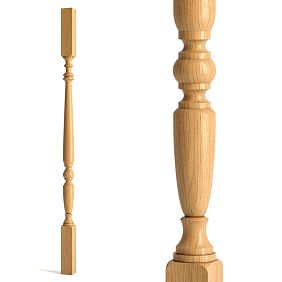
The main staircase in a classic mansion is not a transport artery between floors, but a theatrical set, a place where the ceremonial ascent unfolds. The owner of the house descends the steps to meet the guests, like an actor stepping onto the stage. The guest ascends to the chambers, feeling the solemnity of the moment.Baroque-style wooden balusterstransform this scene into a work of art—each carved element is rich in detail, every acanthus leaf curl, every volute, every rosette is carved as if the fate of the staircase depends on the precision of the line. Baroque does not tolerate emptiness, does not recognize modesty. It is the style of royal palaces, cardinals' residences, patrons' mansions—a style where luxury is not hidden but displayed.Balusters for a staircase in Baroque stylisticsrequire an understanding of the style's canons, the correct choice of wood species, competent composition of carving, and professional installation. Let's explore how to create a staircase worthy of a palace.



Baroque: the philosophy of excess and theatricality
Baroque originated in Italy in the late 16th century as a reaction to the strictness of the Renaissance. If the Renaissance admired harmony, proportions, and mathematical precision, Baroque admired emotion, movement, and drama. Architecture, sculpture, and painting sought to astonish the viewer, evoke awe, trembling, and admiration.




Key features of Baroque aesthetics
Abundance of decoration. In Baroque, there are no empty planes. Every surface—wall, ceiling, column, staircase—is covered with ornamentation: stucco, carving, painting, gilding.A wooden baluster in Baroque stylehas no smooth, flat sections—its entire length from base to capital is covered in relief.
Dynamics of forms. Baroque loves S-shaped lines, spirals, volutes (scrolls), and curves. A straight line is static, boring. A curved line is dynamic, alive, creating an illusion of movement. A carved baluster twists in a spiral, like a column in a Bernini temple.
Contrast of light and shadow. Baroque carving is deep (the relief protrudes 20-40 mm from the base plane), creating sharp shadows. Light falling on the baluster highlights the protruding elements, leaving recesses in shadow. The play of light and shadow changes depending on the time of day and lighting—the baluster looks different in the morning, afternoon, and evening.
Naturalism of ornaments. Baroque depicts nature in detail: acanthus leaves with carved edges and veins, grape clusters with each berry, flowers (roses, tulips, lilies) with petals where textures are distinguishable. This is not stylization (as in Art Nouveau or Art Deco) but realism striving for sculptural precision.
Symmetry and asymmetry simultaneously. The overall composition is symmetrical (the left and right parts of the baluster are mirror reflections), but details can be asymmetrical (a leaf curved to the right, a flower turned to the left)—this creates tension and intrigue.
Our factory also produces:


Baroque in staircase architecture
The staircase of a Baroque mansion is the central axis of the house. It is wide (2.5-4 meters), with gentle steps (riser height 14-16 cm, tread width 30-35 cm—comfortable for a slow, ceremonial ascent in heavy clothing). Landings between flights are spacious, adorned with sculptures, mirrors, and paintings.
Railings and balusters for such a staircaseare not functional railings but a sculptural gallery. Each baluster is a work of the carver, taking days to create. Posts (support balusters at turns and ends of the flight) are massive (diameter 120-200 mm, height 1200-1500 mm), crowned with finials (toppings in the shape of a ball, vase, pinecone, or sculptural figure).
Get Consultation
Anatomy of a Baroque baluster: carving elements
Staircase Balusterconsists of three functional parts: the base (attached to the step or stringer), the body (the main decorative part), and the capital (the upper part supporting the handrail). In Baroque, each part becomes a field for carving.
Base: plinth with petals and volutes
The base of a Baroque baluster resembles the base of a classical column but more complex. The basic shape is a cylinder or polyhedron (square, octagon), from which decorative elements extend:
Petal rosette. A circular ornament of petals radiating from the center to the edges. Petals can be wide and rounded (rose, lotus) or narrow and pointed (daisy, aster). The carving is two-tiered—upper petals overlap lower ones, creating volume.
Volutes at the base. Spiral scrolls extending downward or sideways from the base. A volute can be symmetrical (an S-shaped curve with two scrolls) or one-sided (a single large scroll). The thickness of the volute tapers toward the end (an effect of diminishing energy).
Flutes (vertical grooves). They run upward from the base for 50-100 mm, creating a visual connection between the base and the baluster body. In Baroque, flutes are often twisted (spiraling) or filled (with carved ornament inside the groove, imitating cord or reed).
Body: a symphony of plant ornaments
The body of the baluster is its visual dominant, the longest part (600-900 mm). Here the carver demonstrates their skill.
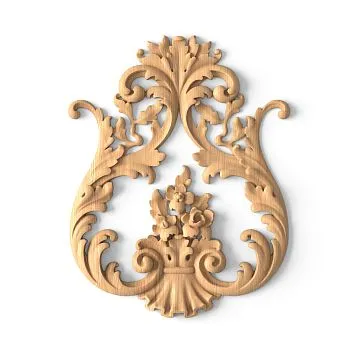
Acanthus leaves. Acanthus is a herbaceous Mediterranean plant with carved leaves, which became a symbol of classical and Baroque carving. The acanthus leaf is depicted as large (height 100-200 mm), with deeply carved edges, curved (the tip of the leaf curls outward, creating dynamism). The leaves are arranged in several tiers, overlapping each other, forming a three-dimensional composition. The leaf veins are incised with thin lines, creating detail.
Grapevines with clusters. The vine (flexible grape stem) spirals around the baluster. From the vine extend tendrils (thin, twisted shoots), leaves (five-lobed, carved), and clusters (spherical berries gathered in a conical shape). The clusters are placed on one or both sides, hanging down under their own weight. The carving is so realistic that one wants to pick a berry.
Floral compositions. Roses, tulips, lilies, peonies are carved in half-relief (the flower protrudes from the plane by 30-40 mm). The petals have texture (veins, folds), the center of the flower is detailed (stamens, pistils). The flowers are combined with buds (unopened flowers), leaves, stems, creating a garland that encircles the baluster.
Cartouches and shields. A cartouche is a decorative frame, often in the shape of a shield or scroll, with wavy edges, scrolls at the corners. Inside the cartouche may be the monogram of the homeowner, a coat of arms, a symbol (crown, scepter, mythological figure). The cartouche is placed in the center of the baluster body, becoming the compositional center.
Putti and mascaron. Putti are plump infants (cherubs) without wings or with wings, depicted playing, holding garlands, making music. Mascaron are sculpted faces (human or mythological creatures—satyrs, lions, gorgons), usually frontal, with expressive facial expressions. These elements are used rarely (requiring the highest skill), but if present, the staircase becomes a museum piece.
Capital: the crowning chord
The capital of a baluster is analogous to a column capital, but more miniature. In Baroque, variants of the Corinthian and Composite orders are used:
Corinthian capital. Bell-shaped form, covered with two rows of acanthus leaves (the lower row larger, the upper row smaller). From under the upper row protrude volutes (four or eight—at the corners), between the volutes—a rosette or a small flower. The capital is crowned by an abacus (a square slab with concave sides).
Composite capital. A hybrid of Corinthian and Ionic: acanthus leaves at the bottom, Ionic volutes (large, spiral) at the top. More lush, Baroque in spirit.
Simplified capital. For balusters where the body is already oversaturated with carving, the capital can be more laconic—a simple torus (convex cylinder), several rings (horizontal projections), minimal plant ornament. This is a balance: not to overload the composition.
Wood species: choice for carving and durability
Carving is an aggressive treatment of wood. The chisel removes thin layers of material, creates fine details (the thickness of an element can be 2-5 mm), fragile ones (a flower petal, a leaf tip). Not every wood can withstand this without chipping.
Oak is rightfully considered one of the most prestigious species for furniture making, including beds. Its wood is distinguished by exceptional strength (hardness 3.7-4.5 on the Brinell scale), durability, and expressive texture.
Oak — the standard forof carved wooden balusters. Hardness 3.7-4.0 on the Brinell scale (high), density 700-800 kg/m³ (higher than most hardwoods), texture expressive (large annual rings, medullary rays—light bands radiating outward).
Advantages of oak for carving:
The chisel moves precisely, does not tear out fibers (the wood is dense, homogeneous). Fine details (thin leaf veins, grape tendrils) are carved cleanly, do not chip.
Oak holds its shape for decades. A carved baluster does not dry out (moisture is stable after kiln drying), does not warp, does not crack. Carving done today looks the same in 50 years.
Oak patinates beautifully. Dark patina (black, brown) is rubbed into the recesses of the carving, emphasizes the relief, creates an antique effect (the staircase as if from an old castle).
Disadvantages:
Oak is heavy (a baluster 900 mm long weighs 2.5-3.5 kg compared to 1.5-2 kg for pine). For a staircase, this is not critical (balusters are fixed), but complicates installation.
Oak is expensive. A carved oak baluster costs 5000-15000 rubles per piece (depending on carving complexity) compared to 2000-6000 for beech.
Beech: an economical alternative with fine texture
Beech—hardness 3.8 on the Brinell scale (even higher than oak), density 650-750 kg/m³, texture fine, homogeneous (annual rings barely distinguishable, color pinkish or cream).
Advantages:
Beech cuts cleanly, details turn out elegant. The fine texture does not distract from the carving (oak's large pores can visually compete with thin carving elements).
Beech is 20-30% cheaper than oak (wood is more accessible, grows faster).
Disadvantages:
Beech is hygroscopic (absorbs moisture more actively than oak). If the staircase is in a room with variable humidity (hall with a door to the outside, veranda), beech can deform. Solution—high-quality protective finish (yacht varnish, wax).
Beech is lighter than oak (pinkish hue). For Baroque, where dark tones are traditional (walnut, stained oak), beech has to be stained.
Linden: Softness for Ultra-Complex Carving
Linden is a soft wood species (Brinell hardness 1.8), density 450-500 kg/m³, texture uniform, almost without pattern, color white or light cream.
Advantages:
Linden cuts easily, like butter. The carver cuts parts of incredible complexity — lacy petals, putti hair, wing feathers. For sculptural balusters (where the carving is almost a full-round sculpture) linden is ideal.
Linden does not chip. Even the thinnest elements (1-2 mm thick) are preserved.
Disadvantages:
Linden is soft, easily scratched, dented. For a staircase (where people hold onto railings, lean on them) this is a risk. The solution is a hard lacquer coating (polyurethane lacquer in 5-7 layers) protecting the wood.
Linden is light, with an inexpressive texture. For Baroque, tinting (stain under walnut, oak) and patination are required.
Walnut: Exotic Luxury
Walnut (English, American black) — hardness 3.5-4.0 on the Brinell scale, density 600-700 kg/m³, texture expressive (dark brown color with chocolate, purple, golden hues, wavy grain pattern).
Advantages:
Walnut cuts well (hard but not brittle), carving details are crisp.
Walnut is beautiful without tinting. Its natural color is dark, noble, ideal for Baroque. Patina (gold, silver) on walnut looks luxurious.
Disadvantages:
Walnut is expensive (50-100% more expensive than oak). The wood is imported (American walnut from the USA, European from Turkey, Italy).
Walnut is rare in Russian production (few workshops work with it).
Technology of Creating a Carved Baluster: From Blank to Masterpiece
A carved baluster is the result of a multi-stage process combining machine precision and manual craftsmanship.
Stage 1: Blank Preparation
The blank is a block with a cross-section of 80×80 mm, 100×100 mm, 120×120 mm (depending on the future baluster's diameter), length 950-1000 mm (allowance for trimming ends). Wood is kiln-dried, moisture content 8-10%, free of knots, cracks, rot.
The blank is checked for straightness (warping no more than 1 mm per meter), calibrated (processed on a thickness planer to an exact cross-section ±0.5 mm).
Stage 2: Turning the Basic Form
The blank is mounted in a lathe (secured in centers or a chuck), rotates at 800-1200 rpm. A cutter (chisel) removes wood, forming the baluster's basic form: cylindrical body, tapers, swellings, beads, coves (concave sections).
For Baroque balusters, the basic form is complex: alternation of convex and concave sections, smooth transitions (without sharp angles). Turning is performed by a craftsman manually (the turner feels the wood, controls the form with calipers) or on a copying lathe (automatic turning using a template — faster, but less flexible).
After turning, the baluster is sanded (abrasive paper P80-P120), removing cutter marks.
Stage 3: Carving Layout
The carver applies the contours of the future carving to the baluster with a pencil or chalk. The layout is precise — the ornament is symmetrical, elements are spaced equally, proportions are maintained.
For complex ornaments, a stencil (paper or cardboard template with contours of leaves, flowers, volutes) is used. The stencil is applied to the baluster, contours are traced.
Stage 4: Rough Carving
The carver uses wide chisels (gouges, flat) to roughly carve the main volumes: removes excess wood around a leaf, forms the convexity of a petal, outlines the relief depth. Rough carving is fast, crude — the task is to create the general shape, not the details.
Stage 5: Finish Carving
The carver switches to small chisels (narrow, bent gouges for hard-to-reach places) and works on the details: carves serrations along the leaf edge, veins, petal folds, vine bark texture, individual berries in a cluster. Finish carving is slow, jewelry-like — one baluster takes 8-16 hours of the master's work (depending on complexity).
The carver's skill is manifested in the cleanliness of lines, smoothness of transitions, balance of relief depth (carving too deep weakens the baluster, too shallow loses volume).
Stage 6: Sanding the Carving
The carving is sanded by hand using abrasive paper (P180-P220) wrapped around a wooden stick or finger. Sanding removes small burrs and smooths the surface without erasing the sharpness of details. Hard-to-reach areas (deep recesses, gaps between petals) are sanded with thin strips of paper or a brush.
Step 7: Finishing
The carved baluster is coated with a protective and decorative composition:
Stain (tones the wood to the desired color — walnut, stained oak, ebony). Applied with a brush or sponge, it is absorbed into the wood and emphasizes the grain.
Patina (a dark paint rubbed into the recesses of the carving). Creates an aged effect and highlights the relief. Applied with a brush, excess is wiped off with a cloth — the patina remains in the recesses, while raised parts stay light.
Gilding (gold paint or imitation gold leaf). Applied to raised elements (leaf tips, volutes, rosettes), it creates accents and adds luxury.
Varnish or wax. The final protective layer. Varnish (polyurethane, alkyd) forms a durable film, protecting against moisture and wear. Wax (beeswax, carnauba) provides a matte surface and preserves the tactile feel of the wood. For stairs, varnish is preferable (higher wear resistance).
Composition of carving: balance and rhythm
Wooden balusters for stairsare installed side by side (a spacing of 10-15 cm between baluster axes is a safety standard to prevent a child from squeezing through). It is important that the carving on adjacent balusters creates a harmonious composition, not visual chaos.
Identical balusters: the classical approach
All balusters are identical (carved from the same template, identical down to the smallest details). This creates rhythm, order, and monumentality. The eye glides along the balustrade, perceiving it as a single sculptural ribbon.
Advantage: simplicity of production (one template, established technology), visual harmony.
Disadvantage: some monotony (30 identical balusters may tire the eye).
Alternation: Baroque play
Two or three types of balusters alternate according to a specific pattern (A-B-A-B or A-B-C-A-B-C). For example: a baluster with acanthus leaves, a baluster with grapevines, a baluster with floral garlands.
Advantage: visual variety, richness, each baluster is interesting, yet together they form a harmonious ensemble.
Disadvantage: complexity of production (different templates needed), more expensive (more carver time).
Accent balusters: hierarchy of significance
The majority of balusters are simple (turned or with minimal carving), but at specific intervals (every fifth, seventh) a carved baluster with a complex ornament is installed. This creates visual accents and rhythmic pauses.
Advantage: cost savings (fewer carved balusters, lower overall cost), visual hierarchy.
Disadvantage: less Baroque (Baroque loves excess, not economy).
Newel posts: the supporting giants of the staircase
Newel posts (supporting balusters) are installed at staircase turns, at the beginning and end of a flight. They are larger than regular balusters (diameter 120-200 mm, height 1200-1500 mm) and bear greater load (the handrail is attached to the newel posts, balusters are intermediate supports).
Carving of newel posts: the culmination of craftsmanship
The newel post is the visual focal point of the staircase. Its carving should be the most complex and impressive.
Narrative carving. The newel post may depict a scene: putti holding a garland, allegorical figures (Fortune with a cornucopia, Glory with a trumpet), mythological creatures (griffin, sphinx). This is almost a full-round sculpture, requiring months of a master's work.
Heraldic carving. The newel post is adorned with the client's coat of arms (family crest, corporate logo), surrounded by ornamentation (laurel wreaths, banners, weapons).
Architectural carving. The newel post imitates a classical column: a base with petals, a fluted shaft (vertical grooves), a Corinthian order capital. This is a reference to antiquity, which Baroque transformed into its own aesthetic.
Finial: the newel post cap
The finial is a decorative element crowning the newel post. Finial shapes include:
Ball (smooth or carved with ornament). Symbol of perfection, completeness.
Vase or urn (with lid, carved handles, garlands). Symbol of abundance.
Pine cone (scales detailed carved). Symbol of fertility, eternity.
Sculptural figure (lion, eagle, angel). Symbol of protection, power, divine patronage.
The finial is attached to the post with a dowel (wooden pin) or threaded connection (threads are cut into the post, the finial is screwed on).
Installation: a union of beauty and strength
Carved balusters are fragile (thin carving elements can break if handled carelessly). Installation requires professionalism.
Preparing steps and handrail
Steps must have holes for balusters (diameter 10-12 mm, depth 30-40 mm) or grooves (if balusters are installed into the stair stringer). Holes are drilled with an accuracy of ±1 mm according to markings, verticality is controlled with a level.
The handrail has a lower groove (milled channel width 30-40 mm, depth 15-20 mm), into which the upper ends of the balusters fit.
Installing balusters
The lower end of the baluster is cut at an angle (if the stairs are sloped) or left straight (if the baluster is in a vertical plane). A hole for a dowel (wooden pin diameter 8-10 mm, length 40-50 mm) is drilled at the end, or threads are cut for a stud (metal threaded rod).
The dowel is glued into the baluster hole (PVA wood glue or polyurethane), inserted into the step hole, and the baluster is fixed. Excess glue is wiped off.
The upper end of the baluster fits into the handrail groove. The handrail is glued to the balusters (wood glue), additionally secured from below with screws (through the baluster into the handrail) or from above (the screw is countersunk, the hole is covered with a wooden plug).
Checking verticality and spacing
After installing each baluster, verticality is checked (level or plumb line). Deviation is unacceptable — a crooked balustrade ruins the entire staircase.
The spacing between balusters is measured with a tape measure (must be consistent along the entire flight length). Even a 5 mm deviation is noticeable to the eye.
Frequently asked questions
How much does a Baroque-style carved wooden baluster cost?
Depends on wood species, carving complexity, manufacturer. A simple carved beech baluster (one or two ornaments, medium-depth carving) — 3000-5000 rubles. A complex oak one (multi-tiered carving, high detail) — 8000-15000 rubles. A unique walnut one (handmade, sculptural carving) — 20000-50000 rubles. For a 3-meter flight staircase, 15-20 balusters are needed — total cost 45000-300000 rubles (depends on choice).
How to care for carved balusters?
Weekly: wipe with a dry soft cloth (removing dust from carvings). A soft brush or compressed air (compressor with a blow gun) can be used for hard-to-reach areas.
Monthly: wipe with a slightly damp cloth with a neutral detergent (to remove grease deposits from hands), then with a dry cloth.
Every 2-3 years: renew wax coating (if balusters are waxed). Wax is applied with a soft cloth, rubbed in, and polished. This refreshes the color and protects the wood.
Every 5-7 years: assess the condition of the varnish coating. If the varnish is worn (especially on the handrail, where hands constantly touch) — re-varnishing (sanding, applying new varnish).
Avoid: impacts (carved elements are fragile), aggressive chemicals (chlorine, solvents damage varnish), excess water (wood can swell).
Can balusters be ordered according to a custom sketch?
Yes. Many workshops accept custom orders. You provide a sketch (drawing, photo of the desired ornament) or a description of your wishes (style, carving elements, dimensions). The carver creates a template, carves a trial baluster, and coordinates with you. After approval, the full set is manufactured.
Minimum quantity for a custom order — usually 10-15 pieces (less is not cost-effective — template development costs won't be recouped). Production time — 4-8 weeks (depends on complexity). Price is 30-50% higher than standard models.
What is the optimal baluster height?
Standard baluster height — 900 mm (from step to top point). This provides a handrail height of 900-950 mm (comfortable for a person of average height 165-175 cm).
For tall people (height 180-190 cm) it can be increased to 950-1000 mm. For children, it's better to add an additional lower handrail at a height of 600-650 mm (the child holds onto it, without reaching for the upper one).
Wooden or polyurethane balusters: what to choose for Baroque?
For authentic Baroque — only wood. Polyurethane can imitate carving (molds reproduce details), but:
Polyurethane feels cold to the touch (synthetic), wood is warm (natural material).
Polyurethane is uniform (all balusters are identical down to the molecule), wood is alive (each baluster has a unique texture, slight variations in carving — the trace of the master's hand).
Polyurethane has a plastic sheen (even matte looks artificial), wood has a noble matte finish or deep lacquer gloss.
For budget projects, Baroque imitations — polyurethane is acceptable. For serious classical interiors — only wood.
How long does it take to manufacture a set of carved balusters?
For a standard model (available in the manufacturer's catalog) — 2-4 weeks (depends on workshop workload, number of balusters). Balusters are carved in batches (5-10 pieces simultaneously), go through all stages, are packaged, and shipped.
For a custom order (unique model) — 6-12 weeks. Includes template development (1-2 weeks), carving a trial baluster (1 week), approval, batch production (3-8 weeks depending on quantity and complexity), final finishing.
If the project is urgent — some workshops offer expedited production (surcharge 30-50%, timeframe is halved).
Conclusion: staircase as a work of art
Baroque-style wooden balusters— not just a structural element of a staircase, but an embodiment of the philosophy of luxury, craftsmanship, timeless beauty. Every carved leaf, every volute, every petal is carved as if the fate of the house depends on their perfection.
Creating a Baroque staircase is a long, expensive process requiring the involvement of professionals: an architect (designs the staircase structure, calculates loads), a designer (develops the carving concept, style), a carver (transforms wood into sculpture), an installer (assembles everything into one, ensuring strength and safety). But the result justifies the costs: the staircase becomes the center of the house, an object of admiration, pride, a family heirloom passed down through generations.
STAVROS company specializes in the production ofcarved balusters for staircasesmade from solid oak, beech, ash in Baroque, Rococo, Classicism, Renaissance styles. The production base in St. Petersburg is equipped with modern equipment: CNC lathes for forming basic geometry, milling centers for precise reproduction of ornaments, manual carving sections where masters with many years of experience create detailing by hand.
The assortment includes over 80 models of carved balusters (from classical with acanthus leaves to complex with multi-figure compositions), over 50 models of posts (with various types of capitals, finials, carvings), dozens of handrail options (ergonomic, with carved inserts, patinated). Each model is available in several wood species, finishing options (stain, patina, gilding, lacquer, wax), sizes (height, diameter adapted to the project).
For custom projects, STAVROS offers a service for developing unique balusters based on customer sketches. The company's designer consults on style, suggests ornament options, creates 3D visualization (the customer sees what the staircase will look like before production begins). Carvers carve a trial baluster, which can be evaluated in person, and adjustments can be made. After approval, serial production is launched. The minimum batch for a custom order is 10 pieces, timeframe — 8-12 weeks.
Logistics are organized across Russia: delivery to Moscow and St. Petersburg — by own transport (careful packaging, cargo insurance), to regions — by transport companies (wooden crating protects balusters from damage). For large projects (country houses, hotels, restaurants), delivery with unloading and lifting to the site is possible.
STAVROS installation crews perform turnkey staircase installation: from load calculation, structural design to assembly, finishing, handover to the customer. Warranty on the structure — 5 years, on carved elements (subject to operating conditions) — 3 years.
Create interiors whereBalusters for staircaseare not hidden, but displayed as works of art. Where ascending the steps becomes an aesthetic experience, where the hand sliding along the carved handrail feels the warmth of the wood, the texture of the carving, the labor of the master.STAVROS carved wooden balusters— the choice of those who are not ready to compromise between beauty and quality, who value tradition, craftsmanship, eternal values.