Article Contents:
- Beech among hardwoods: classification and position in the hierarchy
- Density of beech: physical parameter with practical implications
- Uniform beech texture: aesthetics of calmness and functional advantages
- Staining and coloring beech: revealing decorative potential
- Care for beech balusters: preserving beauty for decades
- Neat relief: processing and decoration of beech balusters
- Conclusion

Beech — wood often underestimated, overshadowed by the more famous oak. But those who know the material not by hearsay understand: beech is European elegance, dimensional stability, structural uniformity unmatched by other species. It is wood without the dramatic contrasts of oak texture, without the capriciousness of ash, without the resinous nature of conifers. Beech is calmness, predictability, reliability, dressed in a warm pinkish hue.
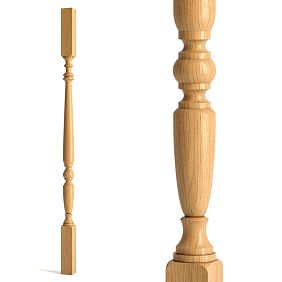
Beech balusters — the choice of those who value European quality without paying a premium for a flashy name. This material has been used for centuries to make furniture, parquet, musical instruments — items where stability is critical, where deformation is unacceptable, where smooth processing is essential. All these qualities beech imparts to balusters: they retain their shape for decades, do not warp from seasonal humidity fluctuations, are polished to a silky smoothness, and perfectly accept staining and coloring.
Beech balustersThis is a compromise between the affordability of pine and the prestige of oak. In terms of strength, beech does not fall short of oak, even surpassing it in stability, and is 20-30% more affordable. But beech has its own characteristics: sensitivity to moisture, requiring protective coating, uniform texture, which some may find dull compared to the expressive grain of oak or ash. Understanding these characteristics is key to making the right choice.
This article is a detailed analysis of beech balusters as a material. Why beech belongs to hardwoods and what this means in practice. What is the density of beech wood and how it affects the longevity of balusters. Why uniform beech texture is an advantage for certain interior styles. How staining and coloring reveal the potential of beech. What care beech balusters require to maintain beauty for decades. After reading, you will understand whether beech is suitable for your staircase project.




Beech among hardwoods: classification and position in the hierarchy
Wood species are classified by botanical affiliation and physical-mechanical properties. Botanically, they are divided into conifers (pine, spruce, larch, cedar) and broadleaf (oak, ash, beech, birch, aspen). Broadleaf trees are further divided into hardwoods and softwoods — a classification based on wood density and hardness.
Hardwoods — are broadleaf trees whose wood has high density (more than 550 kg/m³ at 12% moisture) and hardness (more than 40 N/mm² by Brinell). Hardwoods include: oak, ash, beech, hornbeam, maple, acacia, elm, walnut. These species grow slowly, forming dense structures with narrow annual rings, ensuring the strength and durability of the wood.
Softwoods — are broadleaf trees with density less than 550 kg/m³ and hardness less than 40 N/mm²: birch, aspen, linden, poplar, alder. They grow faster, their wood is loose, soft, less strong and durable. Used where high mechanical strength is not required: interior finishing, light furniture, packaging.
Beech confidently occupies a place in the first tier of hardwoods. The density of beech wood at standard moisture content of 12% is 680 kg/m³ — higher than oak (670 kg/m³), significantly higher than ash (650 kg/m³). The hardness of beech by Brinell: end grain 65.1 N/mm², radial 53.2 N/mm², tangential 49.5 N/mm² — figures comparable to oak and exceeding most other European species.
What does this mean in practice for balusters? High density ensures strength — beech balusters withstand the same loads as oak balusters without risk of bending or breaking. High hardness ensures durability — the surface of beech balusters does not wear from accidental contact, does not leave dents from impacts, retains smoothness for decades.
Comparative table of hardwoods for balusters:
| Species | Density, kg/m³ | Hardness, N/mm² | Stability | Price relative to oak |
|---|---|---|---|---|
| Oak | 670 | 64 (end grain) | High | 100% (base) |
| Beech | 680 | 65 (end grain) | Very High | 70-80% |
| Ash | 650 | 60 (end grain) | Medium | 80-90% |
| Hornbeam | 750 | 70 (end grain) | High | 90-110% |
| Maple | 650 | Oak stands out for its optimal balance of characteristics and price. It surpasses oak in density and hardness, surpasses ash in stability, is more affordable than beech, and is 20-30% cheaper than oak. For balusters, where strength, stability, and smooth processing are required, oak is one of the best solutions among hardwoods. | High | 85-95% |
Mechanical properties of oak in numbers:
Compressive strength along the grain: 53-62 MPa (megapascal)
-
Static bending strength: 104-120 MPa
-
Elastic modulus: 14000 MPa (material stiffness)
-
Impact toughness: 7.6 kJ/m² (resistance to impact loads)
-
Wear resistance: 0.10 mm (abrasion across grain)
-
These numbers mean that an oak baluster with a cross-section of 50×50 mm and height of 900 mm can withstand a horizontal load exceeding 150 kg without residual deformation. For stair railings, where the normative load is 30-50 kg per meter of handrail, the safety factor is threefold. An oak baluster will not break, bend, or crack under any household loads.
These figures indicate that a letter-shaped baluster with a cross-section of 50×50 mm and a height of 900 mm can withstand a horizontal load exceeding 150 kg without residual deformation. For stair railings, where the normative load is 30-50 kg per linear meter of handrail, the safety factor is threefold. A beech baluster will not break, bend, or crack under any household loads.
Why hardwoods are preferred for balusters:
Balusters work under bending, bearing horizontal load from the handrail. Softwood (pine, spruce, softwoods) may sag under prolonged load, weakening fasteners. Hardwood (oak, beech, ash) retains its shape for decades.
Balusters often come into contact with hands, clothing, and furniture during furniture movement. Softwood wears down, develops scratches, and loses smoothness. Hardwood retains its original surface for years.
Balusters with thin cross-sections (40-50 mm) require strong material to avoid breaking under accidental impacts. Softwood yields chips and cracks. Hardwood withstands mechanical impacts without damage.
Choosing beech for balusters means selecting material from the top tier of hardwoods — a time-tested solution guaranteeing strength, durability, and wear resistance comparable to oak, but at a more affordable price.




Density of beech: a physical parameter with practical consequences
Wood density is the mass per unit volume, expressed in kilograms per cubic meter. It may seem abstract, but it determines most operational characteristics: strength, wear resistance, stability, processing difficulty, acoustic properties.
Density of beech wood at standard moisture content of 12% is 680 kg/m³. This means a cubic meter of dry beech weighs 680 kilograms. For comparison: pine — 500 kg/m³, birch — 630 kg/m³, oak — 670 kg/m³, beech — 750 kg/m³. Beech is denser than oak, significantly denser than coniferous and softwood species.
Where does density come from?
Wood consists of cells — fibers, vessels, parenchyma. The space between cells is filled with air. The ratio of cell wall mass to wood volume determines density. In fast-growing species (pine, aspen) cells are large, walls thin, and there is much air — low density. In slow-growing hardwoods (oak, beech) cells are small, walls thick, and there is little air — high density.
Beech grows slowly, especially in height. Under favorable conditions, a tree adds 30-50 centimeters per year, forming dense annual rings 2-4 millimeters wide. Such slow growth creates dense, heavy wood with a fine-pored structure.
Practical consequences of high density:
Strength: dense wood is stronger than loose wood. Bending strength of beech is 104-120 MPa versus 80-90 MPa for pine. A beech baluster with a 50 mm diameter withstands twice the load compared to a pine baluster of the same diameter.
Wear resistance: dense wood wears down more slowly. Beech abrasion coefficient is 0.10 mm versus 0.20 mm for pine. Over 20 years of use, a beech baluster wears 2 mm at contact points, while pine wears 4 mm. The difference is visually noticeable.
Fastener retention: screws and dowels penetrate tighter and hold better in dense wood. Pull-out load for a 5 mm diameter screw in beech is about 80 kg, versus 50 kg in pine. Fasteners on beech balusters loosen more slowly.
Acoustics: dense wood absorbs sound better than loose wood. A staircase with beech balusters is quieter when walking and resonates less. The squeaks characteristic of pine staircases are less common on beech staircases.
Thermal conductivity: dense wood feels colder to the touch. A beech handrail in an unheated room feels cool, while pine feels warmer. In heated residential spaces, the difference is not noticeable.
Processing difficulty: dense wood is harder to cut, requires more powerful tools and more time. Turning a beech baluster takes 20-30% more time than turning a pine one. Cutters and routers wear out faster. This is factored into manufacturing cost.
Weight: dense wood is heavier. A beech baluster 50×50×900 mm weighs about 1.5 kg, while pine weighs 1.0 kg. For a set of 50 balusters, the difference is 25 kg. During transportation and installation, this is noticeable but not critical.
Density and moisture:
Wood density depends on moisture content. Freshly cut beech has moisture content around 80%, density 900-1000 kg/m³ (wood + water). After kiln drying to 8-10% moisture, density drops to 650-660 kg/m³. At standard moisture content of 12% (equilibrium for residential spaces), density is 680 kg/m³ as stated.
This means: if the balusters are made from properly dried beech (moisture 8-10%), after installation in a heated room they will absorb moisture from the air until reaching equilibrium moisture content of 10-12%, slightly increasing in size (swelling about 0.5-1%), and density stabilizes. If the balusters are made from under-dried beech (moisture 15-20%), they will dry out, shrink, and may develop deformations and cracks.
Therefore, when purchasing beech balusters, request moisture measurement confirmation. Readings should be 8-10%, no higher. This guarantees dimensional stability and absence of deformations.
Density and grade of wood:
Beech density is relatively constant throughout the cross-section of the trunk, unlike oak, where the heartwood is denser than the sapwood. However, the presence of defects (knots, burls, cracks) locally reduces density. Therefore, high-grade beech balusters (Extra, A) are not only visually cleaner but also denser and stronger than balusters of grade B or C with numerous knots.
Choosing beech for balusters means selecting a material with density providing strength comparable to oak, wear resistance exceeding most European species, dimensional stability, and critical for longevity of joinery connections.
Our factory also produces:


Uniform beech texture: aesthetics of calmness and functional advantages
Wood texture is the visual pattern created by annual rings, rays, vessels, and pores. Texture can be pronounced (contrasting annual rings, large vessels) or uniform (weakly expressed rings, small pores). Oak, ash, larch have pronounced texture. Beech, maple, hornbeam have uniform texture.
Structural features of beech:
Beech's annual rings are weakly expressed. Earlywood (spring growth) and latewood (summer-autumn growth) differ slightly in density, with a smooth transition between them. On longitudinal sections, annual rings appear as thin light lines, but contrast is low, creating a calm pattern.
Beech vessels are small, with diameter 0.05-0.08 mm, evenly distributed throughout the wood thickness. On end-grain sections, they appear as microscopic dots, creating a uniform fine-grained structure. On longitudinal sections, vessels are invisible to the naked eye.
Heartwood rays are a distinctive feature of beech. On radial sections (plane passing through the heartwood and bark), heartwood rays appear as shiny bands 1-3 mm wide, running perpendicular to annual rings. This creates a delicate mother-of-pearl sheen, adding elegance. On tangential sections (plane tangent to annual rings), heartwood rays appear as bean-shaped streaks — the characteristic "fluting" of beech wood.
The natural color of beech varies from light cream to pinkish-brown. Young wood is lighter, while mature wood has a pinkish hue. After steaming (thermal treatment with steam at 100-120°C for several days), beech acquires a uniform reddish-brown color, highly valued in furniture manufacturing.
Visual characteristics of beech balusters:
The surface of beech balusters is uniform, without sharp color transitions or contrasting bands. This creates a calm, unobtrusive appearance. Beech does not compete for attention with other interior elements but complements them, remaining a background.
Heartwood rays on radial surfaces (side surfaces of balusters cut through the heartwood) create a delicate "fluting," adding elegance without overloading. This effect is especially noticeable under oblique lighting and is enhanced by transparent lacquer.
Absence of large pores and vessels gives smoothness. After sanding with 220-240 grit abrasive, beech surfaces are silky and pleasant to the touch. Pores are not tactilely perceptible, unlike oak or ash, where large vessels create roughness.
Functional advantages of uniform texture:
Predictable processing: uniform wood cuts evenly, without fiber tear-outs characteristic of species with contrasting texture. Turning beech balusters yields a clean surface with minimal tool marks. Milling creates sharp edges without chipping.
Sanding quality: fine-pored structure sands to mirror-like smoothness. Abrasive removes material evenly, leaving no scratches or unevenness. Beech balusters after final sanding to 320 grit achieve smoothness unattainable for pine or oak without multiple sanding passes.
Staining and toning: uniform structure accepts stains evenly, without blotches or uneven tones. Light areas (earlywood) and dark areas (latewood) of beech differ negligibly in absorption, and stain lays evenly. This is critical for toning and patination.
Visual compatibility: calm beech texture harmonizes with any style. In classic interiors, beech does not compete with carved furniture or moldings, remaining a background. In modern minimalism, beech’s uniformity aligns with the philosophy of simplicity. In Scandinavian style, light beech creates a sense of lightness and space.
Absence of visual fatigue: pronounced texture (oak, ash) attracts attention but may tire with prolonged contact. Beech’s uniform texture is calm, non-irritating, and comfortable for daily perception.
For which interiors is beech optimal:
Modern minimalism: minimalist forms require calm materials without visual noise. Square-section beech balusters with minimal processing, coated with matte oil, perfectly fit minimalist aesthetics.
Scandinavian style: light wood, natural tones, simplicity — beech balusters in natural or bleached color create an atmosphere of northern lightness.
Classic with emphasis on form: if in a classic interior the focus is on complex baluster profiles (turned elements, carving), beech’s uniform texture does not distract from the form, emphasizing the relief.
Interiors with active decor: if the room contains many visually rich elements (vivid wallpapers, paintings, carved furniture), calm beech balusters create balance without overloading the space.
For which interiors is beech less suitable:
Rustic, country, chalet: these styles value pronounced texture, knotty appearance, and "rural" character of wood. Uniform beech appears too smooth and "civilized."
Interiors emphasizing wood texture: if the interior concept revolves around the beauty of wood grain (pronounced annual rings, contrasting bands), beech loses to oak or ash.
The uniform texture of beech is an aesthetic of calmness and a functional advantage. Choosing beech balusters means choosing a material that is beautiful in its restrained elegance, harmonious in most styles, predictable in processing, ideal for staining and coloring.
Get Consultation
Staining and Coloring Beech: Revealing Decorative Potential
Beech is one of the best species for staining and coloring due to its uniform fine-pored structure, even absorption, and neutral base color. While oak and ash are prized for their expressive natural texture that should not be concealed by paint, beech is the ideal canvas for color experiments.
Why Beech Stains Well:
Uniform Density: The absence of sharp transitions between early and late wood means even absorption of stains. In oak, early wood is loose and absorbs stain actively, while late wood is dense and absorbs poorly — resulting in unevenness. In beech, all wood absorbs equally.
Fine Pores: The fine-pored structure creates a smooth surface on which paint lays evenly without sinking into large vessels. In oak and ash, large vessels absorb stain more intensely, creating dark streaks — an effect desirable for emphasizing texture but undesirable for even staining.
Neutral Base Color: Beech’s light creamy-pink hue is an excellent base for any tone. Dark stains (wenge, mahogany, walnut) yield rich, deep colors. Light stains (whitewashing, pastels) do not conflict with the base tone.
Absence of Tannins: Oak contains tannins (tannic substances) that may react with some stains, unpredictably altering the final color. Beech contains virtually no tannins, so stains behave predictably.
Types of Beech Baluster Staining:
Transparent Staining with Stain: Color change while preserving texture visibility. Stain (water-based, alcohol-based, or oil-based) penetrates the wood, coloring it from within. Texture, medullary rays, and growth rings remain visible but take on a new hue.
Popular Tones for Beech:
-
Walnut, Mahogany: Warm brown tones that lend beech a classic, dignified appearance.
-
Wenge, Dark Oak: Rich dark brown, almost black tones for contrasting modern interiors.
-
Gray, Graphite: Cool tones for Scandinavian and loft styles.
-
Whitewashing: Lightening wood with special compounds to achieve the effect of whitewashed oak.
Technology: Surface is sanded to smoothness (abrasive 180-220 grit), stain is applied with brush, pad, or spray in 1-2 coats, followed by a protective clear finish (varnish or oil).
Opaque Coloring with Paint: Complete concealment of wood texture under colored coating. Uses covering paint (acrylic, alkyd, polyurethane) that forms a dense film on the surface.
Popular Colors:
-
White: Classic for Provence, Scandinavian style, and classic interiors with light color palettes.
-
Gray (various shades): Universal modern color that pairs with any palette.
-
Black, Graphite: For contrasting interiors, lofts, and modern classics.
-
Pastel (blue, mint, lavender, cream): For Provence, shabby chic, and children’s rooms.
-
Vibrant Colors (blue, green, red): Accent solutions for bold interiors.
Technology: Surface is sanded, knots and defects are filled with putty, primer is applied (1-2 coats), surface is sanded with 240-320 grit abrasive after drying, paint is applied (2-3 coats with intermediate sanding), final protective lacquer layer (optional).
Patina: Artificial aging to create an effect of elegant wear. A contrasting color patina is applied to stained or colored surfaces, then partially wiped off from raised areas, leaving it in recesses. This creates the effect of vintage furniture that has weathered decades.
Typical Combinations:
-
White Base + Gray or Brown Patina (Provence, Shabby Chic)
-
Dark Base (Walnut, Wenge) + Gold or Silver Patina (Classic, Baroque)
-
Gray Base + White Patina (Scandinavian Vintage)
Brushing with Staining: Mechanical processing with a stiff brush that removes soft fibers and leaves hard ones, followed by staining. Creates a textured surface that highlights wood grain. Brushing is less effective on beech than on oak or ash (they have more contrasting grain), but can be used to create a light relief texture.
Advantages of stained beech balusters:
Color flexibility: ability to select an exact shade to match the existing interior or create a contrast.
Defect concealment: staining hides small knots and color variations, allowing the use of grade B wood instead of expensive Extra grade without loss of visual quality.
Renewal: stained balusters can be repainted after 10-15 years, updating the interior without replacing the staircase.
UV protection: dense paint protects wood from ultraviolet rays, preventing fading and color changes.
Practical recommendations:
Choose high-quality stains and paints — products from reputable manufacturers (Osmo, Tikkurila, Belinka, Biofa) provide predictable results and longevity. Cheap formulations may result in uneven color, fading, or flaking.
Do test stains — before staining all balusters, stain one sample, let it dry, and evaluate the color under different lighting. The color in the can may differ from the color on the wood.
Follow the technology — each layer must be fully dry before applying the next. Intermediate sanding is mandatory to remove raised fibers and achieve smoothness.
Protect with a finish — even opaque paint requires a protective lacquer (matte or semi-gloss) to increase durability and ease of maintenance.
Staining and toning reveal the decorative potential of beech, transforming it from a material with neutral texture into a canvas for color solutions. Beech balusters can be any color, any style, any degree of decoration — from natural light to bright accent shades.
Care for beech balusters: preserving beauty for decades
Beech is a durable material, but requires proper care. The main feature of beech is its sensitivity to moisture. Beech wood is hygroscopic, actively absorbing moisture from the air and equally actively releasing it when humidity decreases. This causes dimensional changes (swelling when moistened, shrinking when drying), which under extreme fluctuations may lead to warping and cracking.
Moisture protection — priority number one:
Beech balusters must have a quality protective coating — lacquer (polyurethane, alkyd, acrylic-urethane) in 3-4 layers or oil-wax (Osmo, Biofa, Belinka) in 2-3 layers. The coating creates a barrier that slows moisture exchange between the wood and air, stabilizing dimensions.
Lacquer forms a film on the surface — full isolation if there are no damages. A scratch or chip in the lacquer exposes the wood, moisture begins to penetrate, and darkening may start under the film. Therefore, lacquer coating requires careful handling and timely repair of damage.
Oil-wax penetrates into the wood, creating partial protection. Oil does not form a film, so damage is less critical — additional layers can be applied locally. However, oil provides less moisture protection than lacquer, and oil requires regular renewal (every 3-5 years).
Control of humidity in the room:
Optimal air humidity for wooden items — 45-60%. At this humidity, beech balusters remain stable, do not dry out or swell, and the coating does not crack.
In winter, with intensive heating, air humidity drops to 20-30% — wood dries out, cracks may form. Solution: use humidifiers to maintain humidity at 45-50%. The cost of a humidifier (5000-15000 rubles) pays for itself by preserving not only balusters, but also parquet, furniture, and doors.
In summer, with high humidity (60-70%), wood swells. In most cases, this is not critical, but in poorly ventilated rooms, mold may appear. Solution: ventilation, airing, and if necessary, a dehumidifier.
Regular cleaning:
Dust accumulating on balusters absorbs moisture from the air, creating conditions for mold and wood darkening. Regular (every 1-2 weeks) dry or damp wiping with a soft cloth removes dust, maintaining cleanliness.
Wet cleaning is permissible with well-wrung-out cloth (not wet!). After wiping, it is advisable to dry thoroughly. Avoid aggressive cleaning agents — they may damage the coating. Use specialized wood care products or plain water.
For lacquered balusters, furniture polishes (Pronto, Pledge) are suitable — they clean, create an additional protective layer, and add shine. For oiled balusters, polishes are unnecessary; a dry or slightly damp wipe is sufficient.
Coating refresh:
Lacquer coating lasts 10-15 years depending on usage intensity and lacquer quality. Signs of needing renewal: dullness, wear in contact areas (upper parts of balusters where hands rest), micro-cracks in the coating.
Lacquer renewal: remove old coating (by sanding or stripping), sand wood to smoothness, apply new lacquer in 3-4 layers with intermediate sanding. The work is labor-intensive, but extends baluster lifespan by another 10-15 years.
Oil coating requires more frequent renewal — every 3-5 years. The process is simpler: clean surface of dirt, light sanding with abrasive pad (grit 240-320), apply new oil layer, and spread. Can be done independently over weekends.
Protection against mechanical damage:
Beech is hard, but not indestructible. A heavy object impact may leave a dent or scratch. When moving furniture up the stairs, protect balusters — wrap furniture in cloth, use cardboard or polystyrene pads at potential contact points.
Children and pets — sources of mechanical impact. Toys, impacts, scratches from claws — all this gradually damages the coating and wood. Complete prevention is impossible, but it can be minimized: explain to children rules for using the staircase, trim pets’ claws, eliminate pets’ habit of sharpening claws on balusters (repellent sprays, special scratching posts).
Repair of local damage:
Scratches on varnished surfaces: light scratches can be removed with polishing compound or special paste. Deep scratches require local sanding and reapplication of varnish (difficult to make invisible; better to entrust professionals).
Dents: small dents on the beech surface can be attempted to be raised by steaming — place a damp cloth over the dent, iron with hot iron (without direct contact with wood), moisture and heat will cause fibers to swell, partially lifting the dent. After drying — sanding and finishing.
Cracks: small cracks are filled with wood-colored putty (Tikkurila, Borma Wachs), sanded, and finished. Deep through cracks indicate serious humidity problems and require replacement of the baluster.
Seasonal changes:
Wood 'breathes' — it shrinks by 0.5–1.5% in winter and swells by the same 0.5–1.5% in summer. For a 50 mm diameter baluster, this is 0.25–0.75 mm dimensional change — visually imperceptible, but noticeable in joints. Quality fasteners (glued dowels, bolts) compensate for these micro-movements. Weak fasteners (a single screw without glue) may loosen.
Don't worry if you notice micro-gaps between balusters and handrail in dry winter air — this is normal shrinkage reaction. In summer, as humidity increases, the gaps will close. If gaps are large (over 1–2 mm) — this indicates under-dried wood during manufacturing or extremely low air humidity (below 30%).
Care specifics for painted beech balusters:
Painted balusters require less care — paint provides additional moisture protection. However, paint may chip upon impact, exposing the wood. Chipped areas must be repainted promptly to prevent moisture penetration.
White and light-colored painted balusters require more frequent cleaning — dirt is more visible on them. Use gentle, non-abrasive cleaning agents to avoid damaging the paint.
Problem areas:
Lower parts of balusters (where they meet steps) — risk zone where moisture may accumulate during wet stair cleaning. Wipe steps thoroughly with a wrung-out cloth, avoid puddles at the base of balusters.
Upper parts of balusters (under the handrail) — contact zone for hands, where finish wears faster. Regularly inspect; renew finish locally or completely if worn.
Fastener areas — check annually for loosening. Tighten fasteners (bolts) or re-glue (dowels) if any play is detected.
Service life with proper care:
Beech balusters with quality protective finish, in rooms with controlled humidity, with regular cleaning and timely finish renewal, last 50–80 years without replacement. Oak under the same conditions — 80–100 years, pine — 30–50 years. Beech — the golden middle ground between longevity and cost.
Proper care for beech balusters is not daily rituals or complex procedures. It involves controlling air humidity (humidifier in winter), regular dust wiping (once a week), and finish renewal every 10–15 years (varnish) or 3–5 years (oil). Following these simple rules ensures decades of flawless appearance and service life for your balusters.
Careful relief: processing and decoration of beech balusters
The phrase 'careful relief' accurately describes beech balusters. This is not a wild, unprocessed log with knots and cracks, nor a massive, rough column — but a finely crafted item, where every profile element is executed with jewel-like precision, where the surface is smooth as silk, where transitions between elements are smooth and harmonious.
Why beech is ideal for creating careful relief:
Fine-grained structure allows making delicate details without risk of chipping. On oak or ash with large vessels, fine relief (thin rounds, narrow moldings, fine carving) may chip along vessel lines. Beech holds shape even in details as thin as 3–5 millimeters.
High density ensures strength of relief elements. A protruding thin round on a beech baluster withstands accidental impact without chipping. On pine, it may break off.
Uniformity provides predictable processing. A gouge or router cuts beech evenly, without fiber tearing or sudden knots changing hardness. The craftsman can create complex profiles knowing the material won't let them down.
Excellent sandability of beech allows achieving perfect smoothness on any relief element. Grooves, moldings, transitions between elements are sanded to silk-smoothness, without roughness or marks.
Types of relief on beech balusters:
Simple turned profiles: balusters with classic elements — one or two spheres, cylinders, cones, simple moldings. Made on a lathe in 10–15 minutes per baluster. Accuracy is achieved through precise lathe setup and quality sanding. Beech provides clean finish with minimal tool marks.
Complex turned profiles: balusters with multiple elements — 3–5 spheres of different diameters, complex moldings, transitions, asymmetric elements. Require CNC lathe programming or high lathe skill. Beech allows creating elements from 15 to 80 mm diameter on one baluster without risk of defects.
Milled profiles: balusters with elements created by milling — longitudinal grooves (flutes), dados, geometric patterns, relief surfaces. Made on CNC milling machines. Beech holds sharp groove edges, doesn't chip on edges, sands easily in grooves.
Carved balusters: items with hand or machine-carved elements — floral ornaments, geometric patterns, figurative elements. Beech is a grateful material for carving: dense (holds fine details), uniform (cuts evenly), without large knots (doesn't interfere with tool work). Carved beech balusters can have details as thin as 2–3 mm, retaining strength.
Combined profiles: combination of turning, milling, and carving on one baluster. For example, turned body with milled grooves and carved inlays. Beech allows combining technologies without limitations — the material is equally well processed by any method.
Carefulness as a quality criterion:
Careful relief is not only profile complexity, but also execution quality:
Line clarity: transitions between elements must be clear, without blurring. The fillet should have a clear radius, the round should have a correct cylindrical shape, the sphere — ideal sphericity. The letter can achieve this provided with a quality tool and machine setup.
Surface smoothness: after processing, each relief element must be smooth. Tool marks, abrasive scratches, roughness — signs of poor workmanship. After 220-320 grit polishing, the letter surface is silk-smooth everywhere — both on convex and recessed areas.
Symmetry: precisely turned balusters must be symmetrical relative to the rotation axis. Spheres must be perfectly round, not oval. Cylinders — strictly cylindrical, without conicity. Modern CNC lathes guarantee symmetry; manual turning requires skill.
Profile consistency within a batch: all balusters in a batch must have identical profiles. If on one baluster a 45 mm diameter sphere is located 300 mm from the bottom, all others must be similarly positioned with accuracy ±1-2 mm. CNC-machined letter balusters from a single program ensure absolute consistency.
Absence of processing defects: chips, fiber tears, unevenness, cracks, split knots — all these are unacceptable on quality letter balusters. Using premium-grade wood (Extra, A) and professional processing eliminates these defects.
Relief and interior style:
Classic style: complex turned profiles with multiple elements, traditional forms (spheres, rounds, balusters, cones), symmetry, harmony of proportions. Letter balusters in natural color or stained to walnut, mahogany.
Baroque, Empire: carved balusters with vegetal ornamentation, complex profiles with asymmetrical elements, gilding or silvering. Letter is ideal for carving and patina.
Modern classic: simplified classical profiles — 1-2 spheres, simple transitions, symmetry, but without excessive decoration. Letter balusters painted white, gray, or with natural finish.
Minimalism: minimal relief — square or round section with chamfers, one or two simple fillets, or complete absence of decoration. Letter with matte oil or painted.
Art Deco: geometric relief — vertical grooves, diamonds, zigzags, strict forms. Letter stained in dark tones or painted in contrasting colors.
Manufacturing letter balusters with careful relief requires:
Quality raw material — letter from air-dried (humidity 8-10%), premium grade (no large knots, cracks), properly stored (horizontally, protected from moisture).
Modern equipment — CNC lathes for precise repeatable profiles, CNC milling centers for complex reliefs, grinding machines for final finishing.
Qualified personnel — machine operators understanding material and technology, master carvers (for carved balusters), polishers who refine surfaces to perfection.
Quality control — checking each baluster for dimensional accuracy, processing quality, absence of defects, discarding items with deviations.
Correct finishing — quality lacquer or oil applied according to technology, enhancing relief and protecting wood.
Careful relief on letter balusters is the result of combining material properties (homogeneity, density, fine grain) and manufacturer professionalism (equipment, skill, quality control). When choosing letter balusters with relief, look for manufacturers who can show samples, guarantee profile consistency, and use modern equipment.
Conclusion
Beech balusters— European quality accessible to Russian consumers. This is wood from the first class of hardwoods with density 680 kg/m³, hardness 65 N/mm², strength comparable to oak. It has dimensional stability with a shrinkage coefficient of 0.47, less than oak, meaning minimal deformation during seasonal humidity fluctuations.
Uniform letter grain — not a drawback, but an advantage for certain styles and applications. Calm visual pattern without contrasting stripes harmonizes with minimalism, Scandinavian style, modern classic, without competing with other interior elements. Fine-grained structure creates silk-smooth finish after polishing, pleasant to the touch. Heartwood rays add an elegant pearl-like sheen on radial cuts.
Letter — ideal canvas for staining and toning due to uniform density and neutral base color. Transparent staining with dye transforms light letter into noble walnut, dark wenge, modern gray, whitewashed oak. Opaque painting with paint opens endless color possibilities — from classic white to bold accent tones. Patination creates vintage furniture effect. Letter balusters can be any color, any style, any degree of decoration.
Care for letter balusters requires attention to humidity. Protective coating (3-4 layers of lacquer or 2-3 layers of oil) is mandatory to isolate wood from air humidity fluctuations. Controlling room humidity (45-60% with humidifier in winter) prevents deformation. Regular dust cleaning (every 1-2 weeks), recoating every 10-15 years (lacquer) or 3-5 years (oil) — simple measures ensuring 50-80 years of service.
Care for beech balusters requires attention to humidity. Protective coating (3-4 layers of varnish or 2-3 layers of oil) is mandatory to isolate wood from air humidity fluctuations. Controlling room humidity (45-60% using a humidifier in winter) prevents deformation. Regular dust cleaning (every 1-2 weeks) and periodic reapplication of coating (every 10-15 years for varnish or 3-5 years for oil) — simple measures ensuring 50-80 years of service.
Company STAVROS specializes in manufacturing letter balusters from European air-dried (humidity 8-10%, documented by hygrometer) premium grades (Extra, A) without large knots or defects. Production on CNC lathes and milling centers guarantees dimensional accuracy (±0.5 mm), identical profiles of all balusters in a batch, high-quality processing without chips or scratches.
In the assortmentletter balustersof various profiles: simple turned (2-3 elements), complex turned (4-5 elements), milled with grooves, carved with ornamentation. Sections from 40×40 to 80×80 mm, heights from 800 to 1200 mm, non-standard sizes on request. Any type of final finish: transparent lacquer (matte, satin, glossy), oil-wax, staining with dye in any shade, opaque painting, patination, or delivery without finish for self-finishing.
Technical consultation helps select the optimal baluster profile for interior style, calculate required quantity, and choose matching letter handrails. Samples are sent upon request (1-2 balusters with finish) for live evaluation of color, texture, and processing quality. Custom manufacturing from individual sketches — opportunity to create a unique profile matching your design project.
Fastening kits in assortment: letter grooved dowels (diameter 8-12 mm), polyurethane wood glue (Titebond, Kleiberit), metal newel caps for posts, furniture screws, tension bolts. Full calculation of required fasteners for your project, consultations on fastening methods for different stair types (on stringers, treads, modular).
12-month warranty against manufacturing defects: cracking and warping of wood (if caused by insufficient drying), dimensional inaccuracies, processing and finishing defects. In case of defects, free replacement with delivery. Packaging ensures protection: individual wrapping of each baluster, secure boxes with padding, marked "Fragile". Delivery within Moscow and its region by own transport, across Russia via courier companies.
Beech balusters — a smart choice for those who value the quality-to-price ratio. Strength comparable to oak at 20-30% lower price, higher stability than oak, uniform texture like a clean canvas for staining and painting, ideal workability for creating neat profiles. For classic interiors where the shape of balusters matters more than wood grain expression. For modern styles valuing restraint and minimalism. For painted staircases where the wood grain is hidden under paint, paying extra for oak grain is meaningless.
Properly manufactured from quality raw materials, protected by reliable finishes, and installed according to technology, beech balusters serve for decades without deformation, cracking, or loss of smoothness. They create a safe barrier, visually appealing rhythm, and pleasant tactile experience. Investing in beech balusters is investing in European quality, proven over centuries of use in the most demanding interiors.