












































































Article Contents:
- What is a Baluster: From Antiquity to Modern Times
- Wood Species: Oak, Beech, Ash in the Context of Loads
- Turned Balusters: Symmetry and Lathe Artistry
- Flat Balusters: When Space Dictates Form
- Carved Balusters: When Wood Becomes Sculpture
- Railing and Baluster System: Safety Engineering
- Stair Components: Ecosystem of Elements
- Quantity Calculation: The Mathematics of a Stair Flight
- Installing Balusters: Step-by-Step Technology
- Buying Balusters: Criteria for Choosing a Quality Product
- Finishing Treatment: Protection and Aesthetics of Balusters
- Styles and Eras: How Balusters Define Interior Character
- Installation Errors: What to Avoid During Installation
- Frequently Asked Questions
- Can Balusters Made from Different Wood Species Be Installed on the Same Staircase?
- What is the Optimal Distance Between Balusters for Child Safety?
- Should Balusters Be Coated with a Protective Compound Before Installation?
- Can a Single Damaged Baluster Be Replaced Without Dismantling the Entire Staircase?
- What is the Standard Height of Balusters for Residential Stairs?
- Oak Balusters Are Several Times More Expensive Than Beech — Is the Price Premium Justified?
- How to Care for Wooden Balusters During Use?
- Can Metal Balusters Be Used Instead of Wooden Ones on a Wooden Staircase?
- How Long Does It Take to Install Balusters on a Standard Staircase?
- Is It Worth Buying Ready-Made Baluster Kits or Ordering Custom Manufacturing?
- Conclusion: choice of professionals
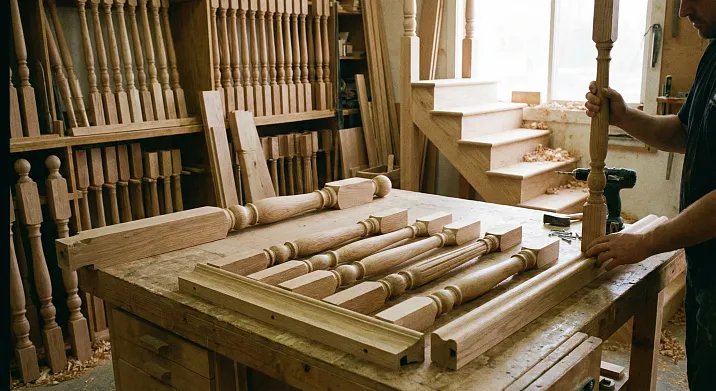
A staircase is not just a path between floors. It is the vertical artery of a house, an architectural element visible from any point in the space. And if the steps are the function, thenBalusters for staircase— is the character, style, safety. They hold the railings, protect against falls, and set the rhythm for perceiving the entire structure. But how do you choose the right balusters among hundreds of options? How do you avoid mistakes with dimensions, material, and fastening methods? Let's delve deeply — with an understanding of engineering, aesthetics, and the practical experience of those who have been building staircases for decades.


What is a Baluster: From Antiquity to Modern Times
The word 'baluster' comes from the Italian language, where 'balaustro' referred to a turned post with a characteristic shape resembling a pomegranate flower. In the architecture of Ancient Greece and Rome, balusters adorned balconies, terraces, and staircases of public buildings — temples, amphitheaters, baths. The Renaissance revived this form, turning the baluster into a mandatory element of grand staircases in palaces and mansions.
The modern baluster has retained its essence but expanded its boundaries. It is a vertical post installed between the stair treads and the handrail. Its primary function is to create a guardrail that prevents falls. The second function is decorative: balusters form the visual rhythm, set the style of the staircase, and connect it with the interior of the house. The third function is structural: balusters transfer part of the load from the handrail to the treads, enhancing the rigidity of the entire guardrail system.
The standard height of a baluster is 900 millimeters from the surface of the tread to the lower plane of the handrail. This dimension is defined by building codes as optimal for safety — railings at a height of 900-950 millimeters are at the level of an adult's center of gravity, allowing effective leaning on them while simultaneously preventing accidental toppling over the guardrail.




Wood species: oak, beech, ash in the context of loads
Choosing the wood species for balusters is not a matter of personal preference, but a calculation of strength, durability, and wear resistance. A staircase is a high-traffic area where dozens, hundreds of ascents and descents occur daily. Balusters experience not only vertical loads but also lateral ones—when they are grabbed, leaned on, or rested against.
Oak holds the leading position due to its density of 700 kilograms per cubic meter and hardness of 3.7-3.9 units on the Brinell scale. An oak baluster can withstand a lateral load of up to 100 kilograms without deformation. The high tannin content makes oak resistant to moisture, fungus, and insects—a critically important property for staircases in homes with variable heating, on verandas, and in high-humidity areas. Oak's texture is expressive, with contrasting annual rings and medullary rays creating a noble pattern. The color ranges from light golden to dark brown, depending on the wood's origin and processing method.
Beech is an alternative with a density of 650 kilograms per cubic meter and hardness of 3.2-3.5 units. Beech balusters are strong but more pliable to work with—turning, carving, and sanding require less time and effort. The texture is fine-grained, uniform, without sharp transitions—an ideal background for painting and tinting. The light shade of beech with a slight pinkish undertone creates a sense of airiness and visually lightens the massiveness of the staircase. A critical feature is hygroscopicity. Beech actively reacts to changes in air humidity, requiring a stable microclimate in the room.
Ash is a species with a unique combination of strength and elasticity. Density is 650-700 kilograms per cubic meter, but ash is more elastic than oak—it bends without breaking. This makes ash balusters ideal for structures with curved sections where flexibility is required. Ash's texture is bright, with pronounced annual rings, and the color is light with a yellowish or grayish tint. Ash takes well to tinting, accepting any shades from natural to exotic.
Our factory also produces:




Turned balusters: symmetry and lathe artistry
The classic baluster shape is turned, created on a lathe. A square-section solid wood blank is secured in the lathe's chuck and rotated at high speeds. Cutting tools remove layers of wood, forming a profile with alternating thickenings and narrowings, spheres, cylinders, and cones. The result is a perfectly symmetrical post, where every millimeter is at an equal distance from the central axis.
Modern production uses CNC (Computer Numerical Control) machines, where the baluster profile is programmed in a 3D model. The machine reproduces the specified shape with an accuracy of up to tenths of a millimeter, ensuring the identity of all items in a series. This is critically important for staircases where dozens of balusters are installed—any discrepancy in dimensions or proportions will be noticeable to the eye.
Profiles of turned balusters range from simple cylinders with decorative rings to complex multi-tiered compositions. The classic profile includes a base—an expanded footing for attachment to the tread; a body—the central part with decorative elements; and a neck—the upper part on which the handrail is installed. Proportions follow compositional rules—the base and neck occupy 15-20 percent of the height each, and the body occupies 60-70 percent.
Get Consultation
Flat balusters: when space dictates the form
Not every staircase allows for the installation of round turned balusters. Narrow flights, limited space, and specific architecture require more compact solutions.Flat balustersFlat balusters are the answer to these challenges. They are rectangular slats with a thickness of 30-40 millimeters and a width of 80-120 millimeters, installed with the narrow side facing the staircase flight.
The advantage of flat balusters is space saving. Where a round baluster with a 70-millimeter diameter consumes a significant width of the flight, a flat one with a 35-millimeter thickness leaves more room for passage. On narrow spiral staircases where every centimeter is critical, flat balusters become the only sensible choice.
The decorative aspect of flat balusters is achieved through milling, carving, and perforation. On the wide plane, one can create openwork patterns, geometric designs, or floral motifs. A modern approach is laser cutting, which allows for cutting the most intricate patterns with jeweler's precision. Such balusters turn into lace-like panels where the play of light and shadow creates an ever-changing picture.
Carved balusters: when wood becomes sculpture
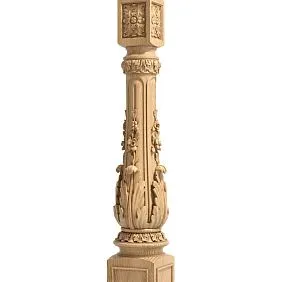
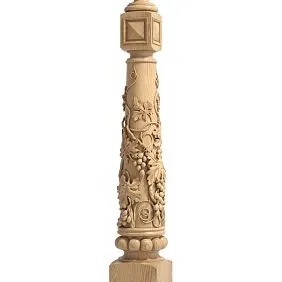
Wood carving is the highest form of decorative baluster processing. A carved element is created either manually by a master carver or on a CNC milling machine using a 3D model. The result is a three-dimensional ornament where leaves, flowers, scrolls, and geometric figures protrude from the baluster's body, creating deep relief.
Carved balusters are used in high-status interiors—mansions, estates, representative buildings—where the staircase must demonstrate not just function, but art. Carving styles vary: Baroque—lush, with an abundance of floral motifs and dynamic forms; Classical—restrained, with symmetrical ornaments and clear lines; Eastern—with complex geometric patterns and calligraphic elements.
The production of carved balusters is labor-intensive. Even with CNC, manual finishing is required—cleaning transitions, sanding hard-to-reach areas, and accentuating details. The manufacturing time for one carved baluster can reach several hours compared to 15-20 minutes for a simple turned one. Accordingly, the price of carved balusters is 3-5 times higher than standard ones.
Handrail and baluster system: safety engineering
Handrails and balustersThe handrail and balusters form a unified railing system where each element works towards the common goal—ensuring safety during ascent and descent. The handrail takes on the supporting loads from hands, and the balusters transfer these loads to the treads, distributing them along the entire length of the flight.
The distance between adjacent balusters is regulated by building codes. The maximum gap is 150 millimeters. This requirement is dictated by child safety: a child should not be able to put their head between the posts. In practice, the optimal distance is 120-130 millimeters, which corresponds to installing two balusters on each tread with a standard depth of 280-300 millimeters.
The method of attaching balusters determines the reliability of the entire structure. The lower end of the baluster is attached to the tread using one of three methods: mortise and tenon joint—a blind hole is drilled in the tread, a tenon is formed on the baluster, which fits into the hole and is glued; threaded fastening—a metal stud is screwed into the baluster from below, which then enters a threaded insert glued into the tread; mounting on a sub-baluster rail—a horizontal strip attached to the tread ends, to which balusters are fastened with screws from the side.
The upper end of the baluster is connected to the handrail also in several ways. The classic method is the baluster fitting into a groove milled into the lower part of the handrail. The groove depth is 20-25 millimeters, and the width corresponds to the baluster's cross-section. The joint is glued and additionally secured with finish nails driven at an angle through the handrail into the baluster's end. An alternative is installing a handrail bracket with a groove into which the balusters fit, and the handrail is attached on top of the bracket.
Staircase components: an ecosystem of elements
staircase componentsA staircase is not just balusters. It is an entire system of interconnected elements where each part performs its function, and the absence or incorrect choice of even one component compromises the entire structure.
Handrail—the main supporting element held onto while moving. The handrail's cross-section is ergonomically optimized for hand grip—an oval profile of 60×45 millimeters or a round one with a diameter of 50-55 millimeters. The surface is carefully sanded to smoothness and coated with oil or varnish for comfortable tactile contact. The handrail length corresponds to the flight length plus overhangs of 200-300 millimeters at the beginning and end for easy grasping.
Newel posts—massive vertical posts installed at the beginning and end of a flight, as well as at staircase turning points. The post cross-section is 100×100 millimeters or a diameter of 120 millimeters—significantly larger than that of regular balusters. Newel posts bear the main structural load from the handrail, especially at turns where significant lateral forces occur. The attachment of newel posts is reinforced—through the tread into the staircase's load-bearing structure using metal studs with a diameter of 12-16 millimeters.
Stringer and carriage—load-bearing elements on which the treads rest. A stringer is an inclined beam to whose inner side treads are attached in grooves or with metal fasteners. A carriage is a beam with cutouts on which treads are laid from above. For staircases with balusters, a carriage construction is preferable, as balusters are attached directly to the treads, and access to the tread ends simplifies installation.
Risers—vertical planks that close the space between treads. They are not structurally mandatory but perform important functions: they give the staircase visual solidity, prevent debris from falling through, and enhance safety by eliminating the risk of a foot slipping between treads. The riser thickness is 18-25 millimeters, and the height corresponds to the tread height—usually 150-200 millimeters.
Quantity calculation: the mathematics of a staircase flight
How many balusters are needed for a staircase? The answer depends on the flight length, chosen installation spacing, and the presence of landing turns. Precise calculation is critical — a shortage of balusters compromises safety, while an excess creates visual clutter and unjustified expenses.
The standard approach is two balusters per tread. With a tread depth of 280-300 millimeters, this results in a distance of 100-120 millimeters between balusters, which complies with safety standards. For a staircase with 15 treads, 30 standard balusters are required, plus 2-4 support posts at the start, end, and any turns.
An alternative approach is one baluster per tread, supplemented with horizontal rails between balusters at mid-height. The rails create additional support points for the handrail and close gaps, ensuring safety. This method is used in modern minimalist interiors where visual lightness of the railing is important.
For spiral staircases, the calculation is more complex. The treads are trapezoidal, widening toward the outer edge. Balusters are installed only along the outer edge, where the main path of movement is. The number of balusters per tread can vary from one on narrow treads to three on wide, turning ones.
Baluster Installation: Step-by-Step Technology
Installing balusters requires precise measurements, the correct tools, and an understanding of the sequence of operations. An error at any stage will lead to misalignment, gaps, and instability of the railing.
Preparation begins with marking. Points for baluster installation are marked on the treads. For two balusters per tread, the standard placement is at 1/3 and 2/3 of the tread depth from the front edge. This ensures even load distribution and visual balance. Marking is done along the entire flight length using a template to ensure identical positioning on each tread.
Trimming balusters to height is necessary because standard balusters are produced with extra length. The handrail is installed at an angle matching the staircase's incline, and each baluster has an individual height depending on its position on the tread. The lower end of the baluster is cut at a 90-degree angle for installation on the horizontal tread. The upper end is cut at an angle equal to the flight's incline (typically 35-45 degrees) for a tight fit against the sloped handrail.
Fastening begins with the support posts. The post is installed at the start of the flight, checked for vertical alignment with a level in two planes, and secured with temporary supports. A hole 12-14 millimeters in diameter is drilled through the post, passing through the tread into the load-bearing structure. A threaded metal rod is inserted into the hole and secured from below with a nut and a wide washer. The top of the rod is cut flush, and the hole is covered with a wooden plug or decorative cap.
Installing standard balusters is done after mounting the posts. For tenon fastening, blind holes 25-30 millimeters deep are drilled into the tread, with a diameter matching the baluster's tenon. The tenon is coated with wood glue, the baluster is inserted into the hole, checked for vertical alignment, and tapped with a rubber mallet for a tight fit. For threaded fastening, a rod is screwed into the bottom of the baluster, which then engages with a threaded insert in the tread.
Installing the handrail completes the assembly. The handrail is test-fitted, and contact points with the baluster ends are marked. A groove 20-25 millimeters deep is routed into the bottom of the handrail. The groove is filled with glue, the handrail is placed over the baluster ends, and pressed firmly. Finish nails 50-60 millimeters long are driven through the handrail at a 45-degree angle into the baluster ends, countersunk below the surface, and the holes are filled with wood-colored putty.
Buying Balusters: Criteria for Choosing a Quality Product
The market offers a huge variety of balusters — from simple cylinders to carved masterpieces, from minimally priced pine to premium oak. How to avoid mistakes and to buy balustersthat will last for decades?
Wood moisture content is the first and most critical parameter. Balusters should be made from wood with a moisture content of 8-12 percent. This is the equilibrium moisture content for heated interiors. Balusters made from green wood (moisture content 18-20 percent or higher) will begin to dry after installation, shrinking in cross-section. This will lead to gaps in connections with the handrail, weakened fastenings, and warping. In the worst case, the balusters themselves may crack along the grain.
Geometric precision is the second criterion. A baluster must be strictly cylindrical or have the specified profile without eccentricity, waviness, or tapering. Check visually — stand the baluster vertically and look along its axis. Any deviations will be noticeable. For a set of balusters, uniformity is critical — all pieces must have the same height (before trimming), identical diameters at control points, and identical decorative element profiles.
Surface quality determines how much time will be needed for finishing. Well-sanded balusters have a smooth surface without fuzz, scratches, or tool marks. Light sanding with 240-320 grit abrasive before applying the finish is sufficient. Poorly processed balusters will require multi-stage sanding, starting with coarse 80-120 grit abrasive, which will take hours of work and may ruin the profile.
Wood species must match the operating conditions. For heavily used staircases in residential homes, oak or ash is optimal. For staircases in rarely used areas — attics, basements — beech is acceptable. Pine is suitable only for temporary structures or decorative staircases with minimal load. Exotic species — meranti, merbau, teak — have high density and moisture resistance, but their price is several times higher than that of European species.
Finishing: Protection and Aesthetics of Balusters
Untreated wood of balusters is vulnerable to dirt, moisture, and mechanical damage. The finish serves two purposes: it protects the material from destructive factors and reveals the decorative qualities of the wood.
Oil with hard wax is the optimal choice for balusters. The oil penetrates the wood structure, strengthening the top layer from within. Hard wax fills the pores, creating an additional protective barrier. The finish is breathable — the wood retains its ability to regulate moisture. An oiled surface feels warm and pleasant to the touch — an important quality for handrails and balusters that are frequently touched. Oil is easy to renew — simply wipe the surface with a cleaner, lightly sand, and apply a fresh coat.
Varnish creates a hard protective film on the wood surface. Polyurethane varnish provides high resistance to abrasion, scratches, and moisture. For stair balusters, matte or semi-matte varnish is recommended — gloss creates glare, visually cheapens the material, and shows every fingerprint. Varnish is applied in three coats with intermediate sanding using 320-400 grit abrasive to remove raised fibers and dust. The final coat is not sanded — its surface remains perfectly smooth.
Toning changes the color of the wood while preserving the grain. Water- or alcohol-based stains penetrate the fibers, coloring them from within. Light beech can be toned to resemble dark walnut, oak to wenge or aged wood. Toning requires care — stain may apply unevenly, especially on complex turned profiles with diameter transitions. Testing on a sample of the same wood is mandatory before toning the entire batch.
Wax is a traditional finish for antique furniture and classic interiors. Beeswax is rubbed into the wood by hand or with a mechanical polishing machine. The surface acquires a soft, silky sheen and a light honey aroma. Wax highlights the grain, making the wood visually warmer. However, wax's protective properties are weaker than oil or varnish — it requires regular renewal once a year.
Styles and Eras: How Balusters Define the Character of an Interior
The shape of balusters is a code that reveals the stylistic affiliation of an interior. Even a person unfamiliar with architecture intuitively distinguishes a classic staircase from a modern one by the silhouette of the balusters.
Classicism requires balusters with proportions derived from ancient orders. The base, shaft, and capital are clearly defined. The profile includes beads, coves, astragals — elements borrowed from columns. The wood is toned to noble dark shades or, conversely, bleached to create the effect of marble colonnades. Carving is minimal, with emphasis on the purity of geometric forms.
Baroque and Rococo — the triumph of decorativeness. Balusters are covered with carved ornamentation, curved into complex S-shapes, and enhanced with gilding and patination. Each baluster is a miniature sculpture showcasing the carver's skill. Such staircases are created for high-end mansions, where displaying wealth and status is part of the concept.
Art Nouveau offers smooth, organic forms inspired by nature. Art Nouveau balusters lack strict symmetry — they resemble plant stems, sinuous lines, flowing volumes. Often, balusters are replaced with solid panels with cut-out patterns of flowers, leaves, or waves. Wood is combined with metal and glass, creating complex compositions.
Scandinavian minimalism uses simple forms — smooth cylinders or slightly tapered posts 40-50 millimeters in diameter. No decorative carving, only clean lines. Light wood — beech, ash, birch — is coated with clear oil or white lacquer. Visual lightness is important — balusters should occupy minimal space and allow light to pass through.
Loft style allows for roughness and deliberate carelessness. Balusters made from thick square-section timber, wire-brushed to emphasize the grain, with visible processing marks. Wood is combined with metal posts, cables, and glass. Toning in dark shades or, conversely, bleaching to a gray color.
Installation Mistakes: What to Avoid During Installation
Installing balusters yourself is a feasible task, but it requires attention to detail. Typical mistakes compromise both safety and aesthetics.
Incorrect cutting angle of the baluster top ends leads to gaps in the connection with the handrail. The angle must precisely match the stair flight's incline. An error of even 2-3 degrees creates a visible gap. Check with a protractor or using a cardboard template cut to the actual stair angle.
Deviation of balusters from vertical is unacceptable. Even a slight tilt of 1-2 degrees is noticeable to the eye, especially when balusters are lined up. Each baluster is checked with a level in two planes during installation—along the flight and across it. Temporary bracing until the adhesive sets prevents shifting.
Insufficient depth of the tenon in the hole reduces joint strength. The tenon must enter the hole at least 20 millimeters for secure fixation. A hole that is too deep (more than 40 millimeters) risks a through-hole, weakening the tread structure.
Using low-quality adhesive leads to loose joints. For wooden structures, use D3 or D4 grade waterproof PVA wood glue with a shear strength of at least 10 MPa. Regular office PVA does not provide the necessary strength.
Failure to acclimate balusters before installation is a common mistake. Balusters brought from a cold warehouse to a warm house must rest for at least 48 hours to equalize temperature and humidity. Installing immediately after delivery will lead to deformations after acclimatization.
Frequently Asked Questions
Can balusters made from different wood species be installed on the same staircase?
Technically possible, but aesthetically debatable. Different species have different colors and textures, creating visual inconsistency. If it's a deliberate design choice—alternating dark and light balusters—the effect can be interesting. But random mixing looks like economizing on materials.
What is the optimal distance between balusters for child safety?
Building codes require a maximum of 150 millimeters between the centers of adjacent balusters. In practice, a safe gap is 100-120 millimeters. This prevents a child from putting their head between the posts. For families with young children, it is recommended to minimize the distance as much as possible or use additional horizontal crossbars.
Should balusters be coated with a protective finish before installation?
Absolutely. After installation, it's difficult to finish balusters properly—varnish seeping into joints, uneven coating. Balusters are coated with a finish before installation, with a small allowance on the ends, which are then trimmed to the required angle and touched up locally if necessary.
Can a single damaged baluster be replaced without dismantling the entire staircase?
Yes, if the baluster has a tenon connection. The handrail at the replacement point is carefully sawn through, the damaged baluster is knocked out from below, a new one is installed, and the handrail is glued. The seam is concealed with filler and touch-up. With threaded fastening, replacement is even easier—the stud is unscrewed, the baluster is removed, and a new one is installed.
What is the standard baluster height for residential staircases?
From the tread surface to the bottom of the handrail—900 millimeters. Considering a handrail thickness of 50-60 millimeters and the mounting method, the net baluster height is 880-920 millimeters. Balusters are usually sold with an allowance of 950-1000 millimeters for on-site trimming.
Oak balusters are several times more expensive than beech ones—is the premium justified?
For heavily used staircases—yes. Oak is stronger, more durable, more resistant to moisture and damage. Oak balusters will last 50-70 years without losing their properties. Beech requires a stable microclimate and may need replacement after 20-30 years. In the long term, oak is economically justified.
How to care for wooden balusters during use?
Regular dry cleaning—removing dust with a soft cloth. Once a month—damp cleaning with a slightly moist cloth without excess water. For oiled surfaces—reapply oil every 2-3 years. For varnished surfaces—monitor coating integrity; if wear appears, perform local restoration.
Can metal balusters be used instead of wooden ones on a wooden staircase?
Yes, this is a popular technique in modern interiors. Metal balusters—forged, stainless steel, powder-coated—create an interesting contrast with wooden treads and handrails. It's important to choose a fastening system compatible with wood.
How long does it take to install balusters on a standard staircase?
For an experienced craftsman—6-8 hours for a staircase with 15 treads and 30 balusters. This includes marking, trimming, drilling, installation, and handrail mounting. For a beginner—two to three times longer. It's critical not to rush, to check each baluster with a level, and to ensure connection accuracy.
Is it worth buying ready-made baluster kits or ordering custom manufacturing?
Ready-made kits save time and money if standard sizes and styles suit your staircase. Custom manufacturing is necessary for non-standard structures, unique design solutions, and restoration of historical objects. The price of custom balusters is 2-3 times higher than standard ones.
Conclusion: Choosing professionals
A staircase is built for decades. It's an investment not only in functionality but also in safety, aesthetics, and property value. High-qualityWooden balusters—is the foundation of a reliable railing that will serve for generations.
STAVROS Company has specialized in manufacturing wooden staircase components from solid wood for over twenty years. The range includes hundreds of baluster models—from classic turned to modern flat, from simple cylindrical to exclusive carved ones. Each product is made from selected oak, beech, or ash wood, dried to an optimal moisture content of 8-12 percent.
STAVROS production is equipped with modern CNC machines, ensuring jewelry-like precision in geometry and identical quality across all items in a batch. Quality control at every stage guarantees the absence of defects. Finishing with eco-friendly oils and varnishes reveals the beauty of the wood and provides long-lasting protection.
STAVROS works with both professional builders and designers, as well as private customers building homes themselves. Technical support, consultations on quantity calculation, style selection, and installation method choice are part of the standard service. When necessary, STAVROS specialists visit the site for measurements and consultations.
By choosing STAVROS products, you choose reliability, proven by thousands of completed projects across the country. These arestaircase componentsthe foundations on which your family's safety, your home's beauty, and your confidence in tomorrow rest.


