Article Contents:
- Technical perfection of the 50x50 size
- Engineering logic of optimal proportions
- Material science aspects
- Variety of Stylistic Solutions
- Classic interpretations
- Modern design concepts
- Manufacturing Technologies
- Raw material preparation and roughing operations
- Mechanical processing and decoration
- Installation and mounting of 50x50 balusters
- Mounting systems for various bases
- Handrail installation technology
- Wood species for 50x50 balusters
- Coniferous species: accessibility and practicality
- Hardwood species: strength and prestige
- Final finishing and protective coatings
- Surface Preparation
- Protective coating systems
- Economic aspects of selection
- Pricing factors
- Economic efficiency
- Modern Trends and Innovations
- Digital technologies in production
- Ecological innovations
- Conclusion
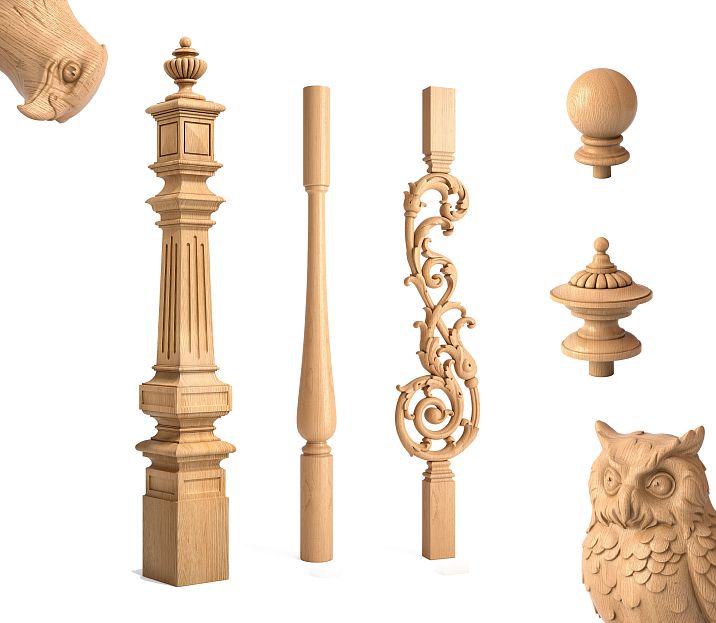
What unites majestic mansions of the past century and modern country houses? Attention to details that transform an ordinary staircase into an architectural masterpiece. Balusters 50x50 have become the golden standard in staircase design, combining optimal proportions, reliable construction, and limitless creative expression.
The 50x50 millimeter size has not been randomly popular among architects and designers. These proportions create an ideal balance between elegance and strength, allowing balusters to harmoniously fit into interiors of any scale — from compact city apartments to spacious country residences. The square cross-section opens up vast possibilities for decorative processing, from classic turned forms to modern geometric solutions.
In an era when every interior element must carry not only aesthetic but also functional load, balusters of this format demonstrate remarkable versatility. They can withstand significant loads, ensuring the safety of staircase structures, while maintaining the elegance of lines and refined forms.


Technical perfection of the 50x50 size




Engineering logic of optimal proportions
Why exactly 50x50 mm became the standard for baluster production? The answer lies in carefully calculated engineering designs and decades of master craftsmanship. The square cross-section with a 50 mm side provides a moment of resistance sufficient to withstand horizontal loads of up to 100 kg per meter of handrail — exactly the requirements imposed by modern building codes.
The cross-sectional area of 2500 mm² creates an optimal balance of strength and weight of the structure. The baluster does not appear bulky, yet it possesses sufficient rigidity to ensure safety. The square shape eliminates the possibility of the element rotating at mounting points, which is critically important for the longevity of connections.
Aerodynamic properties of the square cross-section also play a role in operational comfort. Sharp edges create turbulence in air flows, which promotes better air exchange in stairwell spaces. This is especially important in homes with high ceilings, where air stagnation may occur.
Standardization of the 50x50 mm size simplifies the design and manufacturing of accompanying elements — handrails, baluster supports, mounting systems. Manufacturers can optimize technological processes, positively affecting product quality and cost.
Our factory also produces:


Material Science Aspects
The 50x50 mm size is optimal in terms of wood raw material usage. Such blanks can be obtained from logs with a diameter of 180 mm, corresponding to trees aged 40-60 years — the optimal period for harvesting construction-grade timber. At the same time, maximum yield of quality material is ensured with minimal waste.
The drying process of blanks of this cross-section proceeds evenly, without forming internal stresses. The 50 mm wall thickness allows moisture to evaporate gradually, preventing cracking and warping. Drying time is 3-4 weeks when technological parameters are observed.
Processing balusters with a 50x50 mm cross-section does not require special equipment. Standard turning and milling machines handle such blanks without additional fixtures. This makes production more accessible and allows maintaining competitive pricing.
The square cross-section simplifies marking and quality control of processing. All four sides are equal, eliminating orientation errors when installing decorative elements or making connections.
Get Consultation
Variety of stylistic solutions
Classic interpretations
Traditional balusters sized 50x50 In classical execution, they represent miniature architectural orders. Base, shaft, and capital — three main elements, whose proportions are defined by the canons of ancient architecture. The Doric order dictates strictness and simplicity of forms, the Ionic — elegance of transitions, the Corinthian — richness of decorative elements.
Turned balusters demonstrate the mastery of turning craftsmanship. Smooth transitions between profile elements, perfect symmetry, flawless surface finish — all this is achieved thanks to optimal blank dimensions. The 50x50 mm cross-section allows creating complex profiles without risking weakening the structure.
Fluted balusters with vertical grooves evoke ancient columns. The number of flutes is usually 16 or 20 — this ensures harmonious perception of proportions at this cross-section. The depth of grooves does not exceed 8–10 mm, preserving the strength of the item.
Turned balusters present a special manufacturing complexity. Spiral grooves require special equipment and high skill from the craftsman. The spiral pitch is calculated based on the baluster height and number of turns — usually 1.5–2 turns per standard height of 900 mm.
Modern design concepts
Minimalist approach to balusters with a 50x50 mm cross-section emphasizes the purity of geometric forms. The absence of decorative elements is compensated by perfect proportions and surface finish quality. Such balusters become part of the architectural composition, not distracting from the overall concept.
Asymmetric forms create dynamic compositions in modern interiors. Shifting the center of gravity, uneven volume distribution, contrasting textures — all this is possible due to the sufficient strength of a 50x50 mm square cross-section.
Combined solutions combine wood with other materials. Metal inserts, glass elements, stone details create expressive contrasts. The 50x50 mm size allows integrating various materials without compromising structural integrity.
Perforated balusters with cut-out patterns demonstrate the capabilities of modern equipment. Laser cutting and CNC milling allow creating complex openwork compositions. Square cross-section simplifies machine programming and ensures precision processing.
Manufacturing Technologies
Raw material preparation and roughing operations
Production of quality balusters begins with careful selection of timber. For manufacturing items with a 50x50 mm cross-section, 60x60 mm dimensional lumber is used, ensuring a machining allowance. Moisture content of blanks should not exceed 12% for interior use and 18% for exterior applications.
Material cutting is performed on high-precision saws with carbide-tipped blades. Clean cut is critically important for subsequent operations — any chips or irregularities require additional processing. The cutting angle must be strictly 90°, deviations are not allowed.
Blank calibration is performed on four-sided planers. All four sides are processed simultaneously, ensuring ideal geometry of the square cross-section. Tolerances for dimensions are ±0.1 mm, ensuring interchangeability of items.
Blank quality control includes checking geometric parameters, moisture content, and presence of wood defects. Blanks with knots, cracks, or resin pockets are rejected or directed for manufacturing less critical items.
Mechanical processing and decoration
Turning balusters with a 50x50 mm cross-section requires special fixtures. The blank is secured in centers or a chuck ensuring reliable fixation without deformation. Rotation speed is selected depending on wood species and profile complexity.
Decorative element milling is performed on specialized CNC machines. Program control ensures perfect repetition of complex profiles and ornaments. Tool change is automatic, eliminating operator errors.
Hand carving is used to create unique items. The master carver uses traditional tools — chisels, gouges, and marking gauges. The work requires high skill and artistic taste. The time to manufacture a single carved baluster may take several days.
Polishing is the final stage of mechanical processing. The process is carried out in stages, starting with 120-grit abrasive and ending with 400-grit. The polishing direction must align with the direction of wood grain.
Installation and mounting of 50x50 balusters
Mounting systems to various bases
Fastening 50x50 mm balusters Attachment to wooden steps can be performed in several ways. The most reliable method is through bolt fastening with M8 or M10 bolts. The bolt passes through the entire step thickness and is secured with a nut from the bottom side. The bolt head is embedded into the wood and covered with a wooden plug.
Shank fastening provides aesthetically perfect connections without visible metal elements. Coaxial holes with a 12 mm diameter are drilled in the baluster end and in the step. A 80 mm wooden shank ensures secure fixation when using quality carpentry glue.
Anchoring fastening is used when installing on concrete bases. Chemical anchors create a monolithic connection capable of withstanding significant loads. Anchor depth should be at least 80 mm to ensure required strength.
Adjustable fasteners allow adjusting baluster position after installation. Special screw mechanisms compensate for foundation inaccuracies and ensure perfect verticality of elements. Such systems are especially relevant when working with uneven surfaces.
Handrail Installation Technology
Top mounting of balusters to handrails is performed through a handrail support plate. A 20x40 mm section plate is secured to baluster ends with 60 mm long self-tapping screws. It is important to ensure strict horizontal alignment of the plate along the entire length of the railing.
The handrail is mounted on the support plate and secured with self-tapping screws driven from below. Screw length is chosen so that they securely enter the handrail but do not protrude beyond the front surface. The connection is additionally reinforced with carpentry glue.
Handrail connections are made using angled 45° tenons. The joint is glued and clamped with clamps until the glue fully dries. Wooden dowels or metal bolts may be used to strengthen the connection.
Handrail ends are finished with special decorative elements. They may be turned together with the handrail or manufactured separately and attached with a tenon. The shape of the ends should harmonize with the overall baluster style.
Wood species for 50x50 balusters
Coniferous species: accessibility and practicality
Spruce remains the most popular material for manufacturing balusters due to optimal price-to-quality ratio. Spruce wood density of 500–550 kg/m³ provides sufficient strength for most applications. Natural resins protect against moisture and biological damage.
Larch stands out among coniferous species with unique performance characteristics. Density reaches 665 kg/m³, comparable to hardwoods. High resin and tannin content makes larch practically impervious to moisture and pests.
Spruce is attracted by its uniform structure and minimal knots. The light, almost white color of spruce wood is ideal for modern interiors. Density of 450-500 kg/m³ ensures easy processing and good holding of fasteners.
Cedar is an elite material among coniferous species. Its unique aromatic properties create a special atmosphere in the home. Cedar wood has natural antiseptic properties and does not require additional protective treatment.
Hardwood species: strength and prestige
Oak is the king among materials for making balusters. Density of 700 kg/m³ ensures exceptional strength and durability. Tannins in oak wood provide natural resistance to moisture and biological damage. Oak's texture with clearly visible growth rings creates a unique pattern.
Ash is attracted by its exceptional viscosity and elasticity. With density of 650-700 kg/m³, this species can withstand significant dynamic loads without cracking. Light ash tones with contrasting texture harmonize beautifully with modern interior solutions.
Beech is characterized by uniform structure and beautiful pinkish hue. Density of 680 kg/m³ ensures high product strength. Beech wood is easy to process and retains its shape well after drying. Its ability to be evenly stained allows creating products of any color scheme.
Walnut is an elite material with a unique texture and noble chocolate tone. Walnut wood density reaches 650 kg/m³, and its workability allows creating delicate decorative elements. Natural oils in the wood composition provide additional protection against external influences.
Finishing and protective coatings
Surface preparation
Quality finishing begins with careful sanding of all surfaces. The process is carried out in stages, using abrasives of different grits. Initial sanding is performed with 120-150 grit material to remove marks from mechanical processing and minor defects.
Intermediate sanding with 220-240 grit abrasive levels the surface and prepares it for final finishing. Special attention is paid to transition areas between different profile elements — there should be no steps or unevenness here.
Final sanding is performed with 320-400 grit abrasive to achieve a perfectly smooth surface. All movements must be directed along the wood grain — crosswise scratches will become visible after applying a transparent finish.
Dust removal after each sanding stage is critically important for finish quality. Dust is first removed with a vacuum cleaner, then with a sticky cloth or cloth slightly dampened with white spirit. The surface must be absolutely clean before applying the finish.
Protective coating systems
The choice of protective coating depends on operating conditions and aesthetic preferences. Lacquers provide maximum protection against mechanical damage and moisture, forming a durable film on the wood surface.
Oil-based finishes penetrate deeply into the wood structure, highlighting its natural beauty. They do not form a film on the surface, preserving the tactile feel of wood. Oils are easily repairable in case of local damage.
Wax finishes provide a silky sheen and pleasant tactile texture. Wax protects against moisture and dirt while allowing the wood to "breathe". Such finishes are especially popular in eco-oriented interiors.
Combined systems combine the advantages of different types of finishes. Oil impregnation followed by lacquer application provides deep protection and attractive appearance. Primer-lacquer-lacquer creates the most durable finish for heavily used surfaces.
Economic aspects of selection
Pricing Factors
Cost Baluster with cross-section 50x50 The price is determined by many factors. The wood species plays a decisive role — products made of oak or ash cost 3-5 times more than pine equivalents. Processing complexity also significantly affects the price — carved balusters may cost 10 times more than simple turned ones.
Order volume allows optimizing production processes and reducing unit cost. Ordering a complete set of stair elements can result in a significant discount. Standard sizes and profiles are cheaper than custom designs.
Surface processing quality affects labor costs and, consequently, the price. Balusters for painting require less meticulous preparation than those for transparent finishes. Hand sanding is significantly more expensive than machine sanding but provides higher quality.
Logistical costs can constitute a significant portion of the total cost, especially for remote regions. Balusters are bulky items requiring special packaging and careful transportation.
Economic Efficiency
Investments in quality balusters pay off through their longevity and low operating costs. Hardwood products last 30-50 years without major repairs, whereas cheap alternatives require replacement every 10-15 years.
Energy efficiency of wooden structures contributes to reduced heating costs. Wood has low thermal conductivity, providing additional insulation in the stair area. This is especially important for homes with high ceilings.
Maintenance cost of quality balusters is minimal. Properly treated wood requires only periodic cleaning and renewal of protective coating every 5-7 years. Cheap items may require annual repair and renewal.
Residual value of quality balusters remains high even after many years of use. During home reconstruction, they can be dismantled and reused or sold as antique items.
Modern trends and innovations
Digital technologies in production
CNC machines have revolutionized baluster production. Five-axis machining centers can create items of any complexity with micron-level precision. Programming machines allows reproducing complex profiles with perfect repeatability.
3D modeling helps visualize the future product and optimize its design. Virtual testing allows identifying weak spots and reinforcing them even during the design phase. The client can see the result before production begins.
Laser processing opens new possibilities for decorating balusters. Laser engraving allows applying delicate ornaments, inscriptions, and images with photographic precision. Laser cutting creates delicate elements impossible to achieve with traditional methods.
Robotic systems are beginning to find application in mass production. Robots ensure consistent processing quality and eliminate human factors. They are especially effective in performing monotonous operations — sanding, painting, packaging.
Ecological Innovations
Using certified wood from sustainably managed forests is becoming a standard of responsible production. FSC or PEFC certification guarantees that the material was obtained without harm to the environment.
Safe finishes free of formaldehyde and other harmful substances ensure a healthy microclimate in the home. Water-based lacquers and adhesives based on natural resins do not emit toxic substances and are suitable for children's rooms.
Waste recycling minimizes environmental impact. Sawdust is used to produce pellets, shavings for particleboard, and trimmings for small details.
Energy-efficient technologies reduce the carbon footprint of production. Using renewable energy sources, optimizing processes, and heat recovery — all these measures contribute to creating an environmentally clean production.
Conclusion
Balusters with cross-section 50x50 mm represent an ideal combination of functionality, aesthetics, and economic efficiency. This size has become an industry standard due to optimal proportions that ensure necessary strength while preserving elegant form.
Variety of stylistic solutions allows using balusters of this format in interiors of any style — from classic to ultra-modern. The square cross-section opens up wide possibilities for decorative processing and integration with other materials.
Modern production technologies ensure the highest quality of products while maintaining competitive prices. Automation of processes, precise computer control, innovative materials and coatings — all of this contributes to creating world-class products.
Ecological aspects are becoming increasingly important for consumers. Responsible forestry, safe materials, energy-efficient production — these factors determine the choice of a modern buyer.
Investing in quality balusters is an investment in the longevity, safety, and beauty of your home. Properly selected and professionally installed elements will delight you and your loved ones for many years.
118.35 $