Article Contents:
- Psychology of the color gold in interior design
- Harmony with other colors
- Technologies for creating gold plating
- Alternative gilding methods
- Materials for the base of golden balusters
- Wooden bases
- Stylistic directions in design
- Modern Interpretations
- Technical aspects of installation
- Features of different mounting methods
- Operation and Maintenance
- Coating restoration
- Economic Aspects
- Long-Term Economic Efficiency
- Trends in Modern Design
- Influence of digital technologies
- Application in various interior types
- Specific requirements
- Innovations and the Future
- Development prospects
- Conclusion
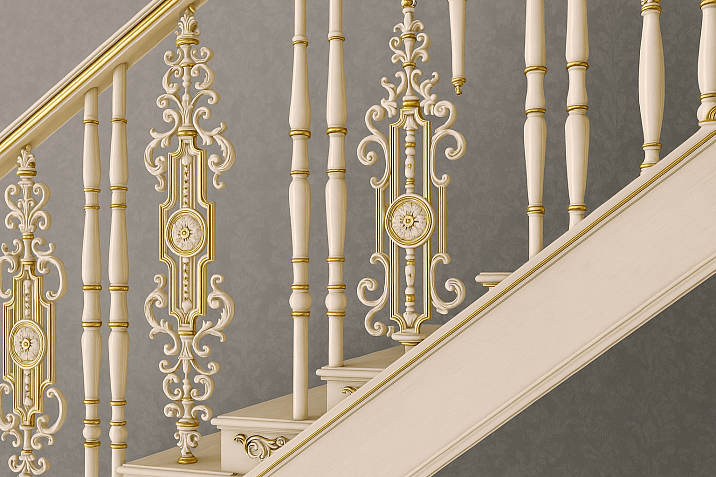
Gold — the metal of the gods, symbol of eternity and perfection. When this noble hue meets refined architectural forms, something truly magical is born. Golden balusters transforms an ordinary staircase into a work of art, where each step becomes part of a solemn ceremony ascending to beauty.
Imagine morning light streaming through windows and playing on the golden surfaces of balusters. Each ray becomes a precious thread woven into the symphony of the interior. This is not merely a decorative element — it is the philosophy of luxury embodied in metal and wood, a way to declare your impeccable taste and understanding of true beauty.
In the world of modern design, where minimalism often borders on asceticism, golden balusters bring us back to the understanding that beauty has the right to exist. They remind us of times when every detail of the home was created not merely for function, but for the soul, when masters poured not only professionalism but also a striving for perfection into their work.


Psychology of the color gold in interior design
Gold is not just a color — it is a state of mind, an energy capable of transforming space and the mood of people within it. Psychologists assert that golden hues stimulate creative thinking, boost self-esteem, and create a sense of well-being.
The energetic influence of gold metal affects the human subconscious, awakening associations with sunlight, warmth, and abundance. When we see golden elements in interior design, our brain automatically interprets them as signs of success and prosperity. This is not coincidence — for millennia, gold has been a symbol of power, wealth, and divine protection.
Influence on spatial perception — another important aspect of using golden balusters. They possess a unique ability to visually expand a space, creating a play of light and shadow. Reflective surfaces in golden tones function like numerous small mirrors, multiplying light streams and creating a sense of lightness even in compact spaces.
The symbolic meaning of gold in various cultures is remarkably similar. From ancient Egypt to modern China, this color is associated with higher powers, wisdom, and spiritual enlightenment. Incorporating golden elements into interior design subconsciously creates a sacred space — a place where the everyday meets the sublime.




Harmony with other colors
Classic combinations of gold with white, cream, and ivory create an atmosphere of aristocratic elegance. These combinations have been tested over centuries and never go out of style. White walls and golden balusters — this classic works in any interior, from a Baroque palace to a modern apartment.
Contrasting solutions with black, dark blue, or emerald create a dramatic effect and highlight the luxury of golden elements. Such combinations require boldness and understanding of color harmony, but the result exceeds all expectations.
Monochromatic compositions in various shades of gold — from pale yellow to rich bronze — create a complex, multi-layered picture. This approach requires high designer skill, but allows for truly unique interiors.
Our factory also produces:


Technologies for creating gold plating
Modern technologies allow creating gold plating in various ways, each with its own features, advantages, and applications. The choice of technology depends on the base material, operating conditions, and desired aesthetic effect.
Electroplating is the most durable and high-quality method of applying gold plating to metallic surfaces. During electrolysis, a thin layer of real gold deposits onto the surface of the object, creating a coating ranging from several microns to dozens of microns thick.
The advantages of electroplating include exceptional corrosion resistance, color retention for decades, and the ability to create coatings of varying thickness. The disadvantage is the high cost of the process and the need for specialized equipment.
Vacuum deposition is a modern technology allowing the application of extremely thin layers of gold or gold-colored alloys onto any surface. This method ensures uniform coverage of complex shapes and enables the creation of various shades of gold.
Get Consultation
Alternative gold-plating methods
Powder coating with gold-colored compounds offers an economical solution for creating a gold effect. Modern powder paints contain metallic pigments that produce a convincing gold imitation at significantly lower cost.
Liquid gold plating using special compositions allows creating gold coatings by brush or spray. This method is suitable for restoration work and artistic effects.
Leaf gold plating is a traditional technique used for centuries. Ultra-thin gold leaves are adhered to a prepared surface using a special adhesive. This method provides the most authentic appearance but requires high craftsmanship.
Base materials for gold balusters
Choosing the base material is critically important for creating quality gold balusters. Each material has its own characteristics that affect the application technology, durability, and appearance of the finished product.
Stainless steel is an ideal base for gold balusters due to its corrosion resistance and strength. The polished surface of stainless steel provides an ideal base for applying a gold coating, ensuring mirror-like gloss and longevity.
Advantages of stainless steel include resistance to moisture, temperature fluctuations, and mechanical impacts. Stainless steel balusters with gold coating are suitable for both indoor and outdoor applications.
Brass is traditionally used to create golden items due to its natural color close to gold. Brass balusters can be polished to a mirror finish or coated with additional protective compounds.
Wooden bases
solid wood provides unique opportunities for creating gold wooden balusters. Modern technologies allow applying gold-colored coatings onto wooden surfaces, creating the effect of precious metal while preserving the warmth and coziness of natural wood.
Preparing a wooden surface requires special attention. The wood must be carefully dried, sanded, and coated with special primers ensuring adhesion of the gold coating.
Composite materials based on wood and polymers combine the advantages of natural and synthetic materials. They are dimensionally stable, do not warp or crack, making them ideal bases for gold coatings.
Stylistic directions in design
Gold balusters are used in various stylistic directions, from classical to ultra-modern. Each style imposes specific requirements on shape, proportions, and the character of the gold coating.
The classical style requires strict adherence to canonical proportions and traditional forms. Gold balusters in a classical style often have complex profiles with alternating convex and concave elements. In this case, the gold plating must be flawless, with uniform coverage of all surfaces.
A distinctive feature of classical gold balusters is their ability to create a sense of grandeur and ceremonial elegance. They transform a staircase into a ceremonial interior element, emphasizing the status and taste of the owners.
Baroque opulence implies using gold in maximum volume. Baroque gold balusters feature complex, curved forms, an abundance of decorative elements, and rich play of light and shadow.
Modern Interpretations
Art Deco introduces geometric clarity and symmetry into gold balusters. This style values contrasts and dramatic effects, so gold elements are often combined with black or dark surfaces.
Modern minimalism uses gold very sparingly, as an accent element. Minimalist balusters with gold coating have simple geometric shapes and flawless surface quality.
Eclecticism allows boldly combining gold elements with the most unexpected materials and forms. This approach requires high artistic taste but enables creating truly unique interiors.
Technical aspects of installation
Installing gold balusters requires special attention to details and the use of specialized technologies that ensure the preservation of the coating and the longevity of the structure.
Surface preparation of the base is critically important for quality installation. All surfaces must be thoroughly cleaned of contaminants, degreased, and leveled if necessary. Any defects in the base may lead to uneven baluster installation and damage to the gold coating.
Protection of the coating during installation is ensured by using special protective films and soft pads. All tools must have protective coatings that prevent scratches and damage to the gold surface.
Fastening elements for gold balusters must be made of corrosion-resistant materials and have the appropriate coating. Using ordinary steel fasteners may result in rust stains and damage to the appearance.
Features of different mounting methods
Flange mounting ensures secure fixation of balusters and even load distribution. Flanges must be made from the same material as the balusters and have the appropriate coating.
Threaded connections require the use of special sealants and protective compounds to prevent corrosion at connection points. All threaded elements must be gold-coated or have a neutral coating.
Welded connections are used only in factory conditions, followed by coating the entire structure. The quality of welding is critically important for the final appearance of the product.
Operation and Maintenance
Gold balusters require special care to maintain their original appearance and luster. Proper maintenance extends the coating's lifespan and preserves the aesthetic qualities of the items.
Regular cleaning should be done with soft materials without abrasive substances. It is best to use special microfiber cloths and neutral cleaning agents. Aggressive chemical compounds may damage the gold coating.
Cleaning frequency depends on the intensity of staircase use and environmental conditions. In residential spaces, weekly wet cleaning is sufficient; in public buildings, daily cleaning may be required.
Protection against mechanical damage includes using protective pads at high-contact points, careful handling when moving furniture and other items. Even minor scratches on the gold coating can significantly degrade the appearance of the item.
Coating restoration
Local repair of minor damage can be performed using special touch-up compounds. Modern materials allow restoration of the gold coating almost invisibly to the eye.
Full restoration of the coating requires disassembling the balusters and reapplying the gold layer in factory conditions. This process is costly but allows complete restoration of the original appearance of the items.
Preventive maintenance includes regular inspection of the coating, timely elimination of minor defects, and monitoring of fasteners. Preventing problems is always cheaper than fixing them.
Economic Aspects
The cost of gold balusters significantly exceeds the price of ordinary items, but these investments are justified by longevity, prestige, and their ability to increase property value.
Pricing factors include the cost of the base material, coating application technology, complexity of the item's shape, and order volume. The most expensive are balusters with real gold coating applied by electroplating.
Cost savings on volume are possible when ordering large batches of items. Many manufacturers offer progressive discount systems, making large projects more economically viable.
Alternative solutions allow achieving a gold effect at lower costs. High-quality gold imitation using modern materials can be practically indistinguishable from real gilding.
Long-term economic efficiency
The service life of quality gold balusters is measured in decades. With proper care, they retain their appearance and functionality for 20–30 years or more, making them economically advantageous in the long term.
Impact on property value can be very significant. Luxurious interiors with gold elements enhance the prestige and market value of the property.
The possibility of restoration allows extending the service life of items practically indefinitely. This is especially important for historical buildings and cultural heritage sites.
Trends in modern design
The modern market for gold balusters is developing under the influence of changes in design preferences, emergence of new technologies and materials.
Personalization is becoming a key trend. Clients increasingly demand unique solutions reflecting their individuality. The ability to create exclusive gold balusters according to individual sketches has become an important competitive advantage.
Environmental awareness influences the choice of technologies and materials. Preference is given to environmentally friendly coating application methods and waste recycling from production.
Integration of technologies opens new design possibilities. LED lighting integrated into gold balusters creates fantastic lighting effects and transforms the staircase into an art object.
Influence of digital technologies
3D modeling allows clients to see future products in their interiors even before production begins. Virtual reality makes the selection process more intuitive and reduces the risk of errors.
Production automation increases product quality and reduces costs. Robotic lines ensure uniform coating and eliminate human factors.
Online sales expand market geography and make exclusive items accessible to customers from remote regions.
Application in Various Interior Types
Golden balusters are used in the most diverse interiors, from private residences to public buildings. Each type of building imposes its own requirements for design and functionality.
Private homes allow full use of golden balusters' decorative potential. Here, one can go beyond functional requirements and create truly luxurious compositions.
Hotels and restaurants use golden elements to create an atmosphere of luxury and exclusivity. Grand staircases with golden balusters make a strong impression on guests and highlight the establishment's status.
Representative office buildings can also benefit from using golden elements in the design of entrance areas and grand staircases.
Specific Requirements
Public buildings impose higher requirements for coating durability and wear resistance. Intensive use requires the application of the most durable gold-plating technologies.
Historic buildings require adherence to authenticity and use of traditional techniques. Restoration of golden elements in such structures is a special art.
Climate conditions influence the choice of coating technology. For humid climates, especially durable coatings are required; for dry climates, protection against static electricity is needed.
Innovations and the Future
Technological advancements open new possibilities for creating golden balusters. Nanotechnologies, new materials, and processing methods promise revolutionary changes in the industry.
Nanomaterials allow creating coatings with unique properties: self-cleaning surfaces, antibacterial coatings, and color-changing surfaces depending on lighting.
Smart materials with shape memory open possibilities for creating transformable structures. Balusters changing their shape depending on operating conditions are no longer science fiction.
Biocompatible coatings are becoming increasingly important in an era of heightened attention to ecology and health. Gold coatings with antibacterial properties are especially relevant for medical facilities.
Development Prospects
Mass customization will make unique golden balusters accessible to a broad range of consumers. Automated production will allow creating individual items at the price of mass-produced ones.
Virtual reality will change the design and sales process. Clients will be able to 'walk through' their future interior and assess how golden balusters will look in real conditions.
Artificial intelligence will help create optimal design solutions by analyzing client preferences and offering the best options.
Conclusion
World golden balusters It represents a wonderful blend of ancient traditions and modern technologies, where the eternal beauty of gold meets innovative solutions. These elements do not merely decorate interiors — they create an atmosphere of luxury and elegance, transforming an ordinary staircase into a work of art.
Choosing golden balusters is an investment in beauty that pays off not only in aesthetic pleasure but also in increasing property value. Quality items serve for decades, maintaining their luster and appeal with proper care.
Modern technologies allow creating golden coatings of any complexity and durability. From real gold plating to high-quality imitation — everyone can find a solution that suits their needs and budget.
In an era of standardization and mass production, golden balusters remain symbols of individuality and exclusivity. They remind us that beauty has the right to exist, that luxury is not a luxury but a means of expressing human striving for perfection.
The future of golden balusters is linked to the development of new technologies and materials, but the foundation remains unchanged — the desire to create something beautiful that will delight the eye and elevate the spirit. Investing in quality golden balusters, you invest in the eternal values of beauty and perfection.
STAVROS, recognized as a leading company in the production of wooden architectural elements, understands the importance of every detail in creating a perfect interior. Years of experience, use of advanced technologies, and deep understanding of client needs allow STAVROS to offer solutions that combine traditional craftsmanship with modern requirements for quality and functionality. Choosing STAVROS products means not just acquiring architectural elements, but the opportunity to realize your dreams of a beautiful home, where every detail speaks of your impeccable taste and pursuit of perfection.