












































































Article Contents:
- Geometry of perfection: why the round shape captivated architects for centuries
- Philosophy of the circle in architecture
- Technical advantages of a round cross-section
- Technological aspects of manufacturing round balusters
- Turning processing: the art of creating an ideal form
- Modern technologies in the production of round balusters
- Artistic finishing of round balusters
- Material science: selection of wood for round balusters
- Oak: the standard of strength and beauty
- Ash: flexibility and elegance
- Beech: Universality and Accessibility
- Coniferous species: economy without compromising quality
- Design solutions with round balusters
- Classic style: Eternal elegance
- Modern interpretation of classicism
- Ethnic motifs in the design of round balusters
- Technical Requirements and Standards
- Normative requirements for round balusters
- Quality control during production
- Installation and mounting of round balusters
- Methods of attaching to the base
- Installing handrails on round balusters
- Features of installation on different types of staircases
- Protective Coatings and Finishing
- Coating materials for round balusters
- Oil finishes
- Staining and painting
- Operation and maintenance of round balusters
- Regular Maintenance
- Repair and restoration
- Prevention of Damage
- Economic aspects of choosing round balusters
- Pricing factors
- Cost Comparison of Different Materials
- Economic efficiency
- Innovations in the production of round balusters
- Modern Processing Technologies
- Ecological innovations
- Production digitization
- Conclusion
What makes a person stand still in awe before an elegant staircase? Why do some structures seem cold and impersonal, while others radiate warmth and nobility? The secret lies in the details, and one of the most important among them is the round baluster — an element that transforms an ordinary staircase into an architectural masterpiece.
The round shape of balusters has not been a coincidence in becoming a classic of world architecture. It embodies the harmony of natural lines, where there are no sharp angles or abrupt transitions — only smooth curves that create a sense of completeness and perfection. When the craftsman creates a round balusterhe does not simply process wood — he infuses life into an architectural form that will delight the eye and serve people for decades.
Imagine a staircase without balusters — it is like a symphony without melody, a painting without colors. Round balusters become the notes that create the rhythm and harmony of the entire composition. Their silhouettes, repeated at equal intervals, form a visual rhythm that soothes the gaze and creates a sense of order and stability.


Geometry of perfection: why the round shape captivated architects for centuries




Philosophy of the circle in architecture
The circle is a symbol of perfection, infinity, and harmony. In architecture, round forms have always been associated with divine beginnings, natural beauty, and naturalness. When ancient masters first began creating round balusters, they intuitively understood that this form possesses a special magic in influencing human perception.
The psychological impact of round shapes on humans has been studied by modern science. The absence of sharp angles creates a sense of safety and comfort. The gaze easily glides over smooth curves, encountering no obstacles, which evokes a subconscious feeling of tranquility and harmony.
Ergonomic advantages of round balusters are manifested in tactile sensations. The hand naturally grips the round surface, which is especially important when using balusters as additional support while moving up stairs. The smooth, polished surface of a round baluster is pleasant to the touch and does not cause discomfort even with prolonged contact.
Our factory also produces:


Technical advantages of round cross-section
From an engineering standpoint, a round cross-section has several indisputable advantages. Even distribution of stresses around the entire perimeter of the cross-section makes round balusters more resistant to bending loads compared to square or rectangular counterparts.
The absence of stress concentrators in the form of sharp angles significantly increases the durability of the structure. In square balusters, it is precisely the corners that become weak points, where cracks and chips most often occur. The round shape lacks this drawback.
The aerodynamic properties of round balusters also play a role in their longevity. Air flows smoothly around the round surface without turbulence, reducing wind loads on the structure and minimizing dust and dirt accumulation.
Get Consultation
Technological aspects of manufacturing round balusters
Turning processing: the art of creating an ideal shape
Manufacturing quality round balusters Manufacturing begins with turning. This process requires not only modern equipment but also the highest level of craftsmanship. The lathe becomes an artist's tool, and the wooden blank becomes the material for creating a masterpiece.
Preparation of the blank includes careful selection of wood without defects, proper orientation of fibers, and precise centering. The slightest inaccuracy at this stage will result in wobble of the blank and inability to achieve a quality surface.
Spindle rotation speed is selected depending on the blank's diameter and wood species. For hardwoods such as oak or beech, lower speeds are required, but greater cutting force is needed. Softwoods allow working at higher speeds, but require special care to avoid scratches and chips.
The processing sequence includes rough turning to establish the overall shape, semi-finish turning to refine dimensions, and finish turning to achieve the required surface roughness. Each stage requires changing the tool and adjusting the processing parameters.
Modern technologies in the production of round balusters
Numerical control machines have revolutionized the production of round balusters. The ability to program complex profiles allows creating products with high repeatability and precision. Copying machines ensure accurate reproduction of the standard sample, which is critically important when manufacturing large batches of balusters.
Multi-spindle automatics allow simultaneous processing of several blanks, significantly increasing productivity. Modern feed systems and removal of finished products minimize human involvement in the production process.
Quality control is performed at every stage of production. Laser measurement systems control the baluster diameter with accuracy to hundredths of a millimeter. Vision systems detect surface defects invisible to the human eye.
Artistic processing of round balusters
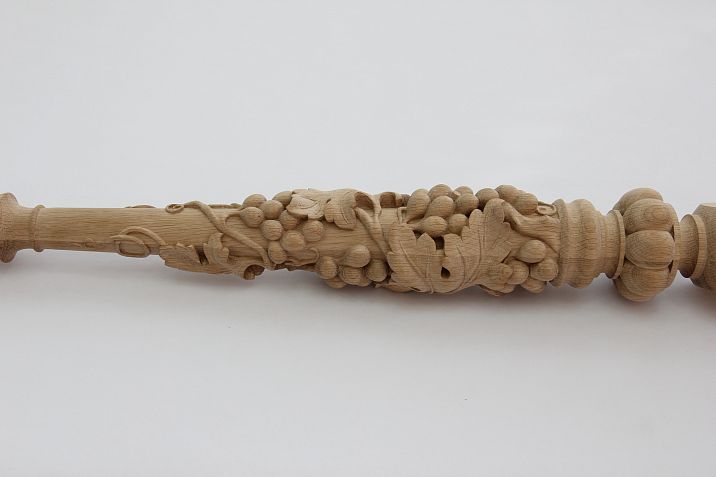
Carving on round balusters requires special skill. Working on a cylindrical surface is significantly more complex than on a flat surface, as the tool must constantly adapt to the changing curvature of the surface.
Spiral carving is one of the most effective types of decoration for round balusters. Helical grooves encircling the baluster body create a play of light and shadow, giving the item dynamism and expressiveness. Executing such carving requires special equipment and the highest level of craftsmanship.
Combined processing combines turning with milling and hand carving. This approach allows creating unique items that combine the geometric precision of machine processing with the individuality of handwork.
Wood science: selection of wood for round balusters
Oak: the standard of strength and beauty
Oak is rightfully considered the king among wood species for manufacturing round balusters. Its density reaches 700 kg/m³, ensuring exceptional strength and longevity of the products. The hardness of oak allows creating thin, complex-shaped details without risk of damage.
The texture of oak wood, with characteristic growth rings and medullary rays, creates a unique pattern on the surface of round balusters. After quality sanding and lacquering, this texture becomes even more pronounced.
The color range of oak varies from light yellow to dark brown depending on growing conditions and drying method. Walnut oak acquires noble gray-brown tones, especially prized in classic interiors.
Dimensional stability of oak balusters is ensured by low shrinkage and swelling coefficients. Properly dried oak practically does not change its dimensions with fluctuations in air humidity.
Ash: Flexibility and Elegance
Beech is an excellent alternative to oak for manufacturing round balusters. High viscosity of this species allows creating products with thin elements that do not break under load.
The light-colored ash with a slight cream tone makes it an ideal choice for modern interiors. The wood is easily stained, allowing virtually any desired color to be achieved.
Ash is exceptionally workable—it is easy to turn, mill, and sand. The resulting surface is smooth and uniform, which is especially important for round balusters, where any defects are immediately noticeable.
Beech: Universality and Accessibility
Beech holds a special place among materials for making round balusters due to its versatility. This species combines sufficient strength, good workability, and relatively affordable cost.
The uniform structure of beech wood, lacking a pronounced grain, makes it ideal for various types of finishing. Beech stains, stains, and lacquers exceptionally well.
The density of beech is about 650 kg/m³, providing sufficient strength for most applications. At the same time, the wood remains soft enough for comfortable hand-tool processing.
Coniferous species: economical without compromising quality
Spruce and pine represent an economical segment of materials for round balusters. Despite their lower cost, these species offer several unique advantages.
The resinous nature of coniferous species provides natural protection against insects and fungal damage. The essential oils contained in the resin create a beneficial microclimate indoors.
The lightness of coniferous wood simplifies the transportation and installation of balusters. This is especially important when working at height or in hard-to-reach areas.
Larch stands out among coniferous species for its exceptional moisture resistance. Larch balusters can be used in high-humidity conditions without additional protective treatment.
Design solutions with round balusters
Classic Style: Eternal Elegance
Classic round balusters are characterized by strict proportions and noble forms. The foundation of classic design consists of geometric elements: spheres, cylinders, cones, combined into a harmonious composition.
The principle of the golden ratio underlies the proportions of classic balusters. The ratio of various parts is calculated with mathematical precision, creating visually perfect forms. Such balusters never go out of style and harmoniously fit into any interior.
Symmetry and rhythm play a key role in classic design. Identical balusters placed at equal intervals create a sense of order and stability. This technique is especially effective on long straight runs.
Modern Interpretation of Classicism
Modern designers reinterpret classic forms, adapting them to the requirements of the 21st century. Simplification of details and clean lines characterize the modern interpretation of round balusters.
Contrasting material combinations create interesting visual effects. Wooden round balusters combined with metal handrails or glass inserts look fresh and modern.
Playing with scale allows creating unexpected compositions. Balusters of different diameters, installed in a certain order, create a dynamic rhythm and attract attention.
Ethnic motifs in the design of round balusters
Russian style implies the use of traditional ornaments and motifs of folk art. Round balusters can be adorned with carved elements imitating Russian wooden architecture.
Scandinavian minimalism dictates its own rules: light wood species, simple forms, minimal decoration. Round balusters in Scandinavian style emphasize the natural beauty of wood.
Mediterranean style allows for a more free interpretation of forms. Balusters may have slightly irregular geometry, imitating the handiwork of old masters.
Technical requirements and standards
Normative requirements for round balusters
The production and installation of round balusters are regulated by construction norms and rules. The height of balusters must ensure safe use of stairs by people of different heights. The standard height is 900 mm from the top of the step to the top of the handrail.
The distance between balusters should not exceed 150 mm to prevent children from slipping. This requirement is especially important for residential buildings and educational institutions.
The strength characteristics of balusters must ensure the ability to withstand horizontal loads from handrails. Round balusters with a diameter of 40-50 mm can withstand loads exceeding normative requirements.
Measuring the geometry of thin balusters requires high-precision tools. Deviations in dimensions, imperceptible on large elements, may critically affect the strength of thin balusters. Modern coordinate measuring machines allow controlling geometry with accuracy down to hundredths of a millimeter.
The geometric accuracy of round balusters is controlled at every stage of production. Deviations in diameter should not exceed ±0.5 mm, and deviations from straightness should not exceed ±1 mm over a length of 1000 mm.
Surface quality is assessed visually and with special instruments. Surface roughness should not exceed Ra 3.2 micrometers for items intended for transparent finishing.
Wood moisture is controlled by electronic moisture meters. For balusters intended for use in heated rooms, moisture content should not exceed 12%.
Installation and mounting of round balusters
Methods of Mounting to the Base
Mounting on bolts is the most common method of installing round balusters. A central hole is drilled in the end of the baluster, into which a threaded bolt is screwed. A corresponding hole is drilled in the tread or underbaluster.
Mounting on dowels is a traditional carpentry method. Wooden dowels provide a strong connection and full material compatibility. This method is especially suitable for restoration work.
Screws are used for temporary structures or when quick disassembly is required. Screws are driven in at an angle and concealed with wooden plugs.
Installing handrails on round balusters
Routing a groove in the lower part of the handrail ensures precise fitting onto round balusters. The groove depth should be 15-20 mm for secure fixation.
Adhesive bonding complements mechanical fastening, ensuring structural monolithism. Water-resistant adhesives based on PVA or polyurethane are used.
Additional fastening with screws or bolts is performed from below at an angle. Fastener heads are recessed into the wood and concealed with putty.
Features of installation on different types of staircases
Stringer staircases offer the greatest opportunities for mounting round balusters. The step thickness is usually sufficient for secure fastening of fasteners.
Tread staircases require a special approach. Balusters can be mounted to the stringer via a baluster bracket or directly to the side surface.
Helical staircases present special difficulty due to variable incline angles. Each baluster requires individual adjustment for height and installation angle.
Protective coatings and finishing
Coatings for round balusters
Polyurethane varnishes provide maximum protection for round balusters against mechanical damage and moisture. Two-component formulations create an exceptionally strong coating capable of withstanding heavy loads.
Alkyd varnishes represent a compromise between quality and cost. They provide good wood protection and highlight its natural texture.
Water-based varnishes are becoming increasingly popular due to their ecological safety and lack of odor. Modern formulations do not fall short in quality compared to traditional solvent-based varnishes.
Oil finishes
Linseed oil is a traditional finish for wooden items. It deeply penetrates the wood structure, highlighting its texture and creating a matte surface.
Tung oil offers superior protective properties compared to linseed oil. It creates a water-repellent film and does not yellow over time.
Wax finishes provide round balusters with a unique tactile appeal. Wax is easy to apply and renew, creating a pleasant to-the-touch surface.
Staining and painting
Water-based stains allow changing the wood color while preserving its texture. They are environmentally safe and have no strong odor.
Alcohol-based stains provide quick drying and even coloring. They are especially suitable for hardwoods.
Oil-based stains deeply penetrate the wood and create rich colors. They require more time to dry but provide excellent results.
Operation and Care of Round Balusters
Regular Maintenance
Daily care of round balusters involves removing dust with a dry or slightly damp cloth. Do not use aggressive cleaning agents, which may damage the protective coating.
Weekly cleaning includes more thorough cleaning using special wood care products. It is important to ensure that moisture does not get into joints and connections.
Seasonal maintenance involves inspecting all structural elements, checking the strength of fasteners and the condition of the protective coating. If necessary, local restoration of the coating is performed.
Repair and Restoration
Scratches on the surface of round balusters are removed by sanding with fine-grit paper, followed by applying a protective coating.
Replacing damaged elements requires dismantling part of the structure. New balusters must exactly match the dimensions and shape of the replaced ones.
Restoration of antique balusters requires a special approach and the use of traditional materials and technologies. It is important to preserve the historical authenticity of the items.
Damage Prevention
Controlling the microclimate in the room helps prevent deformation of wooden balusters. The optimal air humidity is 40-60%.
Protection against mechanical damage includes installing protective elements at points of possible contact with furniture or other objects.
Timely renewal of the coating prevents moisture penetration into the wood and development of fungal damage.
Economic Aspects of Choosing Round Balusters
Pricing Factors
The type of wood is the primary factor determining the cost of round balusters. Oak balusters are significantly more expensive than pine ones, but they also last much longer.
Processing complexity affects labor costs and, consequently, the price. Simple turned balusters are cheaper than carved or milled ones.
Order volume significantly affects unit cost. With larger volumes, manufacturers offer substantial discounts.
The quality of finish also affects the price. Balusters with multi-layer lacquer coating cost more than those with simple oil impregnation.
Comparison of the cost of different materials
|
Material |
Price per unit (RUB) |
Service life (years) |
Ownership cost (RUB/year) |
|
Pine |
500-800 |
15-20 |
25-53 |
|
Beech |
800-1200 |
25-30 |
27-48 |
|
Ash |
1000-1500 |
30-40 |
25-50 |
|
Oak |
1500-2500 |
50-100 |
15-50 |
Economic Efficiency
Long-term investments in quality round balusters pay off due to their longevity and minimal maintenance costs.
The increase in property value due to a quality staircase with beautiful balusters can amount to 5-10% of the total property value.
Cost savings on repairs are achieved through the use of quality materials and professional installation.
Innovations in the Production of Round Balusters
Modern Processing Technologies
Laser processing allows creating complex decorative elements on the surface of round balusters with high precision.
Ultrasonic welding of wooden elements opens new possibilities for creating composite balusters with improved properties.
Plasma surface treatment improves adhesion of protective coatings and increases product longevity.
Ecological Innovations
The use of renewable resources is becoming an increasingly important factor when selecting materials for balusters.
Zero-waste production technologies allow using all parts of wood, including sawdust and shavings.
Ecologically clean plant-based coatings replace traditional compositions with high volatile organic compound content.
Digitalization of production
Computer-aided design systems allow creating accurate 3D models of balusters before production begins.
Internet of Things in production enables real-time monitoring of all manufacturing stages.
Artificial intelligence helps optimize production processes and quality control.
Conclusion
World round balusters — is a wonderful universe where mathematical precision meets artistic taste, where ancient traditions intertwine with modern technologies. Each round baluster carries centuries of master craftsmanship, understanding that true beauty lies in simplicity and perfection of form.
Traveling up the steps of a staircase with quality round balusters is not just moving between floors—it is daily contact with beauty, a sense of reliability and confidence with every step. Properly designed and manufactured round balusters serve not just one generation, becoming family heirlooms and symbols of home comfort.
In today's world, where speed often outweighs quality, choosing natural materials and traditional craftsmanship becomes especially valuable. Wooden round balusters carry the warmth of nature, the energy of the craftsman, and the spirit of home, creating a unique atmosphere of harmony and beauty.
Each baluster round — is a small work of art, created by the hands of a master and intended to delight the eye and serve people. Their smooth curves, ideal proportions, and noble wood texture create a sense of completeness and perfection that cannot be achieved with artificial materials.
Choosing round balusters for your home means choosing not just functional safety elements, but investing in beauty, comfort, and longevity. This decision will bring satisfaction for many years, creating an atmosphere of coziness and harmony in your home.
For many years, STAVROS has remained a faithful guardian of woodworking traditions, combining centuries of craftsmanship experience with modern production technologies. Every STAVROS product is the result of meticulous work by professionals who understand that round balusters are not just elements of staircase construction, but works of art capable of transforming any space. STAVROS specialists know that perfection of round shape requires a special approach, the highest precision, and deep understanding of wood properties. Choosing STAVROS means choosing quality, reliability, and beauty that will become an inseparable part of your home for many years, creating an atmosphere of coziness and elegance, where every detail contributes to your comfort and aesthetic pleasure.


