Article Contents:
- Evolution of design: from craft traditions to digital technologies
- Anatomy of a technical drawing: structure and components
- Basic projections and views
- Dimensional chains and tolerances
- Mathematical foundations of design: calculations and formulas
- Calculation of basic proportions
- Engineering strength calculations
- Technological features of various materials
- Wooden balusters: traditions and innovations
- Metal constructions: strength and elegance
- Composite materials: technologies of the future
- Modern CAD systems: tools for professionals
- 2D design
- 3D modeling
- Specialized solutions
- Standards and regulations: requirements for drawing formatting
- Basic GOST requirements
- Specific requirements for woodworking
- Parametric design: flexibility and efficiency
- Creating parametric families
- Libraries of standard elements
- Manufacturing technology and its impact on design
- Turning processing
- Milling processing
- Manual processing
- Quality Control and Metrology
- Control dimensions
- Methods of Control
- Economic Aspects of Design
- Structural optimization
- Production Automation
- Conclusion
Creating the ideal staircase begins not with the first wood cut, but with a carefully thought-out design. Baluster drawing — is the foundation upon which the entire concept of a stair railing is built. Without precise technical calculations and detailed drawings, it is impossible to create a structure that is simultaneously safe, functional, and aesthetically perfect.
Modern baluster design requires a deep understanding not only of architectural principles but also of engineering calculations, ergonomic requirements, and artistic canons. Every line on the drawing has meaning, and each dimension affects the final result. A professional approach to creating technical documentation determines the success of the entire project.


Evolution of design: from craft traditions to digital technologies
The history of baluster drawing spans centuries. In the Renaissance, masters created sketches on parchment, passing down the secrets of their craft from generation to generation. Each element was drawn by hand, with jewel-like precision and artistic flair.
Traditional design methods were based on classical architectural canons. Baluster proportions were derived from mathematical relationships found in nature. The golden ratio, modular systems, harmonic series — all of this found reflection in technical drawings.
The Industrial Revolution introduced changes to the design process. Standardized dimensions, typical solutions, and mass production emerged. Drawings became more technical, less artistic, but more precise from an engineering standpoint.
The digital era has fundamentally changed design approaches. Modern CAD systems allow creating 3D models, conducting engineering calculations, and simulating loads. The accuracy of modern drawings reaches microns, which was unimaginable in the era of manual drafting.




Anatomy of a Technical Drawing: Structure and Components
A professional baluster drawing is a complex technical document including numerous interrelated elements. Each component carries specific information and serves a particular purpose.
Our factory also produces:


Main Projections and Views
The front view shows the baluster in its natural position — vertically. This view contains the primary information about proportions, overall dimensions, and distinctive profile features. It is precisely this view that determines the aesthetic appeal of the product.
The top view reveals the cross-sectional shape of the baluster. For round turned elements, this is a circle with the diameter indicated. For square or rectangular balusters — corresponding geometric figures with side dimensions.
Sections and cuts show the internal structure of the baluster, connection features, and hidden fastening elements. These are especially important when designing composite balusters or elements with complex internal geometry.
Additional views may include unfoldings for carved elements, detailed views of fastening joints, and variations of decorative elements.
Get Consultation
Dimension Chains and Tolerances
Proper dimensioning is an art requiring deep understanding of the manufacturing technology. Dimension chains must be logical, avoid accumulation of errors, and ensure ease of control during production.
Basic dimensions define the baluster’s overall dimensions — total height, diameters of characteristic cross-sections, base and top dimensions. These dimensions are critically important for ensuring compatibility with other staircase elements.
Functional dimensions are related to operational characteristics — installation height, distances between balusters, fastener parameters. The accuracy of these dimensions determines the safety and usability of the staircase.
Reference dimensions are informational and help control the correctness of manufacturing. They are enclosed in parentheses and are not subject to mandatory control.
Tolerances and fits define requirements for manufacturing accuracy. For decorative elements, tolerances may be relatively loose, while for functional joints — very tight.
Mathematical Foundations of Design: Calculations and Formulas
Creating a baluster drawing begins with mathematical calculations. Modern design is based on precise formulas that take into account numerous factors.
Calculation of Basic Proportions
Classic baluster proportions are based on modular systems. A module is a basic unit of measurement from which all other dimensions are derived. Traditionally, the module equals the base diameter of the baluster or its characteristic dimension.
The height of a baluster is usually 8–12 modules. This ratio ensures optimal visual perception and structural strength. Too tall balusters appear disproportionate, too short ones — squat.
The diameter of the central part varies from 0.6 to 0.8 modules. This creates a characteristic taper, giving the baluster elegance and lightness.
Dimensions of decorative elements are calculated using special formulas that account for perceptual characteristics. Too small details are lost, too large ones — disrupt harmony.
Engineering Strength Calculations
A baluster must withstand significant loads — vertical, horizontal, and torsional. Strength calculations are based on the laws of material resistance.
Bending calculation determines the baluster’s ability to resist lateral loads. The maximum bending moment occurs at the narrowest cross-section. The calculation formula considers the material’s modulus of elasticity, section’s moment of inertia, and allowable stresses.
Compression calculation is important for tall balusters, which may lose stability under vertical loads. The critical force is determined by Euler’s formula, taking into account end fixation conditions.
Connection calculations include checking the strength of joints connecting to treads and handrails. Special attention is paid to stress concentration at sections where the cross-section changes.
Technological Features of Different Materials
Material selection fundamentally affects design characteristics and drawing presentation. Each material has its own technological limitations and capabilities.
Wooden balusters: traditions and innovations
Wood remains the most popular material for manufacturing balusters. The variety of species allows creating products with unique characteristics.
Turned balusters are manufactured on turning machines. The drawing must take into account technological limitations — impossibility of creating chamfers, requirements for tool grinding angles, features of workpiece clamping.
Milled elements allow creating more complex profiles. The drawing must include information about the tool path, cutting depth, and operation sequence.
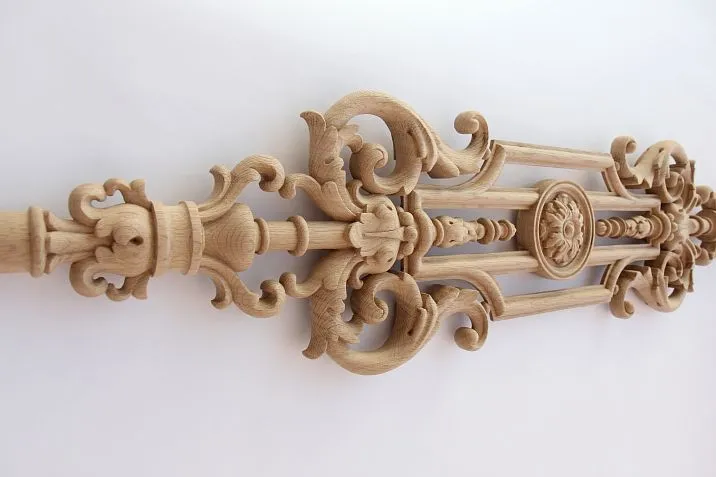
Carved balusters require a special approach to design. The drawing is supplemented with templates, unfoldings, and detailed sketches of decorative elements.
Metal structures: strength and elegance
Metallic balusters open new possibilities for designers. The high strength of the material allows creating more elegant and lightweight structures.
Forged elements are designed considering the specifics of manual forging. The drawing must show the sequence of operations, blank sizes, and methods of connecting individual elements.
Cast balusters require the design of casting fixtures. The drawing is supplemented with information about gating systems, machining allowances, and technological drafts.
Welded structures are designed considering requirements for welds. The drawing includes markings of weld types, edge preparation methods, and welding sequence.
Composite Materials: Technologies of the Future
Modern composite materials open new horizons in baluster design. The possibility of creating complex shapes combines with high operational characteristics.
Fiberglass balusters can have any shape limited only by the designer's imagination. The drawing must consider molding characteristics, fiber orientation, and stress concentration zones.
Carbon fiber elements have exceptional strength at low weight. Designing requires specialized knowledge of composite material behavior under load.
Modern CAD systems: tools for professionals
Modern design is unthinkable without using computer-aided design systems. Each system has its own features and areas of application.
2D Design
AutoCAD remains the standard for creating technical drawings. Powerful drawing tools, libraries of standard elements, and parametric capabilities make it indispensable for professionals.
KOMPAS-Graphik — a domestic system fully compliant with Russian standards. Built-in GOST libraries, automatic drawing formatting, and integration with production systems.
DraftSight — a free alternative to AutoCAD with basic functionality. Suitable for small projects and novice designers.
3D Modeling
SolidWorks — leader in parametric modeling. Ability to create associative drawings, automatic dimension updates, and engineering calculations.
Inventor from Autodesk combines powerful modeling capabilities with an intuitive interface. Built-in tools for designing wooden structures.
Fusion 360 — a cloud-based system combining modeling, calculations, and production preparation. Ideal for small teams and startups.
Specialized solutions
Cabinet Vision — a specialized system for furniture and woodworking design. Built-in hardware libraries, automatic specification generation, and integration with CNC equipment.
Woody — a domestic development for furniture production. Simple interface, quick learning, affordable price.
SketchUp — a simple and intuitive system for conceptual design. Suitable for creating sketches and presentation materials.
Standards and Regulations: Requirements for Drawing Formatting
Professional drawing formatting requires strict adherence to current standards. In Russia, the GOST system is in effect; internationally, ISO standards are used.
Main GOST Requirements
GOST 2.301-68 establishes drawing sheet formats. For balusters, formats A4 and A3 are typically used, depending on the complexity of the item.
GOST 2.302-68 defines image scales. For balusters, scales 1:1, 1:2, and 1:5 are applied depending on size and detail level.
GOST 2.303-68 establishes line types and thicknesses. Proper use of lines ensures drawing readability and conveys necessary information.
GOST 2.307-2011 regulates dimensioning and tolerances. Proper dimension placement is the foundation of a quality drawing.
Woodworking has specific requirements.
Drawings of wooden items have their own features related to the material and processing technology specifics.
The direction of the grain must be indicated on the drawing using special conventional markings. This is critically important for ensuring the strength of the item.
Processing allowances take into account the specifics of woodworking — shrinkage, warping, and the need for mechanical processing.
Requirements for wood moisture are specified in the technical requirements of the drawing. This affects the dimensional stability of the finished item.
Parametric design: flexibility and efficiency
Modern CAD systems allow creating parametric models where changing one parameter automatically recalculates the entire item's geometry.
Creating parametric families
Basic geometry defines the overall shape of the baluster. Parameters include total height, diameters of characteristic cross-sections, proportions of individual elements.
Decorative elements are parameterized separately. The number of grooves, their depth and width, radii of fillets — all of these can be changed independently.
Fastening dimensions are linked to the overall dimensions of the item. Changing the baluster's height automatically recalculates the dimensions of tenons and mortises.
Libraries of standard elements
Creating libraries of standard balusters significantly speeds up the design process. The library should include:
- Classic profiles — traditional shapes, time-tested
- Modern solutions — minimalist forms for contemporary interiors
- Designer-developed elements — unique elements created by designers
Manufacturing technology and its impact on design
Understanding technological processes is critically important for creating quality drawings. The designer must know the capabilities and limitations of each processing method.
Turning Processing
Capabilities of the technology include creating parts of any complexity, high productivity, and excellent surface quality.
Limitations are associated with the inability to create chamfers, limitations on the length of processed parts, and requirements for blank stiffness.
Design features include ensuring the manufacturability of the shape, calculating cutting regimes, and designing tooling.
Milling Processing
Multi-axis machining allows creating complex spatial forms. Modern CNC machines provide high precision and repeatability.
3D milling opens up possibilities for creating sculptural forms. The drawing is supplemented with a 3D model and control programs.
Combined machining combines different types of milling to achieve the optimal result.
Manual processing
Wood carving requires a special approach to design. The drawing is supplemented with templates, sketches, and detailed ornament drawings.
Artistic metalworking of elements is designed taking into account the capabilities of the craftsman and the specifics of manual work.
Combined technologies combine machine and manual processing to achieve a unique result.
Quality control and metrology
A quality drawing must contain all necessary information for controlling the finished item. The control system is designed simultaneously with the item.
Control dimensions
Functional dimensions are subject to mandatory control. Deviations from these dimensions affect the product's operability.
Reference dimensions are controlled selectively. They serve for an overall assessment of manufacturing quality.
Hidden dimensions are controlled using special methods — templates, gauges, measuring instruments.
Methods of control
Linear measurements are performed using calipers, micrometers, measuring rulers. Accuracy depends on the drawing requirements.
Shape control is performed using templates, profilometers, coordinate measuring machines. Especially important for complex profiles.
Surface roughness control affects the appearance and operational characteristics of the product.
Economic aspects of design
Proper design must consider economic factors — material costs, manufacturing labor, equipment capabilities.
Design optimization
The technological design reduces manufacturing labor. Simple shapes are processed faster and at lower cost.
Standardization of elements allows using standard fixtures and tools. This is especially important in mass production.
Material consumption affects the product's cost. Optimizing the shape can significantly reduce material usage.
Production automation
CNC machines require special programming. The drawing must contain all necessary information for creating control programs.
Robotized complexes allow fully automating the manufacturing process. Design is carried out considering the capabilities of robotics.
Integration with ERP systems ensures linkage between design, production planning, and inventory management.
Conclusion
Creating a quality baluster drawing is an art requiring deep knowledge in design, technology, materials science, and aesthetics. Modern design tools open boundless creative possibilities, but the foundation remains fundamental engineering principles.
Professional Baluster drawing It is not merely technical documentation, but the foundation for creating products that will serve for decades, delighting owners with beauty and reliability. Every line on the drawing, every dimension, matters for the final result.
Investments in quality design are paid back many times over during production and operation. Accurate drawings eliminate manufacturing errors, reduce scrap, and speed up production processes. Finished products fully meet customer expectations and safety requirements.
The future of baluster design is linked to the development of digital technologies — virtual and augmented reality, artificial intelligence, cloud computing. But the foundation will always remain a deep understanding of design principles and respect for craftsmanship traditions.
For many years, STAVROS has remained a leader in the design and manufacturing of stair elements. Our designers master all modern design methods and are ready to create drawings for balusters of any complexity. We do not merely design products — we create the foundation for works of art that will adorn your home and serve for many generations.