Article Contents:
- History of Origin and Evolution of Handrails and Balusters
- Functional Purpose of Handrails and Balusters
- Ensuring Safety
- Supporting Function
- Constructive function
- Aesthetic Function
- Space zoning
- Variety of Materials for Manufacturing
- Wooden Handrails and Balusters
- Metal Handrails and Balusters
- Glass Handrails and Railings
- Stone Balusters
- Composite Materials
- Technical Standards and Regulations
- Height of Handrails
- Distance between balusters
- Handrail Dimensions
- Strength characteristics
- Special Requirements
- Design Solutions and Styles
- Classic style
- Modern style
- Loft and Industrial Style
- Country and rustic
- Art Deco
- High-Tech
- Manufacturing and processing technologies
- Woodworking
- Metalworking
- Glass Processing
- Installation of Handrails and Balusters
- Preparatory work
- Ways to mount balusters
- Installing Support Posts
- Handrail Installation
- Features of Installing Different Types of Railings
- Maintenance and care
- Care for Wooden Elements
- Care for metal elements
- Care for Glass Elements
- Preventive Inspection and Repair
- Selecting Handrails and Balusters for Different Spaces
- For Residential Spaces
- For Public Buildings
- For Outdoor Use
- Trends and Innovations in Handrail and Baluster Design
- Modern trends
- Innovative materials and technologies
- Future of Handrail and Baluster Design
- Conclusion
In the world of architectural design, there are elements that simultaneously serve both functional and aesthetic roles. Such elements, without a doubt, include Handrails and balusters – indispensable components of staircases, balconies, and terraces. They not only ensure safety during movement but also become key details that shape the appearance of a building’s interior or exterior.
Have you ever thought about how significant these architectural elements are in our daily lives? Every time we climb stairs and hold onto the handrail, we intuitively feel the reliability and protection provided by a well-designed railing system.
In this article, we will dive into the wonderful world railings and balusters, uncover their historical origins, functional features, variety of materials and design solutions. You will learn about technical standards and regulations that ensure the safety of these structures, as well as receive valuable recommendations on choosing and installing these important elements in your home.


History of Origin and Evolution of Railing and Balusters
Architectural History railings and balusters It traces its roots back to deep antiquity. The earliest prototypes of modern railings appeared in ancient Greece, where architecture played not only a utilitarian but also a high aesthetic role. It was the Greeks who began using decorative vertical posts to adorn temples and public buildings. These elements served primarily a decorative function, emphasizing the status and grandeur of the structures.
Over time, balusters transformed from purely decorative elements into functional ones. Ancient Romans, inheriting Greek architectural traditions, improved the construction and began actively using balustrades not only as decoration but also as safety elements on bridges, staircases, and terraces.
The true golden age of baluster art came during the Renaissance. Italian masters perfected the techniques of stone and wood carving, creating exquisite baluster forms that became an indispensable part of palace architecture. It was precisely during this period that classical proportions and shapes of balusters were established, which we can still observe today.
In the Baroque and Rococo periods, balusters acquired even more refined and ornate forms, reflecting the general trend toward opulence and decoration. Masters of that time created true works of art, where each baluster was a miniature sculpture.
With the advent of the industrial era, not only production technologies but also materials changed. Metal balusters appeared, opening new possibilities for architectural creativity. Cast iron allowed creating delicate and strong structures that adorned many urban mansions and public buildings of the 19th century.
The 20th century brought functionalism and minimalism, which also influenced the design of railings and balusters. In place of ornate forms came simple lines and geometric clarity. New materials — stainless steel, aluminum, tempered glass — allowed creating light and visually weightless structures.
In our day, we observe a wonderful diversity of styles and materials in design railings and balusters. From classic carved wooden balusters to ultra-modern glass panels — the choice is limited only by the designer's imagination and the technical capabilities of materials.




perform a whole complex of important functions, making them indispensable elements of architectural structures:
Modern Handrails and balusters perform a whole range of important functions that make them indispensable elements of architectural structures:
Our factory also produces:


Ensuring Safety
The primary function of any railing is protection against falling. This is especially important for staircases, balconies, terraces, and other elevated areas. Properly designed railings must withstand significant lateral loads, allowing a person to confidently lean on them when necessary.
Balusters in this system play the role of vertical supports, evenly distributing the load and ensuring the stability of the entire structure. They are installed at a certain distance from each other (usually no more than 10-15 cm) to prevent slipping between them, which is especially important in homes with children.
Get Consultation
Support Function
In addition to protection against falling, railings serve as support when ascending and descending stairs. An ergonomically designed handrail allows one to hold on securely, which is especially important for elderly people and those with disabilities. The optimal handrail width is 3 to 7 cm — this size is convenient for gripping with the hand.
Constructive function
Balusters do not merely support the handrail — they add additional rigidity and strength to the entire structure. In staircase railing systems, they evenly distribute the load between the handrail and the base (steps, stringers, or floor), creating a unified strong system.
Aesthetic Function
It cannot be underestimated for its decorative role railings and balusters. They are an important element of interior or exterior design, capable of emphasizing the architectural style of a building. The variety of forms, materials, and finishes allows creating unique compositions that become true ornaments of space.
In open floor plans, railings with balusters are often used for visual separation of space without creating solid partitions. This approach allows preserving the feeling of spaciousness while simultaneously defining functional zones.
Space Zoning
Variety of Materials for Manufacturing
The modern market offers a wide range of materials for manufacturing
, each of which possesses its own unique properties and aesthetic qualities. railings and balusters, each of which possesses its own unique properties and aesthetic qualities.
Wooden railings and balusters
Wood remains one of the most popular and traditional materials for manufacturing balusters. Its natural beauty, warmth, and eco-friendliness make it an ideal choice for creating a cozy atmosphere in the home.
Advantages of wooden balusters:
- Ecological safety and naturalness
- Aesthetic appeal and natural energy
- Wide possibilities for decorative processing (carving, turning, milling)
- Good compatibility with other materials in interior design
- Durability with proper processing and maintenance
Various types of wood are used to make balusters, each with its own characteristics:
- Oak – distinguished by exceptional strength, durability, and elegant texture. Ideal for creating premium classic interiors.
- Beech – hard and dense wood with uniform structure, easily processed and polished.
- Ash – features a beautiful grain and high strength, resistant to mechanical impacts.
- Spruce – a more affordable option, easy to process, but requires quality protective treatment.
- Larch – distinguished by high resistance to moisture and rot, making it suitable for outdoor use.
Wooden balusters are divided by manufacturing method:
- Turned – manufactured on turning lathes, have round or oval cross-sections with various decorative elements.
- Milled – created using milling machines, may have longitudinal or helical grooves.
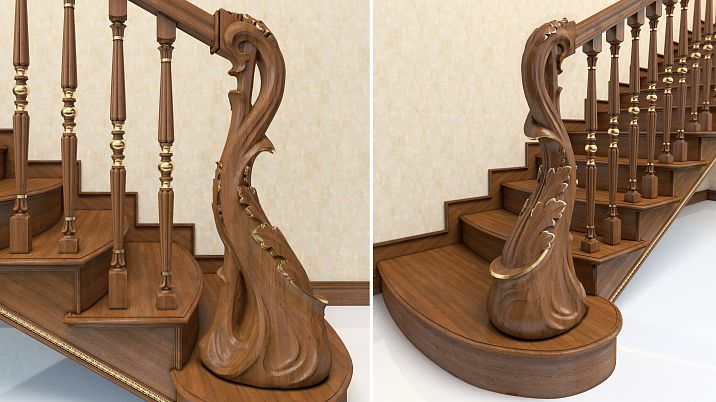
- Carved – handcrafted or made on multi-axis programmable machines, distinguished by unique artistic design.
Metal railings and balusters
Metal provides virtually unlimited possibilities for creating both classic and modern designs. Main types of metal used for balusters:
- Stainless steel – modern material with high resistance to corrosion and mechanical damage. Ideal for outdoor use and humid environments.
- Black metal with powder coating – affordable option with wide color and texture options.
- Wrought iron – traditional material allowing creation of unique artistic pieces with high strength.
- Aluminum – lightweight and corrosion-resistant material, suitable for modern minimalist interiors.
Metal balusters can be:
- Wrought – manufactured by artistic forging, distinguished by unique design and high strength.
- Cast – created by casting into molds, allowing reproduction of complex decorative elements.
- Welded – assembled from separate elements by welding, ensuring high structural strength.
Glass railings and barriers
Glass as a material for barriers became popular relatively recently but has already gained recognition due to its visual lightness and modern appearance.
Advantages of glass barriers:
- Visual lightness and transparency, creating a sense of spaciousness
- Ability to allow unobstructed light penetration
- Modern and elegant外观
- Resistance to moisture and corrosion
- Easy to maintain
For railings, tempered or triple-layer glass with a thickness of 8 mm is used, which has high strength and safety. When broken, such glass shatters into small, blunt fragments or remains on the film, minimizing the risk of injury.
Stone balusters
Stone is a material associated with eternity and monumentality. Stone balusters are most often used in building exteriors or in luxurious classical interiors.
Advantages of stone balusters:
- Exceptional durability and strength
- Resistance to atmospheric effects
- Magnificent and luxurious appearance
- Variety of natural textures and shades
For manufacturing stone balusters are used:
- Marble – a noble material with a distinctive pattern and wide color range.
- Granite – an exceptionally strong and durable stone, resistant to abrasion and mechanical impacts.
- Limestone – a softer stone that is easier to process but less resistant to external influences.
- Artificial stone – a modern alternative to natural stone, possessing similar aesthetic qualities but with less weight and cost.
Combined materials
Modern technologies allow for creating Handrails and balusters from a combination of various materials, which opens up new design possibilities. Popular combinations:
- Wood and metal – a classic combination, where a wooden handrail is complemented by metal balusters or vice versa.
- Metal and glass – a modern solution, where a metal frame is complemented by glass panels.
- Stone and metal – a monumental combination for exterior solutions.
Technical standards and regulations
When designing and installing railings and balusters a number of technical standards and regulations must be considered to ensure the safety and functionality of structures.
Height of railings
The height of railings is one of the key parameters regulated by building codes:
- For staircases in residential buildings – 900–1000 mm from the level of the step
- For balconies and terraces – no less than 1200 mm
- For public buildings – no less than 900 mm, and if height exceeds 6 meters – no less than 1000 mm
- For children’s facilities – additional handrails are provided at a height of about 500 mm
Distance between balusters
The spacing between balusters is also regulated by safety standards:
- Standard distance – 10–15 cm
- For children’s facilities – no more than 10 cm
- The minimum distance is chosen based on the requirement that a child cannot slip between balusters
Handrail dimensions
The handrail must be comfortable to grasp with the hand:
- Optimal width – from 3 to 7 cm
- Shape – preferably rounded at the top
- Distance from wall to wall-mounted handrail – at least 4 cm
Strength characteristics
Railings must withstand certain loads:
- Horizontal load on handrail – not less than 0.3 kN/m (about 30 kg per meter of length)
- Vertical load – not less than 0.5 kN (about 50 kg) at any point
- For public buildings, strength requirements are higher
Special requirements
Depending on the purpose of the room, additional requirements may be imposed:
- For ramps – two levels of handrails (at heights of 700 and 900 mm)
- For children’s facilities – vertical spacing not exceeding 100 mm
- For medical facilities – special antibacterial coatings and absence of sharp angles
Designer solutions and styles
Design selection railings and balusters depends on the overall interior or exterior style. Let’s consider the main stylistic directions:
Classic style
Classic balusters are characterized by symmetrical proportions and elegant forms. They often have complex profiles with thickening and tapering, resembling vases or columns. Materials for such balusters are usually high-grade wood or stone.
Features of classic railings:
- Turned wooden balusters with smooth lines
- Massive support posts with decorative tops
- Wide, comfortable handrail with rounded profile
- Rich finish – carving, inlay, patination
Modern style
Modern Handrails and balusters Distinguished by simplicity of forms and clarity of lines. They can be made of metal, glass, or combinations of materials.
Features of modern railings:
- Minimalist metal posts with simple geometric shapes
- Glass panels instead of traditional balusters
- Handrails made of stainless steel or wood with simple profile
- Absence of excessive decoration, emphasis on material texture
Loft and industrial style
These styles are characterized by the use of rough industrial materials and forms:
- Railings made of untreated or weathered metal
- Combination of metal pipes and wooden elements
- Visible fastening elements as part of the design
- Rough textures and deliberate 'industrial' look
Countryside and rustic
These styles differ in the use of natural materials and traditional techniques:
- Balusters made of rough-hewn wood with preserved natural texture
- Wrought elements with plant motifs
- Weathered surfaces, patina, wear marks
- Natural tones and textures
Art Deco
Art Deco style implies the use of luxurious materials and geometric forms:
- Contrasting material combinations (metal and wood, glass and stone)
- Geometric patterns and zigzag lines
- Use of exotic wood species or their imitations
- Decorative metal inserts, often with gold plating or chrome
High-tech
High-tech style is characterized by the use of modern technological materials:
- Handrails made of polished stainless steel or aluminum
- Glass panels with minimal fastening
- LED lighting integrated into the structure
- Clear geometric forms without decorative elements
Manufacturing and processing technologies
Modern technologies allow for creating Handrails and balusters of varying complexity and design. Let's consider the main manufacturing methods:
Woodworking
Turning – a traditional method of making wooden balusters. The blank is secured to a lathe and rotated around its axis, while the craftsman uses special cutters to shape it. Modern CNC machines allow automating this process and ensuring high precision and repeatability.
Milling – a method in which the baluster’s shape is created using milling tools. This method allows creating both simple geometric forms and complex relief surfaces.
Artistic carving – a manual wood processing method requiring high skill. The carver uses special tools to create unique decorative elements – from simple geometric patterns to complex sculptural compositions.
Gluing and assembly – a method in which the baluster is assembled from several parts. This allows creating complex shapes that cannot be turned from a single piece of wood.
Metalworking
Artistic forging – a traditional metalworking method in which the craftsman manually shapes the item using heating and mechanical force. This method allows creating unique decorative elements with high artistic value.
Casting – a method in which molten metal is poured into a mold corresponding to the future item. After cooling and solidifying, the mold is dismantled, and the resulting part undergoes additional processing.
Laser cutting – a modern technology allowing high-precision cutting of complex-shaped parts from metal sheets. This method is often used to create decorative panels and intricate elements.
Bending and welding – methods allowing the creation of three-dimensional metal structures from profiled tubes, rods, and sheet metal.
Glass processing
Tempering – a thermal treatment process for glass, increasing its strength by 4–7 times compared to ordinary glass. Tempered glass breaks into small, blunt fragments, reducing the risk of injury.
Triplexing – a technology for creating multi-layered glass, in which several layers are bonded with a special polymer film. When broken, such glass does not shatter, and fragments remain on the film.
Faceting – processing the edge of glass at an angle, creating a decorative effect of light refraction.
UV bonding – a method of joining glass parts using a special adhesive that hardens under ultraviolet radiation. This method allows creating virtually invisible joints.
Installation of railings and balusters – a guarantee of their durability and safety. Let's consider the main stages and methods of installation:
– an important stage that affects not only the appearance but also the durability of the structure: railings and balusters Before beginning installation, it is necessary:
Preparation Work
To conduct precise measurements of the installation site
- To prepare all necessary materials and tools
- To check the flatness of surfaces to which the railing elements will be attached
- If necessary, to mark the locations for installing balusters and support posts
- Marking locations for installing balusters and support posts
Ways to Mount Balusters
Mounting to steps and handrail
The most common method of installing balusters on a staircase is to attach their lower part to the steps or stringer, and the upper part to the handrail. For this, various methods are used:
- Dowel joint – at the ends of the baluster, dowels are formed, which are inserted into corresponding slots in the handrail and base. This method ensures a secure connection and an aesthetically pleasing appearance without visible fasteners.
- Through fastening – the baluster passes through the handrail and is secured with wedges or dowels. This method ensures especially strong connection.
- Fastening with bolts or dowels – metal bolts or wooden dowels are installed at the ends of the baluster and at the mounting points, ensuring connection.
- Fastening with metal brackets – balusters are mounted to the base and handrail using special metal brackets. This method is often used for metal balusters.
Fastening to the baluster base
In some constructions, a baluster base – a horizontal plank mounted on the stringer or floor for attaching balusters – is used. This method is especially convenient for installing flat, carved, or pierced balusters, which fit neatly into the groove of the baluster base.
Fastening to the floor
In some design solutions, balusters are mounted directly to the floor, while the handrail extends beyond the staircase. In this case, special embedded parts or anchor bolts are used for mounting.
Installation of Support Posts
Support posts are key structural elements bearing the main load. Their installation requires special attention:
- Posts are installed at the beginning and end of the staircase run, as well as at turns.
- Metal embedded parts or anchor bolts are used for mounting to the floor.
- It is important to ensure vertical alignment of the post using a construction level.
- After installing the post, the handrail is attached to it, and if necessary, intermediate balusters.
Installing the handrail
The handrail must form a smooth line along the entire length of the staircase:
- If necessary, the handrail is adjusted to the length and shape of the staircase.
- At turns, special connecting elements are used or a custom-fit adjustment is performed.
- The handrail is attached to the upper part of the balusters and support posts using dowels, screws, or special fasteners.
- At joints between separate parts of the handrail, connecting bolts or dowels are used.
Features of installing different types of railings
Wooden railings
When installing wooden railings, it is important to consider possible changes in the dimensions of wood due to fluctuations in humidity. All wooden elements must be well-dried (humidity not exceeding 12% for indoor and 15-20% for outdoor structures) and treated with protective compounds.
Metal railings often require welding or special fasteners. It is important to provide anti-corrosion protection for all metal parts, especially at connection points.
Installation of metal railings often requires welding or special fasteners. It is important to provide anti-corrosion protection for all metal parts, especially at connection points.
Glass railings
Installation of glass panels requires special precision and care. Glass is secured using special clamping profiles, point holders, or a spider glazing system.
Care and Maintenance
Durability and attractive appearance railings and balusters depend largely on proper care and timely maintenance.
Care for wooden elements
Wooden railings and balusters require regular care to preserve their beauty and protect against damage:
- Regular cleaning – removing dust with soft cloth or specialized wood surface care products.
- Periodic renewal of protective coating – depending on usage intensity and operating conditions, it is recommended to renew varnish or oil-based coating every 3-5 years.
- Protection from moisture – wooden elements should be kept away from direct contact with water and high humidity.
- Protection from sunlight – direct sunlight can cause fading and cracking of wood, so it is recommended to use protective compounds with UV filters.
Care for metal elements
Metal railings and balusters require less care, but also need periodic maintenance:
- Cleaning from dust and dirt – regular wiping with soft cloth using specialized metal surface cleaners.
- Checking for corrosion – especially at connection points and fasteners.
- Touch-up of damaged areas – for painted metal elements.
- Polishing – for stainless steel or brass elements, periodic polishing will help maintain shine.
Care for glass elements
Glass panels require regular cleaning to maintain their transparency:
- Cleaning with specialized glass cleaners – without abrasive components that may scratch the surface.
- Checking fasteners – periodic inspection and tightening of fasteners as needed.
- Removing fingerprints and smudges – using microfiber cloth and specialized cleaners.
Preventive inspection and repair
Regular inspection railings and balusters allows timely identification and resolution of potential issues:
- Checking the reliability of fastening – it is recommended to inspect all connections at least once a year and tighten fasteners as needed.
- Inspecting for cracks and damage – especially in areas of maximum load.
- Checking structural stability – the railing should not wobble or bend under moderate force.
- Timely replacement of damaged elements – if serious damage is detected, individual elements should be replaced without waiting for the entire structure to fail.
Choosing railings and balusters for different rooms
Choosing railings and balusters depends on the room's purpose, style, and usage characteristics.
For residential spaces
In residential buildings and apartments, the choice of railings is primarily determined by the interior style and personal preferences of the owners:
- For classic interiors – turned wooden balusters made from precious wood species, possibly with carved elements.
- For modern interiors – minimalist metal posts, glass panels, or combined variants.
- For country or rustic style homes – rough-hewn wood, wrought iron elements with plant motifs.
- For homes with children – special attention should be paid to safety: minimal distance between balusters, absence of sharp corners, secure fastening of all elements.
For public buildings
In public buildings, the choice of railings is determined not only by aesthetic but also by functional requirements:
- For office buildings – modern materials (stainless steel, glass), simple forms, high strength.
- For shopping centers – durable and wear-resistant materials, resistant to intensive use.
- For educational institutions – safe constructions with additional handrails for children, absence of sharp corners and small parts.
- For medical facilities – materials resistant to disinfection, smooth surfaces without hard-to-clean areas.
For outdoor use
Railings installed outdoors must be resistant to atmospheric conditions:
- For terraces and verandas – materials resistant to moisture and temperature fluctuations (larch, teak, stainless steel, aluminum).
- For balconies – strong constructions with a height of at least 1200 mm, resistant to wind loads.
- For entrance areas – wear-resistant materials, resistant to mechanical damage and contamination.
- For landscape design – materials harmonizing with the surrounding nature, resistant to soil and plant effects.
Trends and innovations in railing and baluster design
The world of architecture and design is not standing still, and Handrails and balusters is also subject to the influence of modern trends and innovations.
Modern Trends
Minimalism and clean lines – modern design favors simple forms and clean lines. Popular are thin metal posts, glass panels without visible fasteners, minimalist wooden elements without excessive decoration.
Material mixing – combining different materials in one construction: wood and metal, glass and stone, concrete and wood. Such combinations allow creating unique and expressive solutions.
Ecological and natural – return to natural materials, use of environmentally friendly processing technologies, minimal impact on the environment.
Individualization and customization – moving away from standard solutions in favor of individual design that takes into account the specific characteristics of a particular space and the client’s preferences.
Innovative materials and technologies
Composite materials – modern composites combine the best qualities of various materials: metal strength, wood aesthetics, plastic lightness. They are resistant to moisture, temperature fluctuations, and require minimal maintenance.
Smart technologies – integration of lighting, motion sensors, and security systems into railing construction. For example, LED lighting built into handrails or baluster bases, which not only serves a decorative function but also enhances safety at night.
3D printing – a technology enabling the creation of unique elements with complex shapes that are impossible or very difficult to manufacture using traditional methods.
Nanocoatings – special coatings that impart new properties to materials: self-cleaning surfaces, increased resistance to abrasion, antibacterial properties.
The future of railing and baluster design
The future of design railings and balusters is related to further integration of technologies, increased functionality and eco-friendliness:
- Modular systems – constructions that easily adapt to changing needs and conditions.
- Transformable elements – railings that can change their shape or function depending on the situation.
- Biomimetic design – forms inspired by nature, combining aesthetic appeal with functionality and ergonomics.
- Interactive surfaces – railings that respond to touch, changing color or texture, providing information.
Conclusion
Handrails and balusters These are not just functional elements ensuring safety when moving along staircases or elevated areas. These are important architectural details capable of transforming space, emphasizing its style and character.
From classic turned wooden balusters to ultra-modern glass panels – the variety of materials, forms, and technologies allows creating unique solutions for any interior or exterior. At the same time, it is important to remember that beauty should not come at the expense of functionality and safety – properly designed and installed railings must comply with all technical norms and standards.
Choosing Handrails and balusters When choosing railings for your home or public building, pay attention not only to their appearance, but also to the quality of materials, reliability of construction, ease of use and maintenance. Investing in quality railings is investing in safety and comfort for many years.
The STAVROS company has been a leading Russian manufacturer of premium solid wood products, including staircase components, for more than 20 years. Thanks to the combination of traditional craftsmanship and modern technologies, STAVROS creates unique Handrails and balustersrailings that become true interior ornaments. STAVROS products decorate objects not only in Russia, but also in the USA, Canada, France, and many other countries around the world, which is the best proof of the high quality and aesthetic value of the products.