













































































Corner decorative element MLD-4U-2.1L
Dimensions and Options
Have questions?
Customers also buy


Yulia Kh.
March 24, 2026
I was satisfied with the quality of the products; we purchased furniture legs. I would especially like to highlight the professionalism of manager Oksana—very client-oriented, competent, and precise specialist. She even arranged additional trimming of some elements as an extra service for us. Huge thanks!
Incognito 7.
March 24, 2026
One of the few firms that is pleasant to interact with on renovation matters. Adequate, responsive managers. Adherence to deadlines. Execution of even complex projects. Bravo! May there be more such firms!!
Marina D.
February 15, 2026
The company ordered the pens for us when we ordered furniture. But I decided to write a review personally because they are amazing! Stylish, expensive, high-quality!
More than 20 years on the market
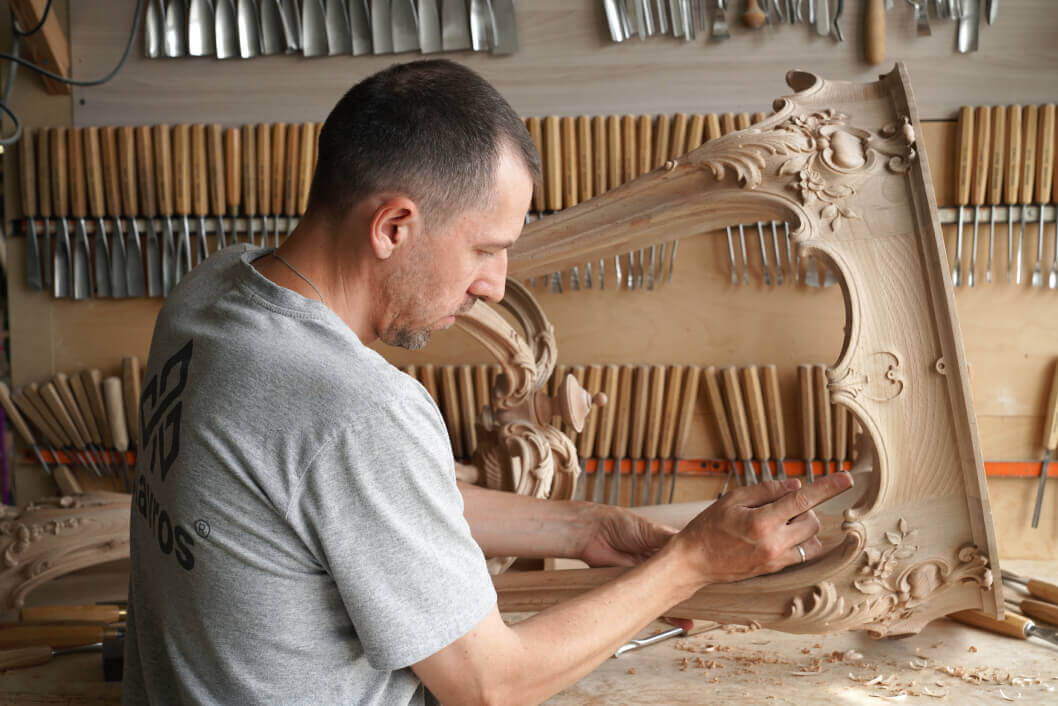
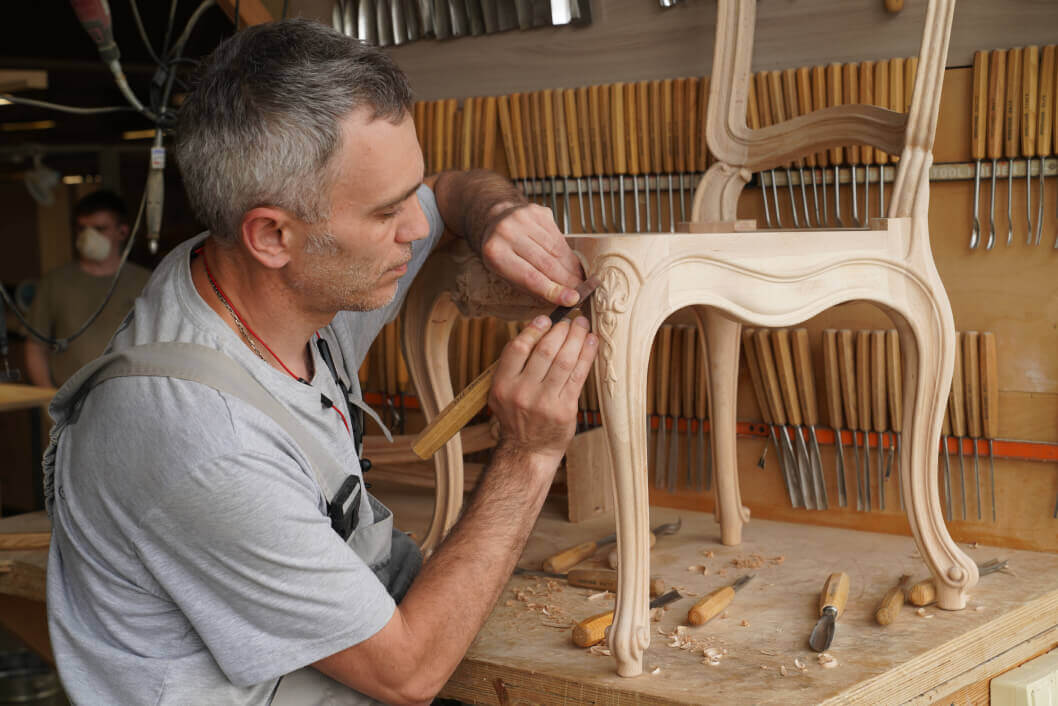
The company's success began in 2002, when two artists — Andrey Ragozin and Evgeny Tsapko — created a small creative workshop for producing wooden carved items. The masters' work was quickly noticed, and within a year they were invited to participate in the reconstruction of the Konstantinovskiy Palace in Strelna.
After the success of this project, the company focused on recreating palace interiors, furniture, church furnishings, and carved decorations in various artistic styles. They worked with cultural heritage sites: The Hermitage, the Alexandrovsky Palace, the Troitsko-Izmaylovsky Cathedral, the Sheremetyevsky Mansion, and many others.
The masters' task — and still is — to create wooden items with the highest level of detail and understanding of every element, based on impeccable knowledge of artistic laws and interior styles.

STAVROS Guarantees
Quality of products without complaints
We save your time, peace of mind, and budget
Large warehouse program
We solve your tasks with maximum speed
Adherence to production deadlines
Streamlined process reduces all risks
Delivery from 1 piece throughout Russia
Quality service regardless of order volume
Your positive business reputation
Reliable partner — the foundation of your business
More products in the molding decor category




Frequently asked questions
Our showrooms are located in Saint Petersburg and Moscow. Production is located in Saint Petersburg.
Moscow contacts: https://www.stavros.ru/contacts_all/?tab=msk
Contacts of Saint Petersburg: https://www.stavros.ru/contacts_all/?tab=spb
- Send request by email [email protected]
- Write to us at Telegram
- Write to us at WhatsApp
- Order by phone +7 (800) 555-46-75
- Visit our showroom in Saint Petersburg and Moscow
Yes, we ship orders throughout Russia and to CIS countries.
We cooperate with transportation companies such as СДЭК and DPD.
You can also arrange pickup of your order through any convenient transportation company for you.
Delivery cost depends on the size, weight of the item, and delivery address.
When placing an order, the delivery cost is calculated automatically and displayed as a separate line on our website.
Prices and availability of items on the website are always current. Data is updated daily.
Note: items in stock are stored on the warehouse in unpolished form and shipped within 3 working days.
If the item is not in stock, average production time: 5–10 working days.
This is the quality of polishing of the items.
Standard — machine polishing, at a more attractive price.
Prestige — detailed hand polishing, items do not require further work.
More details: https://www.stavros.ru/information/kachestvo/
This is the type of veneer of the items.
Under enamel: produced by gluing wooden laminates without color and texture matching. Contrast tonal and textural differences are noticeable. This blank should be chosen if the item is intended for opaque coating.
Under tinting: produced by gluing wooden laminates with color and texture matching. Tonal and textural differences may occur. This blank should be chosen if the item is intended for semi-transparent finish.
More details: https://www.stavros.ru/information/kachestvo/
Beech — dense, non-porous wood, most often used for items covered with enamel.
Oak — dense, porous wood with clearly visible natural grain. Due to its strength and decorative properties, it is often used in items with semi-transparent coating, highlighting the wood pattern.
Custom-made, if non-standard items are required, we can produce products from other types of wood, including blanks provided by the customer, manufactured according to our technical specifications.
All our furniture legs can withstand a vertical load of at least 100 kg.
Average production time for custom-made items: 5–10 working days.
Most items are stored on the warehouse in unpolished form. We need time to polish and pack orders.
Yes, we manufacture non-standard items according to individual projects, but we only accept orders with a minimum quantity.
We can manufacture items of the desired size, but we only work with bulk orders. For details, please consult the sales department manager.
Yes, some of our products can be used outdoors. For example, polyurethane items, as well as carved door casings made of pine.
Other items are produced to order using PUR glue, if minimum quantity is available. No warranty is provided for such products, as outdoor conditions are considered aggressive.
Yes, we paint items when ordering products for a total amount of 150,000 rubles or more.
- Dust removal. After sanding, the surface must be dusted.
- Priming. Apply primer in an even layer.
- Matting. After the primer has fully dried, the surface should be matted (lightly sanded for better adhesion).
- Finish coating. Apply finish coating: lacquer or enamel, in 2 layers, with interlayer drying.
More details: https://www.stavros.ru/information/sovety/
Apply adhesive to the decor. Place it on the surface and press briefly. Then, lift the decor from the surface and leave it open for 3–5 minutes. Press the decor firmly onto the surface and hold for 5–10 seconds.
More details: https://www.stavros.ru/information/sovety/
Ideally, you should prepare a design project before placing an order.
You can do this yourself by downloading drawings of our products from our website, or you can order a project from us.
If the number of decorative elements and fittings is small, our company's manager can assist you with selection.
Unfortunately, this service is not provided.
The packaging method depends on the type of items, but in each case, we ensure sufficient protection for safe transportation.
We most often use corrugated cardboard and stretch film. Fragile items are additionally secured on a rigid base to prevent damage during transport.
We ship all items starting from 1 piece.
Room measurements and item installation can be performed by our partners — carpentry companies represented in most regions of Russia.
Often searched in category Wooden and MDF items
7083
2945
2639
1453
1323
1088
858
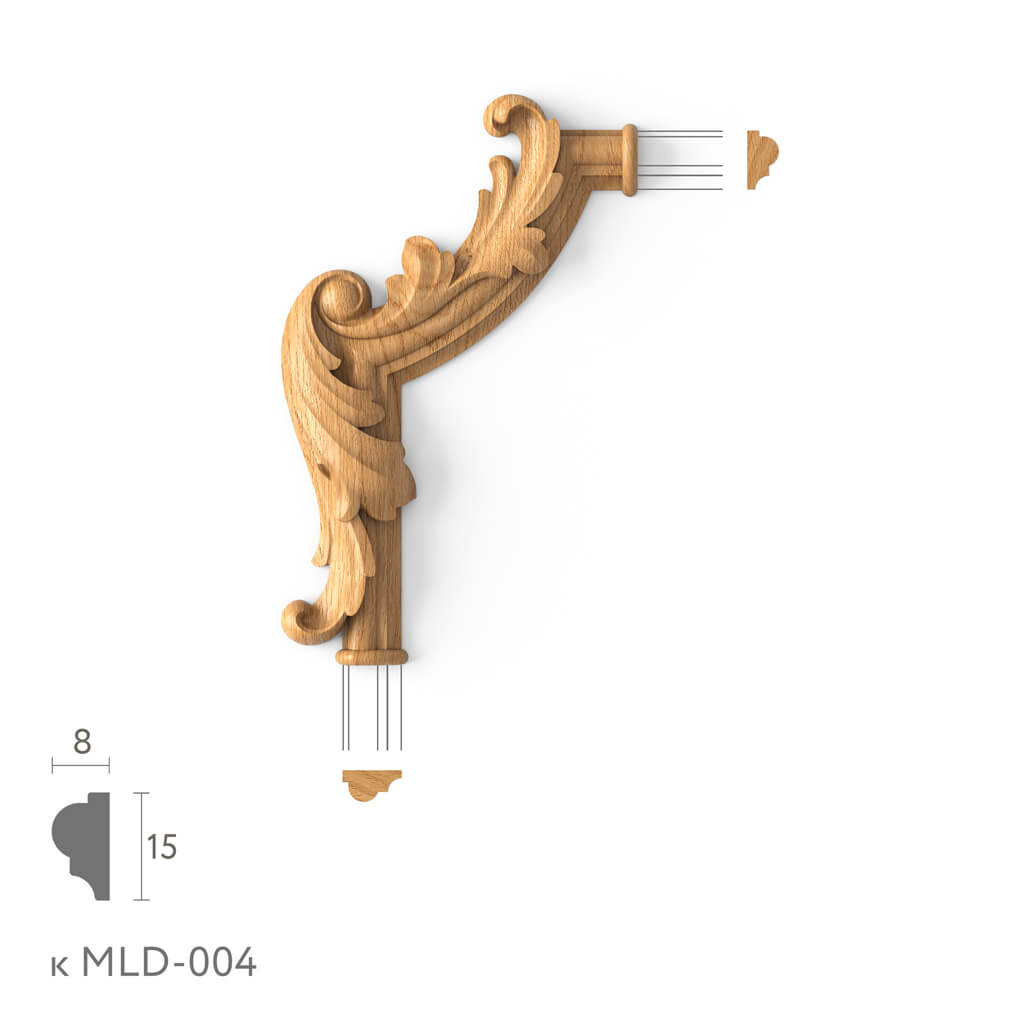
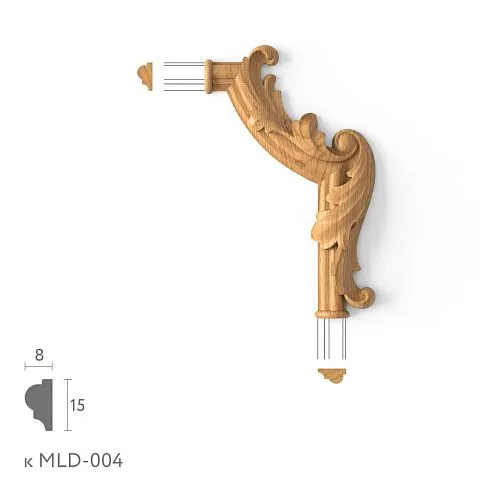
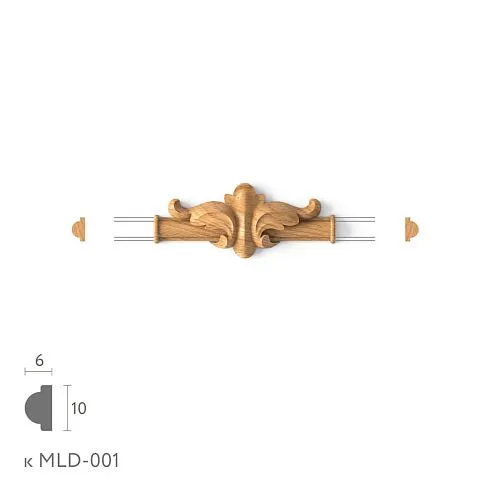
Corner decorative element MLD-4U-2.1L: left corner decor for molding MLD-004 made of solid wood for enamel
The left corner of a molding frame is not just a technical joint. It is the moment when the decorative system either convinces or disappoints. It is precisely where two profiles meet at a right angle that the quality of the solution and the accuracy of component selection are revealed.Decorative corner element MLD-4U-2.1L— is not an 'extra' decoration. It is the left corner element for molding layout, a paired part to the right MLD-4U-2.1R, created so that a frame made of molding MLD-004 looks complete, professional, and expensive — in the best sense of the word.
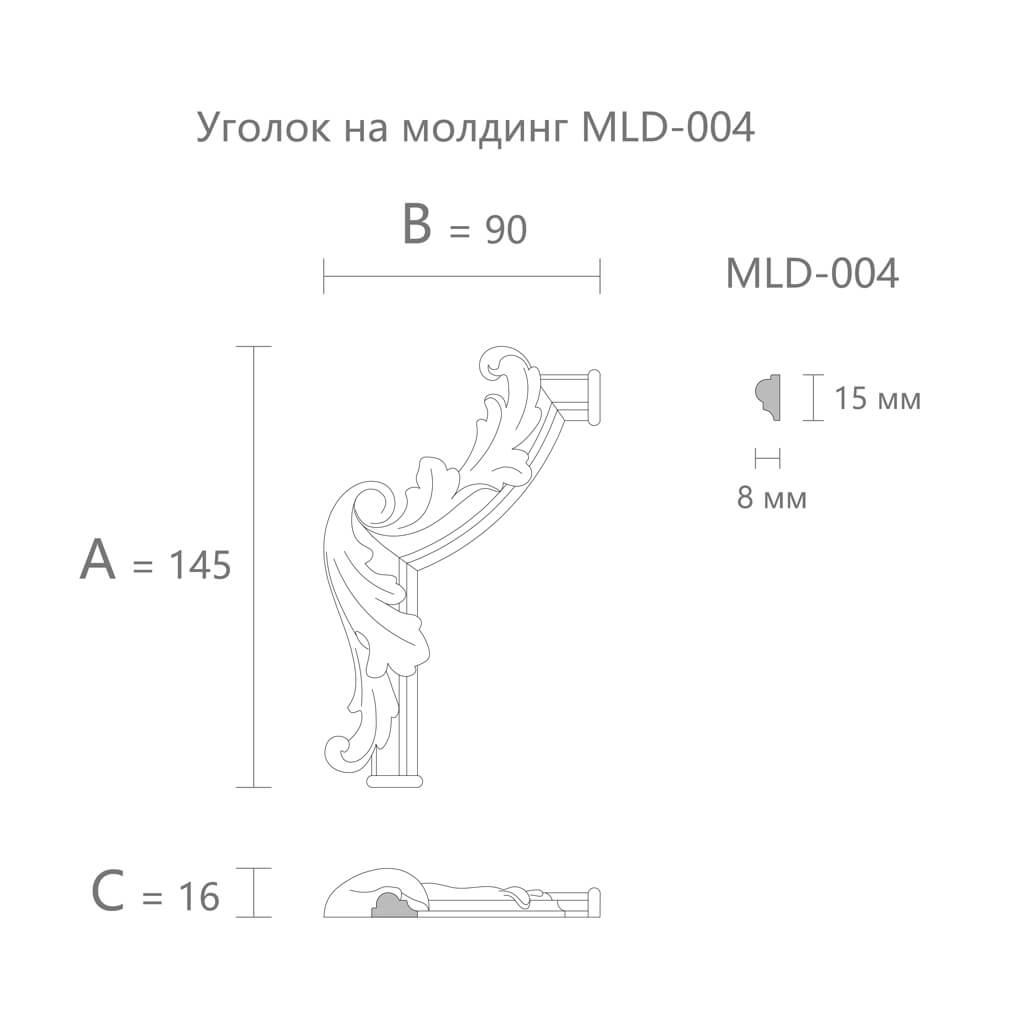
Product dimensions: 145 × 90 × 16 mm. Finish: 'Standard' — machine sanding. Coating: 'For enamel' — re-gluing for opaque painting. Material: beech or oak — to choose from depending on the project requirements. Manufactured by STAVROS, Saint Petersburg. Item from the sectiondecoration for moldings, where corner elements, center overlays, and carved decor made of solid wood are systematized by belonging to specific molding profiles.
Decor for moldings of this class is not bought because the part is 'beautiful'. It is bought because without the left corner element, a symmetrical molding frame is impossible — physically and compositionally.
Corner decorative element MLD-4U-2.1L: what exactly you are purchasing
Let's start with a precise definition. MLD-4U-2.1L is a left corner decorative element made of solid wood. The letter 'L' in the article number stands for Left. This is not a convention or a production code: it is an indication of its function within the molding system.
What does 'left' mean in relation to a corner decoration? When looking at a mounted molding frame frontally, the left corner element occupies two corners — the top left and the bottom left. Its ornamental axis is oriented in such a way that, paired with the right element MLD-4U-2.1R on the opposite corners, it creates mirror symmetry. The classic floral ornament 'unfolds' from the left side of the frame to the right — towards its mirror partner.
It is precisely this principle of mirror ornamental symmetry that is one of the fundamentals in the decorative tradition of European classicism. Without it, the frame looks like a random set of corner pieces. With it — like a thoughtful decorative system with character.
Product technical data:
| Parameter | Value |
|---|---|
| Article number | MLD-4U-2.1L |
| Dimensions | 145 × 90 × 16 mm |
| Orientation | Left |
| Material | Beech or oak (to choose) |
| Finish | Standard |
| Finishing | For enamel |
| Partner molding | MLD-004 |
| Installation | Construction adhesive |
| Application | Furniture, doors, wall panels, decorative frames |
The product is manufactured in Saint Petersburg. Production time is 3–7 business days. Delivery across Russia via the SDEK transport service.
Which molding is the MLD-4U-2.1L intended for: systematicity as the main value
Corner decoration works correctly only with systemic compatibility with the molding profile. This is not a wish — it is a technical requirement. The geometry of the side zones of the corner element, where the ends of the molding runs adjoin, must exactly match the profile of the molding. Any mismatch — a step, a gap, or a visible seam — becomes apparent after painting and ruins the entire decorative result.
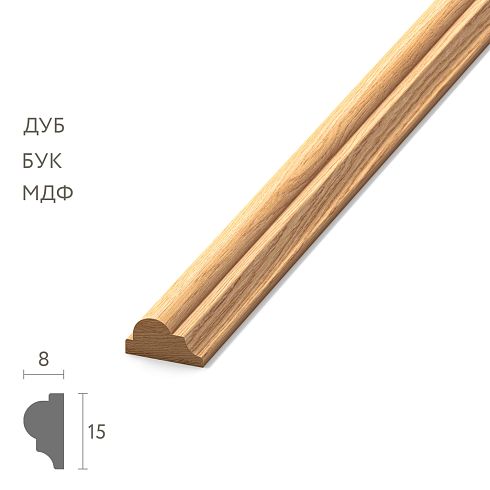
MLD-4U-2.1L is designed for Molding MLD-004— a wooden molding profile produced by STAVROS. The MLD-004 molding has a cross-section of 15×8 mm, making it more substantial and decoratively weighty compared to the basic quarter-round MLD-001 (10×6 mm). It is this profile scale that also determined the size of the corner element: 145 × 90 × 16 mm — a proportion where the corner accent is commensurate with the larger molding.
The combined use of the MLD-004 molding and the MLD-4U series corner elements creates what can rightly be called a 'molding system': pre-coordinated components that install without fitting, deliver a predictable result, and, when painted a uniform color, appear as a holistically designed decorative program.
The full catalog of decorative corner and center elements for MLD-004 and other STAVROS profiles is available in the section decoration for moldings. There you will also find current stock items and the ability to select a complete kit for frame layout.
Article STAVROS"Shaped Solutions: Decorative Moldings, Layouts, and Contour Profiles" reveals the logic behind constructing multi-level molding systems — from simple frame cells to complex panel compositions with raised panels and carved accents.
Design and form of the left corner element: ornament as an architectural statement
When discussing the form of a decorative corner, it's easy to slip into generalities. We won't do that. Let's describe it concretely.
MLD-4U-2.1L — a 145 × 90 mm rectangle with a diagonally oriented ornamental axis. The larger dimension of 145 mm runs along the horizontal molding run, the smaller 90 mm along the vertical. The asymmetry of the geometry is compensated by the symmetry of the ornament along the diagonal axis: the pattern unfolds from the right angle towards the open area of the piece, creating a sense of movement and opening.
The ornament is a classic floral motif. Smooth scrolls, petal-like forms, soft transitions in relief from plane to volume. This is decor with a provenance: it originates from the European woodworking tradition of the 17th–18th centuries, from the same cultural soil that produced Boulle furniture, English cabinets of the Chippendale era, and Russian classical interiors of Catherine the Great's time. Today, this language is not outdated — it has simply become one of the recurring stylistic solutions in the design of classical and neoclassical furniture.
A relief depth of 16 mm is a significant plastic characteristic. The corner element protrudes 16 mm above the plane of the facade at the highest point of the ornament. This creates a clear difference in levels: the facade plane — the molding profile — the corner accent. These three depth levels produce a pronounced play of shadows under side lighting. The frame acquires a sculptural quality that flat milling or printed photographic decor cannot convey.
The left-hand orientation of the ornament in MLD-4U-2.1L is not simply a mirror image of the right-hand element. It is a fundamental detail ensuring the correct ornamental program during joint installation. When viewing the finished frame, the ornaments of the left and right corner elements create a visual dialogue: they are symmetrical, they 'converse' with each other across the space of the molding run.
Mixing left and right corner elements in one frame disrupts this dialogue. The frame appears either as an error or as carelessness—with equally 'asymmetrical' corners facing the same direction instead of forming a mirrored pair.
Material: oak or beech, Standard, Under enamel—how to make the right choice
This is the section that requires an honest conversation without marketing simplifications. For the left corner element to the molding, two materials are available—oak and beech. Both are good. Both are applicable. But each—in its own context.
Oak: when you need a wood species with a name
Oak is a species with a reputation. Heavy, dense, durable, with a pronounced texture of large vessels and a characteristic shimmering luster of medullary rays. Under transparent or tinted coating, oak is magnificent: its texture is an independent decorative element.
For products under opaque enamel, the situation is more complex. The large vessels of oak, exposed on the sanded surface, without special treatment, 'show through' the paint layer—especially with a matte or satin finish. This is not critical but requires an additional operation: filling the pores with a special pore-filling primer before applying the main primer.
When to choose oak for MLD-4U-2.1L:
-
Project with transparent or tinted coating—oil, wax, varnish with tinting
-
Mixed systems: some elements under varnish, some under enamel—for uniformity of wood species throughout the project
-
The client fundamentally insists on oak as a 'status' wood species.
-
Interior in the style of 'English classic' or 'dark study', where oak texture is part of the concept.
Beech: when you need a result without additional operations.
Beech is a diffuse-porous wood species. The pores are evenly distributed across the cross-section and have a small diameter. On a sanded beech surface, there are no open large vessels. Primer lays evenly, enamel — uniformly, without special pore treatment.
For furniture manufacturers and DIY projects where work is done under enamel, beech is a more technological choice: fewer preparatory operations, predictable results with standard priming and painting.
When to choose beech for MLD-4U-2.1L:
-
The project is entirely under opaque enamel — white, cream, colored.
-
Production context where reproducibility of results on serial orders is important.
-
Limited budget — beech is generally more affordable than oak.
-
Modern neoclassicism or Provence with white or pastel coloring.
"Standard": precise definition without unnecessary words
"Standard" in the STAVROS system is machine grinding. The product surface is processed with industrial grinding equipment with specified parameters. The result is a uniform, reproducible surface without traces of manual tools and independent of the individual skill of the worker.
For carved corner elements under enamel, this is the optimal execution: a smooth base for primer and paint, without the risk of uneven processing on flat and relief areas of the ornament.
'Under enamel': regluing without grain matching
In the production of "Under enamel" products, STAVROS uses the regluing of sections without selecting them by color and wood grain direction. Under opaque enamel, the section boundaries, wood shade, and texture are not visible—they are hidden by the paint layer. Texture selection makes sense only with transparent coating.
"Under enamel" is an economically justified solution that reduces the product cost without losing functional qualities when painted. This is an honest production choice, not a simplification.
Where to use the decorative corner element MLD-4U-2.1L: application space
On furniture facades: classic as a functional strategy
A furniture facade with a molding frame is a solution that needs no defense. It has worked for several centuries and continues to work because it answers an unchanging demand: how to make furniture look more expensive without radically increasing production costs.
A molding frame made from profile MLD-004 with corner elements MLD-4U-2.1L (left) and MLD-4U-2.1R (right) on four corners is a decorative program that, when painted uniformly with enamel across the entire system, looks like expensive classic joinery. Three levels of depth (facade – molding – corner accent), clear ornament, mirror symmetry horizontally—all this creates a feeling of the facade being 'sculpted,' which cannot be reproduced with flat decor.
For which furniture objects MLD-4U-2.1L is most appropriate:
-
Kitchen sets with large fronts — particularly lower section doors 500–600 mm wide, where the 145 × 90 mm corner element scale fits organically into the proportions
-
Sliding wardrobes and built-in dressing rooms — decorative molding frames on end and front panels give system furniture individuality
-
Buffets, sideboard sections, and display cabinets — the upper glazed part with molding frames on the glass particularly benefits from neat corner accents
-
Chests of drawers with framed drawer fronts — the horizontal rhythm of molding frames with corner decorative elements across all drawers creates a unified ornamental program for the entire chest
-
Library sections and office cabinets — MLD-4U-2.1L in oak combined with a transparent finish or dark enamel creates an 'English club' atmosphere
On doors and panels: the door as a decorative object
Interior door with molding frames — one of the most common applications of corner decorative elements in domestic interiors. The technology is simple and accessible: MLD-004 molding profiles are glued onto a smooth MDF panel to form frame cells, and left and right corner decorative elements of the MLD-4U series are mounted into the corners of each cell.
On a standard 2000 × 800 mm door with two cells, 4 corner elements are needed for each cell — totaling 8 pieces (4 left MLD-4U-2.1L + 4 right MLD-4U-2.1R). With three cells — 12 pieces. This needs to be calculated in advance when ordering.
On sliding wardrobe doors with decorative inserts, the principle is the same. The only limitation: the total thickness of the front 'sandwich' (door panel + molding + projection of corner elements) must fit within the tolerances of the guide system.
On cabinet doors with mirrors or glass, a molding frame with MLD-4U-2.1L corner decorative elements creates a classic 'mirror frame' directly on the door — without a separate mirror frame, built into the door design.
On wall panels and decorative layouts: when a wall acquires architecture
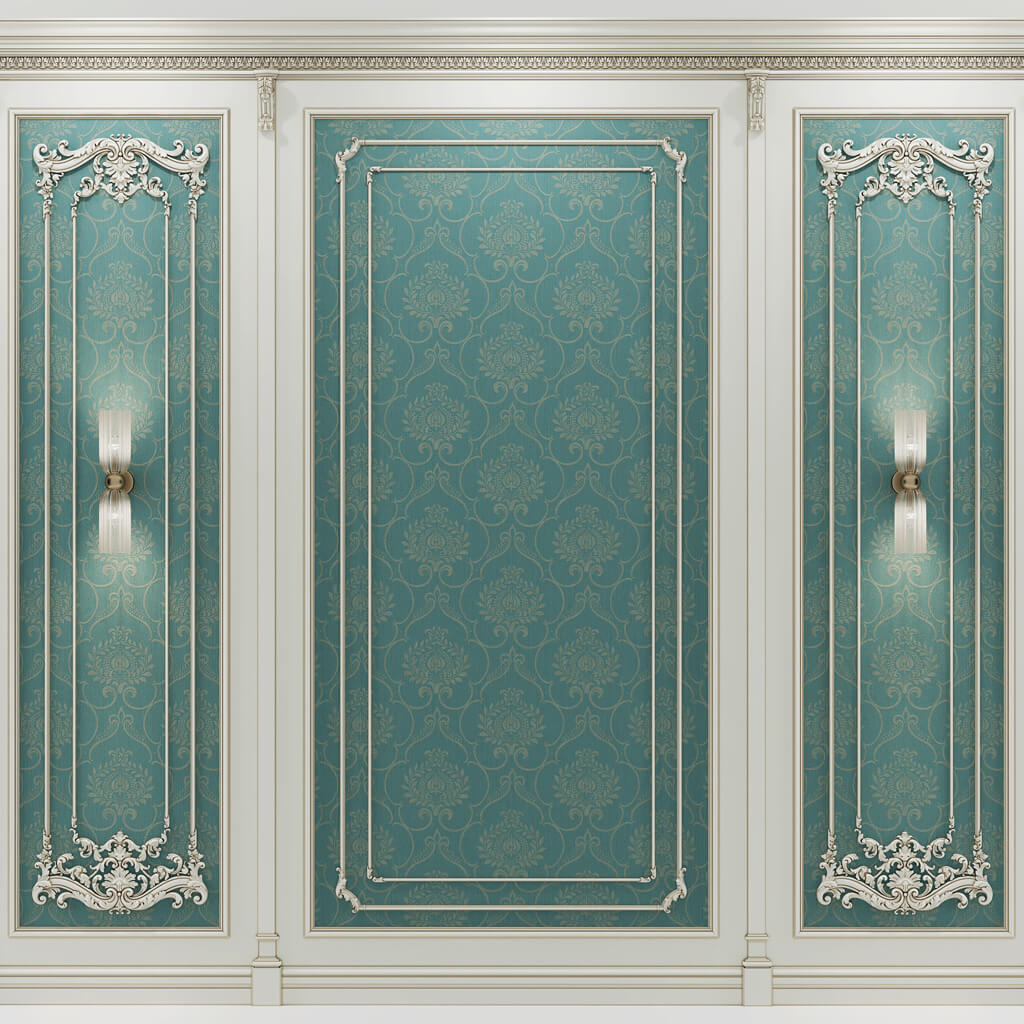
Wall molding layout made of wooden profiles is a modern equivalent of historical boiserie: the French technique of wall decoration with wooden panels featuring framed cells, which flourished in the 17th–18th centuries in palace interiors and remains relevant to this day.
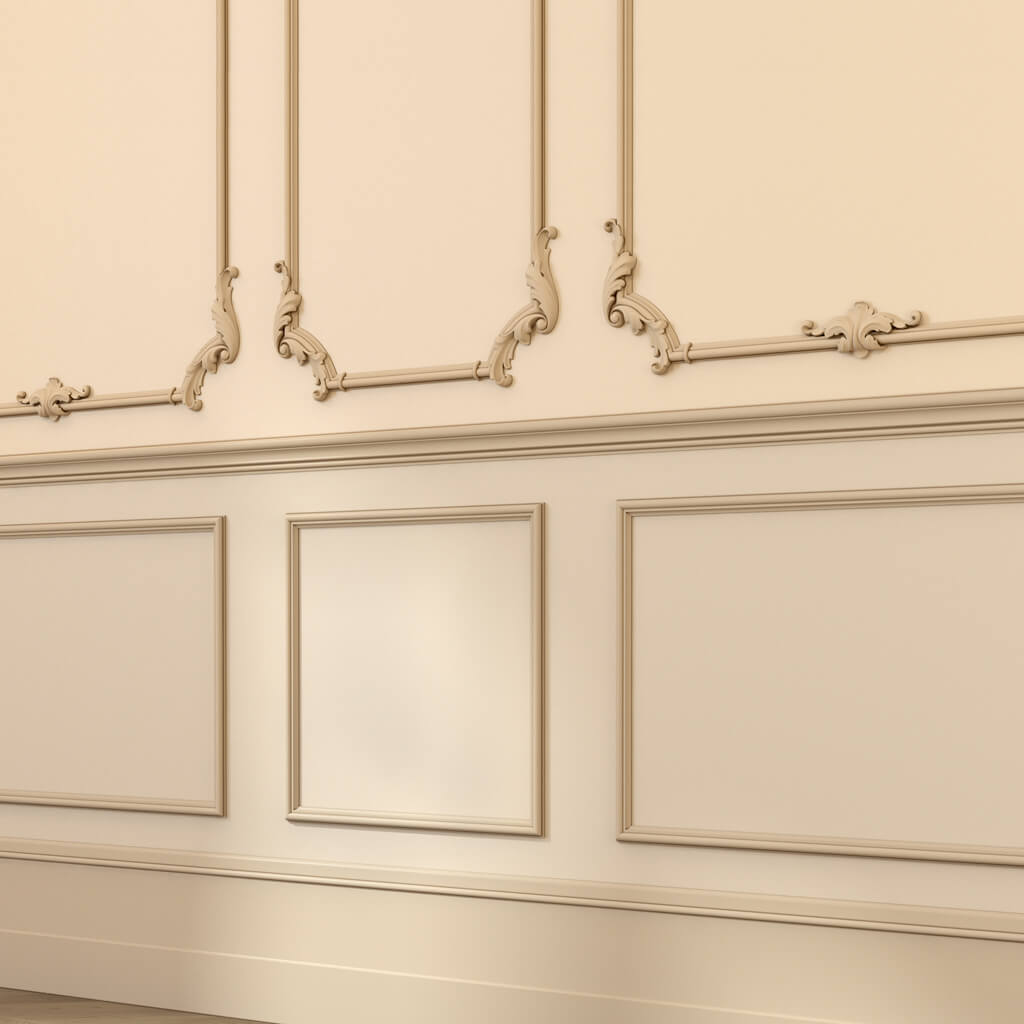
Wooden molding MLD-004, applied to the wall surface to form rectangular frame-like "fields," creates architectural relief on the wall—rhythm, depth, and a classic character. The left corner elements MLD-4U-2.1L in such wall layout occupy the left corners of each frame cell.
On a wall layout, the size 145 × 90 × 16 mm is particularly justified: wall frames are larger than furniture ones, and corner points are visible from a greater distance—from 2–3 meters and beyond. A smaller corner element would go unnoticed. The 145 × 90 mm element creates a visible, significant decorative accent.
Recommendations for use on walls:
-
Entryway in a classical or neoclassical home—molding frames give the 'entry' space a formal, architectural character
-
Living room with a fireplace or seating area—wall frames around the perimeter create a backdrop for furniture and decor placement
-
Study or library—wooden molding frames made of oak with a clear finish create the atmosphere of a serious workspace
-
Bedroom—a framed layout behind the bed headboard creates 'wall decor' without a separate headboard
In classical and neoclassical interiors: precision of quotation
Carved solid wood corner decor is not a stylization or retro. It is one of those techniques that have been continuously present in the European decorative arsenal for several centuries—and every thirty to forty years, it returns to the contemporary context in an updated interpretation.
In classic interiorleft corner element MLD-4U-2.1Lsounds like an organic detail of the overall program: next to a molded ceiling, herringbone parquet, good fabric on the windows, and furniture on curved legs, a wooden carved corner of a molding frame is a detail from the same cultural circle as everything else.
In neoclassicism—more restrained. Less decorative density, more air, clean surfaces with pinpoint ornamental statements. A molding frame with neat corner accents on a white facade is 'new classic' in its pure form.
Size 145 × 90 × 16 mm: proportional logic
Let's try to understand the size not abstractly, but through specific objects.
Facade width 500 mm, height 700 mm. Frame with a 35 mm offset: frame—430 × 630 mm. Horizontal runs: 430 − 145 − 145 = 140 mm. Vertical: 630 − 90 − 90 = 450 mm. Proportion—normal: corners are noticeable, the frame field remains free.
Facade width 600 mm, height 900 mm. Frame 530 × 830 mm. Horizontal runs: 530 − 290 = 240 mm. Vertical: 830 − 180 = 650 mm. Excellent proportions: corner accents are substantial, runs are full-fledged.
Facade width 450 mm, height 600 mm. Frame 380 × 530 mm. Horizontal runs: 380 − 290 = 90 mm. On the edge—corner elements occupy more than 75% of the horizontal run. For facades 450 mm wide, it is better to choose corner elements of a smaller standard size.
Conclusion: MLD-4U-2.1L is optimal for facades with a width from 500 mm and height from 700 mm. For wall panels—from 600 × 800 mm.
A relief depth of 16 mm with the MLD-004 profile (height 15 mm) means the corner element protrudes slightly above the level of the molding profile. This is intentional: in the decorative hierarchy of the frame, the corner is more important than the run. The slight additional protrusion visually 'anchors' the corner accent as the dominant element.
What to pair with MLD-4U-2.1L: complete configuration of the molding system
A molding frame is not a single component, but a system. Let's name all its elements.
1. Molding MLD-004 — the mandatory foundation of the system. Profile 15×8 mm, wooden, manufactured by STAVROS. Purchased in the section molding products. Quantity is calculated based on the total perimeter of all frames plus a 10–15% reserve.
2. Right paired corner element MLD-4U-2.1R — a symmetrical frame is impossible without it. For one rectangular frame: 2 left (MLD-4U-2.1L) + 2 right (MLD-4U-2.1R) = 4 corner elements. Remember to specify the quantity and orientation separately when ordering.
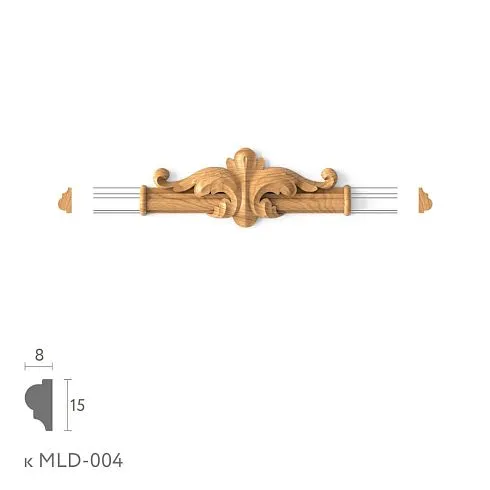
3. Central decorative overlays of the MLD-4 series — installed in the center of the molding runs, adding an ornamental accent at the midpoint of each run. In the full decorative program (corner + central overlays), the frame gains the richness of a classic molding system — with ornamentation both at the corners and along the runs. Assortment in the section decor for STAVROS moldings.
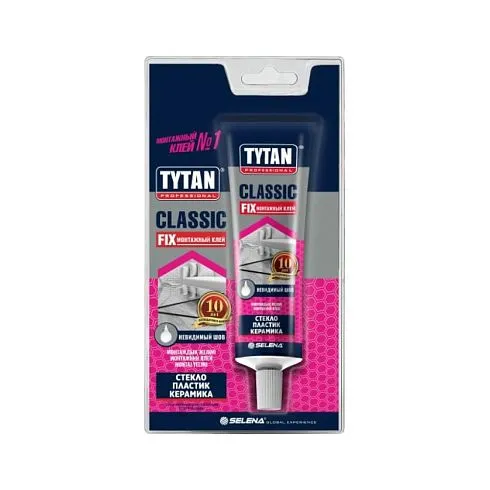
4. Mounting adhesive — a specialized compound for wooden decorative elements. Provides quick setting and high-strength bonding to MDF, chipboard, and wooden surfaces. The adhesive is applied to the back surface of the element, not to the facade surface — this makes it easier to control application on textured back areas.
5. Acrylic sealant — for filling joint gaps. Applied after installing the entire frame system, before priming. Color — white or paintable.
6. Acrylic primer — one coat over the entire system: facade + moldings + corner elements. Ensures even absorption of the enamel and prevents the 'raising' of wood fibers under the first coat of paint.
7. Enamel — acrylic (recommended for kitchens and wet areas) or alkyd (for living rooms). Apply in 2–3 coats with full drying between layers.
Installation and finishing: step by step and without unnecessary words
A good molding frame results from the correct sequence of actions. Violating the step order is the only real cause of poor results.
Step 1. Surface preparation
Facade surface — clean, dry, degreased. On laminated MDF — light sanding of the installation area with P150 to improve adhesion. On untreated MDF — degreasing and dusting with P180.
Step 2. Marking
Draw the frame outline with a pencil. Determine the corner points. Check: which corner the left MLD-4U-2.1L occupies, which — the right MLD-4U-2.1R. Left — in left corners (top left and bottom left when viewed frontally). Not the opposite.
Step 3. Mounting corner elements — first thing
Corner elements are mounted before cutting molding runs. Apply adhesive to the back surface of MLD-4U-2.1L. Place at the corner point of the marking. Press. Secure with painter's tape or clamps. Wait for setting. Repeat for all four corner elements of the frame.
Step 4. Cutting and mounting molding runs
After securing the corner elements — cut the molding. Length of each run: from the inner plane of one corner element to the inner plane of the opposite one. Cut strictly straight, 90 degrees. Check the length with a dry fit.
Apply adhesive to the back side of the run. Place it between the corner elements. The ends of the molding should fit tightly against the side planes of the corner elements. Secure with painter's tape until set.
Step 5. Gap Filling
Fill all joint zones with acrylic sealant — where the ends of the molding meet the corner elements. After drying — sand with P180. The joint surface should be smooth, without steps.
Step 6. Priming
One coat of acrylic primer over the entire system. Wait for complete drying.
Step 7. Painting with enamel
Two to three coats with drying between coats. For carved surfaces — use a brush with natural bristles. Carefully guide the brush into deep areas of the ornament. Avoid drips in the lower points of the relief. When using acrylic spray — protect adjacent surfaces from overspray.
Critical Errors
Let's list the most common ones:
-
Orientation is mixed up. The left element is mounted in the right corner. Ornamental symmetry is broken — the frame "curves". Fixing after installation is difficult. Always check orientation before applying adhesive.
-
Molding is cut to the full length of the frame. Without accounting for the depth of corner elements, it does not fit into the space between them. Cut runs only after fixing corner elements.
-
Painting without primer. The first layer of enamel applies unevenly. Priming is a mandatory stage, not optional.
Why exactly MLD-4U-2.1L: commercial precision
Let's summarize without rhetoric. MLD-4U-2.1L is chosen when a predictable result is needed in a molding frame with MLD-004.
Five specific reasons:
-
System compatibility with MLD-004 — joint without gap, without step, without artifacts after painting
-
Left-sided ornament orientation — mirror symmetry with MLD-4U-2.1R, correct classical frame
-
Material choice: oak or beech — two options for different tasks: oak for transparent or tinting coating, beech for opaque enamel
-
"Standard" execution — machine sanding, uniform surface, ready for primer
-
Dimensions 145 × 90 × 16 mm — proportionate to the large MLD-004 profile, creating a pronounced decorative accent on medium and large-scale facades and panels.
FAQ: Questions to Ask Before Purchase
Which molding is MLD-4U-2.1L intended for?
For the MLD-004 molding manufactured by STAVROS. The geometry of the side zones of the corner element is coordinated with the profile of this molding. Use with other profiles requires prior 'dry-fit' compatibility check before applying adhesive.
Is this a standalone decor or a component element?
A component of the molding frame system. Independently, without the MLD-004 molding, it is used only in non-standard decorative solutions — as a point corner accent without a framing context.
How does the left corner element differ from the right MLD-4U-2.1R?
By the orientation of the ornament. Left and right are a mirrored pair. When installed together on the left and right corners of a frame, they create a symmetrical decorative program. Using only left or only right elements on all four corners of a single frame disrupts symmetry.
What to choose under enamel: oak or beech?
For opaque enamel finishing, beech is technologically preferable: its fine-pored, homogeneous structure without large open vessels ensures a smooth coating without additional pore treatment. Oak for enamel requires a pore-filling primer before the main priming.
How many pieces are needed for one frame?
Four corner elements: 2 left (MLD-4U-2.1L) + 2 right (MLD-4U-2.1R). For multiple cells, multiply accordingly. Specify the quantity of each article separately when ordering.
Is MLD-4U-2.1L suitable for MDF furniture fronts?
Yes. MDF is the standard surface for mounting wooden decor with adhesive. On laminated MDF, light sanding of the mounting area is recommended before applying the adhesive.
What does 'Standard' mean?
Machine sanding. The surface is uniform, ready for priming and painting without manual finishing.
What does 'For enamel' mean in the description of re-gluing?
Re-gluing sections without matching by color and grain direction. Under opaque enamel, the wood texture and tone are not visible, so texture matching is not performed. Reduces the product cost without quality loss when painting.
Where can I find the full kit for the molding frame with MLD-004?
Molding MLD-004 — in the section of STAVROS millwork products. Left and right corner elements, central overlays of the MLD-4 series — in the section decoration for moldings. All items can be selected in a single order.
How to understand if the orientation is chosen correctly before mounting?
Place the item on the table with the ornament facing up. The diagonal axis of the ornament should run from the right angle of the item to the open area. For the left element (MLD-4U-2.1L), this orientation corresponds to the left corner of the frame when viewed frontally. If in any doubt, perform a dry fit into the corner marking point before applying adhesive.
Your request has been sent!
Our manager will contact you within 5 minutes