












































































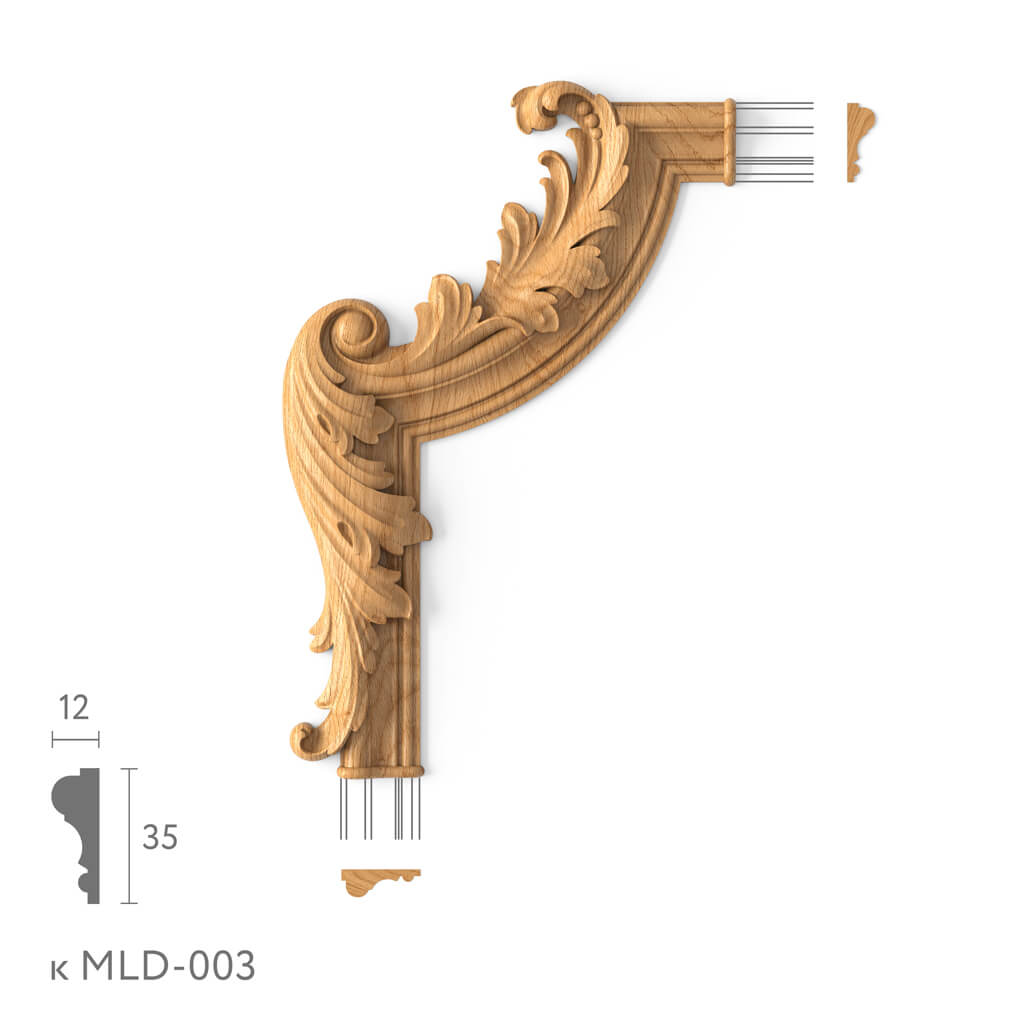

Corner decorative element MLD-3U-2.1L
Dimensions and Options
Have questions?
Customers also buy



Yulia Kh.
March 24, 2026
I was satisfied with the quality of the products; we purchased furniture legs. I would especially like to highlight the professionalism of manager Oksana—very client-oriented, competent, and precise specialist. She even arranged additional trimming of some elements as an extra service for us. Huge thanks!
Incognito 7.
March 24, 2026
One of the few firms that is pleasant to interact with on renovation matters. Adequate, responsive managers. Adherence to deadlines. Execution of even complex projects. Bravo! May there be more such firms!!
Marina D.
February 15, 2026
The company ordered the pens for us when we ordered furniture. But I decided to write a review personally because they are amazing! Stylish, expensive, high-quality!
More than 20 years on the market
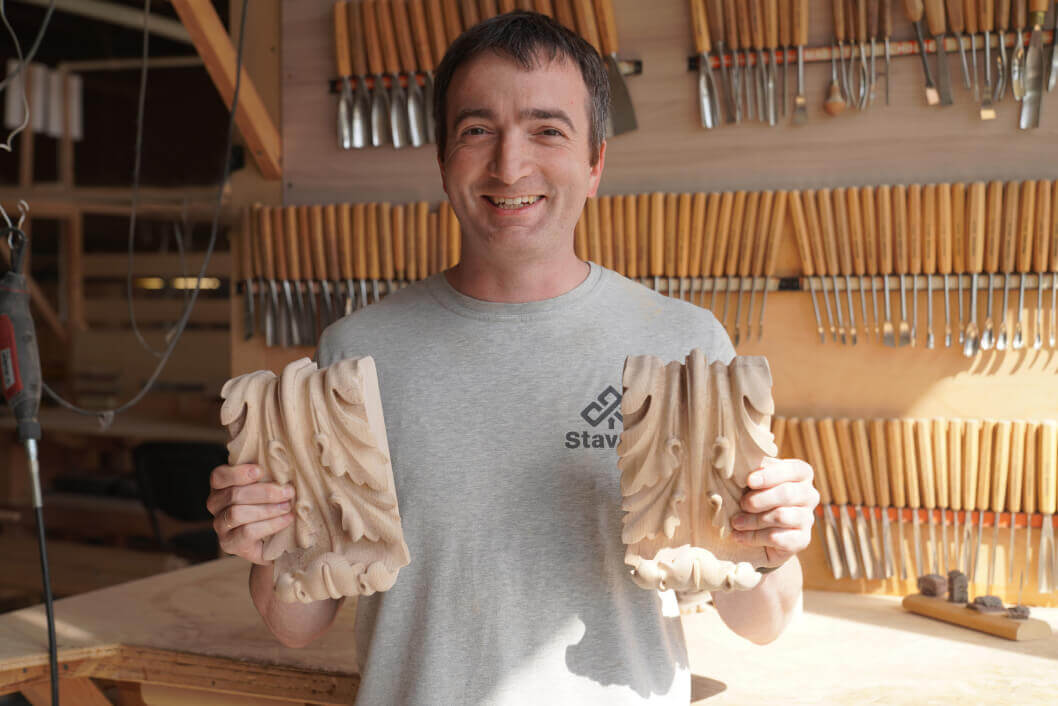
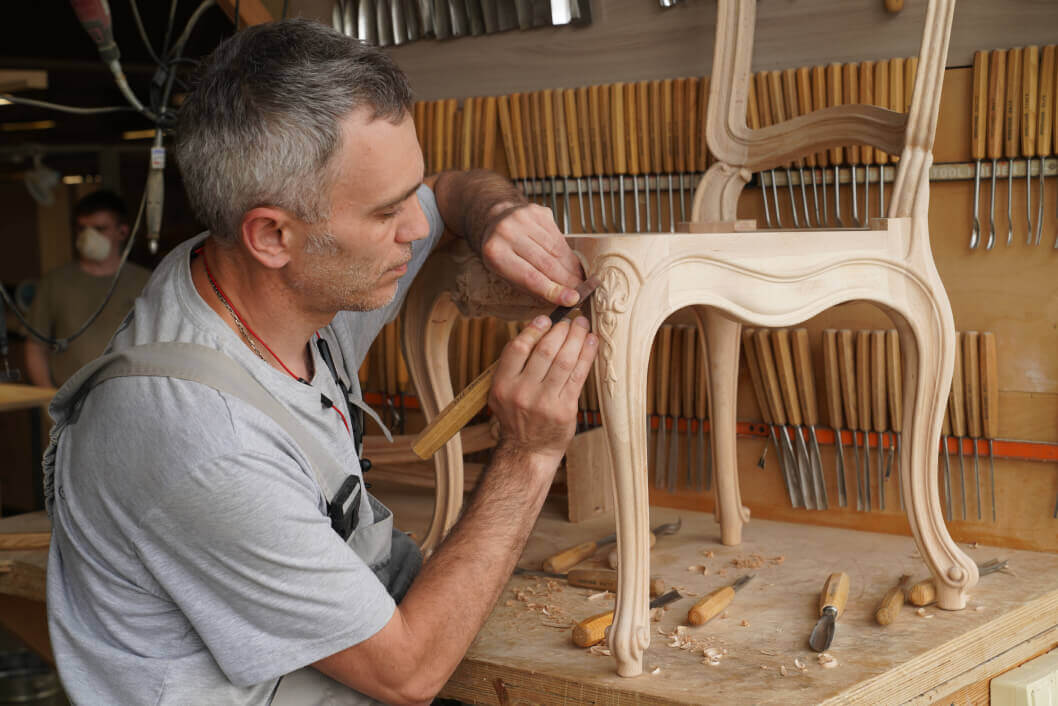
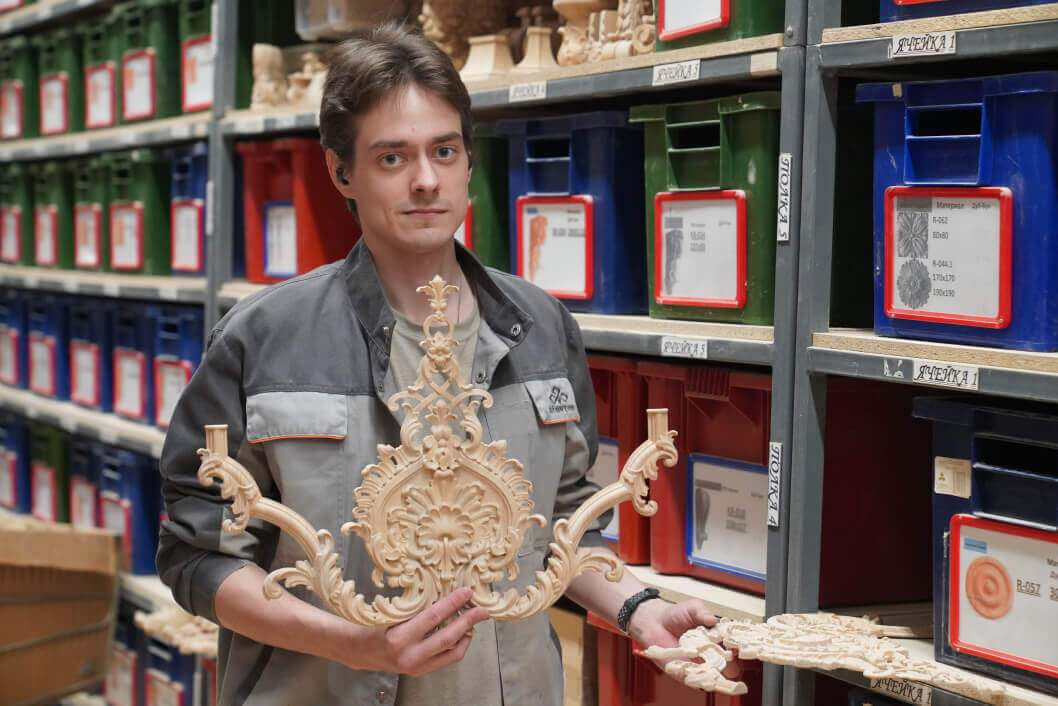
The company's success began in 2002, when two artists — Andrey Ragozin and Evgeny Tsapko — created a small creative workshop for producing wooden carved items. The masters' work was quickly noticed, and within a year they were invited to participate in the reconstruction of the Konstantinovskiy Palace in Strelna.
After the success of this project, the company focused on recreating palace interiors, furniture, church furnishings, and carved decorations in various artistic styles. They worked with cultural heritage sites: The Hermitage, the Alexandrovsky Palace, the Troitsko-Izmaylovsky Cathedral, the Sheremetyevsky Mansion, and many others.
The masters' task — and still is — to create wooden items with the highest level of detail and understanding of every element, based on impeccable knowledge of artistic laws and interior styles.
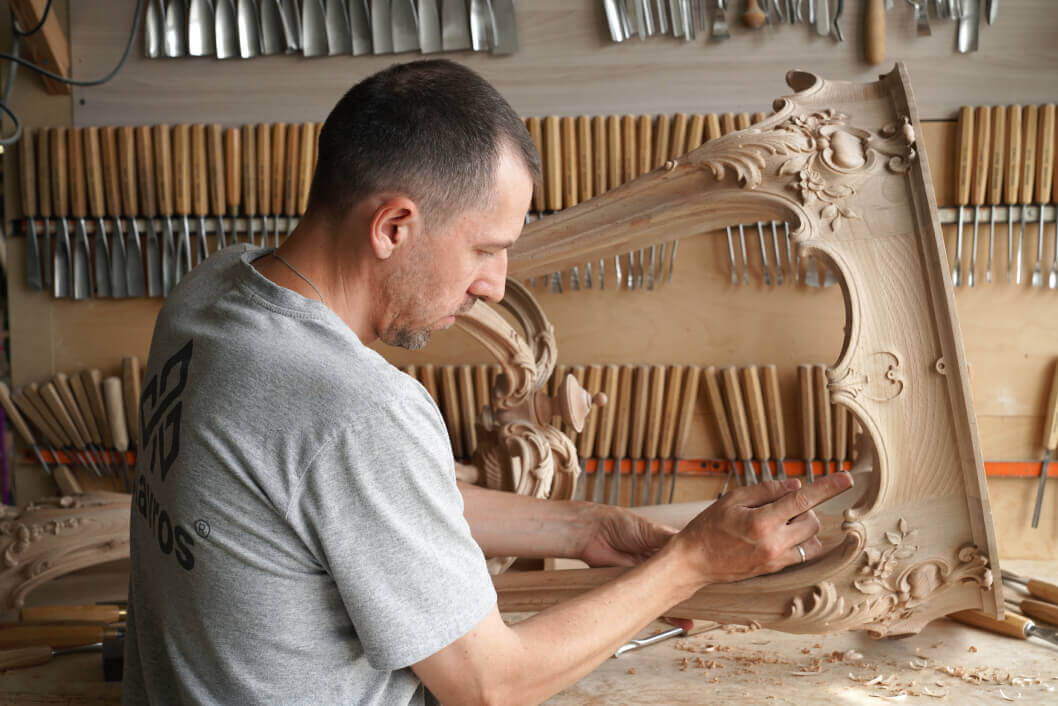

STAVROS Guarantees
Quality of products without complaints
We save your time, peace of mind, and budget
Large warehouse program
We solve your tasks with maximum speed
Adherence to production deadlines
Streamlined process reduces all risks
Delivery from 1 piece throughout Russia
Quality service regardless of order volume
Your positive business reputation
Reliable partner — the foundation of your business
More products in the molding decor category


Frequently asked questions
Our showrooms are located in Saint Petersburg and Moscow. Production is located in Saint Petersburg.
Moscow contacts: https://www.stavros.ru/contacts_all/?tab=msk
Contacts of Saint Petersburg: https://www.stavros.ru/contacts_all/?tab=spb
- Send request by email [email protected]
- Write to us at Telegram
- Write to us at WhatsApp
- Order by phone +7 (800) 555-46-75
- Visit our showroom in Saint Petersburg and Moscow
Yes, we ship orders throughout Russia and to CIS countries.
We cooperate with transportation companies such as СДЭК and DPD.
You can also arrange pickup of your order through any convenient transportation company for you.
Delivery cost depends on the size, weight of the item, and delivery address.
When placing an order, the delivery cost is calculated automatically and displayed as a separate line on our website.
Prices and availability of items on the website are always current. Data is updated daily.
Note: items in stock are stored on the warehouse in unpolished form and shipped within 3 working days.
If the item is not in stock, average production time: 5–10 working days.
This is the quality of polishing of the items.
Standard — machine polishing, at a more attractive price.
Prestige — detailed hand polishing, items do not require further work.
More details: https://www.stavros.ru/information/kachestvo/
This is the type of veneer of the items.
Under enamel: produced by gluing wooden laminates without color and texture matching. Contrast tonal and textural differences are noticeable. This blank should be chosen if the item is intended for opaque coating.
Under tinting: produced by gluing wooden laminates with color and texture matching. Tonal and textural differences may occur. This blank should be chosen if the item is intended for semi-transparent finish.
More details: https://www.stavros.ru/information/kachestvo/
Beech — dense, non-porous wood, most often used for items covered with enamel.
Oak — dense, porous wood with clearly visible natural grain. Due to its strength and decorative properties, it is often used in items with semi-transparent coating, highlighting the wood pattern.
Custom-made, if non-standard items are required, we can produce products from other types of wood, including blanks provided by the customer, manufactured according to our technical specifications.
All our furniture legs can withstand a vertical load of at least 100 kg.
Average production time for custom-made items: 5–10 working days.
Most items are stored on the warehouse in unpolished form. We need time to polish and pack orders.
Yes, we manufacture non-standard items according to individual projects, but we only accept orders with a minimum quantity.
We can manufacture items of the desired size, but we only work with bulk orders. For details, please consult the sales department manager.
Yes, some of our products can be used outdoors. For example, polyurethane items, as well as carved door casings made of pine.
Other items are produced to order using PUR glue, if minimum quantity is available. No warranty is provided for such products, as outdoor conditions are considered aggressive.
Yes, we paint items when ordering products for a total amount of 150,000 rubles or more.
- Dust removal. After sanding, the surface must be dusted.
- Priming. Apply primer in an even layer.
- Matting. After the primer has fully dried, the surface should be matted (lightly sanded for better adhesion).
- Finish coating. Apply finish coating: lacquer or enamel, in 2 layers, with interlayer drying.
More details: https://www.stavros.ru/information/sovety/
Apply adhesive to the decor. Place it on the surface and press briefly. Then, lift the decor from the surface and leave it open for 3–5 minutes. Press the decor firmly onto the surface and hold for 5–10 seconds.
More details: https://www.stavros.ru/information/sovety/
Ideally, you should prepare a design project before placing an order.
You can do this yourself by downloading drawings of our products from our website, or you can order a project from us.
If the number of decorative elements and fittings is small, our company's manager can assist you with selection.
Unfortunately, this service is not provided.
The packaging method depends on the type of items, but in each case, we ensure sufficient protection for safe transportation.
We most often use corrugated cardboard and stretch film. Fragile items are additionally secured on a rigid base to prevent damage during transport.
We ship all items starting from 1 piece.
Room measurements and item installation can be performed by our partners — carpentry companies represented in most regions of Russia.
Often searched in category Wooden and MDF items
7083
2945
2639
1453
1323
1088
858
Corner decorative element MLD-3U-2.1L: large carved solid wood decor for walls, furniture, and architectural interior solutions
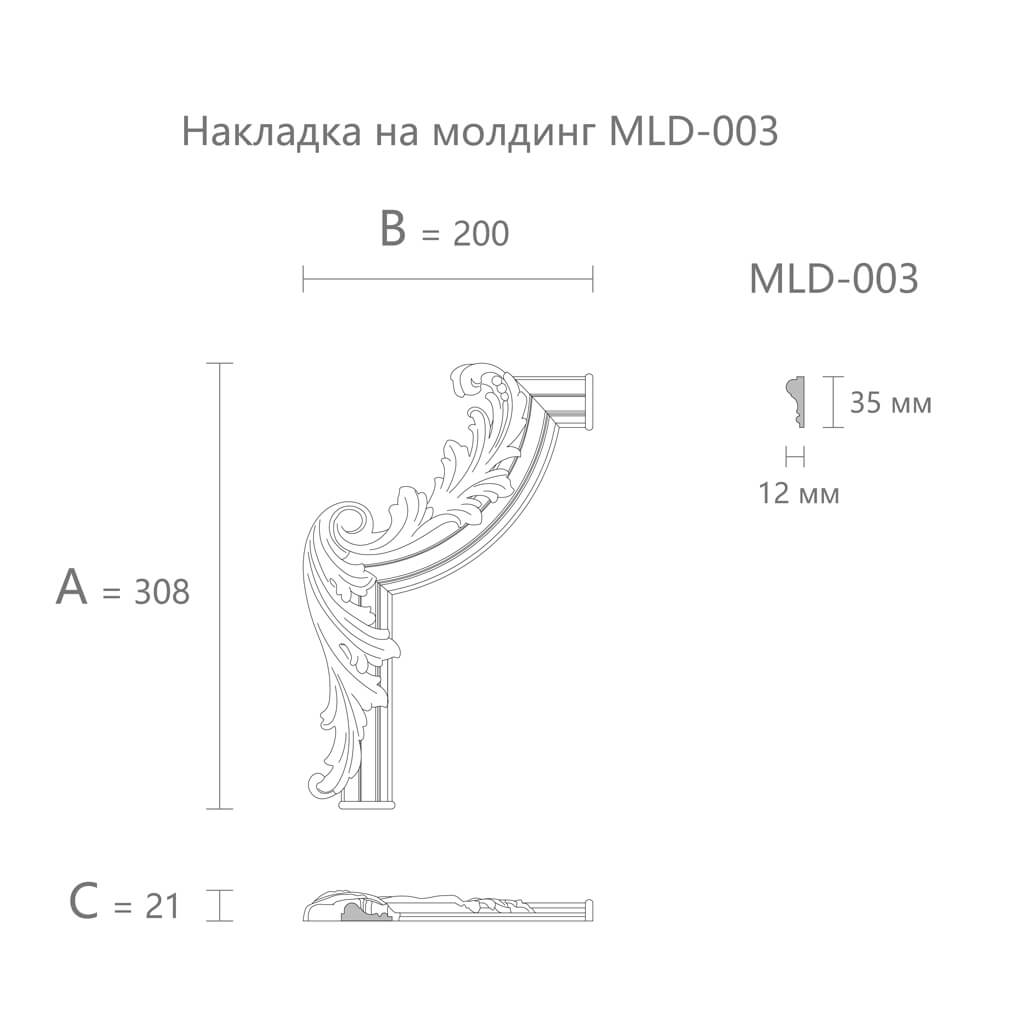
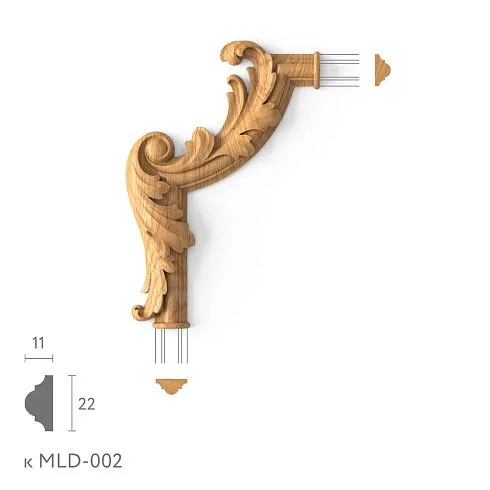
There are pieces that immediately set the scale of the conversation. Not about 'decorating' in the everyday sense—but about architectural thinking that manifests in details.Decorative corner element MLD-3U-2.1L—is one of them. Dimensions 308 × 200 × 21 mm, material—solid beech or oak, finish—'Beech, Standard, Under enamel'. The item is made to order; if in stock, shipping is within 3 business days.
MLD-3U-2.1L is a left corner decorative element. This is not an abstract 'carved overlay' for any corner—it is a precisely oriented piece: it occupies the left corners of a rectangular molding frame (left upper and left lower when viewed frontally) and forms a mirrored pair with the right element MLD-3U-2.1R. Together they create an ornamentally symmetrical framing system that reads as a unified architectural statement.
This is the largest corner element in the MLD-U series, included in the section'Decor for moldings'STAVROS—where corner elements, carved overlays, and connecting decor made of beech and oak for walls, ceilings, furniture, and decorative panels are concentrated. Construction feature: the back of the piece has a recess for the molding profile—for precise fitting of molding run ends without gaps and with a neat, professional result.
Corner decorative element MLD-3U-2.1L for classical and neoclassical decor
Decorative interiors live in proportions. A wall frame of 800 × 1200 mm requires a corner accent of a completely different scale than a 400 × 600 mm frame. On large surfaces, small corner decor simply disappears—it's invisible to both the eye and the camera. This is where the story of MLD-3U-2.1L begins.
308 mm horizontally and 200 mm vertically — this is a corner element comparable in size to an A4 sheet of paper. With a relief depth of 21 mm, it provides a sculptural volume noticeable from a distance of 5–6 meters — that is, precisely from the distance from which a large interior is viewed. This is not a 'small detail' — it is an accent element of a large decorative solution.
Who works with this format? Designers implementing classical and neoclassical projects for spacious areas: living rooms of 40 sq. m and above, grand corridors, studies with high ceilings, bedrooms with architectural molding layouts. Furniture makers creating large case furniture — sliding wardrobes with fronts 600–800 mm wide, library and study sections, furniture for dressing rooms. Everyone who understands: the scale of the detail must correspond to the scale of the object.
MLD-3U-2.1L — a wooden corner element made of solid wood with carved ornamentation in a classic botanical style. It is used in compositedecorative molding systemsfor wall panels, furniture fronts, cabinet doors, interior doors, decorative frame trims. Everywhere where a molding profile forms a rectangular frame — and this frame is large enough to 'accommodate' a 308 × 200 mm corner accent.
Dimensions, material, and execution
Precise geometry: 308 × 200 × 21 mm
Three numbers that determine everything — from applicability to proportional calculations.
308 mm — the size along the horizontal molding run. This is almost a third of a meter: on a 700 mm wide front, the corner element occupies 44% of the horizontal run. On a 900 mm front — 34%. On a 1000 mm wide wall frame — 31%.
200 mm — the size along the vertical molding run. The aspect ratio 308:200 ≈ 1:0.65, close to the golden ratio proportion (1:0.618). This means the element's form is perceived as visually harmonious — subconsciously, at the level of perception.
21 mm — relief depth. With side lighting, this relief creates a pronounced three-dimensional play of shadows: carved swirls and leaf forms of the ornament 'protrude' from the facade plane by 21 mm at the highest point. This approaches sculptural relief — with differences in shadows across several depth levels.
Proportional applicability table for MLD-3U-2.1L:
| Facade width | Frame (40 mm inset) | Horizontal run (between corner elements) | Vertical run | Assessment |
|---|---|---|---|---|
| 700 мм | 620 мм | 4 мм | — | Too tight |
| 800 мм | 720 мм | 104 мм | — | At the limit |
| 900 мм | 820 мм | 204 мм | — | Good |
| 1000 мм | 920 мм | 304 мм | — | Excellent |
| 1200 мм | 1120 мм | 504 мм | — | Ideally |
For a vertical frame run with a height of 1000 mm: 1000 − 80 (margins) − 400 (two corner elements of 200 mm each) = 520 mm — excellent proportion. Height 800 mm: 800 − 80 − 400 = 320 mm — acceptable. Height 600 mm: 600 − 80 − 400 = 120 mm — minimum.
Minimum recommended object dimensions for MLD-3U-2.1L:
-
Facade/wall cell width — from 850–900 mm
-
Height — from 800–900 mm
-
For wall frames — from 900 × 1000 mm
For more compact facades (600–700 mm), choose corner elements of the MLD-2U series (200 × 135 mm) or MLD-4U series (145 × 90 mm).
Material: beech or oak
The choice of wood species in a decorative element for enamel is a technological decision, not an aesthetic one. Under opaque paint, the texture and color of the wood are not visible. However, the consequences of an incorrect choice are visible: open pores, uneven finish, unstable material behavior under microclimate changes.
Beech (Fagus orientalis, Fagus sylvatica) is a diffuse-porous hardwood. Pores with a diameter of 0.02–0.05 mm are evenly distributed throughout the cross-section. The sanded surface of beech is uniform and fine-grained — a standard acrylic primer seals it in one coat. Enamel applies evenly, without porosity artifacts. The density of beech at 12% moisture content is 620–680 kg/m³: sufficient for clear carved relief with fine details.
Practical conclusion: beech for enamel is a straightforward technological path without reservations. Take it, prime it, paint it. No additional operations.
Oak (Quercus robur, Quercus petraea) is a ring-porous species with a fundamentally different structure. In the early zone of each annual ring — large vessels with a diameter of 0.1–0.3 mm, clearly visible to the naked eye. The density of oak is 650–750 kg/m³. The relief of carving on oak turns out clear and sharp.
Under transparent or tinted coating, oak is the best choice: its shimmering medullary rays, characteristic vascular pattern, warm tone in various shades from golden to dark brown — this is an independent decorative value. Under white or light enamel, oak requires preliminary application of a pore-filling primer: without this, large open pores may 'show through' the thin layer of paint, especially with a matte finish.
| Criterion | Beech | Oak |
|---|---|---|
| Surface structure | Fine-porous, uniform | Coarse-porous, with pronounced vessels |
| Primer for enamel | Standard primer | Filler primer + base primer |
| For clear lacquer / tinting | Neutral texture | Expressive texture, recommended |
| Density | 620–680 kg/m³ | 650–750 kg/m³ |
| Carved relief | Sharp | Very sharp |
| Recommended when | Project fully under enamel | Transparent finish or oak context |
«Standard» and «Under enamel» execution
«Standard» — machine sanding with industrial equipment. Characteristics: reproducible uniform surface, no dependence on manual execution, identical processing quality on all items in the series. For corner elements under opaque enamel — optimal and sufficient execution.
«Under enamel» — regluing (gluing solid wood sections) without color or grain direction matching. The logic is simple: with an opaque finish coating, there is no point in using select wood for color and texture matching of sections. «Under enamel» reduces material consumption and production labor costs — which directly affects the product cost without compromising the quality of the finishing surface.
Alternatives — «Prestige» (manual finishing) and «Under tinting» (regluing with tone and texture matching). These executions are relevant for transparent or semi-transparent finish coatings — where the wood grain and tone will be visible.
What decorative element MLD-3U-2.1L is suitable for
This question is often asked by designers working with solid wood corner decor for the first time. The answer is best given not through a list of objects, but through function: the corner decorative element covers the intersection point of molding runs with a decorative carved detail, turning a structural node into an artistic accent. This is not a small 'plug' or just an overlay. It is a pinpoint architectural accent that defines the character of the entire frame system.
Wall molding layouts in large interiors
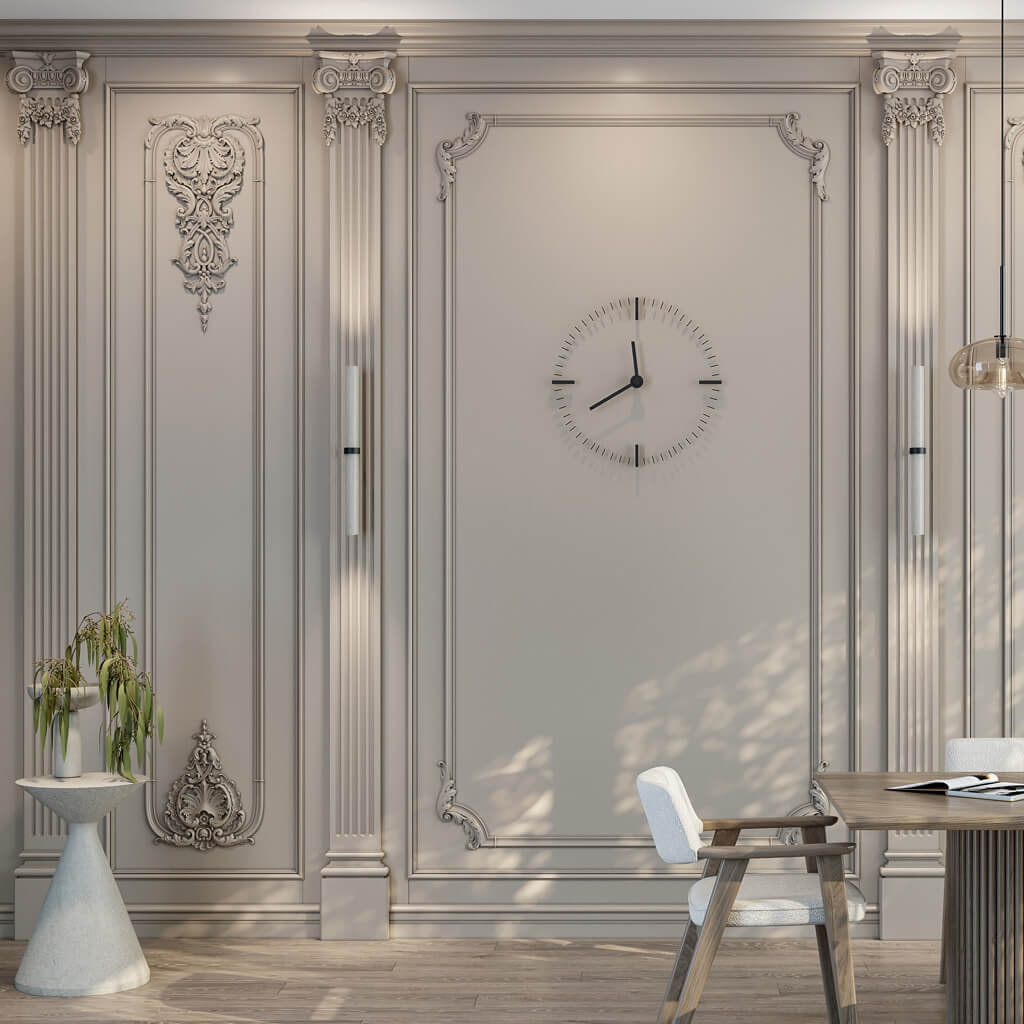
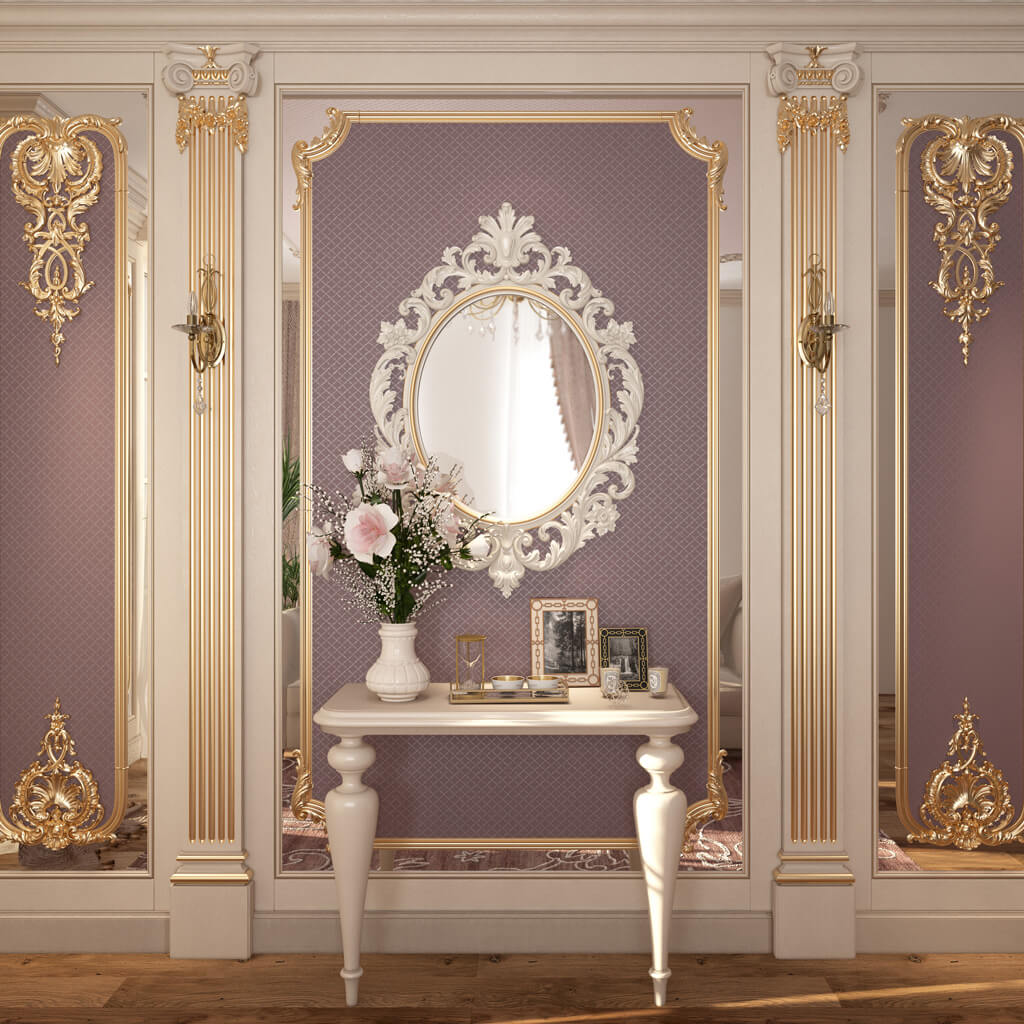
Wall molding layout — the most democratic way to give a room architectural dignity without interfering with the structure. WoodenMolding profilesare applied directly to the wall, forming rectangular 'fields' — decorative cells that visually break down the wall plane into orderly architectural fragments.
In this system, the size of the corner decorative elements should correspond to the scale of the wall and the cells. A small room with a low ceiling — small corner elements. A spacious living room of 40+ sq. m with 3.2 m ceilings — here the MLD-3U-2.1L (308 × 200 mm) is appropriate and justified.
Specific application scenarios:
Living room with decorative wall niches. The molding frame surrounds the niche — like a 'picture frame' around an empty field or a mantel shelf. The MLD-3U-2.1L corner elements form ornamental corner points, making the niche frame an independent decorative statement.
Grand hallway with paneling from floor to chair rail height. The lower tier of the walls is framed with molding frames. With a paneling height of 90–120 cm and a cell width of 700–900 mm, the MLD-3U-2.1L corner elements set the correct decorative scale.
Bedroom with an 'architectural' headboard. The molding frame behind the bed headboard creates a framed 'background' for the headboard and wall light. A frame 1400–1800 mm wide (for a double bed) with MLD-3U-2.1L corner elements is a complete interior design technique.
Study with a dado panel belt. The lower belt of the study walls — dark, rich, 'library-like'. Oak MLD-3U-2.1L corner elements for tinting as part of an oak molding system create an 'English club' atmosphere.
Large-scale furniture fronts
Carved corner element made of solid wood308 × 200 mm is a part for large furniture. Let's calculate precisely:
Sliding wardrobe, door 800 × 2000 mm, one frame cell per door. Frame with 50 mm offset: 700 × 1900 mm. Horizontal runs: 700 − 616 = 84 mm — already a bit tight. So, for 800 mm wide facades, MLD-3U-2.1L should be considered cautiously, with fitting.
Sliding wardrobe, door 900 × 2000 mm. Frame: 800 × 1900 mm. Horizontal runs: 800 − 616 = 184 mm — okay. Vertical: 1900 − 400 = 1500 mm — excellent.
Sideboard, door 700 × 1200 mm. Frame: 600 × 1100 mm. Horizontal run: 600 − 616 = −16 mm. Not suitable. Here, MLD-2U or MLD-4U is needed.
Furniture objects for which MLD-3U-2.1L is suitable:
-
Large wardrobes with doors from 900 mm wide
-
Kitchen island countertops with decorative end facades
-
End decorative panels of large kitchen sets
-
Library sections with large glazed doors 800–1000 mm wide
-
Fireplace portals with wooden overlay elements — here corner accents often require exactly such a large scale
-
Chests of drawers with wide drawer fronts from 700–900 mm
Doors and door panels
The MLD-3U-2.1L interior door with molding frames and corner decorative elements is, without exaggeration, a masterpiece of joinery. But size is important to consider.
Standard door 2000 × 800 mm with one frame cell: horizontal frame run ≈ 720 mm, between corner elements 720 − 616 = 104 mm — at the limit. Recommended for doors 900 mm wide and more.
For standard 800 mm wide doors with molding frames and large corner elements, it is better to consider a two-panel solution (upper + lower smaller cells) with MLD-2U corner elements.
Applied to doors 900–1000 mm wide, MLD-3U-2.1L creates a powerful, 'heavy' in a good sense decorative tone. Such a door occupies space not only physically, but also visually — it 'holds' the room.
Decorative frames, trims, and interior accents
In addition to standard wall and furniture applications, a large solid wood corner decorative element works well:
-
On decorative frames for mirrors: a frame with MLD-002 molding and MLD-3U-2.1L corner elements on all four corners — a monumental mirror in the Italian Baroque style
-
On the framing of decorative niches with lighting: light falling on the 21 mm relief creates a pronounced play of shadows
-
In fireplace portals as corner accents of facing planes
-
On decorative partitions with molding frames
Advantages of the MLD-3U-2.1L model
Scale as the main advantage
308 × 200 × 21 mm is not just a set of numbers. It's a solution for spaces and objects where decor must 'work' at a distance. The MLD-3U-2.1L corner accent is visible from 5–6 meters: this fundamentally distinguishes it from compact corner elements that create a 'subtle' decorative effect up close but disappear in the perception of a spacious interior.
A 21 mm relief with side interior lighting (which is how most modern interior lighting solutions work — spot downlights directed at walls, or floor lamps with side lighting) creates deep shadow play with multiple levels of chiaroscuro. This makes the corner element noticeable in any lighting — in the morning with natural side light, in the evening with directed artificial light.
Natural solid wood, not an imitation
A wooden decorative element made of solid beech or oak is a living material with its own biography. It has weight, density, a characteristic tactile image. Polyurethane analogs, gypsum and MDF overlays create a visually similar effect, but — always with a caveat. Natural solid wood:
-
Absorbs and releases heat differently than polymer — to the touch it is warmer and more 'alive'
-
Holds fasteners (beads, dowels, screws) with fundamentally greater strength than polyurethane foam
-
Repaired with wood filler while preserving the relief in case of chipping or mechanical damage
-
Lasts for decades without material degradation (polyurethane foam yellows and loses strength over time, especially in areas with temperature fluctuations)
-
Suitable for multiple repaints
Precise fit into the molding system
The recess on the back for the molding profile is a design feature easily underestimated when ordering but impossible to miss during installation. The ends of the molding runs fit into the side zones of the corner element with a precise fit—no gap along the profile, no adjustment by sanding, no excessive sealant. Result: the joint is structurally sealed, not just visually covered.
The side grooves for glazing beads additionally secure the corner element in the molding system, preventing lateral shifting as the adhesive seam shrinks.
Symmetry as an aesthetic argument
The left-handed orientation of MLD-3U-2.1L is specifically designed for mirror symmetry with the right-handed MLD-3U-2.1R. A symmetrical molding frame with correctly oriented corner elements creates a sense of 'correctness' that the eye registers immediately, without analysis. This feeling of 'correctness' and 'completeness' is the primary decorative function of corner elements in a paired system.
Universal finish
'Standard, For enamel' is the most practical production finish for the broadest range of projects. White enamel, cream, gray, dusty mint—any color from a standard palette adheres equally well to the beech surface. If needed, the 'For tinting' finish with 'Prestige' sanding enables a transparent or tinted finish—especially relevant for oak specimens.
Application in Interior Design: Specific Scenarios and Tips
Classical Interiors: Dense Ornamental Program
In a classical interior, decor works within a system of saturation: ceiling cornices, moldings, parquet with borders, patterned fabrics, furniture with carved details—all these elements create a unified ornamental field. The corner wooden element MLD-3U-2.1L fits into this field as one of the key accents of the wall and furniture program.
When working in the 'high classic' style, consider oak execution for tinting: dark oak on wall panels with golden accents is a canonical technique that has long become a standard.
From the article STAVROS"Shaped Solutions: Decorative Moldings, Layouts, and Contour Profiles"the logic is clearly visible: the molding system is designed not element by element, but as an integral decorative program—from the molding profile to corner elements and central overlays.
Neoclassicism: Focal Accent on a Clean Background
Neoclassicism is a discipline of decor. Less ornament, more meaning in each accent. A molding frame with corner decorative elements MLD-3U-2.1L on a white wall is the 'entire decorative statement' of the interior. It works precisely because it is singular: the gaze focuses, the details of the ornament are legible, and the 308 × 200 mm scale holds attention.
For neoclassicism, maintaining proportions is especially important: frames should not be too frequent. Three to four molding frames per wall is sufficient. Each with four corner elements MLD-3U-2.1L—that's 12–16 pieces per wall. Calculate in advance.
Custom Furniture Classic
Furniture makers working on custom projects in classic or neoclassical styles well understand the value of a properly chosen decorative element. Here, systemic compatibility is important: a carvedcorner decorative element MLD-3U-2.1L is used in conjunction with the MLD-002 molding and the central decorative overlays of the MLD-3 series — all these items are available in the STAVROS assortment in the sectionmolding productsanddecoration for moldings.
Studies and Libraries: Oak as a Material Manifesto
A study with oak molding paneling is a space that 'speaks' about its owner without words. That is why study projects should be approached with particular care in the choice of wood species, finish, and scale of decor.
Oakdecorative corner element MLD-3U-2.1L for tinting 'dark walnut' or 'English oak' as part of a wall molding system — this is not just decor. It is a statement that works throughout the life of the interior.
Compatibility with moldings and decorative systems
Molding MLD-002: main profile of the series
The MLD-3U series of corner elements was designed for a specific molding profile. The MLD-002 molding (20 × 12 mm) in beech and oak is the systemic partner of this corner element. The recess on the back of the MLD-3U-2.1L is calculated for the cross-section of this particular profile: the ends of the molding runs fit into the element's mounting zones tightly, without gaps.
The full range of STAVROS molding profiles for systems with corner elements is available in the sectionof oak and beech millwork products. When selecting a molding, verify compatibility with the MLD-3U series corner elements via the profile datasheet.
Right paired element MLD-3U-2.1R
Without the right element, there is no symmetrical frame. Calculation: 1 cell = 2 left (MLD-3U-2.1L) + 2 right (MLD-3U-2.1R) = 4 pieces. When placing an order, always specify both part numbers with separate quantities.
Calculation examples:
-
One wall frame → 2 × MLD-3U-2.1L + 2 × MLD-3U-2.1R
-
Cabinet with three doors of 1 cell each → 6 × MLD-3U-2.1L + 6 × MLD-3U-2.1R
-
Living room with eight wall frames → 16 × MLD-3U-2.1L + 16 × MLD-3U-2.1R
-
Add 10% reserve for each part number
MLD-3 center overlays: system reinforcement
With large frame cells (from 900 × 1200 mm and larger), long molding runs appear 'empty' relative to the saturated corner accents. The MLD-3 series central decorative overlays, installed at the center of horizontal and vertical runs, add ornamental richness around the entire frame perimeter.
This solution visually shortens the runs, adds rhythm, and makes the system resemble historical boiserie. The range of central overlays is in themolding decor section.
Installation: A technology that does not forgive violations
The correct sequence is not a suggestion
Installing a molding frame with MLD-3U-2.1L corner decorative elements is a process where the order of operations is critical. Violating the sequence leads to errors that can only be corrected by dismantling.
Stage 1. Preparing the facade surface.
On laminated MDF: sand the installation area with P150 abrasive to break down the surface film and ensure adhesive adhesion. On untreated MDF, veneer, wood: degrease.
Check for flatness: permissible deviation under the corner element is no more than 0.5 mm over a length of 308 mm. Surface unevenness under the element means poor adhesion and wobbling of the part. Correct with filler before installation.
Stage 2. Marking.
Draw the frame outline with a pencil. Mark the corner points considering the dimensions of the corner elements: 308 mm extends along the horizontal, 200 mm along the vertical. Check the orientation: MLD-3U-2.1L is for left corners. The ornamental axis opens to the left. A dry-fit check is mandatory.
Step 3. Installation of corner elements — always the first step.
Adhesive is applied to the back surface of MLD-3U-2.1L. The element is placed on the corner marking point, pressed, and secured with painter's tape in 3–4 diagonal points or with furniture clamps. Setting time — 20–30 minutes according to the adhesive data sheet. All four corner elements (2 left + 2 right) are installed before cutting the molding.
Step 4. Cutting the molding according to the actual measurement.
Run length = distance between the inner planes of the fixed corner elements. Cut — strictly 90 degrees. Dry fitting before applying adhesive.
Step 5. Installation of molding runs.
Adhesive on the back surface of the run. The molding end fits into the recess of the corner element. Press, secure with tape.
Step 6. Sealing and sanding of joints.
Acrylic sealant on all joint areas. Complete drying. Sanding with P180 to a smooth joint surface.
Step 7. Priming.
One coat of acrylic primer over the entire system: facade + moldings + corner elements — in a single technological pass. Complete drying.
Stage 8. Painting.
Two to three coats of enamel. Natural bristle brush on relief areas. Check for drips in the lower points of the relief between coats.
Three mistakes that happen the first time
Orientation is mixed up. The left element is placed on the right. The ornament loses symmetry. Check each element before applying glue — orientation cannot be corrected after setting.
Molding cut before installing corner elements. The actual distance between fixed corner elements almost always differs from the theoretical calculation. Cut only according to actual measurement.
Primer skipped. Enamel on sanded wood without primer applies unevenly: areas with different surface absorption give uneven gloss. Primer is a mandatory step.
Made to order and shipping terms
Decorative corner element MLD-3U-2.1L is made to order. If in stock, shipment is possible within 3 business days. Delivery across Russia.
When placing an order, specify:
-
Material: beech or oak
-
Finish: Standard or Prestige
-
Surface preparation: For enamel or For tinting
-
Quantity: separately for MLD-3U-2.1L (left) and MLD-3U-2.1R (right)
It is recommended to order both items simultaneously to avoid discrepancies in batch, wood shade, and processing parameters.
FAQ: most frequently asked questions
What is the decorative corner element MLD-3U-2.1L suitable for?
For decorating corners in molding frame systems: on wall panels, furniture fronts, cabinet doors, interior doors, and decorative trims. Its size of 308 × 200 mm is designed for large objects: fronts with a width from 850–900 mm, wall frames from 900 × 1000 mm.
How does the left corner element differ from the right one?
By the orientation of the ornamental pattern. The left MLD-3U-2.1L occupies the left corners of the frame cell, the right MLD-3U-2.1R occupies the right ones. Together they form mirror symmetry. Using only one type for all four corners disrupts the symmetry of the ornament.
Is MLD-3U-2.1L suitable for enamel?
Yes, especially in the 'Beech, Standard, For enamel' version. The beech surface with machine sanding is ready for applying acrylic primer and enamel without additional surface preparation operations.
Can it be ordered in oak?
Yes. When ordering, specify the material: oak. The oak version is recommended for transparent or tinted finishes where the wood grain will be visible. For white or light enamel, oak requires a preliminary pore-filling primer.
Can this element be used for furniture fronts?
Yes, for facades with a width of 850–900 mm. For narrower facades, the proportions are disrupted: the corner elements occupy too large a share of the horizontal run. For facades 600–800 mm, choose MLD-2U-2.1L (200 × 135 mm) or MLD-4U-2.1L.
Is the product suitable for a classic interior?
Absolutely. The MLD-3U-2.1L carved floral ornament is designed in the tradition of European classical decor. It organically fits into classical and neoclassical interior programs — from strict Empire style to warm French classicism.
Where else can carved wooden corner elements be used besides walls and furniture?
On fireplace portals (corner accents of the front planes), decorative mirror frames, frames for decorative niches with lighting, decorative partitions with molding frames. The principle is the same everywhere: where a molding profile forms a rectangular frame — and the frame is sufficiently large in scale.
How quickly is the shipment made?
If the goods are in stock — within 3 working days. Please check availability when placing your order.
How many corner elements are needed for one project?
The calculation is simple: 1 frame cell = 2 left + 2 right = 4 pieces. Multiply by the number of cells in the project. Add 10–15% reserve.
Where can I see other sizes of corner elements and select a molding?
In the sectiondecoration for moldingsThe full range of corner elements for all series (MLD-1U, MLD-2U, MLD-3U, MLD-4U) is presented. Molding profiles for these elements are in the sectionmolding products made of beech and oak.
Your request has been sent!
Our manager will contact you within 5 minutes