












































































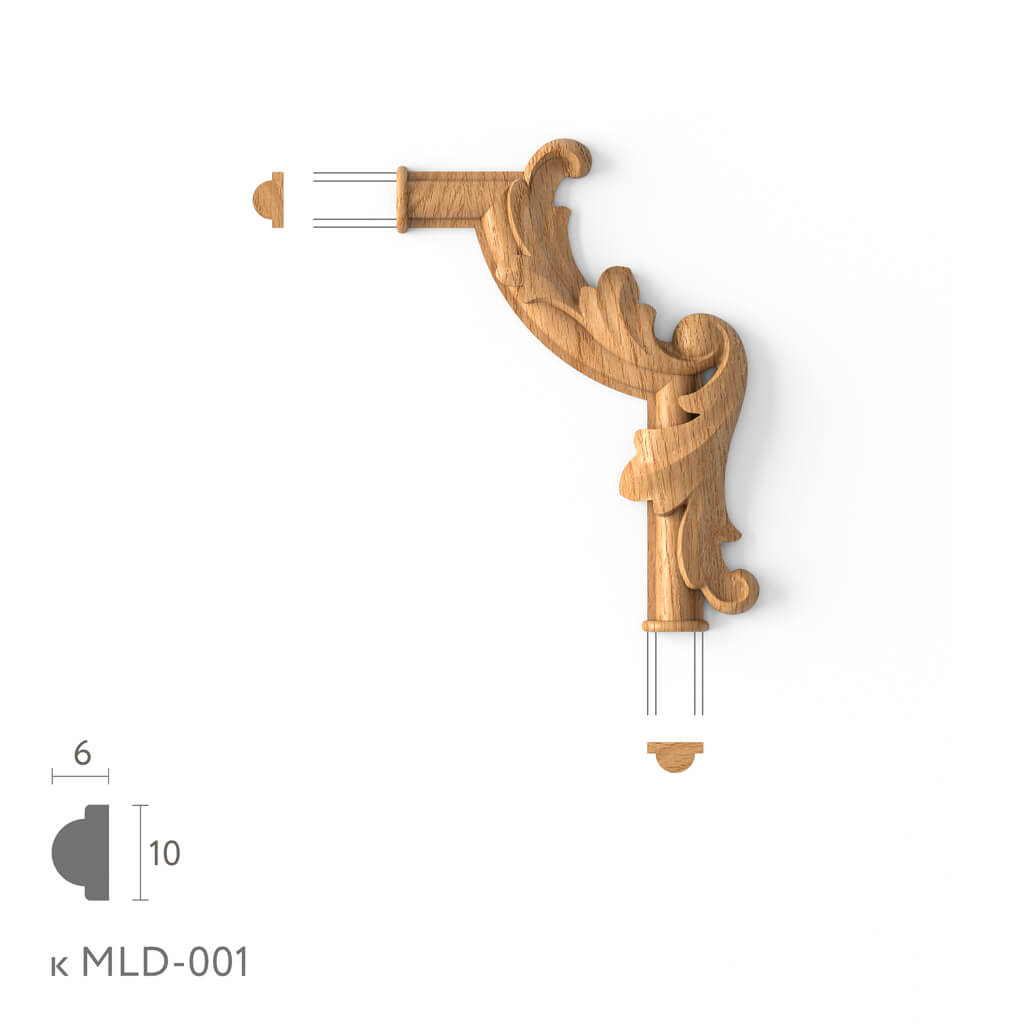

Corner decorative element MLD-1U-2.1R
Dimensions and Options
Have questions?
Customers also buy


Yulia Kh.
March 24, 2026
I was satisfied with the quality of the products; we purchased furniture legs. I would especially like to highlight the professionalism of manager Oksana—very client-oriented, competent, and precise specialist. She even arranged additional trimming of some elements as an extra service for us. Huge thanks!
Incognito 7.
March 24, 2026
One of the few firms that is pleasant to interact with on renovation matters. Adequate, responsive managers. Adherence to deadlines. Execution of even complex projects. Bravo! May there be more such firms!!
Marina D.
February 15, 2026
The company ordered the pens for us when we ordered furniture. But I decided to write a review personally because they are amazing! Stylish, expensive, high-quality!
More than 20 years on the market
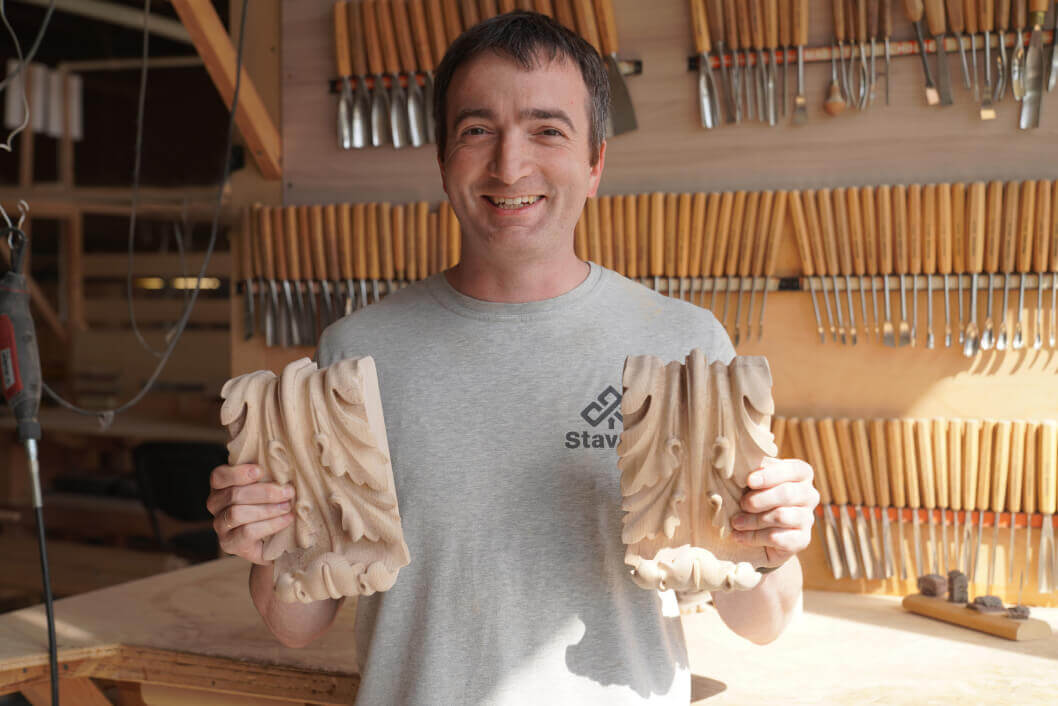
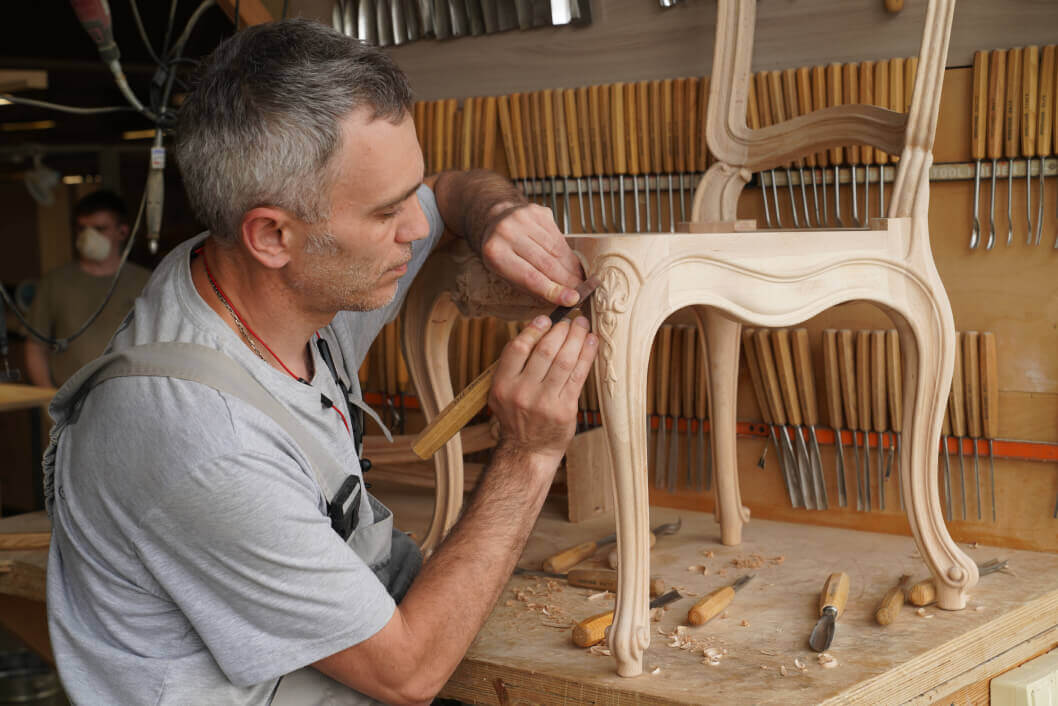
The company's success began in 2002, when two artists — Andrey Ragozin and Evgeny Tsapko — created a small creative workshop for producing wooden carved items. The masters' work was quickly noticed, and within a year they were invited to participate in the reconstruction of the Konstantinovskiy Palace in Strelna.
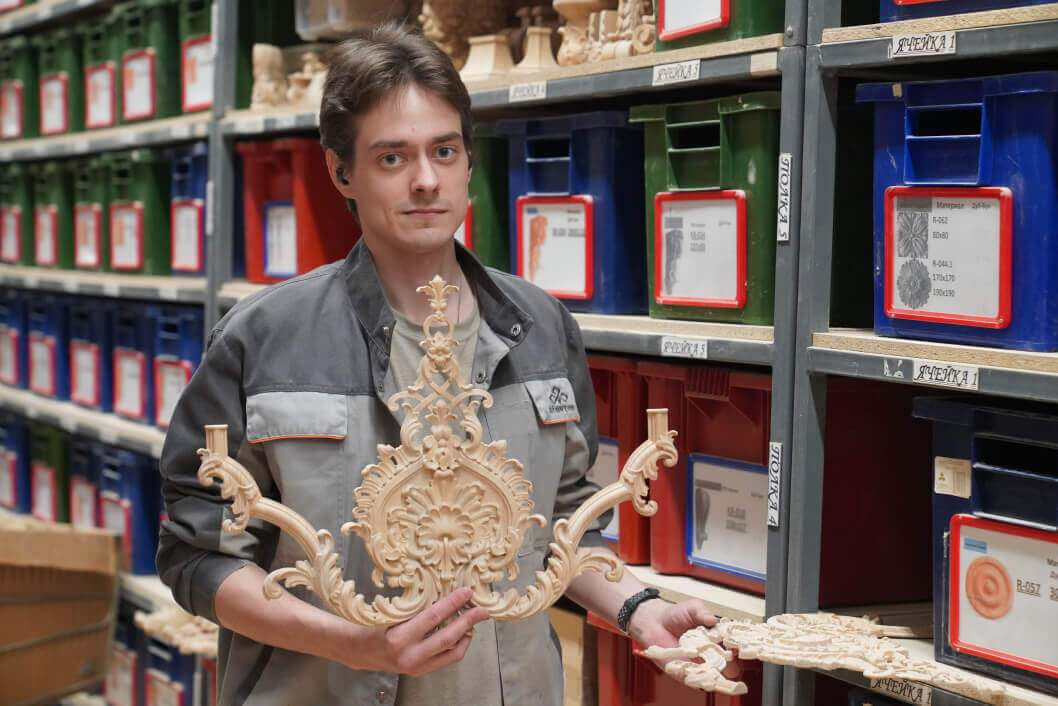
After the success of this project, the company focused on recreating palace interiors, furniture, church furnishings, and carved decorations in various artistic styles. They worked with cultural heritage sites: The Hermitage, the Alexandrovsky Palace, the Troitsko-Izmaylovsky Cathedral, the Sheremetyevsky Mansion, and many others.
The masters' task — and still is — to create wooden items with the highest level of detail and understanding of every element, based on impeccable knowledge of artistic laws and interior styles.

STAVROS Guarantees
Quality of products without complaints
We save your time, peace of mind, and budget
Large warehouse program
We solve your tasks with maximum speed
Adherence to production deadlines
Streamlined process reduces all risks
Delivery from 1 piece throughout Russia
Quality service regardless of order volume
Your positive business reputation
Reliable partner — the foundation of your business
More products in the molding decor category


Frequently asked questions
Our showrooms are located in Saint Petersburg and Moscow. Production is located in Saint Petersburg.
Moscow contacts: https://www.stavros.ru/contacts_all/?tab=msk
Contacts of Saint Petersburg: https://www.stavros.ru/contacts_all/?tab=spb
- Send request by email [email protected]
- Write to us at Telegram
- Write to us at WhatsApp
- Order by phone +7 (800) 555-46-75
- Visit our showroom in Saint Petersburg and Moscow
Yes, we ship orders throughout Russia and to CIS countries.
We cooperate with transportation companies such as СДЭК and DPD.
You can also arrange pickup of your order through any convenient transportation company for you.
Delivery cost depends on the size, weight of the item, and delivery address.
When placing an order, the delivery cost is calculated automatically and displayed as a separate line on our website.
Prices and availability of items on the website are always current. Data is updated daily.
Note: items in stock are stored on the warehouse in unpolished form and shipped within 3 working days.
If the item is not in stock, average production time: 5–10 working days.
This is the quality of polishing of the items.
Standard — machine polishing, at a more attractive price.
Prestige — detailed hand polishing, items do not require further work.
More details: https://www.stavros.ru/information/kachestvo/
This is the type of veneer of the items.
Under enamel: produced by gluing wooden laminates without color and texture matching. Contrast tonal and textural differences are noticeable. This blank should be chosen if the item is intended for opaque coating.
Under tinting: produced by gluing wooden laminates with color and texture matching. Tonal and textural differences may occur. This blank should be chosen if the item is intended for semi-transparent finish.
More details: https://www.stavros.ru/information/kachestvo/
Beech — dense, non-porous wood, most often used for items covered with enamel.
Oak — dense, porous wood with clearly visible natural grain. Due to its strength and decorative properties, it is often used in items with semi-transparent coating, highlighting the wood pattern.
Custom-made, if non-standard items are required, we can produce products from other types of wood, including blanks provided by the customer, manufactured according to our technical specifications.
All our furniture legs can withstand a vertical load of at least 100 kg.
Average production time for custom-made items: 5–10 working days.
Most items are stored on the warehouse in unpolished form. We need time to polish and pack orders.
Yes, we manufacture non-standard items according to individual projects, but we only accept orders with a minimum quantity.
We can manufacture items of the desired size, but we only work with bulk orders. For details, please consult the sales department manager.
Yes, some of our products can be used outdoors. For example, polyurethane items, as well as carved door casings made of pine.
Other items are produced to order using PUR glue, if minimum quantity is available. No warranty is provided for such products, as outdoor conditions are considered aggressive.
Yes, we paint items when ordering products for a total amount of 150,000 rubles or more.
- Dust removal. After sanding, the surface must be dusted.
- Priming. Apply primer in an even layer.
- Matting. After the primer has fully dried, the surface should be matted (lightly sanded for better adhesion).
- Finish coating. Apply finish coating: lacquer or enamel, in 2 layers, with interlayer drying.
More details: https://www.stavros.ru/information/sovety/
Apply adhesive to the decor. Place it on the surface and press briefly. Then, lift the decor from the surface and leave it open for 3–5 minutes. Press the decor firmly onto the surface and hold for 5–10 seconds.
More details: https://www.stavros.ru/information/sovety/
Ideally, you should prepare a design project before placing an order.
You can do this yourself by downloading drawings of our products from our website, or you can order a project from us.
If the number of decorative elements and fittings is small, our company's manager can assist you with selection.
Unfortunately, this service is not provided.
The packaging method depends on the type of items, but in each case, we ensure sufficient protection for safe transportation.
We most often use corrugated cardboard and stretch film. Fragile items are additionally secured on a rigid base to prevent damage during transport.
We ship all items starting from 1 piece.
Room measurements and item installation can be performed by our partners — carpentry companies represented in most regions of Russia.
Often searched in category Wooden and MDF items
7082
2945
2639
1453
1323
1083
858
Corner decorative element MLD-1U-2.1R: right corner decor for MLD-001 molding made of beech for enamel
The right corner is no less important than the left. This may sound obvious, but it's exactly what is most often overlooked: people order corner decorative elements without specifying orientation, receive four 'left' or four 'right' pieces, and then puzzle over why the frame doesn't assemble symmetrically.Corner decorative element MLD-1U-2.1R— this is the right element from a paired system. It works in tandem with the left MLD-1U-2.1L; together they cover both corners of a horizontal molding frame run, forming a symmetrical, decoratively complete corner cell.
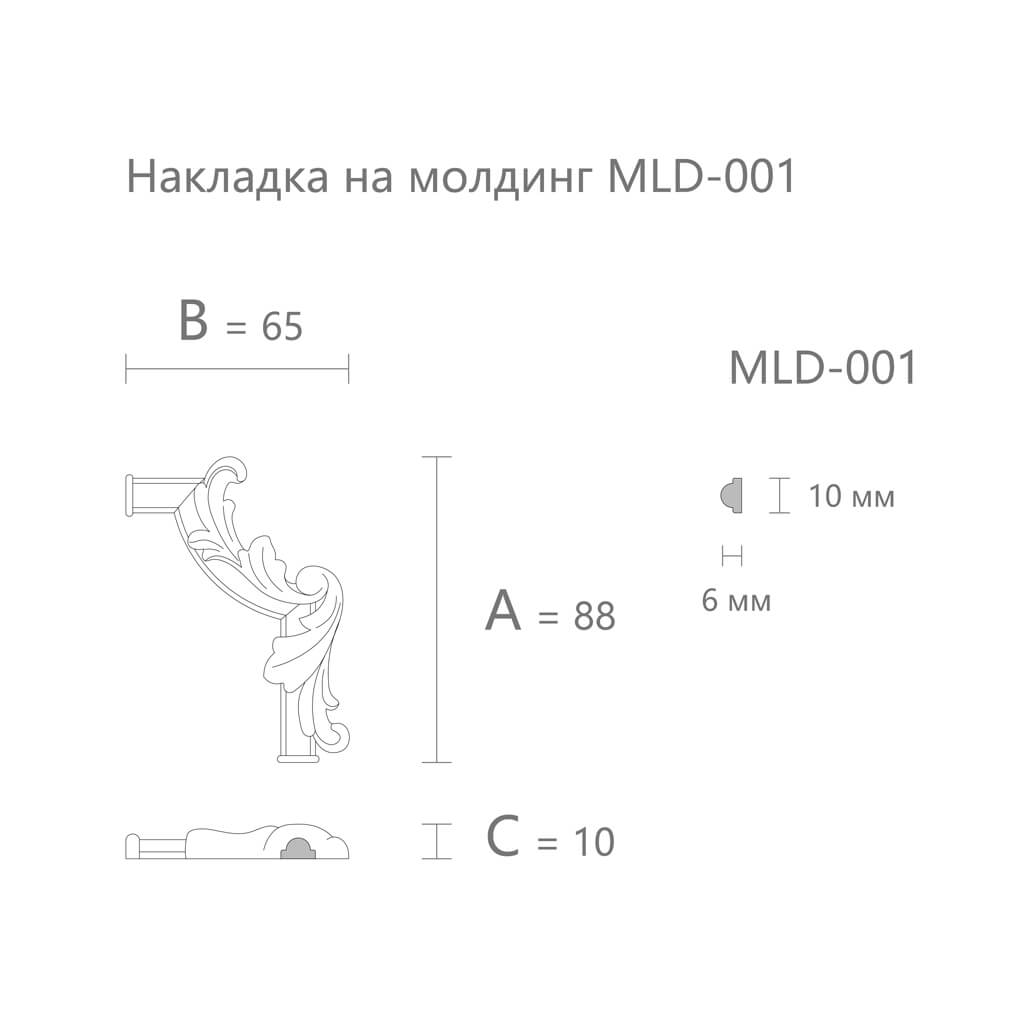
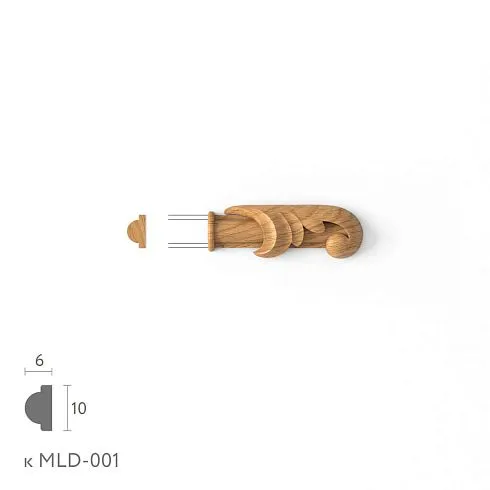
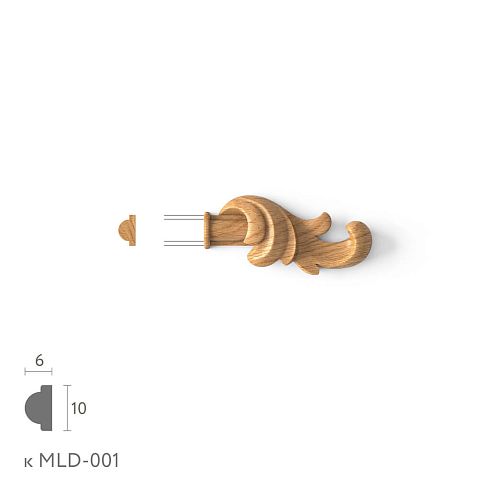
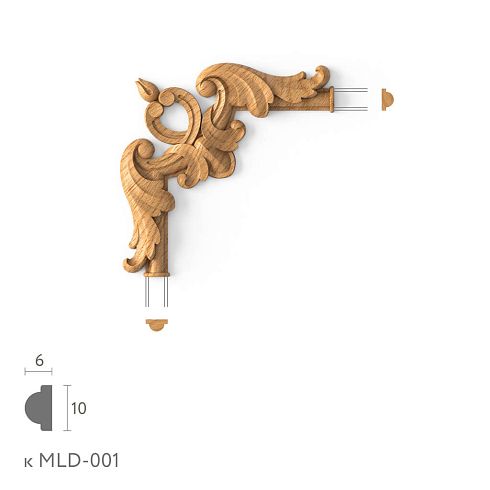
Before you is a carved corner element made of beech, specifically designed for the MLD-001 molding — a 10×6 mm wooden profile with a quarter-round cross-section manufactured by STAVROS. Product dimensions: 88 × 65 × 10 mm. Finish: Standard. Surface: For enamel. Manufacturer: STAVROS, Saint Petersburg. Production time: 3–7 business days. Delivery across Russia — SDEK.
Corner decor for this type of molding is not an additional part taken 'for beauty.' It is a functional key to the molding layout system. Without the correct corner element, the frame remains unfinished: the joint is visible, the angle is technically correct but decoratively poor. Witha decorative corner for moldingthe corner becomes an accent, the frame becomes an ornament, the facade becomes a decorative object.
Decorative element corner MLD-1U-2.1R — what it is and its purpose
The letter 'R' in the article number is not just a technical designation. It indicates a function in the system. 'R' — Right. This means the product is intended for finishing right angles in a molding frame layout.
How does a right corner element differ from a left one? By the orientation of the ornament relative to the angle bisector. The classic floral ornament on corner decorative elements is read directionally: the main ornamental motif unfolds in a specific direction. On the left element — to the right, on the right — to the left. When used together on two adjacent corners of a horizontal run, they form mirror symmetry: the ornaments face each other or away from each other — depending on the series design. This symmetry is not an aesthetic whim but a decorative law: an asymmetrical frame is perceived as carelessness.
Functionally, MLD-1U-2.1R performs the same tasks as its left counterpart:
-
Closes the corner joint of molding profiles with a decorative accent
-
Visually 'completes' the frame cell at the corner point
-
Eliminates the need for precise 45-degree miter cuts on the molding
-
Adds volume, a classic character, and ornamental value to the frame
Product technical specifications:
| Parameter | Value |
|---|---|
| Article number | MLD-1U-2.1R |
| Dimensions | 88 × 65 × 10 mm |
| Orientation | Right |
| Material | Beech |
| Finish | Standard |
| Finishing | For enamel |
| Partner molding | MLD-001 (10×6 mm, quarter-round) |
| Installation | Construction adhesive |
| Application | Furniture, doors, wall panels, frame layouts |
STAVROS production guarantees the consistency of the corner element geometry with the MLD-001 profile. This is not just a 'similar' corner decor—it is a part designed within the same system as the molding.
For which molding is MLD-1U-2.1R intended: STAVROS system logic
Asking yourself this question before purchase means saving time, money, and nerves. A corner decorative element works correctly only when its geometry is aligned with the molding geometry. A difference in profile of a few tenths of a millimeter—and the joint doesn't fit, and the seam is visible even under a layer of paint.
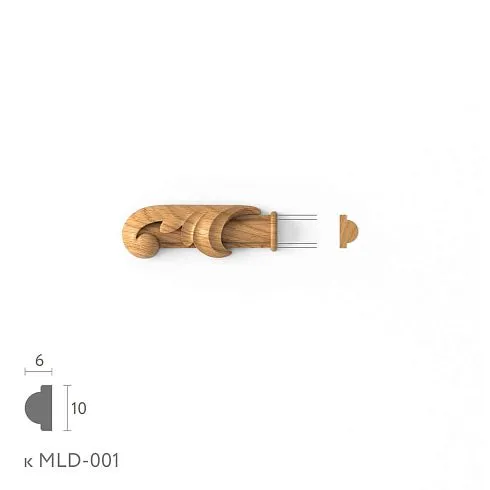
MLD-1U-2.1R is designed for Molding MLD-001— a wooden profile with a 10×6 mm cross-section in the shape of a quarter-circle. This is one of the basic molding profiles in the STAVROS catalog, compatible with the full range of molding decorations in this series.
What does a 'quarter-round' profile with a 10×6 cross-section mean? The profile height above the surface is 10 mm, the horizontal projection (width attached to the facade) is 6 mm. The cross-section is a smooth arc, whose radius defines the characteristic soft line of the profile. It is this softness that distinguishes the quarter-round molding from angular ogees or rigid rectangular profiles: the line of the frame formed by MLD-001 is perceived as lively, handcrafted, not like a technical drawing.
The side zones of the corner element MLD-1U-2.1R precisely match the MLD-001 profile: where the molding end meets the corner element, the profiles align without a step or visible gap. After painting in a single color, the transition from the molding to the corner element disappears completely—leaving a solid, monolithic decorative frame with classic carved corner accents.
It is this systemic consistency that makesDecor for MoldingSTAVROS a commercially strong proposition: the customer receives not a set of randomly selected parts, but a project-coordinated system that assembles predictably and delivers a guaranteed result.
Design and form: what makes the right corner element indispensable in the framing system
The right corner element MLD-1U-2.1R features a carved classical ornament of a botanical nature. Soft curves, smooth transitions in relief, symmetrical orientation of the motif along the diagonal axis of the product—all this creates a sense of handcrafted decoration, although the production is machine-based. A good carving matrix and precise casting in the production of STAVROS beech products yield a surface that, after sanding and painting, is perceived as expensive handiwork.
The 88 × 65 mm rectangle with a diagonally oriented ornament is a form that allows the corner element to occupy two molding runs simultaneously. Along the 88 mm side, it overlaps the end of one run (horizontal or vertical); along the 65 mm side—the end of the other. The 23 mm difference between the sides gives the product a slight rectangularity, which, when installed in a right corner, is perceived organically: the longer side runs along the longer molding run, the shorter side—along the shorter one. This visually corrects the proportions of the entire frame.
A relief depth of 10 mm relative to the product's background plane is sufficient for a clear ornamental 'statement' under direct lighting and pronounced sculptural play under side lighting. The decoration does not get lost in the light or fade under standard interior lighting—it is legible under any conditions.
The right orientation of the ornament is a fundamental decorative detail. The botanical classical motif has a direction of unfolding. In the right corner element, this motif is rotated so that when used together with the left element MLD-1U-2.1L on the two corners of a horizontal run, the ornaments form a mirror symmetry. This creates a sense of decorative dialogue: the left and right corners face each other, holding the molding run between them like decorative 'guardians' of the frame.
It is this mirror principle that is one of the fundamental laws of the classical decorative system. Ornaments on paired elements should not merely be similar—they must be mirror images. Random mixing of left and right elements destroys symmetry and turns a well-thought-out system into a collection of random details.
Material: beech, Standard, Under enamel—three words that embody a production concept.
When an experienced master cabinetmaker reads 'beech, Standard, Under enamel' in the specification, they immediately understand what they are dealing with. The right material in the right execution for the right type of finish. Let's break down each component.
Beech: a wood species for opaque finishing.
Beech is not the most spectacular wood species in terms of texture. It lacks the oak's 'armor' of large pores, the ash's fiery grain, or the walnut's shimmering dark depth. Beech is a practical, workmanlike species with a uniform, fine-pored structure and a slight pinkish tint in its natural wood.
But it is precisely this 'practicality' that makes beech ideal for painting with opaque enamel. The uniform structure provides an even base for paint. Fine pores do not require special treatment before priming. The neutral tint does not 'show through' the enamel, preventing yellowing or unwanted warm tones under white coatings.
Take oak for comparison: the large, open pores of oak, when enamel is applied without pore filling, create a pronounced texture on the finished surface. This is undesirable when working with carved details, where the purity of the ornamental pattern is important, not the textural play of the surface. With beech, this problem does not exist: primer—paint—a perfectly smooth surface.
An additional advantage: beech cuts and mills well, producing clean ornamental transitions without chipping. For carved corner elements with classical ornamentation, this is critical—sharp relief edges, fine ornamental details must be reproduced accurately, without loss of form.
'Standard': machine sanding as a guarantee of a smooth surface.
In the STAVROS quality classification system, 'Standard' means machine sanding. The product is processed on industrial equipment with precise control of sanding parameters. The surface is uniform, free from marks of hand tools, without inconsistencies in grit, ready for primer application.
For corner carved elements under enamel, this is important for another reason: enamel—especially glossy or semi-gloss—is a strict 'detector' of surface defects. The slightest scratch, unevenness, or sanding mark will show through under the paint. Machine sanding in the 'Standard' finish eliminates this risk: the surface is uniform.
Hand sanding in this context is not an advantage but a potential source of unevenness. Only on large, flat surfaces can manual work be justified. On compact carved parts, the machine wins.
'Under enamel': regluing without grain matching
In the production of STAVROS wooden products, the regluing technology is used—joining several wooden sections for stabilization and material savings. When manufacturing 'Under enamel,' sections are not matched by color or grain direction.
Why is this the right decision? Because under opaque enamel, the wood grain is not visible. The boundary between sections, differences in shades, mismatched grain directions—all of this is hidden under a layer of paint. Grain matching only makes sense with transparent or tinted coatings, where the wood grain is a decorative element. With opaque enamel, grain matching is an expense without results.
The 'Under enamel' finish reduces the cost of the product without compromising its functional qualities for this type of finishing. For furniture manufacturers and decorators working with enameled facades, this is direct savings without compromises.
Where to use the right corner element MLD-1U-2.1R: specific objects and solutions
The right corner element works exclusively within a system. Its application always involves a frame layout with molding, always paired with the left counterpart, and always on a paintable facade or panel. Let's examine the objects.
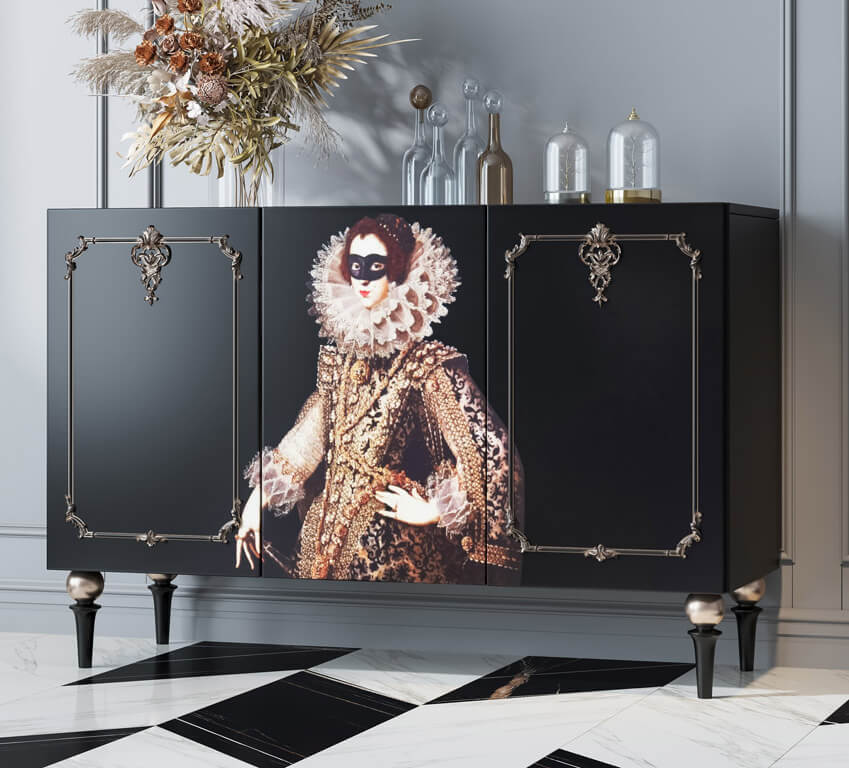
On furniture facades: from a chest of drawers to a kitchen set
A furniture facade with a molding frame is a classic decorative technique with a centuries-old history. Molding frames on cabinet doors appeared in European furniture in the 17th century and have remained relevant ever since: the simplicity of the concept and the expressiveness of the result make this technique timeless.
right corner element for moldingThe MLD-1U-2.1R, as part of the molding frame, occupies the right corners of each frame cell. For one rectangular frame, two right and two left corner elements are needed — one for each of the four corners. If there are several frames (and on a cabinet with two doors there are at least two — one per door), the number of corner elements is multiplied accordingly.
On kitchen sets, molding frames with corner decorative elements are one of the most in-demand solutions today. Furniture in classic style, Provence, neoclassical — wherever facades are painted white, cream, pastel green, blue, or gray, a molding frame with carved corner accents creates a 'salon' feel without significant additional costs.
On cabinets and dressers, the right corner element is especially important as part of a symmetrical system. Take a sliding wardrobe with decorative end panels: a molding frame on the end panel with right and left corner elements at the corners turns a technical end into an independent decorative object — not just a 'wall,' but a completion of the furniture system.
Typical furniture objects of application:
-
Kitchen sets with frame facades for painting — right corners of all doors in upper and lower sections
-
Sliding wardrobes with decorative end panels and inserts
-
Dressers and cabinets with molding framing on drawers
-
Sideboards and display cabinet sections with glazed upper parts
-
Built-in wardrobe and library systems in classic style
On doors and panels: the corner as a point of decorative completion
A door leaf with molding layout is one of the most common applications for corner decorative elements. A smooth MDF panel with glued MLD-001 moldings and corner elements on all corners of all frame cells transforms into a door with the appearance of expensive joinery.
On a standard interior door with a height of 2000 mm, 2–3 frame cells are usually made. Each cell has 4 corners. With three cells, there are a total of 12 corner elements (6 left and 6 right). With proper installation, observing cell proportions and symmetry of corner element placement, the door acquires an architectural, classical character.
The right element MLD-1U-2.1R occupies the lower right and upper right corners of each cell—depending on the orientation of the ornament in the series. It is important when ordering to check: which specific corner the right element occupies and which the left element occupies, so that the ornaments form correct symmetry within the frame.
On sliding doors (wardrobe doors) and cabinet doors, MLD-1U-2.1R is used in the same way as on interior doors. The only condition for sliding systems: the total thickness of the facade with molding and corner elements must fit within the tolerances of the guide system.
On wall panels and decorative layouts: architecturality without an architect
A wall molding layout is a way to give a standard living space an architectural character without construction interventions. Molding frames, glued directly onto the wall surface, divide it into 'fields'—decorative cells in a classical spirit.
When working with wooden moldings on walls, the right corner element MLD-1U-2.1R occupies the right corners of each wall cell. On a wall layout, scale is even more important than on furniture: the wall frame is larger, and corner points are visible from a greater distance. The quality and precision of corner decorative elements in such a context are what define the 'class' of the entire system.
The most organic context: walls in an entrance hall, living room, dining room, or study in a classical or neoclassical interior. Molding frames with corner decorative elements, painted white on a painted wall, are one of the most traditional and yet never outdated techniques of European interior classicism.
In the sectiondecor for STAVROS moldingsAll corner and central decorative elements for creating full-fledged wall and furniture layouts with MLD-001 molding are assembled here.
In classical and neoclassical interiors: when the character of the detail matters
Carved wood decor is material culture. It carries historical memory of technology, of manual labor, of the value of ornament as such. In a classic interior, a wooden carved corner element resonates as its own detail in the general chorus: alongside a stucco ceiling, herringbone parquet, wooden facades, and good upholstered furniture MLD-1U-2.1R — an organic participant in the ensemble.
In a neoclassical interior — stricter, more laconic. Molding frames without excessive ornament, neat carved corner accents, monochrome painting — this is a modern interpretation of tradition, commonly called 'new classicism'. Here, MLD-1U-2.1R works as a subtle, restrained decorative accent, not as a demonstrative historical quote.
Useful material on the topic — article STAVROSon wooden corner elements and joint finishing— recommended for a deeper understanding of the logic of corner decorative solutions in furniture and interiors.
Size 88 × 65 × 10 mm: a proportion calculated for the MLD-001 profile
The size of a corner element is not an arbitrary parameter. It is the result of calculating proportional correspondence with the partner molding profile.
Molding MLD-001 has a profile height of 10 mm. Corner element MLD-1U-2.1R has a relief depth also of 10 mm — and at the same time protrudes above the level of the molding: corner decor in the decorative hierarchy of a frame is more important than the molding run. It should slightly 'overhang' the molding — not aggressively, not coarsely, but noticeably. Precisely 10 mm of relief with a 10 mm molding profile height creates the necessary balance.
The 88 mm side runs along the longer molding run (typically — horizontal). These 88 mm are the length that the corner element 'covers' on the horizontal run. For a frame 300 mm wide, this is about 30% of the run width at each end — proportionate, appropriate.
The 65 mm side runs along the vertical run. On a vertical run 500–600 mm high, these 65 mm are about 11–13%. The corner element here reads as a light accent, not overloading the vertical line of the frame.
Let's calculate a specific example. A furniture front measuring 450 × 700 mm. A frame with a 35 mm offset from the edge: frame size is 380 × 630 mm. Horizontal runs: 380 − 88 − 88 = 204 mm (length of the free run between corner elements at each end). Vertical runs: 630 − 65 − 65 = 500 mm of free run. The frame proportions are visually correct; the corner elements do not 'eat up' the frame field.
A compact wooden corner measuring 88 × 65 × 10 mm is the optimal format specifically for a 10×6 mm molding. On more massive molding profiles (e.g., profiles 20–25 mm high), larger corner elements would be required. On the thin MLD-001 molding, it's a perfect fit.
What to pair MLD-1U-2.1R with: system configuration of a molding frame
Let's name it directly and specifically: what exactly needs to be ordered to get a complete molding frame.
1. Molding MLD-001 is a mandatory partner. Profile 10×6 mm, quarter-round, made of beech. Quantity: frame perimeter (sum of lengths of all runs) plus 10–15% margin for trimming. The molding is cut into runs with a straight cut — at 90 degrees, because the corner joints are covered by corner elements, not mitered at 45.
2. Left corner element MLD-1U-2.1L is paired with the right one. For one rectangular frame, 2 right (MLD-1U-2.1R) and 2 left (MLD-1U-2.1L) are needed — a total of 4 pieces. This is the standard configuration for one frame cell.
3. Central decorative overlays for molding runs are an optional but strong element of the system. Installed in the center of long runs, they add an ornamental accent to the frame not only at the corners but also along the sides. The full range of central overlays is in the section decoration for moldings STAVROS.
4. Mounting adhesive — a specialized compound for wooden decor. Provides reliable adhesion to MDF, plywood, chipboard, painted wooden surfaces. Universal mounting adhesive works, but specialized adhesive ensures faster setting and higher bond strength on wooden substrates.
5. Acrylic sealant — for filling gaps in the joint areas of the molding and corner elements. Applied before priming. Color — white or for subsequent painting.
6. Acrylic primer — one coat before painting. Ensures uniform absorption of the enamel across the entire system: the molding, corner elements, and front are primed in a single technological operation.
7. Primer enamel for final painting — acrylic or alkyd, depending on the object's requirements. For kitchen fronts — acrylic with a hard, wash-resistant coating is recommended.
Full range of compatible system elements — moldings, corner decorations, center overlays — in the sectionwooden decor for STAVROS moldings.
Installation and finishing: the right corner is assembled the same way as the left — but don't confuse them
Installing corner elements into a molding frame is technically simple work where correct sequence matters most. Errors in sequence are the sole reason for most unsatisfactory results.
Installation sequence
Step 1. Frame marking. Draw the frame outline on the front surface with a thin pencil. Edge offset — standard 25–40 mm. Mark the frame's corner points. Before applying glue, verify that MLD-1U-2.1R (right element) goes into the right corners — according to your marking.
Step 2. Dry fitting. Lay all four corner elements on the front in intended positions, cut molding runs to preliminary size. Ensure the right element fits into the right corner and the molding adjoins it without gaps. Check ornamental symmetry: left and right elements should form a mirror pair.
Step 3. Installing corner elements. First — corner elements, then — molding runs. Apply glue to the back surface of MLD-1U-2.1R. Place against surface, align with marking. Press across the entire back area. Secure with painter's tape. Install all four corner elements, check each one's position by level and marking. Let glue set according to instructions.
Step 4. Installing molding runs. Cut molding MLD-001 to exact size — from the side plane of one corner element to the side plane of another. Straight cut at 90 degrees. Apply glue to the run's back side. Place between corner elements. Molding ends should tightly adjoin the side planes of corner elements.
Step 5. Gap filling and sanding. Fill gaps at joint points with acrylic sealant. After drying — sanding with P180 at joint areas. Surface after sanding should be smooth, without steps or visible transitions.
Step 6. Priming. One coat of acrylic primer over the entire system: facade + molding + corner elements. Allow to dry according to the primer instructions.
Step 7. Painting with enamel. Two to three coats with drying between layers. On carved corner elements, work with a fine natural brush, carefully working the paint into the recesses of the ornament. Avoid 'runs' in the lower points of the relief.
Typical mistakes and how to avoid them
Error 1: Swapped right and left. Check the orientation before applying glue. Re-gluing after installation risks damaging the facade surface.
Error 2: Molding cut with excess. If the run is longer than the distance between the corner elements, it will not fit. Cut exactly to size 'from corner to corner', or even 0.5 mm less — the gap is filled with sealant.
Error 3: Corner elements installed after the molding. In this case, achieving a tight fit of the molding to the corner element is significantly more difficult. Always first — corner elements, then — runs.
Error 4: Painting without priming. Beech without primer absorbs the first coat of enamel unevenly, resulting in a spotty finish. Primer is a mandatory step.
Why exactly MLD-1U-2.1R: The final argument in favor of the right choice
The right corner element MLD-1U-2.1R is chosen not because it is 'beautiful' or 'wooden'. It is chosen because it is systemic. It is created for a specific task in a specific molding system, and outside this system, the product's potential is not fully realized.
Five reasons to choose it:
-
System compatibility with molding MLD-001. Geometry is coordinated, joint is gap-free, result is predictable.
-
Right orientation of the ornament. Ensures mirror symmetry in a pair with the left MLD-1U-2.1L — a key condition for a correct classical frame.
-
Beech under enamel. Fine-porous structure, ideal for opaque painting, without special pore treatment.
-
Standard finish. Machine sanding, surface ready for primer and paint without additional finishing.
-
Compact format 88 × 65 × 10 mm. Proportional to the MLD-001 profile, does not overload the corner, creates a neat decorative accent.
FAQ: most frequently asked questions
For which molding is MLD-1U-2.1R intended?
For the MLD-001 molding — a wooden profile of 10×6 mm quarter-round cross-section produced by STAVROS. The geometry of the corner zones of the element is coordinated specifically with this profile. Use with moldings from other manufacturers or other sizes requires prior compatibility verification.
Is this an independent decorative element or a component part?
A component part for a molding frame system. Independently, without the MLD-001 molding, MLD-1U-2.1R is rarely used and only as a decorative corner accent in non-standard projects.
How does the right corner element differ from the left one (MLD-1U-2.1L)?
By the orientation of the ornament. The right and left elements are a mirror pair. When used together on two adjacent corners of a horizontal run, they create a symmetrical decorative composition. Using one right or one left on both corners of one run will disrupt the ornamental symmetry.
How many pieces are needed for one frame?
For one rectangular frame — 2 right (MLD-1U-2.1R) and 2 left (MLD-1U-2.1L), total 4 corner elements. For a cabinet with two doors — 4 + 4 = 8 pieces (4 right and 4 left). When ordering, always specify the number of frames to correctly calculate the quantity of each article.
Is the element suitable for MDF furniture fronts?
Yes. MDF is a good surface for mounting wooden decor with glue. The MDF surface must be clean, dry, and degreased. On laminated MDF, light sanding of the mounting area with P150 is recommended to improve adhesion.
What does 'Standard' mean in the product description for STAVROS?
Machine sanding. The surface is processed with industrial sanding equipment with uniform material removal. Ready for primer and paint application without additional manual preparation.
What does 'For enamel' mean regarding regluing?
Regluing without matching sections by color and wood grain direction. With opaque enamel painting, the wood texture and tone are not visible, so matching by texture is not performed. This reduces the product cost without affecting the quality of the final result when painting.
Can MLD-1U-2.1R be used with MDF molding or another wooden profile?
Technically possible, but geometric consistency is guaranteed only with MLD-001. If you use a different profile, check compatibility 'dry' before applying glue.
How to find other decorative elements for the MLD-001 molding system?
In the sectiondecor for STAVROS moldingsCorner elements of all series, central overlays for molding runs, and compatible molding profiles are presented. There, you can also select a complete set for frame layout of any scale.
Is a professional installer needed for installation?
No. Installation is done independently: glue, painter's tape, level, pencil. The key conditions for success are the correct sequence (first corner elements, then molding runs) and precise marking before applying glue. Experience in woodworking is not required.
Your request has been sent!
Our manager will contact you within 5 minutes