













































































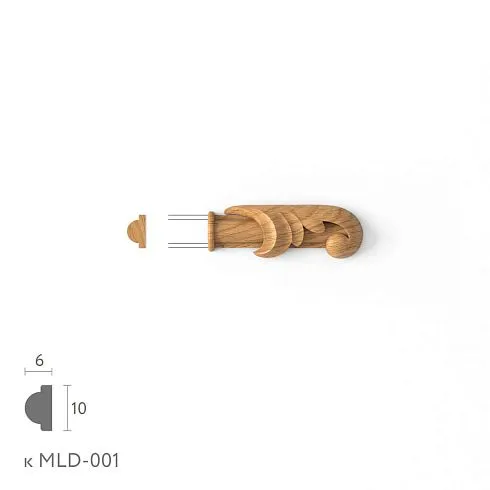
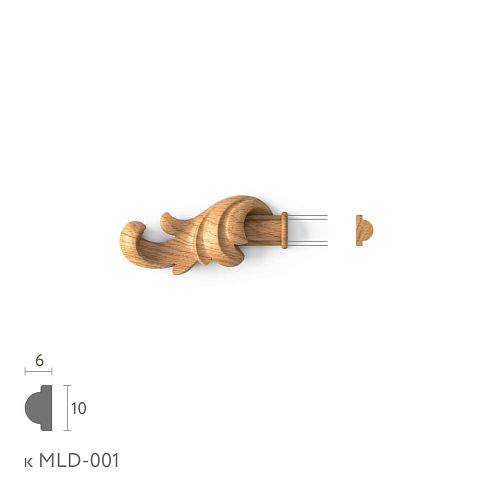
Corner decorative element MLD-1U-1.1
Dimensions and Options
Have questions?
Customers also buy




Yulia Kh.
March 24, 2026
I was satisfied with the quality of the products; we purchased furniture legs. I would especially like to highlight the professionalism of manager Oksana—very client-oriented, competent, and precise specialist. She even arranged additional trimming of some elements as an extra service for us. Huge thanks!
Incognito 7.
March 24, 2026
One of the few firms that is pleasant to interact with on renovation matters. Adequate, responsive managers. Adherence to deadlines. Execution of even complex projects. Bravo! May there be more such firms!!
Marina D.
February 15, 2026
The company ordered the pens for us when we ordered furniture. But I decided to write a review personally because they are amazing! Stylish, expensive, high-quality!
More than 20 years on the market
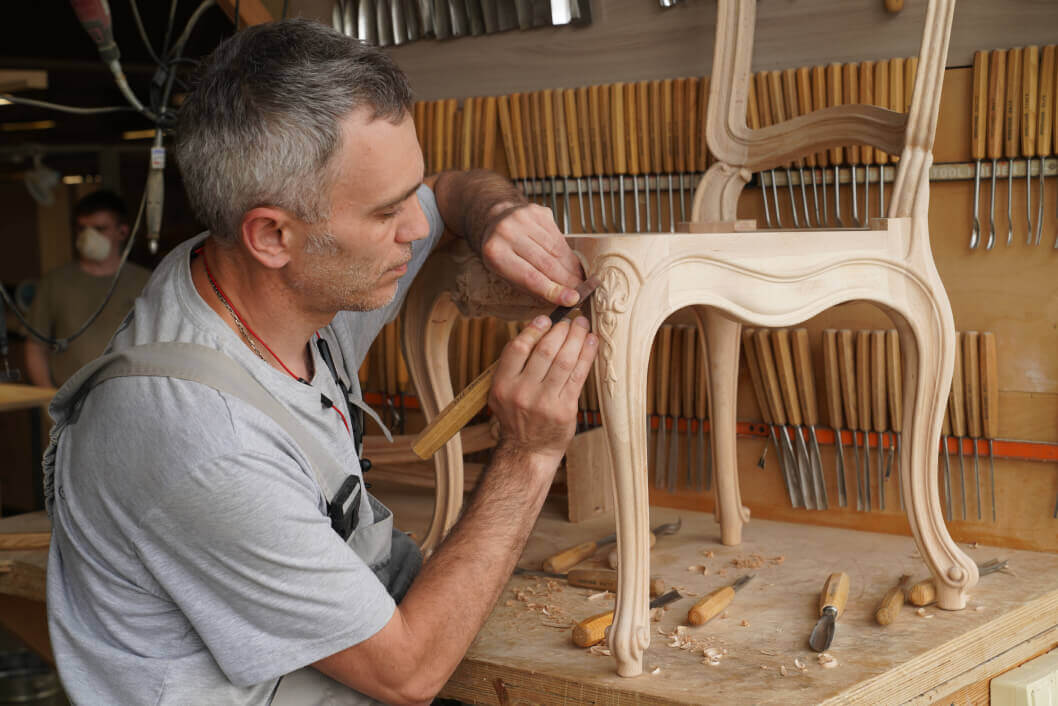
The company's success began in 2002, when two artists — Andrey Ragozin and Evgeny Tsapko — created a small creative workshop for producing wooden carved items. The masters' work was quickly noticed, and within a year they were invited to participate in the reconstruction of the Konstantinovskiy Palace in Strelna.
After the success of this project, the company focused on recreating palace interiors, furniture, church furnishings, and carved decorations in various artistic styles. They worked with cultural heritage sites: The Hermitage, the Alexandrovsky Palace, the Troitsko-Izmaylovsky Cathedral, the Sheremetyevsky Mansion, and many others.
The masters' task — and still is — to create wooden items with the highest level of detail and understanding of every element, based on impeccable knowledge of artistic laws and interior styles.

STAVROS Guarantees
Quality of products without complaints
We save your time, peace of mind, and budget
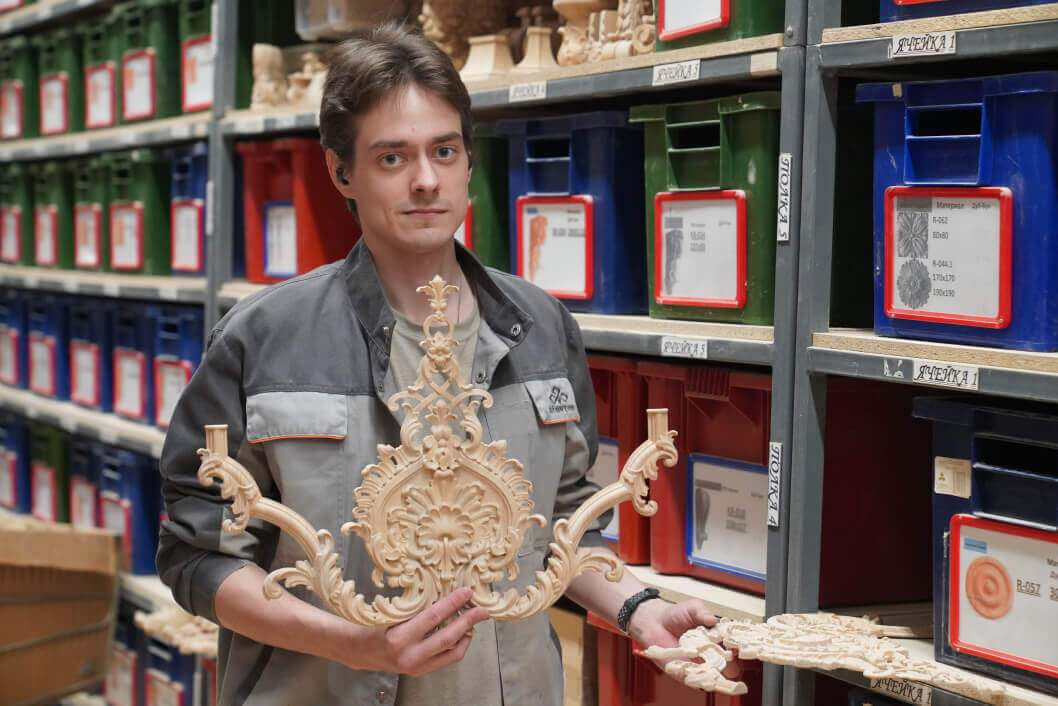
Large warehouse program
We solve your tasks with maximum speed
Adherence to production deadlines
Streamlined process reduces all risks
Delivery from 1 piece throughout Russia
Quality service regardless of order volume
Your positive business reputation
Reliable partner — the foundation of your business
More products in the molding decor category



Frequently asked questions
Our showrooms are located in Saint Petersburg and Moscow. Production is located in Saint Petersburg.
Moscow contacts: https://www.stavros.ru/contacts_all/?tab=msk
Contacts of Saint Petersburg: https://www.stavros.ru/contacts_all/?tab=spb
- Send request by email [email protected]
- Write to us at Telegram
- Write to us at WhatsApp
- Order by phone +7 (800) 555-46-75
- Visit our showroom in Saint Petersburg and Moscow
Yes, we ship orders throughout Russia and to CIS countries.
We cooperate with transportation companies such as СДЭК and DPD.
You can also arrange pickup of your order through any convenient transportation company for you.
Delivery cost depends on the size, weight of the item, and delivery address.
When placing an order, the delivery cost is calculated automatically and displayed as a separate line on our website.
Prices and availability of items on the website are always current. Data is updated daily.
Note: items in stock are stored on the warehouse in unpolished form and shipped within 3 working days.
If the item is not in stock, average production time: 5–10 working days.
This is the quality of polishing of the items.
Standard — machine polishing, at a more attractive price.
Prestige — detailed hand polishing, items do not require further work.
More details: https://www.stavros.ru/information/kachestvo/
This is the type of veneer of the items.
Under enamel: produced by gluing wooden laminates without color and texture matching. Contrast tonal and textural differences are noticeable. This blank should be chosen if the item is intended for opaque coating.
Under tinting: produced by gluing wooden laminates with color and texture matching. Tonal and textural differences may occur. This blank should be chosen if the item is intended for semi-transparent finish.
More details: https://www.stavros.ru/information/kachestvo/
Beech — dense, non-porous wood, most often used for items covered with enamel.
Oak — dense, porous wood with clearly visible natural grain. Due to its strength and decorative properties, it is often used in items with semi-transparent coating, highlighting the wood pattern.
Custom-made, if non-standard items are required, we can produce products from other types of wood, including blanks provided by the customer, manufactured according to our technical specifications.
All our furniture legs can withstand a vertical load of at least 100 kg.
Average production time for custom-made items: 5–10 working days.
Most items are stored on the warehouse in unpolished form. We need time to polish and pack orders.
Yes, we manufacture non-standard items according to individual projects, but we only accept orders with a minimum quantity.
We can manufacture items of the desired size, but we only work with bulk orders. For details, please consult the sales department manager.
Yes, some of our products can be used outdoors. For example, polyurethane items, as well as carved door casings made of pine.
Other items are produced to order using PUR glue, if minimum quantity is available. No warranty is provided for such products, as outdoor conditions are considered aggressive.
Yes, we paint items when ordering products for a total amount of 150,000 rubles or more.
- Dust removal. After sanding, the surface must be dusted.
- Priming. Apply primer in an even layer.
- Matting. After the primer has fully dried, the surface should be matted (lightly sanded for better adhesion).
- Finish coating. Apply finish coating: lacquer or enamel, in 2 layers, with interlayer drying.
More details: https://www.stavros.ru/information/sovety/
Apply adhesive to the decor. Place it on the surface and press briefly. Then, lift the decor from the surface and leave it open for 3–5 minutes. Press the decor firmly onto the surface and hold for 5–10 seconds.
More details: https://www.stavros.ru/information/sovety/
Ideally, you should prepare a design project before placing an order.
You can do this yourself by downloading drawings of our products from our website, or you can order a project from us.
If the number of decorative elements and fittings is small, our company's manager can assist you with selection.
Unfortunately, this service is not provided.
The packaging method depends on the type of items, but in each case, we ensure sufficient protection for safe transportation.
We most often use corrugated cardboard and stretch film. Fragile items are additionally secured on a rigid base to prevent damage during transport.
We ship all items starting from 1 piece.
Room measurements and item installation can be performed by our partners — carpentry companies represented in most regions of Russia.
Often searched in category Wooden and MDF items
7082
2932
2639
1442
1323
1083
858
Decorative corner element MLD-1U-1.1: the corner as art, not a technical necessity
A corner is a point where lines converge. In construction, it's simply a joint. In decor, it's a moment that either ruins the impression of the entire composition or completes it with dignity. It is precisely such moments that professional designers, experienced carpenters, and furniture production masters think about when they chooseCorner decorative element MLD-1U-1.1.
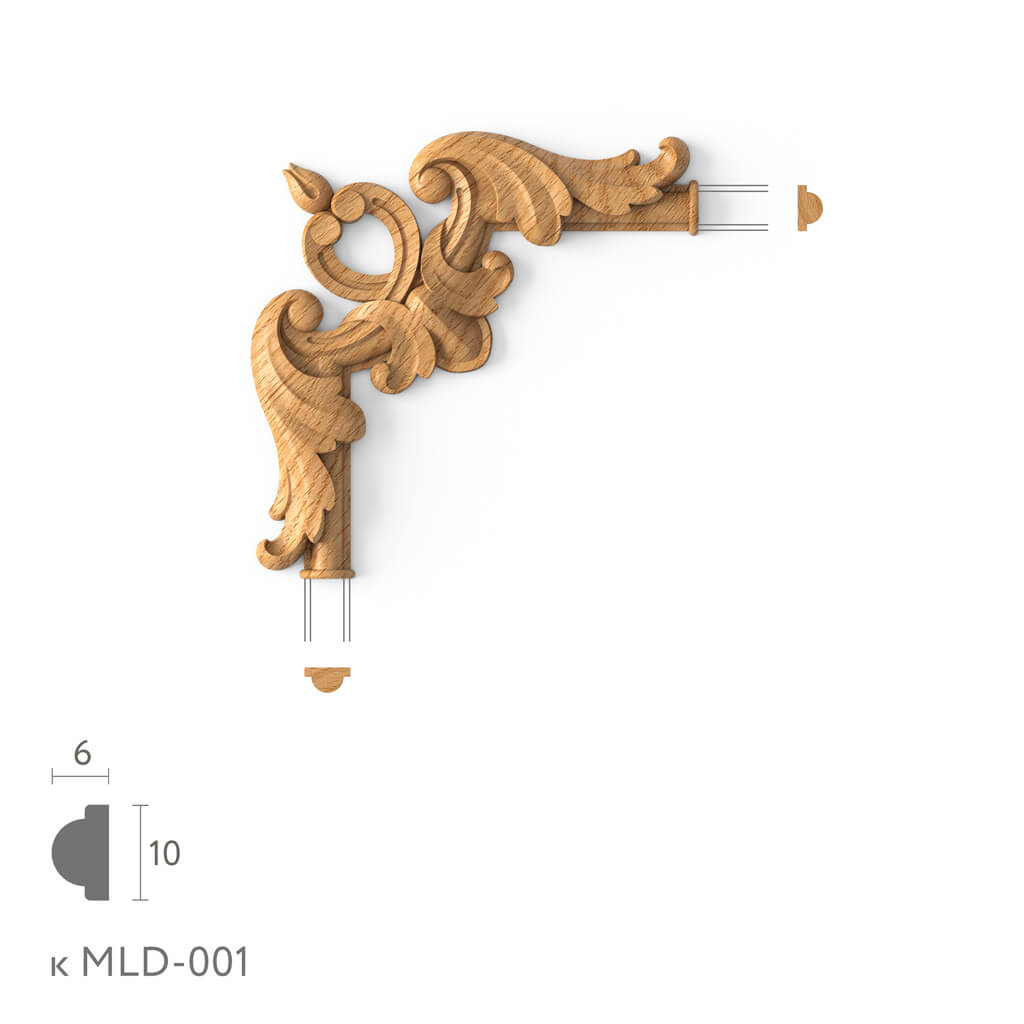
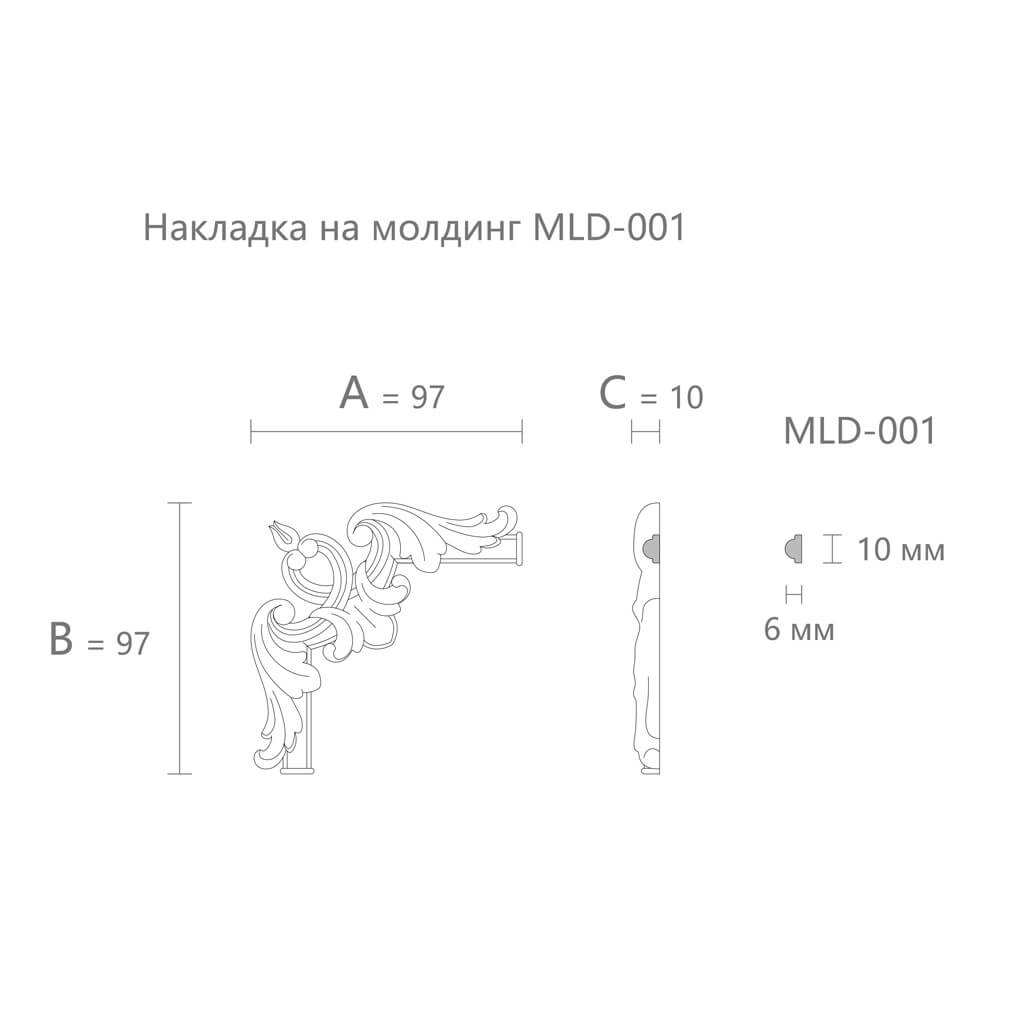
This product does not claim to be the main character of the decorative scene. Its work is subtler and more responsible — to become that neat final touch in the corner of a frame composition, which turns a set of moldings into a cohesive, precise, visually flawless system. Size 97 × 97 × 10 mm, material — beech or oak, finish — standard, for enamel. Everything is restrained, precise, professional.
Let's examine this product in all its details — from purpose to application scenarios, from material selection to installation.
What is a decorative corner element and why it is indispensable
First of all — a definition. A decorative corner element is an overlay part that is installed at the intersection point of moldings or in the corner zone of a decorative frame composition. Its function is fundamentally different from that of a central overlay or a connecting element.
A central overlay carries an ornamental accent. A connecting element links lines in a straight line. A corner element works where the straight line ends and the turn begins — where the molding changes direction from vertical to horizontal or vice versa.
What happens at this point without a corner element? The moldings are joined at a 45-degree angle. The cut, even perfectly executed, remains a cut — technically competent, but devoid of decorative content. It exposes the wood end grain, emphasizes the joint, makes it visible and tangible to the eye. And all the professionalism of working with moldings at that moment takes a back seat.
The decorative corner element MLD-1U-1.1 closes this joint in a fundamentally different way. It does not hide it — it transforms it. The technical connection point becomes a decorative accent. The corner of the frame turns into an elegant ornamental detail that you want to examine. This is precisely the difference between good work and excellent work.
What is the decorative corner element MLD-1U-1.1 for
To be more precise, it's worth distinguishing several levels of benefit that this element provides.
Technical level: solving the joint problem
Moldings are cut at 45 degrees — this is standard technology for frame decorative schemes. But an angled cut, especially on profiles of complex shape, is never visually perfect. Even with flawless work, fibers, irregularities, and porosity are visible on the end. After painting, this often appears as a dark spot or visible seam.
The corner element completely covers this joint. Moldings fit under it from both sides, and the connection point ends up hidden under the decorative overlay. As a result, the seam disappears, and an ornamental detail appears in its place.
Decorative level: visual accent in the corner
The corner of a frame is not just a geometric point. In a decorative scheme, it is the place of greatest concentration of visual attention. The eye, moving along the contour of the molding, always pauses at the corner. If there is nothing there — the eye moves on, and the corner is perceived as an emptiness. If a corner decorative element is placed there — the eye lingers, receives ornamental pleasure, and the entire frame is perceived as a complete artistic system.
System level: the element as part of a decorative collection
MLD-1U-1.1 is not a separate product in a vacuum. It is a detail included in the systemdecoration for moldings, where each element — corner, connecting, central — is developed as part of a single collection. This means that the MLD-1U-1.1 corner decor matches other items in the system in proportions, style, and profile character.
It is precisely this systematic approach that makes the result truly professional: the details do not 'argue' with each other but work in an ensemble.
Corner decorative element for classical and neoclassical design
There are things that only become clear when working with real projects. One such insight is understanding that classical interiors don't rely on one grand detail, but on a system of small solutions, each inconspicuous on its own, but together they create a sense of aristocratic solidity.
Corner decor is one such solution. It appears at four or eight points of the framing scheme, never dominating, always supporting. Its ornament is usually restrained: a small acanthus motif, a light botanical detail, a geometric pattern — nothing flashy, yet everything perfectly in its place.
It is precisely this restraint that makes MLD-1U-1.1 versatile for a wide range of styles:
-
Classical — with its strict symmetry and attention to detail;
-
Neoclassical — where classical motifs are reinterpreted in a modern context;
-
Provence — with light decorativeness and white enamel;
-
Empire — with an emphasis on monumentality and completeness of forms;
-
English classical style — with natural wood and clear molding frames.
None of these styles can do without corner decor — just as no painting can do without a frame.
Beech or Oak: Material Choice as a Strategic Decision
This is not a matter of taste. It is a matter of project strategy. The choice between beech for enamel and oak for natural finish determines not only the appearance of the finished product but also the entire technological chain of decorative work.
Beech, standard, for enamel: purity and color
Beech is a helper wood. It does not try to draw attention to itself: it has a fine, almost imperceptible texture, a light uniform color, and a dense structure without large pores. All this means one thing: any enamel lays on a beech surface like on a perfectly prepared canvas.
The 'for enamel' finish means not just a choice of species—it is technological readiness for painting. The surface of the product is sanded, dusted, and primed if necessary. A craftsman receiving such a blank can immediately proceed to applying the final coating without additional preparation.
For which projects is this critical?
-
Kitchens in white or light shades—where all decorative details must be the same color as the fronts;
-
Cabinets painted in a non-standard RAL color—where precise color matching is more important than texture;
-
Doors in a unified style with paneling and moldings—where the decor and base are painted in the same tone;
-
Wall panels for enamel—in living rooms, studies, hallways of classic interiors.
Oak: Living Texture and Natural Depth
Oak speaks for itself. Large pores, a pronounced grain pattern, warm golden-brown or gray-brown tones depending on the finish—all this makes oak decor a self-sufficient artistic object.
An oak corner element is chosen when:
-
the interior is built on natural materials—wood, stone, linen, leather;
-
the final finish involves staining, oiling, or clear varnish;
-
durability under load is important—oak is harder than beech and more resistant to wear;
-
the style requires a 'natural' presence—rustic, hunting style, heavy English classic;
-
details must retain decorative value without periodic repainting.
Both materials are solid wood. Not veneer, not MDF with coating, not polymer. Real wood with a natural structure that only gains greater nobility over the years.
Size 97 × 97 × 10 mm: Geometry That Works
The square format of the corner element is not accidental. It is geometric logic.
The frame corner is the intersection of two lines of equal thickness. For the corner overlay to organically cover the joint, it must be symmetrical in both directions. That is why the ideal corner element is a square. And that is why 97 × 97 mm is the format that fits into place without distortion, without asymmetry, without a sense of randomness.
97 mm on each side is sufficient to:
-
completely cover the joint of moldings regardless of the profile thickness;
-
create a noticeable accent visible from an arm's length distance;
-
not dominate the molding contour, remaining within the proportional norms of a classical frame.
A thickness of 10 mm is the parameter responsible for relief. Ten millimeters is enough for a voluminous ornamental pattern with pronounced chiaroscuro, but not so much as to create a visual 'protrusion' on the surface of the facade or door. The decor fits organically into the plane, as a continuation of the molding contour, not like a foreign object glued to it.
Compare this to thin 3–5 mm overlays: they have no relief, no shadow, no volume. They look like a flat sticker. 10 mm is that golden mean where the decor remains decor, not a stamp.
To understand the proportions: on a standard furniture door 400 mm wide and 700 mm high, a 97 × 97 mm corner element occupies slightly less than a quarter of the width—exactly enough for an accent without overload.
How the MLD-1U-1.1 corner element enhances the decorative composition
There is a phenomenon experienced designers call the 'completion effect.' It occurs when all decorative elements are in their proper places—with nothing extra and nothing missing.
A corner decorative element is one of those details whose absence you hardly notice at first, but becomes impossible to ignore once it's in place. Before it appeared, the frame was just a frame. Afterward—it became an interior object.
How exactly does this happen?
The gaze receives a route. A molding frame is a line. The eye moves along it. When decorative elements are placed in the corners, the gaze pauses, 'reads' the ornament, and continues moving. Rhythm emerges. The interior begins to breathe.
Corners cease to be technical. The joint of moldings no longer looks like a construction solution. It looks like an artistic intention. This is a fundamental difference.
The composition gains scale. Corner elements visually 'hold' the frame, creating a sense of structural stability in the decor. A frame without corner details seems light, almost temporary. With corner elements, it is perceived as a permanent architectural detail.
A decorative narrative is added. The ornament of a corner element is an artistic language that speaks about the interior's style. Acanthus speaks of classicism. Geometry—of neoclassicism. A floral motif—of Provence or Art Deco. This is not just decor; it's a statement.
Where is the decorative element MLD-1U-1.1 used?
Furniture Facades and Cabinets
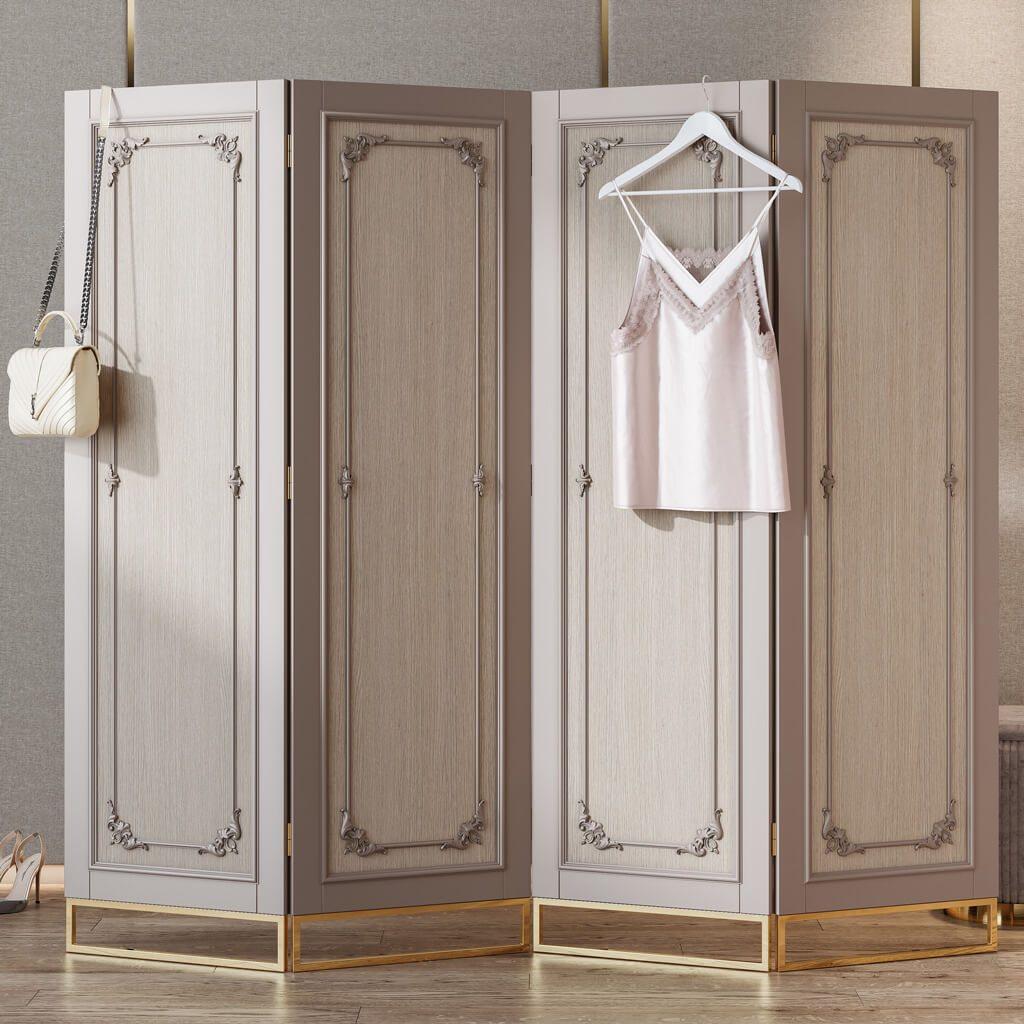
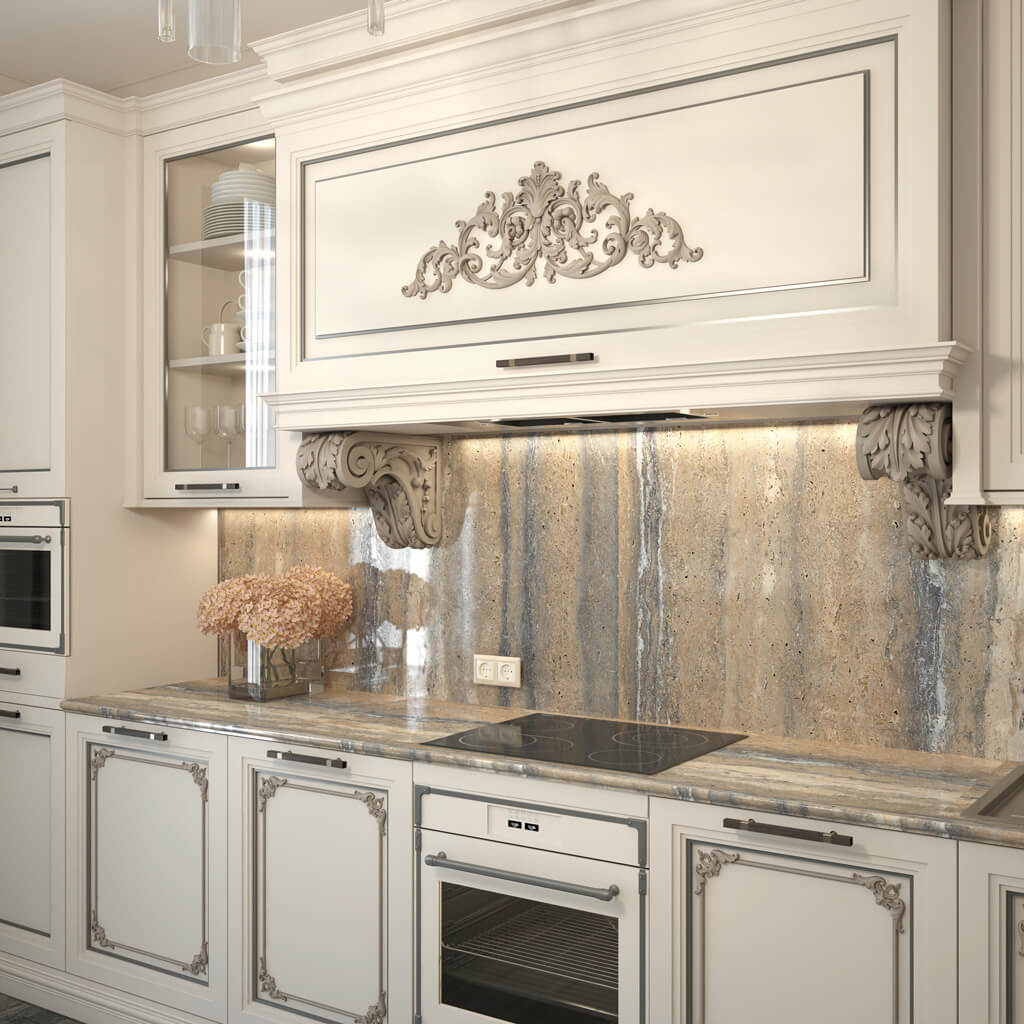
MLD-1U-1.1 is installed at the four corners of each framed facade panel. In a kitchen with six doors, this amounts to 24 corner elements — a system that creates the feel of an expensive furniture set even when using budget core materials.
Interior doors
On a door leaf, the corner decorative element works in tandem with the molding frame of the upper and lower decorative panels. A standard one-and-a-half percent door has two to three panels, each framed with molding. Corner elements at each of the four corners of every panel provide 8 to 12 decorative accents on a single leaf — creating a rich, professional look.
For doors, the beech version for enamel is especially relevant: it allows the entire leaf to be painted in a single color, and the decor merges with the door into a monolithic artistic object.
Wall decorative panels
In classic and neoclassical interiors, walls are often decorated with a system of molding frames — horizontal bands with rectangular or square panel fields inside. Corner decorative elements are installed at the intersections of the molding strips.
If a 4-meter-long wall is divided into three panels, and the panel height suggests a two-level division — the number of corner elements on one wall can reach 30–40 pieces. It is precisely this saturation that creates that 'well-curated' effect which distinguishes professional interior decor.
Decorative frames and portals
Fireplaces, decorative niches, mirror frames, picture and panel frames — all these objects are essentially framed structures and require the same corner solutions as furniture facades.
The MLD-1U-1.1 corner decor looks especially impressive in mirror frames: the reflection multiplies the decorative detail, creating a sense of an infinite ornamental row.
Display cases and glazed structures
In display cabinets, corner elements are installed in transition zones between glazed and solid sections, framing the outer contour of the glazed field. This is especially important for buffets, library cabinets, and display shelving in classic style.
For such projects, it is also worth paying attention toDecorative overlays for furniture and facades— central overlays that organically complement corner decor in framed furniture decoration schemes.
Advantages of the decorative corner element MLD-1U-1.1
Let's examine the specific merits of the product, not just general statements about quality.
Precise square geometry
97 × 97 mm — a perfect square. This means the element functions equally correctly in any orientation: it cannot be confused with the 'face' or turned the wrong way. This reduces the likelihood of installation errors and speeds up work.
Volumetric relief with restrained thickness
10 mm thickness — sufficient for expressive ornamental relief. The decor does not 'cling' to the surface like a flat sticker: it has real volume, creating a play of light and shadow under side lighting.
Material from solid natural wood
Beech or oak — not composite, not MDF with coating. Natural wood is processed differently: it absorbs paint more deeply, holds its shape more reliably, lasts longer. Ten years after installation, such decor will look the same as on the day it was installed.
Two execution options within one model
Beech for enamel and oak are essentially two different products for two different scenarios. The ability to choose within one model means that MLD-1U-1.1 is suitable for both painting projects and projects with natural finishing.
Compatibility with the system of moldings and decorative elements
The MLD-1U-1.1 corner decor was created as part of a system. This means it is coordinated in proportions and style with other items in the line. The full catalog of compatible moldings is available in the section Wood molding decor, which collects corner, connecting, and central elements for creating comprehensive decorative schemes.
Ease of Installation
Adhesive installation technology — no dowels, no tools, no special skills. Wood glue or PVA glue, a flat degreased surface, a little pressure — and the decor fits perfectly in place. The glue sets in an hour, holds firmly in a day.
Practical application scenarios for MLD-1U-1.1
Theory is good, but practice is more convincing. Let's look at several real situations where the MLD-1U-1.1 corner decorative element solves specific tasks.
Kitchen in a classic white style. MDF fronts with milled frame grooves, molding along the front contour, white enamel over the entire surface. MLD-1U-1.1 made of beech for white enamel is installed in the corners of each front. After painting, the decor merges with the front into a single object — and the kitchen acquires an appearance associated with 'luxury' category kitchen sets.
A classic interior door with two panels. Solid wood or MDF panel, moldings along the contour of the upper and lower panel, four MLD-1U-1.1 corner elements in each frame. A door in natural oak with oak corner elements — the result resembles a door from a 19th-century noble estate.
Decorative wall panels in the living room. Horizontal molding frames divide the wall into three fields. At the intersections of the moldings — corner elements every 60–80 centimeters. White enamel over the entire wall surface, including the decor. The result is a living room in the style of Versailles apartments, created by an ordinary carpenter.
A mirror in the hallway with molding framing. A simple frameless mirror framed by wooden moldings, with corner decorative elements at four points. The cost of work is minimal. The visual result is a mirror in an antique style.
Corner decor and a professional eye for detail
Over many years of practice working with classic furniture and interior decor, one simple truth becomes clear: the difference between a good project and an outstanding one is always in the details. Not the base material, not expensive hardware, not the size of the product. Precisely the details.
A corner decorative element is a detail at the level of an 'outstanding project'. A client entering a room with decorated walls does not analyze — they feel. They feel completeness, solidity, professionalism. And it is precisely the MLD-1U-1.1 in the four corners of each frame that creates this feeling.
It is also important to understand: a decorative corner element does not require expensive base material. It can be installed on a budget-produced MDF facade — and the facade immediately moves into another visual category. This means that such decor is not a luxury, but a tool. A tool for managing the visual perception of an interior.
In the sectionDecor for MoldingOther elements for creating such professional solutions are also presented: corner and connecting elements of different sizes and styles, central overlays, system collections. All of these are possibilities for building decorative schemes of any complexity.
Molding system: how MLD-1U-1.1 integrates into the overall architecture of the decor
To understand the role of this corner element, it is worth looking at the structure of the decorative molding system as a whole.
The classic molding scheme for a furniture front or wall panel includes:
-
Moldings are profiled wooden strips that form the frame contour. They come in several cross-sections—from a modest quarter-circle to a complex three-step profile.
-
Corner elements cover the joints of moldings at four (or eight, with double framing) points. This is precisely where MLD-1U-1.1 comes into play.
-
Connecting elements join extended horizontal molding runs on long surfaces.
-
Central overlays are positioned at the geometric center of each framed panel and carry the main ornamental motif.
Remove any of these elements—and the system ceases to function as a unified whole. This is the law of classical decor: every detail is inseparable from its context.
MLD-1U-1.1 is a second-level detail. It's not the first one you notice, but the first whose absence ruins the impression. This is its value and its indispensability.
For those assembling a comprehensive system, it's also worth paying attention tosolid oak and beech moldings—wooden millwork that functions within the same system as the MLD-1U-1.1 corner decor and other elements of the collection.
For furniture, doors, and decorative interior solutions
Once more — specifically and to the point — about exactly which types of projects this corner decorative element is suitable for.
Classical and neoclassical furniture — the main area of application. Sliding wardrobes with decorative doors, kitchen sets in Provence or classic style, library wall units, wardrobe systems with carved decor. Wherever there is a molding frame — there is a place for MLD-1U-1.1.
Interior and entrance doors — projects where the door leaf is not just a functional element, but also part of the interior decor. Doors with corner overlays are always perceived as significantly more expensive and professional than similar doors without them.
Decorative wall panels — one of the most popular trends today in classical and neoclassical interiors. Molding panels around the entire perimeter of the living room, bedroom, or study — this was the prerogative of expensive interiors 30 years ago, and what is now accessible to everyone thanks precisely to products like MLD-1U-1.1.
Display cases, sideboards, shelving units — furniture with glazed sections, where ornamental decor enhances the architectural character of the piece.
Decorative portals — framing for fireplaces, mirrors, niches, decorative inserts. Wherever there is a frame structure — there is a place for corner decor.
Order the decorative corner element MLD-1U-1.1
Corner decorative element MLD-1U-1.1— is the solution that turns a corner from a technical detail into a decorative accent. Size 97 × 97 × 10 mm, natural beech under enamel or oak, precise square geometry, relief ornament.
It is suitable for furniture, doors, wall panels, display cases, and decorative portals — for any project where a molding frame requires professional corner finishing.
Choose beech for projects with enamel painting. Choose oak for natural finishing. In both cases, you get a solid wood product ready for installation and final processing.
Place an order — and your next project will gain that completeness for which true classical decor is created.
Frequently Asked Questions (FAQ)
What is the decorative corner element MLD-1U-1.1 used for?
It is installed at the corner points of molding frame schemes — on furniture, doors, wall panels. Its task is to cover the technical joint of moldings and turn the corner into a decorative accent, making the entire composition integral and complete.
Where can a wooden decorative corner element be used?
On furniture fronts, interior doors, decorative wall panels, showcases, mirror frames, decorative portals, and fireplace surrounds. Anywhere moldings form a frame contour, a corner element is needed.
Is MLD-1U-1.1 suitable for furniture fronts?
Yes — this is one of the primary applications. On a standard furniture door with molding framing, four corner elements form a complete frame decorative scheme.
Can this element be used for doors?
Yes. For interior doors with decorative panels, the corner element is installed at four points of each panel. This is a classic solution for doors with ornamental design.
How does beech under enamel differ from oak?
Beech is a homogeneous species with a fine texture, ideal for enamel painting in any color. Oak is a species with a pronounced natural grain, suitable for natural transparent finishes — stains, oils, varnishes. The choice depends on the project's finishing concept.
Which interior styles is such decor suitable for?
For classic, neoclassical, baroque, empire, provence, English classic style, as well as for modern interiors with wall and furniture molding decor.
How does the size 97 × 97 × 10 mm affect application?
The square format is convenient for any frame corner — the element is symmetrical and has no 'top' or 'bottom'. The 10 mm thickness provides volumetric relief with pronounced chiaroscuro, without creating a visual 'protrusion' on the surface.
Is the element suitable for framing and panel decoration?
Yes — this is one of the key scenarios. Wall decorative panels with molding frames require corner elements at every intersection point of molding profiles.
Is the product suitable for painting projects?
Yes — the 'beech, standard, for enamel' finish is specifically designed for painting projects. The surface is prepared for primer and enamel application.
Why is the corner element important for decorative composition?
Because visual attention concentrates precisely at the corners of the framing scheme. Without corner decorative elements, the molding frame remains a technical detail. With them — it becomes part of the interior's artistic language.
Your request has been sent!
Our manager will contact you within 5 minutes