













































































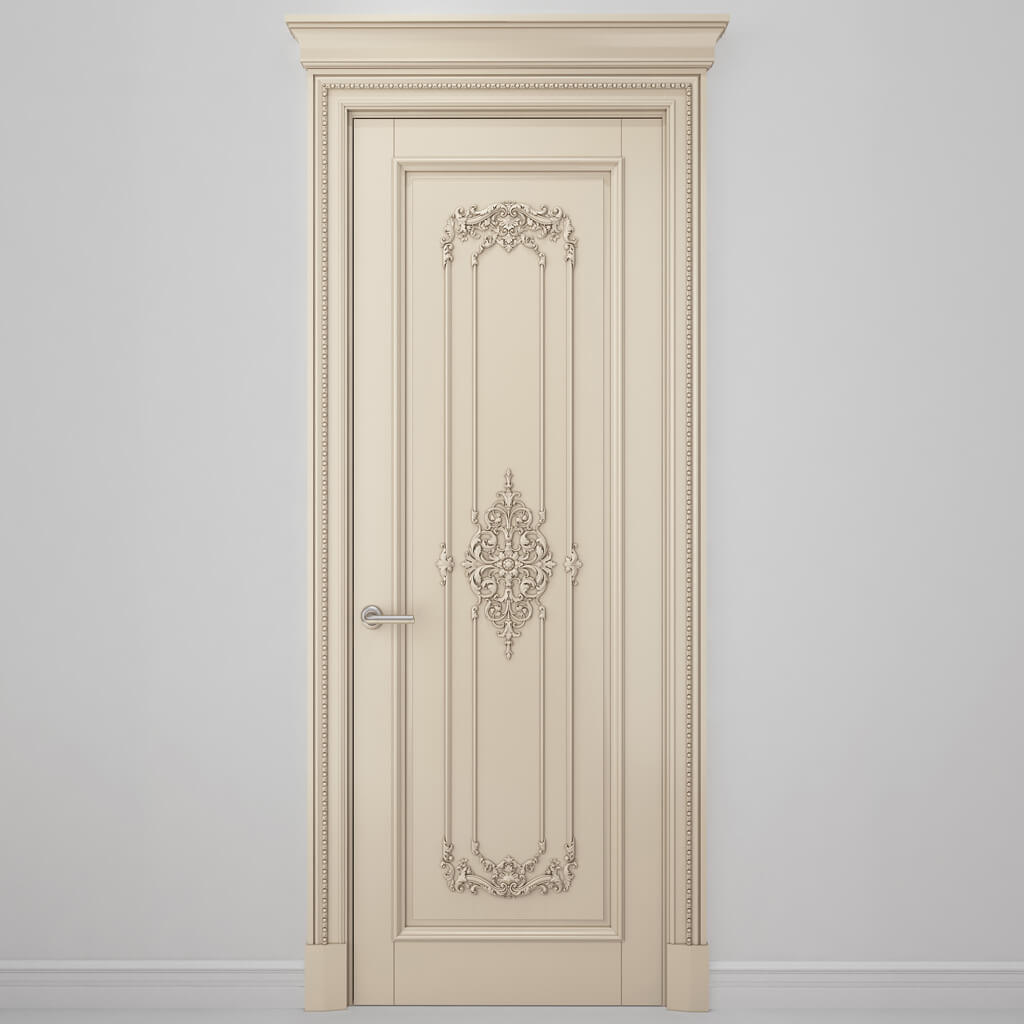
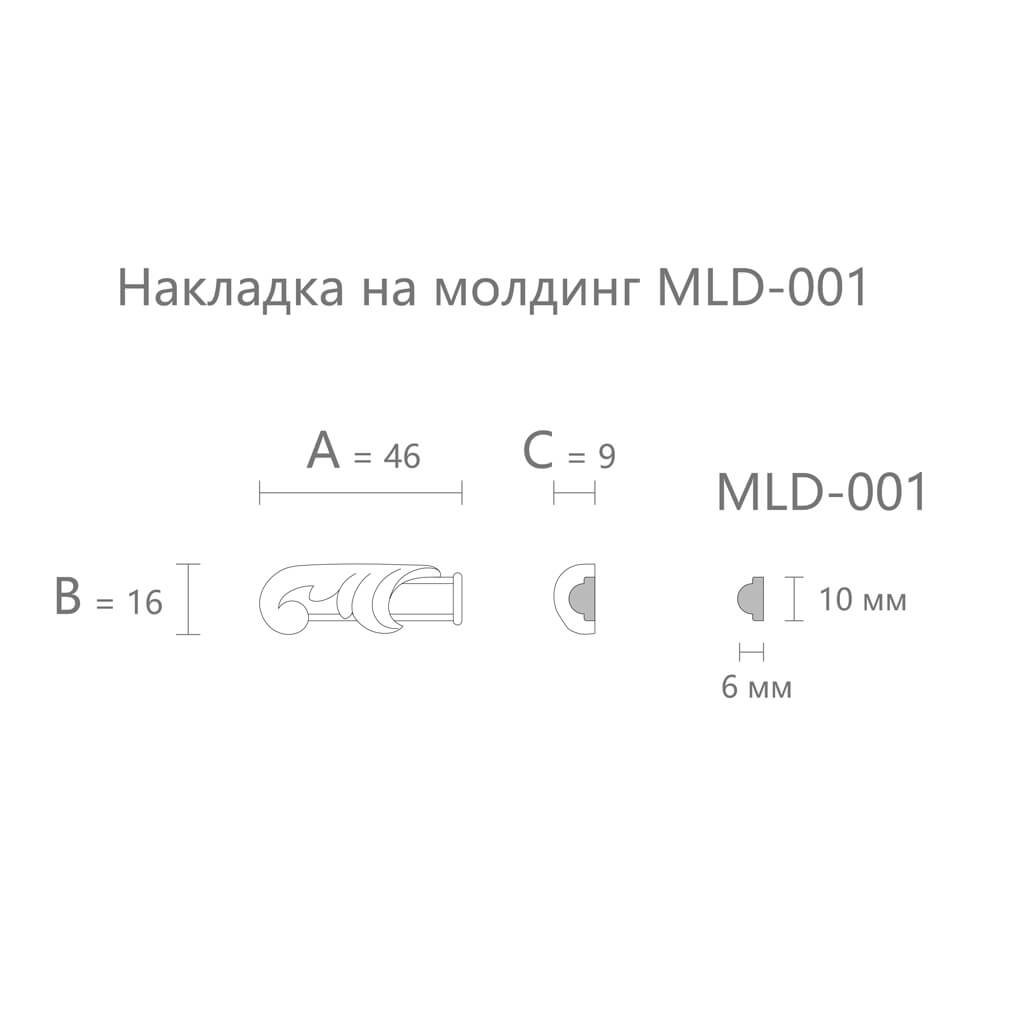

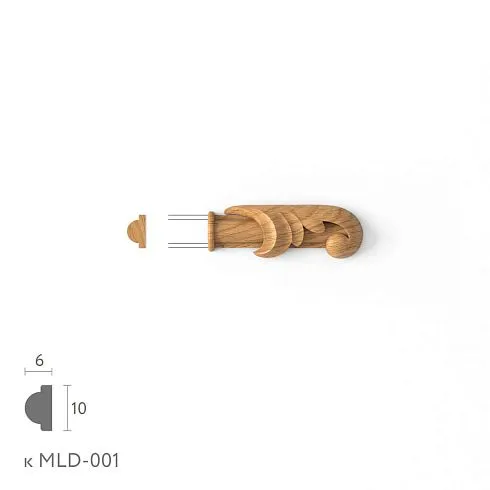
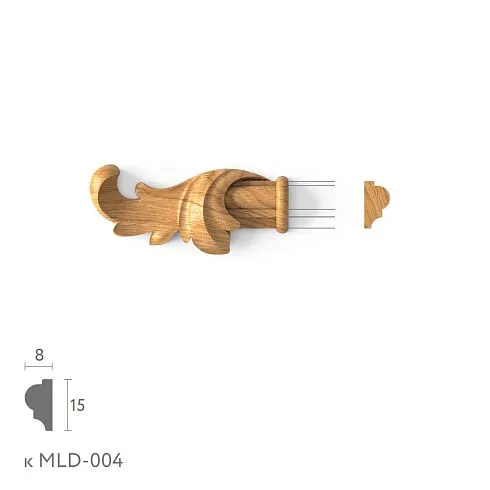
Carved molding tip N-438.1L set for MLD-001
Dimensions and Options
Have questions?
Customers also buy



Yulia Kh.
March 24, 2026
I was satisfied with the quality of the products; we purchased furniture legs. I would especially like to highlight the professionalism of manager Oksana—very client-oriented, competent, and precise specialist. She even arranged additional trimming of some elements as an extra service for us. Huge thanks!
Incognito 7.
March 24, 2026
One of the few firms that is pleasant to interact with on renovation matters. Adequate, responsive managers. Adherence to deadlines. Execution of even complex projects. Bravo! May there be more such firms!!
Marina D.
February 15, 2026
The company ordered the pens for us when we ordered furniture. But I decided to write a review personally because they are amazing! Stylish, expensive, high-quality!
More than 20 years on the market
The company's success began in 2002, when two artists — Andrey Ragozin and Evgeny Tsapko — created a small creative workshop for producing wooden carved items. The masters' work was quickly noticed, and within a year they were invited to participate in the reconstruction of the Konstantinovskiy Palace in Strelna.
After the success of this project, the company focused on recreating palace interiors, furniture, church furnishings, and carved decorations in various artistic styles. They worked with cultural heritage sites: The Hermitage, the Alexandrovsky Palace, the Troitsko-Izmaylovsky Cathedral, the Sheremetyevsky Mansion, and many others.
The masters' task — and still is — to create wooden items with the highest level of detail and understanding of every element, based on impeccable knowledge of artistic laws and interior styles.
STAVROS Guarantees
Quality of products without complaints
We save your time, peace of mind, and budget
Large warehouse program
We solve your tasks with maximum speed
Adherence to production deadlines
Streamlined process reduces all risks
Delivery from 1 piece throughout Russia
Quality service regardless of order volume
Your positive business reputation
Reliable partner — the foundation of your business
More products in the molding decor category


Frequently asked questions
Our showrooms are located in Saint Petersburg and Moscow. Production is located in Saint Petersburg.
Moscow contacts: https://www.stavros.ru/contacts_all/?tab=msk
Contacts of Saint Petersburg: https://www.stavros.ru/contacts_all/?tab=spb
- Send request by email [email protected]
- Write to us at Telegram
- Write to us at WhatsApp
- Order by phone +7 (800) 555-46-75
- Visit our showroom in Saint Petersburg and Moscow
Yes, we ship orders throughout Russia and to CIS countries.
We cooperate with transportation companies such as СДЭК and DPD.
You can also arrange pickup of your order through any convenient transportation company for you.
Delivery cost depends on the size, weight of the item, and delivery address.
When placing an order, the delivery cost is calculated automatically and displayed as a separate line on our website.
Prices and availability of items on the website are always current. Data is updated daily.
Note: items in stock are stored on the warehouse in unpolished form and shipped within 3 working days.
If the item is not in stock, average production time: 5–10 working days.
This is the quality of polishing of the items.
Standard — machine polishing, at a more attractive price.
Prestige — detailed hand polishing, items do not require further work.
More details: https://www.stavros.ru/information/kachestvo/
This is the type of veneer of the items.
Under enamel: produced by gluing wooden laminates without color and texture matching. Contrast tonal and textural differences are noticeable. This blank should be chosen if the item is intended for opaque coating.
Under tinting: produced by gluing wooden laminates with color and texture matching. Tonal and textural differences may occur. This blank should be chosen if the item is intended for semi-transparent finish.
More details: https://www.stavros.ru/information/kachestvo/
Beech — dense, non-porous wood, most often used for items covered with enamel.
Oak — dense, porous wood with clearly visible natural grain. Due to its strength and decorative properties, it is often used in items with semi-transparent coating, highlighting the wood pattern.
Custom-made, if non-standard items are required, we can produce products from other types of wood, including blanks provided by the customer, manufactured according to our technical specifications.
All our furniture legs can withstand a vertical load of at least 100 kg.
Average production time for custom-made items: 5–10 working days.
Most items are stored on the warehouse in unpolished form. We need time to polish and pack orders.
Yes, we manufacture non-standard items according to individual projects, but we only accept orders with a minimum quantity.
We can manufacture items of the desired size, but we only work with bulk orders. For details, please consult the sales department manager.
Yes, some of our products can be used outdoors. For example, polyurethane items, as well as carved door casings made of pine.
Other items are produced to order using PUR glue, if minimum quantity is available. No warranty is provided for such products, as outdoor conditions are considered aggressive.
Yes, we paint items when ordering products for a total amount of 150,000 rubles or more.
- Dust removal. After sanding, the surface must be dusted.
- Priming. Apply primer in an even layer.
- Matting. After the primer has fully dried, the surface should be matted (lightly sanded for better adhesion).
- Finish coating. Apply finish coating: lacquer or enamel, in 2 layers, with interlayer drying.
More details: https://www.stavros.ru/information/sovety/
Apply adhesive to the decor. Place it on the surface and press briefly. Then, lift the decor from the surface and leave it open for 3–5 minutes. Press the decor firmly onto the surface and hold for 5–10 seconds.
More details: https://www.stavros.ru/information/sovety/
Ideally, you should prepare a design project before placing an order.
You can do this yourself by downloading drawings of our products from our website, or you can order a project from us.
If the number of decorative elements and fittings is small, our company's manager can assist you with selection.
Unfortunately, this service is not provided.
The packaging method depends on the type of items, but in each case, we ensure sufficient protection for safe transportation.
We most often use corrugated cardboard and stretch film. Fragile items are additionally secured on a rigid base to prevent damage during transport.
We ship all items starting from 1 piece.
Room measurements and item installation can be performed by our partners — carpentry companies represented in most regions of Russia.
Often searched in category Wooden and MDF items
7082
2945
2639
1449
1323
1083
858
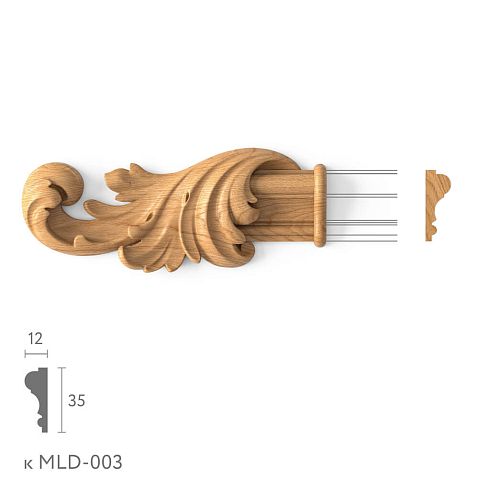
Carved molding tip N-438.1L for MLD-001, 46 × 16 × 9 mm — beech, standard for enamel or oak
Details make all the difference. In furniture manufacturing and interior decor, this statement is not a metaphor but a literal professional truth. It is precisely where a less experienced craftsman would put a period that an experienced one continues: closing ends, framing edges, finishing decorative lines. The carved molding tip N-438.1L is exactly such a detail. Small in size but fundamentally important in function. It turns an unfinished molding end into a neat, expressive decorative accent and gives the entire composition that finished, professional look that distinguishes a high-class product from an ordinary one.
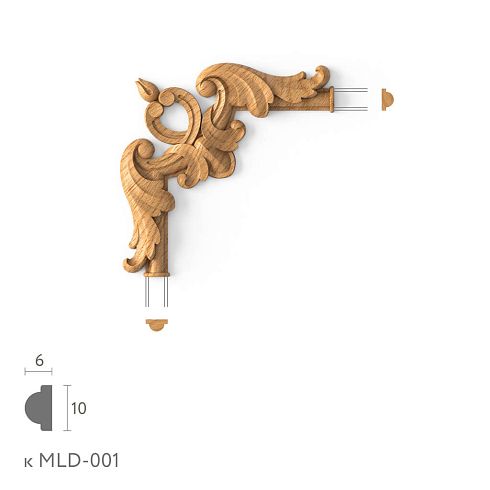
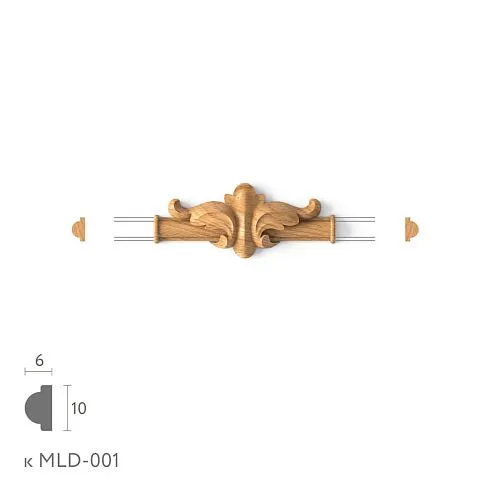
N-438.1L is a carved wooden tip designed as a component for the MLD-001 molding. Manufacturing material — beech in the 'standard for enamel' version or oak in the version for natural finish. Product size — 46 × 16 × 9 mm. The 'L' index in the designation indicates left-handed execution. This is not a separate abstract part that can be applied arbitrarily — it is an element of a specific decorative system, designed for precise work with the MLD-001 molding. If you are looking for a neat, professionally looking finish for a decorative line on furniture, a door, or a facade — this tip is created exactly for such a task.
Wood molding decorOn the stavros.ru website — it is a well-thought-out system of compatible elements: right- and left-handed tips, corner overlays, central inserts. N-438.1L is part of this system, and it works most effectively precisely within its framework: precisely, without adjustment, with a predictable result.
What is the carved tip N-438.1L for
An unfinished end is not a trifle
Molding — a decorative profiled strip — is present in a huge number of products: on kitchen fronts, interior doors, cabinets, showcases, wall panels. It sets the rhythm of the surface, structures the plane, adds volume and a classic character. But molding has a beginning and an end — two end cuts. And it is precisely these ends, in the absence of proper decorative finishing, that become the weak point of the entire structure.
An open molding end is a visual 'break': the line simply stops, leaving a bare cut. Such a cut may be technically neat but decoratively unfinished. The N-438.1L tip closes this end with a carved decorative element: the ornament continues the molding's style, smoothly finishes the decorative line, and gives it a logically justified ending.
This solution falls into the category of those that do not immediately catch the eye — but their absence is noticed instantly. A product with properly finished molding ends is perceived as the work of a professional. A product without them — as an unfinished work, even if everything else is done flawlessly.
Decorative function in the system
The N-438.1L tip performs several specific functions simultaneously in the decorative system:
-
It closes the end cut of the MLD-001 molding with a tight fit to the profile
-
Creates a volumetric carved accent on the end instead of a flat cut
-
Visually 'completes' the decorative line of the molding, giving it a classic finish
-
Enhances the overall decorative impression of the furniture, door, or facade
All together — this is not just a closed end, but a decorative statement: here, work was done with intention and attention to detail.
Kit for MLD-001 molding
A system instead of random selection
Experienced furniture makers and designers are well aware of the trap of 'similar' parts: when you take a tip 'by eye' — one that looks similar, roughly matches in width — and in the end, you discover a gap, a profile mismatch, the need for fitting, puttying, secondary processing. The result still turns out mediocre: the joint is visible, the transition is uneven, the feeling of 'we picked something similar' doesn't go away.
The N-438.1L is designed as an element of the MLD-001 molding system. The back side of the tip features a recess that precisely replicates the cross-sectional profile of the MLD-001. During installation, this means: a tight fit without gaps, contour matching along the entire perimeter of the profile, a clean joint without additional processing. The finished part fits into its place — exactly as it was designed.
This is important to understand when choosing:wooden decor for moldingsin a system configuration yields a fundamentally different result than arbitrarily selected elements. N-438.1L is not 'something similar', but an exact solution.
MLD-001 and its decorative system
The MLD-001 molding is one of the basic elements of the collection of wooden decorative products. Within this collection, it is provided not only with left and right end caps, but also with corner elements, central overlays, and other components. N-438.1L is one such element, designed for use in conjunction with the right-hand end cap N-438.1R or independently where only a left-hand finish is required.
Left-hand version N-438.1L: what is the fundamental difference
What the index 'L' means
In the system of decorative components for moldings, the index 'L' (Left) means that the end cap is designed for installation on the left end of the molding. This is a fundamentally important detail that cannot be ignored when ordering. End caps N-438.1L and N-438.1R are not interchangeable products. Their profile cut, ornament direction, and decorative finish shape are mirror opposites.
If N-438.1R closes the right end of the molding, then N-438.1L closes the left end. For symmetrical design of a furniture front, door leaf, or decorative panel, you will need both: a right and a left end cap. It is in this pair that they create a symmetrical, complete decorative solution.
Symmetry as a principle of classical decor
Symmetry is one of the fundamental principles of classical interior and furniture design. When a molding is positioned horizontally on a front, both its ends should be designed identically—and yet mirrored. The left end receives N-438.1L, the right end receives N-438.1R. The result is flawless symmetry of the ornamental band, characteristic of classical furniture craftsmanship.
This is especially important for:
-
Door panels with horizontal decorative belts
-
Furniture fronts with symmetrical ornamental stripes
-
Display cabinets with framed molding glass inserts
-
Decorative portals and frames in classical interiors
-
Wall panels with a central ornamental band
In each of these casesCarved wooden decorationworks in pairs — left and right tips as two mirrored completions of one decorative statement.
Material: beech, standard, for enamel or oak
Why material choice is a project concept choice
Two material options are not just two items in a technical table. They are two different approaches to decorative solutions, two different finish results. And the right choice directly depends on how you envision the final appearance of your product.
Beech under enamel: a neutral base for any color
Beech is a hard deciduous wood with fine, uniform, almost neutral texture. The pores are small, the grain pattern is unobtrusive, and the material density is high and homogeneous. All this makes beech an ideal choice for products that will be painted with enamel.
The 'standard under enamel' version is a beech tip, processed and prepared specifically for subsequent painting. When applying acrylic or alkyd enamel, the surface becomes even, smooth, and uniform — without protruding fibers or textural irregularities. It is the perfect base for white classic enamel, cream and pastel shades, gray anthracite, or any custom color from the RAL or NCS palette.
BeechDecorative molding tipThe enamel version allows the tip to completely 'merge' with the molding into a single painted part — so that the joint boundary disappears under the paint, and the entire decorative system is perceived as a monolithic product. This is precisely why the enamel version is needed: not just painting, but full visual integration of all system elements.
The beech version is primarily in demand for furniture production under painting: white and light-toned kitchen sets, classic enamel doors, built-in cabinets and wardrobe systems with lacquered fronts.
Oak: when wood texture is a value
Oak is a completely different material with a completely different character. Large open pores, a pronounced grain pattern, warm natural shades from light honey to dark beige — all this makes oak not just a building material, but a decorative object with its own aesthetics. Oak does not seek to hide under paint. It wants to be seen.
The oak tip N-438.1L is chosen for projects where natural wood texture is part of the design concept. This includes furniture with oil or wax finishes, doors in natural classic style, showcases and shelving made of solid wood, interiors where wood is present as a through material — in floors, beams, furniture. In such a context,Solid Wood Furniture Decormade of oak becomes an organic part of a unified material theme, not a foreign insert.
Oak takes well to tinting: from light Scandinavian to dark stained, from walnut to wenge. The open pores evenly absorb the tinting composition, creating a rich, deep shade while preserving the natural grain pattern.
Brief comparison of options
| Parameter | Beech for enamel | Oak |
|---|---|---|
| Surface texture | Fine-pored, smooth | Open pores, pronounced grain pattern |
| Best finish | Enamel, acrylic paint | Oil, wax, tint |
| For which projects | Paintable furniture and doors | Natural furniture, interiors with wood |
| Is the texture visible under the paint | No, the surface is uniform | Moderately, pattern may show through |
| Price level | More affordable | Slightly higher |
Size 46 × 16 × 9 mm: compactness with practical logic
Three parameters — three arguments in favor of using this product in specific decorative tasks.
46 mm — length. Covers the end zone of the MLD-001 molding with a slight decorative overhang. This is enough for the tip to visually present itself as an independent decorative accent, without appearing too large or disproportionate to the molding.
16 mm — width. Corresponds to the cross-sectional width of the MLD-001 molding. The tip completely covers the end plane of the molding in width, without creating side overhang and ensuring a neat flush transition.
9 mm — thickness (profile height). Sufficient to form an expressive three-dimensional relief on the end of the molding. At the same time, 9 mm is a moderate thickness that does not disrupt the overall proportions of the product and does not create excessive overhang.
The combination of these three parameters makes N-438.1L a product for precise work. It does not try to 'occupy the space' of a large decorative element — it works in its area with jewelry-like precision. This is exactly the kind of compact carved element needed where the scale of the product is small: a cabinet, a bedside table, a small display cabinet, a decorative frame on a wall panel.
Design and Visual Effect: What Happens After Installation
Carved Pattern as a Stylistic Signal
The word 'carved' in the description of this finial carries a specific semantic load: the surface of the product has a multi-level relief pattern formed during the milling process. This is not a flat end profile or a smooth button—it is a three-dimensional decorative element with protrusions, recesses, smooth transitions, and a symmetrical ornamental composition.
The character of the ornament is classic, leaning towards traditional furniture plasticity. Smooth shapes, neat symmetry, a finished silhouette. Such an ornament works as a stylistic signal: it communicates that the furniture or door is made in the classical or neoclassical tradition, that the details are well thought out and consciously designed.
Three Visual Effects of One Finial
After installation, the N-438.1L provides three interrelated visual effects:
The first is completeness. The molding no longer ends abruptly. The decorative line receives a logical, ornamentally designed finish. This is a fundamental effect, without which professional decorative work is impossible.
The second is the volumetric nature of the end. The flat cut turns into a relief decorative detail. The end of the molding ceases to be a 'technical' element and becomes part of the decorative system. This is especially noticeable with side lighting, when the relief of the finial begins to cast shadows and play with chiaroscuro.
The third is the feeling of an expensive product. It is precisely correctly designed details—ends, transitions, finishes—that create the feeling of handcrafted, high-quality work. The N-438.1L finial adds to the molding that level of detailing that is perceived as a sign of professional carpentry craftsmanship.
Where the N-438.1L Finial is Used
Furniture Fronts: A Standard Task for a Non-Standard Result
The production of case furniture is the primary application area for this product. Moldings on the fronts of kitchen sets, cabinets, dressers, nightstands, and wardrobe systems have open ends. N-438.1L closes the left end of each MLD-001 molding installed on the front. In serial production, this ensures uniformity of the decorative solution across the entire furniture collection.
This tip works especially effectively in combination with N-438.1R on the same molding: the left and right tips create a symmetrical decorative finish on both sides—precisely the result characteristic of premium-class furniture.
Doors: Classic Door Leaf Framing
Interior doors in a classic interior are traditionally decorated with moldings. Horizontal decorative belts on the leaf, ornamental inserts, frame systems—all of this requires neat finishing on the ends. N-438.1L closes the left end of each horizontal molding on the door leaf, giving the entire decorative system of the door a finished, professional appearance.
Display cases and cabinets with glass
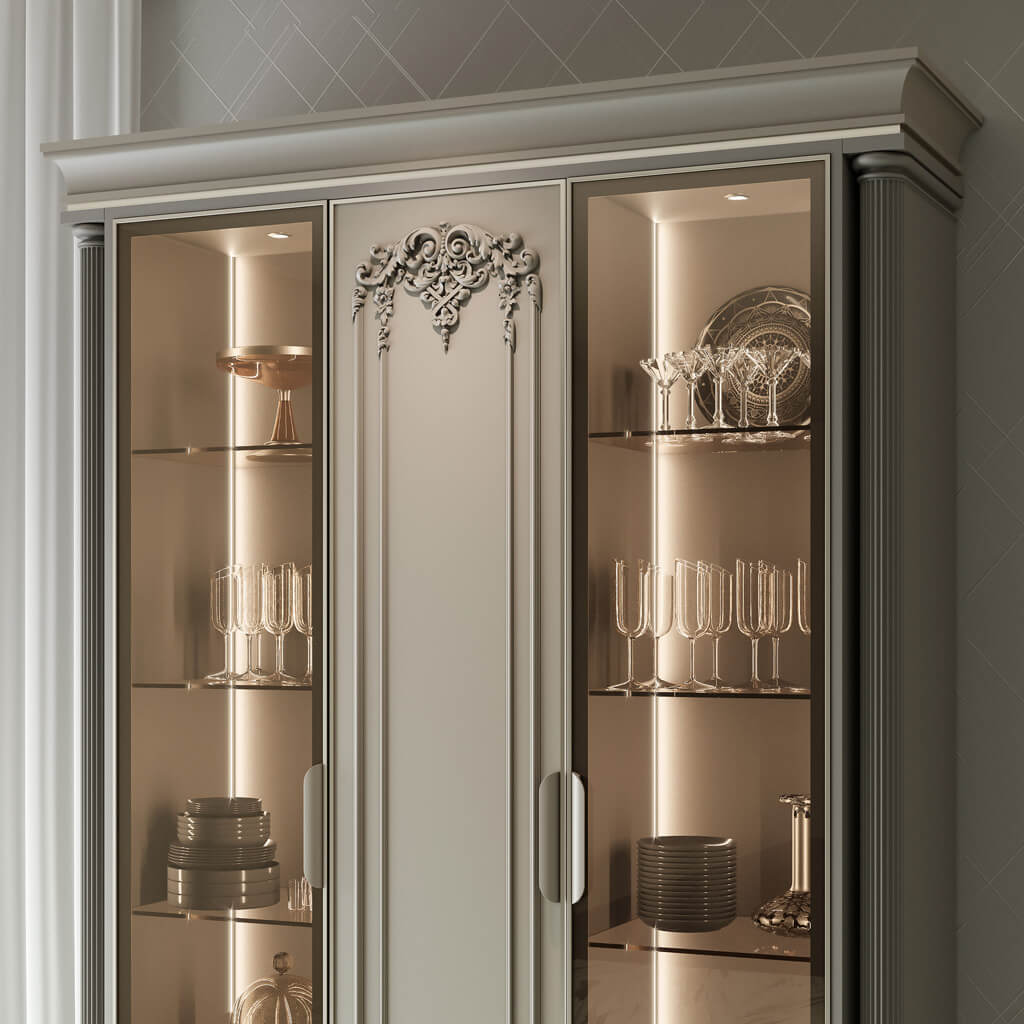
Display cabinets with glazed fronts are a special area where decorative detailing is critically important. Moldings framing glass inserts must be finished around the entire perimeter, including the ends. The carved tip N-438.1L closes the left ends of such moldings, creating a neat decorative frame around the glass.
Wall panels and interior decorative systems
Where the molding is used as an element of a wall decorative system—in horizontal belts, in niche framings, in decorative frames—N-438.1L performs exactly the same role. It closes the left ends of moldings at the edges of panels, at corner transitions, and at the endpoints of decorative lines.
Joinery and Authorial Projects
In authorial furniture and high-class joinery work, decorative detailing is a matter of reputation.Decorative Elements for Solid Wood Furnitureare used here not as serial components, but as meaningful parts of a specific product. In this context, N-438.1L is a detail that reflects attention to completeness and a professional approach to every element of the product.
For which styles and projects is N-438.1L suitable?
A carved wooden finial is a detail with a clearly defined stylistic affiliation. It is not an element of minimalism or constructivism. Its character is defined by the classical furniture tradition. Here are the stylistic contexts in which it works most organically:
Classic and neoclassical — the main environment. Symmetry, profiled moldings, carved details, natural wood. N-438.1L fits into this system without the slightest conflict.
Modern classic — a neutral base with pinpoint classical accents. The finial adds decorative depth to clean lines — exactly as much as needed for stylistic definition without overload.
Provence and French classic — aged white surfaces, natural wood, ornamental decor. A beech finial under white or cream enamel fits perfectly into this aesthetic.
Eclecticism with classical accents — a mixed style where N-438.1L helps create unity of decorative language on accent furniture pieces.
Restoration projects — if the original finial is lost or damaged, N-438.1L (provided the profile is compatible) can serve as a repair replacement while preserving the original's style.
Advantages of the carved finial N-438.1L: specific and to the point
Not marketing theses — real applied properties:
-
Precise compatibility with MLD-001 — the backside cutout matches the molding profile, tight fit without adjustment
-
Left-hand version — designed for symmetrical pairing with N-438.1R
-
Natural wood — beech or oak, both materials offer high strength and long service life
-
Project selection — beech for enamel on paintable items, oak for natural finish
-
Compact size 46 × 16 × 9 mm — a precise tool for fine decorative work
-
Expressive carved ornament — three-dimensional relief, classic character, good chiaroscuro
-
Simple installation — wood glue, tight fit, standard finishing
-
Systematic approach — part of the collectionof solid wood, compatible with other elements of the MLD-001 decorative molding system
Installation: what to know before mounting
Preparation
The end cut of molding MLD-001 before installing the tip must be even, perpendicular to the molding axis, clean and dry. If necessary — light sanding of the end with fine-grit sandpaper (grit 180–240).
Always perform a dry fit: place N-438.1L on the left end of the molding and ensure a tight fit of the recess. When properly aligned, the tip should not wobble and there should be no visible gaps along the profile contour.
Gluing
Use woodworking PVA glue or PVA-based mounting adhesive. Apply a thin, even layer to the back surface of the tip and the end of the molding. Press firmly, maintain pressure for 2–3 minutes. If necessary, secure with painter's tape during full curing (12–24 hours).
Remove excess glue along the joint contour with a damp cloth before it dries. After final curing, the joint can be filled with fine-grain wood filler if needed, sanded, and a finish coating applied.
Finishing coating
For beech version under enamel: wood primer → finish enamel in one or two coats of the desired shade. It is optimal to paint the tip after installation — this ensures a uniform color for the entire decorative system without a visible joint line.
For oak version: wood oil or wax, or tinting impregnation followed by matte or glossy varnish. Before applying oil or wax — sand along the grain with 220 grit.
Order carved tip N-438.1L for molding MLD-001
Every professional in furniture making and interior design knows: between 'almost done' and 'done' lies a chasm. And this chasm is most often filled precisely by details like the carved tip N-438.1L. A small element that closes the end, completes the line, adds symmetry, and makes the product truly finished.
If your project uses molding MLD-001 — the left end of this molding has no precise decorative finishing other than N-438.1L. OrderCarved Decoration for Furniture and Doorsmade from natural wood in the required finish — beech for enamel or oak — on the website stavros.ru. The right-hand tip N-438.1R and the full range of accessories for molding MLD-001 are also available here, as well as a wide collection ofof wood and MDF productsfor any decorative tasks.
One tip—and the molding transforms from an unfinished strip into a solid, professionally looking decorative detail. That's how the right parts work in the right hands.
Frequently Asked Questions about the N-438.1L Tip
How does the N-438.1L differ from the N-438.1R?
N-438.1L is a left-hand version, N-438.1R is a right-hand version. Their cutout shape and ornament direction are mirrored. To symmetrically finish one molding, both products are needed.
Is it necessary to buy both tips—left and right?
If the molding has two open ends and symmetrical finishing is required—yes, both are needed. If the molding butts into a corner or frame on one side—one tip for the open end is sufficient.
Can the N-438.1L be used with moldings from other series?
The product is designed for the MLD-001 profile. Use with other moldings without prior compatibility check of the profile is not recommended: the fit may not match.
Is beech suitable for enamel in dark shades—like walnut or wenge?
Yes, beech can be painted in any shade. For dark shades, it's important to use a primer-sealer before applying paint—this prevents the wood tone from showing through the dark enamel.
How to calculate the number of tips for a project?
For each molding with two open ends, two tips are needed — one N-438.1L and one N-438.1R. Count the number of MLD-001 moldings in the project and multiply by two. If some moldings abut a frame on one side — adjust the calculation.
Can the tip be installed before painting the product?
For the beech version under enamel — it is recommended to mount the tip before the final painting. Then the tip and molding are painted in a unified tone, the joint is concealed by paint, and the product is perceived as monolithic.
How long does installation take?
Direct installation time — 5–10 minutes per tip. Load-bearing time — 30–60 minutes. Full adhesive curing — 12–24 hours.
Is this tip suitable for restoring old furniture?
Yes, provided that the molding profile in the restored item matches the MLD-001 profile. It is recommended to take preliminary measurements and compare with the product parameters.
Your request has been sent!
Our manager will contact you within 5 minutes