













































































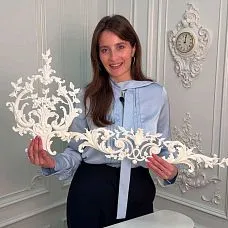
CPU-5-6 Molding Decor Kit
Dimensions and Options
Set Composition


Have questions?
Customers also buy



Marina D.
February 15, 2026
The company ordered the pens for us when we ordered furniture. But I decided to write a review personally because they are amazing! Stylish, expensive, high-quality!
Polina Sh.
February 4, 2026
Went on a tour. To say I'm delighted is an understatement. The largest production facility in Russia, impressive in its scale and dedication to the craft! It was very interesting and informative. You can immediately see - true masters of their trade! We were welcomed in the best possible way, were polite...
Svetlana A.
January 30, 2026
It's great that you can almost always find the necessary elements for the project. The products match the description, with prompt feedback and delivery!
More than 20 years on the market
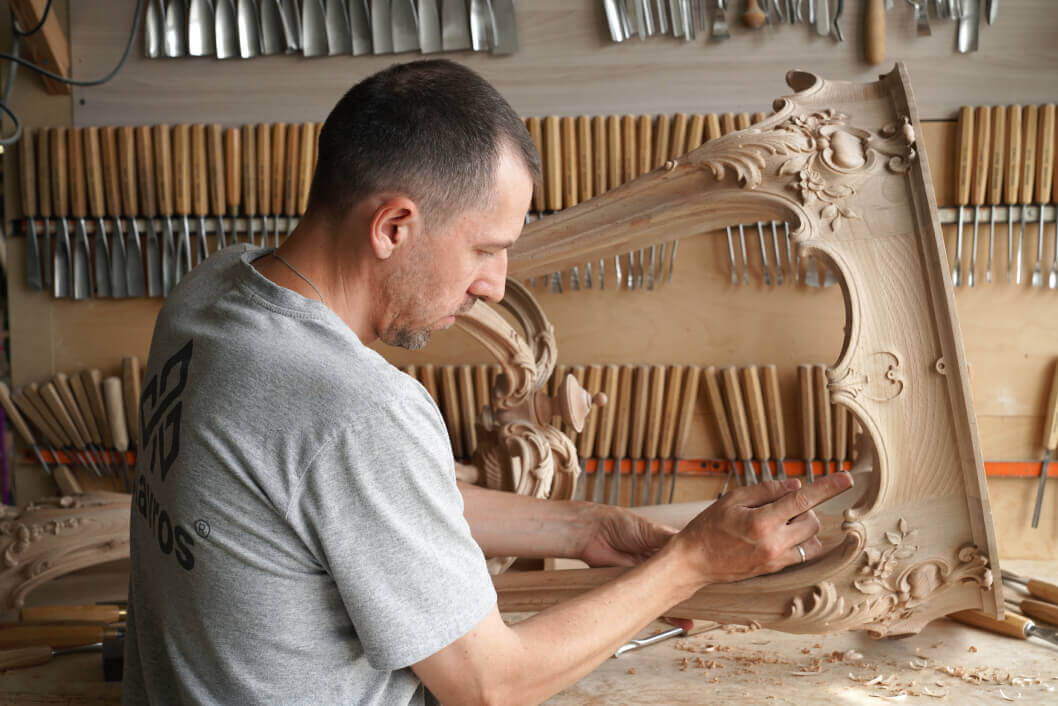
The company's success began in 2002, when two artists — Andrey Ragozin and Evgeny Tsapko — created a small creative workshop for producing wooden carved items. The masters' work was quickly noticed, and within a year they were invited to participate in the reconstruction of the Konstantinovskiy Palace in Strelna.
After the success of this project, the company focused on recreating palace interiors, furniture, church furnishings, and carved decorations in various artistic styles. They worked with cultural heritage sites: The Hermitage, the Alexandrovsky Palace, the Troitsko-Izmaylovsky Cathedral, the Sheremetyevsky Mansion, and many others.
The masters' task — and still is — to create wooden items with the highest level of detail and understanding of every element, based on impeccable knowledge of artistic laws and interior styles.
STAVROS Guarantees
Quality of products without complaints
We save your time, peace of mind, and budget
Large warehouse program
We solve your tasks with maximum speed
Adherence to production deadlines
Streamlined process reduces all risks
Delivery from 1 piece throughout Russia
Quality service regardless of order volume
Your positive business reputation
Reliable partner — the foundation of your business
More products from the "Versailles" collection



Frequently asked questions
Our showrooms are located in Saint Petersburg and Moscow. Production is located in Saint Petersburg.
Moscow contacts: https://www.stavros.ru/contacts_all/?tab=msk
Contacts of Saint Petersburg: https://www.stavros.ru/contacts_all/?tab=spb
- Send request by email [email protected]
- Write to us at Telegram
- Write to us at WhatsApp
- Order by phone +7 (800) 555-46-75
- Visit our showroom in Saint Petersburg and Moscow
Yes, we ship orders throughout Russia and to CIS countries.
We cooperate with transportation companies such as СДЭК and DPD.
You can also arrange pickup of your order through any convenient transportation company for you.
Delivery cost depends on the size, weight of the item, and delivery address.
When placing an order, the delivery cost is calculated automatically and displayed as a separate line on our website.
Prices and availability of items on the website are always current. Data is updated daily.
Note: items in stock are stored on the warehouse in unpolished form and shipped within 3 working days.
If the item is not in stock, average production time: 5–10 working days.
This is the quality of polishing of the items.
Standard — machine polishing, at a more attractive price.
Prestige — detailed hand polishing, items do not require further work.
More details: https://www.stavros.ru/information/kachestvo/
This is the type of veneer of the items.
Under enamel: produced by gluing wooden laminates without color and texture matching. Contrast tonal and textural differences are noticeable. This blank should be chosen if the item is intended for opaque coating.
Under tinting: produced by gluing wooden laminates with color and texture matching. Tonal and textural differences may occur. This blank should be chosen if the item is intended for semi-transparent finish.
More details: https://www.stavros.ru/information/kachestvo/
Beech — dense, non-porous wood, most often used for items covered with enamel.
Oak — dense, porous wood with clearly visible natural grain. Due to its strength and decorative properties, it is often used in items with semi-transparent coating, highlighting the wood pattern.
Custom-made, if non-standard items are required, we can produce products from other types of wood, including blanks provided by the customer, manufactured according to our technical specifications.
All our furniture legs can withstand a vertical load of at least 100 kg.
Average production time for custom-made items: 5–10 working days.
Most items are stored on the warehouse in unpolished form. We need time to polish and pack orders.
Yes, we manufacture non-standard items according to individual projects, but we only accept orders with a minimum quantity.
We can manufacture items of the desired size, but we only work with bulk orders. For details, please consult the sales department manager.
Yes, some of our products can be used outdoors. For example, polyurethane items, as well as carved door casings made of pine.
Other items are produced to order using PUR glue, if minimum quantity is available. No warranty is provided for such products, as outdoor conditions are considered aggressive.
Yes, we paint items when ordering products for a total amount of 150,000 rubles or more.
- Dust removal. After sanding, the surface must be dusted.
- Priming. Apply primer in an even layer.
- Matting. After the primer has fully dried, the surface should be matted (lightly sanded for better adhesion).
- Finish coating. Apply finish coating: lacquer or enamel, in 2 layers, with interlayer drying.
More details: https://www.stavros.ru/information/sovety/
Apply adhesive to the decor. Place it on the surface and press briefly. Then, lift the decor from the surface and leave it open for 3–5 minutes. Press the decor firmly onto the surface and hold for 5–10 seconds.
More details: https://www.stavros.ru/information/sovety/
Ideally, you should prepare a design project before placing an order.
You can do this yourself by downloading drawings of our products from our website, or you can order a project from us.
If the number of decorative elements and fittings is small, our company's manager can assist you with selection.
Unfortunately, this service is not provided.
The packaging method depends on the type of items, but in each case, we ensure sufficient protection for safe transportation.
We most often use corrugated cardboard and stretch film. Fragile items are additionally secured on a rigid base to prevent damage during transport.
We ship all items starting from 1 piece.
Room measurements and item installation can be performed by our partners — carpentry companies represented in most regions of Russia.
Often searched in category Wall Decor
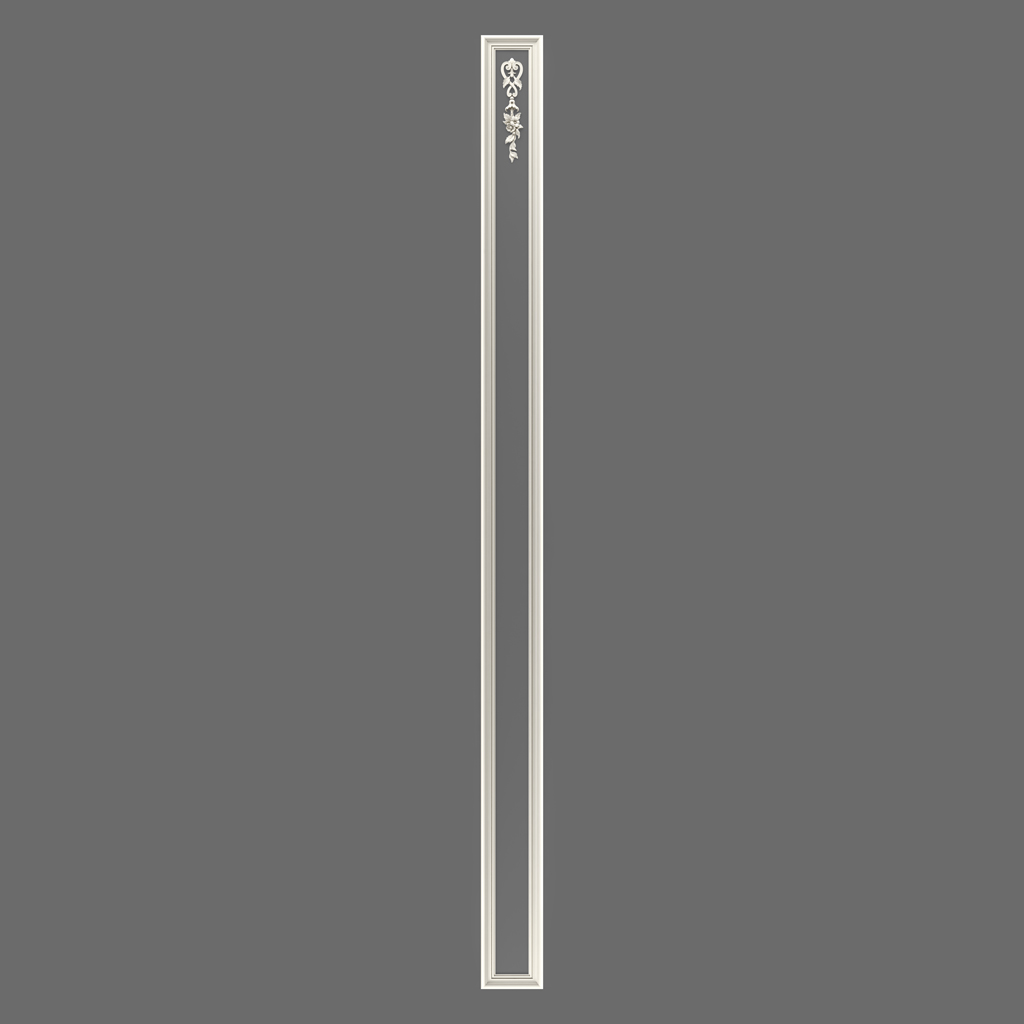
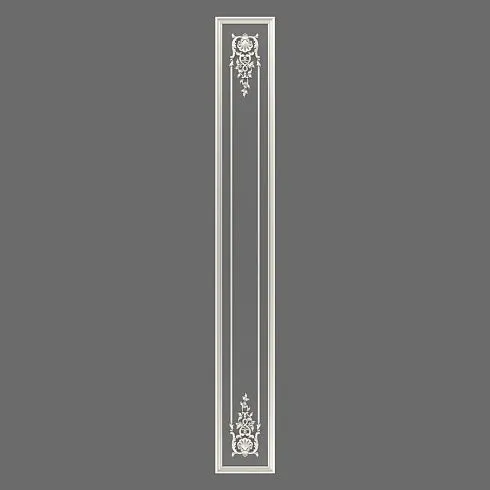
CPU-5-6 Molding Decor Kit — a narrow vertical decorative strip from the "Versailles" collection
Laconic elegance: when minimal format creates maximum rhythm
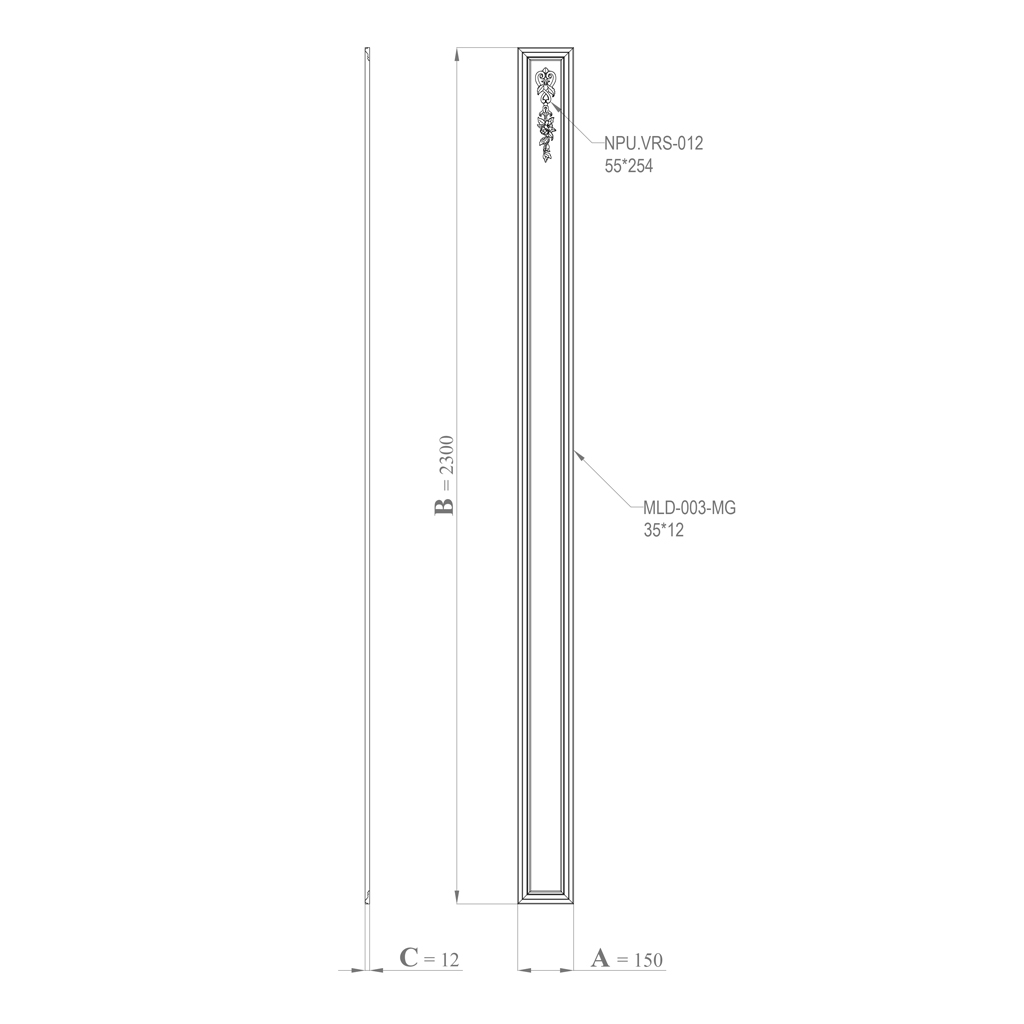
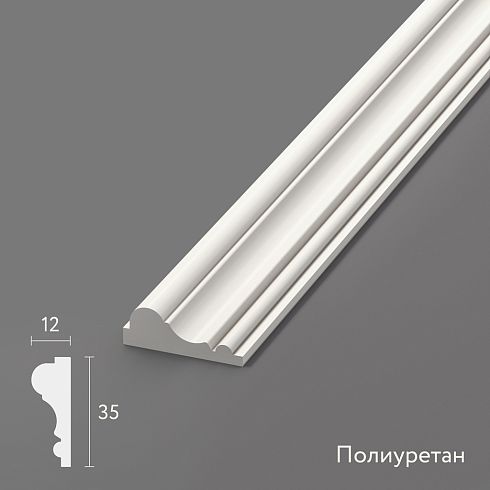
The CPU-5-6 Molding Decor Kit from the "Versailles" collection represents a fundamentally different type of decorative product compared to all previous versions of the CPU-5 series. While the CPU-5-1 through CPU-5-5 kits create wide vertical panels in a 650 mm format with rich ornamental decoration, the CPU-5-6 solves a completely different architectural task: it forms a narrow vertical decorative strip 150 mm wide and 2300 mm high with a 12 mm relief—an elegant, strict, yet ornamentally rich accent element, which in classical architectural tradition is referred to as a pilaster strip, lesene, or decorative vertical belt. This very format—narrow, tall, vertically oriented—is one of the key structural elements of the boiserie system: it separates wide ornamental panels, marks inter-panel wall sections, accentuates room corners, and creates a rhythmic pulse along the wall, without which even the richest Versailles panels would appear not as a system but as a collection of separate decorative objects. The CPU-5-6 kit consists of two components—an MDF molding MLD-003-MG with a 35 × 12 mm profile, 2600 mm long, and a polyurethane decorative element NPU.VRS-012 measuring 55 × 254 × 11 mm—and this two-element simplicity, which seems minimalist compared to the twelve-element CPU-5-4 and CPU-5-5 kits, is its fundamental advantage: CPU-5-6 does not compete with wide panels but serves them, creating an architectural rhythm that transforms a set of separate decorative sections into a unified, complete system of palace decor.
"Versailles" Collection: the ornamental code unifying the entire series
The affiliation of CPU-5-6 with the "Versailles" collection is not merely decorative labeling—it is a direct indication of the product's ornamental belonging to a specific historical source. The Palace of Versailles, constructed under Louis XIV from 1661 to 1710, is not just a monument of French architecture but the primary normative source for the entire classical interior tradition of Europe. The decorative vocabulary developed in the workshops of Versailles under Charles Le Brun and his successors—acanthus leaves, floral garlands, shell-palmette motifs, S-shaped scrolls, symmetrical arabesques—became the universal language of architectural ornamentation, which three centuries later remains as readable, significant, and relevant as at the time of its creation. The ornamental decor NPU.VRS-012, included in the CPU-5-6 kit, reproduces precisely this language in a vertically oriented element format: its ornamental program belongs to the same tradition as the rich medallions and horizontal belts of the wide panels in the CPU-5 series. This stylistic unity is the key condition for the architectural compatibility of CPU-5-6 with the other kits in the series: the narrow strip CPU-5-6 and the wide panel CPU-5-5 speak the same ornamental language, belong to the same decorative tradition, and when applied together create a unified, stylistically impeccable system—exactly as Versailles boiserie should be.
150 × 2300 mm Format: the architectural role of the narrow vertical strip
To properly understand the CPU-5-6 kit, it is necessary to grasp the architectural function of a narrow vertical strip 150 mm wide within a classical wall decor system. In canonical French boiserie, decorative panel systems were never installed flush—there was always a separating element between wide panels, which, depending on the richness of the decor, could be either a simple vertical molding, a decorative lesene with ornamentation, or a full pilaster with capital and base. The narrow vertical strip 150 mm wide occupies a middle position in this hierarchy: it is wider than a simple separating molding but narrower than a full pilaster, and this intermediate position makes it the most universal separating element for a wide range of interior tasks. With the width of CPU-5-2 / CPU-5-3 / CPU-5-4 / CPU-5-5 panels being 650 mm, the CPU-5-6 vertical strip 150 mm wide creates an inter-panel separator that is visually perceived as a light vertical accent—narrow enough not to compete with wide panels in decorative weight, yet rich enough ornamentally to support their Versailles character. The height of 2300 mm exactly matches the height of the main panels in the CPU-5 series—a mandatory condition for creating a horizontally aligned decorative row where the top and bottom edges of all elements are at the same level. This horizontal alignment, creating a unified line along the top and bottom edges of the entire system, is one of the main signs of professional, architecturally competent boiserie.
MLD-003-MG Molding in CPU-5-6: one load-bearing line—the entire architectural contour
The MLD-003-MG molding with a 35 × 12 mm profile and length of 2600 mm is the sole load-bearing element in the CPU-5-6 kit, and this uniqueness defines the architectural character of this kit. In the wide panels of the CPU-5 series, there are two, and in the richest versions three types of moldings—double and triple contours create that effect of layering and architectural depth associated with top-class Versailles boiserie. In CPU-5-6, the single MLD-003-MG molding performs all the framing work independently: it forms both vertical edges of the narrow 150 mm wide strip, creates horizontal top and bottom limiters of the system when necessary, and defines the sole architectural contour within which the ornamental elements NPU.VRS-012 are placed. A profile width of 35 mm with a total strip width of 150 mm means the moldings occupy 70 mm (two times 35), leaving an internal field 80 mm wide—this is precisely the space where the vertical ornamental decor NPU.VRS-012, 55 mm wide, is placed with side gaps of 12.5 mm on each side. The molding profile depth of 12 mm creates a pronounced relief under side lighting: two vertical frame lines cast vertical shadows that visually "project" the narrow strip from the wall plane and give it a sculptural, volumetric presence. The length of 2600 mm ensures coverage of the full 2300 mm height with a 300 mm allowance for trimming—without the need for lengthwise joints, which is an absolute quality requirement for vertical load-bearing elements of great height. The material—MDF with factory white primer—ensures absolute straightness of the profile along all 2600 mm, geometric stability under normal operating conditions, precise reproducibility of a 45° miter cut for end trimming, and a perfectly smooth surface for final painting.
NPU.VRS-012 Decorative Element: the vertical arabesque of Versailles ornamentation
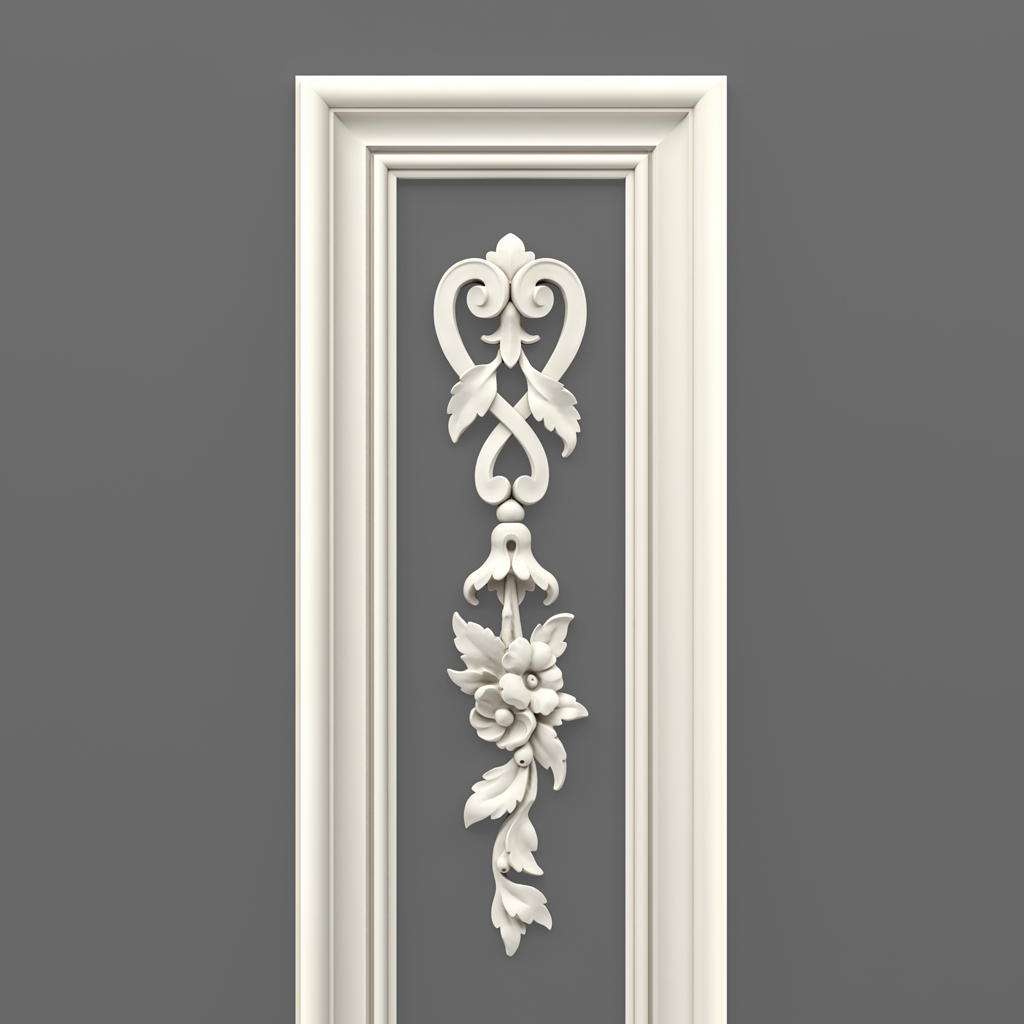
The polyurethane decorative element NPU.VRS-012, measuring 55 × 254 × 11 mm, is the ornamental heart of the CPU-5-6 kit and carries the entire decorative program of the narrow vertical strip. Its dimensions—55 mm wide, 254 mm high, 11 mm relief depth—immediately reveal the architectural intent: with a width of 55 mm, the element fits precisely into the internal frame field 80 mm wide with neat side gaps; a height of 254 mm sets the rhythm of the vertical row when multiple elements are used repetitively along the 2300 mm height—exactly nine NPU.VRS-012 elements, each 254 mm high, fit into the full strip height, with a total row height of 2286 mm, leaving a minimal gap for adjusting placement with a strip height of 2300 mm. This near-perfect match is not accidental: the kit's production system is designed so that decorative elements fit the panel height with minimal residual error—this significantly simplifies installation and eliminates the need for complex calculations during setup. The relief depth of 11 mm—practically equal to the load-bearing molding depth of 12 mm—creates visual unity between the contour lines of the frame and the ornamental details of the internal field: they are perceived as parts of a single plastic whole, not as a frame with separately glued decor. The ornamental language of NPU.VRS-012 belongs to the Versailles tradition and reproduces motifs of vertical ornamental strips that in the Palace of Versailles separated panels in wall sections, accentuated lesenes, and created decorative filling for narrow architectural zones—zones that, without decor, would be perceived as "empty" and would disrupt the total character of the ornamental program of palace interiors.
Vertical Rhythm as an Architectural Strategy: nine repetitions of one motif
Using multiple identical NPU.VRS-012 decorative elements along the entire strip height—nine pieces for a full height of 2300 mm—is an intentional architectural solution that creates a fundamentally different effect compared to a single large central decor. In the wide panels of the CPU-5 series, one or two medallions create a focal ornamental accent—expressive, noticeable, drawing the eye to a specific point. In the narrow CPU-5-6 strip, the rhythmically repeating vertical element NPU.VRS-012 creates a continuous ornamental vertical—a decorative pathway that guides the eye from the baseboard to the cornice, creating a sense of infinite ascent. This technique—multiple rhythmic repetitions of one ornamental motif in a vertical row—is one of the basic tools of classical decorative architecture. In Versailles, it was applied on pilasters, lesenes, and decorative pylons, where vertical ornamental strips created a sense of growth, upward aspiration, and lightness of load-bearing structures—the very qualities that ancient architects formulated in the proportions of the Corinthian column. With inter-element intervals equal to the ornamental row spacing step, the rhythm of NPU.VRS-012 can be adjusted to a specific room height: elements can be placed flush without gaps, creating a continuous ornamental vertical, or with equal intervals, creating an accentuated dotted line. The interval between elements is perceived as a "pause" in the ornamental rhythm—and this pause is also a decorative tool: a denser rhythm creates a sense of festivity and richness, a sparser one—lightness and elegance. A professional installer or designer working with CPU-5-6 receives a tool for fine-tuning the decorative rhythm of the narrow strip depending on the height and character of a specific room.
CPU-5-6 in the System of Wide Versailles Panels: the role of separator and rhythm section
The main and most obvious application of the CPU-5-6 kit is its use as a separating element between wide panels of the CPU-5 series in a unified wall decor system. Consider a typical configuration: a wall 4800 mm wide is decorated with three wide CPU-5-3 or CPU-5-5 panels, each 650 mm wide. Three panels occupy 1950 mm of the 4800 mm. The remaining space of 2850 mm is distributed among four inter-panel gaps (before the first panel, between each of the three, and after the last). With equal distribution, each gap is 712 mm—too much for an inter-panel span without decorative filling. In this case, one narrow CPU-5-6 strip 150 mm wide is installed in each gap, and the remaining spans become 140.5 mm on each side—neat, uniform, visually precise intervals between wide panels and narrow strips. The rhythmic structure of such a wall is as follows: gap — CPU-5-6 strip — gap — CPU-5-5 panel — gap — CPU-5-6 strip — gap — CPU-5-5 panel — gap — CPU-5-6 strip — gap — CPU-5-5 panel — gap — CPU-5-6 strip — gap. This rhythm—wide, narrow, wide, narrow—is the classical principle of alternating dominant and subordinate elements in boiserie, a direct analogue of the colonnade-with-intercolumniation principle, which dates back to ancient architecture and entered the decorative system of Versailles through the Renaissance and Baroque. In this configuration, the narrow CPU-5-6 strips are not just separators—they are active architectural elements that set the system's rhythm and create those very "pauses" without which a continuous row of wide panels would be perceived as monotonous and overloaded.
Independent Application: scenarios without wide panels
The CPU-5-6 kit is a full-fledged architectural product and can be applied independently—without wide panels of the CPU-5 series as adjacent elements. Several scenarios of its independent use deserve separate consideration. The first scenario—a rhythmic row of narrow strips along an entire wall without wide panels: CPU-5-6 strips are installed at equal intervals along the wall, creating decorative articulation in the tradition of lesenes and vertical rustication. With a strip width of 150 mm and a step of 400 mm, approximately six to seven strips fit on a 4 m wide wall, creating a light rhythmic grid without the heavy framing system of wide panels. This option is optimal for spaces where decorative activation of the wall is required with minimal intervention in its proportions—for example, in narrow corridors where wide panels would visually reduce the already limited width. The second scenario—an accent framing strip along the edges of a door or window opening: two symmetrical CPU-5-6 strips installed on both sides of the opening at a distance of 50–100 mm from the casing create a decorative architectural framing that visually enlarges the opening and gives it a formal, Versailles character. The third scenario—a vertical divider between fabric or mirror panel upholstery: in interiors with fabric-filled wall niches, the narrow CPU-5-6 strip serves as an elegant ornamental transition between two fabric sections. The fourth scenario—corner accent: installing a CPU-5-6 strip in the corner zone of a room, where two walls meet at a right angle, creates decorative accentuation of the corner, transforming it from a structural seam into an element of the architectural program.
Technical Specifications: precise data for designers and installers
The CPU-5-6 kit forms a narrow vertical decorative strip with overall dimensions of 150 × 2300 × 12 mm. Kit composition: MDF molding MLD-003-MG with a 35 × 12 mm profile and length of 2600 mm—one unit; polyurethane decorative element NPU.VRS-012 measuring 55 × 254 × 11 mm—quantity determined by the calculated placement step along the panel height. Internal frame field width with molding profile of 35 mm: 150 − 2 × 35 = 80 mm. The NPU.VRS-012 element width—55 mm—fits into the 80 mm field with side gaps of 12.5 mm. Calculated quantity of NPU.VRS-012 elements for solid filling of 2300 mm height: 2300 ÷ 254 ≈ 9 pieces with a total height of 2286 mm. Maximum system relief depth—12 mm (MLD-003-MG molding profile), ornamental relief of NPU.VRS-012—11 mm. Both components are supplied with factory white acrylic primer. All final paint coatings are compatible without additional surface treatment. Made-to-order production: average lead time 5–10 business days. Delivery across Russia via SDEK transport company.
Ornamental Decor Material: high-density polyurethane in a narrow format
The NPU.VRS-012 decorative element is made of rigid high-density polyurethane—the same material used for all ornamental elements of the "Versailles" collection. Given the small size of the product—55 × 254 × 11 mm—the properties of polyurethane become particularly important. The small size means the element will be installed in quantities of nine per strip, and in this case, the uniformity of production tolerances for each item becomes critically important: if one of the nine elements has a production deviation in height of even 0.5 mm, this deviation accumulates in a row of nine and creates a total error of 4.5 mm, which is visually noticeable. Polyurethane injection molding ensures dimensional stability with an accuracy of ±0.2 mm per unit—with nine elements, the total accumulated error does not exceed 1.8 mm, which is an acceptable tolerance for decorative installation. The polyurethane's water absorption coefficient of less than one percent makes NPU.VRS-012 applicable in bathrooms, kitchens, and other high-humidity environments—an important property for a decorative strip that may be used in a wide variety of conditions. Thermal stability in the range from −60°C to +100°C guarantees geometry preservation under any seasonal changes in room microclimate. The impact resistance of polyurethane significantly exceeds that of gypsum: in a narrow strip where the distance from individual elements to traffic surfaces is minimal, impact resistance is a key operational requirement. The estimated service life of polyurethane elements under normal conditions is from thirty to fifty years without degradation of relief or adhesion to final coatings.
MDF of the Molding: precise verticality at a height of 2.3 meters
The MLD-003-MG molding made of medium-density fiberboard (MDF), when working as part of the narrow vertical strip CPU-5-6, solves a task fundamentally different from its role in wide panels: here it is not the perimeter frame of a rectangular construction but two vertical load-bearing lines extending to a height of 2300 mm. For load-bearing vertical lines of such height, absolute straightness along the entire length is a critically important requirement: a bend in the molding of even 2 mm at mid-height will be clearly visible to the naked eye when viewed along the wall. Medium-density MDF provides precisely the straightness required here: homogeneous structure without internal stresses, uniform density along the entire length, absence of fiberiness and warping under normal operating conditions. The 35 × 12 mm profile with a length of 2600 mm has a moment of inertia of the cross-section sufficient to maintain straightness without support along the entire length during installation—this is important when a single installer works, who cannot hold the entire molding length simultaneously while applying adhesive and aligning vertically. The factory white primer creates a perfectly smooth, uniformly porous surface for final paint—for vertical load-bearing lines, which under side lighting are perceived as pure geometric strips, surface evenness is as important as shape straightness.
Stylistic Range of CPU-5-6: from strict classicism to Versailles splendor
Despite its minimalist two-element composition, the CPU-5-6 kit possesses a wide stylistic range, determined by the final color solution and context of application. In strict Neoclassicism, the narrow CPU-5-6 strip in pure white monochrome creates a geometrically precise, laconic vertical accent, akin to the pilaster separators of Caserta and Pavlovsk Palace—architecturally impeccable yet restrained. In Versailles Baroque, the same strip in a cream-white tone with golden patina on the NPU.VRS-012 ornamental elements transforms into a golden vertical thread piercing the boiserie system from floor to ceiling—a motif characteristic of the richest Versailles interiors. In modern classicism and transitional style, the CPU-5-6 strip in the wall tone with a slightly more saturated molding shade creates a subtle geometric rhythm that enriches the wall surface with structure without excessive decor. In the Scandinavian interpretation of classicism—neutral gray-white tones, minimal gaps, regular rhythm—CPU-5-6 blurs the line between classical decor and minimalist geometry, creating an interior solution that is simultaneously historically correct and contemporary. In Art Deco interiors, the geometric strictness of the molding frame combined with ornamental elements of the Versailles vocabulary creates the characteristic dialogue for this style between straight line and living ornament, between geometry and nature.
Application in corridors, halls, and transitional spaces
The narrow format of the CPU-5-6 kit makes it particularly organic in corridors, halls, stairwells, and other transitional spaces where wall width does not allow for the use of wide panels CPU-5-2 to CPU-5-5. In a standard corridor 1200–1500 mm wide, a wide 650 mm panel would look disproportionately heavy and monumental — it would occupy more than half the wall width, disrupting the visual balance. The narrow 150 mm wide CPU-5-6 strip fits perfectly in the same corridor: three strips with equal intervals on a 1500 mm wide wall create a light, rhythmic decor that activates the surface without weighing it down. In the halls and lobbies of representative buildings, vertical CPU-5-6 strips installed on both sides of the main entrance doorway create a solemn architectural framing, visually enlarging the entrance and giving it a palatial scale. In stairwells, narrow strips fix the rhythm of the flight and create a vertical decorative row, which, when viewed from bottom to top, forms a sense of ornamental ascent. In galleries and enfilades — spaces defined precisely by length and perspective — a regular row of CPU-5-6 strips creates an ornamental perspective that enhances the feeling of spatial depth.
Combining CPU-5-6 with cornices, baseboards, and ceiling decorations
An architectural system that combines decorative CPU-5-6 strips with horizontal elements — ceiling cornices and floor baseboards — creates a full perimeter ornamental program where vertical and horizontal accents interact as parts of a single whole. The top point of the narrow CPU-5-6 strip (at a height of 2300 mm) in a room with a standard 2.5 m ceiling is located about 100–200 mm from the ceiling — this space is occupied by the ceiling cornice. If the cornice profile is coordinated with the MLD-003-MG molding profile (35 × 12 mm) in scale and style, the system gains architectural coherence: the vertical strips seem to 'grow' from the baseboard and 'rest' against the cornice, creating a sense of a column or pilaster with a base and capital. The bottom point of the CPU-5-6 strip rests on the baseboard — and here stylistic correspondence is also important: a baseboard with a profile in the 'Versailles' ornamental tradition creates the correct 'foundation' for vertical decorative strips. Ceiling rosettes and medallions in the center of the ceiling, executed in the same ornamental tradition, create a visual axis echoed by the vertical rows of CPU-5-6 strips — as a result, the room acquires the completeness of an architectural decorative program characteristic of Versailles interiors: the entire space from floor to ceiling, from corner to corner, is organized rhythmically and ornamentally.
Installation of the narrow vertical strip: principles and sequence
Installing the CPU-5-6 kit is technically much simpler than mounting the wide panels of the CPU-5 series, but requires no less careful adherence to the principle of vertical accuracy. The preparatory stage begins with marking vertical axes: each CPU-5-6 strip is checked with a laser level for verticality from floor to ceiling, and deviation from vertical in a tall, narrow structure is noticeably more pronounced than in a wide, horizontal one. The wall surface in the installation area is leveled if necessary and primed. The MLD-003-MG molding is cut into segments: two vertical ones to the full height of 2300 mm with precise end cuts, and upper and lower horizontal limiters if needed — with 45° miter cuts at intersection points with the vertical ones. The vertical moldings are glued to the wall with polymer mounting adhesive, with mandatory additional fixation using screws every 50–60 cm: long vertical moldings, under the weight of their own polyurethane decor, can gradually settle without mechanical fastening. After fixing the moldings, the positions of the NPU.VRS-012 elements are marked along the height: their vertical axis is strictly in the center of the 80 mm inner field, i.e., 75 mm from each vertical edge of the strip. Each NPU.VRS-012 element is glued with polymer adhesive and held under pressure for 30 seconds. After installing all ornamental elements, the joints between them and the moldings are filled with white acrylic sealant, sanded, and painted with a finishing coat.
Calculation for a full room: how many CPU-5-6 kits are needed for an interior
Planning a system of decorative CPU-5-6 strips in combination with wide panels of the CPU-5 series or as a standalone solution requires a simple calculation to precisely determine the number of kits. For a 'strips as dividers between wide panels' system: if a wall of width W m is decorated with N wide panels of 650 mm width, the number of inter-panel positions for dividers is N+1 (one divider on each side of each panel). Each position occupies one narrow CPU-5-6 strip. Thus, for three wide panels, four CPU-5-6 strips are required — one on each side of the outer panels and between each pair of adjacent ones. For standalone application — a regular rhythmic row of strips on a wall: the number of strips is determined by the rhythm step. With a step of 500 mm (distance between the central axes of adjacent strips), a 4 m wide wall accommodates seven to eight strips, each of which is one CPU-5-6 kit. For full perimeter decoration of a standard living room with three decorated walls, an average of eighteen to twenty-four CPU-5-6 kits will be required when used as dividers between wide panels — depending on the number of wide panels in the system.
Durability and care: simplicity with maximum reliability
The two-element composition of the CPU-5-6 kit ensures maximum ease of operation with a service life identical to the most complex versions of the series. The polyurethane NPU.VRS-012 elements require no special care throughout the estimated service life of thirty to fifty years: a soft brush with natural bristles to remove dust from the recesses of the ornamental relief and a soft cloth with a neutral soap solution for wet cleaning — this is sufficient to maintain the impeccable appearance of the system. The MLD-003-MG molding, when properly installed with mechanical screw fixation, maintains geometric stability and fastening strength for a comparable period. Renewing the finishing coating of the entire system is done by repainting without dismantling — when applied in a thin layer with a sprayer, the relief of the NPU.VRS-012 ornamental elements, with its 11 mm depth, retains full detail through any number of renewals. The CPU-5-6 kit is a long-term architectural investment with minimal operating costs: once installed, the Versailles vertical strip will adorn the interior and maintain its decorative character without restoration or replacement for decades, being updated only with a new coat of paint according to the owner's desire and taste. It is precisely this combination of the historical solidity of the decorative language of the 'Versailles' collection with the technological reliability of modern materials — polyurethane and MDF — that makes CPU-5-6 a product worthy not only of today's interior but also of the interior of the next generation.
Your request has been sent!
Our manager will contact you within 5 minutes