












































































CPU-8-1 Molding Decor Set
Dimensions and Options
Set Composition


Have questions?
Customers also buy



Marina D.
February 15, 2026
The company ordered the pens for us when we ordered furniture. But I decided to write a review personally because they are amazing! Stylish, expensive, high-quality!
Polina Sh.
February 4, 2026
Went on a tour. To say I'm delighted is an understatement. The largest production facility in Russia, impressive in its scale and dedication to the craft! It was very interesting and informative. You can immediately see - true masters of their trade! We were welcomed in the best possible way, were polite...
Svetlana A.
January 30, 2026
It's great that you can almost always find the necessary elements for the project. The products match the description, with prompt feedback and delivery!
More than 20 years on the market
The company's success began in 2002, when two artists — Andrey Ragozin and Evgeny Tsapko — created a small creative workshop for producing wooden carved items. The masters' work was quickly noticed, and within a year they were invited to participate in the reconstruction of the Konstantinovskiy Palace in Strelna.
After the success of this project, the company focused on recreating palace interiors, furniture, church furnishings, and carved decorations in various artistic styles. They worked with cultural heritage sites: The Hermitage, the Alexandrovsky Palace, the Troitsko-Izmaylovsky Cathedral, the Sheremetyevsky Mansion, and many others.
The masters' task — and still is — to create wooden items with the highest level of detail and understanding of every element, based on impeccable knowledge of artistic laws and interior styles.


STAVROS Guarantees
Quality of products without complaints
We save your time, peace of mind, and budget
Large warehouse program
We solve your tasks with maximum speed
Adherence to production deadlines
Streamlined process reduces all risks
Delivery from 1 piece throughout Russia
Quality service regardless of order volume
Your positive business reputation
Reliable partner — the foundation of your business
More products from the "Summer Garden" collection


Frequently asked questions
Our showrooms are located in Saint Petersburg and Moscow. Production is located in Saint Petersburg.
Moscow contacts: https://www.stavros.ru/contacts_all/?tab=msk
Contacts of Saint Petersburg: https://www.stavros.ru/contacts_all/?tab=spb
- Send request by email [email protected]
- Write to us at Telegram
- Write to us at WhatsApp
- Order by phone +7 (800) 555-46-75
- Visit our showroom in Saint Petersburg and Moscow
Yes, we ship orders throughout Russia and to CIS countries.
We cooperate with transportation companies such as СДЭК and DPD.
You can also arrange pickup of your order through any convenient transportation company for you.
Delivery cost depends on the size, weight of the item, and delivery address.
When placing an order, the delivery cost is calculated automatically and displayed as a separate line on our website.
Prices and availability of items on the website are always current. Data is updated daily.
Note: items in stock are stored on the warehouse in unpolished form and shipped within 3 working days.
If the item is not in stock, average production time: 5–10 working days.
This is the quality of polishing of the items.
Standard — machine polishing, at a more attractive price.
Prestige — detailed hand polishing, items do not require further work.
More details: https://www.stavros.ru/information/kachestvo/
This is the type of veneer of the items.
Under enamel: produced by gluing wooden laminates without color and texture matching. Contrast tonal and textural differences are noticeable. This blank should be chosen if the item is intended for opaque coating.
Under tinting: produced by gluing wooden laminates with color and texture matching. Tonal and textural differences may occur. This blank should be chosen if the item is intended for semi-transparent finish.
More details: https://www.stavros.ru/information/kachestvo/
Beech — dense, non-porous wood, most often used for items covered with enamel.
Oak — dense, porous wood with clearly visible natural grain. Due to its strength and decorative properties, it is often used in items with semi-transparent coating, highlighting the wood pattern.
Custom-made, if non-standard items are required, we can produce products from other types of wood, including blanks provided by the customer, manufactured according to our technical specifications.
All our furniture legs can withstand a vertical load of at least 100 kg.
Average production time for custom-made items: 5–10 working days.
Most items are stored on the warehouse in unpolished form. We need time to polish and pack orders.
Yes, we manufacture non-standard items according to individual projects, but we only accept orders with a minimum quantity.
We can manufacture items of the desired size, but we only work with bulk orders. For details, please consult the sales department manager.
Yes, some of our products can be used outdoors. For example, polyurethane items, as well as carved door casings made of pine.
Other items are produced to order using PUR glue, if minimum quantity is available. No warranty is provided for such products, as outdoor conditions are considered aggressive.
Yes, we paint items when ordering products for a total amount of 150,000 rubles or more.
- Dust removal. After sanding, the surface must be dusted.
- Priming. Apply primer in an even layer.
- Matting. After the primer has fully dried, the surface should be matted (lightly sanded for better adhesion).
- Finish coating. Apply finish coating: lacquer or enamel, in 2 layers, with interlayer drying.
More details: https://www.stavros.ru/information/sovety/
Apply adhesive to the decor. Place it on the surface and press briefly. Then, lift the decor from the surface and leave it open for 3–5 minutes. Press the decor firmly onto the surface and hold for 5–10 seconds.
More details: https://www.stavros.ru/information/sovety/
Ideally, you should prepare a design project before placing an order.
You can do this yourself by downloading drawings of our products from our website, or you can order a project from us.
If the number of decorative elements and fittings is small, our company's manager can assist you with selection.
Unfortunately, this service is not provided.
The packaging method depends on the type of items, but in each case, we ensure sufficient protection for safe transportation.
We most often use corrugated cardboard and stretch film. Fragile items are additionally secured on a rigid base to prevent damage during transport.
We ship all items starting from 1 piece.
Room measurements and item installation can be performed by our partners — carpentry companies represented in most regions of Russia.
Often searched in category Wall Decor
CPU-8-1 Molding Decor Set — "Summer Garden" Collection: Living Nature on Your Interior Walls
When Nature Becomes Architecture: The Concept of the First Set in the Collection
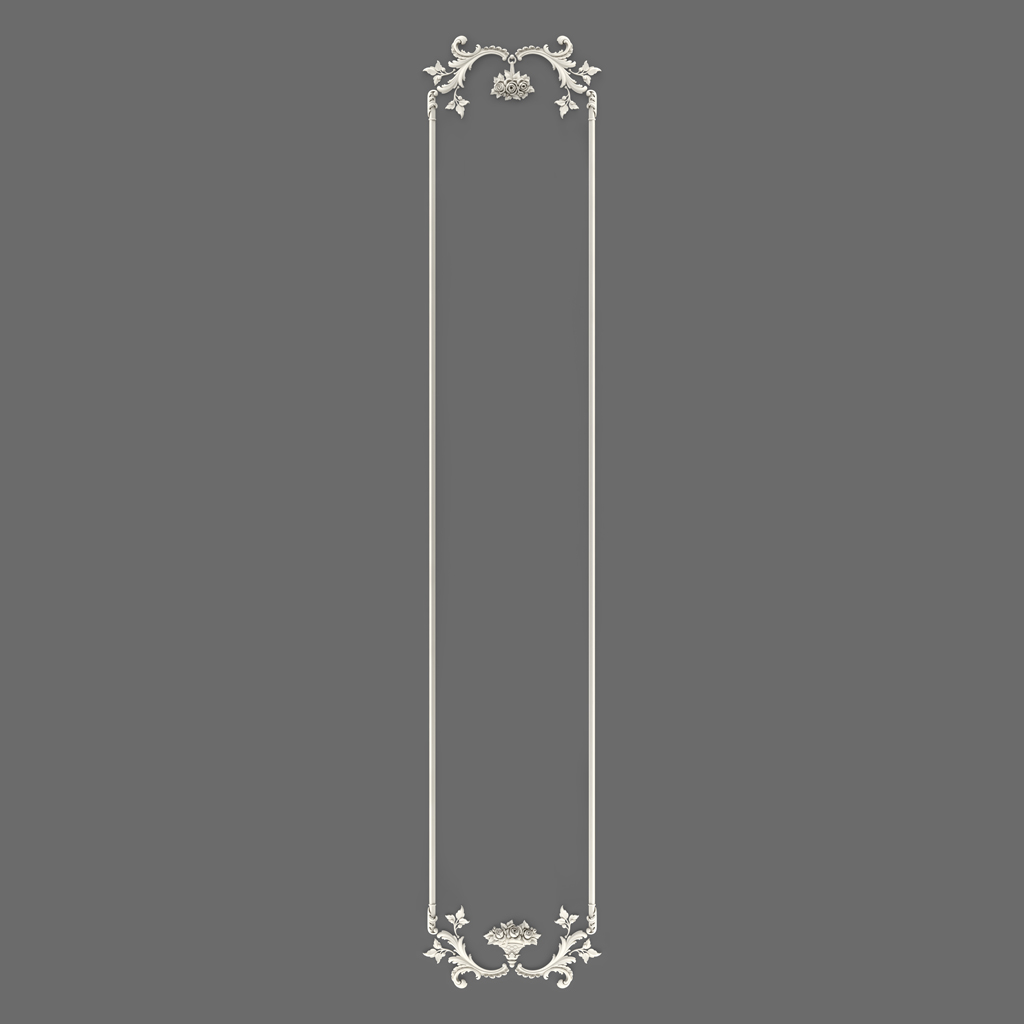
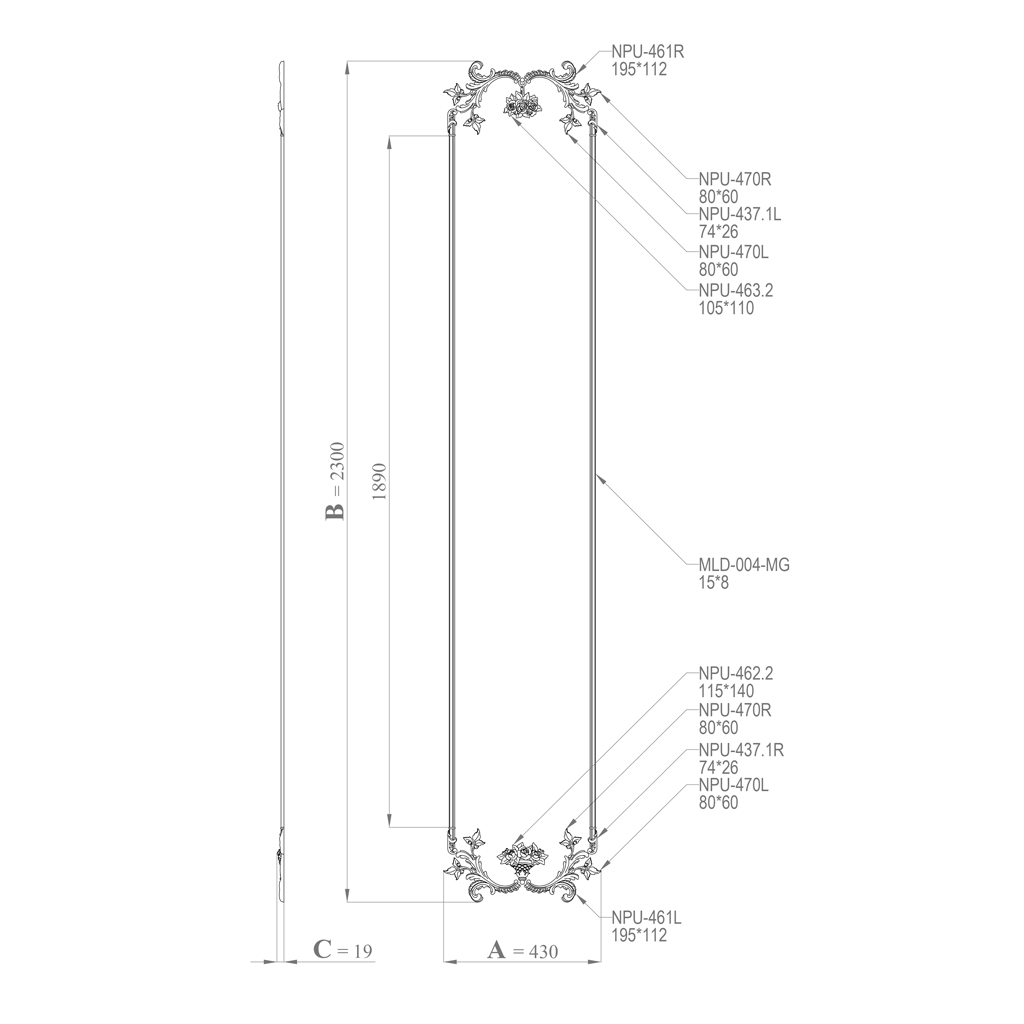
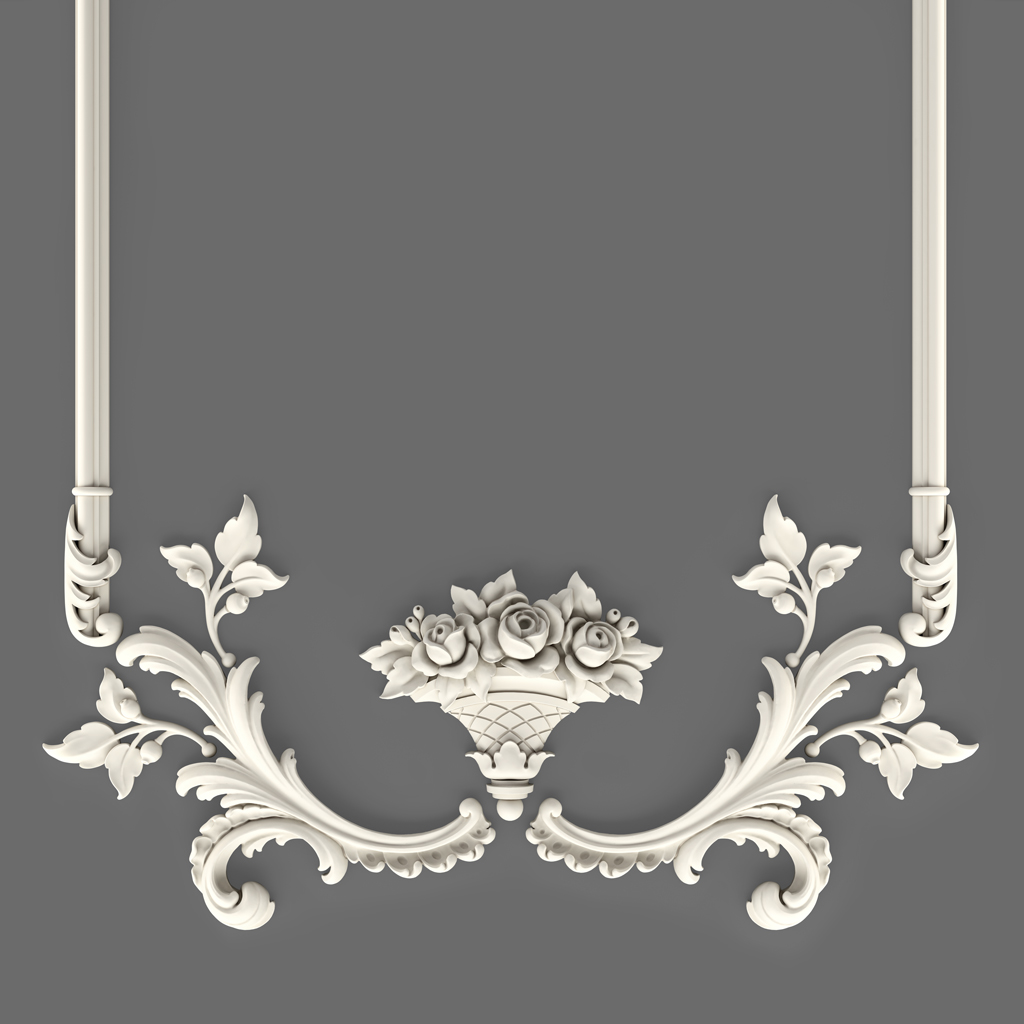
The CPU-8-1 Molding Decor Set from the "Summer Garden" collection is a vertical decorative wall panel measuring 430 × 2300 × 19 mm, representing one of the most distinctive and poetically expressive lines in the polyurethane decor assortment. Unlike the "Versailles" collection with its strict geometric language of boiserie and academic Baroque ornamental vocabulary, the "Summer Garden" collection draws inspiration from a fundamentally different source — living nature, images of a blooming garden, and the free organic forms of leaves, flowers, stems, and branches. In the European decorative tradition since Louis XV and the Rococo era, these have consistently been contrasted with the strict geometry of Classicism as symbols of naturalness, freedom, and lyrical beauty. CPU-8-1 is the foundational, starter set of this collection — it establishes its decorative vocabulary, its plastic language, and its architectural logic, upon which all broader and ornamentally richer formats of the CPU-8 series are built. Nine carefully selected components — one load-bearing molding MLD-004-MG with a profile unique to the series (15 × 8 mm), six polyurethane ornamental decors with natural motifs, and a pair of mirrored corner accents NPU-437.1L/R — create an ornamental program within the 430 mm width and 2300 mm height, where every square centimeter of the surface tells the story of a summer garden: blooming, alive, saturated with light and the movement of organic forms.
The fundamental distinguishing feature of CPU-8-1 compared to all panels in the "Versailles" collection is the principle of ornamental asymmetry within global symmetry. The "Summer Garden" decorative system is built not on strict geometric axes and mirror repetitions, but on the organic rhythm of natural forms: the paired mirrored decors NPU-461L and NPU-461R, NPU-470L and NPU-470R create the overall symmetry of the system, but each individual element carries a living, freely unfolding ornamental form, perceived as a sketch from life rather than an architect's blueprint. It is precisely this combination — architectural symmetry as a supporting principle and living organic form as decorative content — that creates the special character of the "Summer Garden" collection, unmistakably distinguishing it from any other decorative system: it is simultaneously organized and alive, ordered and free, architectural and poetic.
"Summer Garden" Collection: Natural Ornament in the Tradition of European Rococo and Art Nouveau
To understand the decorative program of CPU-8-1, it is necessary to refer to the two main historical sources of the ornamental language of the "Summer Garden" collection — 18th-century Rococo and the Art Nouveau style at the turn of the 19th–20th centuries. Both movements share a fundamental commitment to natural organic form as the primary source of decorative inspiration — a stance directly opposing the geometric rationalism of Classicism.
Rococo, which emerged in France during the Regency of Philippe d'Orléans and flourished under Louis XV, was a reaction to the monumental solemnity of Versailles Baroque: Rococo decor became smaller, more intimate, delicate, and natural. Shells, leaves, flowers, branches — all these motifs, already present in Baroque ornament, came to the forefront in Rococo, freed from strict symmetrical discipline and acquiring the character of living, free growth. The famous 'rocaille' — asymmetrical scrolls of leaves and shells — became the symbol of this style: a decorative element that reveals new details with each viewing, never repeats exactly, and creates a sense of natural diversity within ornamental order.
Art Nouveau (known in Russia as 'Modern'), which emerged at the end of the 19th century, took the next step in the same direction: natural organic form became not just an ornamental motif, but a structural principle of architecture and decor. Irises and lilies, ivy and wisteria, dragonflies and butterflies — the entire world of living nature entered the decorative vocabulary of Art Nouveau with a completeness unmatched before or since in any other style. The famous St. Petersburg 'Summer Garden' with its cast-iron fence, where each section is a unique ornamental work with plant and zoomorphic motifs, is one of the pinnacle examples of applying natural ornament in an architectural context — and it is precisely this tradition that is the main source of inspiration for the "Summer Garden" collection.
The elements of the collection — symmetrical leaf decors NPU-461L/R, central floral medallions NPU-462.2, corner plant accents NPU-463.2, delicate small decors NPU-470L/R — reproduce an ornamental language at the intersection of Rococo and Art Nouveau: organic forms, free from academic strictness, yet organized into an architecturally coherent system. This is a language that creates in the interior a sense of living nature, framed within architectural order — a garden, geometrically organized yet filled with living, breathing plants.
Composition of the CPU-8-1 Set: Nine Components and Their Decorative Roles
The architectural logic of the CPU-8-1 set is built on a hierarchy of nine components, each occupying a specific place in the decorative program of the panel and performing its unique ornamental function. Examining each element in its functional and historical context allows for a complete understanding of the decorative intent of the system.
Molding MLD-004-MG (15 × 8 × 2600 mm) — Load-Bearing Contour with Natural Scale
The MLD-004-MG molding with a 15 × 8 mm profile is the only load-bearing linear element of the CPU-8-1 set, and its dimensions alone declare a fundamentally different architectural approach compared to the moldings of the "Versailles" collection. The 15 × 8 mm profile — significantly thinner than the external molding MLD-003-MG (35 × 12 mm) from the Versailles system — creates a delicate, gentle frame line, organically suited to the character of natural decor. In the "Summer Garden" collection, the molding does not play the role of an architectural load-bearing frame that sets a monumental scale for the system, but rather that of a light, airy frame that tactfully holds the living organic decor within architectural boundaries without competing with it in decorative weight. A profile width of 15 mm with an overall panel width of 430 mm means the molding occupies 30 mm (15 mm on each side) out of 430 — less than 7% of the total width. This is the smallest share of load-bearing contour among all systems in the series, creating a sense of a maximally open, free internal field — precisely the space needed for the living organic decors of the "Summer Garden" to fully unfold their ornamental program. The material — medium-density fiberboard (MDF) with factory-applied white acrylic primer — ensures absolute straightness of the profile along its entire 2600 mm length and geometric stability under normal operating conditions. The 2600 mm length exceeds the full panel height of 2300 mm with a 300 mm allowance for trimming — without lengthwise joints, which is a mandatory condition for high-quality installation of vertical load-bearing elements.
NPU-461L and NPU-461R (195 × 112 × 13 mm) — Symmetrical Leaf Overlays for the Upper Zone
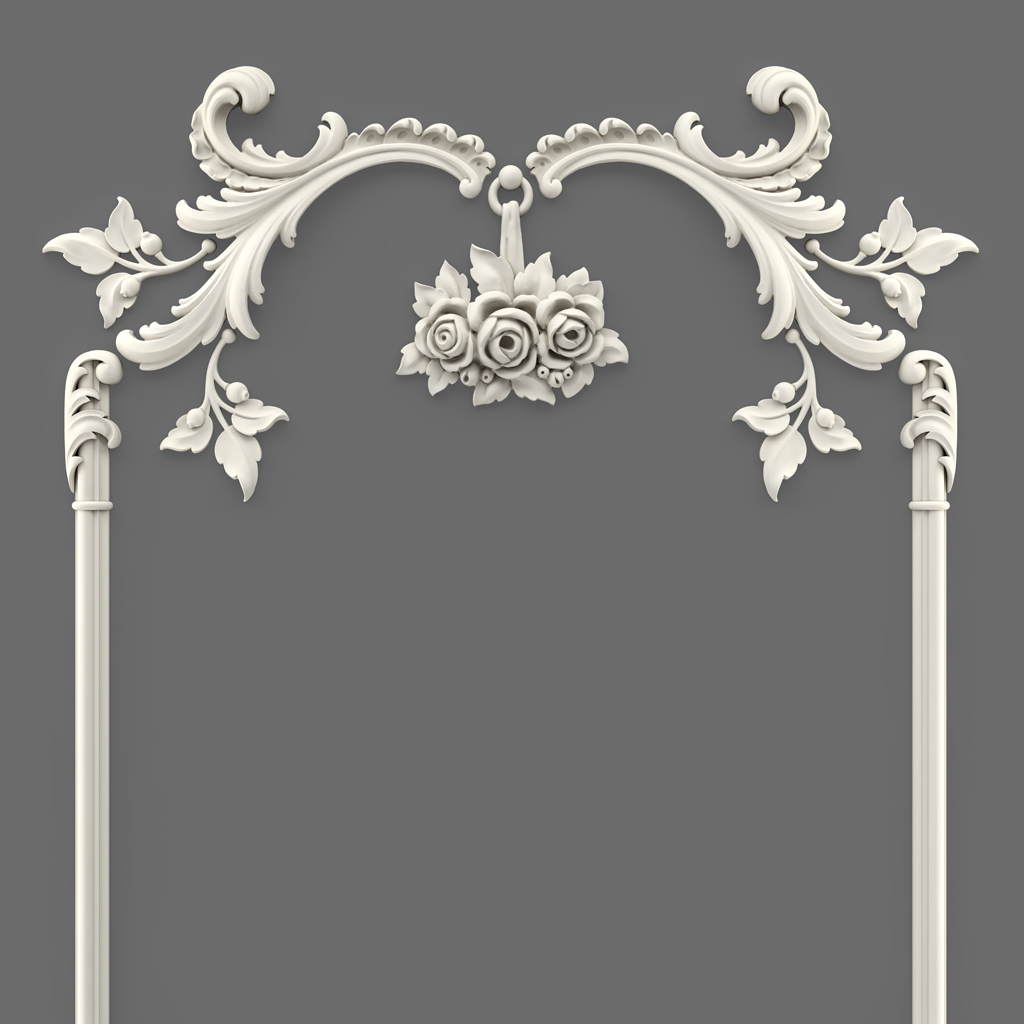
The pair of symmetrical decors NPU-461L and NPU-461R, sized 195 × 112 × 13 mm, is one of the key ornamental accents of the CPU-8-1 system. Their horizontally elongated proportions — width 195 mm, height 112 mm, aspect ratio approximately 1.74:1 — create a pronounced horizontal motif that, in a vertically oriented panel, functions as a structuring transverse accent, establishing horizontal rhythmic reference points within the tall vertical surface. The left overlay NPU-461L and the right NPU-461R are positioned mirror-symmetrically relative to the vertical central axis of the panel: together they form a horizontal ornamental pair, perceived as a single two-sided decorative motif, divided at the center. A relief depth of 13 mm with a width of 195 mm creates an expressive plastic form with rich chiaroscuro. The ornamental program of these overlays belongs to the natural vocabulary of the "Summer Garden": unfolding leaves, curved stems, soft scrolls of organic forms — motifs that in the Art Nouveau decorative tradition adorned brackets, cartouches, and horizontal belt ornaments. The NPU-461L/R pair is applied in the upper zone of the panel's internal field, creating a horizontal ornamental accent in the area that is first caught by the eye upon entering a room.
NPU-462.2 (115 × 140 × 19 mm) — Central Floral Medallion with Maximum Relief
The NPU-462.2 molding decor, sized 115 × 140 × 19 mm, is the central ornamental event of the entire CPU-8-1 system and carries the maximum relief depth — 19 mm, matching the maximum relief depth of the panel itself. This vertically oriented element with an aspect ratio of approximately 1:1.2 is positioned at the center of the panel's internal field along the vertical axis — the geometric center of gravity of the entire system, around which the ornamental program of the other decors is organized. A relief depth of 19 mm with an ornamental field width of 115 mm creates a relief/width ratio of about 16.5% — an exceptionally high indicator of plastic expressiveness, ensuring the richest play of shadows under any lighting. It is precisely the 19 mm relief that makes NPU-462.2 that "sculptural center" perceived as genuine handcrafted molding, not a flat stamped decor. The ornamental program of NPU-462.2 is a floral medallion: a central floral motif, surrounded by leaves and organic scrolls, creates the image of a blooming garden in its concentrated, medallion embodiment. Such floral medallions adorned the central fields of wall sections in Rococo and Art Nouveau interiors — from the small apartments of Versailles under Louis XV to Art Nouveau mansions of the early 20th century.
NPU-463.2 (110 × 105 × 16 mm) — Rosette Accent for the Transitional Zone
The NPU-463.2 molding decor, sized 110 × 105 × 16 mm — an almost square element with an aspect ratio of 1:0.95 — is a decorative accent for the transitional zone between the central medallion NPU-462.2 and the lower leaf decors of the system. With a width of 110 mm and height of 105 mm, this element creates a dense, compact ornamental motif with a relief of 16 mm — two millimeters shallower than the central medallion NPU-462.2 (19 mm), establishing a correct hierarchy of reliefs in the system: the central element has maximum relief, all others have slightly less. This hierarchy of relief depth is an architecturally sound technique: when the system is painted monochromatically in a single white tone, it is precisely the difference in relief depth that creates a visual hierarchy of elements under side lighting — the central decor casts deeper shadows and is perceived as the main accent, NPU-463.2 as a secondary but important ornamental episode. The ornamental program of NPU-463.2 belongs to the same natural vocabulary: a rosette motif with leaves and petals, close to the traditional "rosette" of classical ornament, but executed in the free, organic manner of the "Summer Garden."
NPU-470L and NPU-470R (80 × 60 × 8 mm) — Small Horizontal Overlays for the Lower Zone
A pair of small horizontal overlays, NPU-470L and NPU-470R, measuring 80 × 60 × 8 mm, occupies the lower ornamental zone in the CPU-8-1 system and serves as a decorative 'base' for the larger upper elements. Their modest dimensions—80 mm wide, 60 mm high—and a delicate 8 mm relief create subtle, unobtrusive lower accents. When viewing the entire system, they are perceived as a concluding ornamental stanza—a quiet finale following the rich ornamental statement of the upper and central zones. The mirror symmetry between the left NPU-470L and right NPU-470R ensures horizontal decorative balance in the lower zone, echoing the symmetry of the upper pair NPU-461L/R and establishing an overall rhythmic structure. In this structure, the upper and lower horizontal pairs of symmetrical accents frame the central vertical axis featuring the NPU-462.2 and NPU-463.2 medallions. Despite the minimal 8 mm relief—the smallest in the system—these elements carry a full ornamental load: when viewed up close, their natural ornamental motif is clearly legible. This level of detail is particularly important in the lower zone, at the level of hands and gaze during close inspection.
NPU-437.1L and NPU-437.1R (74 × 26 × 12 mm) — corner accents for molding.
A pair of polyurethane corner accents, NPU-437.1L and NPU-437.1R, measuring 74 × 26 × 12 mm, is a specialized addition to the MLD-004-MG molding. They are designed for the decorative finishing of the molding's corner intersections and, according to the catalog description, are part of the 'kit for MLDPU-004'. These elements are installed at the corner joints of the frame outline, concealing the technical points where the molding's end cuts meet beneath lively ornamental motifs in the 'Summer Garden' style. With a width of 74 mm and a height of 26 mm, the corner accents feature a horizontally elongated ornamental motif with a 12 mm relief—deep enough for expressive plasticity when viewed up close. Symmetry between the left and right overlays is mandatory: the corner accents are installed in pairs in mirror-symmetrical positions, ensuring decorative balance at each corner node of the system.
Spatial organization of the system: how nine elements create a unified whole.
The decorative program of the CPU-8-1 kit unfolds vertically across a panel height of 2300 mm within several ornamental zones, clearly organized relative to the vertical central axis. This spatial distribution is not arbitrary—it reproduces the principles of vertical ornamental organization characteristic of the finest examples of historical interiors with natural decor.
The upper zone, located approximately in the upper third of the inner field's height, is the zone of first impression—the area of the wall a person sees first upon entering a room and from a normal viewing distance. This is where the horizontal pair NPU-461L/R, measuring 195 × 112 mm—the widest and most horizontally oriented ornamental elements in the system—is positioned. They create a powerful horizontal accent in the upper zone, visually 'anchoring' the panel at the top and preventing a sense of instability in the vertical system. The central zone—the area of the golden section vertically, approximately at the 850–1000 mm mark from the bottom edge—is the zone of the main ornamental event. Here resides the central medallion NPU-462.2, measuring 115 × 140 mm with a maximum relief of 19 mm—the main decorative accent that draws the eye and creates the ornamental focus of the entire system. The transitional zone, between the central medallion and the lower accents, is occupied by the rosette decor NPU-463.2, which creates an ornamental bridge between the two main zones and prevents emptiness in this part of the field. The lower zone—approximately the lower third—features the small horizontal overlays NPU-470L/R, which create a lower symmetrical pair echoing the upper pair NPU-461L/R and complete the vertical ornamental program with a decorative 'base'. The corner accents NPU-437.1L/R are positioned at the corner points of the MLD-004-MG molding's frame outline, decoratively finishing all geometric transition nodes of the system.
Natural ornament as an architectural strategy: why the 'Summer Garden' works so organically in interiors.
One of the most important virtues of the 'Summer Garden' collection, and the CPU-8-1 kit in particular, is their ability to 'soften' an interior—to imbue it with a sense of life, warmth, and organic quality, which is fundamentally impossible when using strictly geometric decorative systems. This property of natural ornament has been known since antiquity: Greek masters adorned temples with acanthus leaves precisely because living plant motifs softened the monumentality of stone architecture and introduced a sense of natural lightness and growth. In modern residential interiors, this property is especially valuable: urban apartments, surrounded by the rectilinear geometry of concrete and glass, crave living organic forms that remind one of nature and create a sense of coziness, warmth, and an organic connection with the surrounding world.
The decors of the 'Summer Garden' collection—leaves, flowers, stems, natural scrolls—create precisely this sensation when viewing a finished panel: a living natural presence introduced into an architectural form. They do not shout about their ornamental status, like the monumental medallions of a Versailles system—they whisper, lyrically and tenderly, about a blooming garden, summer sun, and green shadows. This lyrical character makes the 'Summer Garden' collection ideal for bedrooms, children's rooms, personal studies, libraries—all those spaces where a person spends time in solitude and where excessive solemnity of decor would be inappropriate.
At the same time, CPU-8-1 is an architecturally serious product with a full-fledged, multi-component ornamental program—it is not 'light' in the sense of decorative insufficiency. Nine carefully composed elements within a 430 mm width create an ornamental density quite comparable to the basic versions of the wide panels in the 'Versailles' collection—but it is an ornamental density of a different quality, a different character: not architectural-monumental, but living, organic, lyrical.
The 'Summer Garden' collection and the 'Versailles' collection: a comparative architectural portrait.
Understanding CPU-8-1 would be incomplete without juxtaposing the two key collections—'Versailles' and 'Summer Garden'—as two fundamentally different architectural approaches to wall decoration. This comparison is important for designers and clients making decisions about system selection.
The 'Versailles' collection appeals to architectural reason: its ornamental language is subordinated to strict geometric discipline, its moldings create clear rectangular frames, its medallions fill these frames according to the laws of symmetry and academic ornamentation. A Versailles interior is, first and foremost, an architectural statement: solemn, significant, monumental. It speaks of status, power, and cultural tradition. The 'Summer Garden' collection appeals to feeling: its ornamental language is free, organic, lyrical. Its decors are not rigidly inscribed within geometric frames—they breathe freely in the open field of the panel. Its leaves and flowers speak of nature, the beauty of the living world, personal space, and coziness.
Neither of these two concepts is 'better' in an absolute sense—they solve fundamentally different interior tasks. Versailles decor is for formal spaces: living rooms, halls, foyers, where making an impression is important. 'Summer Garden' decor is for personal spaces: bedrooms, studies, children's rooms, winter gardens, where creating coziness and a sense of living nature is important. Professional interiors often use both systems simultaneously: Versailles decor in the formal zone, 'Summer Garden' in the private zone—and it is precisely such a solution that creates an interior space possessing both solemnity and warmth, architectural significance and personal lyricism.
430 mm width: the architectural potential of the medium format.
The 430 mm width, which defines the CPU-8-1 format, holds a special place in the hierarchy of the CPU-8 series formats. It is significantly wider than narrow divider strips (150–300 mm) but narrower than the wide panels of the CPU-8 series with their 800 mm format. 430 mm is the 'medium,' most universal format, opening the widest possible range of architectural applications.
In piers between window openings with widths of 400–500 mm, the CPU-8-1 panel fits perfectly, filling the space from baseboard to cornice and transforming a technically necessary pier into a decoratively significant architectural element. In an independent rhythmic row along a wall, several CPU-8-1 panels with equal inter-panel intervals create a light, airy ornamental grid that structures the wall surface without weighing it down. As a framing element on the sides of a door or window opening, the CPU-8-1 panel creates decorative side framing, giving the opening a lyrical-natural character. In a mixed system with wider CPU-8-2 or CPU-8-3 panels—as a divider element with its own ornamental program, creating rhythmic alternation of formats.
Technical specifications: complete data for designers.
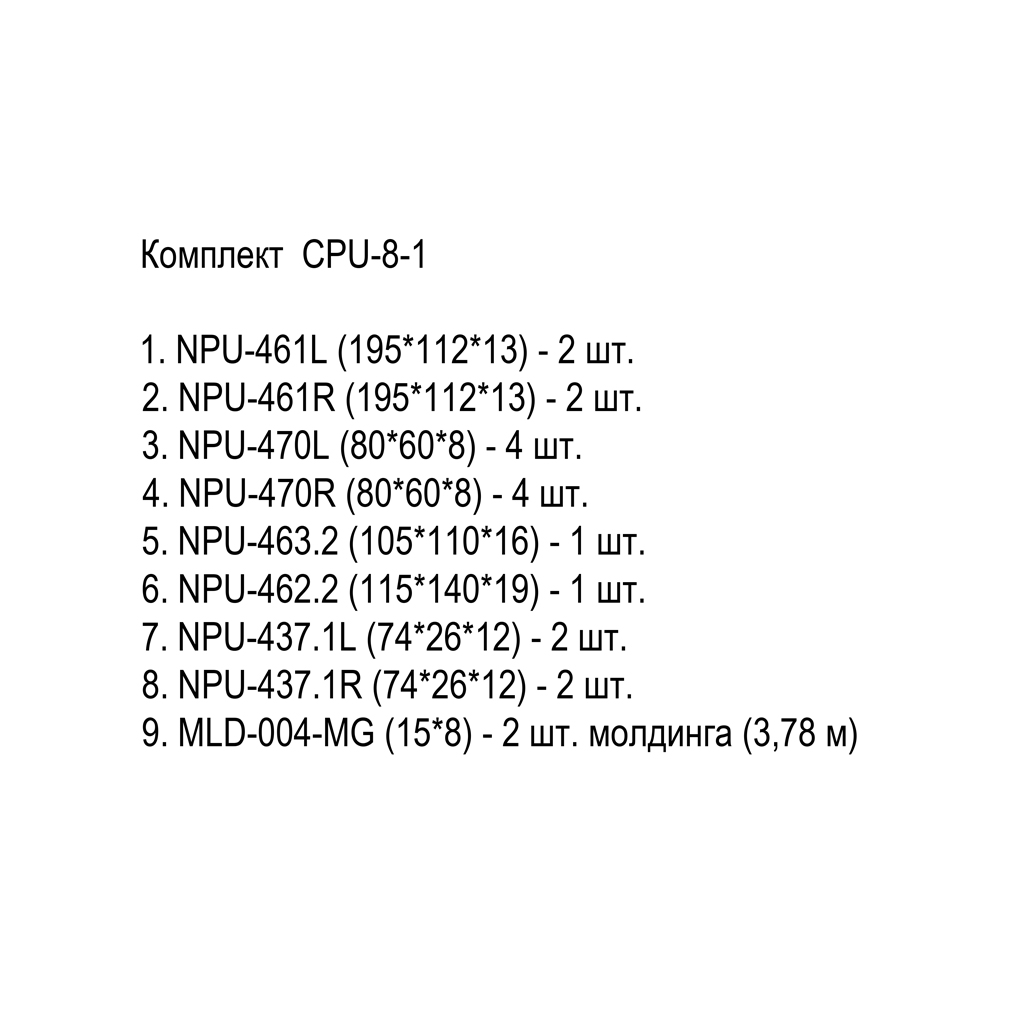
The CPU-8-1 kit creates a vertical decorative panel with overall dimensions of 430 × 2300 mm and a maximum relief depth of 19 mm—the central medallion NPU-462.2. Full component composition: primed MDF molding MLD-004-MG, profile 15 × 8 mm, length 2600 mm—one unit; polyurethane molded decor NPU-461L, size 195 × 112 × 13 mm—one piece; polyurethane molded decor NPU-461R, size 195 × 112 × 13 mm—one piece; polyurethane molding NPU-437.1L, size 74 × 26 × 12 mm—one piece; polyurethane molding NPU-437.1R, size 74 × 26 × 12 mm—one piece; polyurethane molded decor NPU-462.2, size 115 × 140 × 19 mm—one piece; polyurethane molded decor NPU-463.2, size 110 × 105 × 16 mm—one piece; polyurethane molded decor NPU-470L, size 80 × 60 × 8 mm—one piece; polyurethane molded decor NPU-470R, size 80 × 60 × 8 mm—one piece. Total: nine individual items across nine nomenclature positions. All ornamental polyurethane elements are supplied with factory white acrylic primer. MDF molding—with 'Prestige' primer (detailed manual sanding). Material of the supporting molding—medium-density fiberboard (MDF). Material of ornamental decors—high-density rigid polyurethane.
The use of high-density rigid polyurethane for the ornamental decors of the 'Summer Garden' collection is particularly justified compared to any other material, precisely in the context of natural motifs with their thin, complex reliefs. Leaves, flowers, stems—all these ornamental forms have complex three-dimensional geometry with numerous thin and undercut details: leaf veins, flower petals, veins and contours of organic forms require reproduction accuracy unattainable in any other technological process except pressure casting from a homogeneous material. Plaster cast in a mold reproduces fine details but has limited strength—thin leaf veins and thin petals chip at the slightest mechanical impact. Polystyrene foam is easy to cut but does not provide the necessary detailing. High-density polyurethane simultaneously ensures casting precision, flexural strength, and impact resistance—making it an ideal material for finely-relief natural ornaments with their numerous fragile details. With a relief of 19 mm for the central medallion NPU-462.2 and an overall element width of 115 mm, individual ornamental details—petals, leaves, scrolls—can have a thickness of less than 5 mm. Polyurethane maintains mechanical strength at such small cross-sections for decades, whereas plaster would inevitably destroy such details upon first accidental contact.
The water absorption coefficient of polyurethane, less than one percent, makes all elements of the 'Summer Garden' collection applicable in rooms with high humidity—bathrooms, kitchens, swimming pools—where natural motifs are especially organic and appropriate. Temperature stability from −60°C to +100°C ensures applicability in unheated verandas and loggias—spaces maximally close to nature, where the 'Summer Garden' decor creates a particularly organic image. Estimated service life—30–50 years without degradation of decorative properties.
The polyurethane's water absorption coefficient of less than one percent makes all items in the 'Summer Garden' collection suitable for use in high-humidity areas—bathrooms, kitchens, and swimming pools—where natural motifs are especially organic and fitting. Temperature stability from −60°C to +100°C ensures applicability on unheated verandas and loggias—spaces that are as close to nature as possible, where the 'Summer Garden' decor creates a particularly harmonious look. The estimated service life is 30–50 years without degradation of decorative properties.
Color and finish solutions: how to 'bring to life' the summer garden in an interior.
The range of finish color solutions for CPU-8-1 is determined by the natural character of the ornamental program and creates fundamentally different imagery possibilities compared to monumental Versailles systems.
White monochrome — maximum plasticity. A unified white finish for the entire system—MLD-004-MG molding, all seven ornamental decors, and the panel field—matching the wall color creates a system where the relief from 8 to 19 mm is read exclusively through light and shadow. With side lighting from natural light or directional fixtures, leaves and flowers 'come alive' in the play of shadows, creating a sensation of genuine sculptural natural stucco.
Green background with white decors — botanical character. A dark green, sage green, or olive wall background with white 'Summer Garden' ornamental decors creates an image of a botanical garden—natural, saturated, organic. Such color solutions are characteristic of interiors in the maximalist and biophilic design styles.
Creamy white with green tinting on decors. A delicate green patina or glaze applied only to the ornamental elements, with white moldings and a cream background, creates an image of living stucco covered with a light patina—a motif characteristic of interiors in the Provencal and shabby chic styles.
Aged warm white. A creamy white base coat with an umber glaze in the recesses of the relief imitates natural aging and creates the illusion of historical stucco 'with a history'—an organic solution for all variants of interiors in a classical or Provencal spirit.
Golden patina on decors. Gold on leaves and flowers, with white moldings and a light background, creates an image of gilded garden ornamentation, referencing the decorative traditions of the Grand Trianon and Rococo interiors.
Application in various types of interiors: specific scenarios.
Bedroom. The CPU-8-1 set is one of the most organic solutions for decorating the wall behind the bed headboard in a bedroom. The natural character of the ornament creates an atmosphere of a secluded garden—gentle, lyrical, and conducive to rest. One or two CPU-8-1 panels on the headboard wall, with neutral other walls, create a delicate, cozy decorative accent without excessive formality.
Children's room. The natural motifs of the 'Summer Garden'—leaves, flowers, organic forms—are organically perceived in a children's space, creating a connection with the living natural world. CPU-8-1 panels in a children's room in pastel natural tones—mint, soft green, peach—create a cozy, lively decor that is both safe (polyurethane is non-toxic and impact-resistant) and aesthetically rich.
Winter garden and veranda. Transitional spaces between the house and garden—winter gardens, glazed verandas, loggias—are the ideal area for applying the 'Summer Garden'. Natural decor on the border between architecture and living nature creates a meaningful spatial integrity—decorated walls echo with living plants, forming a unified image.
Bathroom. The moisture resistance of polyurethane makes CPU-8-1 applicable in bathrooms, where natural motifs—flowers and leaves—create an image of a botanical garden in the intimate space of water treatments. A solution characteristic of high-class interiors in hotels and spa centers.
Restaurant and café with a garden theme. In commercial establishments with a concept of 'food and nature', 'garden and coziness', the decor of the 'Summer Garden' collection on walls creates an imaginative environment that organically supports the establishment's concept and creates a memorable visual image.
Installation of the CPU-8-1 set: nuances of working with natural decor
Installation of CPU-8-1 is technically similar to mounting any other set in the series but requires special attention to positioning paired mirror elements—NPU-461L/R and NPU-470L/R. Failure to maintain symmetry when placing paired overlays immediately disrupts the architectural balance of the system.
Preparation stage: marking the vertical central axis of the panel with a laser level; marking horizontal axes of all ornamental elements vertically; leveling the surface if necessary; priming with acrylic primer. First installation stage: attaching the supporting molding MLD-004-MG—two vertical sections at full height with 45° miter cuts at upper and lower nodes; fixing with mounting adhesive and securing with screws every 50–60 cm; installing corner accents NPU-437.1L/R into the corner nodes of the molding. Second stage: installing the upper pair NPU-461L and NPU-461R strictly along the central axis of symmetry at equal distances from the center to the edges; checking horizontal alignment with a laser level. Third stage: installing the central medallion NPU-462.2 strictly along the vertical central axis at the calculated height. Fourth stage: installing the rosette accent NPU-463.2 along the central axis at the calculated distance from NPU-462.2. Fifth stage: installing the lower pair NPU-470L and NPU-470R mirror-symmetrically along the central axis. Final stage: filling all joints with white acrylic sealant, sanding, and final painting.
Durability and renewal: 'Summer Garden' for decades
The estimated service life of all polyurethane elements of CPU-8-1 is 30–50 years without degradation of decorative properties. The natural ornamental motifs of the collection do not age or go out of style: leaves and flowers remain relevant in interiors of any era and through any stylistic trend shifts. Maintenance involves a soft brush with natural bristles to remove dust from recesses in the relief and a soft cloth with a neutral soap solution for wet cleaning. If wishing to update the color scheme, the entire system can be repainted without dismantling—a new color image with the same ornamental program is created within one working day. The CPU-8-1 set from the 'Summer Garden' collection is an architectural investment in interior design with a long-term horizon: lyrical natural decor, embodied in a technologically advanced modern material, will adorn and enliven the space for decades, remaining consistently relevant and consistently beautiful—like the summer garden itself, which blooms anew each summer.
Your request has been sent!
Our manager will contact you within 5 minutes