











































































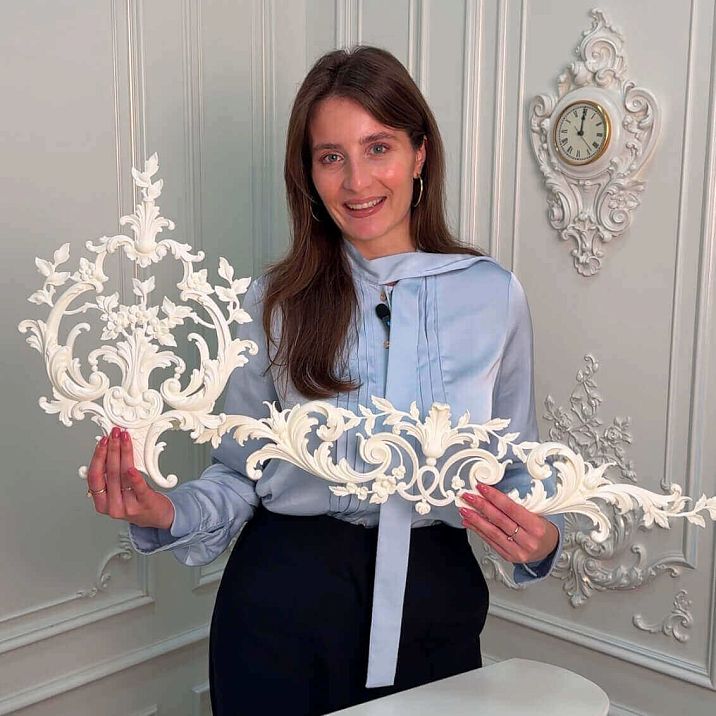

CPU-8-3 Molding Decor Kit
Dimensions and Options
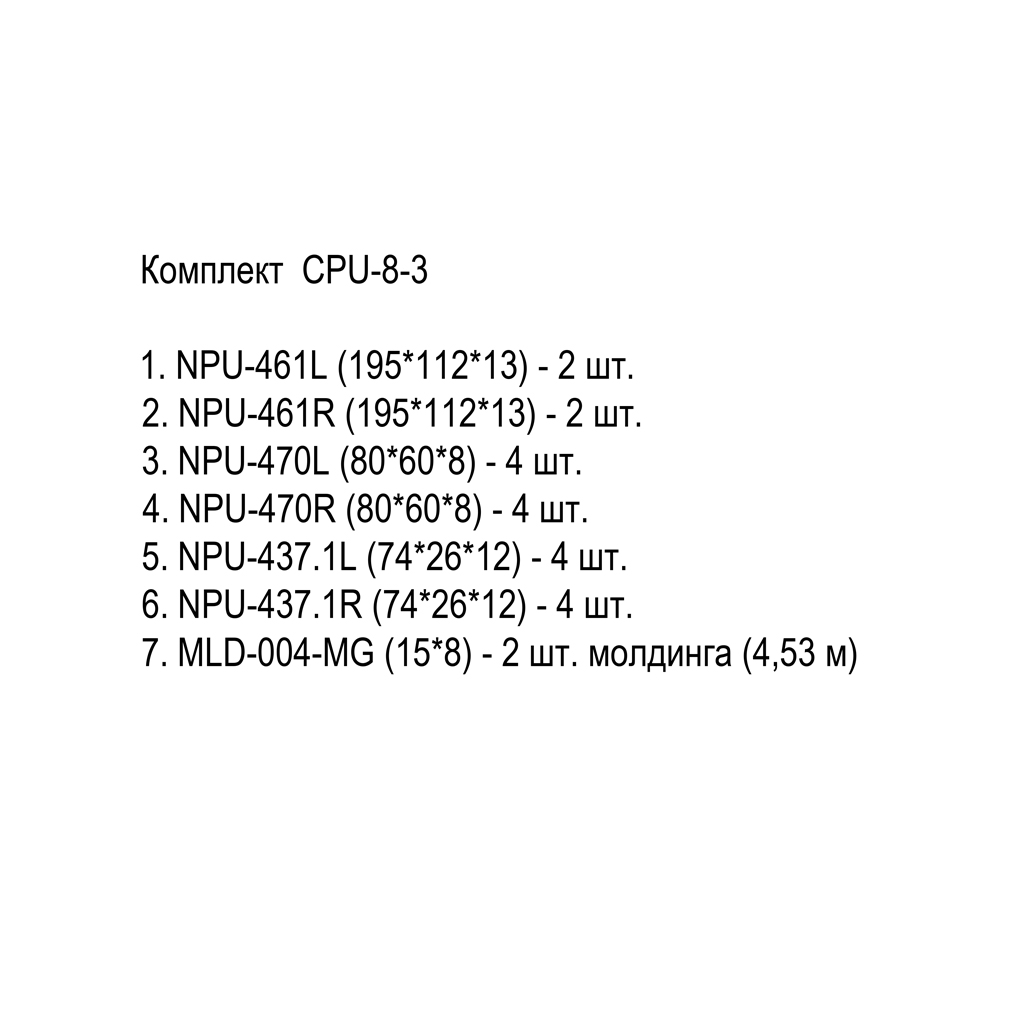
Set Composition


Have questions?
Customers also buy




Yulia Kh.
March 24, 2026
I was satisfied with the quality of the products; we purchased furniture legs. I would especially like to highlight the professionalism of manager Oksana—very client-oriented, competent, and precise specialist. She even arranged additional trimming of some elements as an extra service for us. Huge thanks!
Incognito 7.
March 24, 2026
One of the few firms that is pleasant to interact with on renovation matters. Adequate, responsive managers. Adherence to deadlines. Execution of even complex projects. Bravo! May there be more such firms!!
Marina D.
February 15, 2026
The company ordered the pens for us when we ordered furniture. But I decided to write a review personally because they are amazing! Stylish, expensive, high-quality!
More than 20 years on the market
The company's success began in 2002, when two artists — Andrey Ragozin and Evgeny Tsapko — created a small creative workshop for producing wooden carved items. The masters' work was quickly noticed, and within a year they were invited to participate in the reconstruction of the Konstantinovskiy Palace in Strelna.
After the success of this project, the company focused on recreating palace interiors, furniture, church furnishings, and carved decorations in various artistic styles. They worked with cultural heritage sites: The Hermitage, the Alexandrovsky Palace, the Troitsko-Izmaylovsky Cathedral, the Sheremetyevsky Mansion, and many others.
The masters' task — and still is — to create wooden items with the highest level of detail and understanding of every element, based on impeccable knowledge of artistic laws and interior styles.


STAVROS Guarantees
Quality of products without complaints
We save your time, peace of mind, and budget
Large warehouse program
We solve your tasks with maximum speed
Adherence to production deadlines
Streamlined process reduces all risks
Delivery from 1 piece throughout Russia
Quality service regardless of order volume
Your positive business reputation
Reliable partner — the foundation of your business
More products from the "Summer Garden" collection


Frequently asked questions
Our showrooms are located in Saint Petersburg and Moscow. Production is located in Saint Petersburg.
Moscow contacts: https://www.stavros.ru/contacts_all/?tab=msk
Contacts of Saint Petersburg: https://www.stavros.ru/contacts_all/?tab=spb
- Send request by email [email protected]
- Write to us at Telegram
- Write to us at WhatsApp
- Order by phone +7 (800) 555-46-75
- Visit our showroom in Saint Petersburg and Moscow
Yes, we ship orders throughout Russia and to CIS countries.
We cooperate with transportation companies such as СДЭК and DPD.
You can also arrange pickup of your order through any convenient transportation company for you.
Delivery cost depends on the size, weight of the item, and delivery address.
When placing an order, the delivery cost is calculated automatically and displayed as a separate line on our website.
Prices and availability of items on the website are always current. Data is updated daily.
Note: items in stock are stored on the warehouse in unpolished form and shipped within 3 working days.
If the item is not in stock, average production time: 5–10 working days.
This is the quality of polishing of the items.
Standard — machine polishing, at a more attractive price.
Prestige — detailed hand polishing, items do not require further work.
More details: https://www.stavros.ru/information/kachestvo/
This is the type of veneer of the items.
Under enamel: produced by gluing wooden laminates without color and texture matching. Contrast tonal and textural differences are noticeable. This blank should be chosen if the item is intended for opaque coating.
Under tinting: produced by gluing wooden laminates with color and texture matching. Tonal and textural differences may occur. This blank should be chosen if the item is intended for semi-transparent finish.
More details: https://www.stavros.ru/information/kachestvo/
Beech — dense, non-porous wood, most often used for items covered with enamel.
Oak — dense, porous wood with clearly visible natural grain. Due to its strength and decorative properties, it is often used in items with semi-transparent coating, highlighting the wood pattern.
Custom-made, if non-standard items are required, we can produce products from other types of wood, including blanks provided by the customer, manufactured according to our technical specifications.
All our furniture legs can withstand a vertical load of at least 100 kg.
Average production time for custom-made items: 5–10 working days.
Most items are stored on the warehouse in unpolished form. We need time to polish and pack orders.
Yes, we manufacture non-standard items according to individual projects, but we only accept orders with a minimum quantity.
We can manufacture items of the desired size, but we only work with bulk orders. For details, please consult the sales department manager.
Yes, some of our products can be used outdoors. For example, polyurethane items, as well as carved door casings made of pine.
Other items are produced to order using PUR glue, if minimum quantity is available. No warranty is provided for such products, as outdoor conditions are considered aggressive.
Yes, we paint items when ordering products for a total amount of 150,000 rubles or more.
- Dust removal. After sanding, the surface must be dusted.
- Priming. Apply primer in an even layer.
- Matting. After the primer has fully dried, the surface should be matted (lightly sanded for better adhesion).
- Finish coating. Apply finish coating: lacquer or enamel, in 2 layers, with interlayer drying.
More details: https://www.stavros.ru/information/sovety/
Apply adhesive to the decor. Place it on the surface and press briefly. Then, lift the decor from the surface and leave it open for 3–5 minutes. Press the decor firmly onto the surface and hold for 5–10 seconds.
More details: https://www.stavros.ru/information/sovety/
Ideally, you should prepare a design project before placing an order.
You can do this yourself by downloading drawings of our products from our website, or you can order a project from us.
If the number of decorative elements and fittings is small, our company's manager can assist you with selection.
Unfortunately, this service is not provided.
The packaging method depends on the type of items, but in each case, we ensure sufficient protection for safe transportation.
We most often use corrugated cardboard and stretch film. Fragile items are additionally secured on a rigid base to prevent damage during transport.
We ship all items starting from 1 piece.
Room measurements and item installation can be performed by our partners — carpentry companies represented in most regions of Russia.
Often searched in category Wall Decor
CPU-8-3 Molding Decor Kit — 'Summer Garden' Collection: a wide-format botanical panel for creating a total natural interior
When 800 mm becomes a botanical canvas: the architectural concept of CPU-8-3
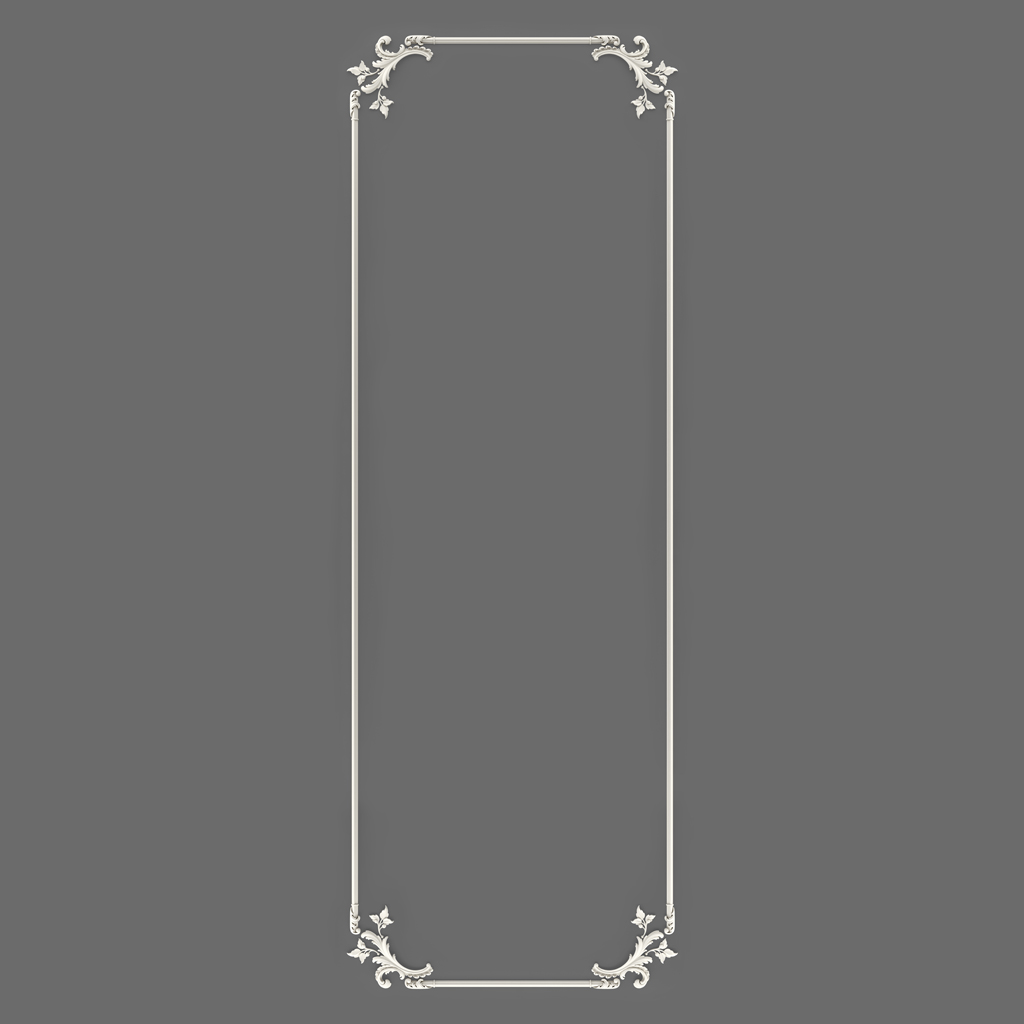
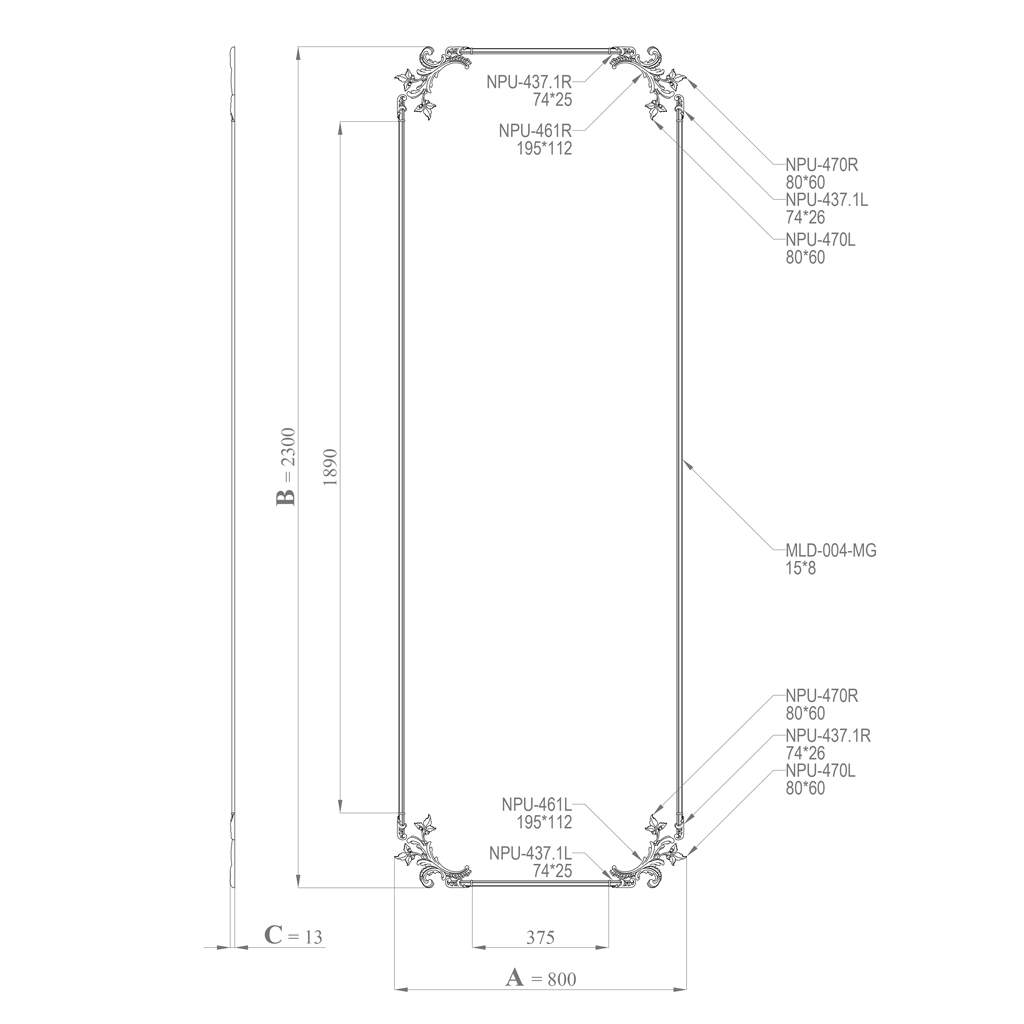
The CPU-8-3 Molding Decor Kit from the 'Summer Garden' collection is the widest vertical decorative wall panel in the CPU-8 series, measuring 800 × 2300 × 13 mm. It introduces a fundamentally new architectural scale to the collection's system and presents it in its most complete, monumental, wide-format embodiment. While the CPU-8-1 and CPU-8-2 kits operated within a 430-millimeter strip—compact enough for integration into wall sections and use as rhythmic dividers—the CPU-8-3, with its 800 mm width, moves to a different architectural scale. It is no longer an 'accent strip' but a full-format wall section, comparable in width to the wide Versailles panels of the CPU-5 series. It is capable of independently creating a total ornamental program for an entire wall, even in relatively small quantities—two, three, or four panels per wall.
The transition from 430 mm to 800 mm—almost doubling the width—signifies a fundamentally different decorative logic for the system. Across the 800 mm width unfolds not a 'narrative' in a narrow strip, but a full-fledged botanical canvas. The natural ornamental decors of the 'Summer Garden' collection gain sufficient horizontal space for symmetrical, free, breathing placement, where each element is perceived not as 'inserted' into a tight frame, but as organically positioned in an open natural field. This is a space of 'breath'—the very ornamental freedom that distinguishes the best historical examples of boiserie from interiors overloaded with decor: a wide panel field where natural decorative forms exist freely, without constraint, in correct proportions between ornamental events and decorative pauses. The maximum relief depth of 13 mm, characteristic of the CPU-8-3, is a fundamentally calibrated solution for the wide format. At a width of 800 mm, a 13 mm relief creates excellent plastic expressiveness without the 'aggressive' sculptural quality that, over large areas, could create an effect of overload. This is a delicate, refined relief, designed for perception precisely on a wide field—a relief that, with side lighting, creates a rich shadow pattern across the entire 800 × 2300 mm plane, transforming the panel into a three-dimensional architectural work.
The wide format in the history of decorative art: from royal apartments to modern classics
The history of wide-format decorative wall panels dates back to the same Versailles workshops of the 17th–18th centuries that created the entire European tradition of boiserie. Wide ornamental sections in the apartments of Louis XV, in the Hall of Mirrors at Versailles, and in the small studies and private salons of French châteaux occupied widths from 700 to 1200 mm—precisely in this range where the ornamental field is spacious enough to unfold a complex, multi-level decorative program. The CPU-8-3, with its 800 mm width, falls in the middle of this historical range and inherits precisely that large-scale tradition embodied in the 'Versailles' collection by the wide kits of the CPU-5 series.
The fundamental historical distinction of the CPU-8-3 from the wide panels of the 'Versailles' collection lies in the natural, organic character of its ornamental program. The Versailles wide sections were built on the geometric discipline of classicism: rectangular frames, central medallions, ornamental belts along axes of symmetry. The wide 'Summer Garden' CPU-8-3 is built on a fundamentally different decorative concept—that of natural ornament, which occupies the wide field with organic freedom, not subject to a rigid geometric grid. The leaves, flowers, stems, and organic swirls of the 'Summer Garden' collection, within the 800-millimeter field, create an image not of 'boiserie'—architecturally organized decorative paneling—but of a 'natural wall': a vertical botanical space where living natural forms are organized architecturally yet retain the character of free natural growth.
This concept harks back to two key historical traditions. The first is French tapestries (gobelins) with natural scenes, which in the royal apartments of the 17th–18th centuries covered walls between wooden pilasters, creating the image of a living garden within a stone palace. The second is decorative panels in the Art Nouveau style of the late 19th to early 20th centuries, which adorned wide wall sections of mansions with plant arabesques, floral garlands, and natural motifs in the spirit of Alphonse Mucha. The CPU-8-3 synthesizes both traditions: the architectural rigor of the 'Summer Garden' framing system and the natural freedom of botanical ornament unfolding in a wide, open field.
Format 800 × 2300 mm: proportions and their architectural meaning
The proportions of the CPU-8-3 panel—800 mm width at 2300 mm height, an aspect ratio of approximately 1:2.875—are architecturally significant and deserve separate consideration. This is the proportion of a moderately elongated rectangle, close to a 'double square' (1:2) and significantly wider than the 'portrait' proportion of narrow panels. At a height of 2300 mm (the standard height from baseboard to cornice in rooms with ceilings of 2.6–2.8 m), a width of 800 mm creates a panel that, when viewed from a distance of three to four meters, is perceived as a rectangle close to a square—a 'painting' on the wall, not a 'strip'.
This perception has fundamental architectural significance: narrow panels are perceived as rhythmic elements, parts of a sequence; wide panels are perceived as independent decorative objects, self-sufficient architectural events. The CPU-8-3 is precisely an 'eventful' format: a single such panel on a wall already creates a decorative statement; a row of three or four panels creates a total wall decoration. The 800 mm width is optimal from the perspective of interior proportions: with standard ceilings of 2.6–3.0 m, precisely this size creates a panel with those 'close-to-square' proportions, where the internal ornamental program is perceived most fully and expressively.
A maximum relief depth of 13 mm, with a field width of 800 mm, means that an average element with a relief of 10–13 mm occupies only 1.25–1.625% of the panel's width in terms of relief dimension. This is the smallest percentage ratio among all formats in the CPU-8 series, which defines the delicate, painterly character of the relief on the wide field—not sculptural, but precisely painterly: the relief creates not 'volumes' but 'strokes' on a wide background. It is this property that makes the CPU-8-3 closest in decorative character to historical painted murals, while retaining all the advantages of sculptural, three-dimensional ornament.
Molding system: how the frame for the botanical canvas is formed
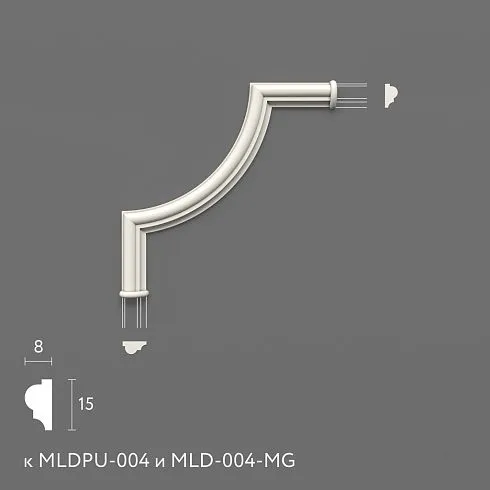
The frame contour of the CPU-8-3 panel is built on a molding system specifically formed for this wide format. In the 800-millimeter panel, the function of the load-bearing molding—to delineate the boundaries of the decorative field, create a clear contour separating the ornamental panel from the rest of the wall space—is realized with particular architectural consistency. At a width of 800 mm, the molding contour creates a decorative frame for the wide internal field. The principles of its construction can be compared to a frame for a large painting: the frame must be substantial enough to create a clear visual boundary, yet simultaneously delicate enough not to compete with the rich content of the internal field. The MLD-004-MG molding series, with its 15 × 8 mm profile inherited from the narrow-format CPU-8-1 and CPU-8-2 kits, acquires a different relative scale in the wide-format CPU-8-3 version: 15 mm on an 800 mm width is only 1.875% of the transverse dimension per side, creating an extremely delicate, almost immaterial contour. Precisely such delicacy of the frame in the wide format is the correct architectural solution: the frame indicates the decorative field but does not claim decorative primacy, preserving it for the natural ornamental decors within.
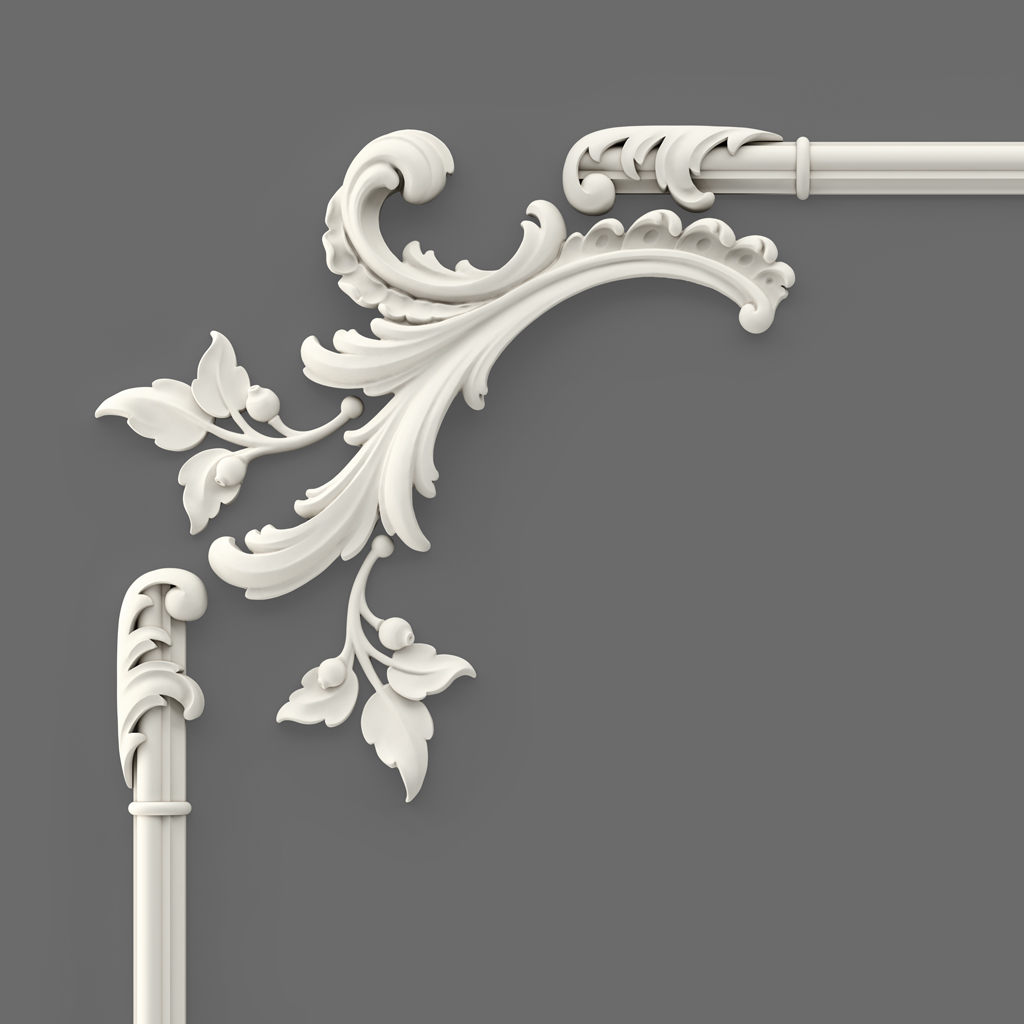
In the wide-format CPU-8-3 system, the corner accents at the intersections of the NPU-437.1L/R molding acquire increased decorative significance compared to narrow formats: with a wider field and correspondingly longer horizontal molding segments, the four corner nodes are perceived as more distantly spaced points, and each requires more expressive decorative treatment. This explains the fact that in wide-format systems, corner accents have greater relative importance than in narrow ones: they 'assemble' the wide frame into a unified system, visually connecting the four distant corners of the decorative field.
Ornamental program of the wide field: principles of decor placement in 800 mm
The transition from 430 mm (CPU-8-1 and CPU-8-2) to 800 mm (CPU-8-3) doubles not just the width but fundamentally changes the principle of ornamental organization of the internal field. In the 430-millimeter strip, decorative elements were practically inevitably arranged in a single vertical sequence: the field width did not allow for placing elements horizontally side by side, and the entire ornamental program was read as a vertical narrative. In the 800-millimeter field, a fundamentally new possibility emerges—horizontal grouping of elements: two decors placed side by side horizontally within the wide field create 'horizontal pairs' and 'horizontal groups,' which organize the panel space completely differently—not as a sequence, but as a 'scene' with characters placed on it.
Precisely this possibility of horizontal grouping is the main architectural advantage of the 800 mm format for natural ornament. Floral medallions, leaf decors, and organic overlays, which in the narrow format were forced to line up in a thread of vertical narrative, in the wide format create ornamental 'bouquets' and 'compositions'—groups of elements between which spatial relationships are established, similar to the relationships of plants in a natural garden: some elements 'bloom' in the center, others 'grow' on the sides, and others 'frame' the main composition from below and above. It is precisely this ability to create a full-fledged 'garden scene' within a single panel—not a linear narrative, but a three-dimensional natural composition—that makes the CPU-8-3 architecturally the most complex and decoratively the richest kit in the CPU-8 series.
The monumental decors of the collection—large leaf overlays NPU-461L/R, wide botanical panels NPU-464, and other large-format elements—unfold with fundamentally different completeness in the 800-millimeter field compared to the narrow 430-millimeter one. With an element width of 300 mm (NPU-464) and a field width of 800 mm, there remains about 250 mm on each side—space where side accent elements are organically placed to the right and left of the central decor, creating a three-part horizontal organization: center—side accent—side accent. This three-part horizontal structure is one of the fundamental principles of the classical decorative system: it reproduces the architectural principle of 'risalit—side wings,' 'medallion—side cartouches,' 'main motif—side repeats,' which in the history of interior decor is one of the most stable and universally perceived as 'correct.'
Natural ornament on 800 mm: decorative strategy of the wide format
In the context of the natural ornament of the 'Summer Garden' collection, the wide 800 × 2300 mm field creates several specific decorative strategies, each yielding a unique visual result.
Strategy 'Large Botanical Garden'
Central dominant—a monumental decor in the center of the field, symmetrically flanked by paired side elements. Horizontally: the central decor occupies a width of 300–350 mm, paired side elements 150–200 mm each, inter-element gaps of 50–75 mm. Vertically: several horizontal tiers with increasing or symmetrically decreasing scale of decors. Result—a botanical garden 'in cross-section,' where each tier is an independent floral-foliage scene, and the entire panel is perceived as a vertical slice of a natural landscape from ground to canopy.
Strategy 'Vertical Alley'
Two symmetrical vertical rows of large leaf decors are arranged parallel, with a central void or a central vertical row of small accent elements. Result—an image of two trees or climbing plants growing parallel on either side of a central axis: a natural, dynamic, living image distinguished by maximum vertical directionality.
Strategy 'Floral Field'
Uniform, rhythmic distribution of decors across the entire 800 × 2300 mm field without a pronounced central dominant: creates an image of wallpaper with a natural motif, but three-dimensional and relief. Decors repeat in a regular rhythm—in vertical rows or in a checkerboard pattern—creating a continuous natural fabric of ornament.
Each of these strategies is architecturally correct and delivers excellent results. The choice between them is determined by the nature of the space, the desired image, and the stylistic concept of the interior. It is precisely this multi-variant applicability of the large-format CPU-8-3 panel that distinguishes it from narrow formats, where the choice of strategy is limited to a single vertical narrative.
Maximum relief of 13 mm: the architectural function of delicate plasticity
The maximum relief depth of 13 mm in the CPU-8-3 system deserves separate consideration, as it is more moderate compared to the 19 mm in CPU-8-1 and CPU-8-2. This is not a random technical limitation—it is a deliberate architectural decision dictated by the logic of the wide format.
With the same absolute relief depth, the relative plastic expressiveness of an element depends on its size: on a small element 65 mm wide, a 13 mm relief creates a relief/width ratio = 20%—very high, creating a rich shadow pattern. On a large element 300 mm wide, the same 13 mm relief creates a ratio of only 4.3%—more delicate, painterly. In a wide 800 mm field, decorations of various scales are perceived from a greater distance than in a narrow 430 mm field, and it is precisely when viewed from a distance of four to five meters that the 13 mm relief provides the optimal lighting effect: deep enough to create discernible chiaroscuro, and delicate enough to avoid creating harsh shadow contrasts that disrupt the integrity of the wide decorative field.
The most important consequence of the 13-millimeter relief is the possibility of using LED lighting from any side angle without creating 'overexposure' of deep recesses, which with a deeper relief (19 mm) creates excessively contrasty, 'hard' shadows. The CPU-8-3 panel with a 13 mm relief is perfectly adapted for lighting—by wall sconces, directional spotlights, or LED strips in the cornice zone—whereby the organic natural forms of the 'Summer Garden' receive soft, volumetric lighting, close to natural daylight filtering through the foliage of a real garden.
The 'Summer Garden' Collection — CPU-8 Series: Architectural Evolution from 430 to 800 mm
CPU-8-3 is the third and widest kit in the CPU-8 series, and its place in the collection's evolutionary line deserves detailed description. The entire line CPU-8-1 → CPU-8-2 → CPU-8-3 represents the sequential development of a single decorative language in several directions simultaneously.
In format width: 430 mm (CPU-8-1 and CPU-8-2) → 800 mm (CPU-8-3). Almost doubling the width shifts the system from a 'strip' to a 'panel' scale—with a corresponding change in decorative strategy and visual outcome.
In ornamental density: basic CPU-8-1 (nine components, a distributed ornamental program of moderate density) → saturated CPU-8-2 (twelve components, a total ornamental program with a monumental central dominant in a narrow format) → large-format CPU-8-3 (a large number of components in a wide field with a fundamentally different horizontal placement strategy). Each subsequent kit is not simply 'richer,' but qualitatively different in architectural principle.
In the scale of decorative expression: CPU-8-1 — a concise accent; CPU-8-2 — a saturated accent; CPU-8-3 — total decorative adornment. It is CPU-8-3 that allows creating a complete covering of an entire wall in a room from three to four panels—a result unattainable using only narrow formats without an excessive number of panels.
In architectural complexity: in CPU-8-1 and CPU-8-2, all decorations are organized along a single vertical axis; in CPU-8-3, the possibility of a two- and three-axis horizontal structure opens up, creating a fundamentally more complex and architecturally rich ornamental program.
Application of CPU-8-3: Spaces and Scenarios
Living Room — Feature Wall
Three CPU-8-3 panels 800 mm wide with inter-panel gaps of 100–150 mm create a row with a total width of about 2700 mm—sufficient for decorative coverage of the feature wall in a living room of 20–25 sq. m. The wide field of each panel creates an ornamental program comparable to the full wall adornment of a small study—and three such panels in a row form a solemn, rich, nature-saturated decorative adornment for the main room of the house.
Library and Study
Against a dark wall background—deep olive, bottle green, saturated ochre—the wide CPU-8-3 panels with relief natural decorations create the image of a study-orangerie: botanical reliefs on a dark background are perceived as three-dimensional natural illustrations, organically combined with the atmosphere of a scholarly, cultured, knowledge-filled space.
Grand Hall and Vestibule
In a spacious hall or vestibule of a residential or commercial property, a row of CPU-8-3 panels creates the first and strongest visual impression. The wide field of each panel with a natural ornamental program declares a high class of space upon entry and sets the visual keynote for the entire subsequent interior. The use of a solemn gold or bronze patina tone on the ornamental decorations with white moldings creates an image comparable to the best historical Art Nouveau interiors.
Restaurant, Hotel, Spa
In hospitality establishments, the wide format CPU-8-3 is an ideal solution for decorating long walls of dining halls, lobbies, spa zones, and hotel corridors. The natural character of the 'Summer Garden' ornament creates an atmosphere of coziness, naturalness, and living beauty, which is one of the most sought-after in contemporary hotel design—a biophilic approach to interior design, reproducing natural images in an architectural context. At the same time, CPU-8-3 with a width of 800 mm allows for complete decoration of restaurant hall or hotel corridor walls with a relatively small number of panels, reducing installation time and overall project cost.
Children's Room and Bedroom
In personal, private spaces, the large-format CPU-8-3 panel creates a holistic natural adornment that, with the correct color solution, is perceived as a 'living wall.' In a children's room: a mint-green or sky-blue background with white relief decorations creates the image of a natural fairy tale, stimulating a child's imagination. In a bedroom: a creamy-white system matching the wall color creates a gentle, cozy atmosphere, comparable to the feeling of falling asleep in a summer garden.
Bathroom and Spa
The moisture resistance of polyurethane elements (water absorption less than 1%) opens a special niche for CPU-8-3: decorative design of large bathrooms, spa zones, and pools. A large-format panel with natural ornaments in a bathroom or spa creates the atmosphere of a botanical orangerie—natural luxury that, with proper lighting, transforms the space of personal water treatments into a place of genuine comfort and beauty.
Stylistic Concepts: Eight Visual Solutions for CPU-8-3
White Monochrome with Directional Lighting. A unified white color for the entire panel—molding, decorations, and wall field—with side lighting from a wall sconce or narrowly directed spotlight creates a system of grazing light across the relief. With a maximum relief of 13 mm on the wide 800 mm field, the light grazes the ornamental forms of the 'Summer Garden,' creating soft, painterly chiaroscuro with dozens of shades of white—from a bright highlight on the protrusions to deep shadow in the recesses. A maximally refined result—the architecture of relief without color distraction.
Deep Green Background with White Decorations. A saturated bottle green, emerald, or dark olive wall background with white CPU-8-3 panels creates the image of a natural garden space in its evening, mysterious guise—dark greenery and white relief forms are perceived as moonlight filtering through the foliage of a night garden.
Gold and Cream. A gold patina on the ornamental decorations—primarily on the large botanical decorations—with creamy-white moldings and a light wall creates the image of a Versailles 'summer garden' in its most solemn, formal incarnation: golden leaves and flowers on a light background—a motif characteristic of the best examples of Rococo decorative art.
Terracotta Provençal. A warm terracotta or peach background with white or slightly yellowish decorations creates the image of a Provençal garden—warm, tactile, cozy. An aged patina in the recesses of the ornament enhances this image, creating a sense of decoration 'with history' and 'with the sun of Provence.'
Botanical Watercolor. A light watercolor background—soft mint, pale lavender, or pale peach—with white or delicately tinted decorations creates a watercolor image, close to classical botanical illustration of the 18th–19th centuries. An elegant, delicate, artistically refined solution.
Midnight Blue Garden. A deep midnight blue (navy, ink, or petrol) background with white or slightly silvered decorations creates the image of a nocturnal garden: romantic, mysterious, and rich. A silver patina on the ornaments enhances the nighttime ambiance.
Natural Linen. A wall background painted in the color of natural linen (beige-gray, 'unbleached') with white or slightly patinated decorations creates a natural, 'neutral' look — natural stucco in a neutral natural environment, the most organic solution for Scandinavian classicism or modern minimalism with natural accents.
Contrasting Black & White. A black or anthracite wall with impeccably white CPU-8-3 panels creates a maximally graphic, contemporary look — a classic natural ornament in a modern monochrome context. A solution for modern classicism and Art Deco style: the contrast between the geometric molding outline and the lively natural ornament within is perceived as a visual dialogue between order and freedom.
CPU-8-3 Technical Specifications: complete data
The CPU-8-3 kit creates a vertical decorative wall panel with overall dimensions of 800 × 2300 mm and a maximum relief depth of 13 mm. The material of the ornamental decorations is rigid high-density polyurethane with a factory-applied white acrylic primer. The material of the supporting molding is medium-density fiberboard (MDF) with a factory 'Prestige' primer (detailed manual sanding, surface requires no further preparation before painting). Molding length: 2600 mm — covers the full panel height of 2300 mm with excess for trimming without seams. All components are supplied with factory primer, ready for installation and final painting. Average production time for custom orders: 5–10 business days. Delivery across Russia and CIS via SDEK transport company.
CPU-8-3 Installation: working with a wide-format panel
The wide-format CPU-8-3 panel requires particular care during the marking stage. With a width of 800 mm, any misalignment of the vertical moldings, any deviation from vertical or horizontal, is immediately noticeable over a large area and cannot be corrected without dismantling.
Preliminary stage: applying precise vertical and horizontal marking lines using a laser level; calculating the positions of all ornamental elements horizontally and vertically, taking into account axes of symmetry and inter-element gaps; checking the flatness of the wall substrate (permissible deviation — no more than 2 mm per linear meter). First installation stage: installing two vertical sections of the supporting molding MLD-004-MG according to the markings, strictly vertical using a laser level; fixing with mounting adhesive with mandatory additional fastening using screws every 50 cm for a 2300 mm long molding. Second stage: installing two horizontal sections of molding (top and bottom) with precise 45° miter cuts; checking the squareness of the frame with diagonal measurements (diagonals must be equal). Third stage: installing four corner accents NPU-437.1L/R into all corner joints. Fourth stage: installing large central decorations strictly along the central axes, with mandatory checking of the horizontality of the lower edge of each element using a level; for large, heavy decorations — additional temporary fixation with painter's tape until the adhesive fully sets. Fifth stage: sequential installation of all side and accent decorations, checking the symmetry of each pair relative to the central axes. Final stage: filling all joints with white acrylic sealant, sanding, final painting — using a spray gun for the most even coverage of the relief surfaces.
Materials: high-density polyurethane in a wide-format context
For the wide-format CPU-8-3 panel, the properties of rigid high-density polyurethane acquire several additional advantages, especially important in a large format.
Dimensional Stability. With decorative element widths up to 300–350 mm and heights up to 420–600 mm, the material's dimensional stability is critically important: any thermal deformation or shrinkage during drying on large elements accumulates and creates visible gaps or warping. Rigid polyurethane has a coefficient of linear expansion close to zero within the range of normal room temperatures, eliminating any change in dimensions due to seasonal temperature fluctuations in a living space. Low Weight for Large Sizes. Large polyurethane decorations measuring 300–600 mm weigh several times less than plaster equivalents of the same volume. For mounting on a vertical wall surface, low weight is a fundamental advantage: large, lightweight polyurethane decorations are reliably held by mounting adhesive without risk of detachment under their own weight, whereas heavy plaster equivalents of similar sizes would require prolonged mechanical fastening or special fixation systems. Casting Precision on Large Items. During pressure casting of large items (300–600 mm), polyurethane provides the same precision in reproducing the master model as with small elements: a 13 mm relief across the entire 300 × 420 mm area is reproduced with uniform depth without the dips and bulges characteristic of plaster castings in large molds.
Wide-Format System in a Complete Interior: CPU-8-3 in combination with other kits
One of the most important architectural advantages of the wide-format CPU-8-3 is its organic combination with the other kits in the CPU-8 series within the unified 'Summer Garden' system. Several specific mixed systems:
CPU-8-3 and CPU-8-1 as alternation of wide and narrow. A row where wide CPU-8-3 panels (800 mm) alternate with narrow CPU-8-1 dividers (430 mm) creates a decorative rhythm of 'strong and weak beats,' characteristic of the best historical boiserie: wide panels are decorative 'forte,' narrow ones are 'piano.' Inter-panel gaps between CPU-8-3 are filled with CPU-8-1, creating a continuous decorative row without bare wall sections.
CPU-8-3 and CPU-8-2 as increasing ornamental density. When using both formats in one room, CPU-8-2 on narrow wall sections and CPU-8-3 on wide wall fields create a unified 'Summer Garden' ornamental system with formats adapted to specific architectural surfaces. Stylistic unity is ensured by the common ornamental vocabulary of all three kits in the CPU-8 series.
CPU-8-3 and the 'Versailles' System. A non-standard but architecturally valid solution: wide CPU-8-3 panels from the 'Summer Garden' on accent walls combined with Versailles molding frames from the 'Versailles' collection in transitional and framing zones. The natural ornament of the 'Summer Garden' within the strict geometric frames of 'Versailles' reproduces one of the most historically authentic combinations: this is precisely how many Rococo interiors are arranged, where strict molding frames enclose natural decorative inserts with lively botanical motifs.
Durability and Care: natural beauty without aging
The polyurethane decorations of CPU-8-3 are designed for thirty to fifty years of operation without degradation of decorative properties. The natural ornamental forms of the 'Summer Garden' — leaves, flowers, stems — do not lose relevance over time: they appeal to the eternal images of living nature, which human perception finds beautiful regardless of changing stylistic trends. Daily care for relief surfaces includes light wiping with a soft cloth or soft brush to remove dust from the recesses of the relief. For deeper cleaning — a neutral soap solution without abrasive components. If you wish to update the color scheme after a decade or when changing the interior concept, the entire CPU-8-3 system can be repainted in a new color without dismantling: a new thin layer of paint, applied with a spray gun, preserves the full detail of the 13 mm relief, opening up a fundamentally different decorative look while maintaining the same ornamental program.
The CPU-8-3 decorative stucco kit from the collection"Summer Garden"— is the ultimate embodiment of natural decorative poetry in an architectural context: a wide field of 800 × 2300 mm, filled with lively natural ornaments with a delicate 13 mm relief, creates in any space the feeling of a summer garden — blooming, breathing, filled with sunlight and the shade of living leaves — which does not become outdated and does not require replacement, because the source of its beauty is nature itself.
Your request has been sent!
Our manager will contact you within 5 minutes