Article Contents:
- What are interior flexible wall panels
- Construction: how it works
- What tasks was this material created for
- Why is this particularly important for interior finishing?
- Where flexible panels for interior walls are most commonly used
- Living room: accent and architectural logic
- Bedroom: headboard as an accent
- Hallway and corridor
- Hallway
- Office
- Office and meeting rooms
- Commercial spaces
- Columns, arches, niches, radius walls
- What are the textures and types of interior flexible wall panels
- Wood-look
- Stone-look
- Plaster and concrete-look
- For painting
- Slatted flexible panels
- Smooth and textured
- What tasks do flexible wall panels solve in interior design
- Accent Wall
- Decorating complex geometry
- Soft transition between surfaces
- Space zoning
- Visual upscaling of the interior
- How to choose interior flexible wall panels by room type
- living room
- for the bedroom
- For the hallway
- For the corridor
- For Office
- For offices and meeting rooms
- For commercial spaces
- How to choose flexible panels by interior style
- Modern minimalism
- Japandi and Scandinavian style
- Neoclassicism and Modern Classicism
- Loft and Industrial Style
- Warm natural interior
- How to choose panels by texture, color and format
- Light and dark panels
- Smooth and textured surfaces
- Pattern scale and room
- Combination with floor, ceiling, furniture
- Flexible panels or regular wall panels: which is better
- What to look for when choosing interior flexible wall panels
- Wall geometry
- Surface type
- Room scale
- Lighting
- Pattern and rhythm
- Maintenance
- Wall preparation for flexible panel installation
- Substrate condition
- Leveling
- Marking and Fitting
- Pattern and joint planning
- Installation of interior flexible wall panels
- Cutting
- Adhesive Application and Fixation
- Module joining
- Finishing corners and junctions
- Final inspection
- Typical mistakes when choosing and installing
- Inappropriate texture for the room
- Overloaded interior
- Scale error
- Poor wall preparation
- Poorly thought-out layout
- Ignoring lighting
- Different batches
- What to combine interior flexible wall panels with
- Who are these panels especially suitable for
- FAQ: Answers to Popular Questions
- Conclusion
- About the Company STAVROS
When a person first sees an interior with clad walls — smooth, textured, alive — they rarely wonder what specific material was used. They simply feel: it's good here. There is character here. Every detail has been thought through. And only later, when faced with the task of their own renovation, comes the understanding: wall material is a decision that requires conscious choice.
Interior flexible wall panels— one of those materials that has moved from a narrow professional niche into broad demand over the past few years. It is sought by interior designers, architects, apartment owners, and commercial space owners. It is chosen where living texture, complex geometry, or simply an expressive wall without extra effort is needed.
What lies behind this? Why the flexible format? Which walls and spaces is it suitable for — and how to choose without making a mistake? Let's break it all down step by step and honestly.


What are interior flexible wall panels




Construction: how it works
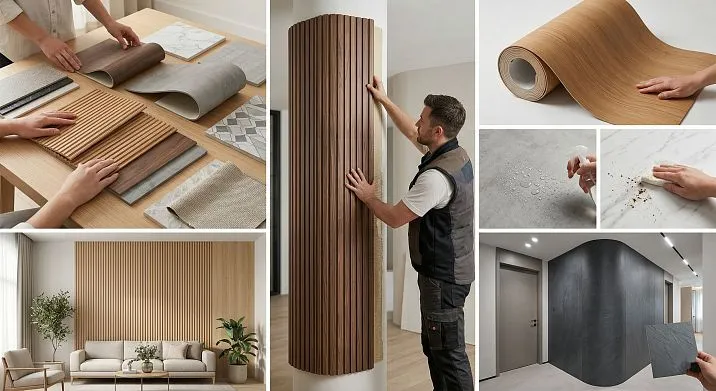
A flexible wall panel for interior finishing is not just a sheet with relief. It is a structure where finishing elements — slats, strips, planks — are fixed on an elastic base: a dense fabric backing that maintains spacing and parallelism but allows the canvas to bend along any curve.
This is precisely how a flexible panel fundamentally differs from a rigid one, where the backing is a monolithic MDF board. A rigid construction is flawless on a straight wall but does not tolerate bends. A flexible one follows the architecture.
Our factory also produces:


For what tasks was this material created?
Request for Flexible wall panels appeared exactly when interior fashion took a step towards curvilinear forms. Radius walls, columns, arches, rounded niches, curved furniture fronts — all of this required a material that wraps around the surface without losing the pattern. Flexible panels became the answer to this request.
But it's important: today they are purchased not only for complex geometry. A flexible panel also works on a straight wall — where adhesive installation without guides, quick setup, and seamless joining are needed.
Get Consultation
Why is this important specifically for interior finishing?
The word 'interior' in the name is not a random clarification. It excludes everything related to facade and exterior finishing. Wall panels for interior application are designed for the conditions of residential and commercial interiors: stable temperature, normal humidity, visual contact with a person at arm's length.
This is precisely why they are subject to increased requirements for texture, geometric accuracy, cleanliness of edges and surface. An interior wall is a surface that is examined up close, leaned against, and lived next to daily.
Where are flexible panels for interior walls most commonly used?
Living room: accent and architectural logic
The living room is a space where the wall is constantly "working": receiving guests, serving as a backdrop for life, and setting the mood for the entire interior. A TV wall, a side accent plane, the area behind the sofa — all three scenarios are perfectly solvedwith decorative flexible wall panels.
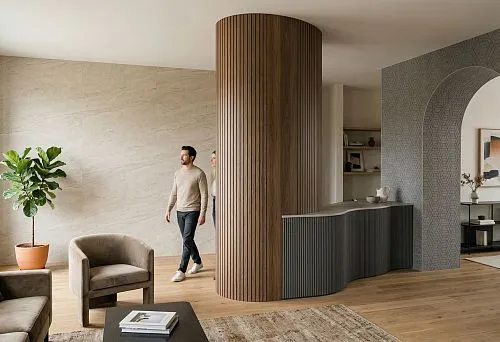
Cases where the living room has rounded elements are particularly interesting — decorative columns, arched transitions, niches with soft geometry. Here, the flexible format is indispensable: the slat pattern runs continuously, wrapping around all curves without seams or adjustments.
Bedroom: headboard as an accent
The bed headboard is the most popular area for applying wall panels in the bedroom. A vertical slat pattern behind the bed sets the scale for the entire space, creating depth and warmth.
If the headboard is built into an arch or a rounded niche — this is a direct task for a flexible panel. The pattern follows the shape of the niche as a single canvas, and the wall reads as a custom-made architectural detail.Flexible panels for the bedroomin a soft oak tone or neutral paint create an atmosphere that is easy to relax in.
Hallway and corridor
The hallway welcomes. And it is often here that the architecture is particularly unconventional: arched openings, pylons, transitions between walls with different angles. All of this is a scenario forflexible panels for the hallwaywhich unify straight and curved sections with a single slatted rhythm.
Practical bonus: the slatted structure conceals minor irregularities of old walls far more effectively than any flat covering.
Corridor
In a long corridor, a slatted wall solves two problems at once: it adds visual depth and creates a guide—directing the gaze along the vertical slats. Dark, closely spaced slats 'compress' an overly wide corridor; light, sparsely spaced ones visually widen a narrow one.
Office
A strict, office-style interior is an environment where walls carry reputational weight.Flexible wall panels for interior finishingmade of dark oak with a matte oil finish create an office character without bulky solutions. If the space contains niches, rounded corners, or decorative columns—the flexible format solves the task without manual fitting.
Office and meeting rooms
In an office interior, a wall panel serves a dual function: visual and acoustic. The slatted structure diffuses sound, reducing reverberation in large meeting halls. This is not a secondary bonus, but a measurable practical result.
Commercial spaces
Restaurants, hotels, boutiques, medical centers—commercial interiors place special demands on wall materials: high traffic, durability, visual representativeness.Flexible wall panel for interiorSolid oak in a commercial space is an investment that pays off for years without replacing the finish.
Columns, arches, niches, radius walls
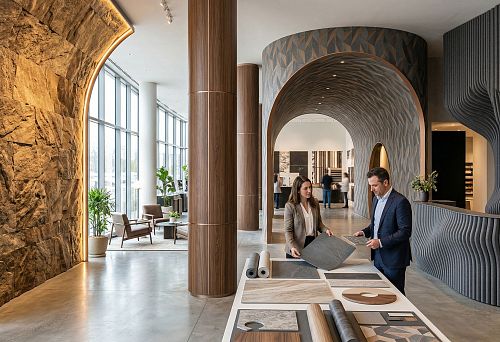
This is the main 'specialization' of the flexible format. A column that needs to be clad with slatted texture around a closed perimeter. An arched vault where the slatted pattern must run continuously along the curve. A niche with rounded corners, where a rigid panel requires individual fitting of each transition. All these tasks are solved bypanels for complex surfacesin a flexible design — as a single sheet, without seams on bends.
What types of internal flexible wall panels are there by texture and appearance
Wood-look
The most in-demand texture.Flexible panels with wood-grain texturecome in two fundamental types: natural (solid oak slats) and imitation (MDF or PVC with wood-grain printing).
The difference is critical. Solid oak is a living texture, a unique grain pattern, tactile warmth, aroma. This cannot be imitated by any printing. MDF with a wood finish is an image, not a material.
If you choose 'wood-look' — choose the real thing. For a wall you see every day, it's a difference in feeling, not just in price.
Stone-look
Flexible panels with a stone texture reproduce the texture of slate, limestone, travertine, marble. Installation on curved surfaces is one of the key advantages: natural stone for cladding a column requires manual fitting of each fragment, a panel does not.
In interiors, they create a brutal depth — especially good in areas with concrete and metal details.
Plaster and concrete-look
Relief gypsum and polymerdecorative flexible wall panelsimitate the textures of plaster, putty, raw concrete. They offer the possibility to achieve an industrial aesthetic without the labor costs of a decorative plasterer.
The flexible format is especially valuable here for rounded elements: a concrete-look wall smoothly transitioning into a column — without breaking the texture.
For painting
Smooth or textured MDF panels, primed for painting, offer complete freedom in color choice. RAL, NCS, Pantone—any shade. Repainting in the future—without dismantling. This is the most flexible choice in a commercial sense: the interior changes without replacing the material.
Slatted flexible panels
A separate and very relevant type—slatted flexible panelson a fabric base. Parallel slats with equal spacing create a linear rhythm on the surface and a pronounced play of light and shadow. This is precisely the type most often meant when people say 'slatted wall.' It is also the most challenging to apply to curved surfaces—and the flexible format is the only correct solution here.
Smooth and textured
A smooth flexible panel—clean, strict, architectural. Ideal for minimalist and contemporary interiors.
A textured one—voluminous, tactile, with shadows. Ideal for spaces with directional lighting: the 'sharper' the light angle, the more expressive the texture.
What tasks do flexible wall panels solve in an interior
Accent Wall
The main decorative task in a modern interior. Three walls are neutral, the fourth—textured, lively, with character. A slatted flexible panel on an accent wall creates a depth of light and shadow unattainable with paint or wallpaper. It is a three-dimensional surface that reacts to every change in lighting.
Complex geometry finishing
Where conventional panels say 'no' — flexible panels say 'yes'. Columns, arches, niches, rounded partitions — these are all application areaspanels for complex wall geometry.
Smooth transition between surfaces
The flexible panel allows for a continuous slatted pattern to extend from a straight wall, through a rounded corner, and onto the next plane. This creates a sense of monolithic architectural space—without 'patches' or compromises.
Space Zoning
A slatted wall is a strong visual zone divider. In an open floor plan, it separates the living room and dining area, work zone and relaxation zone — without building partitions, only through a change in texture and visual rhythm.
Visual upscaling of the interior
A slatted surface in an interior visually 'reads' as an expensive solution. This 'effect/cost' ratio favorably distinguishes the material: the result looks like custom joinery, while the installation technology is significantly simpler.
How to choose interior flexible wall panels by room type
For the living room
The scale of the slat should correspond to the room's area. A spacious living room — large spacing, wide slat. A small one — thin, dense slat. Tone: for a living room, warm, natural tones are preferable — oiled oak or paintable MDF in a warm neutral shade.
For the bedroom
The bedroom does not tolerate visual aggression.Flexible panels for the bedroomshould be quiet: light oak, soft tones, moderate spacing. Avoid dark saturated tones and large textures near the sleeping area—they create tension.
For the hallway
The hallway is used intensively. Priority is coating durability. Solid oak with an oil finish is preferable to painted MDF: paint in high-contact areas requires frequent renewal.
For the corridor
Vertical slat rhythm is optimal for any corridor: it 'organizes' long spaces and creates a sense of completeness. In a narrow corridor—light slats, sparse spacing. In a wide one—you can allow a dark accent.
For an office
Dark oak, dense spacing, matte finish. Next to bookshelves, in niches for built-in shelving, on an accent end wall—wood-look panelsin the study create the atmosphere of a serious workspace.
For offices and meeting rooms
Functional acoustics + visual representativeness. Choose slatted panels: the slatted structure disperses sound. Color—neutral or corporate according to the RAL system. Painted MDF is more convenient in this case—the color can be coordinated with the brand book.
For commercial spaces
Solid oak is the unequivocal choice for high-traffic spaces. Durability, resistance to mechanical wear, visual class that does not fade over time.
How to choose flexible panels according to interior style
Modern minimalism
Narrow or medium slats, neutral color, matte finish. MDF in white, light gray, off-white. Strict vertical lines, minimal surrounding decor. The panel here does not dominate—it works as a subtle architectural rhythm.
Japandi and Scandinavian style
Oak with clear oil or light whitewashed tint. Thin slats, moderate spacing, soft chiaroscuro. Plenty of air, natural texture, no excessive decorativeness.Flexible wood-look panelsin this context—not decor, but the interior material itself.
Neoclassicism and modern classicism
A slatted panel in a neoclassical interior occupies the lower third of the wall—like a decorative frieze framed by moldings. Wide slats with a dark oak tone, clear proportions, combination with cornice profiles. Precision is important here—the slatted pattern must be coordinated with the architectural divisions of the wall.
Loft and industrial style
Wide slats, dark paint: anthracite, dark blue, olive. Nearby—exposed concrete, metal accents, brutal texture. The slatted panel in a loft serves as a 'warm' counterpoint to cold materials—the warmth of wood against the cold of concrete.
Warm natural interior
Natural oak in oil without tinting. Soft organic shapes, natural materials. The slatted surface here is the central material, not an accent. Everything else is in dialogue with it.
How to choose panels by texture, color, and format
Light and dark panels
Light ones expand and open up space. Dark ones add depth and weight—good for accent elements and large rooms where a visual 'anchor' point is needed.
Smooth and textured surfaces
A smooth surface is strict and laconic. A textured surface is activated by light: the brighter and more 'sharp' the source, the more expressive the texture. In rooms with diffused lighting, the texture may be lost—consider this when choosing.
Scale of pattern and room
A wide plank with a large spacing in a small room visually 'overwhelms'. A thin and dense plank in a large hall 'gets lost'. The scale of the pattern should match the scale of the space. This rule is broken more often than any other.
Combination with floor, ceiling, furniture
Flexible panels for interior wall finishingIn oak finish, they work better with a matte floor coating: glossy floor + glossy wall is overkill. Oak on the wall + oak parquet is warmth and unity, but with a difference in the final finish.
Flexible panels or regular wall panels: which is better
| Criterion | Flexible wall panel | Rigid slatted panel | Decorative plaster | Wallpaper | Paint |
|---|---|---|---|---|---|
| Curvilinear surfaces | Yes | No | Yes | Limited | Yes |
| Plank pattern | Yes | Yes | No | Imitation | No |
| Natural wood texture | Yes (oak) | Yes (oak) | No | No | No |
| Installation without guides | Yes | Partially | No | Yes | Yes |
| Repaintability | Yes (MDF) | Yes (MDF) | Yes | No | Yes |
| Durability | High (oak) | High (oak) | High | Low | Medium |
| Visual depth | High | High | Medium | Low | No |
| Application for columns | Yes | No | Yes | No | Yes |
| Installation speed | High | High | Low | Medium | High |
Conclusion:Flexible panels for interior wall finishingThey excel where architectural continuity is needed across different types of surfaces. On straight walls, they are equivalent to rigid ones in result, but more convenient to install.
What to look for when choosing interior flexible wall panels
Wall geometry
The first question before purchase: is there at least one curve? If yes — flexible format is mandatory. If no — the choice between flexible and rigid is determined by other criteria.
Surface type
Brick, concrete, drywall, OSB, old plaster — each type of substrate requires its own preparation approach. The surface must be clean, dry, strong, without crumbling fragments.
Room scale
Already discussed. This is a critically important parameter that is ignored more often than others. Check the scale of the slat on a sample — not in a photograph.
Lighting
The slatted and textured surface is revealed under directional lighting. Without accent lighting, 30–40% of the material's visual potential is lost. Plan the lighting before selecting the panel, not after.
Pattern and rhythm
The rhythm of the slats must be coordinated with the room's architecture: window proportions, ceiling height, furniture placement. A chaotic choice of 'the first one you like' leads to visual discomfort.
Maintenance
Oak with an oil finish requires renewing the protective coating every 2–5 years. Painted MDF is wiped with a damp cloth and locally retouched if necessary. Both options do not require special products.
Preparing the wall for flexible panel installation
Substrate condition
Dirty, loose, damp surfaces are the primary enemy of adhesive installation. Remove all unstable material, dust off, degrease. If the surface is porous, apply a deep-penetration primer.
Leveling
Minor irregularities (up to 3 mm per meter) are concealed by the slatted structure. Significant deviations (over 5 mm) are leveled with putty or by installing on a frame.
Marking and Fitting
Establish vertical and horizontal guidelines. Perform a dry fit: lay out the panels without adhesive, check the layout, ensure symmetry. This 20–30 minutes prevents errors during final installation.
Planning the pattern and joints
Where will the joints be? They should be placed in the least noticeable areas—in corners, behind furniture, behind door frames. On columns—at a single point around the perimeter, chosen deliberately.
Installation of internal flexible wall panels
Cutting
MDF slats are cut with a utility knife along the fabric backing line — without chips. Oak — with a fine-toothed saw or miter saw. Cut angle: strictly 90°, unless a different joint angle is specified.
Applying glue and fixing
Mounting adhesive with high initial adhesion is applied to the fabric backing in a zigzag pattern — not as a solid layer. Excess will seep through the gaps and ruin the surface. On vertical surfaces — apply adhesive additionally to the wall.
Press smoothly, from one edge to the other. On curved sections — gradually, maintaining pressure for 5–7 seconds on each bend segment.
Module Joining
Slat to slat, without gaps and without overlap. With precise end geometry, the joint visually disappears — this is a sign of quality manufacturing.
Internal corners are detailed with a technological gap of 2-3 mm to compensate for thermal deformation. The gap is covered with a corner trim
External corner — trim both modules at 45°, join with a miter joint. Internal corner — one panel flush against the other. Adjacency to other materials — transition profile or color-matched sealant.
Final inspection
Check the parallelism of the slats, uniformity of spacing, and cleanliness of joints. When illuminated at an angle — ensure the pattern reads correctly.
Typical Errors in Selection and Installation
Inappropriate texture for the room
Textured panel in a bedroom with diffused lighting — the texture 'fades', money is wasted. Smooth panel in a large bright hall — the surface looks 'empty'. Test a sample under real lighting conditions.
Overloaded interior
A bright accent wall + bright floor + bright furniture is visual chaos. Slatted paneling works well on one accent wall combined with neutral surfaces in the rest of the space.
Scale error
Already mentioned, but I'll repeat: the width of the slat and the spacing should match the scale of the room. Check this on a sample before purchasing a batch.
Poor wall preparation
Any savings on base preparation result in a peeling panel after 3–6 months. Wall preparation is not an optional step.
Poorly thought-out layout
Dry fitting is a mandatory step. Otherwise, you get a narrow offcut in the most noticeable place or a joint in the middle of the accent wall.
Ignoring light
Once again: plan lighting before installation, not after. Lay cable channels for built-in lighting in advance.
Different batches
Natural oak may have color variations between batches. Order the entire volume as a single batch with a reserve of 8–10%.
What to combine interior flexible wall panels with
Wood + marble. A classic contrast of warmth and cold. Especially good in the kitchen, bathroom, restaurant space.
Wood + metal. Brass, matte steel, black metal — create an industrial-premium combination with the warm texture of oak.
Slats + built-in lighting. LED in front of the panel — active chiaroscuro. LED in the grooves — soft diffuse glow. Both options transform an ordinary slatted surface into an architectural luminaire.
Slatted wall + hidden doors. One of the most relevant solutions in modern interior design. A door integrated into the slatted rhythm without visible frames — the slatted pattern 'absorbs' it.
Slats + textiles. Linen, wool, velvet — a tactile dialogue with the slatted surface. Textured wood and soft textiles create a richness of textures without overload.
Oak + parquet. A unified material on the wall and floor — warmth and unity. The difference in finish is important: matte wall + glossy floor, or vice versa.
Who are these panels especially suitable for
Interior designer. A professional tool for any non-standard geometry. Predictable result, stable batch, precise edges.
Architect. Large-scale commercial projects with columns, arches, radius walls — this is the direct specializationflexible panels for interior wallsmade of solid oak
For private clients. For people who approach renovation thoughtfully and want designer results without a designer budget. Installation with adhesive, cutting with a knife, dry fitting — these are steps accessible to a careful 'home craftsman'.
For those working with complex geometry. Columns, arches, niches, rounded corners — a flexible format is essential here.
For those who want to combine decorativeness and practicality. An oak slatted wall is beautiful and durable. Calculate the cost of ownership: solid oak for 30 years vs. wallpaper for 5 — and the choice is obvious.
FAQ: Answers to popular questions
What are interior flexible wall panels?
These are finishing constructions where decorative elements — slats, strips, relief planks — are fixed on an elastic base. This allows the panel to bend along any curved surface while preserving the pattern and spacing. Used for interior wall finishing, columns, arches, niches, furniture fronts.
How do they differ from regular wall panels?
A regular rigid panel is mounted on an MDF backing and does not bend. A flexible one is on a fabric base, wraps around any curve without deforming the pattern.
Are flexible panels suitable for an apartment?
Yes, this is one of the main application scenarios. Accent walls in the living room and bedroom, headboard design, hallway decoration — all these are private projects.
Can they be used in the living room?
Yes. The TV area, accent wall behind the sofa, decorative columns, arches — all these zones are covered.Flexible wall panels for interior finishing.
Are they suitable for the bedroom?
Yes. An accent wall behind the headboard is a classic scenario. Important: for the bedroom, choose a calm tone and moderate slat spacing.
Can they be used in the hallway?
Yes. An entryway with arched openings or rounded corners is a direct task for the flexible format.
Are flexible panels suitable for columns and arches?
Yes — and that's their main 'specialization'. A rigid panel does not wrap around the column along the perimeter; a flexible one wraps completely, joining at a single point.
What textures are available?
Wood-like (including natural solid oak), stone-like, plaster-like, concrete-like, smooth for painting, textured, slatted.
Which panels are better to choose for a modern interior?
Slatted oak or MDF for painting in neutral tones. Strict rhythm, vertical orientation, matte finish.
Can flexible panels be used for an accent wall?
Yes — this is one of the main use cases.
Is it difficult to install?
No. Installation is done with adhesive, cutting with a knife (MDF) or a saw (oak), seamless joining. With a prepared base and dry fitting — it is accessible to a careful non-specialist.
Does the substrate need to be perfectly level?
No. Minor irregularities (up to 3 mm) are concealed by the slatted structure. Significant variations — are eliminated before installation.
How are flexible panels joined?
Slat to slat, without a gap. With precise ends, the joint visually disappears.
How to care for it?
MDF for painting — a damp cloth. Oak in oil — renewing the oil coating every 2–5 years.
What is better: flexible panels or rigid wall panels?
Depends on the geometry. If there is a curve — only flexible ones. If everything is rectilinear — both options are equivalent; the choice is determined by the material and installation method.
Conclusion
Flexible panels for interior walls— is a material for interiors where form is primary. Where a straight wall transitions into a curved one, where a column requires monolithic cladding, where an arch should be perceived as a single architectural element — this is a solution that has no equal alternatives.
On flat surfaces, they compete with rigid panels on equal terms. There is no winner here — there is a task, and the tool is selected for it.
Choose based on surface geometry. Choose based on material: oak — if you need natural aesthetics and durability; MDF for painting — if you need an exact color and the possibility of renewal. Order a sample before purchasing a batch. Plan lighting before installation, not after.
About the company STAVROS
Interior wall finishing is a decision made once and lives with you for years. That's why it's important that the material is not just beautiful in a picture, but precise, reliable, and correctly selected for your task.
STAVROS producesslatted panels made of MDF and solid oak— rigid and flexible, for painting and tinting, for straight walls and for any complex geometry. Our own full-cycle production guarantees stable edge geometry, batch uniformity, and a surface ready for finishing from the first time.
STAVROS — is the choice of designers, architects, and private clients who value results without compromise. Full catalog, technical parameters, professional consultation — on the official website.