Article Contents:
- Introduction
- Definitions and basic concepts
- What is a machine?
- Classification of machines by type of processing
- Definition and Purpose
- Types of cutting machines
- Circular saws
- Band saws
- Sawing machines
- Definition and role in woodworking
- Main types of jointers
- Planers
- Router machines
- Role of sanding in woodworking
- Main types of sanding machines
- Band sanders
- Extrusion and rotary sanders
- Pneumatic and portable sanding devices
- Role of routing in artistic and technical woodworking
- Types of router machines
- Desktop router machines
- Portable router devices
- Definition and purpose of drilling machines
- Types of drilling machines
- Stationary drilling machines
- Portable Drill Presses
- Definition and Advantages of CNC Machines
- Applications of CNC Machines
- Importance of Quality Control in Woodworking
- Basic Measuring Tools
- Tape Measures, Rulers, and Protractors
- Gauges and Micrometers
- Digital Measuring Instruments
- Planning and Organizing the Work Process
- Technical Maintenance and Equipment Upgrades
- Training and Experience Exchange
- Ideas for Creativity
In the world of woodworking, machines play a decisive role, enabling craftsmen to bring the most daring design ideas to life and transform raw materials into masterpieces of craftsmanship. Today, we will examine types of woodworking machines, define key concepts, share practical tips and ideas that will help you choose the optimal equipment for your projects. In this article, we will change the tone of narration: instead of dry factual exposition, we will strive to speak in a lively, accessible language, with personal recommendations and useful insights. If you want to learn more about modern trends in woodworking and find inspiration for your ideas, we recommend also visitingSTAVROS website.


Introduction
Working with wood has always been a sign of craftsmanship and creativity. From ancient hand tools to modern CNC machines — woodworking technologies have undergone tremendous changes. However, the core task remains the same: to transform raw wood into a quality, beautiful, and durable product.
In this article, we will examine types of woodworking machines, paying attention to both traditional mechanical devices and modern electronic solutions. We will define what a machine is, consider its main types, provide advice on equipment selection, discuss operational characteristics, and offer ideas for optimizing production processes. Our material will be useful for both beginners and experienced professionals seeking to expand their knowledge and improve the quality of their work.




Definitions and Basic Concepts
Our factory also produces:


What is a Machine?
A machine is a device or complex of machines designed to perform specific operations on material, in this case, wood. Machines can be manual, mechanized, or automated and differ by their method of operation, type of processing, and level of automation. Broadly speaking, a woodworking machine enables tasks such as sawing, planing, sanding, milling, drilling, and other forms of mechanical wood processing.
Get Consultation
Classification of Machines by Type of Processing
Depending on the operations performed, woodworking machines can be divided into the following main groups:
● Cutting Machines: designed for sawing wood (circular saws, band saws, jigsaws, etc.).
● Planing Machines: used for leveling and planing wood surfaces.
● Sanding Machines: devices that provide smooth and even surfaces on workpieces.
● Milling Machines: used to create complex profiles, patterns, and decorative elements.
● Drilling Machines: used to create holes of various shapes and sizes.
● CNC Machines (Computer Numerical Control): automated devices that allow performing complex and precise wood processing operations with minimal human involvement.
Each group has its own characteristics, advantages, and applications, and the choice of machine depends on the specific tasks facing the craftsman or manufacturing enterprise.
Cutting Machines for Woodworking
Definition and Purpose
Sawing machines are designed for cutting wood into parts of the required shape and size. This is one of the basic operations, without which it is impossible to produce quality wooden products. Sawing machines allow performing both straight cuts and complex curved cuts, which is especially important when manufacturing decorative elements.
Types of Sawing Machines
Circular Saws
A circular saw is one of the most popular types of woodworking machines. It is equipped with a circular disc with teeth rotating at high speed, allowing for fast and precise cutting of blanks.
Tips and Ideas:
● Pay attention to the motor power, disc diameter, and the ability to adjust the cutting angle when choosing a circular saw.
● Use saws with dust extraction systems to maintain a clean working area and improve cut quality.
● Circular saws are ideal for cutting large blanks, manufacturing furniture parts, and preparing material for further processing.
Band Saws
A band saw operates on the principle of a continuous toothed belt moving through two rollers. This type of saw allows for both straight and curved cuts, making it a versatile tool in woodworking.
Tips and Ideas:
● Band saws are suitable for cutting thick blanks and creating complex contours.
● Regularly check the belt tension and condition of the teeth to ensure quality cutting.
● Band saws are often used to create non-standard decorative elements, allowing you to add individuality to your products.
Sawing Machines
A sawing machine is a portable tool used for rough processing and dismantling, as well as for cutting wood in hard-to-reach areas.
Tips and Ideas:
● Sawing machines are convenient for performing work in field conditions or small workshops.
● They are ideal for dismantling old furniture, preparing material for repair or reconstruction.
● Choose models with adjustable cutting speed and ergonomic design to ensure comfort during prolonged work.
Jointers
Definition and Role in Woodworking
Jointers are designed for leveling and planing wood surfaces. These machines allow you to obtain perfectly flat blanks, which is a mandatory step before further processing and assembly of products. Planing also helps remove irregularities, defects, and bark remnants, improving the quality and aesthetics of the final product.
Main Types of Jointers
Planer Machines
A planer machine (or hand plane) is used for leveling large wood surfaces and giving them the required thickness. It allows you to remove excess material, create a smooth surface, and prepare the blank for subsequent sanding or finishing.
Tips and Ideas:
● When choosing a planer machine, pay attention to motor power, adjustable blades, and compatibility with different types of wood.
● Regularly inspect and adjust cutting tools to ensure consistent processing quality.
● Planer machines are especially useful when manufacturing countertops, doors, furniture facades, and other large components.
Shaper Machines
A shaper machine (or jointer) is used for processing smaller parts and creating smooth edges. It allows achieving high precision and neatness during planing, which is especially important for manufacturing decorative elements and small details.
Tips and Ideas:
● Use this type of machine for processing narrow workpieces that require special care.
● Adjust the cutting depth to avoid excessive material removal while maintaining the desired shape of the workpiece.
● These machines are suitable for small workshops and individual projects where high precision and detail are essential.
Sanding Machines
The Role of Sanding in Wood Processing
Sanding is a process aimed at creating a smooth and even wood surface. Sanding machines allow removal of minor defects, improve material texture, and prepare it for finishing coatings. Proper sanding gives the finished product a polished look, highlighting its natural beauty.
Main Types of Sanding Machines
Belt Sanding Machines
Belt sanding machines operate using an abrasive belt that rotates at high speed, providing uniform sanding of the surface. These machines are suitable for processing large areas and creating smooth surfaces on large workpieces.
Tips and Ideas:
● Choose models with adjustable belt speed to adapt the sanding process to the specific type of wood.
● Use replaceable belts with different grits to achieve optimal results: coarse grit for initial sanding and fine grit for finishing sanding.
● Belt sanding machines are ideal for preparing countertops, furniture facades, and decorative panels.
Extrusion and Rotary Sanding Machines
Rotary sanding machines are used for processing parts with curved surfaces and complex shapes. They allow achieving high precision and uniformity of sanding, which is especially important for items where every detail matters.
Tips and Ideas:
● Use rotary sanding machines for small parts and complex contours where it is important to preserve the shape and details of the wood grain pattern.
● Regularly check the condition of abrasive elements and replace them as needed to maintain sanding quality.
● These machines are ideal for decorative items where high precision and detail are required.
Pneumatic and Portable Sanding Devices
Pneumatic sanding devices and portable sanding machines provide the ability to quickly and effectively sand in confined spaces or areas where stationary equipment is difficult to use. They offer high mobility and are convenient for small jobs and defect correction.
Tips and Ideas:
● Portable sanding devices are especially useful for processing complex shapes and hard-to-reach areas.
● Pay attention to ergonomics and ease of use to reduce fatigue during prolonged work.
● These tools work well with automated quality control systems, enabling high standards of processing.
Router Machines
The Role of Routing in Artistic and Technical Wood Processing
Routing is a process of creating decorative profiles, recesses, and complex patterns on the wood surface using router machines. This type of processing allows craftsmen not only to improve the appearance of items but also to create functional elements, such as slots for joining parts.
Types of Router Machines
Desktop Router Machines
Desktop router machines are among the most common in woodworking. They allow performing a wide range of operations: from creating decorative profiles to recesses and edge processing.
Tips and Ideas:
● Choose machines with adjustable parameters such as spindle speed and cutting depth to adapt the process to specific tasks.
● Desktop router machines are ideal for small workshops and individual projects where precision and repeatability of results are important.
Use modern dust extraction systems to maintain a clean work area and improve processing quality.
Portable milling devices
Portable routers (or milling machines) are versatile tools that allow milling operations in locations where a stationary machine is not suitable. They are convenient for creating decorative elements, edge processing, making grooves, and even engraving.
Tips and Ideas:
Portable routers are equipped with depth-of-cut adjustment systems and guides, ensuring high precision in operation.
Use them to create unique decorative solutions and individual projects.
Modern models often have the capability to connect to a computer for creating complex patterns using computer numerical control (CNC).
Drilling machines
Definition and purpose of drilling machines
Drilling machines are designed to create holes in wood, which is necessary for furniture assembly, installing decorative elements, and other operations. These machines allow precise and fast drilling of various sizes and shapes, which is an important stage in the production process.
Types of drilling machines
Stationary drilling machines
Stationary drilling machines provide high drilling accuracy and ease of operation with large workpieces. They are equipped with various attachments and adjustable parameters, allowing the drilling process to be adapted to specific requirements.
Tips and Ideas:
When selecting a stationary drilling machine, pay attention to motor power, adjustment accuracy, and the ability to install various types of drill bits.
Such machines are ideal for mass production, where high repeatability and stable results are required.
Regularly perform technical maintenance and check the condition of drill bits to prevent breakage and improve operational efficiency.
Portable drilling machines
Portable drilling machines are compact devices convenient for use in field conditions and small workshops. They allow quick and accurate drilling in hard-to-reach areas where stationary equipment cannot be used.
Tips and Ideas:
Portable drilling machines are equipped with batteries, ensuring mobility and independence from electrical outlets.
Use them for small jobs, repairs, and installing fasteners in difficult conditions.
Pay attention to ergonomics and ease of use to reduce hand strain and ensure high drilling accuracy.
CNC machines (Computer Numerical Control)
Definition and advantages of CNC machines
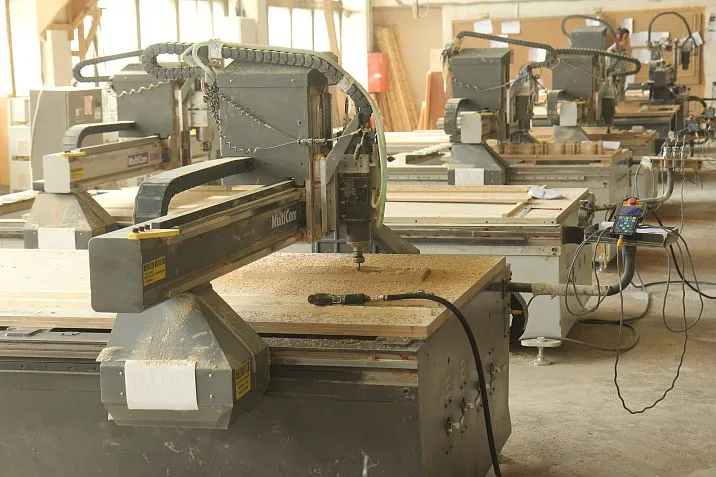
CNC machines (Computer Numerical Control) are modern automated devices that allow performing complex woodworking operations with minimal operator involvement. These machines are controlled by a computer, ensuring incredible precision, repeatability, and the ability to execute complex patterns and designs.
Applications of CNC machines
CNC machines are used for:
● Creating decorative panels and complex profiles
● Cutting out patterns and ornaments
● Producing furniture with high precision and complex joints
● Manufacturing interior decoration elements
Tips and Ideas:
● When selecting a CNC machine, pay attention to its software and integration capabilities with CAD systems.
● These machines allow for quick adaptation to individual orders, which is a major advantage for mass production of exclusive items.
● Regular training of operators and software setup will help extract maximum benefit from automated processes.
Specialized measuring and control tools
Importance of quality control in woodworking
Quality control of wood processing is an essential part of any production process. Using specialized measuring instruments allows for high processing accuracy, reduces the likelihood of errors, and improves the stability of results.
Main measuring tools
Tape measures, rulers, and protractors
These basic tools are used to measure the length, width, height, and angles of workpieces.
● Tape measures and rulers allow for precise measurement of item dimensions, which is an important step in preparing for further processing.
● Protractors are used to check the accuracy of angles, which is especially important when assembling complex structures.
Gauges and micrometers
Gauges and micrometers are used for precise control of part dimensions. They allow measuring even the smallest deviations and ensuring the product meets specified parameters.
Digital measuring instruments
Modern digital devices, such as laser measuring systems and digital micrometers, are integrated with computer systems for automatic data collection and quality control. These devices help craftsmen promptly detect flaws and adjust processing procedures.
Ideas and tips for optimizing tool usage
Planning and organizing the workflow
Effective use of tools begins with proper organization of the workspace and planning of processes.
● Create a comfortable workspace: Ensure your workspace is well-lit, clean, and organized. This will allow you to quickly locate necessary tools and reduce the likelihood of errors.
● Develop a work schedule: Planning work for the day or week will help optimize processes, divide tasks into stages, and ensure consistent processing quality.
Technical maintenance and equipment updates
Regular technical maintenance is the key to long-term and stable tool operation.
● Conduct regular inspections: Check the condition of cutting elements, abrasive belts, drill bits, and other consumables.
● Update equipment: Do not hesitate to invest in new technologies that will help improve efficiency and quality of work.
● Use modern protective equipment: This not only increases safety but also extends the service life of your tools.
Training and experience exchange
Continuous learning is the key to success when working with modern tools.
● Attend master classes and seminars: Regular training in new methods and technologies will keep you up to date with the latest trends in woodworking.
● Communicate with colleagues: Participate in professional forums, discuss new products, and share your experience with other craftsmen.
● Follow reviews and tests: Study independent reviews of tools and equipment to select the best models and optimize processes.
Ideas for creativity
Innovative ideas in working with tools can become your competitive advantage.
● Experiment with settings: Try adjusting speed, cutting depth, material abrasiveness — this may yield unexpected and interesting results.
● Combine traditional and modern methods: Use hand tools for details requiring special delicacy, and automated machines for mass production.
● Introduce new technologies: Laser cutting, digital modeling, and 3D printing open up vast opportunities for creating unique designs and complex patterns.
● Develop custom projects: Accept orders for unique items, using modern technology to realize the customer’s creative vision.
Conclusion
Types of woodworking machines represent a crucial element of modern production, combining ancient craft traditions with the latest technological advancements. From hand tools that convey the soul and individuality of each piece, to high-tech CNC machines ensuring stable and precise processing — all play a decisive role in creating quality, beautiful, and durable products.
We have reviewed the history of development of woodworking tools, main types of machines, their functional features, modern technologies, and practical recommendations for selection, operation, and maintenance. Modern trends require craftsmen to be able to combine traditional crafts with innovative technologies, enabling the creation of products meeting the highest standards of quality and aesthetics.
If you wish to succeed in woodworking, do not forget to organize your workflow, perform regular equipment maintenance, and continuously learn new methods and technologies. Use innovative solutions, experiment with settings, and do not fear introducing novelties — this will allow you to remain competitive and create unique items capable of winning over even the most discerning connoisseurs.
For additional information on modern woodworking technologies, as well as for seeking inspiration and ideas, we recommend visitingSTAVROS website.
Remember: the right choice of tools is the key to your success. May every item created using modern machines reflect your craftsmanship, love for crafts, and pursuit of perfection. In a world where woodworking art is becoming increasingly sought after, the right tools will help you realize the boldest ideas, preserve traditions, and open new horizons for creativity.