Article Contents:
- Biophilic Design: Technologies in Harmony with Nature
- Principles of Biophilic Approach to Smart Handrails
- Built-in Lighting: Light at Your Fingertips
- Technologies of Built-in Lighting
- Color Scenarios and Effects
- Motion and Presence Sensors
- Tactile Indicators: Navigation by Touch
- Types of Tactile Indicators
- Standards and regulations
- Integration with lighting
- Integration with Smart Home System
- Communication Protocols
- Automation Scenarios
- Voice Control
- Monitoring and Analytics
- Power Supply and Autonomy
- Wired Power
- Battery Power
- Hybrid Systems
- Energy efficiency
- Materials and Construction
- Preparing Wooden Base
- Electronics Protection
- Structural strength
- Installation and mounting
- Stage 1: Planning
- Stage 2: Preparation
- Stage 3: Installing Handrail
- Stage 4: Setup and Programming
- Stage 5: Testing
- Safety and Certification
- Electrical Safety
- Fire safety
- Data Security
- Cost and Economic Viability
- Alternatives and Compromises
- Smart Handrails: Trends 2026+
- Company STAVROS: Technology and Tradition
- Frequently Asked Questions
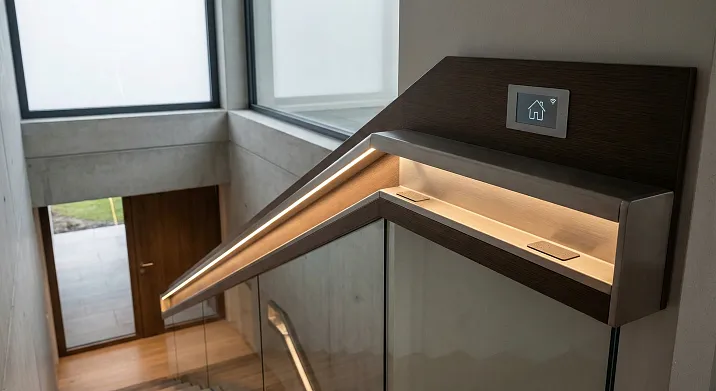
The staircase in a house is not just a way to move from floor to floor. It is a daily route you walk dozens of times, sometimes in complete darkness, sometimes in a hurry, sometimes carrying a load. And if there are elderly people or small children in the house, staircase safety becomes critically important. In 2026, smart home technologies penetrate every element of interior design, andhandrails for stairs in a private housethey are no longer just wooden sticks to hold onto. They become smart — with built-in lighting, motion sensors, tactile indicators, and integration with the smart home system. Imagine: you descend at night to the kitchen for water, and the handrail softly illuminates under your palm, lighting your path. This is not science fiction — it is reality in 2026.
Why are smart handrails becoming a trend? Because they solve real problems. Falls on stairs are one of the main causes of household injuries. Statistics show that 70% of falls occur at night or under insufficient lighting. Smart handrail lighting turns on automatically when someone approaches the stairs, illuminating the steps and creating a sense of safety. For people with impaired vision, tactile indicators on the handrail inform them where the stairs begin, where turns are, and where the last step is. And integration with the smart home system allows you to configure the handrail’s operation according to your scenario: bright light in the morning, soft dimmed lighting at night, automatic activation when the bedroom door opens.
But smart technologies in 2026 are not cold futuristic robotism and blinking LEDs. It is biophilic design, where high technologies are hidden within natural materials, whereRound Handrailwhat remains from warm oak is pleasant to the touch, retains natural texture, but at the same time glows softly from within, responds to touch, communicates with other devices in the house. In this article, we explore all aspects of smart handrails in 2026: built-in lighting technology, tactile indicator systems, integration with smart home, biophilic design approach. Ready to step into the future without losing touch with nature?


Biophilic Design: Technology in Harmony with Nature
Before discussing technologies, it is important to understand the philosophy that defines the design of smart handrails in 2026. Biophilic design is a concept that acknowledges humanity’s innate need for connection with nature. We feel more comfortable in environments with natural materials, organic forms, and natural light. But we also live in the 21st century, where technology simplifies life, enhances safety, and creates comfort.
Smart handrails in 2026 are a synthesis of these two worlds. The foundation —Natural Woodhigh-quality hardwoods: oak, beech, ash. Warm to the touch, with visible texture, with natural scent. But inside this wood are technologies: LED strips for lighting, sensors for detecting touch, motion sensors, wireless modules for connecting to the smart home system. Technologies are invisible — they do not disrupt the visual purity of the natural material. When you look at the handrail, you see wood. When you touch it, you feel wood. But when you pass by at night, the handrail comes alive, softly illuminating your path.




Principles of Biophilic Approach to Smart Handrails
Natural materials as the base. No plastic, metal, or visible electronics on the surface. Only wood, possibly with accents of stone, glass, or natural metal (bronze, copper) at mounting points. Wood is chosen not only for its strength but also for its aesthetics — beautiful texture, pleasant color, tactile warmth.
Hidden integration of technologies. All electronic components are embedded inside the handrail or at mounting points. The LED strip is laid in a special channel, covered with a semi-transparent acrylic or frosted glass insert. Light passes through this insert, but the strip itself is not visible. Motion sensors are placed at the ends of the handrail or in mounting brackets. Wires run inside the handrail or are hidden behind the mounting points in the wall.
Warm light, imitating natural. LED strips have a color temperature of 2700–3000K, corresponding to the warm light of a setting sun or candle. This creates a cozy atmosphere, not irritating the eyes at night. Modern LED systems can not only adjust brightness but also the color tone — from warmer tones in the evening to neutral tones in the morning, replicating natural lighting cycles.
Adaptive behavior. The handrail does not simply turn on and off. It adapts to the situation: brightness depends on the time of day and ambient lighting, activation speed depends on movement speed (fast movement — fast activation, slow movement — gradual light increase), duration of illumination depends on activity (if a person stops on the stairs, the light does not turn off).
Our factory also produces:







Built-in Lighting: Light at Your Fingertips
Lighting — the first and most important smart function of the handrail.Wall-mounted handrails for stairswith built-in lighting solve the problem of safety at night, create ambient lighting, and save electricity compared to constantly lit fixtures.
Get Consultation
Built-in Lighting Technology
LED strips — the core of the system. Special LED strips for furniture are used — compact, flexible, low-energy consumption. Power — 5–10 W per meter of handrail length, providing sufficient light for safe movement without blinding. Strips have IP44–IP65 protection class, ensuring protection against dust and moisture.
Options for LED strip placement. There are three main approaches. First — bottom lighting: the LED strip is placed on the underside of the handrail, illuminating the steps. This is the most practical solution, as the light is directed where it is most needed. Second — internal lighting: in a round handrail, a longitudinal groove is milled, the LED strip is placed inside, and covered with a semi-transparent insert. The handrail glows from within along its entire length, creating a glowing crystal effect. Third — contour lighting: the LED strip is placed on the wall behind the handrail, creating a light halo around it.
Diffusers for soft light. To prevent individual LEDs from creating glare spots, diffusers — semi-transparent inserts made of acrylic or polycarbonate — are used to scatter the light, making it uniform. The diffuser can be matte (for the softest light) or transparent with microstructure (for brighter, but still uniform light).
Smart brightness control. The system automatically adjusts brightness depending on the time of day and ambient lighting. The light sensor measures levels of natural and artificial light. During the day, when it is already bright, the lighting may not turn on or may glow minimally. In the evening, brightness is medium. At night (23:00–6:00) — minimal, to avoid waking sleeping people, but sufficient for safe movement.
Color Scenarios and Effects
Modern RGB LED strips allow not only to change brightness, but also color. This opens up possibilities for creating various scenarios. Neutral white (4000–4500K) in the morning and during the day — invigorating, promoting activity. Warm white (2700–3000K) in the evening — relaxing, cozy. Very warm amber (2000–2200K) at night — does not suppress melatonin production, does not interfere with sleep.
For special occasions, you can set color scenarios. For example, soft blue for parties, green for creating a natural atmosphere, red for romantic evenings. Or dynamic effects: smooth color transitions, light waves, moving lights. This is more for decorative purposes than for daily use, but the option is available.
Adaptive color temperature — an innovation of 2026. The system automatically changes the color tone of light throughout the day, replicating the natural cycle of sunlight. In the morning — cool blue tone (like morning sky), during the day — neutral white (like midday sun), in the evening — warm yellow (like sunset), at night — warm reddish tone (like campfire embers). Studies show that such lighting positively affects circadian rhythms, improves sleep, and increases alertness during the day.
Motion and presence sensors
Sensors activate lighting only when needed, not constantly. Motion sensors are placed at the start and end of stairs, at turns. They detect approaching people and turn on lighting 2–3 seconds before the person reaches the stairs. Detection range is 3–5 meters, viewing angle is 120–180 degrees.
Presence sensors — more advanced technology. They don’t just detect movement, but also determine if a person is within the zone. If a person stops on the stairs (e.g., talking on the phone or carrying something), the light does not turn off. Only when the person leaves the stair zone, after a set time (usually 30–60 seconds), the light gradually dims.
Direction-of-motion recognition — another smart feature. The system detects whether a person is moving up or down and activates lighting for the corresponding section. If you are going up, the lower part of the stairs lights up first, then the upper part gradually lights up, as if following you. This saves energy and creates an interesting visual effect.
Tactile indicators: navigation by touch
For people with impaired vision or in complete darkness, tactile indicators on the handrail are a critical safety feature. They indicate where the stairs begin, where turns are, and where the last step is, allowing orientation by touch.
Types of tactile indicators
Textured sections — the simplest option. Specific sections of the handrail have a different surface texture: ridges, grooves, inserts of another material. For example, 30 cm before the start of the stairs, a section with transverse grooves begins. This signals: 'Attention, stairs ahead.' At the end of the stairs, a section with longitudinal grooves: 'Stairs end.'
Geometric elements — protrusions, rings, balls, embedded in the handrail. They feel like small irregularities but do not interfere with hand sliding. The classic variant is a ring with a diameter 5–10 mm larger than the main handrail diameter, 20–30 mm long. One ring — start of stairs. Two rings in a row with a 10 cm gap — turn. Three rings — end of stairs.
Vibrotactile indicators — a high-tech solution. Microvibrators (like in smartphones) are embedded beneath the handrail surface. When a hand approaches a key point (start, turn, end of stairs), the handrail vibrates slightly to signal it. The vibration can vary: one short pulse — start, two pulses — turn, three — end. This is an invisible method that does not alter the handrail’s appearance.
Thermal indicators — experimental technology for 2026. Thermoelements are embedded in key handrail sections, slightly heating or cooling the surface. As a person runs their hand along the handrail, they feel temperature differences: warm section — start of stairs, cold — end. A temperature difference of just 2–3 degrees is enough to be perceived.
Standards and regulations
Public buildings have standards for tactile indicators ensuring accessibility for people with disabilities. In private homes, these standards are not mandatory, but compliance increases safety. Main requirements: tactile indicators must be placed 30 cm before the start and after the end of stairs, at turns, must be clearly distinguishable by touch, but not cause discomfort during normal use.
Integration with lighting
Tactile indicators can be integrated with lighting systems. For example, in areas with tactile elements (rings, textured sections), additional lighting — an LED — is embedded, which glows brighter than the rest of the lighting. This creates both visual and tactile markers simultaneously. For people with normal vision, this is an additional visual cue; for those with impaired vision, it’s tactile.
Integration with smart home systems
Smart handrail is not an isolated device, but part of the smart home ecosystem. It communicates with other systems, receives data, executes commands, and participates in automation scenarios.
Communication protocols
To integrate with a smart home, the handrail must support standard communication protocols. Wi-Fi — the most common, allows connecting the handrail to the home network, controlling via smartphone, integrating with popular smart home platforms (Apple HomeKit, Google Home, Amazon Alexa, Yandex Alice). Zigbee and Z-Wave — specialized smart home protocols, more energy-efficient, with lower latency, creating mesh networks (each device can relay signals from others, expanding coverage).
Bluetooth — for local control via smartphone without internet connection. Matter — a new universal smart home standard ensuring cross-brand device compatibility. Handrails from 2026 support Matter, guaranteeing long-term compatibility and easy setup.
Automation scenarios
Scenario 'Good morning'. At 7:00, the smart home begins waking up: curtains open, music turns on, coffee machine starts. When you get up from bed and head toward the stairs, the handrail’s motion sensor detects your approach, turns on bright energizing lighting (4000K), possibly plays a welcome message through the built-in speaker. As you descend, you hold the handrail, and it follows you with light all the way to the kitchen.
Scenario 'Good night'. At 23:00, you say 'Alice, good night'. The smart home begins the procedure: all lights except night lights are turned off, curtains close, relaxing music turns on. The handrail’s lighting switches to night mode — minimal brightness, very warm light (2000K), which doesn’t interfere with melatonin production. If you need to go downstairs at night (to the bathroom, kitchen), the handrail will turn on automatically, but at minimum brightness, to avoid fully waking you.
Scenario 'Guests'. When guests arrive, you can activate 'Party' mode: the handrail glows brighter, possibly with colorful effects, creating a festive atmosphere. Or, conversely, 'Movie' mode: when the movie starts, all lights turn off or switch to minimal mode, handrail lighting turns off to avoid distraction.
Safety scenario. If the alarm triggers (smoke, break-in), the handrail turns on at maximum brightness, glows red, flashes, providing evacuation lighting and drawing attention to danger. If the system detects a fall on the stairs (sudden impact, lack of movement), it may automatically call for help, turn on bright lighting, send notifications to family members’ phones.
Voice control
'Alice, turn on the stairs light' — the handrail’s lighting turns on. 'Okay, Google, make the stairs light brighter' — brightness increases. 'Siri, turn off the handrail lighting' — light turns off. Voice control makes using the smart handrail even more convenient, especially when hands are occupied.
Complex commands can be set. 'Alice, reading mode' — living room lighting becomes bright neutral, handrail switches to standby with minimal brightness. 'Okay, Google, romantic evening' — overall lighting dims, smart candles turn on, handrail glows warm amber with gentle light waves.
Monitoring and analytics
The smart handrail collects data on its usage. How many times per day someone walks down the stairs, when the most active movement occurs, how long the light stays on. This data helps optimize settings and identify behavioral patterns. For example, the system may notice that someone descends to the kitchen every night at 3:00. Based on this, it may suggest creating an automatic scenario: at 3:00, automatically turn on minimal lighting on the stairs and in the kitchen.
For elderly people living alone, monitoring activity on the stairs can be an important health indicator. If there is no activity for several consecutive days — this is a warning signal, and the system may send a notification to relatives or neighbors.
Power and autonomy
Smart features require electricity. There are several approaches to powering a smart handrail.
Wired power
The most reliable option — connection to a 220V network. Requires laying a wire to the beginning of the handrail (usually hidden in the wall or under the skirting board), installing a power supply unit (12V or 24V for LED), which powers the entire system. Advantages: unlimited operation, high power (can use bright lighting, additional functions). Disadvantages: requires wiring, which complicates installation, especially in an already built house.
Battery-powered
Built-in lithium-ion batteries provide autonomous operation. Battery capacity — 10000–20000 mAh, which, with economical use (lighting turns on only by motion sensor, 10–15 times per day for 2–3 minutes), ensures 3–6 months of operation. Charging via USB-C or wireless charging station.
Advantages: no need to lay wires, can be installed anywhere, easily removable for charging. Disadvantages: requires periodic charging, power is limited (cannot use very bright lighting or power-hungry functions), battery capacity decreases over time.
Hybrid systems
Combination of wired and battery power. Main power — from the grid, battery serves as backup in case of power outage. This ensures maximum reliability: even if there is no electricity, the staircase lighting will continue to operate for several hours on battery power.
Energy efficiency
Modern LED and electronic components consume minimal energy. LED strip power — 5–10 W/m. For a 3-meter handrail, this is 15–30 W. If the light turns on 15 times per day for 3 minutes, total daily operation time — 45 minutes, consumption — 0.375–0.75 W·h. Per month — 11–22 W·h, which at a cost of 5 rubles/kWh amounts to approximately 6–11 kopecks per month.
Motion sensors in standby mode consume 0.1–0.5 W. System controller — 1–2 W. Total constant consumption — 1–3 W, or 24–72 W·h per day, about 1 ruble per month. Thus, the full operating cost of a smart handrail is approximately 1–2 rubles per month, which is completely insignificant.
Materials and Construction
How to integrate electronics into natural wood while preserving strength, aesthetics, and safety?
Wooden base preparation
Round HandrailFor smart applications, it is made from glued laminated timber — this is more stable than solid wood. During production, a longitudinal channel is milled into the blank to accommodate LED strips, wires, sensors. The channel can be on the underside (for step lighting) or inside the handrail along the central axis (for internal lighting).
Channel depth — 8–12 mm, width — 12–20 mm (depending on LED strip size). After installing electronics, the channel is covered with an insert. For internal lighting, the insert must be semi-transparent — made of matte acrylic, polycarbonate, or special light-transmitting wood (thin shavings with epoxy resin). For hidden channels, the insert can be made of the same wood, matched precisely in color and texture.
Electronics protection
Electronic components must be protected from moisture, dust, and mechanical damage. LED strips have silicone coating (IP65 protection class). Motion sensors are placed in sealed housings. Wires — in heat-shrink tubing. All connections — soldering or reliable connectors.
The control unit (controller) is placed at the beginning or end of the handrail, in a special compartment or mounting bracket. It must allow access for maintenance, battery replacement, and firmware reprogramming.
Structural strength
Milling the channel should not critically weaken the handrail. Calculations show that for a 50 mm diameter handrail with a 10 mm deep and 15 mm wide channel, bending strength is reduced by approximately 20%. Considering the initial safety margin (required to withstand 100 kg load, designed with 200–300 kg safety margin), this is acceptable. For heavily loaded sections, a larger diameter handrail (60 mm) can be used or additional brackets can be installed.
Installation and mounting
Installing a smart handrail is more complex than installing a regular one, as it requires electrical connections, electronic setup, and integration with a smart home system.
Stage 1: Planning
System configuration is determined: wired or battery power, which sensors and where to install them, how to integrate with the existing smart home system. A wiring plan is prepared (if wired power), and locations for power supply units and controllers are selected.
Stage 2: Preparation
If wired power is used, wires are laid. Usually, this is 2×0.75 mm² cable from the nearest distribution box to the power supply unit installation point. Wires are laid concealed — in wall grooves, under skirting boards, in cable channels.
Installmounting brackets for the handrailIf brackets are used to mount sensors or controllers, they must be designed accordingly — with cavities, allowing wire routing.
Stage 3: Handrail Installation
The handrail is mounted on brackets. If it consists of multiple sections, they are connected using special connectors that provide both mechanical and electrical connections (power and signal transmission). It is important to ensure correct orientation: the channel with the LED strip should be directed downward (for step lighting) or toward the wall (for contour lighting).
Wires from the handrail connect to the power supply and controller. Polarity must be observed (this is critical for LED — incorrect polarity will cause them not to light or to fail).
Stage 4: Setup and Programming
The controller is configured via a mobile app or web interface. Parameters set include brightness for different modes, motion sensor sensitivity, delay before turning off, color temperature, and automation scenarios.
The system integrates with smart home platforms. If using Apple HomeKit, Google Home, or Amazon Alexa, the handrail is added to the respective app, commands are configured, and it is integrated into automation scenarios.
Stage 5: Testing
All functions are tested: motion sensor activation/deactivation, correct lighting operation, voice command response, and scenario functionality. Parameters are adjusted to achieve optimal results — sensitivity, brightness, or delay may need adjustment.
Safety and Certification
A smart handrail is an electrical device located in constant contact with humans, so safety is critical.
Electrical safety
LED strip voltage is 12V or 24V DC — a safe low voltage that poses no risk of electric shock even with direct contact. The power supply converting 220V AC to 12/24V must have Class II (double insulation) protection and safety certification.
All live parts must be properly insulated. There must be no possibility of accidental contact with live wires. If the handrail is used in damp areas (e.g., on a porch where rain is possible), the protection class must be IP65 or higher.
Fire safety
LEDs heat very little (maximum temperature 40–50°C), so fire risk is minimal. However, all electrical connections must be made properly — no crimping, only soldering or certified connectors. Wires must have non-flammable insulation.
The power supply must have overload and short-circuit protection. In case of an abnormal situation, it automatically disconnects to prevent fire.
Data Security
A smart handrail connected to the internet is theoretically vulnerable to cyberattacks. Protection is provided by encrypting all transmitted data (TLS/SSL protocols), regular firmware updates to patch identified vulnerabilities, and using strong passwords for access to controls.
It is advisable to connect smart devices to a separate network (guest Wi-Fi), isolated from the main home network with computers and sensitive data. This limits potential consequences of a compromised smart device.
Cost and Economic Justification
A smart handrail is significantly more expensive than a standard one. Consider the following approximate prices.
Standard wooden handrail: 2000–5000 rubles per linear meter depending on wood type and quality. Smart handrail with basic functions (built-in lighting, motion sensor): 8000–15000 rubles per linear meter. Smart handrail with advanced functions (RGB lighting, tactile indicators, smart home integration): 15000–30000 rubles per linear meter.
Additional: power supply — 2000–5000 rubles, smart home controller — 5000–15000 rubles, installation and setup — 10000–30000 rubles. For a 5-meter staircase, the total cost of a smart handrail will be 60000–180000 rubles.
Is this much? It depends on perspective. For an average home with a renovation budget of 2–3 million rubles, this represents 3–9% of the budget. For a premium home with a 10–20 million ruble budget, it’s less than 1%. But considering that staircases are used daily for decades, investing in safety, comfort, and aesthetics is justified.
Alternatives and Compromises
If a full smart handrail seems too expensive or complex, there are intermediate options.
Surface-mounted LED strip. The simplest option — buy a standard handrail and add an LED strip with a motion sensor separately. An adhesive-based LED strip is attached to the underside of the handrail, and the motion sensor is installed nearby. Cost — 3000–8000 rubles. Drawback — visible wires, less seamless integration, limited functionality.
Wall-mounted lights with sensors. Instead of built-in lighting in the handrail, install wall-mounted lights along the staircase with motion sensors. They will illuminate the staircase and handrail. Cost — 5000–15000 rubles depending on the number and quality of lights. Drawback — not part of the handrail, requires wall space, may not fit the design.
Smart ambient lighting. Use smart ceiling lights that turn on via motion sensor or voice command. This won’t replace handrail lighting, but will provide general staircase illumination. Cost — from 3000 rubles per smart bulb.
The Future of Smart Handrails: Trends 2026+
Where are smart handrail technologies headed? What will we see in the coming years?
Biometric identification. The handrail recognizes who is holding it (by fingerprint, hand temperature, grip pattern) and automatically adjusts to that person: turns on their favorite light color, plays a greeting, opens the door to their room.
Health monitoring. Built-in sensors measure pulse, body temperature, and stress level (via skin conductivity). If you are descending stairs with an elevated heart rate, the system may suggest stopping, sitting down, or calling for help.
Tactile feedback. The handrail can guide movement: a gentle vibration to the right means move left (e.g., if there’s an obstacle or construction ahead). For visually impaired individuals, this is a revolutionary navigation technology.
Energy Generation. The handrail collects energy from hand movement (piezoelectric elements) or body heat (thermoelectric elements), charging the built-in battery. Fully autonomous operation without the need for charging or connection to a power source.
AR/VR Integration. When using AR glasses (which may become commonplace by the end of the 2020s), the handrail can display virtual information: directional arrows, warnings, decorative effects.
STAVROS Company: Technology and Tradition
Creating a smart handrail requires not only technical knowledge but also craftsmanship in woodworking. STAVROS is a synthesis of traditional carpentry and innovation. For more than twenty years, STAVROS has producedwooden itemshighest quality: handrails, balusters, moldings, skirting boards, decorative elements.
STAVROS keeps pace with time, adopting smart home technologies. We develop handrails with integrated lighting, ready for connection to control systems, adapted for biophilic design. Our engineers and designers work to ensure technologies are unobtrusive, seamlessly integrated into natural wood, without compromising aesthetics.
STAVROS uses only high-quality wood — oak, beech, ash — dried in a kiln to optimal moisture content. This guarantees stability and prevents deformation after installation. Modern equipment — CNC turning and milling machines — ensures precision in manufacturing channels for electronics and uniformity of all elements in a batch.
We offer not only standard solutions but also custom design. If you have an idea for a smart handrail with unique features, we will bring it to life. Professional consultants will help you choose the system configuration, select components, and calculate costs. STAVROS masters will perform installation, setup, and integration with your smart home.
Choosing STAVROS, you get a guarantee of wood quality, manufacturing precision, and structural reliability. Your smart handrail will serve for decades, combining the beauty of natural wood with the safety and comfort of modern technology. STAVROS — the bridge between tradition and the future.
Frequently asked questions
Can smart lighting be installed on an existing handrail?
Technically yes, but this requires milling a channel for the LED strip, which may weaken the structure. It’s simpler to install a surface-mounted LED strip on the underside, but this is less aesthetically pleasing. The optimal solution is to plan a smart handrail during the staircase design phase.
Is 12V lighting safe for children?
Absolutely safe. 12V DC does not pose an electric shock hazard. Even if a child accidentally touches an exposed wire, nothing will happen.
How long does an LED strip last?
Quality LEDs have a lifespan of 30,000–50,000 hours. With daily use of 45 minutes, this equals 4,000–7,000 days or 11–19 years. In practice, the LED strip will need replacement after 10–15 years, when brightness drops by 30–50%.
Can a smart handrail be used outdoors?
Yes, if all components have an IP65 or higher protection rating. The wood must be treated with water-resistant compounds. It’s better to use moisture-resistant species — larch, oak with impregnation.
Is a professional required for installation?
A basic installation (handrail mounting, power connection) can be done by a skilled homeowner. However, for concealed wiring, integration with a smart home system, and configuring complex scenarios, it’s better to hire a specialist.
What if the electricity goes out?
If powered by the grid, the lighting will turn off. Therefore, a hybrid system with a backup battery is recommended. It will provide several hours of operation during a power outage.
Can brightness be manually controlled?
Yes, usually the controller has physical buttons for manual control, or you can use a mobile app or voice commands.
Is the smart handrail compatible with different smart home systems?
It depends on the controller. Modern universal controllers support multiple protocols (Wi-Fi, Zigbee, Matter) and are compatible with most platforms (Apple HomeKit, Google Home, Amazon Alexa, Yandex).
How much energy does a smart handrail consume?
About 0.5–1 kWh per month with moderate use. This equals 2.5–5 rubles per month at average electricity rates.
Can a smart handrail be made by oneself?
If you have woodworking skills, basic electronics and programming knowledge, yes. You will need: a wooden handrail, LED strip, controller (Arduino or ESP32), motion sensor, power supply, wires. There are many instructions online. However, a ready-made solution will be more reliable and safer.
Smart handrails of 2026 are not futuristic fantasy, but accessible reality that makes our homes safer, more comfortable, and more beautiful. The combination of natural materials and advanced technology, biophilic design approach, integration with smart home systems — all this creates a new level of interaction between people and architecture. Your home becomes alive, responsive, caring. And it begins with a simple touch on the handrail, which warmly glows under your hand, accompanying every step.