Article Contents:
- Historical evolution of gable decoration: from antiquity to the present day
- Ancient roots: birth of architectural tradition
- Medieval interpretations: Gothic and Romanesque
- Renaissance: revival of ancient traditions
- Baroque and Rococo: triumph of ornamentation
- Russian tradition: from teremok to Empire style
- Typology of decorative elements: anatomy of gable beauty
- Architectural orders: basis of composition
- Ornamental motifs: language of symbols
- Structural elements: function and beauty
- Material science of gable decoration: choice of beauty substance
- Stone: eternity in decoration
- Wood: living soul of architecture
- Modern materials: technologies serving beauty
- Bio-tech: Organic forms of the future
- Neoclassicism: eternal values in a new interpretation
- Modernism: natural forms in architecture
- Art Deco: geometry of luxury
- Russian style: national roots
- Modern minimalism: beauty of simplicity
- Designing gable compositions: art of harmony
- Compositional principles
- Integration with architecture
- Functional aspects
- Manufacturing technologies: from sketch to realization
- Traditional craftsmanship techniques
- Modern manufacturing technologies
- Surface finishing technologies
- Installation and mounting: technical perfection
- Preparatory work
- Mounting methods
- Sealing and protection of joints
- Regional characteristics and climatic requirements
- Northern regions: battle against cold
- Southern regions: protection from heat and sun
- Coastal zones: aggression of salty air
- Economic aspects: investments in beauty
- Project budgeting
- Comparison of materials by price-quality criteria
- Impact on property value
- Maintenance and care: preserving beauty for centuries
- Regular inspection and diagnostics
- Preventive Measures
- Restoration work
- Frequently asked questions about decorating the house facade gable with decorative elements
- Conclusion: architectural symphony in material
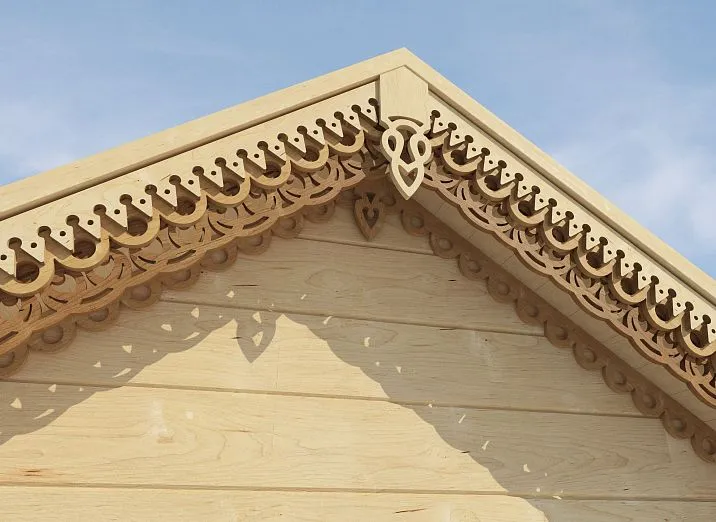
Imagine a house without a gable — it is like a face without eyes, a picture without a frame, a symphony without a finale. Decorating the house facade gable with decorative elements Transforms architectural necessity into a work of art, where every detail tells a story of taste, craftsmanship, and understanding of beauty. In the modern world, where standard construction is often devoid of individuality, a decorated gable becomes the house's calling card, its architectural autograph, capable of making passersby stop and admire.
A gable is not simply a triangular or semicircular finishing element of a building's facade. It is a canvas for creativity, a platform for the self-expression of the architect and client, a place where functionality meets aesthetics in perfect harmony. From ancient Greek temples to Russian teremok, from Gothic cathedrals to modern cottages — the gable has always been a symbol of completion, solemnity, and architectural perfection.
But what turns an ordinary gable into an object of admiration? The secret lies in the details — in delicate wood carving, elegant stone ornaments, thoughtfully designed play of light and shadow, harmonious combination of various decorative elements. Each swirl, each rosette, each molding works in unison, creating a symphony of forms capable of touching the soul and being remembered for life.


Historical evolution of gable decoration: from antiquity to the present day




Ancient roots: birth of architectural tradition
The history of gable decoration traces its roots to deep antiquity. Ancient Greek architects were the first to understand that the triangular completion of a temple was not merely a structural necessity, but also a powerful artistic tool. The pediments of the Parthenon, adorned with sculptural compositions telling myths of Athena's birth and the battles of the gods, became an architectural standard of perfection for millennia.
The Romans developed Greek traditions, adding their love of opulence and ornamentation. Roman pediments were often adorned not only with sculptural groups but also with complex ornamental compositions, including vegetal motifs, geometric patterns, symbolic imagery. It was the Romans who first began using pediments not only in temple architecture, but also in private homes, transforming them into a means of demonstrating the owner's status and taste.
Our factory also produces:


Medieval interpretations: Gothic and Romanesque
Medieval architecture introduced its own modifications to the tradition of gable decoration. The Romanesque style was characterized by massive forms and restrained ornamentation. The pediments of Romanesque cathedrals were often adorned with simple geometric ornaments, symbolic imagery, and strict architectural elements.
Gothic architecture revolutionized the understanding of architectural ornamentation. Gothic pediments, reaching upward, were adorned with delicate stone carving, elegant rosettes, pointed arches. Gothic masters created a unique language of architectural forms, where each detail carried deep symbolic meaning. Trefoils symbolized the Trinity, four-leaf clovers — the four evangelists, roses — the Virgin Mary.
Get Consultation
Renaissance: revival of ancient traditions
The Renaissance era revived interest in ancient forms and proportions. Renaissance architects carefully studied Roman monuments, creating new interpretations of classical motifs. The pediments of Renaissance palazzi were adorned with complex compositions of pilasters, entablatures, sculptural inserts.
Special attention was paid to proportions and harmony. Mathematical precision of ratios, based on the golden section, created a sense of perfection and completeness. Renaissance ornamental motifs — palmettes, acanthus, garlands, putti — became the foundation of European decorative tradition.
Baroque and Rococo: triumph of ornamentation
The 17th-18th centuries brought unprecedented opulence to architectural decoration. Baroque pediments amazed with complex compositions, abundance of sculptural ornamentation, dynamic forms. Every surface was filled with ornament, every detail contributing to the overall impression of luxury and grandeur.
Rococo added French refinement and lightness to Baroque opulence. Asymmetric compositions, pastel tones, elegant vegetal motifs created an atmosphere of aristocratic refinement. Rocaille elements — shells, scrolls, floral garlands — became the hallmark of the style.
Russian tradition: from teremok to Empire style
Russian architecture developed its own tradition of gable decoration, organically combining Byzantine heritage, folk motifs, and European influences. Northern wooden architecture created a unique style of carved decoration, where Facade Decoration it reflected the people's cosmogonic concepts, their connection with nature, and their pursuit of beauty.
Russian Classicism of the 18th-19th centuries adapted European models to local conditions and traditions. The pediments of Russian estates and urban mansions were adorned with porticos, colonnades, and ornamental decoration, creating a unique look of Russian architecture.
Typology of decorative elements: anatomy of gable beauty
Architectural orders: basis of composition
The classical architectural orders — Doric, Ionic, and Corinthian — remain the foundation of pediment compositions even today. Each order has its symbolism, proportions, and decorative features.
The Doric order embodies masculinity, strength, and simplicity. Doric columns without bases and simple capitals create a sense of monumentality and reliability. Doric pediments are often adorned with strict geometric ornaments, emphasizing the architectural logic of the structure.
The Ionic order is more elegant and decorative. The characteristic volutes of Ionic capitals lend lightness and grace to the composition. Ionic pediments are often enhanced with vegetal ornaments, rosettes, and garlands.
The Corinthian order is the most ornate and decorative. Corinthian column capitals adorned with acanthus leaves create a rich play of light and shadow. Corinthian pediments are distinguished by complex compositions, abundance of sculptural decoration, and virtuosity of execution.
Ornamental motifs: the language of symbols
Ornamental motifs decorating pediments are not a random collection of decorative elements, but a complex symbolic system that has evolved over millennia of human culture.
Vegetal ornaments are the most numerous group of decorative motifs. Acanthus leaves symbolize eternal life and renewal. Grapevines represent fertility and abundance. Laurel wreaths signify victory and glory. Oak leaves symbolize strength and longevity.
Geometric patterns are based on mathematical laws and create a sense of order, harmony, and perfection. Meanders symbolize eternity and infinity. Interlaced patterns represent unity and interconnectedness. Stars signify divine energy and celestial harmony.
Zoomorphic motifs include images of real and mythical animals. Eagles symbolize power and freedom. Lions represent strength and nobility. Griffins symbolize the unity of earthly and heavenly realms. Dolphins represent marine elements and connection to the spiritual world.
Constructive elements: function and beauty
Pediment compositions include numerous constructive elements that simultaneously fulfill functional and decorative tasks.
The tympanum is the central part of the pediment, enclosed between cornices. It is here that the main decorative compositions — sculptural groups, reliefs, ornamental panels — are placed. The tympanum may be smooth, serving as a background for other elements, or richly decorated.
Cornices frame the pediment and create transitions between different parts of the composition. Cornices may be simple or complex, including various profiles — coves, moldings, ledges. Well-designed cornices create play of light and shadow, emphasizing the architectural logic of the building.
Acroteria are decorative elements crowning the corners of the pediment. They may be executed as sculptural figures, vases, or vegetal motifs. Acroteria play an important compositional role, completing vertical lines of the building and creating a silhouette.
Materials of pediment decoration: choosing the substance of beauty
Stone: eternity in decoration
Stone decoration of pediments is a choice for centuries. Different types of stone possess unique properties that determine their application in architectural decoration.
Marble is the king of decorative stone. Its crystalline structure creates an unparalleled play of light, and its ability to be finely worked allows for the realization of the most complex artistic concepts. Marble pediments of ancient temples still impress with their perfection of execution.
Granite attracts with its monumentality and durability. Its granular structure creates a unique texture, and its variety of colors — from pink to black — opens up wide compositional possibilities. Granite pediments symbolize reliability and solidity.
Sandstone is a material for those who appreciate warmth and coziness. Its porous structure is easy to work with, and its natural hues create a sense of closeness to nature. Sandstone pediments are especially popular in suburban architecture.
Limestone combines the beauty of marble with the practicality of sandstone. Its homogeneous structure allows for detailed compositions, and its resistance to weathering ensures longevity.
Wood: the living soul of architecture
Wooden pediment decoration possesses a special energy. Each type of wood has its own character, decorative possibilities, and area of application.
Oak is a symbol of strength and longevity. Its hard wood allows for the creation of the finest carving details, and its expressive texture highlights the natural beauty of the material. Oak pediments acquire a noble patina over time, becoming even more attractive.
Linden is a material for delicate artistic carving. Its soft, homogeneous wood is easy to work with, allowing for the creation of the most complex ornamental compositions. Linden pediments were traditionally used in Russian wooden architecture.
Spruce combines the beauty of coniferous species with the hardness of deciduous ones. Its high density and resin content ensure exceptional durability, and its beautiful texture provides decorative appeal.
Larch combines the beauty of coniferous species with the hardness of deciduous ones. Its high density and resin content ensure exceptional durability, and its beautiful texture provides decorative appeal.
Modern materials: technology at the service of beauty
Modern technologies open new possibilities for creating pediment decoration. Polymer materials, composites, and modern coatings allow realizing the most daring design concepts.
High-density polyurethane precisely imitates stone or wooden carving, but surpasses traditional materials in several operational characteristics. Polyurethane facade decorative elements does not fear moisture, does not crack in freezing temperatures, does not fade in sunlight.
Glass fiber concrete allows creating lightweight and strong elements of complex shapes. Its reinforcement with glass fiber ensures high strength at a low weight, which is especially important for pediment compositions.
Artificial stone combines the beauty of natural material with the technological advantages of artificial materials. It can imitate any type of stone, but is lighter, cheaper, and easier to process.
Stylistic Directions: From Classic to Avant-Garde
Neoclassicism: eternal values in a new interpretation
The neoclassical style in pediment decoration is based on reinterpreting ancient traditions with consideration of modern requirements and possibilities. Strict symmetry of compositions, use of classical orders, traditional ornaments create a sense of solemnity and timelessness.
Modern neoclassical pediments often simplify complex ancient compositions, preserving their essence while adapting them to the scale of private architecture. Use of modern materials allows creating elements indistinguishable from historical analogs, but more durable and economical.
Modern: natural forms in architecture
The modern style revolutionized the understanding of architectural decoration. Rejection of historical styles, turn to natural forms, asymmetry of compositions created a completely new aesthetic language.
Modernist pediments are decorated with stylized plant motifs, where each element flows into another, creating a sense of organic unity and movement. Popular modern motifs — irises, lilies, climbing plants — are transformed by masters into complex ornamental compositions.
Art Deco: geometry of luxury
The art deco style of the 1920s-30s brought geometric stylization and industrial aesthetics into architectural decoration. Art deco pediments are characterized by clear lines, stepped forms, and solar motifs.
Zigzag ornaments, stylized images of skyscrapers, cars, airplanes reflected the spirit of the era of technical progress. Use of new materials — steel, aluminum, glass — created an effect of modernity and dynamism.
Russian style: national roots
The revival of interest in national traditions led to the development of the neo-Russian style in architecture. Carved pediment in the Russian style reproduces motifs of folk architecture, adapted to modern conditions.
Traditional Russian ornaments — solar symbols, plant motifs, geometric patterns — receive a new sound in the hands of modern masters. It is important not to copy historical samples, but creatively reinterpret them, creating a modern interpretation of national traditions.
Modern minimalism: beauty of simplicity
The minimalist approach to pediment decoration is based on the philosophy 'less is more'. Simple geometric forms, absence of excessive decoration, emphasis on materials and textures create a sense of modernity and elegance.
Minimalist pediments can be made from homogeneous materials — glass, metal, concrete — with minimal decorative elements. Beauty is achieved through perfect proportions, quality execution, and thoughtful details.
Designing pediment compositions: the art of harmony
Compositional Principles
Creating a harmonious pediment composition requires understanding of basic composition principles, laws of visual perception, and architectural logic.
The golden ratio rule — the basis of harmonious proportions. Dividing the pediment according to the golden ratio creates naturally perceived relationships between parts. Placing main compositional elements at golden section points ensures visual balance.
Symmetry and asymmetry — two fundamentally different approaches to organizing composition. Symmetrical compositions create a sense of stability, solemnity, and classicism. Asymmetrical — dynamism, modernity, individuality.
Rhythm and meter organize the movement of the viewer's gaze across the composition. Regular rhythm creates a calm, measured perception. Increasing or decreasing rhythm adds dynamism. Free rhythm creates a sense of naturalness and organic unity.
Scale — correspondence of decorative element sizes to the overall scale of the building and human body. Properly chosen scale creates a sense of comfort; incorrect scale — discomfort or even oppression.
Integration with architecture
Pediment decoration cannot exist in isolation from the overall architectural solution of the building. It must organically fit into the style, highlight architectural merits, and conceal shortcomings.
Stylistic unity requires decorative elements to correspond to the overall style of the building. A classical pediment is inappropriate for a modernist house, and minimalist decoration will appear foreign on a historical stylization.
Proportional correspondence means that the sizes of pediment elements must correspond to the scale of the building. Small details will be lost on a large house, while large elements will overwhelm a small structure.
Material compatibility requires consideration of interaction between different materials. Wooden decoration harmonizes well with wooden and stone facades, while metallic elements — with modern materials.
Functional aspects
The gable decoration performs not only aesthetic but also functional tasks that must be considered in design.
Protection from atmospheric influences is one of the main functions of gable elements. Eaves, cornices, and gutters protect walls from rain and snow. Properly designed elements must ensure effective water runoff.
Ventilation of the space under the roof can be achieved through decorative gable elements. Lattice inserts, grilles, perforated panels ensure air exchange and prevent moisture condensation.
Placement of engineering communications — a modern reality that must be considered. Antennas, air conditioners, ventilation outlets must be integrated into the decorative composition or concealed behind it.
Manufacturing technologies: from sketch to realization
Traditional craftsmanship techniques
Despite the development of modern technologies, traditional craftsmanship techniques remain the foundation for creating high-quality gable decoration.
Stone carving art is the oldest technique for creating architectural decoration. Working with stone requires not only physical strength, but also a refined artistic sense. Each cut of the chisel must be precise and meaningful.
Modern stonemasons use both traditional tools — chisels, hammers, compasses — and modern equipment — pneumatic hammers, diamond discs, grinding machines. Combining traditional techniques with modern tools allows achieving the highest quality within reasonable manufacturing time.
Wood carving requires a deep understanding of the material's structure, properties, and capabilities. An experienced carver feels the wood, understands the direction of the grain, and anticipates the material's behavior during processing.
The carver's tools — chisels of various profiles, knives, rasps — must be perfectly sharpened. The quality of sharpening directly affects the quality of carving, surface finish, and work speed.
Modern manufacturing technologies
Modern technologies have significantly expanded the possibilities for creating gable decoration, making it more accessible and diverse.
CNC machines have revolutionized the processing of both wood and stone. Computer control ensures precision unattainable by hand methods, allowing reproduction of the most complex compositions with perfect repeatability.
Multi-axis machining centers are capable of creating three-dimensional elements in a single setup, eliminating errors from repositioning. Automatic tool change allows performing various operations in a single cycle.
Laser cutting opens new possibilities for creating intricate elements. The laser beam allows making cuts as thin as fractions of a millimeter, creating a lace-like effect in metal, wood, or plastic.
3D printing is still an exotic but promising technology for creating prototypes and small-batch items. It allows realizing the most complex geometric shapes inaccessible by traditional processing methods.
Surface treatment technologies
The final surface treatment of decorative elements determines their final appearance and durability.
Patination creates an aging effect, giving items a noble antique appearance. Various patination compounds allow mimicking different types of aging — copper oxidation, silver tarnishing, stone weathering.
Gilding is a traditional technique for creating luxurious surfaces. Leaf gold applied on a special primer creates an irreplaceable play of light, symbolizing wealth and status.
Modern protective coatings ensure the longevity of decorative elements in aggressive urban environments. Nanoceramic coatings create an invisible protective film, protecting against dirt, fading, and corrosion.
Installation and mounting: technical perfection
Preparation Work
Quality installation of gable decoration begins with careful preparation. The facade surface must be flat, strong, and clean. Significant irregularities require preliminary leveling.
Inspection of the facade structure determines its load-bearing capacity, material condition, and possibilities for mounting decorative elements. Special attention is paid to junction zones between walls and roof, potential leak areas.
Marking is performed using geodetic tools, laser levels, and precise measuring instruments. Even minor inaccuracies in marking can lead to symmetry disruption and proportion distortion.
Manufacturing templates and fixtures ensures precise positioning of elements. This is especially important for complex multi-element compositions, where each detail must occupy a strictly defined position.
Methods of mounting
The choice of mounting method depends on the material of decorative elements, their size, weight, and operating conditions.
Mechanical mounting ensures maximum reliability. Anchor bolts, plastic anchors, and screws are selected depending on the wall material and characteristics of decorative elements. Special attention is paid to anti-corrosion protection of fasteners.
Adhesive bonding is used for lightweight, small-sized elements. Modern structural adhesives provide connection strength comparable to mechanical mounting, but require ideal surface preparation.
Combined mounting combines mechanical fastening with adhesive bonding. This approach ensures maximum reliability and longevity of installation.
Sealing and protecting joints
Proper sealing of joints is the key to the longevity of the gable decoration. Moisture ingress into joints may lead to material degradation, fastener corrosion, and salt formation.
Sealants are selected according to the materials of the connected elements. Silicone sealants are universal, but have a limited color range. Polyurethane sealants can be colored in any shade, but are more expensive than silicone.
Expansion joints are provided at locations subject to thermal deformation. Joint width is calculated based on the coefficients of thermal expansion of materials and climatic conditions.
Drainage systems ensure removal of moisture that enters the structure. Concealed drainage channels, masked by decorative elements, effectively remove water without compromising the composition's aesthetics.
Regional characteristics and climatic requirements
Northern regions: fighting cold
Gable decoration in northern regions must withstand extremely low temperatures, large temperature fluctuations, and high humidity.
Freeze resistance of materials is a critical parameter for northern conditions. The number of freeze-thaw cycles a material can withstand without damage determines its suitability for use in this climate.
Thermal bridges through decorative elements may lead to wall freezing and condensation formation. Proper design of mounting joints and use of thermal insulation gaskets minimize heat loss.
Snow loads on gable elements can be significant. Snow load calculation is mandatory for all projecting elements, especially for eaves, cornices, and large decorative panels.
Southern regions: protection from heat and sun
Hot climate imposes specific requirements on gable decoration. High temperatures, intense solar radiation, and large daily temperature fluctuations create challenging operating conditions.
UV stability of materials and coatings prevents fading, polymer degradation, and cracking. Special stabilizers incorporated into material compositions ensure long-term resistance to ultraviolet radiation.
Thermal deformations may be significant. Coefficients of thermal expansion of different materials must be considered when designing mounting joints. Expansion joints provide freedom for deformation.
Dust protection is especially relevant in arid regions. Smooth surfaces are easier to clean from dust, and special anti-static coatings prevent dust accumulation.
Coastal zones: aggression of salty air
Marine climate creates special problems for gable decoration. High humidity, salty air, and fog require special protective measures.
Corrosion resistance of metal elements is ensured by using stainless steels, special alloys, and quality protective coatings. Regular maintenance and renewal of coatings extend service life.
Biostability of materials prevents damage by fungi, algae, and lichens. High humidity promotes growth of microorganisms that can not only damage appearance but also destroy the material.
Wind loads in coastal zones may be extreme. Hurricane winds create enormous dynamic loads on decorative elements. Wind load calculation is mandatory.
Economic aspects: Investment in beauty
Project budgeting
Decorating a gable with decorative elements requires significant investment, which must be properly planned and justified.
Design accounts for 10-15% of the total project cost. A quality design is the foundation of successful implementation. Cutting corners on design often leads to significant overspending during manufacturing and installation phases.
Manufacturing elements is the main cost item, accounting for 60-70% of the budget. Cost depends on materials, manufacturing complexity, and order volume. Decor Set Usually costs less than purchasing individual elements.
Installation accounts for 15-20% of the budget. Installation complexity depends on building structure, accessibility of the work area, and weather conditions. Work at height or in confined spaces costs more.
Comparison of materials by cost-effectiveness criterion
Different materials have varying costs for manufacturing, installation, and operation. Proper material selection allows optimizing costs without compromising quality.
Natural stone has high initial cost, but practically requires no maintenance and lasts for centuries. The long-term economic efficiency of stone is very high.
Natural wood is cheaper to manufacture than stone, but requires regular maintenance. Operational cost of wood is higher, but it can be restored, extending its service life.
Polymer materials have moderate manufacturing cost and low operational cost. Their economic efficiency is especially high for complex shapes that are difficult to produce using traditional materials.
Impact on property value
Quality fronton decoration significantly increases property value, improves its liquidity, and shortens sales time.
The uniqueness of decoration creates competitive advantages. In the luxury real estate segment, unique architectural decoration can increase the property value by 30-50%.
The prestige of the address increases due to outstanding architecture. Beautiful buildings become landmarks, enhancing the status of the neighborhood.
Long-term perspective — quality decoration does not become outdated but, on the contrary, gains additional value as a heritage asset.
Care and maintenance: preserving beauty for centuries
Regular inspection and diagnostics
Maintaining fronton decoration in ideal condition requires regular professional servicing.
Annual inspection allows identifying issues at an early stage, when their elimination does not require significant expenses. Special attention is paid to the condition of fasteners, joint sealing, and coating integrity.
Photographic documentation of element conditions allows tracking changes, planning repairs. Regular photographic documentation is especially important for historical buildings.
Instrumental diagnostics using endoscopes, ultrasonic thickness gauges, and thermal imagers allow identifying hidden defects and assessing the condition of areas inaccessible for visual inspection.
Preventive measures
Prevention is always cheaper than repair. Regular preventive measures significantly extend the service life of decorative elements.
Cleaning from contaminants should be performed considering the properties of materials. Soft materials require gentle cleaning, while hard materials can withstand more aggressive methods.
Coating renewal is performed before serious damage appears. Timely renewal of protective coatings prevents moisture penetration, corrosion, and biological damage.
Joint sealing is one of the most important preventive measures. Destruction of sealing leads to moisture ingress into the structure, which may cause serious damage.
Restoration work
Even with quality maintenance, over time restoration of individual elements or the entire composition may be required.
Conservation halts degradation processes and stabilizes the object's condition. Conservation compounds are selected individually for each material and type of damage.
Reconstruction restores lost elements and recreates the original composition appearance. Reconstruction must be based on scientific research, archival materials, and analogs.
Adaptation adapts historical elements to modern operational requirements. Hidden integration of modern engineering systems, improved functional characteristics while preserving the historical appearance.
Frequently Asked Questions about decorating the house fronton with decorative elements
What materials are best suited for fronton decoration in Russian climatic conditions?
Material selection depends on the specific region and project budget. For Russia's middle belt, optimal natural materials are oak and beech, while high-density polyurethane is preferred among synthetic materials. In northern regions, larch and frost-resistant composite materials are preferred. In southern regions, UV stability of materials is crucial. Natural stone is universal for all climatic zones but requires significant investment.
How long does it take to manufacture and install fronton decoration?
Timeframes depend on project complexity and selected materials. Simple polyurethane elements are manufactured in 2-3 weeks; complex wood carving may require 2-3 months. Stone carving is the longest process, up to 6 months for complex compositions. Installation usually takes 1-2 weeks under favorable weather conditions. Plan the project with a buffer for unforeseen circumstances.
Is permission required for installing fronton decoration?
In most cases, decorative fronton elements do not require separate permits if they do not alter building dimensions and comply with fire safety requirements. However, for historical buildings, cultural heritage sites, or buildings in protected zones, approval from relevant authorities may be required. It is recommended to clarify local administrative requirements during the design phase.
How to calculate the required strength of decorative element fastening?
Fastening calculation must be performed by a qualified structural engineer. Factors considered include element weight, wind loads, seismic impacts, and snow loads. Engineering calculation is mandatory for elements weighing over 50 kg. Safety factor for static loads must be at least 2.5, and for dynamic loads at least 1.8. Special attention is paid to fastening to low-strength materials — gas concrete and hollow brick.
Can decorative elements be installed in winter?
Installation is possible but with significant restrictions. Adhesive joints do not achieve full strength at negative temperatures, so winter installation uses only mechanical fastening. Freezing work with stone elements is prohibited. Optimal installation temperature is +5°C and above. For winter installation, heated tents, heated work zones, and special frost-resistant materials are used.
How does fronton decoration affect building energy efficiency?
Properly designed decorative elements can improve building energy efficiency. Eaves and cornices protect walls from direct precipitation, reducing heat loss through wet barriers. Well-designed elements create air gaps, enhancing thermal insulation. However, improper fastening may create thermal bridges, increasing heat loss. It is important to use thermal insulation gaskets at fastening joints.
What is the lifespan of different materials for facade decoration?
Natural stone, with proper care, serves for centuries. Quality wood (oak, larch) with regular maintenance — 50–100 years. Modern polymer materials — 25–50 years depending on quality and usage conditions. Metal elements with quality coating — 30–50 years. Composite materials — 20–30 years. Service life significantly depends on manufacturing quality, installation, and subsequent maintenance.
Conclusion: Architectural symphony in material
Decorating the house facade gable with decorative elements This is not merely a fashion statement or display of wealth, but a fundamental human need for beauty, harmony, and perfection in the surrounding environment. In a world where typical architecture is often devoid of individuality, a decorated pediment becomes a manifesto of personality, a declaration that beauty matters, that details are important, and that architecture must inspire.
Each element of pediment decoration is the result of centuries of human cultural development, a synthesis of technical achievements and artistic traditions. From ancient temples to modern cottages, from carved wooden pavilions to glass skyscrapers — the pediment remains the most important element of architectural form, capable of transforming an ordinary building into a work of art.
Modern technologies open up unprecedented opportunities for creativity. Computer modeling allows creating compositions of any complexity, while new materials expand the palette of possibilities