Article Contents:
- Philosophy of corner detailing in architecture
- Psychology of perception of corner elements
- Materials and technologies for manufacturing corner elements
- Wooden corner elements: classic beyond time
- Polyurethane solutions: modernity and practicality
- Classification of corner elements by functional purpose
- Elements for moldings and trim
- Facade corner solutions
- Technical aspects of design and installation
- Calculation of dimensions and proportions
- Methods of mounting and installation
- Stylistic solutions and design concepts
- Classic styles and traditional approaches
- Modern Minimalist Solutions
- Technological innovations in production
- Modern equipment and processing methods
- Quality control systems
- Ecological aspects and sustainable development
- Ecologically clean materials
- Recycling and disposal
- Economic aspects of using corner elements
- Price-to-Quality Ratio
- Impact on the cost of the object
- Trends and Future Prospects
- New materials and technologies
- Individualization and customization
- Practical recommendations for selection and application
- Criteria for selecting corner elements
- Design errors and ways to avoid them
- Care and maintenance of corner elements
- Regular Maintenance
- Repair and restoration
- Conclusion
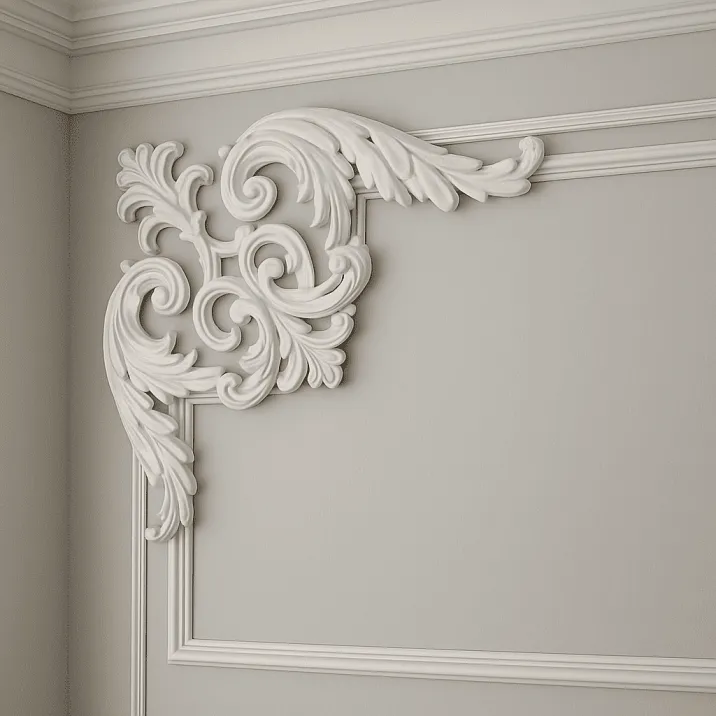
In modern interior design, details that may seem insignificant at first glance occupy a special place, yet they profoundly influence the overall perception of space. Corner finishing element is precisely such a detail — a functional and aesthetic component capable of transforming ordinary joints and transitions into elegant architectural accents.
When we talk about a professional approach to room finishing, it is impossible to overlook the issue of quality corner detailing. It is precisely in corners that flaws in work are most often revealed, wall irregularities become visible, and poor material fitting is evident. Corner decorative elements They solve this problem comprehensively, ensuring not only technically correct solutions but also creating a visually appealing result.


Philosophy of corner detailing in architecture
The history of using corner elements in finishing dates back to deep antiquity. Already in ancient architecture, masters understood the importance of properly finishing transitions between planes. Greek and Roman architects used special profiles and overlays that not only concealed joints but also emphasized the architectural logic of the structure.
In modern understanding Corner finishing element performs multiple functions simultaneously. This includes protection of corners from mechanical damage, masking technological gaps, and creating smooth visual transitions. But most importantly — it enables giving the interior a finished and professional look.




Psychology of Perceiving Corner Elements
The human eye is structured in such a way that we subconsciously evaluate the quality of finishing precisely by the corners and joints. An uneven angle, visible gap, or roughly processed transition instantly creates an impression of carelessness and low-quality work. Conversely, perfectly finished corners using special elements convey professionalism and attention to detail.
Corner Ceiling Element plays a special role in creating the overall impression of a room. Ceiling corners are located at the upper part of our field of vision, and any shortcomings in their finishing are especially noticeable. A properly selected and installed ceiling corner element creates the feeling of a high ceiling and visually expands the space.
Our factory also produces:
Materials and Production Technologies for Corner Elements
The modern decorative elements industry offers a wide range of materials for manufacturing corner details. Each material has its own characteristics, advantages, and areas of application.
Get Consultation
Wooden Corner Elements: Timeless Classic
Wooden Corner Elements remain the most popular choice among designers and developers. Wood as a material possesses unique properties — it is eco-friendly, easy to process, has natural texture beauty, and can be adapted to any interior style.
The manufacturing process of wooden corner elements begins with careful selection of material. For quality products, wood with minimal knots, uniform density, and moisture content is used. Raw materials undergo several drying stages, ensuring dimensional stability of the finished product.
Special attention is paid to profiling — the process of giving the blank the required shape. Modern CNC milling machines allow creating complex profiles with the highest precision. Facade Corner Elements require special strength and resistance to atmospheric influences, so they are made from hardwoods with additional protective treatment.
Polyurethane Solutions: Modernity and Practicality
Corner Polyurethane Element represents a product of modern technologies. Polyurethane as a material possesses several unique properties: it is lightweight, moisture-resistant, does not rot or decay, and is resistant to insects, while it can imitate the texture of wood or stone with remarkable accuracy.
The production of polyurethane corner elements is based on the injection molding technology. Liquid polyurethane is poured into precise molds, where under the influence of temperature and pressure it takes its final shape. This process allows creating items with complex relief and high detail, which would be difficult or expensive to manufacture from other materials.
Classification of Corner Elements by Functional Purpose
Elements for Molding and Trim
Corner Element for Molding occupies a special place in the system of decorative finishing. Molding themselves are an important element of classical and neoclassical design, and corner connections for them must ensure perfect profile alignment at a 90-degree angle.
A high-quality corner element for molding must precisely replicate the profile of the main item, ensure smooth line transitions, and create the impression of a single continuous contour. This requires the highest level of manufacturing precision and a professional approach to design.
door frame trim Often uses special corner elements that create a finished look for portals. These elements can be simple geometric shapes or complex carved details, depending on the interior style and design project requirements.
Facade Corner Solutions
Facade Corner Elements operate under more complex conditions than interior ones. They must withstand temperature fluctuations, precipitation, ultraviolet radiation, and mechanical loads. Therefore, higher requirements are imposed on their manufacturing.
Facade corner elements are often made from hardwoods — oak, ash, larch. These species have high density and natural resistance to moisture. Additionally, the items are treated with special protective compounds that create a barrier against mold, mildew, and insects.
Technical aspects of design and installation
Calculation of dimensions and proportions
Correct calculation of dimensions corner trim element is the foundation of a successful project. Dimensions must harmoniously relate to the scale of the room, ceiling height, and overall proportions of architectural elements.
For standard residential rooms with a height of 2.7–3.0 meters, the optimal width of corner elements is 15–25 mm for thin profiles and up to 50–80 mm for more substantial details. In rooms with high ceilings, these dimensions may be increased proportionally.
Corner elements for walls must take into account the characteristics of the finish. If walls are covered with wallpaper, the corner element should overlap the wallpaper edge by 3–5 mm on each side. When painting walls, this gap can be minimal.
Mounting methods
Quality Installation corner trim element directly affects the final result. There are several main mounting methods, each with its own advantages and areas of application.
Adhesive mounting is the most common for lightweight elements made of polyurethane and thin wooden profiles. Modern polyurethane adhesives provide a reliable connection and allow compensation for minor surface irregularities.
Mechanical mounting using screws or nails is used for heavier elements or when special reliability of the connection is required. Corner element for ceiling Large elements are usually mounted using mechanical methods with subsequent concealment of mounting points.
Stylistic solutions and design concepts
Classic styles and traditional approaches
In classical interiors Corner finishing element plays not only a functional role but is also an important part of the overall composition. Classic style requires strict adherence to proportions and canonical forms.
In baroque interiors, corner elements are characterized by richly decorated designs with floral ornaments, scrolls, and gilding. Mold Corner Element In such interiors, it can become a true work of art, requiring high craftsmanship in its production.
Neoclassicism prefers more strict forms using military and classical symbolism. Corner elements in the neoclassical style are often adorned with eagles, laurel wreaths, and military attributes. Such details require special precision and a deep understanding of the stylistic features of the era.
Modern minimalist solutions
Modern design imposes different requirements on corner elements. Here, simplicity, clear lines, and functionality are valued. Decorative corner elements In a minimalist interior, they should be as inconspicuous as possible, performing their function without drawing attention to themselves.
Scandinavian style prefers natural materials in light tones. Corner elements made of light wood — birch, pine, spruce — fit perfectly into such a concept. They emphasize the naturalness and eco-friendliness of the interior.
High-tech and techno styles can use corner elements made of metal or metal-imitating materials. Such details must have an ideally smooth surface and strict geometric shape.
Technological innovations in production
Modern equipment and processing methods
Today, the production of high-quality corner elements is impossible without using modern high-tech equipment. CNC machines allow achieving processing accuracy down to fractions of a millimeter, which is critically important for elements that must fit together perfectly.
Buy corner molding of high quality can only be obtained from manufacturers equipped with modern equipment. Multi-axis milling centers allow processing complex three-dimensional surfaces in a single setup, ensuring high surface accuracy and quality.
Laser cutting opens new possibilities for creating corner elements with complex contours. This method is especially effective when working with sheet materials — plywood, MDF, plastic. The laser ensures a perfectly clean cut without chips or burrs.
Quality control systems
Modern production of corner elements is unthinkable without strict quality control at all stages. Incoming inspection of raw materials ensures rejection of defective materials. Intermediate control allows identifying and eliminating problems during processing.
Final inspection of finished products includes checking geometric dimensions, surface quality, and compliance with technical requirements. Modern measurement systems allow controlling parameters with the highest accuracy.
Ecological aspects and sustainable development
Ecologically clean materials
Modern requirements for ecological safety of construction materials also apply to decorative elements. Wooden Corner Elements are made from renewable natural raw materials, making them ecologically preferable.
However, it is important to pay attention not only to the material itself but also to the methods of its processing. Adhesives, varnishes, and protective coatings must have a low emission of harmful substances. Modern chemical industry offers ecologically safe alternatives to traditional materials.
Recycling and disposal
Questions of disposal of decorative elements are becoming increasingly relevant. Wooden corner elements can be recycled or used as fuel. Polyurethane items require special recycling methods, but modern technologies allow reusing this material.
Economic aspects of using corner elements
Price-to-quality ratio
Correct choice corner trim element should take into account not only the initial cost but also long-term economic efficiency. Quality elements serve for decades without losing their appearance or functional properties.
Cheap analogs may require replacement within a few years, which ultimately proves more costly. Moreover, low-quality corner elements may negatively affect the overall impression of the interior, which is especially critical for commercial spaces.
Impact on the cost of the object
Quality finishing using professional corner elements significantly increases the market value of real estate. Potential buyers or tenants immediately notice the quality of finishing work, and corners are one of the main indicators of professionalism.
Door Frame Installation using quality corner elements creates an impression of expensive and prestigious renovation, positively affecting the overall evaluation of the object.
Trends in development and future prospects
New materials and technologies
Advancements in materials science open new opportunities for creating corner elements with improved properties. Composite materials based on wood fibers and polymer binders combine the advantages of natural wood and synthetic materials.
Nanotechnology allows creating coatings with special properties — self-cleaning, antibacterial, color-changing depending on temperature or lighting. Such innovations may fundamentally change the approach to interior design.
Individualization and customization
Modern consumers increasingly demand individual solutions. 3D printing and CNC processing technologies make it economically viable to produce single items according to individual dimensions and design.
and frames create a home atmosphere, making it truly cozy and individual. This is an investment in beauty, which pays off every day through aesthetic pleasure from admiring the beautiful. in the future can be created according to individual sketches provided by the client, taking into account all specific features of a particular interior. This opens boundless creative opportunities for designers and architects.
Practical recommendations for selection and application
Criteria for selecting corner elements
When choosing corner trim element must consider multiple factors. First and foremost, this includes compatibility with the overall interior style and architectural features of the room.
The dimensions of the elements should harmoniously correspond to the scale of the room. In small rooms, bulky corner elements will appear inappropriate, while in spacious halls, thin profiles may become lost.
Material quality and manufacturing are the most important criteria for selection. Elements must have uniform structure, smooth surface without defects, precise dimensions, and correct geometry.
Design errors and ways to avoid them
One of the common errors is incorrect calculation of material quantity. When planning procurement, it is necessary to consider not only the main area but also allowances for trimming and possible defects.
Underestimating the complexity of installation is another frequent problem. Installation of decorative corner elements requires certain skills and special tools. It is better to entrust this work to professionals.
Care and maintenance of corner elements
Regular maintenance
Quality corner elements, with proper care, serve for decades. Wooden items require periodic renewal of protective coating — varnish or paint. The frequency of such renewal depends on the conditions of use.
Polyurethane elements are less demanding in care, but they also require regular cleaning from dust and dirt. For cleaning, use mild cleaning agents, avoiding abrasives and aggressive chemicals.
Repair and restoration
In case of damage to corner elements, repair or restoration is possible. Minor chips and scratches on wooden items can be removed using special putties and polishing.
More serious damage may require replacement of individual sections or complete replacement of the element. In such cases, it is important to find items exactly matching the profile and dimensions.
Conclusion
The modern interior design world cannot be imagined without attention to details. Corner finishing element is one of those details that determine the overall quality and perception of space. Properly selected and professionally installed corner elements turn ordinary repairs into a work of art.
Moldings and door frame trim require a special approach and understanding of both technical and aesthetic aspects. Each element must not only perform its function but also harmoniously fit into the overall design concept.
Investments in quality decorative elements always pay off. They not only improve the appearance of the room but also protect structural elements, extending their service life. Proper material selection and professional installation guarantee durability and flawless appearance for many years.
STAVROS Company has been a leader in the production of high-quality decorative elements for interiors and exteriors for many years. Our products combine traditional woodworking techniques with modern innovative solutions. We offer a full range of services — from individual design development to professional installation — guaranteeing our clients outstanding results and long-lasting durability of each element.