Article Contents:
- What Determines the Price of a Wooden Skirting Board
- Five Pricing Factors That Work Simultaneously
- Wood Grade: First vs. Second
- Average Prices for Wooden Skirting Boards in 2025–2026
- Real Price List: K-Series STAVROS
- Price Ranges by Wood Species (Market Reference 2026)
- Why a 'Cheap' Wooden Skirting Board Turns Out to Be Expensive
- Wooden Skirting Board at Leroy Merlin vs. Buying Directly from the Manufacturer
- What's Sold in Construction Hypermarkets
- Direct from Manufacturer: Real Advantages
- How to Calculate the Cost of Wooden Skirting for an Entire Apartment
- Calculation Formula: Three Steps
- Calculation Example for a Typical Two-Room Apartment
- Bathrooms and Kitchens: Is a Separate Calculation Needed?
- Buy Wooden Skirting Board in Moscow and St. Petersburg
- How Purchasing and Delivery Are Organized at STAVROS
- Wooden Skirting Board in Moscow: Where It's More Expensive, Where It's Cheaper
- Wooden Skirting Board in St. Petersburg
- Where You Can Save Without Losing Quality
- Seven Effective Ways to Reduce the Cost
- Where You Shouldn't Skimp
- FAQ: Answers to Popular Questions About Wooden Skirting Board Prices
- About the Company STAVROS

When it comes to renovation, skirting boards are one of those materials people tend to save on. The logic is simple: 'it's just a skirting board.' But this very logic leads to the homeowner looking at warping MDF or faded PVC a year later and wondering how to redo everything from scratch. Wooden skirting boards cost more. But are they worth the money — and how much more expensive are they?
price of wooden skirting boardin 2025–2026 — this is a range from 230 rubles per linear meter (narrow flat profile made of beech) to 6,060 rubles and above (grand palace profile made of oak). The spread is 26 times. And this is only solid wood, not including polyurethane moldings, MDF, and other substitutes.
This article provides a detailed breakdown of pricing: why some profiles cost 300 rubles while others cost 3,000 rubles for the same linear meter. How to correctly calculate the cost for an entire apartment. Whereto buy wooden baseboardin Moscow and St. Petersburg is cheaper than in aggregator stores. And where you can save without losing quality.





What Determines the Price of a Wooden Skirting Board




Five Pricing Factors That Work Simultaneously
The price of a wooden skirting board is not an arbitrary number. It is formed from several specific components, each of which quantitatively influences the final cost. By understanding these factors, the buyer stops comparing 'apples to oranges' and begins to see the real value of each item.
Factor 1: Wood Species
This is the most significant pricing factor. Different species have different raw material costs, varying processing complexities, and different tool consumption during milling. Roughly speaking:
-
Pine, spruce — the cheapest raw material. Soft, fast-growing, widely available.
-
Beech — 2–3 times more expensive than pine for raw material. Hard, requires more frequent cutting tool changes.
-
Oak — 1.5–2 times more expensive than beech. Very hard, high density, significant tool wear.
-
Larch — close to beech in price, sometimes more expensive for certain grades.
-
Exotic species (wenge, teak, merbau) — 3–6 times more expensive than oak for raw material. High import cost, complex processing.
Ultimately, the difference inthe price of a wooden skirting boardbetween pine and oak of the same profile is 2–3 times. Between beech and wenge — 4–7 times.
Factor 2: Profile Complexity (Cross-Section)
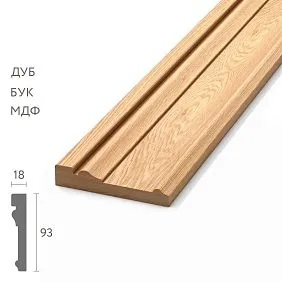
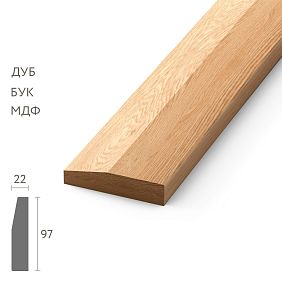
Simple rectangular profile (K-034, K-125) — minimal milling time, minimal tool consumption. Complex multi-element profile (K-066, K-104) — multiple cutter passes, complex tooling, more waste during milling. The difference in processing cost is 3–8 times.
For example, K-034 in beech — from 230 rub./lm. K-066 in oak — from 2,580 rub./lm. Difference — 11 times. Of which: species — x2, profile complexity — x5.
Factor 3: Kiln Drying and Raw Material Preparation
Wooden skirting board from green wood — cheaper. From kiln-dried wood to 8–10% — more expensive. Difference — 15–25% in price. But a wooden skirting board made from undried raw material starts to 'work' after installation: it cracks, warps, forms gaps. Saving on drying is saving on quality, which will turn into problems in 3–6 months.
All K-series STAVROS profiles are made from kiln-dried wood with 8–10% moisture content — this is not marketing, it's a production standard that costs money and is reflected in the price.
Factor 4: Processing Technology
3D milling on modern CNC machining centers — accuracy up to 0.1–0.2 mm, perfect profile geometry, high speed and stability. Outdated equipment — less precise profile, larger geometric tolerance. Hand sanding — surface ready for coating. Machine sanding — requires finishing.
Processing technology affects the final price by 10–20% — not critical, but noticeable.
Factor 5: Production Chain and Markups
This is a pricing factor that you, as a buyer, can manage. Direct manufacturer → buyer: minimum price. Manufacturer → wholesale warehouse → retail store → buyer: each link adds a 15–30% markup. Result: in a retail construction hypermarket, the same skirting board costs 40–80% more than buying directly from the manufacturer.
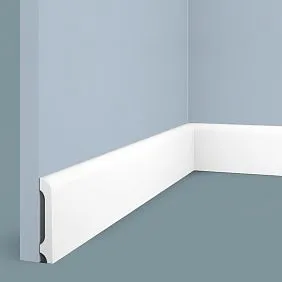
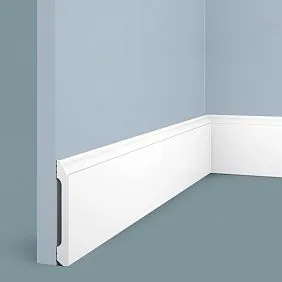
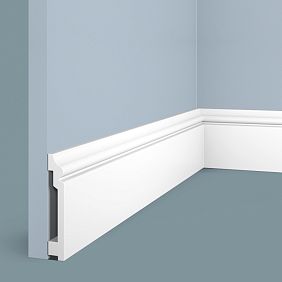
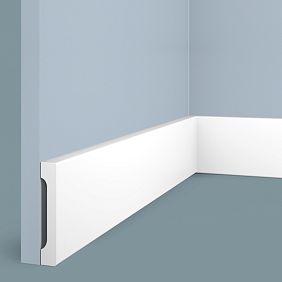
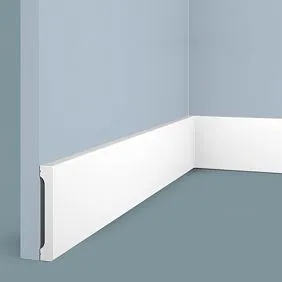
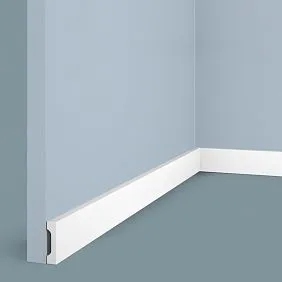
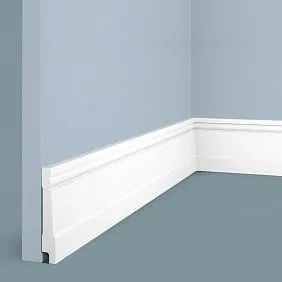
Our factory also produces:

Wood Grade: First vs. Second
Wooden skirting board is produced in two main grades:
Grade A (first, 'knot-free'): clean wood, no knots, no blue stain, no resin pockets. Uniform color and grain. This is the standard for finish skirting boards under transparent coating (oil, varnish) — when the grain is visible. Price — base.
Grade B (second, 'with knots'): live knots, minor grain irregularities, color variations are allowed. For painting — doesn't matter. For varnish or oil — requires choice: some like the 'live' pattern with knots, others want clean grain. Price — 15–25% lower than Grade A.
For painting — confidently choose Grade B: savings without compromising the result. For transparent coating — evaluate a sample in person before making a decision.
Get Consultation
Average Prices for Wooden Skirting Board in 2025–2026
Real Price List: K-series STAVROS
The most accurate data — directly from the manufacturer's website. Current pricesSTAVROS K-series(2025–2026):
| Profile | Height | Price from (RUB/linear meter) | Application category |
|---|---|---|---|
| K-034 | ~30 mm | 230 | Narrow, minimalism, loft |
| K-125 | ~35 mm | 270 | Narrow, minimalism |
| K-105 | ~40 mm | 300 | Flat, modern |
| K-006 | ~60 mm | 440 | Standard, universal |
| K-016 | ~70 mm | 680 | Medium figured |
| K-011 | ~80 mm | 810 | Medium figured |
| K-071 | ~80 mm | 700 | Medium figured |
| K-002 | ~80 mm | 700 | Medium figured |
| K-070 | ~110 mm | 950 | Tall, classic |
| K-009 | ~130 mm | 1 420 | Tall classical |
| K-018 | ~150 mm | 1 630 | Tall formal |
| K-066 | ~170 mm | 2 580 | Formal classical |
| K-104 | ~200+ mm | 6 060 | Palatial |
Also samples of wooden moldings — 180 RUB per set. Opportunity to order and evaluate the profile in person before purchase.
Price ranges by wood species (market reference 2026)
| Species | Min. price (RUB/linear meter) | Average price (RUB/linear meter) | Max. (RUB/linear meter) |
|---|---|---|---|
| Pine (coniferous) | 80–120 | 150–250 | 350–500 |
| Beech | 230 | 400–700 | 1 500–2 500 |
| Oak | 350 | 600–1 200 | 2 500–6 000+ |
| Larch | 280–400 | 500–900 | 1 500–2 500 |
| Wenge / exotic | 1 200–2 000 | 2 500–4 000 | 6 000–12 000 |
Pine baseboard in construction hypermarkets is the cheapest option for wooden moldings. But its limitations (softness, resinousness, instability) are important to consider.
Why "cheap" wooden baseboard turns out to be expensive
The arithmetic is simple. Pine baseboard at 120 RUB/linear meter in the hallway: after 2–3 years, dents from shoes, darkened knots, cracked coating in corners — reinstallation. Again material + installer's labor. Total: 240–300 RUB/linear meter + double labor.
Oak K-006 at 440 RUB/linear meter: after 10 years — unchanged with normal care. Cost of ownership over 10 years — 44 RUB/linear meter per year. Versus 60–80 RUB/linear meter per year for pine with reinstallation.
Cost of wooden baseboardshould be calculated not at the moment of purchase, but over its service life.
Wooden baseboard at Leroy Merlin vs manufacturer directly
What is sold in construction hypermarkets
Leroy wooden baseboard— and similar items at OBI, Castorama, Petrovich are primarily economy-class pine moldings and select beech items. The selection is limited: 5–10 profiles, typically in standard heights (60–100 mm). Sold 'bare' — without any finish.
Advantages of hypermarkets:
-
Can be purchased immediately, without waiting for delivery
-
Can buy a small quantity (2–5 strips) without a minimum order
-
Physically touch and evaluate before purchase
Disadvantages of hypermarkets:
-
Extremely limited profile selection
-
Only budget wood species (pine, less often beech)
-
Price — higher than from the manufacturer: distributor markup + retail markup — 40–80%
-
Wood moisture content does not always meet the 8–10% standard (warehouse storage in unstable humidity conditions)
-
No option to order a custom profile
Example of price difference. A 60 mm beech wooden baseboard in a hypermarket — approximately 350–450 RUB/linear meter (2026). The same material, similar profile directly from the manufacturer (K-006 STAVROS) — from 440 RUB/linear meter. It might seem the prices are close. But from the hypermarket — without a moisture guarantee, without profile choice, without service.
On more complex profiles, the difference is substantial: K-009 (130 mm, oak) from STAVROS — from 1,420 RUB/linear meter. A similar profile in retail, if available at all — 2,000–2,800 RUB/linear meter. Savings when buying direct — 30–50%.
Manufacturer direct: real advantages
Buying directly from the manufacturer is not just about price. It's about the system:
-
Full selection — 30+ profiles in one catalog, not 5–8 items in a hypermarket
-
Cohesive design — baseboards, door casings, cornices from the same series by one manufacturer
-
Stable moisture content — production control at 8–10%, not warehouse storage
-
Custom order — non-standard profiles subject to minimum order quantity
-
Samples — 180 RUB per set: can be obtained and evaluated in person before ordering a batch
-
Delivery — across Russia and CIS, including Moscow and Saint Petersburg
How to calculate the cost of wooden baseboard for an entire apartment
Calculation formula: three steps
Cost calculation is simple math, but with a few nuances that will save money at the procurement stage.
Step 1: Room perimeters
Add up the lengths of all walls in each room. From the resulting sum, subtract the width of door openings (typically 0.8–0.9 m per opening). If a room has two doors — subtract twice.
Example: room 5 × 4 m = perimeter 18 m − 0.9 m (door) = 17.1 m
Step 2: Total apartment perimeter
Add up the perimeters of all rooms. This is the total linear footage of baseboard needed.
Example: living room 17.1 + bedroom 13.2 + kitchen 10.5 + hallway 7.8 + bathroom 5.2 = 53.8 linear meters
Step 3: Allowance for trimming and defects + cost
Add a 10–12% allowance to the working linear footage — for trimming in corners, for angled cuts, for possible defects. The standard length of a piece is 2.5 m. Convert the total linear footage into the number of pieces (divide by 2.5 and round up).
53.8 m × 1.12 = 60.3 m / 2.5 m = 25 pieces (rounded to 26 with allowance)
26 pieces × 2.5 m × price per linear meter = material cost
Calculation example for a typical two-room apartment
Apartment 65 m², 2 rooms + kitchen + hallway + two bathrooms:
| Room | Perimeter | Door openings | Working perimeter |
|---|---|---|---|
| Living room (20 m²) | 18.6 m | −0.9 m | 17.7 m |
| Bedroom (14 m²) | 15.0 m | −0.9 m | 14.1 m |
| Kitchen (11 m²) | 13.2 m | −0.9 m | 12.3 m |
| Hallway (8 m²) | 11.4 m | −0.9 m × 4 = −3.6 m | 7.8 m |
| Bathroom 1 (5 m²) | 9.0 m | −0.8 m | 8.2 m |
| Bathroom 2 (4 m²) | 8.0 m | −0.8 m | 7.2 m |
| TOTAL | 67.3 m |
With 12% allowance: 67.3 × 1.12 = 75.4 m → 31 pieces (2.5 m each)
Cost for different profiles:
| Profile | Price per linear meter | Material cost |
|---|---|---|
| K-006 (60 mm, oak) | 440 р. | 33 176 р. |
| K-016 (70 mm, oak) | 680 р. | 51 272 р. |
| K-070 (110 mm, oak) | 950 р. | 71 630 р. |
| K-009 (130 mm, oak) | 1 420 р. | 107 068 р. |
| K-066 (170 mm, oak) | 2 580 р. | 194 532 р. |
As you can see, the difference between a budget and a premium solution for one apartment is 5–6 times. At the same time, the installation work is the same: the installer's work is priced per linear meter regardless of the profile (usually 100–200 rubles/lm in the regions, 200–400 rubles/lm in Moscow and St. Petersburg).
Bathrooms and kitchens: is a separate calculation needed?
In bathrooms and kitchens, there are areas with high humidity. Two solutions are possible here:
-
Larch wooden skirting with polyurethane varnish or wax is moisture-resistant but requires proper coating. The same K-006 or K-034 made of oak with polyurethane varnish can withstand normal bathroom humidity with normal ventilation.
-
Polyurethane molding KPU-series STAVROS— an absolutely moisture-resistant option with the same classic profiles. KPU-125 — 840 rubles/lm, KPU-105 — 860 rubles/lm. For bathrooms with constantly high humidity, it is the optimal solution.
For an apartment calculation: bathrooms (total ~8–10 lm with a margin) can be purchased in polyurethane, the rest — solid wood. This is a reasonable strategy.
Buy wooden skirting in Moscow and Saint Petersburg
How purchase and delivery are organized at STAVROS
to buy wooden baseboardin Moscow and Saint Petersburg at STAVROS — two scenarios:
Pickup from the warehouse:
STAVROS works with warehouses in Moscow and Saint Petersburg. The order is placed online, payment is made, and it is ready for pickup at the agreed time. Pickup — no delivery cost, the opportunity to inspect the material before receiving it.
City delivery:
Delivery in Moscow and St. Petersburg — by courier or transport company. The length of the rod is 2.5 m: a vehicle with at least 3 m of cargo space or special transport for long cargo is required. When ordering a batch from a certain volume (check with the manager) — delivery is on the manufacturer's terms.
Delivery across Russia and CIS:
By transport companies ("Delovye Linii", "PEK", SDEK) — to any region. The timeframe is 3–10 days depending on the distance. The cost is according to the transport company's rates.
Wooden skirting in Moscow: where it's more expensive, where it's cheaper
Wooden skirting in Moscowcan be purchased in several categories of places:
Construction hypermarkets (Leroy Merlin, OBI): limited assortment, price with a network markup of 40–60%. Convenient for small volumes "here and now".
Specialized trade bases (parquet, carpentry): wider assortment, lower markup 20–30%. But rarely are all the necessary profiles in one place.
Online stores (marketplaces): Yandex Market, Ozon, Wildberries — wooden skirting is available there, but it is impossible to check moisture, geometry, and real quality before receiving it. The risks of return in case of non-compliance are a logistical nightmare.
Direct manufacturer (STAVROS): minimum price in its category, full range of K-series, stable quality, samples before ordering. Optimal for volumes from one room and above.
Wooden skirting board in Saint Petersburg
Wooden skirting in Saint Petersburg— the same logic. The St. Petersburg market for finishing materials is developed, competition is high, but specialized wooden molding of production quality is still the domain of professional suppliers. STAVROS works with a warehouse in St. Petersburg: pickup + city delivery.
For designers and architects working in St. Petersburg with classic and modern interiors — the STAVROS loyalty program: discounts on bulk orders, priority assembly, personal manager.
What you can save on without losing quality
Seven working ways to reduce cost
Saving on wooden skirting boards is a delicate matter. There is proper saving (it doesn't affect the result) and improper saving (it creates problems). We'll only discuss the proper options.
Method 1: Beech instead of oak
Beech is no worse than oak for most applications. Beech hardness is 1,200–1,300 HB, oak is 1,400–1,600 HB. In hallways and corridors, oak is slightly preferable—it's more durable. But in bedrooms, living rooms, and studies, beech performs just as well. And under paint—the difference is completely invisible. The price difference for K-series beech/oak is 20–30%.
Method 2: Second grade for painting
As mentioned above: grade B with knots is quite acceptable where the skirting board is painted. Savings of 15–25% from the base price.
Method 3: Narrow profile in small rooms
Choosing a 130 mm profile in a room with a 2.6 m ceiling is excessive and expensive. K-006 (60 mm) with a ceiling of 2.4–2.7 m is proportional and 3 times cheaper than K-009.
Method 4: Buying directly from the manufacturer
Already discussed above: saving on intermediaries' margins—30–50% on complex profiles.
Method 5: Ordering with a reserve, but without excess
Accurate calculation using the formula (above) with a 10–12% reserve—and not a meter more. Overpaying for extra material that you later have no use for is a common mistake when purchasing.
Method 6: One profile for the entire apartment
Instead of several different profiles for different rooms—one profile for everything. This reduces the number of items in the order and simplifies installation. The interior consistency only benefits from this.
Method 7: Polyurethane molding in bathrooms
KPU-series STAVROSfor wet areas—a reasonable replacement for expensive wooden skirting boards where moisture is a constant factor. KPU-125—840 rub./lm compared to 440 rub./lm for oak K-006—more expensive, but doesn't require special coatings and is completely moisture-resistant. The total cost of ownership over 10 years—may turn out to be more economical.
What not to save on
Chamber drying. Skirting boards made from raw wood—this is saving 15% on purchase and problems the next season. Not worth it.
Wood species for the hallway. In a hallway with heavy traffic, pine skirting boards will last 2–3 years until visible wear. Beech or oak—10–15 years. The price difference in material for one hallway (~8–10 lm)—2,000–3,000 rubles. Reinstallation after 3 years will cost more.
Profile for the sake of 'looks similar'. MDF imitating wood or PVC skirting board with a 'wooden' print—not a replacement. They can't be painted with oil, can't be restored, don't provide the tactile feel of wood. After 5 years—yellowing, film peeling, deformation. Wood for the same price—always better.
FAQ: answers to popular questions about the price of wooden skirting boards
How much does wooden skirting board cost for a 50 m² apartment?
Approximate perimeter of a 50 m² apartment (with hallway, kitchen)—45–55 lm considering openings. With a 12% reserve—50–62 lm. At the price of K-006 (440 rub./lm)—22,000–27,000 rub. For K-070 (950 rub./lm)—47,500–58,900 rub.
What's cheaper: buying skirting boards at Leroy Merlin or from the manufacturer?
For budget profiles (pine, simple beech)—the hypermarket may be comparable or slightly cheaper due to scale. For professional profiles made of oak and beech (medium and high class)—the manufacturer directly is cheaper by 30–60%.
Why are some wooden skirting boards 230 rub., while others are 6,000 rub.?
Wood species + profile complexity. Beech 30 mm rectangular profile (K-034)—from 230 rub. Oak 200+ mm with complex five-element relief (K-104)—from 6,060 rub. A 26-fold difference—this is the real difference in raw material cost and processing.
Does the price of wooden skirting board include coating (varnish, oil)?
No. The price per linear meter is the price of unsanded (P180 sanding at STAVROS) unpainted skirting board. Coating (oil, varnish, enamel) is a separate expense item. Approximately: Osmo oil for oak—350–500 ml per 10 lm of skirting board (1 coat), oil cost 800–1,200 rub. for 750 ml.
Do you need to buy skirting board with a reserve?
Yes — definitely 10–12%. Reason: miter cuts in corners 'consume' 3–5 cm at each end of the plank, defective pieces from inaccurate trimming, possible hidden defects in one of the logs. Buying exactly to size means finishing the repair with inevitable additional purchases.
Can I order samples before purchasing?
Yes. STAVROS offers wooden molding samples for 180 rubles — a set of several profiles that allows you to evaluate the wood species, texture, relief, and reaction to coating before placing the main order. This is the right approach when choosing expensive profiles.
About the company STAVROS
A conversation about price inevitably leads to a conversation about value.wooden skirting board STAVROS— this is not the cheapest option on the market. It is the cheapest option among quality ones: kiln drying 8–10%, 3D milling with a tolerance of 0.2 mm, manual sanding P180, moisture and geometry control of each batch.
Thirty profiles of the K-series — from K-034 (from 230 rub./lm) to K-104 (from 6,060 rub./lm). Oil and enamel, beech and oak, narrow minimalist profile and grand Baroque — all in one catalog. For baseboards — coordinated K-series door trims,KZ-series cornices, Furniture legs, staircase components. For wet areas —KPU-serieswith the same profiles in polyurethane.
Warehouses in Moscow and St. Petersburg. Stock program — shipment on the day of order. Delivery throughout Russia and CIS. Loyalty program for designers and architects. Samples — 180 rub.
Phone: 8 (800) 555-46-75. Consultation — free.
STAVROS — because a wooden baseboard is bought once, and that's exactly why it's worth buying correctly.