Article Contents:
- What thin wooden slats are
- Advantages of using thin wooden slats
- Varieties and technical specifications
- Wood species for making slats
- Application of thin slats in different rooms
- Design techniques and stylistic solutions
- Mounting options and structural solutions
- Finishing and surface treatment
- Lighting and play of light with wooden slats
- Combining slats with other materials
- Care and maintenance of wooden slats
- Economic aspects of using wooden slats
- Trends and prospects for using slats
- Common mistakes when selecting and installing slats
- DIY installation: step-by-step guide
- Innovative solutions and unconventional applications
- Environmental Aspects and Certification
- FAQ: Frequently Asked Questions
- Conclusion

Modern interior design requires not just beauty - it demands the combination of aesthetics with functionality, naturalness with technology, minimalism with expressiveness. In this context,Thin wooden lathsbecome tools capable of transforming space, giving it depth and character. These elegant natural wood products have long ceased to be mere construction materials - today they are full-fledged architectural elements capable of solving numerous tasks, from functional to decorative.


What thin wooden slats are
Wooden slats are flat profiled items made from solid wood, characterized by relatively small thickness and significant length. Traditionally, thin slats are those with thickness from 8 to 25 millimeters, width from 20 to 100 millimeters, and length from 2000 to 3000 millimeters. Such proportions make themTrimming Itemsexceptionally versatile in application.
Slats are manufactured from solid wood of various species. Each species has unique characteristics that determine not only the appearance of the finished product but also its performance qualities. Oak is renowned for its unmatched strength and noble texture with distinct growth rings. Beech features a dense, uniform structure and a pleasant warm tone. Pine is attractive for its accessibility and ease of processing, while larch offers exceptional resistance to moisture and biological influences.
The manufacturing process requires high technological standards. First, high-quality raw material free of critical defects — rot, through cracks, or loose knots — is selected. Then, the blanks undergo kiln drying to a moisture content of 8–12 percent, ensuring dimensional stability during use. After reaching optimal moisture, the wood is cut on specialized machines with high precision, followed by meticulous sanding of all surfaces. The result is a perfectly smooth surface, ready for final finishing or use in its natural state.




Advantages of using thin wooden slats
Popularitywooden boards on the wallin modern design is explained by a comprehensive set of advantages this material possesses. The first and perhaps most significant advantage is absolute eco-friendliness. In an era when health-related concerns are paramount, natural wood has become not just a fashionable trend, but a conscious choice for those who care about their own and their loved ones’ health. Wood does not emit toxic substances, does not cause allergic reactions, and instead enriches indoor air with beneficial phytoncides, creating a unique atmosphere of living material.
Aesthetic qualities of natural wood are difficult to overestimate. Each plank is unique — nature does not repeat itself in its creations. The wood’s texture, with its unique fiber pattern, natural tones ranging from light honey to deep chocolate, and tactile sensations upon touch — all of this creates the very atmosphere of coziness and harmony that cannot be achieved with artificial materials. Even simple pine slats possess the charm of naturalness, let alone noble species such as oak or ash.
Functionalitythin wooden stripsimpress with their variety. They can visually adjust the space - vertically installed strips visually increase the height of the room, making low ceilings less noticeable. Horizontal placement, on the contrary, expands the room, which is especially relevant for narrow spaces. Diagonal placement creates dynamism and adds expressiveness to the interior.
Strips excel at zoning space. In modern apartments with open floor plans, they allow gently dividing functional zones without erecting load-bearing walls. Such partitions preserve the sense of space unity, allow light and air to pass through, yet clearly define privacy boundaries. Kitchen-living room, bedroom-office, children's play and study zones - strip constructions solve these tasks elegantly and effectively.
The acoustic properties of wood make strips an excellent means for improving sound comfort. The structure of wood is capable of absorbing sound waves, reducing noise levels and improving room acoustics. This is especially valuable in city apartments, where the problem of external noise is quite acute. Strip wall or ceiling cladding creates an additional sound-insulating layer, making the space more comfortable for living.
The practicality of the material is manifested in its ability to conceal utilities and irregularities of the base surface. Behind a strip structure, wiring, pipes, ventilation channels can easily be hidden, while maintaining access for maintenance and repair. It is not necessary to perfectly level walls before installation - the frame compensates for irregularities, and the finish covering with strips creates a flawless geometry.
Our factory also produces:


Varieties and technical characteristics
The classification of wooden strips is quite extensive and depends on many parameters. By thickness, they are divided into ultrathin strips from 8 to 12 millimeters, which create almost a graphic effect and do not overload the space. Thin strips of 15-20 millimeters represent an optimal balance of elegance and strength. Strips of medium thickness 20-25 millimeters are more expressive and can be used as a standalone architectural element.
The width of strips also varies within wide limits. Narrow strips of 20-40 millimeters create a frequent rhythm and fine graphics. Medium strips of 50-70 millimeters are universal for most tasks. Wide elements from 80 to 100 millimeters form a large scale and are suitable for spacious rooms.
The length of standard items is usually 2000, 2500, or 3000 millimeters, allowing to cover the height of typical rooms without joints. Custom-made strips of non-standard length can be produced to implement specific design solutions.
The quality of wood is determined by grade. The highest grade implies almost complete absence of visible defects - knots, resin pockets, cracks. The first grade allows for the presence of healthy light knots in limited quantities. The second grade may have more noticeable natural wood features, which is sometimes used as a decorative technique to create a rustic style.
The moisture content of finished products is strictly controlled and should be within the range of 8-12 percent. This is a critically important parameter, since wood with excessive moisture will dry out and deform under heated conditions, while overly dry wood may crack. Stable moisture ensures the preservation of geometry during operation.
Surface treatment can vary. Planed strips have a smooth matte surface after passing through a planer. Sanded strips are additionally processed with abrasive, giving them a velvety texture and readiness for final finishing. Brushed wood undergoes special treatment with metal brushes, which remove soft fibers and emphasize texture, creating an aged effect.
Get Consultation
Wood species for making strips
Oak remains the unrivaled leader in terms of overall characteristics. Its density reaches 700 kilograms per cubic meter, ensuring exceptional strength and durability. The texture of oak is expressive and noble - large pores create a distinctive pattern, and the color range varies from light yellow to dark brown depending on the processing method. Oakform the architecture of walls and ceilings, creating a play of light and shadow.are resistant to mechanical damage, practically immune to rot, and can serve for decades without losing their appearance.
Beech differs with high elasticity and impact resistance. Its light-colored wood with a grayish tint and expressive annual rings creates a modern Scandinavian atmosphere. Beech is slightly lighter than oak, but equally strong and durable. It stains exceptionally well, taking on any shade from bleached to dark wenge.
Larch is a coniferous species that stands out among its relatives for exceptional resistance to moisture and biological damage. Larch wood contains natural resin, which acts as a natural antiseptic. The color varies from yellowish-white to reddish-brown, and the texture is distinctly pronounced. Larch strips can even be used in rooms with high humidity - saunas, bathrooms, balconies.
Larch is a coniferous species distinguished from its relatives by its exceptional resistance to moisture and biological damage. Larch wood contains natural resin that acts as a natural antiseptic. The color ranges from yellowish-white to reddish-brown, and the texture is distinctly pronounced. Larch planks can be used even in rooms with high humidity—saunas, bathrooms, balconies.
Spruce is the most accessible and widespread species for producingwood trim. The wood is soft, light, and easy to work with. The color is light, yellowish-white with a pinkish tint. The texture with characteristic resin streaks creates a typical coniferous tone. Spruce strips are optimal for budget projects, and after proper treatment and staining, they can imitate more expensive species.
Application of thin strips in various rooms
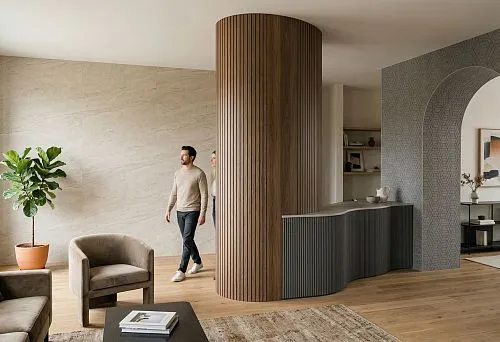
The living room as the central space of the house requires special attention to details.Wooden boards in interiorIn the living room, strips can perform multiple functions. An accent wall behind the sofa or TV, clad with vertical strips, creates an expressive focal point. A strip ceiling with integrated lighting adds drama and visually increases height. A partition between the relaxation zone and dining area gently separates functional areas while preserving space unity.
The bedroom requires a special atmosphere of calm and coziness. A headboard made of natural wooden strips becomes not just a decorative element, but a practical structure - behind it, soft cushions can be placed, bedside lamps or outlets can be mounted. A wall behind the headboard, fully clad with horizontally oriented strips, visually expands the room and creates a sense of security. Strip panels can continue onto the ceiling, forming a kind of canopy.
The children's room is a space where material eco-friendliness is especially important. Wooden strips here can be used for zoning sleeping and play areas, creating safe railings on the second level of a loft bed, decorating creative corners. Natural wood is safe for children's health, and the variety of coloring options allows creating a bright and cheerful interior.
Kitchen and dining room - areas where functionality takes precedence. Strip constructions here can serve as decorative screens for heating radiators, as bases for open shelves, or as zoning elements between the kitchen and dining area. It is important to choose wood species resistant to moisture and temperature fluctuations, and to treat the surface with protective compositions.
The hallway is a space that first meets guests and forms an impression of the house. Strip cladding of one of the walls creates a modern and stylish appearance. Behind the strips, storage areas can be hidden, hooks for clothes can be placed, and mirrors can be integrated. Vertical strips visually increase the height of often narrow corridors.
The bathroom requires a special approach to material selection. Here, larch or thermally treated wood strips are optimal, as they are not afraid of moisture. Strip panels create a spa-like effect, add warmth to cold tiles, and can be used to screen off the bathtub or shower area. Proper ventilation and treatment of wood with moisture-resistant compositions are mandatory.
Design techniques and stylistic solutions
Minimalism and Scandinavian style require clean lines and simple forms. Here, thin strips of light-colored wood - beech, birch, bleached spruce - are appropriate. Vertical placement of strips with equal spacing creates rhythmic graphics. Absence of unnecessary decor, natural color or light staining, matte surface - all this emphasizes the philosophy of the style.
Loft and industrial styles lean toward contrasts and textures. Brushed oak or larch planks with emphasized wood grain combine well with brickwork, concrete surfaces, and metal structures. Dark staining, aged effect, and deliberately rough finishes create a distinctive industrial aesthetic.
Eco-style and naturalism make wood the main hero of the interior. Planks of various species, retaining their natural color and texture, create a multi-layered composition. Asymmetry in placement, variation in plank width and thickness, and use of unfinished wood with knots and natural imperfections are permitted.
Modern classicism demands restraint and elegance. Smooth oak or walnut planks, coated with matte varnish or oil, form elegant panels. Symmetrical arrangement, proportional divisions, and combination withwooden moldingsandcornicescreate a respectable interior.
Japanese style values simplicity and harmony. Thin planks of light wood, arranged with mathematical precision, create meditative compositions. Characteristic use of planks for creating sliding partitions, screens, and decorative panels with backlighting.
Mounting options and structural solutions
The method of attaching planks depends on the specific task and type of base surface. The most common method is mounting on a wooden subframe. On walls or ceilings, 20x40 or 30x40 mm beams are mounted at 40-60 cm intervals. The subframe is leveled to compensate for base irregularities. Planks are fixed to beams using finish nails, clips, or concealed screws. This method is reliable, time-tested, and allows for creating ventilated structures.
A modern alternative is mounting on special metal guide profiles. Aluminum or steel profiles are mounted to the wall, and planks are inserted into their grooves. The advantage of this method is high installation accuracy, the possibility of disassembly and replacement of individual elements, and no visible fasteners. The disadvantage is higher cost of components.
Adhesive mounting is used on flat and strong bases. Special polyurethane adhesives provide secure fixation without mechanical fasteners. This method requires ideal surface preparation and precision, as position adjustments are only possible within a few minutes. Adhesive mounting is optimal for small decorative panels and accent elements.
Self-supporting structures are freestanding partitions or screens. Planks are attached to a frame made of beams, which is installed between floor and ceiling or fixed to walls. Such structures are mobile, can be moved, and are easily dismantled when necessary.
The distance between planks is an important parameter affecting visual perception. A frequent spacing of 5-15 mm creates almost a solid surface with fine shadow seams. A medium spacing of 20-40 mm forms a rhythmic structure with a balance of mass and void. A wide spacing of 50-100 mm creates a translucent structure, allowing more air and light.
Finishing and surface treatment
Unfinished wood, even when finely sanded, requires protection. Finishing treatment solves three tasks: protects against moisture, dirt, and mechanical damage; highlights the natural beauty of the texture; imparts the desired color and gloss level.
Oils and oil-waxes are the most natural finishing method. They deeply penetrate the wood structure, impregnating fibers and creating protection from within. Oil finish highlights texture, slightly deepens color, and creates a matte or silk-matte surface. Wood retains its ability to 'breathe,' regulating humidity in the room. Renewing the finish is simple — just apply a new layer of oil without prior sanding.
Varnishes create a denser protective film on the surface. Water-based acrylic varnishes are eco-friendly, odorless, and dry quickly. Polyurethane varnishes are more durable and suitable for surfaces subjected to intensive use. Gloss level varies from deep matte to high gloss. Varnish finish is long-lasting, but when damaged, it requires complete resanding and reapplication.
Waxes were traditionally used to finish valuable wood species. Wax finish creates a velvety surface, pleasant to the touch, highlighting color depth and texture. Wax is less resistant to abrasion than oil or varnish, requires periodic renewal, but precisely this allows wood to acquire a noble patina over time.
Staining allows changing the color of wood while preserving texture visibility. Stains based on water, alcohol, or oil penetrate fibers and color them. The color palette is virtually limitless — from subtle natural tone changes to radical transformations. Light pine can be stained to resemble walnut or wenge, simple beech can become redwood.
Painting with pigmented coatings completely hides wood texture under a paint layer. This method is used when color purity is important or to mask material defects. Modern wood paints provide durable coatings resistant to abrasion and washing.
Lighting and interaction with wooden planks
Interaction of light with plank structures creates amazing effects that change throughout the day and depending on lighting type. Natural daylight penetrating through gaps between planks creates dynamic play of light and shadow. The pattern changes as the sun moves, transforming a static structure into a living, breathing interior element.
Built-in backlighting enhances architectural expressiveness. LED strips placed behind plank structures create a floating plank effect and soft diffused glow. Mounting backlighting between planks forms rhythmic light stripes, emphasizing verticals or horizontals. Recessed spotlights placed in gaps create accent lighting.
Directed light from spotlights or floodlights creates expressive shadows, highlighting wood relief and texture. Changing the angle of illumination allows achieving various effects — from soft volume to dramatic contrast.
Light color temperature significantly affects perception of wooden planks. Warm light (2700–3000 Kelvin) highlights the natural warmth of wood, making it amber and cozy. Neutral white (4000–4500 Kelvin) shows natural color without distortion. Cool light above 5000 Kelvin gives a modern, slightly detached character.
Combining planks with other materials
Wood has an amazing ability to harmoniously combine with almost any material. Stone and wood — a classic combination of natural materials. Rough stone texture contrasts with the warmth of wood. Marble, granite, travertine in combination withwooden baseboardsand planks create a respectable interior.
Metal adds an industrial note. Black steel, brass, copper, aluminum — each metal interacts with wood in its own way. Thin metal profiles combined with wooden planks create elegant structures. Rough steel elements in loft settings are accentuated by the warmth of natural wood.
Glass and wood form a contrast of transparency and materiality. Glass partitions framed with wooden planks, glass shelves on wooden brackets, panoramic windows framed with wooden strips — all these solutions combine the lightness of glass with the reliability of wood.
Concrete combined with wooden planks loses its coldness and brutality. A smooth concrete wall with a fragment of plank cladding, a concrete ceiling with wooden beams — these contrasts create a distinctive modern interior.
Textile adds softness to wooden structures. Textile panels between battens, textile upholstery on furniture against lath walls, curtains and wooden blinds — textile softens the geometry of wood and adds coziness.
Care and operation of wooden battens
Proper care ensures longevity and preservation of the appearance of wooden structures. Regular dry cleaning is the foundation of care. Dust and dirt are removed with a soft brush, microfiber cloth, or vacuum cleaner with a furniture attachment. Regularity is important, as accumulated dust between battens looks unattractive.
Wet cleaning is performed with a well-wrung cloth with minimal water. Excess moisture is harmful to wood, even under protective coating. Neutral cleaning agents without aggressive chemicals are used for washing. After wet cleaning, the surface is recommended to be dried thoroughly.
Renewal of protective coating is required periodically depending on the type of finish and intensity of use. Oil coatings are renewed every 1-2 years by applying a new layer of oil. Wax surfaces are polished with fresh wax every six months to a year. Lacquered coatings are more durable, but when scratches or scuffs appear, they require sanding and re-lacquering.
Climate conditions significantly affect the condition of wood. Optimal temperature is 18-24 degrees, air humidity 40-60 percent. Sudden changes in temperature and humidity cause deformation. In winter, when heating dries out the air, humidifiers are recommended. In summer, ventilation is beneficial in hot weather.
Protection from direct sunlight prevents wood from fading. Ultraviolet light destroys lignin, which binds fibers, and wood loses color, becoming gray. Curtains, blinds, and glass tinting help protect wooden elements on the sunny side.
Mechanical damage — scratches, dents, chips — are inevitable during use. Minor scratches on oil or waxed surfaces are easily removed by reapplying the coating. Deep damage requires local sanding and restoration of the coating.
Economic aspects of using wooden battens
The cost of implementing a project using wooden battens consists of several components. The price of the material itself depends on the wood species, grade, dimensions, and quality of processing. Spruce battens are the most affordable, with prices starting from relatively modest sums per linear meter.Wooden trimLarch battens are approximately 1.5-2 times more expensive. Oak or beech products belong to the premium segment.
Installation work also affects the total cost. With basic skills and tools, installation can be done independently, significantly saving budget. Hiring professionals increases costs but guarantees quality results. Complexity of the structure, need to create a frame, integration of lighting — all this affects installation cost.
Fittings and consumables add to the total estimate. Studs for substructure, fasteners, glue, primers, finish coatings — all of this must be considered when planning the budget. Special profiles for concealed installation are significantly more expensive than traditional wooden substructure.
Long-term perspective shows that investments in quality wooden battens are justified. The service life of properly installed and maintained solid wood products is decades. The material does not go out of fashion, can be renewed with a new coating, repaired if necessary. Unlike artificial materials, natural wood develops a noble patina with age.
Ecological investments should also be considered. Choosing natural wood, the buyer invests in their own health and comfort of living. Absence of toxic emissions, favorable microclimate, psychological comfort from the presence of natural material — all of this is difficult to evaluate in monetary terms, but it is precisely this that determines the quality of life.
Trends and prospects for using battens
Modern interior design trends show a steady increase in popularity of natural materials. Wooden battens, once a fashionable trend, have become a classic of modern design. Minimalist interiors appreciate them for their clean lines and natural aesthetics. Eco-style makes wood the basis of the concept. Even traditional styles adapt batten structures, finding new ways to use them.
Technological innovations expand application possibilities. Thermally treated wood acquires dimensional stability and moisture resistance, allowing battens to be used even in humid areas and on facades. Impregnated wood serves for decades without losing properties. New water-based protective coatings are eco-friendly and long-lasting.
Digital design technologies allow creating complex batten compositions with mathematical precision. Parametric modeling generates unique patterns. CNC machines ensure ideal precision in manufacturing complex-shaped parts.
Integration with engineering systems makes batten structures multifunctional. Built-in LED lighting, acoustic systems, climate equipment — all of this integrates organically into wooden panels. Smart home controls lighting, creating various lighting scenarios.
Individualization is becoming a key trend. Standard solutions give way to unique projects reflecting the owner's personality. Combining wood species of different shades, non-standard sizes and shapes, experimenting with pattern arrangements — all of this creates unique interiors.
Errors in selecting and installing battens
Insufficient attention to wood moisture is one of the most common errors. Battens with moisture above 12 percent, installed in heated rooms, inevitably dry out. This will result in gaps between planks, warping, cracking. Checking moisture with a moisture meter at purchase is mandatory.
Ignoring material acclimatization leads to problems. Battens brought from a cold warehouse must rest for several days in the room where they will be installed. Wood adapts to temperature and humidity, taking on stable dimensions. Installation without acclimatization risks subsequent deformation.
Incorrect selection of wood species for specific conditions shortens service life. Using spruce battens in humid areas, installing beech on sunny sides without protective coating — such solutions lead to rapid material wear.
Errors in the substructure design disrupt the geometry of the entire structure. Insufficient frequency of frame studs, deviations from plane, improper fastening — all of this will manifest in the final finish. The frame must be rigid, level in one plane, securely fastened to the base surface.
Incorrect choice of fasteners damages appearance. Too thick nails split thin battens. Screws driven without pre-drilling also cause cracks. Using black fasteners leads to rust stains on light wood. Fasteners must match the material — finish nails or galvanized screws for concealed installation.
Absence of gaps for thermal expansion creates stress in the structure. Wood is a living material that reacts to temperature and humidity changes with minor dimensional changes. Battens installed flush without compensating gaps will press against each other, leading to warping.
Insufficient protection of batten ends accelerates moisture loss through end grain. Unprotected ends crack first. Treating ends with primer or special sealant prevents the problem.
DIY installation: step-by-step guide
The preparatory stage begins with precise measurements of the room and calculation of material quantities. The direction of the boards, spacing between them, and method of fastening are determined. Materials are purchased with a 10-15 percent reserve for trimming and possible defects. The boards should acclimate in the room for several days.
Marking the base surface is performed using a laser level or a long straightedge. Lines for fastening the rafters are marked. It is important to ensure strictly parallel placement of the guides — this determines the flatness of the finished surface.
Installation of the rafter begins with the outermost beams. They are fastened to the wall with anchors at a 40-50 cm spacing. Using shims of varying thicknesses, the beams are aligned to a single plane. Intermediate beams are installed with a long straightedge to control the plane. A rafter spacing of 40-60 cm ensures sufficient structural rigidity.
Marking and trimming of boards are performed during the preparation stage. If the boards are installed vertically from floor to ceiling, their length should be 3-5 mm shorter than the room's height — this is a compensatory gap. The ends are trimmed at a 90-degree angle using a circular saw for tight fitting against the floor and ceiling.
Installation of the first board is critically important — it sets the direction of the entire structure. The board is set strictly vertically using a level and fastened to the rafter. Finishing nails 40-50 mm long or thin screws driven at an angle are used. Fasteners are placed where they will be hidden by the next board or remain in shadow.
Subsequent boards are installed at the specified spacing. Calibration shims of equal thickness are used to control the distance. Every fifth to tenth board is checked with a level to control vertical alignment. Adjustments are made as needed.
Processing corners and junctions requires precision. Internal corners are finished with a small gap of 2-3 mm or using a corner profile.made of woodExternal corners are finished with a 45-degree butt joint or with an overlay corner element.
Final finishing includes sanding mounting areas if necessary, dust removal, and application of protective coating. Oil or wax is applied with a brush or pad, carefully worked into the wood. Excess is removed. After the first layer dries, a second layer is applied. Lacquer is applied in 2-3 coats with intermediate sanding using fine abrasive.
Innovative solutions and non-standard applications
Curved structures expand design possibilities. Thin boards, steamed in hot water, are pliable and can form smooth curved surfaces. Such structures require a special frame replicating the desired curvature, but the result impresses with its plasticity and dynamism.
Three-dimensional compositions are created by varying the depth of board mounting. Some boards are installed at one level, while others protrude forward, creating a three-dimensional relief. The play of light and shadow on such surfaces is especially expressive.
Perforated boards with holes of different diameters create an unusual pattern. Holes may be arranged chaotically or form an ornament. Such solutions are especially interesting with backlighting, when light passes through the perforations.
Composite panels combine boards of different widths, thicknesses, and wood species. Alternating oak and ash, contrasting shades, matte and glossy surfaces create a complex texture. Such compositions become artistic objects, works of applied art.
Functional furniture made from boards — another direction of application. Board facades for cabinets, bed backs, countertops, shelves —Wooden profilesbecome the basis of furniture structures. Such furniture is light, airy, and perfectly fits modern interiors.
Acoustic panels made from boards with mineral sound-absorbing fillers improve room acoustics. Such panels are indispensable in home theaters, music rooms, open-plan offices. They simultaneously serve decorative and functional purposes.
Ecological Aspects and Certification
Choosing wood from sustainable sources is a question of responsibility toward nature and future generations. FSC (Forest Stewardship Council) certification guarantees that the wood comes from forests managed according to strict ecological and social standards. Buying certified products supports responsible forestry.
The carbon footprint of wood is minimal compared to synthetic materials. During growth, trees absorb carbon dioxide from the atmosphere and store carbon in their structure. Even when converted into construction materials, wood continues to store this carbon for decades without releasing it into the atmosphere.
The possibility of secondary recycling makes wood a sustainable material. Old wooden structures can be dismantled and reused. Worn wood is recycled into fuel briquettes, compost, or wood flour for composite materials.
Biodegradability is an important advantage of natural wood. Unlike plastics, which persist in nature for hundreds of years, wood fully decomposes naturally, returning nutrients to the soil.
Local production reduces the
FAQ: Frequently Asked Questions
What is the optimal thickness of boards for residential spaces?
For most interior solutions, an optimal thickness of 15-20 mm is recommended. Such boards are strong enough to retain their shape and yet elegant enough not to overwhelm the space. For small rooms, thinner boards of 10-12 mm can be chosen, while spacious rooms may accommodate boards up to 25 mm.
Can wooden boards be used in a bathroom?
Yes, but with certain limitations. Choose wood species resistant to moisture — spruce or thermally treated wood. All surfaces, including ends, must be treated with high-quality hydrophobic coating. Effective ventilation of the room is required. Avoid direct contact with water.
How long do wooden boards last in interiors?
With proper installation, adequate treatment, and regular maintenance, they last 20-30 years or more. High-quality products made from hardwood species can last for decades, acquiring a noble patina with age.
Do battens require complex care?
Care is quite simple - regular dry dusting, periodic wiping with a well-wrung cloth, and reapplying protective coating every 1-2 years for oil-based surfaces. This is no more complicated than caring for regular wooden furniture.
What distance between boards looks best?
There is no universal answer - it all depends on the design concept. For graphic minimalism, a small step of 10-20 millimeters suits best. For more free compositions - 30-50 millimeters. Wide gaps of 70-100 millimeters create translucent structures. Try marking several options on the wall and evaluate visually.
Can wooden boards be painted?
Definitely. Modern wood paints provide durable coverage, preserving the texture (semi-transparent finishes) or fully concealing it (covering enamels). Painting expands design possibilities and allows adapting boards to any interior color scheme.
Is it possible to install boards yourself?
Yes, with basic woodworking skills and necessary tools, installation is well within the reach of a DIY enthusiast. The key is accurate marking, quality substructure, vertical or horizontal alignment control, and careful workmanship. For complex curved structures, it’s better to hire professionals.
Which wood species to choose for the first project?
For getting acquainted with the material, pine is optimal - affordable price, ease of processing, pleasant appearance after toning. After gaining experience with pine, you can move on to more expensive and demanding species.
Does wood react to a heated floor?
A heated floor creates additional stress on wood due to drying out. If boards are installed on walls and the heated floor is in the floor - no problem. If planning to use board cladding on the floor with a heated floor - choose stable species (oak, thermally treated wood), monitor air humidity, and do not exceed floor temperature of 27 degrees.
Which is better - oil or lacquer for boards?
Oil preserves the natural matte texture, highlights the wood structure, is easy to renew, but less resistant to abrasion. Lacquer provides stronger protection, can be matte or glossy, long-lasting, but requires full sanding upon damage. For residential interiors, oil is often preferred for its naturalness and ease of maintenance.
Conclusion
Thin wooden lathsThey are no longer just construction materials or fashion trends - they have become a full-fledged tool of architectural expression, capable of transforming space and creating a unique atmosphere. The combination of natural wood beauty with the geometric precision of modern design, functionality with aesthetics, practicality with eco-friendliness makes board structures a universal solution for various interiors.
Choosing natural wood is choosing health, comfort, and longevity. Qualitywood trim itemsserve for decades, never losing their appeal, but instead acquiring a noble patina of time. They create a special microclimate in the home, fill the space with the warmth of living material, delight the eyes with natural textures and hues.
Modern wood production and processing technologies have reached such a level that they allow using wooden elements in almost any conditions - from dry living rooms to humid bathrooms, from classic interiors to ultra-modern minimalist spaces. The variety of species, sizes, processing methods, and finishes opens up limitless possibilities for realizing the boldest design ideas.
Company STAVROS, with years of experience working with natural wood and modern production equipment, offers a wide range of high-quality wooden boards and other trim elements. Strict quality control at all production stages, use of premium raw materials, and precise adherence to technological processes guarantee stable characteristics and product longevity. Professional consultations from STAVROS specialists will help select the optimal solution for a specific project, taking into account all room specifics and client preferences.
Investing in quality wooden boards is investing in comfort, beauty, and a healthy home atmosphere for many years. Natural wood never goes out of style, never loses relevance, remains an example of natural beauty and eco-friendliness. In a world saturated with artificial materials, the presence of living wood in interiors becomes especially valuable - it brings us back to our roots, to harmony with nature, creating a sense of reliability and stability.