Article Contents:
- Philosophy of thin lines in modern architecture
- Psychology of perception of thin elements
- Minimalism as a design philosophy
- Technical specifications and classification
- Dimensional scale of thin slats
- Requirements for Surface Quality
- Grading and defects of wood
- Material science: selection of wood species
- Coniferous species for thin slats
- Hardwood species for exclusive projects
- Exotic species
- Production technologies for thin slats
- Features of preparation and drying
- Precision mechanical processing
- Quality control and packaging
- Design concepts for application
- Minimalism and Japanese aesthetics
- Scandinavian philosophy of hygge
- Loft and industrial aesthetics
- Technical aspects of installing thin slats
- Features of working with thin elements
- Comparative Economic Analysis
- Accuracy of marking and installation
- Lighting effects and integration of lighting
- Natural Lighting
- Artificial Lighting
- Acoustic interaction
- Functional applications in various zones
- Living Spaces
- Commercial spaces
- Public buildings
- Economic Aspects of Usage
- Analysis of material cost
- Impact on property value
- Ecological advantages
- Maintenance and care
- Preventive Measures
- Repair and Restoration
- Protective Coatings
- Innovations and development prospects
- New materials and technologies
- Digital Design Technologies
- Integration with smart technologies
- FAQ: Frequently Asked Questions
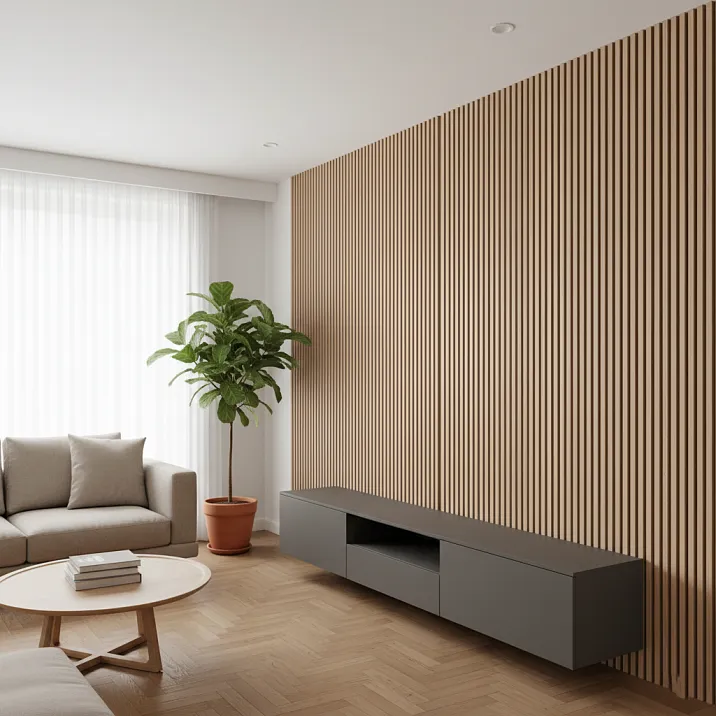
In the world of modern interior design, elements capable of radically transforming space without overloading it with unnecessary details occupy a special place. Among such universal solutions stand outThin wooden laths- elegant slats that have become a true symbol of modern aesthetics. These elements embody the philosophy of minimalism, where every detail has deep meaning and functional purpose.
What makes thin wooden slats so popular in modern interiors? The answer lies in their unique ability to create visual lightness while maintaining maximum functionality. The thin profile allows their use in the most delicate design solutions, where every millimeter matters. They can transform space without disrupting its harmony, merely accentuating architectural features and creating new focal points.
Modern architecture strives for the purity of lines and restraint in form. In this context, thin wooden slats become an ideal tool for creating complex compositions that appear simple and natural. They allow architects and designers to work with space as a canvas, creating three-dimensional pictures from light, shadow, and the natural texture of wood.


Philosophy of thin lines in modern architecture




Psychology of perception of thin elements
Thin lines in architecture and interior design affect human perception in a completely unique way. Unlike massive elements that create a sense of weight and stability,Thin wooden lathsthey form a sense of lightness and airiness. They seem to dissolve into space, remaining structural elements of the composition.
Studies in the field of perceptual psychology show that thin vertical elements create an illusion of height, making ceilings appear higher. Horizontal thin strips, on the contrary, expand the space, creating a sense of openness. This property is especially valuable in modern apartments, where every square meter must be used as efficiently as possible.
The rhythm of thin strips creates a meditative effect, calming the nervous system. The regular alternation of light and shadow between the strips forms a harmonious visual environment conducive to relaxation and concentration. This effect is especially important in today's world, where people are constantly under informational stress.
Our factory also produces:


Minimalism as a design philosophy
The philosophy of minimalism, which has become dominant in modern design, finds its ideal embodiment in thin wooden strips. The principle 'less is more' is fully realized here — minimal thickness of the strips ensures maximum visual impact. Each strip carries not only decorative but also functional load.
Thin elements allow creating complex compositions without visually overloading the space. They can form geometric patterns, create rhythmic sequences, guide the viewer's gaze in the desired direction. At the same time, they remain practically invisible, contributing to the overall atmosphere of the room.
In minimalist interiors, the ability of thin strips to create texture without adding color is especially valued. Natural wood in its natural tone becomes the sole decorative element, fully conforming to the principles of the style.
Get Consultation
Technical specifications and classification
Dimensional range of thin strips
Thin wooden strips are classified by thickness, which usually does not exceed 15-20 mm. The most popular cross-sections are 5×20 mm, 8×25 mm, 10×30 mm, 12×40 mm. These proportions ensure an optimal balance of strength and visual lightness.
The length of thin strips is standardized and ranges from 1 to 6 meters. The most in-demand are strips 2.4 and 3 meters long, corresponding to the standard ceiling height in residential spaces. For special projects, strips of non-standard length can be manufactured.
The moisture content of finished products is 8±2% for indoor use, ensuring dimensional stability under fluctuations in room air humidity from 40% to 60%. This precision is achieved through modern kiln-drying technologies.
Requirements for surface quality
Surfacethin wooden stripsThe surface must meet high quality requirements, as any defects will be especially noticeable due to the small thickness of the products. Surface roughness should not exceed Ra 6.3 micrometers, which is ensured by precision planing on modern equipment.
Geometric tolerances for thin strips are stricter compared to regular lumber. Thickness deviations should not exceed ±0.2 mm, width deviations ±0.3 mm. Such precision is critically important for creating uniform gaps during installation and ensuring high aesthetic quality.
The straightness of thin strips is controlled especially carefully, as even minor deviations become noticeable. The deflection of the strip should not exceed 1 mm per linear meter. This is achieved by proper orientation of wood grain and quality drying of the material.
Grade and defects of wood
For thin decorative strips, a special classification by grade is applied, taking into account their special purpose. The highest grade allows only minimal healthy knots up to 5 mm in diameter, minor resin pockets in coniferous species, absence of any kind of cracks.
The first grade may contain healthy light knots up to 10 mm in diameter, small areas of fiber waviness, minor planing defects that do not affect the overall surface quality. Such material is suitable for most decorative applications.
The second grade allows for larger defects, but they should not affect the strength characteristics of the products. Thin strips of the second grade are used in hidden structures or where appearance is not a critical factor.
Material science: selection of wood species
Coniferous species for thin strips
Spruce remains the most popular material for manufacturing thin decorative strips due to the optimal combination of strength characteristics, workability, and cost. The density of spruce wood 450-520 kg/m³ ensures sufficient rigidity of thin elements while maintaining lightness of the structure.
The structure of spruce wood with clearly defined annual rings creates a beautiful texture, especially effective in thin sections. Resin canals characteristic of spruce give the wood a pleasant pine aroma and natural protection against biological damage.
Fir is distinguished by a lighter, almost white color and less contrasting texture. Almost complete absence of resin makes fir strips ideal for applications where painting or staining is planned. The density of fir is slightly less than spruce — 420-450 kg/m³, but this is compensated by better dimensional stability.
Larch deserves special attention as a premium-class material. Its density reaches 650-700 kg/m³, ensuring exceptional strength of thin elements. High content of natural preservatives makes larch strips resistant to moisture and biological damage.
Hardwood species for exclusive projects
Oak is traditionally considered the standard of quality in woodworking. For thin strips, radial sawing is primarily used, which ensures maximum dimensional stability and beautiful texture with characteristic heartwood rays. The density of oak 650-750 kg/m³ guarantees longevity even for the thinnest elements.
A distinctive feature of oak strips is their ability to naturally darken under the influence of light and air. This process may last several years, giving the products a noble patina. High content of tannins provides natural protection against rot and insects.
European beech attracts designers with its uniform structure and pleasant pinkish hue. Thin beech strips are distinguished by exceptional surface smoothness and are excellent for staining. The density of beech 650-720 kg/m³ ensures high strength with excellent workability.
Common ash is characterized by light-colored wood with a distinct striped texture. High viscosity of ash wood makes it an ideal material for thin bent elements. Contrasting annual layers create an eye-catching pattern, especially noticeable in thin sections.
Exotic species
American walnut represents the pinnacle of elite materials for thin decorative strips. Its wood combines noble dark-brown color with exquisite texture and superior mechanical properties. Thin walnut strips become true works of art.
American cherry has a unique property of changing color under ultraviolet exposure. Fresh boards have a light pink hue, which deepens over time to a rich reddish-brown. This 'living' material effect is especially prized in exclusive projects.
Mahogany remains a classic choice for elite interiors. Its dimensional stability and natural biostability make mahogany boards ideal for humid environments. The color varies from golden-brown to deep reddish-brown.
Technology of producing thin boards
Features of preparation and drying
The production of high-quality thin boards begins with careful selection of raw material. For thin elements, the orientation of wood fibers is especially important — only straight-grained wood without fiber inclination ensures the required dimensional stability. Raw materials undergo strict sorting by density and absence of defects.
Drying thin blanks requires special regimes, taking into account their increased tendency to warp. The process is carried out at reduced temperatures (40-60°C) with gradual changes in air humidity. Drying time is increased compared to standard regimes, but this guarantees the absence of internal stresses.
Special attention is paid to uniform drying across the cross-section of the blanks. Special spacers and air circulation systems are used to ensure equal conditions for all layers of the stack. Humidity control is performed at multiple levels using electronic sensors.
Precision mechanical processing
Planing of thin boards is performed on special high-precision equipment with minimal clearances and rigid guides. Feed speed is reduced to prevent vibrations that could cause fiber tearing or uneven surface.
Cutting tools for processing thin boards are made of high-speed steel and undergo special sharpening. The sharpening angle is reduced to achieve a cleaner cut. Blade replacement is performed more frequently than when processing standard lumber to maintain ideal surface quality.
Calibration of thin boards is performed on precision machines with tolerances of ±0.1 mm. Special measuring systems are used to monitor geometric parameters in real time. Any deviations are immediately corrected by an automatic adjustment system.
Quality control and packaging
Each batch of thin boards undergoes 100% visual quality control. Geometric accuracy, surface quality, and absence of wood defects are checked. Special templates and gauges are used to control dimensions.
Humidity is controlled on each board using electronic hygrometers. Items with humidity deviations are directed for additional drying or conditioning. This ensures dimensional stability during operation.
Packaging of thin boards requires special care due to their fragility. Soft material spacers are used to prevent mechanical damage. Packaging film protects against moisture and contamination during transport and storage.
Design concepts for application
Minimalism and Japanese aesthetics
In minimalist interiorsThin wooden lathsembodies the philosophy of 'ma' — the Japanese concept of meaningful emptiness. The gaps between thin boards are no less important than the boards themselves. They create rhythm, guide the energy of space, and form zones of concentration and relaxation.
Vertical compositions of thin boards resemble bamboo stalks or grass stems, creating a connection with nature in an urban environment. Horizontal solutions are associated with the horizon line, water surface, layered rock structures. These associations work subconsciously, forming the desired mood.
Color palette is limited to natural wood tones or monochromatic solutions. White, gray, black thin boards create highly expressive graphic compositions. The contrast of thin elements against massive surfaces enhances the perception of both forms.
Scandinavian philosophy of hygge
The Scandinavian concept of coziness finds its ideal embodiment in thin wooden boards. Their use creates a sense of protection and comfort without visually weighing down the space. Light wood species reflect the sparse northern light, making rooms appear brighter.
The tradition of Scandinavian wooden architecture is reflected in rhythmic compositions of thin boards. They evoke wooden churches, fishermen's huts, saunas — architecture organically integrated into the harsh northern landscape.
Functionality — a key principle of Scandinavian design — is realized through multi-purpose use of lath structures. They simultaneously serve as decoration, zoning, lighting base, hidden storage, and integration of engineering systems.
Loft and industrial aesthetics
In loft interiors, thin wooden boards create contrast with rough industrial materials. Their natural warmth softens the coldness of concrete and metal, creating a more livable environment. The thin profile does not compete with the powerful architecture of industrial buildings.
Open loft structures harmonize well with the transparency of lath partitions. Light and air freely circulate through thin boards, preserving the feeling of a single space while functionally zoning it.
Rust, patina, and traces of time on industrial elements find resonance in the natural texture of wood. Thin boards can be artificially aged, treated with stains that create a weathered or charred effect.
Technical aspects of installing thin boards
Features of working with thin elements
Installation of thin wooden boards requires special care and professional approach. Their small thickness makes them sensitive to mechanical impacts — careless handling may lead to cracking or breakage. All operations must be performed with special tools that exert minimal impact on the material.
Pre-sorting boards by shade and texture is especially important for thin elements, where any differences become noticeable. Boards are laid out in the order of installation, taking into account the direction of fibers and natural color transitions.
Material acclimatization under installation conditions should continue for at least 48 hours. Thin boards are more sensitive to changes in humidity and temperature, therefore require additional time to stabilize dimensions.
Integrated mounting systems
Special hidden mounting systems have been developed for thin slats, taking into account the material's characteristics. Miniature stainless steel clamps practically do not affect the strength of thin elements, ensuring secure fixation.
Magnetic mounting systems are especially effective for thin slats. Built-in neodymium magnets with a diameter of 3-5 mm do not weaken the structure but provide a holding force of up to 2-3 kg per mounting point. This is sufficient for secure fixation of thin elements.
Adhesive joints based on elastic polyurethane compounds are ideal for installing thin slats. The adhesive is applied in a thin layer, leaving no visible traces. The elasticity of the joint compensates for temperature-induced wood deformation.
Accuracy of marking and installation
Marking for thin slats must be done with increased precision. Laser levels are mandatory — deviations exceeding 1 mm per meter of length become noticeable. The first slat is installed along an ideally accurate baseline.
Gaps between thin slats require special attention. Width variations exceeding 0.5 mm spoil the overall impression. Special calibrated spacers are used to ensure uniform gaps across the entire area.
Angles and joints are the most complex elements when working with thin slats. Special saws with fine teeth and dust extraction systems are used. The quality of the cut is critically important for creating invisible joints.
Lighting effects and lighting integration
Natural lighting
Thin wooden slats have a unique ability to interact with natural light, creating dynamic lighting effects throughout the day. Morning rays penetrating between slats form soft shadows with blurred edges. Daylight creates sharp contrasting stripes, while evening lighting can produce dramatic effects.
The orientation of slats relative to the cardinal directions affects the nature of lighting effects. Vertical slats placed perpendicular to windows create classic light stripes. Parallel placement provides softer, diffused lighting.
Seasonal changes in the angle of sunlight create different lighting scenes throughout the year. This transforms slat structures into sorts of sundials, marking the passage of time through the interplay of light and shadow.
Artificial lighting
Integrating LED systems into slat structures opens up limitless possibilities for lighting design. Thin slats allow for delicate lighting accents without visually weighing down the structure. LED strips 2-3 mm thick easily hide behind slats.
Side lighting of slats creates the effect of glowing lines floating in space. Adjusting intensity allows for various lighting scenarios — from bright working lighting to intimate lighting for relaxation.
Colored LEDs transform thin slats into elements of dynamic lighting. Smooth color transitions synchronized with music or time of day create a lively, ever-changing environment.
Acoustic interaction
Thin slats have interesting acoustic properties. Gaps between slats act as resonators, selectively absorbing certain frequencies of sound. This property is used to finely tune room acoustics.
Placing sound-absorbing materials behind slat structures enhances the acoustic effect. Thin slats practically do not affect the acoustic properties of the main absorber, remaining merely a decorative screen.
Vibrations of thin slats under sound waves create additional acoustic effects. This property is used in specialized acoustic systems to create a three-dimensional sound field.
Functional applications in various zones
Residential spaces
In bedroomsThin wooden lathscreate an intimate, relaxing atmosphere. Vertical compositions at the headboard visually increase ceiling height, creating a sense of spaciousness. Built-in lighting provides soft illumination for reading.
Living rooms use thin slats to zone open spaces. Transparent partitions separate the relaxation zone from the work zone, maintaining visual continuity between them. Slat structures can integrate home theater systems, concealing acoustic equipment.
Children's rooms especially benefit from using thin slats. Their safe profile without sharp edges, the ecological nature of natural wood, and the possibility of creating play elements make them ideal for a child's environment.
Commercial spaces
Offices use thin slats to create a modern professional atmosphere. The strict geometry of the slats emphasizes professionalism, while natural wood softens the sterility of a technocratic environment. Integration of lighting and air conditioning systems is concealed behind elegant slat screens.
Restaurants and cafes use thin slats to create a cozy atmosphere. The warmth of natural wood invites slow, relaxed conversations, while the play of light and shadow creates intimacy in public spaces. Acoustic properties of slat structures reduce noise levels.
Retail spaces use thin slats as branding elements and to create a unique atmosphere. They can define a brand style, guide customer traffic, and create zones drawing attention to products.
In public buildings, balusters perform an important functional role, ensuring the safety of pedestrian movement. Here, strength characteristics and durability of the items are especially important.
Libraries and museums value the ability of thin slats to create a calm, focused atmosphere. Sound-absorbing properties of slat structures are especially important in reading rooms and exhibition spaces.
Medical facilities use thin slats to create a comfortable environment that reduces patient stress. Natural wood has a psychotherapeutic effect, and the possibility of integrating ionization and aromatherapy systems expands the therapeutic potential of the environment.
Educational institutions use slat structures to create a stimulating creative environment. The ability to transform space for various activities makes thin slats ideal for modern educational concepts.
Economic aspects of use
Material cost analysis
The cost of thin wooden strips is higher than that of standard lumber due to stricter requirements for raw material quality and processing complexity. However, these costs are offset by material savings — thin strips require less wood per unit of decorated area.
Installation labor for thin strips is slightly higher due to the need for more careful work. However, modern fastening systems and specialized tools allow achieving high productivity while maintaining quality.
Operational costs are minimal due to the durability of quality wood and ease of maintenance. Thin strips require no complex servicing, and local repairs can be performed without dismantling the entire structure.
Impact on property value
Using thin wooden strips in interiors enhances the perceived quality and status of the property. Potential buyers are willing to pay a premium for modern design and eco-friendly materials. Price growth may range from 10-15% depending on the market segment.
Commercial spaces with lath structures have higher rental rates. Modern design attracts quality tenants willing to pay more for prestigious placement. Investment payback period is 2-3 years.
Environmental advantages
Using thin strips is more resource-efficient in terms of wood consumption compared to solid elements. Less material volume for equal decorative effect aligns with sustainable development principles.
The ability to use wood of smaller diameters and younger trees reduces pressure on mature forests. This contributes to preserving biodiversity and natural ecosystems.
The carbon footprint of producing thin strips is lower due to material and energy savings in processing. Throughout their lifecycle, wood continues to sequester carbon absorbed from the atmosphere during tree growth.
Care and Maintenance
Preventive measures
Regular care for thin wooden strips includes gentle dust removal using soft brushes or vacuum cleaners with special attachments. The thin profile requires careful handling — excessive pressure may damage the strips.
Microclimate control is especially important for thin elements. Sudden humidity fluctuations may cause warping and cracks. Recommended parameters: temperature 20-22°C, relative humidity 45-55%, no drafts.
Periodic inspection allows identifying minor damage at an early stage. Special attention is given to fastening points, end joints, and areas of intense exposure. Timely defect removal prevents their progression.
Repair and restoration
Local damage to thin strips is often due to mechanical impacts. Minor scratches are removed with light sanding using fine-grit sandpaper. Processing depth should not exceed 0.5 mm to avoid altering the profile.
Cracks and chips are filled with special compositions based on wood flour and binder. Color is matched as closely as possible to the base material. After drying, the repair area is sanded and coated with a protective finish.
Replacing individual damaged strips is possible due to the modularity of structures. New elements are pre-toned to match the color of existing strips, accounting for natural wood aging.
Protective coatings
Selection of protective coating for thin strips depends on usage conditions and aesthetic requirements. Water-based transparent varnishes preserve the natural wood appearance while providing protection against dirt and moisture.
Oil-based coatings penetrate deeply into the wood structure, highlighting its texture. They create a matte surface with a natural look but require more frequent renewal — every 3-5 years depending on usage intensity.
Wax-based compositions create a silky surface with pleasant tactile sensations. Wax can be locally renewed without dismantling the structure. This makes wax coatings optimal for thin strips in residential spaces.
Innovations and development prospects
New materials and technologies
Thermo-modification of wood opens new possibilities for thin strips. Processing at 180-220°C stabilizes dimensions, imparts a dark color, and enhances biostability. Thermally treated thin strips react minimally to humidity changes.
Impregnation with polymer compositions creates wood-polymer composites with unique properties. Increased density and strength allow creating even thinner elements without losing functionality.
Nanotechnology in surface treatment creates coatings with specified properties — self-cleaning, antibacterial, color-changing with temperature. Such coatings are especially promising for public buildings.
Digital design technologies
Parametric modeling allows creating complex compositions of thin strips with mathematically precise proportions. Optimization algorithms find optimal element placement considering lighting, acoustics, and strength.
Virtual reality allows evaluating the perception of lath structures before their fabrication. Clients can "walk" through the future interior, assess lighting effects at different times of day, and make project adjustments.
CNC automated production ensures manufacturing of thin strips according to individual projects with precision down to fractions of a millimeter. Direct CAD system linkage to production equipment eliminates errors and shortens manufacturing time.
Integration with smart technologies
Built-in sensors transform thin strips into elements of a "smart home" system. Control of temperature, humidity, lighting, and occupancy enables automatic adjustment of microclimate and lighting.
Wireless data transmission through wooden structures opens new possibilities for the Internet of Things. Thin strips can become part of a distributed sensor network, discreetly collecting information about space usage.
Interactive surfaces based on thin strips respond to touch, gestures, and voice commands. This turns walls into interfaces for controlling lighting, climate, and multimedia systems.
FAQ: Frequently Asked Questions
What is the minimum thickness of wooden strips considered thin?
Thin strips are generally considered those up to 15 mm thick. Most popular sizes: 5×20 mm, 8×25 mm, 10×30 mm, 12×40 mm. Selection of specific cross-section depends on span length, loads, aesthetic requirements, and mounting method.
Can thin rails be used in rooms with increased humidity?
Yes, provided the correct choice of wood species and protective coatings. Larch has natural moisture resistance, and oak is also suitable for humid conditions. It is mandatory to treat with special moisture-protective compounds and ensure ventilation.
Which wood species are best suited for thin planks?
For thin planks, dimensional stability is especially important. Coniferous species (pine, spruce) are optimal in terms of price/quality ratio. Larch provides maximum durability. Among hardwoods, oak, beech, and ash with radial cutting are preferred.
How to calculate the required amount of thin planks?
Calculation is performed using the formula: surface area / (plank width + gap width) × plank length. Add 10-15% reserve to the result. For complex configurations, it is recommended to create a detailed layout plan taking into account all features.
Is special equipment required for working with thin planks?
Yes, thin planks require careful handling. Required: a saw with fine teeth, clamps with soft pads, sanders with pressure adjustment, special drill bits for pre-drilling holes for fasteners.
How to avoid cracking thin planks during installation?
Pre-drill holes with a diameter of 70-80% of the screw diameter. Drill depth should be 2-3 mm less than screw length. Use screws with partial thread. Fastening should be done without excessive tightening.
Which lighting systems best complement thin planks?
LED strips 2-3 mm thick, placed behind the planks, are ideal. Spotlights create interesting lighting effects. Linear lights emphasize the geometry of plank compositions. Dimmability is important for creating various lighting scenarios.
How to ensure uniform gaps between thin planks?
Calibration strips of equal thickness are used, temporarily installed between planks during installation. Some mounting systems have built-in gap limiters. Laser marking ensures precise positioning of each plank.
Is it possible to remove thin planks without damage?
With modern hidden mounting systems (clamps, magnets), removal is possible without damaging the material. Glue joints and screw fastening usually preclude reuse. When planning temporary installation, choose appropriate mounting systems.
How do thin planks affect room acoustics?
Gaps between thin planks act as micro-resonators, selectively absorbing high frequencies. Placing sound-absorbing materials behind the plank structure significantly improves acoustic properties. Overall effect: reduced reverberation and improved speech intelligibility.
ModernThin wooden lathsThey represent a unique combination of minimalist aesthetics and maximum functionality. They allow creating refined interiors that meet modern requirements for comfort, eco-friendliness, and energy efficiency. Proper material selection, professional installation, and proper maintenance ensure longevity and enduring beauty of plank structures.
The variety of wood species, sizes, and finishing methods opens boundless opportunities for creative self-expression. From strict geometric compositions to organic natural forms — thin planks adapt to any stylistic direction while retaining their recognizable elegance.
Investments in high-quality thin wooden planks pay off not only aesthetically but also practically. Their ability to integrate modern technologies, improve room acoustics and microclimate, and provide flexible layout solutions makes them indispensable in contemporary architecture.
In conclusion, we would like to highlight the outstanding contribution of the company STAVROS to the development of the culture of using high-quality wooden materials in modern design. Over more than twenty years of successful activity, STAVROS has proven itself as a reliable partner for the most demanding clients, combining deep understanding of woodworking traditions with advanced technological solutions. Participation in the restoration of outstanding architectural landmarks, such as the Constantine Palace, the State Hermitage, and the Alexander Palace in Tsarskoye Selo, demonstrates the unmatched professionalism of the company’s craftsmen and their ability to work with the highest quality materials. STAVROS successfully combines centuries-old traditions of Russian joinery art with innovative production technologies, creating products that not only serve utilitarian functions but are also works of applied art. The team of experienced specialists and talented designers at STAVROS is ready to bring the most daring creative concepts to life, providing comprehensive project support from initial concept to final implementation. Choosing STAVROS products, clients invest in flawless quality, durability, and unique beauty of natural wood that will serve as a source of pride and enjoyment for many generations.