Article Contents:
- Genesis of turning craftsmanship: from ancient trades to modern technologies
- Anatomy of perfection: structural elements of a turned baluster
- Base: foundation of stability
- Central part: carrier of style
- Upper Part: Point of Connection
- Material Science: Choosing Wood for Turning Work
- Premium hardwoods
- Coniferous Species: Practicality and Accessibility
- Exotic species: exclusivity and challenges
- Technological Process: From Rough Stock to Masterpiece
- Material preparation
- Rough processing
- Final machining
- Modern technologies: CNC in turning
- Advantages of CNC processing
- Programming and setup
- Design solutions: styles and directions
- Classical styles
- Modern directions
- Author's solutions
- Quality control: standards and requirements
- Geometric parameters
- Surface Quality
- Strength characteristics
- Installation and Mounting: Professional Secrets
- Preparation for installation
- Mounting methods
- Installation check
- Maintenance and servicing: preserving beauty
- Regular Cleaning
- Recoating
- Economic Aspects: Investment in Quality
- Pricing factors
- Long-Term Savings
- Conclusion
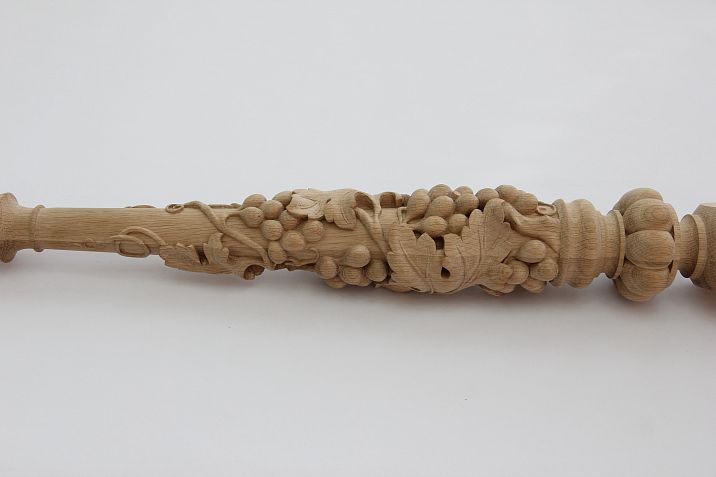
What turns an ordinary staircase into a work of architectural art? The answer lies in details that may seem secondary at first glance, but it is precisely these details that create that unique atmosphere of elegance and nobility. Turned baluster — it is not just a functional railing element, but a embodiment of centuries-old craftsmanship, where every line and curve is born under the hands of an experienced turner, transforming a simple wooden blank into an elegant support for handrails.
In the era of mass production and standardization, turned balusters remain an island of true craftsmanship, where technology meets art. Each piece carries the imprint of the master’s individuality, his understanding of proportions and sense of beauty. That is why turned balusters are so highly valued by architects and designers striving to create interiors with soul and character.


Genesis of turning craftsmanship: from ancient trades to modern technologies
The history of turning goes back to deep antiquity, when the first masters learned to give wood perfectly round shapes using primitive lathes. However, the true flourishing of the art of making turned balusters occurred during the Renaissance, when Italian masters perfected this craft.
The evolution of technology has passed a long path from tread lathes to modern automated complexes with numerical control. But the essence of the process has remained unchanged — a rotating blank is processed by a cutting tool, gradually acquiring the desired shape.
The philosophy of turning lies in understanding that wood is a living material, possessing its own character. An experienced turner does not fight against wood, but works with it, revealing the hidden beauty of its texture and emphasizing the natural qualities of the material.
Modern capabilities of turning processing allow creating items of unprecedented complexity and precision. Computer control ensures perfect repeatability of shapes, which is critically important when manufacturing sets of balusters for large staircases.




Anatomy of perfection: structural elements of a turned baluster
Each turned baluster represents a harmonious combination of functional and decorative elements, where every detail has its purpose and semantic load.
Our factory also produces:


Base: foundation of stability
The lower part of the baluster performs a critically important function — ensuring secure attachment to the step or sub-baluster board. The shape of the base can vary from a simple cylinder to complex multi-tiered structures with decorative elements.
The dimensions of the base are calculated based on the loads the baluster will experience during operation. The standard diameter is 60-80 millimeters for balusters 900 millimeters high, ensuring an optimal balance of strength and aesthetics.
The transition zone between the base and the central part requires special skill from the turner. Smooth transition lines create visual lightness of the structure, while sharp transitions may disrupt the perception of harmony.
Get Consultation
Central part: carrier of style
The body of the baluster is the canvas on which the turner creates his masterpiece. Here are concentrated the main decorative elements, determining the stylistic affiliation of the item.
Classic profiles include traditional elements — ovales, flutes, beads, ovals. Each element has symbolic meaning and historical origin, dating back to ancient architecture.
Modern interpretations of classic forms allow creating balusters that fit organically into contemporary interiors. Simplification of details, emphasis on line purity and geometric precision — characteristic features of the modern approach.
Proportional relationships between various elements of the baluster conform to the laws of the golden section and other mathematical principles, ensuring a harmonious perception of the form.
Upper Part: Connection Point
The top of the baluster must ensure secure connection with the handrail or under-rail board. The shape of the upper part may repeat motifs of the base, creating compositional completeness, or contrast with it, adding dynamics to the overall rhythm of the railing.
Technical requirements for the upper part include precision of dimensions for tight connection with other structural elements. Tolerances must not exceed ±0.5 millimeters to ensure quality assembly.
Wood science: selection of wood for turning
The success of turning work largely depends on the proper selection of material. Not every wood species is suitable for manufacturing high-quality balusters.
Oak — the undisputed leader among materials for stair construction. Density of 650–750 kg/m³ ensures exceptional strength and dimensional stability. Oak balusters can withstand colossal loads without deformation. When mounting, it is important to consider the material’s hardness — all holes must be pre-drilled with quality drill bits.
Oak is an undisputed favorite among materials for turned balusters. Its density of 650-750 kg/m³ ensures excellent workability while providing high strength in the finished product. The expressive texture of oak is accentuated by turning, creating a unique pattern on each baluster.
Ash is distinguished by high impact toughness and elasticity, making it ideal for balusters subjected to dynamic loads. The contrasting texture with alternating light and dark stripes creates an eye-catching visual pattern.
Beech is valued by turners for its uniform structure and excellent workability. Its fine-grained wood allows for perfectly smooth surfaces with minimal subsequent finishing.
Maple has light, almost white wood with barely noticeable grain. This makes it an ideal material for balusters in Scandinavian style or modern minimalist interiors.
Coniferous Species: Practicality and Accessibility
Spruce remains the most popular material due to its availability and ease of processing. Its soft wood allows for clean cuts even with hand tools. The resin provides natural protection against biological damage.
Larch stands out among coniferous species for its high density and moisture resistance. Beautiful texture with contrasting annual rings makes larch balusters attractive even without additional staining.
Cedar possesses unique aromatic properties and natural resistance to insects. Its soft wood is easy to process, but requires care during final finishing.
Exotic Species: Exclusivity and Challenges
Teak attracts attention with its natural oiliness, making the wood practically resistant to moisture. However, these same oils create problems with gluing and applying finishes.
Merbau impresses with its rich reddish-brown color and high dimensional stability. Its dense wood requires sharp tools and skilled turner hands.
Wenge, with its dark, almost black wood, creates a striking contrast when combined with light-colored species. Its high hardness requires special tools and processing regimes.
Technological process: from blank to masterpiece
Manufacturing a quality turned baluster is a multi-stage process requiring precision at every stage.
Material Preparation
Drying wood is a critically important stage that determines the quality of the future product. The material's moisture content must not exceed 8-12% to prevent deformation after manufacturing.
Log selection is performed considering the direction of the grain, absence of wood defects, and uniformity of structure. The blanks must have a square cross-section with dimensions exceeding the maximum diameter of the future baluster by 10-15%.
Center marking is performed with maximum precision. Even a slight misalignment of the center will cause the blank to wobble and prevent achieving a quality surface.
Rough processing
Mounting the blank on the lathe requires careful centering and secure clamping. Using chucks during processing of long blanks prevents vibrations and ensures processing accuracy.
Turning to a cylinder is the first operation, during which a square blank is transformed into a cylindrical roughing stock. Cutting parameters are selected based on the wood species and blank dimensions.
Initial profiling creates the basic contours of the future baluster. At this stage, the main dimensions and proportions of the product are formed.
Final finishing
Final turning requires special skill and patience. Each profile element is processed with a special tool ensuring maximum surface smoothness.
Sanding is performed directly on the lathe using abrasive materials of various grits. The process begins with coarse abrasives (120-150 grit) and ends with fine ones (320-400 grit).
Dimensional control is performed at every processing stage. Using templates and gauges ensures precise conformity to specified dimensions.
Modern technologies: CNC in turning
The introduction of CNC machines has revolutionized the production of turned balusters, combining traditional craftsmanship with modern capabilities.
Advantages of CNC processing
The accuracy of shape reproduction reaches fractions of a millimeter, which is impossible with manual processing. This is especially important when manufacturing large batches of balusters for large-scale projects.
Profile complexity is limited only by programming capabilities. Modern CNC systems allow creating profiles of any complexity with smooth transitions and precise dimensions.
Productivity increases dramatically compared to manual processing. One CNC machine can replace several experienced turners while maintaining high product quality.
Result repeatability ensures identical products within a batch, which is critically important for creating harmonious stair railings.
Programming and setup
Creating control programs requires deep knowledge in both turning technology and programming. Each profile element is described by mathematical functions with precision down to hundredths of a millimeter.
Tool selection for CNC lathes differs from traditional turning tools. Carbide inserts ensure consistent cutting edge dimensions throughout the entire machining cycle.
Cutting parameters are calculated based on material characteristics, tool geometry, and surface finish requirements. Optimization of parameters allows achieving maximum productivity while maintaining quality.
Design solutions: styles and directions
Modern turning baluster designs encompass a wide range of stylistic directions, from classical to ultra-modern.
Classic styles
Baroque is characterized by lavish forms, abundance of decorative elements, complex profiles with numerous details. Balusters in the Baroque style are often complemented by carved elements, creating an effect of luxury and grandeur.
Neoclassicism is distinguished by strict lines, symmetry, and use of classical motifs. Balusters in the Neoclassical style have clear geometric forms with minimal decorative elements.
Classicism strives for harmony of proportions based on classical canons. Balusters are distinguished by restrained elegance and flawless proportions.
Modern interior styles also use oak skirting boards, but in a different interpretation. Minimalism prefers simple rectangular profiles without decorative elements. Smooth surfaces with matte finish create a sense of strictness and elegance.
Minimalism implies maximum simplification of forms, rejection of decorative elements, emphasis on line purity and surface finish quality.
Scandinavian style combines simplicity of forms with coziness, using light wood species and natural finishes that highlight the beauty of texture.
Loft allows combining rough and perfectly polished surfaces, creating a contrast between industrial and refined aesthetics.
Custom Solutions
Individual design allows creating unique balusters reflecting the client's personality and interior features. Each item becomes a work of art.
Combining turning techniques with carving, inlay, and tinting opens up boundless creative possibilities.
Using modern materials in combination with traditional wood creates unexpected effects and expands design possibilities.
Quality Control: Standards and Requirements
The quality of turning balusters is determined by numerous factors, each requiring careful control.
Geometric Parameters
Dimensional accuracy is controlled at every stage of production. Deviations from nominal dimensions must not exceed established tolerances, usually ±0.5 mm for main dimensions.
Element alignment is checked with special instruments. Surface runout relative to the rotation axis must not exceed 0.2 mm to ensure correct baluster installation.
Profile symmetry is controlled visually and with templates. Any deviations from symmetry are immediately noticeable and spoil the overall impression of the item.
Surface Quality
Surface roughness must meet technical specifications. For turning balusters, roughness is typically required to be no more than Ra 1.6 μm.
Absence of defects — chips, tears, burns — is a mandatory condition for quality products. Any surface defects are unacceptable and require rework.
Color uniformity is especially important when using tinted finishes. Spots, streaks, or uneven tone are unacceptable.
Strength characteristics
Absence of internal stresses is checked by special methods. Residual stresses may lead to cracking of the item during operation.
Bending strength must match calculated loads. Tests are conducted on samples made from the same material and using the same technology.
Resistance to cyclic loads is especially important for balusters subjected to variable loads during staircase operation.
Installation and mounting: professional secrets
Correct installation of turning balusters is at least as important as their quality manufacturing. Even the most perfect items can be ruined by improper installation.
Pre-installation preparation
Balusters must be acclimatized in the installation room for at least 48 hours. This allows the wood to reach equilibrium moisture content and minimizes subsequent deformations.
Checking dimensions of all structural elements ensures correct assembly. Any deviations must be identified and corrected before installation begins.
Tool preparation includes checking the sharpness of cutting edges, accuracy of measuring instruments, and proper functioning of power tools.
Methods of mounting
Screwed connection provides maximum fastening strength. A metal screw is screwed into the end of the baluster and secured in the base, creating a reliable connection.
Dowel connection uses wooden cylindrical rods to join elements. This method ensures ecological purity of the connection and allows for disassembly.
Adhesive connection complements mechanical fastening, eliminating gaps and ensuring structural monolithism. Special high-strength woodworking adhesives are used.
Installation Control
The verticality of each baluster is checked with a plumb bob or laser level. Deviations from verticality are unacceptable and spoil the overall appearance of the railing.
The distances between balusters must be uniform, controlled with a tape measure. All gaps must be identical to within a millimeter.
The height of installation of all balusters must be the same. Height variation creates visual discomfort and indicates poor workmanship.
Maintenance and care: preserving beauty
Proper care of turned balusters ensures their longevity and preservation of their original appearance.
Regular cleaning
Dry cleaning is performed using soft cloth or special wipes to remove dust. Abrasive materials are not allowed, as they may damage the finish.
Wet cleaning is performed using special wood surface cleaners. Ordinary water may cause wood swelling and coating damage.
Stain removal requires immediate action. Most stains are easily removed when treated promptly with specialized cleaners.
Recoating
The frequency of renewal depends on usage conditions and the type of finish. Lacquered finishes typically require renewal every 3-5 years.
Surface preparation includes light sanding to remove the top layer of finish and create adhesion for the new layer.
The application of finish must be carried out according to the technology. It is important to observe the temperature regime and air humidity.
Economic aspects: investment in quality
Choosing turned balusters is a long-term investment that should consider not only the initial cost but also operational expenses.
Pricing Factors
Material is the primary factor determining cost. Exotic species may cost several times more than local ones.
Profile complexity affects labor and manufacturing time. Simple cylindrical balusters are significantly cheaper than complex multi-element profiles.
Order volume also affects price. Large batches are usually cheaper per unit.
Urgency of manufacturing may increase cost by 20-50%. Standard manufacturing times are 2-3 weeks.
Long-term savings
The longevity of quality turned balusters ensures long-term cost savings. Properly manufactured items can serve for decades without replacement.
Restorability is an important advantage of wooden balusters. Unlike plastic or metal items, wood can be restored to its original appearance.
Increased property value — quality balusters significantly enhance a home's appeal in the real estate market.
Conclusion
Turned baluster It represents a unique combination of functionality and aesthetics, where ancient craftsmanship traditions meet modern technologies. Each item is the result of the craftsman’s diligent work, his understanding of the material, and his pursuit of perfection.
In a world where mass production often leads to standardization and loss of individuality, turned balusters remain a bastion of true craftsmanship. They carry the warmth of the human hands that created them and the energy of the living wood from which they are made.
Choosing turned balusters for your home is an investment not only in beauty and functionality, but also in a piece of history, in the continuation of traditions passed down from generation to generation. Each baluster becomes a silent witness to family history, a quiet companion of daily life.
Modern technologies open new creative possibilities, but the foundation remains a deep understanding of the material, respect for traditions, and pursuit of perfection. It is precisely these qualities that distinguish true masters from mere performers.
For many years, STAVROS has remained faithful to the principles of quality and craftsmanship in producing turned balusters. Our masters combine rich experience in traditional craftsmanship with the most modern technologies, creating items that will adorn any interior and serve for generations. We understand that each baluster is not merely a structural element, but a part of an architectural symphony, where each note must resonate in harmony with the overall concept.