Article Contents:
- Wall art: from gallery walls to residential interiors
- History of the concept: from salon display to contemporary curation
- Psychology of structured walls
- Functionality of decorative walls
- Wooden frames and moldings: handcrafted expressiveness
- Oak: monumentality and textural expressiveness
- Beech: lightness and delicate framing
- Frame typology: from miniatures to murals
- Manufacturing and processing
- Polyurethane moldings: geometric basis of composition
- Lightness: revolution in mounting
- Geometric precision: ideal repetition
- Variety of profiles: from minimalism to baroque
- Moisture resistance: universal application
- Material synthesis: classicism and modernity in dialogue
- Frame composition: molding as framing, wood as accent
- Modular system: alternating materials
- Symmetrical compositions: classical order
- Asymmetrical collages: modern freedom
- Mounting and painting: technologies of implementation
- Composition planning: mock-up on the floor
- Wall marking: precision as foundation
- Mounting polyurethane moldings: adhesive and fixation
- Mounting wooden frames: fastening to the wall
- Painting: final harmonization
- Conclusion: wall as architect’s canvas

Walls are no longer passive vertical planes dividing space. Modern design transforms them into canvases for architectural compositions, wherewooden framesandInterior moldingscreate structure, depth, tactile richness.Polyurethane moldingscomplement the composition with geometric precision, ease of installation, and accessibility of complex profiles.Decorative framesMade from oak and beech, they frame voids, creating a gallery effect, transforming ordinary walls into curated exhibitions. The combination of natural wood and technologically advanced polyurethane creates a new visual language — walls as artworks, where every line is thoughtfully designed, every frame meaningful, and each material occupies its optimal place in the hierarchy of expressiveness.


Wall Art: From Gallery Walls to Residential Interiors
The trend of turning walls into art objects originated in professional galleries, where the method of hanging artworks itself becomes part of the artistic statement. Home interiors have adopted this approach, creating gallery walls but with greater freedom and personalization.




History of the Concept: From Salon Display to Contemporary Curation
In the 18th-19th centuries, salon display was practiced — densely filling walls with paintings from floor to ceiling without gaps. Frames touched each other, creating a continuous tapestry of images. An aesthetic of abundance, showcasing the wealth of collections. But visually overloaded — each painting competes with its neighbors, making it impossible to focus on any single artwork.
The 20th century, with its modernism, introduced minimalist display — one artwork on a large white wall, maximum air around. The gaze is focused, the artwork receives space for perception. But too austere for home interiors — large empty walls require large-scale artworks, accessible to few only.
The 21st century synthesizes both approaches — a gallery wall with a thoughtfully composed arrangement, where frames of various sizes form an ordered structure. Not the chaotic clutter of salon display, nor the austerity of modernism, but a balance between filled space and air. The key to success — frames become part of the composition, no less important than the content.
Our factory also produces:


Psychology of Structured Walls
An empty white wall is subconsciously perceived as incompleteness, temporariness of space. Evolutionarily, humans are accustomed to visually complex environments — natural landscapes with multiple objects, textures, depths. A monotonous plane is unnatural, creating mild unease.
A structured wall with frames soothes — order, symmetry, repetition of patterns provide a sense of control, predictability, safety. The brain loves patterns — the ability to recognize them was critical for survival. The geometry of frames on the wall — a pattern the brain easily decodes, gaining satisfaction from recognition.
Personalization through the content of frames creates an emotional connection with the space. Family photographs, children’s drawings, favorite posters, personal collections — all of this transforms an impersonal space into one that is personal, filled with history, meaning, memories. Frames are not just decoration, but a means of visualizing identity.
Get Consultation
Functionalities of Decorative Walls
Acoustic function of frames and moldings — sound dispersion across multiple surfaces. A flat smooth wall reflects sound like a mirror, creating echo, resonance. Projecting frames and moldings create multiple reflective surfaces at various angles, dispersing sound and preventing its focus. In rooms with hard surfaces — stone floors, glass partitions — decorative walls improve acoustics.
Hiding wall defects — practical function. Irregularities in plaster, cracks, stains are concealed under frames and moldings. Instead of costly wall leveling — strategic placement of decorative elements. Budget savings while improving visual quality.
Zoning space through decorative walls. A wall with gallery display marks the living room zone. A wall with molding panels — dining room. A wall with large wooden frames — office. Different walls create functional differentiation without physical partitions blocking light and air.
Wooden frames and moldings: crafted expressiveness
wooden framesandInterior moldingscreate visual and tactile foundations of wall art. Natural texture, weight of the material, sound upon touch — all of this creates a sense of authenticity, quality, durability.
Oak: monumentality and textural expressiveness
Oak frames for wall compositions — choice for interiors where solidity, prestige, expressive natural texture matter. The hardness of oak allows creating thin molding profiles without risk of cracking — a 30x15 mm oak plank is strong, while soft pine is fragile.
Oak molding width varies from minimalist 20-30 mm for modern frames to massive 80-120 mm for classical. Narrow molding creates delicate framing, not competing with the content within the frame. Wide molding becomes a decorative object in itself, especially with carving, patina, or complex profile.
Oak frame profile determines style. Flat rectangular — minimalism, Scandinavian style, loft. Beveled with one face — modern classic, transitional style. Complex with scrolls, flutes, beads — classicism, empire, neoclassicism. Carved with vegetal ornament — baroque, rococo, Victorian style.
Oak frame finish affects perception of the entire composition. Natural tone under oil demonstrates texture, creates organic feel, connection to nature. Dark walnut staining adds drama, contrast against light walls and pastel images. Painting in white, cream, gray while preserving visible texture — Scandinavian and Provencal aesthetics. Gilding — classic luxury, suitable for formal living rooms, dining rooms.
Beech: lightness and delicate framing
Beech frames are 3-4 tones lighter than oak, creating lightness, visual expansion of space. For light interiors, spaces with insufficient natural light, modern and Scandinavian styles, beech is preferable to dark oak. Uniform texture without contrasting stripes provides a clean visual background, not competing with frame content.
Fine-grained beech structure allows achieving perfectly smooth molding surface after sanding. Beech frames under lacquer have a silky sheen, pleasing to the eye. Under oil — matte elegance. For photographs, watercolors, graphics, where delicate framing matters, smooth beech molding does not distract from the image.
Birch staining is even due to its uniform structure. White birch frames appear homogeneous, without dark streaks. Pastel tones—light blue, mint, peach—apply evenly, creating gentle frames for children's drawings, romantic compositions, vintage posters.
The drawback of birch is higher hygroscopicity, requiring quality protective treatment. For residential spaces with stable humidity of 40–60 percent, this is not critical. Multi-layer varnishing or special oils provide sufficient protection. For kitchens and bathrooms, where humidity fluctuates, oak is more reliable.
Frame types: from miniatures to panel compositions
Small frames 15x20, 20x30 cm for photographs, postcards, miniature artworks. Grouped in sets of 9–16 on the wall, creating a modular composition. All frames are identical—one size, one profile, one finish—creating visual order. Or intentionally different—varied sizes, profiles, colors—creating visual richness at the risk of chaos.
Medium frames 40x50, 50x70 cm for posters, reproductions, family portraits. Placed individually or in groups of 3–6. Three frames horizontally above the sofa—a classic solution. Six frames in a 2x3 grid—a gallery wall. The profile is wider than for small frames—40–60 mm—creating visual weight proportional to the content.
Large frames 70x100, 100x150 cm for significant artworks, mirrors, textile panels. Placed individually as visual dominants. A large frame above a fireplace, sofa, or headboard becomes the focal point of the room. The profile is substantial—60–100 mm—often carved and patinated—the frame itself becomes a work of art.
Modular frame systems—several frames of different sizes, connected into a single composition. Central large 70x100 cm, surrounded by four medium 40x50 cm, and four small 20x30 cm at the corners. A structured composition is formed, where each frame occupies its place. Ideal for complex multi-level narratives where images are thematically linked.
Manufacturing and Processing
Wooden frames are made from molding strips—profiled stock. The strip is cut at a 45-degree angle, four pieces joined to form a rectangle, corners secured with brackets, nails, or glue. Precision in trimming is critical—gaps at corners are unacceptable, visible, and ruin the perception of quality.
Machine production ensures precision—the circular saw with a rotating table cuts at ideal 45-degree angles. Handcrafting requires a tenon saw and skill—a 1-degree deviation creates a gap. For mass-produced frames, machine production is used; for single pieces, handcrafting is possible with skill.
Surface treatment of the molding is performed before frame assembly. Sanding from coarse 80 grit to fine 240 grit creates smoothness. Coloring, staining, varnishing—each side of the strip is treated separately. After assembly, only the joints are touched up. Final protection with varnish or oil extends the frame’s life for decades.
Polyurethane moldings: geometric foundation of composition
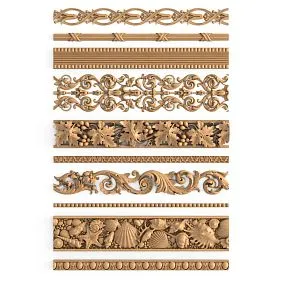
Polyurethane moldingsIn wall compositions, they create architectural structure, geometric frames, classic panels with minimal weight and maximum precision of execution.
Lightness: revolution in mounting
A meter of polyurethane molding 80 mm wide weighs 300–500 grams versus 2000–3000 grams for a wooden equivalent. This difference is critical for large wall compositions. Creating a 3x2.5 meter panel using wooden moldings requires heavy fasteners, dowels, screws—risk of wall damage, labor-intensive installation. Polyurethane moldings are glued with standard mounting adhesive without additional fasteners—fast, clean, reliable.
Transportation and storage of lightweight elements is simpler. Ten wooden molding strips 2.5 meters long weigh 50–60 kilograms—requiring a loader and transport. Polyurethane equivalents weigh 8–12 kilograms—can be carried by one person, fit in a car. For remote locations, upper floors without elevators, lightness is critical.
Minimal load on the wall. Walls made of gypsum board can support polyurethane moldings without risk of sagging or detachment. Heavy wooden moldings require load-bearing walls—brick, concrete. For modern frame houses, apartments with gypsum board partitions, polyurethane is often the only option for large-scale decoration.
Geometric accuracy: perfection of repetition
Injection molding of polyurethane ensures absolute profile identity along the entire length of the strip and between strips. Each curve, each ridge, each line is mathematically precise. This geometric perfection is critical for classic panels, where even minor deviations disrupt symmetry.
Moldings joined at 45 degrees form perfect angles. If the profile repeats perfectly, the joint closes perfectly. Wooden moldings have microscopic profile variations due to humidity fluctuations and structural inhomogeneity—joints require fitting and sanding. Polyurethane moldings join without fitting—the 45-degree cut, glued, joint is perfect.
No deformation over time. Wood reacts to humidity changes—swells when moisture increases, shrinks when it decreases. Molding panels after a year may have gaps at joints or, conversely, compression. Polyurethane is stable—humidity does not affect it, geometry remains the same after 10 years as on the day of installation.
Variety of profiles: from minimalism to baroque
Simple flat strips 20–50 mm wide for minimalist frames on walls. Rectangular cross-section, possibly with a slight bevel. Create graphic lines, structuring the plane without decorative excess. Ideal for lofts, Scandinavian, and modern interiors.
Classic profiles 60–100 mm wide with curves, ridges, grooves. Create light-and-shadow play, architectural depth, classic elegance. For neoclassicism, American classicism, transitional styles, classic profiles create architectural logic for panels.
Carved baroque moldings 100–150 mm wide with floral ornaments, scrolls, rich relief. Create luxury, decorative richness, historical authenticity. For palace styles, baroque, rococo, Victorian styles, carved moldings are mandatory.
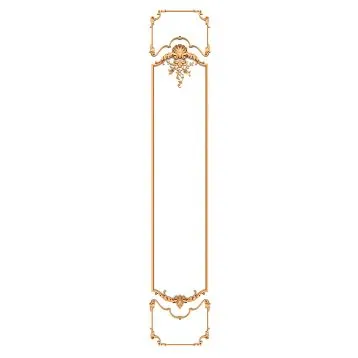
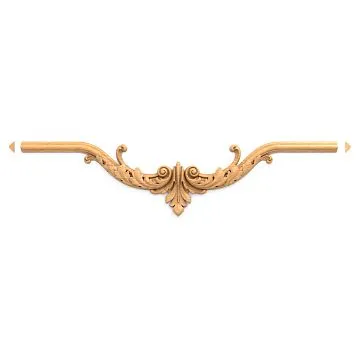
Corner elements—special inserts for panel corners with ornamentation—complement straight moldings. Rosettes at panel centers, cartouches above doors, consoles under shelves—all of these are reproduced with perfect precision by polyurethane molding.
Water resistance: universal application
Polyurethane is absolutely water-resistant—it does not swell, rot, or deform at humidity levels of 90–100 percent. For kitchens, bathrooms, saunas, and pools, polyurethane molding compositions function for decades without problems. Wooden moldings under such conditions require aggressive protection, regular maintenance, and still last less.
Cleaning polyurethane is simple—washed with water and neutral cleaning agents. Grease buildup on the kitchen, condensation in the bathroom, all wash away without trace. Wood absorbs contaminants, requiring delicate cleaning and special agents.
For spaces with high usage—children’s rooms, hallways, commercial areas—water resistance and ease of cleaning are critical. Polyurethane wall compositions are practical, require no careful handling, and last long with minimal maintenance.
Material Synthesis: Classic and Modern in Dialogue
Successful wall compositions combine wooden frames and polyurethane moldings in such a way that the difference between materials enriches, creating textural diversity, functional optimization, and visual complexity.
Frame Composition: Molding as Framing, Wood as Accent
Polyurethane moldings create a grid of panels on the wall — rectangles 100x120, 80x100 centimeters. Within each panel, the wall is painted in a color differing from the main one by 1–2 tones — lighter or darker. Or it is covered with wallpaper featuring a delicate pattern. Molding as an architectural structure divides the wall into sections.
Within each panel, a smaller wooden frame with a work — a photograph, poster, watercolor — is placed. A 60x80 cm oak frame inside a 100x120 cm polyurethane panel. Double framing creates depth, multi-layering, and a hierarchy of attention. Polyurethane as background, wood as accent.
Color coordination is critical. White polyurethane moldings, natural oak frames — classic contrast. Or monochrome — all white with visible wood texture under paint. Or gradient — polyurethane light gray, wood dark gray, creating tonal depth.
Modular System: Alternating Materials
A horizontal polyurethane molding strip, 80 mm wide and 100 cm high, divides the wall. Below the molding — wooden panels or boiserie made of oak, 90 cm high. Above the molding to the ceiling — painted wall with wooden frames of various sizes, hung gallery-style.
Molding as a boundary between panel and gallery zones creates architectural logic. The lower zone is protected by wood from mechanical damage. The upper zone is visually light, filled with framed artworks. Polyurethane molding connects without visually competing with either the panel wood or the frame wood — a neutral white smooth element between textures.
Vertical alternation also works. A 4-meter-wide wall is divided into three 1.3-meter sections by vertical polyurethane moldings. The left section — wooden panels from floor to 200 cm height. The central section — gallery-style hanging of wooden frames. The right section — a polyurethane panel with a mirror in the center. Three different treatments connected by vertical moldings.
Symmetrical Compositions: Classical Order
Central axis of symmetry on the wall — a vertical line in the center. On the left and right, identical-sized polyurethane panels are mirrored. Within each panel, a wooden frame of identical size and profile. The content within the frames is also symmetrical — paired photographs, diptych paintings.
A polyurethane rosette with a 60 cm diameter on the symmetry axis at the top of the wall acts as a visual center. Below the rosette, a large 80x100 cm oak frame holds the main composition piece. On either side, smaller frames 50x70, then even smaller 40x50 — a gradation of sizes from center to edges.
Symmetry calms, creates classical order, a sense of control. Symmetrical compositions are suitable for formal rooms, dining rooms, offices. For creative spaces, children’s rooms, eclectic interiors, asymmetry is allowed — but controlled — visual balance without mirroring.
Asymmetrical Collages: Modern Freedom
Wooden frames of various sizes, from 15x20 to 70x100 cm, are grouped on the wall without a strict grid. Frames may touch at corners, creating density. Or be separated by 5–15 cm space, creating air. Polyurethane moldings are used minimally — framing the entire group of frames peripherally, creating the collage boundary.
Or polyurethane elements are integrated into the collage — small rosettes, cartouches between wooden frames as connecting nodes. A polyurethane rosette with a 200 mm diameter between four small wooden frames creates a local group center within a larger collage.
Asymmetry requires visual balance — if a large heavy frame is on the left, several smaller ones on the right, balancing visually. Or color balance — dark oak frames on the left, light beech on the right. Balance is achieved intuitively or mathematically — dividing the wall into an imaginary grid and distributing frames according to mass equilibrium.
Mounting and Painting: Implementation Technologies
Quality mounting of wall compositions requires precise marking, correct choice of fasteners, careful execution. Painting creates the final visual effect.
Composition Planning: Floor Layout
Before mounting on the wall, all elements are laid out on the floor at actual size. Frames, moldings, distances between them — everything is physically checked. Elements are moved, various configurations are tried, the optimal one is found. Photographed for documentation.
Or a scaled paper mockup is created — the wall is drawn to a 1:10 scale, elements too. Cut out from paper, moved according to the wall drawing, fixed when the composition is found. Less visually intuitive than a physical floor mockup, but faster for large compositions.
Digital tools — 3D modeling programs, interior planning apps — allow visualizing the composition before purchasing materials. The wall is modeled, elements are placed, rendered with lighting and materials. For complex, expensive projects, digital visualization prevents errors.
Wall Marking: Precision as Foundation
The central vertical and horizontal lines of the wall are marked with a pencil using a level and tape measure. For symmetrical compositions, centers of elements are placed on axes. For asymmetrical compositions, axes are used as references, from which distances are measured.
Contours of each element are transferred to the wall with a pencil. Moldings — outer and inner perimeters. Frames — centers of fasteners, corners. Each element’s horizontal and vertical alignment is checked with a level. Deviation exceeding 2 mm per meter is noticeable to the eye and unacceptable.
For complex compositions, templates are used — cardboard or plastic mockups of elements, applied to the wall, traced around. The template ensures that all repeating elements are placed identically. Ten identical frames are hung in an hour with a template, versus three hours without one.
Mounting Polyurethane Moldings: Adhesive and Fixation
The back of the molding is covered with special polyurethane adhesive or acrylic mounting glue. Applied in a zigzag or strip pattern. The molding is placed on the wall according to the marking, pressed, and aligned. Fixed to the wall with painter’s tape until the glue sets — 12–24 hours depending on glue type and temperature.
Joints are mitered at 45 degrees. A miter saw with a rotating table cuts precise angles. Or a hand mitering block for manual trimming. Joints are glued with a thin layer of adhesive, elements are pressed tightly together. Excess glue is immediately wiped off with a damp cloth. After drying, joints are filled with acrylic putty, sanded, and painted — the joint should be invisible.
Long moldings over 2 meters are additionally secured with finishing nails 30-40 mm long, spaced 50-70 cm apart. Nails are countersunk, and holes are filled with putty. Duplication of fastening prevents sagging or peeling under their own weight.
Installation of wooden frames: wall mounting
Wooden frames weighing up to 2 kilograms are hung on two hooks — fasteners are screwed into the wall at a distance matching the distance between hinges on the back of the frame. For drywall, butterfly anchors; for concrete and brick, plastic anchors with screws.
Heavy frames over 2 kilograms require special fasteners. Metal plates are screwed to the back of the frame, plates engage with screws in the wall. Or a cable system — the frame is suspended by cables running from ceiling or wall anchors. For very heavy mirror or panel frames, anchor bolts are used into load-bearing walls.
Checking for levelness after hanging is mandatory. A level is placed against the top edge of the frame, deviation is corrected by shifting one of the hooks. The frame must hang strictly horizontally — any tilt is noticeable and disrupts the perception of the entire composition.
Painting: final harmonization
Polyurethane moldings are primed with acrylic primer, then painted with acrylic paint in 2-3 coats. Inter-coat drying time is 4-6 hours. Final drying is 24 hours before use. Color is chosen according to the overall palette — white is universal, matching wall tone for blending, contrasting for accenting.
Wooden frames are painted or treated before installation. Oil is applied, excess is wiped off, drying time is 24 hours. Lacquer is sprayed or brushed on in 2-3 coats with inter-coat sanding. Paint is applied in 2-3 coats with intermediate drying. Painted frames are hung after the coating has fully cured.
Patina creates an aged effect. The base coat of paint is dried. A patina of another color is applied to the protruding parts of the molding profile, excess is wiped off with a cloth after 5-10 minutes. Patina remains in recesses and on edges. A final matte lacquer coat seals it. For vintage, Provence, and classical interiors, patinated frames create a historical atmosphere.
Conclusion: wall as architect’s canvas
Combinationwooden frames, interior moldingsandpolyurethane moldingstransforms walls into art objects that define the character of the space.Decorative framescreate structure, framing, gallery effect. Polyurethane adds geometric precision, architectural foundation, and practicality.
Wood is used where tactile quality, natural texture, and visual warmth are critical — in frames for artworks, lower wall paneling, and elements accessible to touch. Polyurethane is used where lightness, moisture resistance, and perfect geometry are important — in molding panels, ceiling elements, and framing in humid zones.
Composition strategies, from symmetrical classical to asymmetrical modern, provide tools for any style. Proper planning — floor layout, precise marking, quality fastening — ensures longevity. Thoughtful painting harmonizes different materials into a unified composition.
Investing in wall art pays off with daily aesthetic pleasure, personalization of space, and unique solutions. Walls stop being a backdrop and become active participants in shaping the atmosphere. Every glance at a composition offers a moment of contemplation, connection with images, memories, and meanings. Your space deserves walls that don’t just divide, but tell stories; don’t just enclose, but inspire; don’t just function, but live with you.