Article Contents:
- First question: what is the geometry of your surface
- Flat surfaces: rigid module as a precise tool
- Curved surfaces: flexible base as the only answer
- Material: three paths with different aesthetics and logic
- MDF for painting: when color is more important than texture
- Solid oak: when texture is the essence
- Solid beech: neutrality for a color project
- How size and spacing of slats shape the character of the surface
- Decorative wall panel: application by zones
- Behind the TV: architectural backdrop for TV wall
- At the headboard: warm cocoon of the bedroom
- In a niche: back wall and slopes as a single object
- For furniture fronts: architectural character of furniture
- For columns and arches: complex geometry without compromises
- Application by rooms
- Living room: zoning and accent wall
- Bedroom: natural silence and coziness
- Hallway: first impression and practicality
- Study and office: atmosphere of concentration
- Lighting as part of slatted surface design
- Acoustic action: what is rarely talked about
- Technical inspection before purchase: what to check on the sample
- Installation: an algorithm with no room for error
- Combinations with other interior materials
- FAQ: honest answers to direct questions
- Why STAVROS

Imagine: you are standing in front of a wall and know exactly what you want to achieve in the end — a living vertical rhythm, the texture of natural wood, or a perfectly smooth surface for a deep matte color. But the market offers dozens of options, and they are all called roughly the same. Rigid module or flexible base? MDF or solid oak? Primed for painting or with a ready-made tint? Straight wall or radius column? This is where the difference between a random choice and a professional one begins.
Slatted wall panel— is not just decoration. It is an architectural tool with a specific structural logic. Understanding it once means making confident, precise decisions in any project: residential, commercial, furniture. This is exactly what this article is about. No fluff, no generalities, only practice.
First question: what is the geometry of your surface
Before thinking about color, wood species, or slat spacing — answer one question: is your surface straight or curved? The answer to it completely determines the structural format you need. Everything else is secondary.




Straight surfaces: rigid module as a precise tool
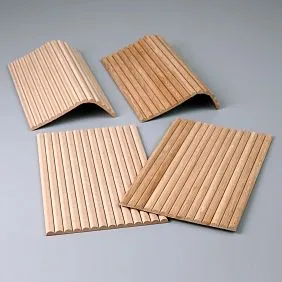
For perfectly flat walls, straight furniture fronts, ceilings without complex geometry — rigidwall panel made of slats for wallson an MDF backing is the optimal solution. What does this mean structurally? The slats are fixed to a dense board with a factory-set spacing — uniform across the entire module length. The entire structure is monolithic: the backing holds the battens, the battens maintain the rhythm. You place the module on the wall, level it, secure it — and get a precise surface.
The rigid construction has one undeniable advantage over any self-assembly: geometric error is eliminated at the factory, not during installation. The spacing between slats does not 'drift' from one module to another. Two adjacent modules butt together end-to-end, and the rhythm of the slats continues without a visible transition. This is precisely why professional installers choose a ready-made module, not a loose assortment of individual battens.
But as soon as a wall has any curvature — a closed cylinder of a column, the bend of an arched vault, a rounded corner transition — the rigid board hits a physical limit. It cannot be bent without breaking. Attempting to cut it into narrow strips to wrap around a radius creates visible seams that are perceived as installation errors. A rigid module is a flawless tool for flat surfaces and only for them.
Our factory also produces:


Curved surfaces: flexible backing as the only answer
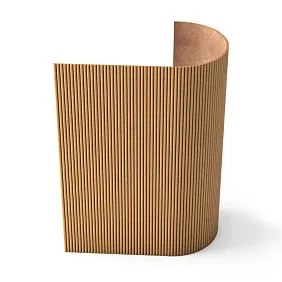
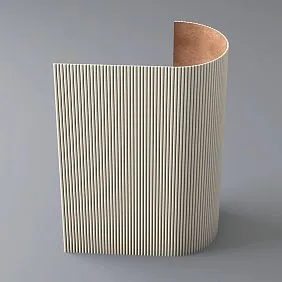
Flexible wall panel made of slatsis a fundamentally different construction. Here, the slats are attached to an elastic fabric backing with precisely calibrated gaps between the battens. These gaps are not just spaces but a functional element of the construction: they allow the panel to bend laterally without deforming the slats themselves.
What happens when wrapping a column? The fabric backing elastically conforms to the surface radius, the slats spread evenly along the outer arc, and their mutual spacing is preserved. The column surface gets a continuous slatted rhythm without a single visible seam. The only seam is in the least noticeable spot, typically on the back side or in a corner. A column transforms from an architectural inconvenience into an accent feature of the space.
Three situations where the flexible format is indispensable:
-
Closed cylindrical surfaces: columns, round supports, large-diameter pipes.
-
Arch transitions and vaults: continuity of slat rhythm through a straight wall and arch bend.
-
Curved furniture fronts: radius cabinets, bent corner shelves, rounded kitchen islands.
Additional argument for flexible base: logistics convenience. The panel is supplied rolled up, cut to required length with a utility knife, and requires no special tools for cutting.
Get Consultation
Material: three paths with different aesthetics and logic
Having decided on the structural format, proceed to the material. This choice determines the aesthetic character of the surface for years to come.
MDF for painting: when color is more important than texture
Slatted panel for the wall made of MDF— is a high-density board 750–850 kg/m³ with a homogeneous, pore-free surface. No natural texture — but a perfect base for any color. Any RAL, NCS, Pantone shade. Matte, satin, semi-gloss finish. A monochrome wall with slat relief matching plaster tone is a sophisticated designer technique that works exclusively with MDF.
Especially interesting is the pre-primed option. Model PAN-002 in the STAVROS catalog is awall panel made of slats for paintingwith two layers of polyurethane primer-sealer already applied. Pores are sealed, surface is ready for finishing. On site — install and paint. No intermediate preparation, no risk of raised fibers, no uneven paint absorption on unprimed areas. For furniture applications, two-component polyurethane or acrylic enamels applied in a spray booth are recommended. For interior walls — acrylic or latex water-based paints without strong odor.
Primed wall panel made of slatsis indispensable in projects where precise matching of corporate colors, brandbook palettes, or shades selected from fan catalogs is crucial. MDF under enamel is the only way to achieve a slatted surface in the exact intended color, without random deviations.
Another scenario where MDF outperforms solid wood: monochrome minimalism, where slats are painted in the exact same tone as the wall. The surface gains texture, but not a color accent — the wall 'comes alive' solely through the play of light and shadow on the battens. A subtle technique, demanding precise color matching, but when executed correctly — flawless.
Solid oak: when texture is the essence
Wall panel made of slats for the wall from oakis about what cannot be reproduced with film, veneer, or imitation printing. The layered pattern of oak grain is unique to each board, alive, changing from angle to angle. The semi-circular profile of the batten scatters light in a special way: early in the morning the surface appears warmer, by evening — deeper and darker. This is not an artistic metaphor, it's the real optics of a semi-circular surface under changing light angles.
Oak with a density of 700–750 kg/m³ and a Brinell hardness of 3.7–3.9 kN/mm² is one of the most durable materials for interior applications. Under clear oil — a warm golden tone, a matte natural surface, tactile warmth that no synthetic material can replicate. Under tinting — a range from Nordic chalky gray to rich wenge, from tobacco cognac to expressive graphite. Each shade reveals the grain pattern in its own way.
An important practical point: the reglue grade. 'For tinting' means selecting slats by color and texture — for semi-transparent coatings that reveal the wood grain. 'For enamel' — without tonal selection, for opaque coatings. If a clear or semi-transparent coating is planned — always request the 'for tinting' grade.
Oak is the right choice for interiors where natural material is a conscious decision, not a tribute to fashion. For country houses with warm organic aesthetics, for offices with a representative function, for restaurants and bars where atmosphere is created through surface texture.
Solid beech: neutrality for color projects
Beech is a homogeneous, fine-pored wood with a neutral light tone and a subtly expressed grain pattern. This makes it preferable for painting with enamels: the surface accepts opaque coating more evenly than open-pored oak, without the risk of the texture 'showing through' the layers of paint.
Beech slat paneling is a choice for design concepts with a color accent: a charcoal-black slat wall in the living room, deep emerald in the bedroom, dusty pink in the nursery. The material remains natural wood with the proper tactile feel, but beech has higher color controllability than oak.
How the size and spacing of slats shape the character of the surface
Choosing between a 'dense' and an 'airy' rhythm of slats is not purely a matter of taste. It is based on a specific visual logic; understanding it yields a predictable result.
Thin slats with narrow spacing create a rich, almost monolithic texture. The surface is perceived as heavy, representative. For small rooms — a delicate background rhythm. For high halls — an architectural detail emphasizing the scale.
Wide slats with large spacing — about openness and air. Japanese interiors with large pauses, Scandinavian minimalism with natural lightness — this is wide spacing.
Medium spacing — the most versatile option for residential interiors. A balance of decorative richness and spatial lightness. Works equally well with oiled oak and with MDF under matte paint.
Approximate table for selecting the format:
| Area of the slatted field | Batten width | Recommended spacing |
|---|---|---|
| Up to 3 m² | 12–20 mm | 15–25 mm |
| 3–8 m² | 20–40 mm | 25–40 mm |
| 8–15 m² | 40–60 mm | 40–60 mm |
| 15+ m² | 60–80 mm | 50–80 mm |
Consider the ceiling height: a vertical slat rhythm optically elongates the room in height. In low rooms, narrow, dense spacing enhances this effect more than wide spacing — use this as an architectural tool.
Decorative wall paneling: application by zones
Behind the TV: Architectural Background for a TV Wall
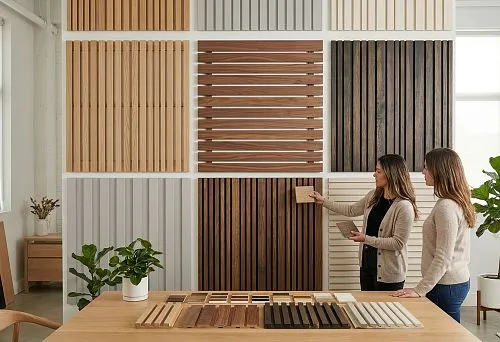
The area behind the TV is the architectural focal point of the living room, where the gaze is directed most of the time.Decorative Slat Panels for WallsThey transform a utilitarian wall into an expressive object. The vertical rhythm of the battens does not compete with the screen—it creates the right architectural context for it. A black screen on a slatted surface of dark oak or graphite MDF looks like an installation, not like technology on a white wall.
When mounted on a frame with an air gap behind the panel, it's the perfect place for hidden LED strips. Soft, diffused light shining through the gaps between the battens in evening lighting creates an atmospheric effect without a visible light source. This is one of the most sought-after techniques in modern living rooms.
At the Headboard: A Warm Cocoon for the Bedroom
Slatted wall panel for a headboard—a technique that designers reproduce in most modern residential projects. The slatted texture behind the bed creates a feeling of cozy framing—tactile, warm, natural. The correct format: a panel behind the bed from floor to ceiling or from the headboard to a height of approximately 1.2–1.5 m above the mattress. The walls on the sides are neutral. The slatted zone functions as an independent architectural object.
For the bedroom, a warm oak tone with an oil finish is especially appropriate: a matte, natural surface that diffuses the light of bedside lamps particularly softly. Or MDF with a powdery, warm, pastel enamel—for concepts where color is the main tool.
In a Niche: The Back Wall and Reveals as a Single Object
A niche is an architectural stroke of luck that a slatted panel turns into a design technique. The back wall and side reveals, clad with a unified slatted module, create depth and visual completeness. An LED strip along the side reveals or along the bottom edge enhances the effect. A niche for a TV, under a bed, under decorative shelves—slatted cladding makes it a living, glowing object.
For furniture fronts: architectural character of furniture
Wall panel made of slats for furniture— one of the most effective techniques in modern furniture design. A slatted front visually lightens a large furniture volume. A floor-to-ceiling sliding wardrobe with slatted fronts ceases to be a neutral rectangle and becomes a full-fledged architectural object in the space.
For straight furniture fronts — rigid panel or flexible: both options work. For curved fronts, rounded ends, radius elements — onlyslatted wall panel on a fabric basewith a flexible construction. The fabric base conforms to any curve without distorting the rhythm of the slats.
For columns and arches: complex geometry without compromise
A cylindrical column is the absolute limit for a rigid panel. But for aslatted wall panel for a radius wallon a fabric base, a column is just another surface. The panel wraps around the cylinder along its entire perimeter, with the only seam hidden in the least noticeable spot. The slatted rhythm closes without breaks.
For arched transitions — the same logic. The slats follow the curve of the vault, maintaining an equal pitch, smoothly transitioning into the adjacent straight walls. The continuity of the rhythm throughout the entire transition is a visual effect only possible with a flexible format featuring precise factory geometry.
Application by rooms
Living room: zoning and accent wall
In living rooms with open floor plansSlatted wall panelWorks as a zoning tool without partitions: a slatted wall behind the sofa visually separates the living room from the dining area without compromising visual openness. In classic living rooms with closed layouts, an accent wall behind the TV zone or sofa creates an architectural focal point. Warm oak with oil finish or dark tint for a modern loft — both solutions work, each within its own concept.
Bedroom: natural tranquility and coziness
Slatted panels in the bedroom are about atmosphere, not decoration. The right material and tone transform the wall behind the bed into an architectural headboard that needs no additional elements. Oak with wax oil gives a warm natural glow, MDF with deep matte paint provides a strict modern tranquility.
Hallway: First impression and practicality
In the hallway, a slatted wall works on two levels: aesthetic — it creates the character of the first space a guest sees — and functional — it protects the wall from mechanical damage. Dense oak with hard lacquer or MDF with polyurethane enamel are resistant to scratches and wet cleaning. The vertical rhythm of the slats optically elongates the hallway — a critical technique for narrow corridors.
Study and office: concentration atmosphere
Dark oak with tinting on a study wall signals a serious, established space. For meeting rooms, a slatted wall behind a presentation screen or speaker's position creates a representative backdrop. MDF in a corporate brand color by RAL is part of the identity, not just finishing.Buy wall slatted panels for interior finishingFor office space, it can be configured for any corporate shade — provided priming and painting are done by the manufacturer or on-site.
Lighting as part of slatted surface design
A slatted wall without thoughtful lighting is only half the result. It is light that reveals the potential of vertical rhythm.
Directional spotlights at a 30–45° angle to the surface create clear linear shadows in the gaps. The surface gains volume and depth unattainable with direct lighting.
Hidden LED strip behind the panel — installed on a frame with an air gap. Diffused light breaks through the gaps between the slats, creating a soft background glow without a visible source. For TV zones, headboards, decorative niches — one of the most atmospheric techniques.
Linear luminaires along the slatted surface — glowing lines in rhythm with the slats. A delicate, almost weightless effect. For bedrooms and restaurant halls.
Lighting is planned simultaneously with the panel — before installation. Adding hidden wiring after finishing is incomparably more difficult and expensive.
Acoustic action: what is rarely talked about
Slatted wall panel— not just decoration. Vertical slats scatter sound waves, disrupting their direct reflection from a smooth wall. Result: reduced reverberation, less echo, improved speech intelligibility. In open living rooms — reduced booming. In meeting rooms — better speech clarity. In restaurants with high ceilings — intimacy even when full.
When installed on a frame with acoustic absorber (mineral wool, acoustic foam) behind the panel, the effect is multiplied: a decorative wall panel made of slats turns into a functional acoustic screen.
Technical inspection before purchase: what to check on a sample
No catalog description can replace tactile contact with a real sample. Before ordering in volume—request a sample and conduct the following checks:
Step accuracy. Measure the distance between slats at several points along the sample's length. Permissible deviation—no more than 0.5 mm. An unstable step means the rhythm will 'drift' when joining multiple modules.
Sanding quality. Run your palm across the slats against the grain—the surface should be smooth, without tear-outs. 'Prestige' level—hand sanding with zero-grit sandpaper. 'Standard' level—machine sanding, minimal marks that are covered by the finish are acceptable.
Fabric backing (for flexible format). Bend the sample across—is there any cracking or white cracks on the surface of the slats? Pull lengthwise and across—is there stability? Inspect the backside—are there any delaminations, glue marks, or uneven weaving?
Joining. Place two samples end-to-end—how tightly do the slats align? A visible gap or step mismatch indicates a problem during installation.
Tone under different lighting. Place the sample against the wall in your space under both daylight and artificial lighting. The color of oak under tint behaves differently under different light spectrums—what appears neutral-warm in daylight may look significantly richer under warm-toned lamps.
Installation: an algorithm with no room for error
A well-chosen but improperly installed panel yields a poor result. Installation is a continuation of the selection.
Surface preparation. The surface is clean, dry, and degreased. Leveling—variations no more than 3–5 mm per linear meter. For adhesive installation—primed surface. For frame installation—metal profiles or wooden battens leveled with a spacing of 400–600 mm.
Marking. A vertical line from the corner—the foundation. A horizontal level along the bottom edge of the first module. The first panel strictly level—the entire subsequent layout depends on this.
Fixing rigid panel. Mounting adhesive applied around the perimeter of the substrate and diagonally. Press level, hold according to adhesive manufacturer's instructions (usually 1–3 minutes). Additional fixing with micro-pins — for ceiling applications and in areas with vibration.
Fixing flexible panel. Contact adhesive applied to both fabric backing and wall surface. After open exposure per instructions — applied, bend formed, additional fixing with micro-pins at points of maximum tension.
Joining. End to end, no gap, no overlap. Precise factory pitch ensures seamless continuation of rhythm without visible transition.
Finishing. MDF — finish paint according to manufacturer's system. Oak — tinting or clear varnish using recommended technology.
Combinations with other interior materials
Slatted surface — active participant in material dialogue. Several combinations that work consistently:
Oak + natural stone. Contrast of organic textures — living wood against mineral pattern. One of the most classic and reliable techniques.
MDF under dark enamel + brass. Matte dark surface and warm metal — contemporary luxury without excessive pomp.
MDF under white or light enamel + linen textile. Scandinavian concept in its purest expression.
Oak under tinting + concrete wall. Industrial-natural contrast — two raw, unpretentious materials that enhance each other.
Slatted panel + live plants. Biophilic design: natural materials on walls plus live greenery create a space you want to return to.
FAQ: honest answers to direct questions
How does PAN-001 differ from PAN-002?
PAN-001 is a slatted panel on a flexible fabric base, made from MDF, solid oak, or beech. Designed for straight and curved surfaces: walls, columns, arches, furniture fronts. PAN-002 is a primed MDF panel on a fabric base, specifically positioned as a product for decorative finishing under painting. The surface is coated with two layers of polyurethane primer, ready for applying the final coating without additional preparation.
Which panel to choose — rigid or flexible — for a regular straight wall?
Both options work. Rigid is a more economical solution for flat, straight walls. Flexible is universal, working on both straight and curved surfaces. The choice is determined by the presence of complex shapes in the project: if there is at least one column or arch — take the flexible format, it will cover the entire project with one structural solution.
How to calculate the number of panels?
Measure the width of the surface to be clad in mm, divide by the module width considering seamless joining, multiply by the number of rows in height. Add 10–12% for trimming. If there are niches, door openings, sockets — create a layout diagram on a sheet of paper or in a simple graphic editor before ordering.
Can I install the slatted panel myself?
Yes, with basic finishing experience. Key tools: spirit level, adhesive mounting gun, pneumatic gun for micro-pins, utility knife for cutting the flexible panel. The most common mistake in self-installation is an uneven base and skipping leveling.
Where can I see samples in person?
At STAVROS showrooms in St. Petersburg and Moscow. Here you can see panel samples in various materials and tints under real lighting — the only way to truly assess how the surface will perform in your project.
What is the current price?
Slatted wall panel priceUpdated daily in the catalog. The price depends on the material (MDF, oak, beech), sanding level (standard/prestige), and order volume. Delivery across Russia — from a single unit.
Are slat panels suitable for wet areas?
Standard panels made of MDF and solid wood — for dry and normally humid rooms. For areas with high humidity (bathrooms, laundry rooms) — only moisture-resistant MDF with waterproof coating or solid wood of dense species under several layers of yacht varnish.
What is the service life of oak slatted panels?
With proper finishing and use in a residential interior — decades. Oil coating is renewed every 3–5 years by applying a new layer without dismantling. Varnish coating is wear-resistant and does not require regular renewal under normal use.
Why STAVROS
Choosing the manufacturer is the final, but no less important step. A slatted panel is a product that requires precise production culture: consistent spacing, calibrated ends, quality fabric backing, uniform color within a batch. Carelessness in production becomes apparent on the mounted wall at the first side light.
STAVROS has been operating since 2002. The company's history began with a workshop for carved wooden products by two artists — Andrey Ragozin and Evgeniy Tsapko. They were quickly noticed: the first major project was the reconstruction of the Konstantinovsky Palace in Strelna. Then — the recreation of the interiors of the Hermitage, the Alexander Palace, the Trinity-Izmailovsky Cathedral, the Sheremetev Mansion. Over twenty years of work to the highest standards have formed an unchanging principle: every product is created with a flawless understanding of artistic laws and the requirements of interior styles.
Today, STAVROS producesbuy slat wall panelsAvailable in MDF for painting, solid oak, and solid beech — in rigid and flexible formats. A large stock program ensures shipment of in-stock items within 3 business days. Custom production — 5–10 business days. Delivery across Russia and CIS countries from a single unit. Showrooms in St. Petersburg and Moscow — for those who choose with a sample in hand.
Quality without complaints — a standard that STAVROS has upheld for over two decades.