Article Contents:
- Functional Purpose of Centerpieces in Architectural Space
- Organization of Visual Space
- Integration of lighting systems
- Correction of Architectural Deficiencies
- Typology and Variants of Centerpieces
- Classic Rosettes: Geometry of Perfection
- Square and Polygonal Centerpieces
- Oval and Elliptical Compositions
- Complex Compositional Centerpieces
- Materials and Their Characteristics
- Polyurethane: Technological Revolution
- Gypsum: Classical Heritage
- Modern composite materials
- Stylistic Directions in Centerpiece Design
- Baroque: Theatrical Grandeur
- Classicism: Strict Harmony
- Color Solutions and Final Finishing
- Modern Interpretations
- Production Technology and Quality Control
- Creation of Master Model
- Molding Technologies
- Casting and Polymerization Process
- Principles of Selection and Evaluation Criteria
- Analysis of Architectural Context
- Proportional relationships
- Quality Characteristics
- Installation and Mounting: Art of Precision
- Preparatory work
- Installation Techniques for Polyurethane Items
- Final Processing and Painting
- Integration with lighting systems
- Central Lighting
- Hidden Lighting
- Directional Lighting
- Maintenance and care
- Regular Cleaning
- Preventive Maintenance
- Recoating
- Economic aspects and return on investment
- Initial costs
- Long-Term Economic Efficiency
- Impact on property value
- Trends and innovations
- Personalization and Individual Design
- Smart Materials and Technologies
- Ecological innovations
- Psychological Aspects of Perception
- Creation of Compositional Order
- Connection to Cultural Heritage
- Status Aspects
- Conclusion
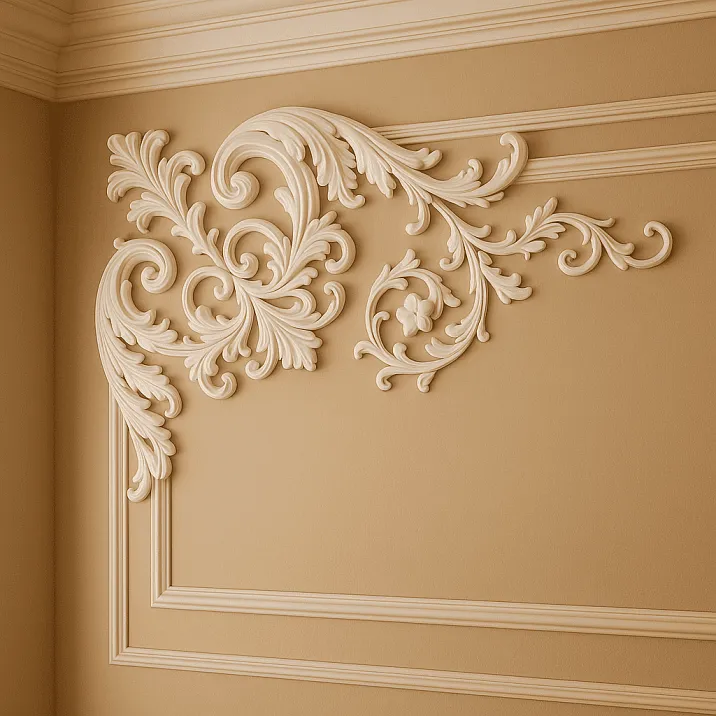
Today buy medallions Anyone who strives to create an interior with character and nobility.
What is a medallion in architectural terms? It is a central compositional element that organizes the space around it, creating a focal point for the viewer's gaze and establishing the rhythm of the entire decorative solution. In the modern world of interior design, polyurethane medallions have become a revolutionary solution, combining classical beauty with the practicality of new technologies.
Forget stereotypes that quality molding is exclusive to elite interiors! Modern polyurethane medallions make elegance accessible without sacrificing quality of execution or aesthetic value. They are capable of radically transforming any space, from a modest city apartment to a spacious country house.


Functional Purpose of Medallions in Architectural Space
Why do professional designers and architects place such importance on central compositional elements? The answer lies in the very nature of human perception of space. Our gaze instinctively seeks a compositional center — a point from which we can build the logic of all surrounding decor.




Visual Space Organization
Mold Intermediate Element Acts as an architectural conductor, managing the symphony of decorative elements. It creates a hierarchy of detail importance, defines the scale of perception, and sets the tone for the entire interior. Without a central element, even the most expensive finishing can appear chaotic and unfinished.
Imagine the ceiling as a canvas of an artist. Cornices create the frame of this canvas, while the medallion is its conceptual center. It is precisely from this point that the entire composition is read, and it determines whether the interior will be perceived as harmonious or random.
Our factory also produces:


Integration of Lighting Systems
Modern medallions not only decorate space but also solve practical problems. Central lighting — chandeliers, pendant lights — requires organic integration into the architecture of the room. Ceiling molding elements Serve as an ideal transitional link between technical lighting elements and the artistic concept of the interior.
A properly chosen medallion can visually increase the size of a chandelier, making it more significant in space, or, conversely, soften an overly bulky light fixture, creating a proportional balance.
Get Consultation
Correction of Architectural Flaws
Not all rooms have ideal proportions. Too high ceilings may create a sense of coldness, too low ones — a feeling of confinement. A well-chosen medallion can visually correct these flaws, creating an optimal perception of space.
In rooms with irregular shapes, the central element becomes a point of reference from which a new, more harmonious geometry of perception is built.
Types and Varieties of Medallions
The world of central decorative elements is rich and diverse. Each type of medallion responds to specific functional and aesthetic tasks, creating unique opportunities for design solutions.
Classic Rosettes: Geometry of Perfection
Round rosettes are the most traditional and universal form of medallions. The circle symbolizes perfection, completeness, harmony — precisely these qualities we strive to bring into our interiors. Classic rosettes can vary from simple concentric rings to complex multi-level compositions.
The diameter of the rosette is determined by the size of the room and ceiling height. For rooms of 15-20 square meters, rosettes with a diameter of 40-60 cm are optimal. Larger rooms require proportionally increased sizes — up to 80-120 cm in diameter.
Square and Polygonal Medallions
Geometric shapes — square, octagon, hexagon — create a more modern, strict impression. They are especially suitable for interiors with clear architectural geometry, where round shapes may appear too soft.
decorative interior ornaments Square forms are often used in styles such as Art Deco, minimalism, contemporary, where geometry becomes the primary artistic language.
Oval and Elliptical Compositions
Oval medallions create a sense of dynamism and movement. They are especially effective in elongated spaces — galleries, corridors, long living rooms — where they help visually correct the proportions of space.
Elliptical forms allow for creating more complex, multi-layered compositions, where the central element interacts with architectural features of the room.
Complex Compositional Medallions
The most impressive results are achieved by using complex multi-element compositions. The central rosette can be complemented by radial elements, corner details, connecting ornaments. Such compositions turn the ceiling into a true painting, where each element plays its role in the overall symphony.
Materials and their characteristics
The choice of material for the center determines not only its appearance, but also its durability, installation features, and project cost. The modern market offers various options, each with its own advantages and limitations.
Polyurethane: Technological Revolution
Polyurethane centers represent an optimal combination of quality, functionality, and accessibility. This material possesses unique properties that make it a leader in modern decorative art.
The moisture resistance of polyurethane allows using centers in any rooms, including bathrooms, kitchens, and pools. The material does not deform under temperature fluctuations, does not crack or crumble, maintaining its original shape for decades.
Lightweight — another critical advantage. A polyurethane center weighs 8-10 times less than a similar gypsum product, which dramatically simplifies installation and reduces load on load-bearing structures.
Gypsum: Classical Heritage
Gypsum centers are a tradition tested over centuries. The material has a unique ability to convey the finest relief details, creating the feeling of a living, handcrafted work of the artist.
The main advantage of gypsum is its 'breathability'. The material regulates humidity in the room, creating a healthy microclimate. Gypsum items can be repainted multiple times, allowing interior updates without replacing decorative elements.
However, gypsum requires special handling: it is heavy, fragile, and afraid of moisture. Installing gypsum centers requires professional skills and additional fasteners.
Modern composite materials
Technological development leads to the emergence of new materials combining advantages of various components. Composite centers may include fiberglass for strength, mineral fillers for dimensional stability, and special additives to improve adhesion.
Stylistic directions in center design
Each era in architectural history developed its characteristic forms of central decorative elements. Understanding these features will help make the right choice for a specific interior.
Baroque: Theatrical Opulence
Baroque centers impress with their ornate decoration and complex composition. Here, the boldest forms are appropriate: shells, scrolls, garlands, figures of angels and amorini. buy medallions In the Baroque style — means bringing the spirit of solemnity and festivity into the interior.
Characteristic elements of Baroque centers: asymmetrical scrolls, floral garlands, shells, mascarons, complex ornament interweavings. Color solutions may include rich gilding, polychrome painting, patina effects.
Classicism: Strict Harmony
Classical centers are distinguished by geometric clarity and strict proportions. The basis of decoration consists of classical motifs: meanders, palmettes, acanthus leaves, laurel wreaths. The color palette is restrained — white, cream, with possible accents of gold.
Classical compositions are built on the principles of symmetry and the golden section. Each element has its place in a strict and hierarchical decoration.
Modern: Natural Forms
The Modern style introduced into decorative art a cult of natural forms. Centers in this style imitate flowers, leaves, waves, creating a sense of organic and naturalness. Asymmetry becomes an artistic device, emphasizing the living nature of forms.
Modern Interpretations
Modern designers are not limited to copying historical samples. Principally new forms are created — minimalist geometric compositions, abstract reliefs, avant-garde solutions.
Eclectic approaches are particularly interesting, where classical motifs are reinterpreted in a modern context, creating unique authorial solutions.
Production technology and quality control
Understanding production processes will help make an informed choice and evaluate the quality of offered items. Not all centers are created equally — technological nuances significantly affect the final quality.
Master model creation
The process begins with creating a master model — the standard from which all subsequent copies will be taken. Leading manufacturers use computer 3D modeling or scanning historical samples followed by refinement.
The quality of the master model determines the quality of all items in the series. Every relief detail, every form nuance must be meticulously worked out.
Molding Technologies
Manufacturing working molds is a critically important stage of production. Molds are made from high-quality silicone capable of capturing the finest details and enduring thousands of molding cycles without loss of quality.
Multi-component molds allow creating items with complex configurations, recesses, and hidden cavities. This expands design possibilities and enables the realization of the most daring artistic concepts.
Injection and Polymerization Process
Injection of the medium requires precise adherence to technological parameters. Temperature of components, mixing time, molding pressure, polymerization modes — each parameter affects the quality of the final product.
Controlled polymerization ensures uniform material properties throughout the entire volume of the item. This guarantees the longevity and stability of the mold.
Principles of Selection and Evaluation Criteria
How to choose the ideal medium for a specific interior? There is a system of criteria that will help make the right choice and avoid costly mistakes.
Architectural Context Analysis
The first step — analysis of the existing space. Ceiling height, room area, interior style, lighting characteristics — all these factors influence the choice of the medium.
In rooms with ceiling heights of 2.7–3.0 meters, mediums with diameters of 30–50 cm are recommended. Higher ceilings allow using larger elements with diameters of 60–120 cm.
Interior style determines the character of decoration. Classical interiors require corresponding historical forms, while modern interiors favor more minimalist solutions.
Proportional Relationships
There are proven proportional relationships that ensure harmonious perception. The diameter of the medium should be approximately 1/7–1/5 of the room’s width to create optimal visual balance.
The relief height of the medium is also important. Too flat elements disappear on the ceiling, while overly detailed ones may appear intrusive. The optimal relief height is 1/10–1/8 of the item’s diameter.
Quality Characteristics
When selecting a medium, pay attention to the quality of execution. The relief should be clear, without blurred details. The surface should be smooth, without pores or imperfections. Geometry should be correct, without distortions or deformations.
Medium in Furniture and in architecture performs similar functions — creating a compositional center. Understanding these principles will help create a harmonious interior.
Installation and Mounting: The Art of Precision
Quality installation is the guarantee of longevity and aesthetic appeal of the medium. Even the highest-quality item may lose its beauty due to improper installation.
Preparatory Work
Successful installation begins with careful preparation of the base. The ceiling must be flat, dry, clean, and strong. All defects — cracks, unevenness, peeling coatings — must be eliminated.
Marking the center is a critically important stage. The medium must be positioned strictly at the center of the room or according to the architectural logic of the space. Even a slight misalignment will continuously draw attention and spoil the overall impression.
Installation Technique for Polyurethane Items
Polyurethane mediums are mounted using a special adhesive that ensures reliable adhesion to various surface types. The adhesive is applied in an even layer using a notched trowel.
When installing large elements, it is recommended to use temporary fastening with screws through the central hole. After the adhesive has fully dried, the screws are removed, and the hole is masked with putty.
Final Processing and Painting
After installation, all joints (if the medium is assembled) must be carefully filled with putty and sanded. Only after this is done is the final painting of the entire element performed.
Graining before painting is mandatory. It ensures even paint absorption and improves coating adhesion to the base.
Integration with Lighting Systems
Modern mediums do not merely decorate ceilings but actively interact with lighting systems, creating complex lighting effects.
Central Lighting
The traditional role of a medallion is to frame the central chandelier or pendant light. The right size and style of a medallion can dramatically change the perception of the fixture.
A large medallion makes the chandelier more significant in the interior, creating a sense of scale and grandeur. An elegant, small medallion highlights the fixture's sophistication, creating an intimate atmosphere.
Hidden Lighting
Modern technologies allow integrating hidden lighting systems into medallions. LED strips placed in relief grooves create striking backlighting that accentuates the beauty of the decor.
Colored lighting opens up new possibilities for creating various moods. Warm yellow light creates a cozy atmosphere, cool white light evokes a sense of modernity, while colored backlighting creates a festive mood.
Directional Backlighting
Spotlights directed at the medallion at various angles create dramatic play of light and shadow. This technique is especially effective for medallions with rich relief, where directional light reveals all the nuances of the decor.
corner trim
Proper care ensures the medallion retains its beauty for many years. Fortunately, modern materials have significantly simplified maintenance procedures.
Regular cleaning
The main maintenance procedure is regular dusting. Dust not only damages the appearance but can also lead to deterioration of the finish. Cleaning is done with a soft brush or vacuum cleaner with a delicate attachment.
Wet cleaning is performed with slightly damp cloth without using aggressive chemicals. Polyurethane is resistant to most household cleaning agents, but neutral compositions are preferable.
Preventive repair
Minor damages — chips, scratches, paint abrasions — should be addressed immediately. Timely repair prevents defects from developing and preserves the aesthetic qualities of the item.
Polyurethane medallions are easily repaired with acrylic putty. After drying, the damaged area is sanded and painted.
Coating renewal
Periodic repainting of the finish not only refreshes the appearance but also extends the lifespan of the item. When repainting, it is important to use compatible materials and follow application technology.
Economic Aspects and Return on Investment
Solution buy medallions This is not only an aesthetic but also an economically justified choice. Let us consider various aspects of economic efficiency.
Initial costs
The cost of medallions varies depending on the material, size, and complexity of the decor. Polyurethane items offer an optimal price-to-quality ratio, falling in the mid-price range between budget and premium materials.
When calculating the total project cost, it is necessary to consider not only the price of the medallion itself, but also the cost of installation, preparatory work, and finishing touches.
Long-term Economic Efficiency
High-quality polyurethane medallions serve for decades without losing their aesthetic qualities. This makes them more cost-effective compared to budget alternatives that require frequent replacement.
Minimal maintenance requirements reduce operating costs. Unlike plaster medallions, polyurethane medallions do not require regular repair of cracks or restoration of damage.
Impact on property value
Quality moldings, including medallions, significantly increase the perceived value of the interior. Market research shows that the presence of quality decor can increase the property's value by 15-25%.
This makes investments in decorative elements not only aesthetically justified, but also financially beneficial.
Trends and Innovations
The industry of decorative materials is constantly evolving, offering new solutions and opportunities. Understanding current trends will help make a choice that remains relevant for many years.
Personalization and Custom Design
Modern technologies allow creating unique medallions based on individual projects. 3D modeling and printing open up opportunities to realize any design ideas.
This is especially relevant for exclusive interiors, where standard solutions do not match the designer's original concept.
Smart Materials and Technologies
Advancements in materials science lead to the emergence of medallions with additional functions. Antibacterial coatings, air-purifying additives, materials with changing properties — all of this is no longer science fiction, but reality for tomorrow.
Ecological Innovations
Growing consumer environmental awareness stimulates the development of more eco-friendly materials and technologies. Biodegradable polymers, renewable resources, and waste-free production are becoming important selection factors.
Psychological Aspects of Perception
Moldings not only affect the aesthetics of interior design, but also the psychological state of people within the space.
Creating compositional order
The presence of a clearly defined center in a composition creates a sense of order and stability. This is especially important in today's world, where people often experience stress due to the chaos of their surroundings.
Connection with cultural heritage
Classic molding forms create a connection with centuries-old traditions, evoking a sense of continuity and cultural rootedness. This positively influences psychological comfort and self-identification.
Status aspects
High-quality decorative elements are traditionally associated with high social status and refined taste. This affects the self-esteem of owners and the impression the interior makes on guests.
Conclusion
buy medallions Today — it means investing in the beauty, quality, and longevity of your interior. Modern manufacturing technologies make exquisite decorative elements accessible to anyone who values harmony and style in their surroundings.
Choosing a molding is not just purchasing a decorative element — it is a decision about the character of your home. A classic rosette creates an atmosphere of nobility and tradition, a modern geometric composition highlights contemporary and progressive views, while an eclectic solution tells a story of a creative approach to life.
Polyurethane moldings combine the beauty of classic forms with the practicality of modern materials. They are resistant to moisture, temperature fluctuations, and mechanical impacts. They are easy to install, require minimal maintenance, and are durable in use.
Each molding is a small work of art capable of transforming an ordinary space into one with character and history. It is a focal point from which the perception of the entire interior begins, the center of composition, defining the harmony of surrounding decor.
The modern market offers moldings to suit any taste and budget — from simple geometric forms to complex artistic compositions. The only thing that matters is making a thoughtful choice, taking into account the specific features of the interior and personal preferences.
Investments in high-quality decorative elements pay off not only in aesthetic pleasure but also in increasing property value. A beautiful, thoughtfully designed interior remains relevant and in demand.
STAVROS is a recognized leader in the production of high-quality polyurethane decorative elements. Years of experience, use of advanced technologies, and strict quality control at every stage of production enable STAVROS to create products that serve as benchmarks in the decorative materials industry. Each STAVROS molding is the result of meticulous work by designers, technologists, and craftsmen striving for perfection. Choosing STAVROS products means obtaining not just a decorative element, but a guarantee of quality, beauty, and durability that will delight you for many years. STAVROS' professional team is ready to assist in selecting the ideal solution for any interior, providing a full range of consulting services and technical support.