Article Contents:
- Transformation of Classicism: From Izba to Smart House
- Philosophical Foundations of the New Approach
- Technological Breakthrough in Wooden House Construction
- Architectural Semantics: The Language of the Modern Russian House
- Morphology of the Modern 'Izba'
- Decorative System of the New Era
- Proportional Systems and Scale
- Engineering Systems as Art of Invisibility
- Climate Systems of the Future
- Smart House in Traditional Envelope
- Energy independence
- Interior Solutions: Traditions in Modern Interpretation
- Layout Flexibility
- Material Palette
- Lighting as an Architectural Element
- Landscape integration: house as part of nature
- Architectural Ecology
- Small architectural forms
- Seasonal adaptation
- Socio-cultural Aspects: Home as Center of Social Life
- Spaces for Communication
- Multi-generational Housing
- Cultural mission
- Economic Efficiency: Investment in the Future
- Energy efficiency and eco-friendliness
- Flexibility and Adaptability
- Social Value
- Technological Innovations: The Future in Traditions
- Digital technologies in design
- New Materials and Structures
- Integration with Nature
- Conclusion: Traditions as Foundation of Innovations
Time mercilessly erases boundaries between eras, yet there are values that remain unchanged. In the modern world of rapid technologies and globalization, more and more people turn their gaze to origins — to what makes us who we are. Modern House in Russian Style becomes not just an architectural solution, but a manifesto of cultural identity, embodying the dream of a home that connects the past with the present.
What drives successful people of the 21st century to choose wooden walls instead of glass and concrete? Why do carved casings compete with panoramic windows? The answer lies deeper than surface aesthetics — in the soul’s need to find roots in a world where everything changes at cosmic speed.
A Russian-style home in modern interpretation — this is a revolutionary concept where centuries-old traditions of Russian architecture meet innovative technologies, creating a symbiosis that seemed impossible just half a century ago.


Transformation of Classicism: From Cottage to Smart House
Modern architecture is undergoing a remarkable metamorphosis, when ancient principles of Russian housebuilding receive a second life in the context of the digital era. The Russian style in modern architecture is no longer limited to copying historical models — it transforms, adapts, and evolves.




Philosophical Foundations of the New Approach
Creators of modern Russian-style homes are guided by a fundamentally different philosophy than their predecessors. If previously, a house was built 'for centuries' in a literal sense, today it must be ready for constant changes, modernization, and adaptation to new technologies.
Modularity becomes the foundation of the modern approach — the ability to expand functionality without compromising architectural integrity. Russian Style Collection Includes elements that can be combined, replaced, or supplemented, creating unique architectural solutions.
Flexible floor plans allow modern wooden homes to adapt to changing family needs. A child’s room can become an office, a guest room can become a workshop, and the attic can become a home theater or gym.
Our factory also produces:


Technological Breakthrough in Wooden Housebuilding
Modern Technologies in Wooden Houses Have radically changed perceptions of the possibilities of this material. Laminated timber, thermowood, and composite wood-based materials open new horizons for architects.
Innovative processing methods allow creating wooden elements with characteristics surpassing traditional materials. Fire resistance, moisture resistance, and biological durability — modern wood is protected from all traditional 'enemies' of wooden housebuilding.
Digital design and robotic production ensure millimeter precision in manufacturing elements. Each detail is designed in 3D, modeled, and virtually tested before physical production begins.
Get Consultation
Architectural Semantics: The Language of the Modern Russian House
Every architectural era creates its own language of forms and symbols. A modern house in Russian style forms a new semantics, where traditional elements receive a modern interpretation and new meanings.
Morphology of the Modern 'Izba'
The exterior appearance of a modern Russian house represents a carefully balanced compromise between recognizability and novelty. The gable roof remains, but its proportions become more dynamic. Windows retain traditional proportions, but technology allows making them significantly larger.
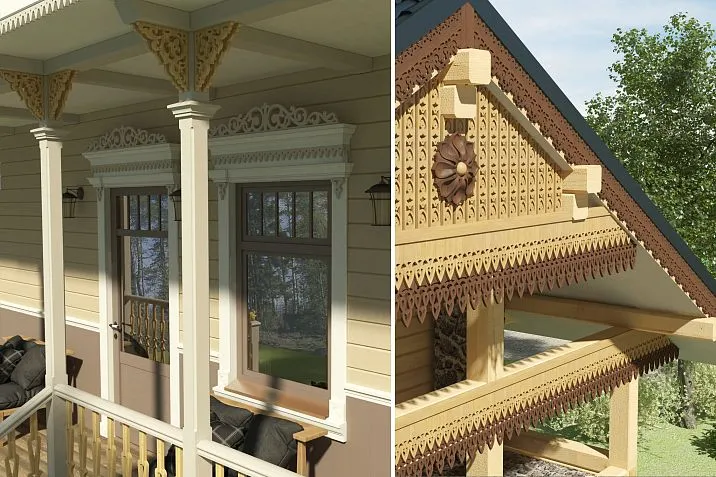
Architectural decoration Becomes not just decoration, but a functional element. Carved elements can conceal engineering utilities, solar panels, ventilation systems. Beauty and functionality merge into a single whole.
Terraces and verandas acquire a new purpose — they become transitional spaces between the house and the garden, equipped with climate control systems, and can be glazed or open depending on the season and weather.
Decorative System of the New Era
Izba adorned with carvingReceives a modern interpretation through the use of high-tech materials and production methods. Traditional motifs are reproduced using laser cutting, 3D printing, and CNC milling.
Wooden Brackets Modern production elements can bear significant loads, supporting not only decorative elements but also solar panels, antennas, and lighting systems. Functionality does not contradict aesthetics, but complements it.
Color solutions become more diverse due to modern coatings. While preserving the traditional palette, architects gain the ability to use dozens of shades of each color, creating subtle gradients and transitions.
Proportional Systems and Scale
Modern Russian-style homes often surpass historical analogs in size, requiring a reassessment of traditional proportional relationships. Architects develop new systems that maintain harmony at an increased scale.
Capitals in Russian Style Adapted to modern structural requirements. They can support heavier floors, function as load-bearing elements, while preserving traditional aesthetics.
Rhythmic facade organization takes into account modern functional needs — large panoramic windows in living rooms, French windows in bedrooms, technical openings for engineering equipment.
Engineering Systems as Art of Invisibility
One of the main challenges of a modern house in Russian style — harmonious integration of complex engineering systems without compromising the historical authenticity of the exterior appearance.
Climate systems of the future
Modern heating, ventilation, and air conditioning systems become practically invisible. Underfloor heating replaces radiators, exhaust ventilation operates silently, and air conditioning is integrated into architectural elements.
Geothermal systems use the earth's energy for heating and cooling homes. Heat pumps provide high efficiency with minimal environmental impact. An eco-friendly Russian home becomes a reality.
Heat recovery systems allow energy consumption to be reduced by 30-50%. Air exiting the home transfers its heat to incoming air, creating a closed-loop energy-saving cycle.
Smart House in traditional shell
Smart technologies are organically integrated into the modern Russian home. The "smart home" system controls lighting, heating, security, and multimedia, while remaining completely hidden from view.
Motion sensors are embedded in carved decorative elements, security cameras are disguised as traditional light fixtures, and acoustic systems are concealed behind wooden wall cladding.
Voice control allows managing all home systems without disrupting the historical atmosphere of the interior. Modern technologies serve comfort while remaining invisible.
Energy independence
Solar panels are integrated into roofing materials, preserving the traditional appearance of the roof. Modern photovoltaic elements can mimic various roofing materials — from shingles to wooden shakes.
Energy storage systems are placed in basements or technical rooms. A modern Russian home can be fully energy-independent, producing more energy than it consumes.
Small-scale wind generators can be styled as traditional weathervanes or decorative roof elements, combining functionality with aesthetics.
Interior solutions: traditions in modern interpretation
The interior space of a modern home in Russian style represents a complex system of interconnected functional zones, where each element performs multiple roles.
Spatial flexibility
Beautiful Interiors of Wooden Houses Modernism is based on the principle of space transformation. Sliding partitions allow combining or dividing rooms according to the needs of the moment.
Transformable furniture saves space and ensures multifunctionality. A dining table becomes a work surface, a sofa becomes a bed, and a wardrobe becomes a home cinema. Beautiful Wooden Furniture Combines traditional aesthetics with modern functionality.
Space zoning is achieved not only by walls, but also by light, color, and texture. Different zones may have varying ceiling heights, creating a dynamic vertical composition.
Material palette
Modern wooden interior Uses a wide spectrum of wood species — from traditional pine and oak to exotic wenge and teak. Each species has its own character, energy, and place in the interior.
Combining different textures creates a rich tactile environment. Roughly finished beams coexist with perfectly polished panels, creating contrasts and accents.
Modern processing technologies allow creating artificially aged wood, imitating various historical finishing techniques, achieving effects unattainable with traditional methods.
Lighting as an architectural element
The lighting architecture of a modern Russian home creates a multi-layered lighting system. Ambient light ensures functionality, accent lighting highlights architectural details, and decorative lighting creates mood.
LED technology allows creating lighting with variable color temperature, mimicking natural changes in daylight throughout the day. The system can automatically adjust to human circadian rhythms.
Hidden backlighting of carved elements creates amazing light-and-shadow effects, transforming static decor into dynamic light installations.
Landscape Integration: The House as Part of Nature
A modern home in Russian style does not exist in isolation — it becomes part of a landscape composition, harmoniously blending into the natural surroundings and enhancing them.
Architectural ecology
Permaculture principles are reflected in the layout of the modern estate. The house is oriented toward the cardinal directions to maximize solar energy and natural lighting.
Landscape design uses local plants, creating sustainable ecosystems that require no additional watering or maintenance. Rainwater is collected and used for garden irrigation.
Green roofs and living walls not only improve the house's insulation, but also create additional habitats for local flora and fauna.
Small architectural forms
Beautiful wooden houses are complemented by a system of small architectural forms executed in a unified style. Gazebos, bridges, and fences create a cohesive composition.
Modern gazebos are equipped with heating, lighting, and sound systems, allowing year-round use. They become additional open-air living spaces.
Water features — ponds, fountains, streams — not only beautify the landscape, but also serve practical functions: they moisten the air, create a favorable microclimate, and provide fire protection.
Seasonal Adaptation
The Russian house has always lived in tune with the seasons, and the modern interpretation preserves this tradition. The house can transform according to the season — becoming more open in summer and more enclosed and cozy in winter.
Sliding glass walls allow the interior space to merge with terraces and gardens in summer. In winter, the house becomes a warm refuge where one can enjoy the view of the snow-covered garden through panoramic windows.
Seasonal lighting highlights the beauty of the house throughout the year. In summer, the focus is on landscape lighting; in winter, on architectural element illumination.
Socio-cultural aspects: the house as a center of public life
A modern house in the Russian style revives the tradition of the house as the center of social life for the family and community. Architectural solutions promote communication and create spaces for various forms of social interaction.
Spaces for communication
Modern planning provides multiple spaces for communication — from intimate corners for two-person conversations to large halls for family celebrations. Each space has its own character and purpose.
The kitchen-living room becomes the heart of the house — the place where the family spends most of its time. An island or peninsula allows cooking without leaving the conversation.
Libraries or offices serve as places for intellectual activity, yet remain open for family interaction. Glass partitions maintain visual connection while providing acoustic separation.
Multi-generational housing
A modern Russian house is often designed to accommodate multiple generations of the family. Separate entrances, independent kitchens, and private zones ensure autonomy while preserving family ties.
Adaptive solutions allow changing the functional purpose of rooms as the family composition changes. Children's rooms can become offices, guest rooms can become rooms for elderly parents.
Barrier-free environments are designed from the outset, ensuring comfort for people of all ages and physical abilities.
Cultural Mission
A house in the Russian style becomes a keeper of cultural traditions, a place for passing knowledge and skills from the older to the younger generation. Workshops, creative studios, and home museums become an integral part of the modern estate.
A home theater can serve not only for watching movies, but also for family performances, musical evenings, and educational programs. Technical capabilities allow creating a professional stage in a home setting.
Libraries are formed not only from books, but also from digital archives of family history, photographs, and documents. Modern technologies allow creating an interactive family encyclopedia.
Economic efficiency: an investment in the future
A modern house in the Russian style represents not only an emotional, but also a rational investment. A properly designed and built house demonstrates high economic efficiency at all stages of its life cycle.
Energy efficiency and eco-friendliness
Modern technologies allow creating homes with nearly zero energy consumption. Quality insulation, efficient engineering systems, and renewable energy sources ensure minimal operating costs.
Using local materials reduces transportation costs and the carbon footprint of construction. Wooden houses sequester carbon, contributing to the fight against climate change.
The longevity of modern materials and structures ensures a long service life with minimal repair investments. Modular construction allows upgrading the house in parts without full-scale reconstruction.
Flexibility and adaptability
The ability to modify the layout without demolishing load-bearing structures ensures the long-term relevance of the house. As family needs change, the house can transform while retaining its value.
Universal engineering systems allow easy integration of new technologies. The house can evolve alongside technological progress, remaining modern for decades.
High liquidity of houses in Russian style is ensured by growing interest in national architectural traditions and an eco-friendly lifestyle.
Social value
Houses in Russian style become centers for reviving craft traditions, creating jobs for woodcarvers, carpenters, and artists. This contributes to preserving traditional crafts and developing a creative economy.
The tourist potential of such houses creates additional income opportunities — from organizing tours to renting out spaces for events.
The cultural significance of the Russian house extends beyond private ownership; it becomes part of the region’s cultural landscape, enhancing its attractiveness and value.
Technological innovations: the future in traditions
The development of technology opens new possibilities for modern houses in Russian style. Artificial intelligence, the Internet of Things, and new materials are transforming perceptions of what is possible in wooden construction.
Digital technologies in design
BIM technologies allow creating a complete digital model of the house, including not only architectural but also structural and engineering solutions. Virtual reality enables "walking through" the house before construction begins.
Parametric design allows creating infinite variations of traditional forms, adapting them to specific conditions and needs. Each house becomes unique while preserving stylistic unity.
Artificial intelligence analyzes climate data, site characteristics, and client preferences, creating optimal design solutions.
New materials and constructions
Engineered wood — CLT, LVL, Glulam — possesses characteristics surpassing traditional wood. It enables creating structures of previously impossible complexity and scale.
Bio-composite materials based on wood fibers combine the ecological properties of wood with improved performance characteristics. They open new possibilities for architectural creativity.
3D printing with wooden composites allows creating complex decorative elements unattainable through traditional carving methods. At the same time, the sense of handcrafted uniqueness is preserved.
Integration with nature
Biomimicry inspires architects to design homes functioning like living organisms. Houses can "breathe," adapt to environmental changes, and self-clean.
Living construction materials — mushroom mycelium, bacterial composites — may in the future become the basis for a new generation of eco-friendly homes.
Symbiosis with the plant world creates house-gardens, where architecture and nature merge into a single whole, creating a fundamentally new type of living environment.
Conclusion: traditions as the foundation of innovations
A modern house in Russian style represents a unique phenomenon of contemporary architecture — it proves that traditions do not contradict innovation but serve as their solid foundation. In an era of globalization and standardization, such houses become islands of cultural identity, places for preserving and developing national architectural traditions.
Living in a modern house in Russian style, a person receives not just a comfortable dwelling, but a space for spiritual growth, creative development, and family happiness. This is a home that nurtures, inspires, and unites generations.
The future of wooden construction appears precisely this way — deeply rooted in traditions, yet open to all achievements of modern science and technology. Houses in Russian style will become a benchmark for sustainable architecture, an example of harmonious coexistence between humans and nature.
Choosing a modern house in Russian style means choosing not just a place to live — you are choosing a philosophy based on respect for the past and belief in the future. You become part of the movement to preserve cultural heritage and its creative development.
For two decades, STAVROS has created masterpieces of wooden architecture, combining deep knowledge of traditions with expert mastery of modern technologies. Our craftsmen create not just houses, but works of art that will delight owners and their descendants for many decades. Choosing STAVROS means choosing unparalleled quality, individual attention, and boundless love for Russian architectural tradition.