Article Contents:
- What is considered modern solid wood furniture today: features and principles
- Feature 1. Form — geometrically clear, without excess
- Feature 2. Finish emphasizes, not masks
- Feature 3. Volume — not overwhelming, but proportionate
- Feature 4. Wood — alive, not 'smoothed over'
- Why natural wood makes an interior warmer but shouldn't overload it
- The warmth of wood: where it comes from
- When wood starts to overload
- Air as a tool
- How to combine natural wood and laconic forms: a detailed breakdown
- Facade: smooth, with emphasis on texture
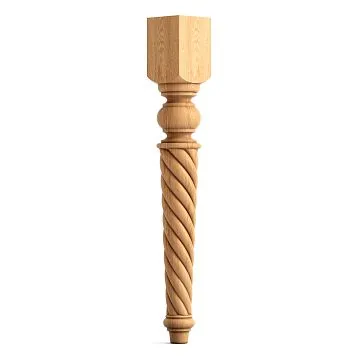
- Legs: thin, conical, with air under the object
- Thickness of tabletops and shelves: proportionate, not excessive
- Minimum fragmentation, maximum integrity
- Which wood species, shades and textures work best in modern interiors
- Oak: the universal leader
- Ash: lightness and air
- Beech: warmth and plasticity
- Walnut: status and richness
- Matte finish vs gloss
- In which rooms does modern solid wood furniture work especially well
- Living room: TV area, dresser, coffee table
- Dining room: dining table
- Bedroom: bed and bedside tables
- Study: desk
- Hallway: console table and shoe rack
- How to make the interior warm with solid wood furniture without making it heavy
- Technique 1. Light walls + medium-tone wood
- Technique 2. Two or three wooden elements with repetition
- Technique 3. Warm light as wood's ally
- Technique 4. Textiles as wood's 'soft' partner
- Technique 5. Avoid placing large wooden volumes next to each other
- Mistakes that make solid wood furniture look outdated and heavy instead of modern
- Mistake 1. Too dark and dense solid wood in a small space
- Mistake 2. Complex silhouette despite good material
- Mistake 3. Shiny lacquer finish on solid wood
- Mistake 4. Wood on all surfaces simultaneously
- Mistake 5. Lack of contrast
- Mistake 6. Attempting to 'update' classic wooden furniture with modern interior
- What to choose: solid wood, combination of wood and neutral fronts, or wood as an accent
- When is fully wooden furniture justified
- When the combination of wood and neutral fronts is optimal
- When wood is better left as a point accent
- Details that complete the modern look of wooden furniture
- Handles: thin, metal, or without handles
- Joints and gaps: precision as a sign of quality
- Metal as a contrast to wood
- Solid wood products in modern interiors: not just furniture
- Practical checklist before buying modern solid wood furniture
- FAQ: answers to popular questions about modern solid wood furniture
- Conclusion
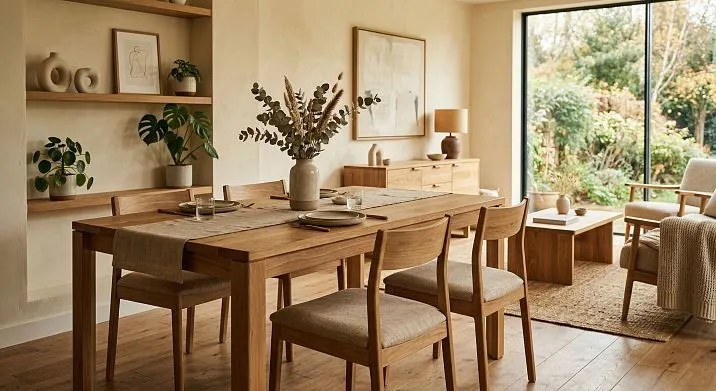
There is a persistent stereotype that anyone who starts thinking about solid wood furniture in a modern apartment encounters: 'It will be too heavy. Too rustic. Too classical.' And this stereotype is the main obstacle between a person and one of the richest solutions for a modern interior.
Let's shatter it immediately and irrevocably.
Modern FurnitureModern solid wood furniture is not a heavy sideboard with carved legs or a peasant table made of rough-hewn planks. It is concise geometry, clean planes, and the natural texture of wood that creates the feeling of a living surface. The form is modern. The material is ancient. It is precisely this combination that gives the interior something hard to fake: warmth that can be felt even with a glance.
Modern wooden furniture today is not about style, but about a principle. A principle where natural material does not overwhelm the space but enriches it. Where solid wood is not a source of visual heaviness but a source of depth and character. Where modern wooden furniture becomes the semantic center of the interior, not its problem.
This article breaks down exactly how furniture in the 'wood plus modernity' style works: which wood species, which forms, which techniques, and where solid wood works for you, and where it starts working against you.


What is considered modern solid wood furniture today: signs and principles
Before talking about style and techniques, we need to understand what exactly distinguishes modern solid wood furniture from 'just wooden' furniture. This is an important question because visually, both categories may seem similar until they are placed in a real space.




Sign 1. Form – geometrically clear, without excess
Modern solid wood furniture has clear geometry: straight or slightly tapered legs, flat fronts, rectangular or softly rounded volumes. No figured cornices, relief carved overlays, or profiled edges.
The form here is minimal. This is fundamental. Because the main visual statement is the wood texture itself: its pattern, its tactility, its living non-uniformity. When the form is complex, the texture gets lost in the relief. When the form is simple, the wood 'speaks' for itself.
Our factory also produces:


Sign 2. The finish highlights, not masks
Dark glossy lacquer covering wood 'like a piano' is a classic, not a modern technique. It masks the texture and makes furniture heavy and 'closed off'.
Modern finishes for solid wood include oil-wax, matte lacquer with an open pore structure, natural oil, or minimal treatment. Such processing preserves the living surface of the wood: it can be seen and felt. This is precisely what creates the feeling of naturalness, authenticity, and an expensive look.
Get Consultation
Sign 3. Volume — not overwhelming, but proportionate
This is a story about multitasking. The sofa transforms into a full-sized bed with an orthopedic mattress. The coffee table unfolds into a dining table for eight. The shelving unit simultaneously serves as a partition, zoning the space, a display case for collections, and a storage area. The chair is equipped with built-in wireless charging, USB ports, and adjustable reading lights.Solid wood works with proportions. A tabletop thickness of 40 mm instead of 80 mm is visual lightness. Thin tapered legs instead of thick rectangular supports create air under the piece. A low chest of drawers instead of a bulky wardrobe is a horizontal line, not a vertical mass.
Modern solid wood does not try to impress with weight. It works through proportions.
Sign 4. Wood — alive, not 'smoothed over'
The natural grain pattern is the main wealth of solid wood. Knots in oak, the light pattern of ash, the soft wave of maple — each surface is unique. The modern approach does not hide this richness behind uniform painting. It showcases it.
This is precisely the fundamental difference between modern solid wood furniture and imitations: wood-grain film lacks this pattern. There — a repeating pattern. Here — the living surface of each piece.
More about whichmodern styles in furniture designset the tone today and how to find your own character in them — in a special analytical material.
Why natural wood makes an interior warmer but shouldn't overload it
This is the central contradiction that needs to be resolved. On one hand — wood as a source of coziness and warmth. On the other — the risk of 'crushing' the space with heavy wooden mass.
The warmth of wood: where it comes from
Wood is perceived as a warm material not only because it's literally warmer to the touch than metal or stone. It's warm because it's alive. Its surface is non-uniform: fibers, knots, tonal transitions create visual 'noise' that the brain reads as the presence of something organic, natural.
This is precisely what gives interiors with wood a sense of being lived-in — even when there are no people in the room, it doesn't seem empty or cold. This is the main interior design argument in favor of modern wooden furniture.
When wood starts to overload
The problem arises when there's too much wood. If all walls are paneled with wood, the floor is wooden, the ceiling is wooden, and the furniture is massive dark wood — the space 'collapses'. Even very good wood in such quantity creates a feeling of tightness and pressure.
For a modern interior, the rule is simple: wood is an accent, not a background. It works in doses. One wooden item in a neutral space — that's precise. Three wooden items of different scales against a neutral background — that's rich and saturated. Wooden surfaces on all planes simultaneously — that's already too much.
Air as a Tool
Modern wooden furniture for a warm interior should 'breathe'. Thin legs, gaps between pieces, empty sections of wall next to wooden volumes—all this creates contrast that makes the wood itself more expressive.
Wood stands out against a neutral background. Without this background, it simply blends into a 'wooden interior' without focus or logic.
How to Combine Natural Wood and Laconic Forms: A Detailed Breakdown
This is the main question of the article, and the answer doesn't fit into one phrase. Let's break it down by elements.
Facade: Smooth, with Emphasis on Texture
The facades of modern solid wood furniture should be even—without milled profiles, without inset frames, without applied relief. A smooth plane of sanded oak or ash, coated with oil or matte varnish, is a surface where the entire grain pattern is visible.
It is the wood grain that becomes the decoration. And this is a fundamental modern approach. The form is simple. The decoration is the very nature of the material.
Legs: Thin, Tapered, with Air Underneath the Piece
Thin legs of tapered shape (narrowing towards the bottom) are one of the main techniques in modern wooden furniture. They create a sense of lightness even for large pieces. A table on tapered legs 'floats' above the floor. A chest of drawers on thin wooden supports looks visually lighter than a similar one on a massive plinth.
Leg height: for a coffee table — 35–45 cm, for a dining table — 72–76 cm, for a cabinet or chest of drawers — 10–20 cm. Even a small height creates a visual 'gap' that changes perception.
Thickness of tabletops and shelves: proportionate, not excessive
In heavy wooden furniture, the tabletop can be 60–80 mm — this is a 'statement of weight'. In modern wooden furniture, the tabletop is 22–40 mm. This is proportionate. Shelves — 20–25 mm. This is lightness.
The thickness should not shout 'I am made of wood'. It should say 'I am made with precision'.
Minimum fragmentation, maximum integrity
Many small details — much fuss. Modern solid wood furniture is built on large and calm volumes. One solid door instead of two small ones. One long drawer instead of three narrow ones. A shelf across the full width of the cabinet instead of three separate ones.
The less 'cutting' — the more impressive and modern the item looks.
Which wood species, shades, and textures work best in a modern interior
Choosing a wood species is not just an aesthetic choice. It is a choice of character that the wood will bring into the space.
Oak: the universal leader
Oak is the most common species in modern solid wood furniture, and for good reason. It is durable (density 690–750 kg/m³), easy to work with, and has an expressive grain pattern with characteristic 'mirrors'—light flashes on the cross-section.
Oak shades in modern interiors:
-
Whitewashed oak is the most 'neutral' and popular. Light gray, warm, without saturation. Pairs well with any walls.
-
Natural oak is a warm medium tone, honey-yellow with a gray tint. A classic of modern interior design.
-
Dark oak (stained or fumed) is rich, dark brown, almost black. Only as an accent in large spaces.
Ash: lightness and airiness
Ash is a lighter wood species with a less pronounced grain pattern than oak. Its texture is softer, the fibers are finer, and the shade ranges from beige-yellow to milky-gray.
Ash furniture is visually lighter. It doesn't feel heavy or draw too much attention. This is why ash is often chosen for small living rooms and bedrooms, where maximum visual lightness is needed while preserving the natural warmth of wood.
Beech: Warmth and Plasticity
Beech is a species with a fine, uniform texture, high density (680–750 kg/m³), and a characteristic pinkish or creamy hue. It bends well, takes finishes excellently, and creates a feeling of 'warm neutrality' in an interior.
Beech furniture is for those who want natural wood without an emphasized grain pattern: calm, warm, delicate.
Walnut: status and richness
Walnut is a dark, rich wood with a very expressive grain pattern. In a modern interior, it works as an accent: one walnut piece in a neutral space makes a statement. Too much walnut is overwhelming.
Optimal: one walnut detail (a dresser, coffee table, or cabinet) in a space with light walls and light or neutral furniture.
Matte finish vs. gloss
Regardless of the wood species, the finish should be matte or satin. Oil-wax, natural oil, or matte open-pore lacquer represent a modern approach. High gloss kills the natural texture and makes wooden furniture feel and look 'plastic'.
More about whichmodern furniture materialsdeliver the best results in aesthetics and durability — covered in a separate detailed analysis.
In which rooms does modern solid wood furniture work especially well
Solid wood is a versatile material, but it serves different purposes in each room. Let's break it down by space.
Living room: TV area, dresser, coffee table
In the living room, solid wood works best in three formats:
TV stand or low chest of drawers under the TV. A wooden piece in a horizontal line beneath the screen creates a warm, lively center for the TV zone. Against neutral walls and light modular elements, it's exactly that 'warm spot' that makes the entire composition come alive.
Coffee table. A wooden table with thin legs is one of the best modern solid wood objects. Small in volume but very expressive. It connects the sofa area and the TV zone through material repetition.
Open shelving unit. Wooden shelves without a back panel, with thin uprights—a light and modern accent in the living room. They can stand alone or serve as a room divider.
Chests and Dresserssolid wood for the living room is a good starting point for those who want to add the warmth of natural wood to the space without a heavy wooden system.
Dining room: dining table
The dining table is the item where solid wood is most justified. It's at the table that the surface matters: its tactility, liveliness, ability to 'accept' the marks of time and only become richer from it.
Modern solid wood dining table: rectangular top 40 mm thick, tapered legs, without unnecessary fragmentation or decoration. Oak or ash with an oil finish is the best option.
Dimensions: for 4 people — 80×140 cm, for 6 — 90×180 cm. Tabletop height is standard, 74–76 cm.
Bedroom: bed and bedside tables
In the bedroom, wood creates a sense of coziness and natural tranquility. A bed with a wooden headboard or a fully wooden frame is one of the most enduring modern trends.
Important: the headboard should be simple. Smooth plank panels, slightly raised slats, paneling with an open texture—this is modern. A carved headboard with ornate details is not modern solid wood furniture; it's classic.
Wooden bedside tables: small, with one drawer or an open shelf, on thin legs. They don't overwhelm but complement.
Study: desk
Solid wood in a desk is a conscious choice of quality and durability. A wooden desktop lasts for decades if properly cared for. It accepts scratches and only gains character over time.
Modern solid wood desk: straight desktop without curves, metal or wooden supports, minimal drawers.
Entryway: console and shoe rack
In the entryway, solid wood works as a 'first impression.' A wooden console with a mirror above it is a warm welcome upon entry. A shoe rack with wooden fronts on thin legs is storage without visual heaviness.
How to make an interior warm with solid wood furniture without becoming heavy
This is a practical section. Specific techniques—no fluff.
Technique 1. Light walls + medium-tone wood
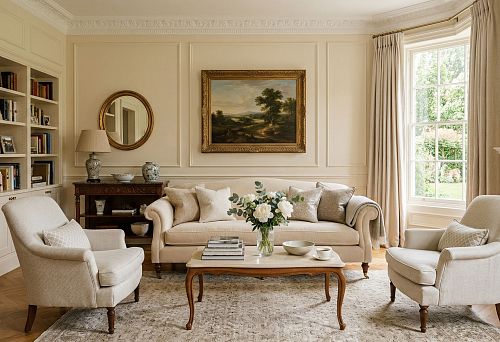
This is the most versatile combination. Neutral light walls (white, cream, warm gray) serve as a backdrop, allowing natural or slightly dark-toned wooden furniture to sound rich and warm. The wall doesn't compete with the wood but showcases it.
If the walls are dark or saturated — the wood should be light (whitewashed oak, ash) or neutral.
Technique 2. Two to three wooden elements with repetition
Rule of repetition: when one material appears in two or three items — it becomes part of a system, not an accident. A wooden table + a wooden mirror frame + a wooden side table — that's rhythm. A single wooden chair in a plastic environment — that's chaos.
Technique 3. Warm light as an ally of wood
A warm light source (2700–3000 K) makes any wood even warmer and deeper. Cold light (4000 K and above) neutralizes the warmth of the wood tone. Therefore, in an interior with wooden furniture, warm lighting is almost a must.
Bottom lighting of a wooden cabinet or inside open shelves creates an additional play of shadow on the fiber texture — it's beautiful and luxurious.
Technique 4. Textiles as a 'soft' partner for wood
Linen, cotton, fine wool — these are textures that go organically alongside wood. They are tactilely close and visually complement the natural character of solid wood.
A sofa with linen upholstery + a wooden coffee table is a classic of modern warm interiors. A sofa with faux leather + a wooden table creates a conflict of tactile signals.
Technique 5. Do not place large wooden volumes next to each other.
If there is a large wooden dining table and a large wooden cabinet a few meters apart in the living room — that's already too much. Let one be the dominant piece, the other — supportive. Or replace one with a neutral item without wood on the surface.
Mistakes that make solid wood furniture look outdated and heavy instead of modern.
An honest breakdown — no diplomacy.
Mistake 1. Too dark and dense solid wood in a small room.
Dark walnut or stained oak in a room of 14–16 sq. m is a visual collapse. Dark wood requires space, volume, high ceilings, and good lighting. In a standard Russian apartment with 2.5 m ceilings — only light species or a medium neutral tone.
Mistake 2. Complex silhouette despite good material.
Solid wood furniture with carved overlays, profiled edges, and ornate cornices is classic furniture. It won't become modern just because you paint it white or place it in a contemporary interior. Form defines style, not the other way around.
A modern interior requires a modern form: straight lines, smooth fronts, minimal relief.
Mistake 3. Glossy lacquer finish on solid wood
High-gloss lacquer kills the wood grain. What you pay for in solid wood—the living surface—is hidden under a mirror-like film. The result is furniture that looks neither like expensive solid wood nor like a modern matte facade.
Only matte or satin finishes.
Mistake 4. Wood on all surfaces simultaneously
Parquet floor + wooden ceiling + wooden kitchen fronts + wooden table + wooden shelves—this is a 'log cabin,' not a modern interior. One or two wooden surfaces in a room, the rest—a neutral background.
Mistake 5. Lack of contrast
Mid-tone wood on walls of the same tone—the furniture gets lost. Contrast is a condition for expressiveness. Light walls + medium or dark wood. Dark walls + light wood. Or neutral walls + expressive wood grain as an accent.
Mistake 6. Attempt to 'update' classic wooden furniture with a modern interior
A classic wooden sideboard with carved details, repainted white and placed in a minimalist modern living room—this is not 'fusion.' It's a conflict. The form remains classic, and no color will change it.
If you want to keep old solid wood furniture—build the interior around it, don't try to fit it into an incompatible context.
What to choose: pure wood, combination of wood and neutral facades, or wood as an accent
Comparative analysis of three strategies — with specific application examples.
| Strategy | When appropriate | Risks | Best examples |
|---|---|---|---|
| Fully wooden furniture | Large room, high ceilings, light wood species | Overload with dark wood or small area | Dining area, bedroom with ash wood bed |
| Array + neutral facades | Any space | Uniform material tonality is important | Chest of drawers: wooden frame + matte inserts; kitchen: wooden countertop + matte facades |
| Wood as an accent | Small rooms, light interiors | There should be one accent, not three or four | Wooden coffee table in a light living room; wooden sofa legs; console in the hallway |
When fully wooden furniture is justified
A dining area with one wooden table and chairs is possible without overload if the walls and floor are neutral. A bedroom with a wooden bed and nightstands is warm and organic. A study with a wooden desk and shelving is a classic 'smart' space.
When the combination of solid wood and neutral fronts is optimal
This is the best strategy for kitchens, hallways, and living rooms with modular systems. Wooden countertop + white fronts on lower cabinets. Wooden base of a chest of drawers + matte drawers. This creates exactly that balance that works as 'modern wood' — without overload and without losing naturalness.
About how the relevantmodern furniture 2025combines solid wood and case solutions into a single system — a detailed breakdown in a separate article.
When wood is better left as a point accent
Small living room up to 16 sq. m. Interior with already rich textiles or complex wallpapers. A space with many other 'speaking' elements. In such cases, one wooden item — and that's enough.
Details that complete the modern look of wooden furniture
Solid wood is the foundation. But it's the details that determine whether the furniture will look modern or not.
Handles: thin, metal, or without handles
For wooden facades in a modern interior — matte metal handles (matte nickel, black metal, bronze). Or complete absence of handles with a push-to-open system. Wooden handles are appropriate if they have a laconic shape — without carving, simple pulls.
handles for modern furnitureSolid wood items are a separate story, deserving attention: quality hardware completes the item's image and creates stylistic unity.
All handles in the system should be of uniform material and shape. Mixing chrome, gold, and wood — only if it is a conscious and moderate design technique.
Joints and gaps: precision as a sign of quality
In good modern solid wood furniture, the gaps between doors and the carcass are uniform, 1.5–2 mm. The tabletop edge is even, without chips or burrs. Drawers slide in smoothly without noise or jamming.
It is precisely these invisible details that shape the feeling of 'expensive or cheap' at first touch.
Metal as a contrast to wood
Metal legs (matte black or matte nickel) on wooden carcasses are one of the main techniques in modern furniture. Metal adds graphics and precision, wood adds warmth and organicity. They work better together than separately.
Solid wood products in a modern interior: not just furniture
Solid wood is not just for case furniture. In modern interiors, it appears in the form of many elements that create a unified wooden 'note' without overloading the space.
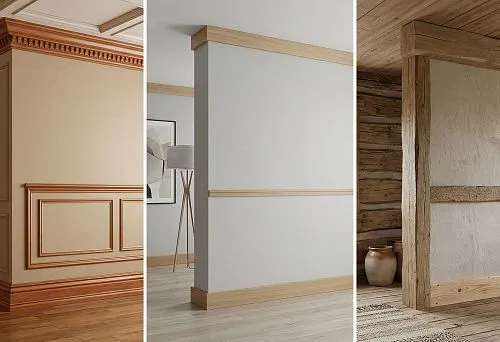
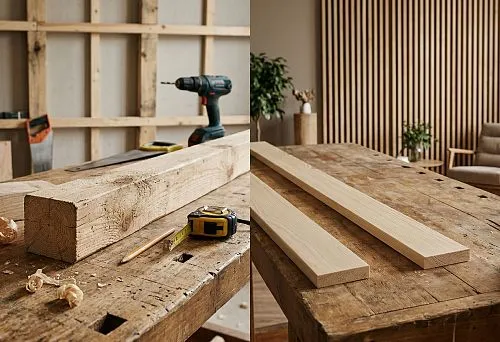
Solid Wood Items— this is a separate category of items: handles, battens, moldings, decorative elements made of natural wood. They allow the wooden theme to run throughout the interior without saturating it with heavy furniture everywhere.
Wooden moldings as a door frame. Wooden battens on an accent wall. Wooden handles on furniture with neutral fronts. A wooden console in the hallway. A wooden mirror frame.
Each of these elements is small, but it contributes to creating the overall warm character of the space.
Practical checklist before buying modern solid wood furniture
Use these questions before going to the store or opening a catalog.
1. What is the area of the room?
Up to 16 sq. m — only light species (ash, bleached oak). 16–25 sq. m — any medium tones. More than 25 sq. m — you can work with rich species (walnut, dark oak).
2. How much wood is already in the interior?
Parquet — counts. Wooden window frames — count. If there is already wood on the floor — the furniture should be in a different tone, contrasting or neutral.
3. Do you need a light or medium shade?
Light wood species are for small and dark rooms. Medium ones are universal. Dark ones are only as an accent in a spacious, bright interior.
4. Do you need visual lightness?
If yes — thin legs, small depth, hanging or compact solutions.
5. What is the storage volume?
If large — a chest of drawers with drawers or a closed shelving unit. If small — an open shelf or coffee table is enough.
6. Will the furniture be an accent or a background?
Accent — expressive grain, dark tone, unusual wood species. Background — neutral light tone, even grain, calm wood species.
7. Fully wooden item or combination with neutral fronts?
If there is already a lot of wood in the space — choose a combination. If there is little wood — you can afford a solid wooden item.
Buy Solid Wood Furniturewith correct answers to these questions means eliminating the possibility of error in advance.
FAQ: answers to popular questions about modern solid wood furniture
Is solid wood furniture suitable for a modern interior?
Yes, and it is one of the best materials for a warm modern space. The main condition: the form must be modern — laconic, without unnecessary relief. Solid wood itself does not make furniture old-fashioned. The form does.
How to choose modern wooden furniture for an apartment?
Focus on light or medium species (oak, ash, beech). Choose a matte finish. Evaluate the form — it should be geometrically simple. Legs — thin or tapered. Fronts — smooth, without relief.
What is better for a modern interior: solid wood or wood imitation?
Solid wood is always better — with an equal budget. Its surface is unique, it lives and ages gracefully. Imitation is a repeating pattern without depth. With a limited budget — good veneer (real wood veneer on an MDF base) is better than laminate.
How not to overload a room with solid wood furniture?
Rule of three: no more than three wooden elements in one room. Light walls as a background. One large wooden item — the dominant, the others — support. Avoid wooden decor where there is already wooden furniture.
What modern solid wood furniture is best for the living room?
A low wooden chest of drawers or TV stand, a wooden coffee table, and one open wooden shelf are the optimal set for a modern living room. They create warmth without overwhelming the space.
Can solid wood be combined with light, smooth fronts?
Not only can it be done—it's one of the strongest techniques in modern design. Wooden elements + smooth matte fronts = a contrast of textures that creates visual depth. The key is a unified tonal temperature of the materials.
Which wood shade makes an interior warmer?
Warm medium tones—natural oak, beech, warm ash. They create the maximum sense of coziness. Whitewashed oak is more neutral. Walnut is richer but requires a light environment.
Where to buy solid wood furniture for a modern home?
Look for manufacturers who work with natural veneer or solid wood and offer modern, laconic forms. A material sample is important—evaluate the texture and finish in person, not just from photos.
Conclusion
Solid wood and a modern interior are not a contradiction. It's a union that, when approached correctly, gives the space something no other material can: living warmth, depth of texture, and a sense of authenticity.
Modern solid wood furniture works through simplicity of form and richness of material. Laconic lines are the frame within which the natural wood grain becomes the main statement. Dosage is the principle that allows preserving airiness and avoiding heavy 'wooden' oversaturation. Proper lighting and a neutral background are the conditions under which solid wood performs at its full strength.
It's not about the quantity of wood. It's about the precision of its placement in space.
STAVROS specializes in manufacturing furniture, products, and decorative elements from natural wood. The STAVROS range includes solid oak, ash, beech, and other wood products, natural wood furniture handles, decorative slats and moldings, as well as modern-style case furniture using veneer and pure solid wood.
STAVROS operates at the intersection of traditional craftsmanship and modern design approach: each product is manufactured with an emphasis on surface finish quality, precision of joints, and material integrity. If you want to create a warm, modern, and truly vibrant interior — STAVROS will help find the right solution.