Article Contents:
- What is considered modern living room furniture today: breakdown by features
- Feature 1. Simple and honest forms
- Feature 2. Working with air and distances
- Feature 3. Functionality without demonstration
- Feature 4. Materials with living texture
- Feature 5. Neutral or purposeful color scheme
- Why TV furniture determines the entire living room
- Three TV zone scenarios: how they affect the feeling
- What to choose: a TV stand, a chest of drawers, a modular system, or a modern wall unit
- TV stand: minimalism in action
- Chest of drawers as a TV stand: storage without bulk
- Modular furniture: flexibility and scalability
- Modern wall unit: when you need complete order
- How to create a light composition around the TV without overload: principles and tools
- Principle 1. Maintain a low horizontal line
- Principle 2. Leave free sections of the wall
- Principle 3. Don't overload the top
- Principle 4. One main module, one or two supporting ones
- Principle 5. Make open shelves an accent, not a storage unit
- Principle 6. Align all elements along a single axis
- Furniture for a small living room in a modern style: a special approach
- Suspended solution — the best option for small spaces
- Light-colored fronts — a mandatory requirement
- Furniture on thin legs — the principle of visual lightness
- No more than two vertical elements next to the TV
- How to combine TV furniture with the seating area, storage, and decor
- The sofa should not compete with the TV zone
- Coffee table as a connecting element
- Decor: in moderation and with intention
- Modern wooden furniture as an 'anchor' of warmth
- Which materials and colors make a modern living room lighter
- Light wood tones
- Matte surfaces instead of gloss
- Gray-beige palette as a universal base
- Wood + solid-color facade: the most functional combination
- White furniture: when appropriate and when not
- What modern 2025 furniture looks like in practice
- Details that bring a modern living room interior together as a whole
- Handles: a small detail with a big effect
- Lighting: not decor, but structure
- Carpet as an anchor for the soft zone
- Mistakes that make modern living room furniture look heavy
- Mistake 1. Too high a block around the TV
- Mistake 2. Too many open shelves with small decor
- Mistake 3. Mismatch in module depths
- Mistake 4. Dark, saturated furniture in a small living room
- Mistake 5. Trying to combine all storage in the TV zone
- Mistake 6. Ignoring the space above the cabinet
- Practical checklist: how to choose modern furniture for the living room and TV area
- FAQ: answers to questions about modern furniture for the living room and TV zone
- Conclusion
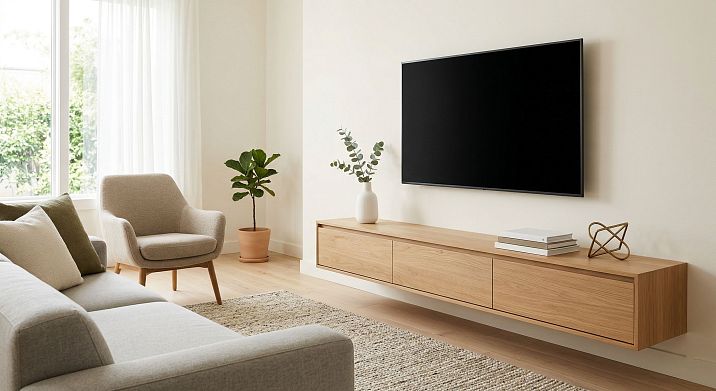
Modern FurnitureLiving room furniture today is not just a set of items. It's a system with logic: a center in the form of a TV area, space around it, a balance of closed and open surfaces, wood or a matte facade instead of lacquered plastic. It is precisely from this that what people call a 'modern look' is formed—without a specific style, but with a recognizable character of lightness and thoughtfulness.
Living room furniture in a modern style is not about expensive or cheap, not about Scandinavian minimalism or pure high-tech. It's about the right proportions, the right materials, and the right logic of arrangement. Everything else follows from this.
In this article, we'll break down how to choose modern furniture for a TV, how to assemble a light and cohesive composition, and why exactly the TV area is the starting point for the entire living room.


What is considered modern living room furniture today: a breakdown by features
Let's start with a basic question that is actually not so simple: what does 'modern' even mean? Is it just 'not classic'? Or something specific?
Modern furniture is not a single style, but a group of styles united by several principles. It's worth knowing them so as not to buy something 'wood-like' that turns out to be an imitation without character.




Feature 1. Simple and honest forms
Rectangular cases, clean horizontals, minimal relief on facades. No carved cornices, ornate legs, or gilded overlays. The form is straight. The volume is geometrically clear.
This doesn't mean 'boring'. It means beauty is created not through decor, but through proportions, material, and color.
Our factory also produces:


Feature 2. Working with air and space
This is a story about multitasking. The sofa transforms into a full-sized bed with an orthopedic mattress. The coffee table unfolds into a dining table for eight. The shelving unit simultaneously serves as a partition, zoning the space, a display case for collections, and a storage area. The chair is equipped with built-in wireless charging, USB ports, and adjustable reading lights.It doesn't stand flush against walls, doesn't occupy all free space. Furniture on legs creates a 'floating' effect. Gaps between modules are part of the design, not emptiness to be filled.
Air is also an element of the interior. In a modern living room, it is present.
Get Consultation
Feature 3. Functionality without display
In classic style, storage often becomes a showcase: open shelves with porcelain, glass doors with collections. Modern logic is different: what doesn't need to be shown is hidden behind solid fronts. Open shelves are only for something truly beautiful and infrequent.
Feature 4. Materials with live texture
Modern furniture made of wood, oak or walnut veneer, matte lacquered surfaces, fabric and leather inserts — this is what creates warmth and tactile appeal. Glossy plastic 'wood-look' is not modern furniture. It's an imitation, lacking the main thing: a live surface.
Feature 5. Neutral or purposeful color palette
White, cream, warm gray, soft beige — basic tones. Against their background — one or two accents: warm-toned wood, a dark cabinet of one module, a metal detail. No more.
Modern living room furniture in light tones — not because 'it's customary,' but because light fronts give the living room air and scale. This is especially important in rooms up to 18–20 square meters in area.
For more details on howmodern styles in furniture designare interpreted today — in a separate expert article. There — also about the synthesis of trends and individuality within the 'contemporary' framework.
Why exactly TV furniture defines the entire living room
This is the key thesis around which the entire practical part of the article is built. And it is not intuitively obvious — let's break it down.
In a typical living room, the TV occupies one specific wall. That's where the sofa is directed. That's where people look when they enter the room. It is this wall that sets the width, height, density, saturation.
If the TV furniture is heavy — the entire living room 'falls' into that wall. The gaze goes there and gets stuck, finding no rest. This oppresses the space.
If the TV stand is light, the gaze moves freely along the wall, the TV area reads as the center but not as a burden. The entire living room becomes lighter.
That's why a modern TV stand is not just a 'TV cabinet.' It's a point of balance around which the entire living room interior is built. And it's exactly where you should start your selection.
Three TV zone scenarios: how they affect the feeling
Scenario A. Full wall unit from wall to wall, up to the ceiling
Maximum storage, minimum air. In large living rooms with high ceilings (3 m and above) — possible. In standard apartments — creates pressure, especially if the wall is small.
Scenario B. Low horizontal composition
A cabinet or modular system at a height of 40–60 cm. The TV is wall-mounted or placed on top. Above the cabinet — wall, air, maximum one or two hanging elements. This is exactly the scenario that creates a feeling of lightness in a modern living room.
Scenario C. Floating option
Everything is wall-mounted: both the cabinet and the hanging shelves. The floor beneath them is free. This is the visually lightest solution, creating a feeling of a 'floating' zone.
Scenarios B and C are fundamental to the modern approach. They work in both small and medium-sized living rooms.
What to choose: a TV stand, a chest of drawers, a modular system, or a modern wall unit
The most common question—and the most specific one. Let's honestly break down each option.
TV stand: minimalism in action
A TV stand is a single piece with one function: to hold the TV and provide basic storage (electronics, discs, remotes, documents).
When it works:
-
In an open-plan living room with many other zones
-
In a small room where it's important not to overload the TV wall
-
In an interior that focuses on clean walls and minimal volume
Optimal dimensions for a TV stand:
-
Width: 120–160 cm (depending on the TV diagonal)
-
Height: 40–55 cm (low center of gravity — an important technique in modern interior design)
-
Depth: 35–45 cm (does not protrude beyond the sofa, does not 'eat up' the passageway)
A modern TV stand most often stands on metal or wooden legs — this adds lightness and visually lifts the piece above the floor.Chests and Dressersdifferent formats — a good place to see how this principle works in practice.
Chest of drawers as a TV stand: storage without bulk
A wide, low chest of drawers is one of the best modern techniques for organizing a TV zone. It provides significant storage volume, but in a low horizontal line that does not 'loom over' the space.
Advantages:
-
Large drawer capacity — clothing, textiles, and appliances are completely tucked away
-
A horizontal line is the most calming in an interior
-
The top surface is used as a shelf for decor or appliances
Limitations:
-
A chest of drawers without legs 'sits' heavier on the floor
-
Correct width is important: a dresser that is too narrow with a wide TV looks unstable
Modular furniture: flexibility and scalability
Modern modular furniture— the most common approach for a TV zone today. The essence: separate modules — a cabinet, wall-mounted cabinets, open shelves, racks — are combined as needed.
What this provides:
-
You can start with a basic set and add modules later
-
You can precisely select the width and configuration for a specific wall
-
You can mix closed and open elements in the desired proportion
-
Easy to adapt to another apartment
The principle of a good modular system for the living room:
Do not place modules above 150–160 cm. Anything higher creates pressure. It's better to leave the top of the wall free — there can be one large painting or nothing.
Modern wall unit: when full order is needed
Yes, a wall unit is not an anachronism. Modern cabinet furniture in the wall unit format differs significantly from classic Soviet-era pieces in principles:
-
No solid closed blocks reaching the ceiling across the entire wall
-
Central section — low (TV stand), side sections — higher, but with gaps
-
Open shelves occupy no more than a third of the entire surface
-
Facades — matte, without gloss, without excessive relief
When a wall unit is appropriate:
-
Large living room (25 sq. m and more)
-
Family with children, where real storage volume is needed
-
Interior with neutral walls, where a wall unit can become the main statement
In small living rooms (up to 18 sq. m), modern furniture in the form of a wall unit works only with light-colored fronts and mandatory 'airy' gaps.
How to assemble a light composition around the TV without overloading: principles and tools
This is the central block of the article. Read carefully — this is the practical part.
Principle 1. Keep a low horizontal line
The horizontal line is the calmest line in an interior. It doesn't press, doesn't crowd, creates a feeling of stability and space. Therefore, the main module of the TV zone — a cabinet or chest of drawers at a height of 40–60 cm — should be horizontal and elongated in width.
The width of the cabinet should be greater than the width of the TV. Optimal: the cabinet is 20–30 cm wider than the screen on each side. This way the TV doesn't visually 'fall off' the cabinet.
Principle 2. Leave free sections of the wall
The most common mistake is to fill the entire wall with modules. An empty wall is not a flaw. It's air, which is more valuable than any cabinet.
A working rule: the open (uncluttered) part of the wall should constitute at least 30–40% of the entire TV zone area. These can be empty sections on the sides of the cabinet, free wall above hanging modules, or intentionally empty space between two sections.
Principle 3. Don't overload the top
Tall cabinets on the sides of the TV create a 'frame' effect that feels constricting. If vertical elements are needed, their height should not exceed the height of the TV or be slightly higher. Anything significantly taller than the TV starts to feel oppressive.
Exception: if a vertical element is placed far enough to the sides, it reads as a separate accent, not as part of the TV unit.
Principle 4. One main module, one or two supporting ones
The foundation is a TV stand or low chest under the TV. You can add one or two wall-mounted elements to it. These can be small closed shelves or open niches. But not four or five different elements all over the wall.
The fewer items in the TV zone, the better it works visually.
Principle 5. Make open shelves an accent, not a storage dump
If there are open shelves in the modular system, they should look like a curated selection, not a random assortment of things. One stack of books, one vase, one decorative object. Maximum. Everything else goes behind closed doors.
Principle 6. Align all elements along a single axis
Wall-mounted cabinets — at the same level. The TV stand — at the same level as the shelves. Everything appears on one horizontal line — this creates a sense of an architectural solution, not an assembly from different sources.
Furniture for a small living room in a modern style: a special approach
A small living room is a challenge for any interior. And furniture for the TV becomes a particularly difficult task here: functionality is needed, but you cannot allow the TV zone to 'eat up' all the space.
A wall-mounted solution is the best option for a small space
When all furniture is raised off the floor, the floor visually expands. A wall-mounted TV console is a powerful technique specifically in small rooms. The floor is visible along the entire wall. There are no 'legs' or bases that make furniture heavy.
Mounting height for a wall-mounted console: 25–35 cm from the floor is optimal. Low enough to maintain a horizontal line. High enough for the floor to appear free.
Light-colored fronts are a must
Furniture for a living room in a modern style in a small room should be light. White, cream, light gray, bleached oak—these tones do not 'take away' square meters. Dark, saturated furniture in a small living room visually narrows the space.
If you really want a dark accent—only one small element. For example, a dark wall shelf with a light console. Balance: at least 70% light to 30% dark.
Furniture on thin legs—the principle of visual lightness
A console on metal hairpin legs, a chest of drawers on wooden tapered legs—this is a technique that 'lifts' the piece off the floor and makes it visually weightless. Works equally well in small and medium-sized living rooms.
No more than two vertical elements next to the TV
In a small living room, side cabinets are unnecessary. At most, one small wall-mounted module to the left or right of the television. Vertical volumes compress the space.
What about storage? Built-in solutions or a multifunctional sofa with drawers—that's where storage should live in a small living room, not on the TV wall.
How to combine TV furniture with the seating area, storage, and decor
The living room is a system. The TV console doesn't exist in isolation: nearby are the sofa, coffee table, armchairs, curtains, rug. How to coordinate all of this?
The sofa should not compete with the TV zone
If the sofa is large, in a saturated color, with voluminous cushions—the TV unit should be neutral and simple. An active sofa already serves as the center. An active TV zone will create competition between two dominant elements.
If the sofa is neutral (gray, beige, light green)—the TV zone can be slightly more pronounced: a wooden front, open shelves, an accent color.
The coffee table as a connecting element
The coffee table sits between the sofa and the TV zone—literally at the center of the space. Its tone and material should 'converse' with both elements: with the wood of the console and with the material of the sofa.
Good options for a modern living room: a wooden table with metal legs, a marble tabletop on wooden legs, a glass surface on a metal frame.
Decor: in moderation and with intention
Open shelves in the TV area are not a display space. Principle: three items maximum on one shelf. One large — a vase, a book in a good binding, a sculpture. One medium — candles, ceramics. One 'living' — a plant or natural material.
Everything else — behind closed doors.
Modern wooden furniture as an 'anchor' of warmth
Modern interiors often use many neutral tones, and the space risks becoming cold. It is modern wooden furniture — wood on cabinet fronts, wooden frames of open shelves, wooden legs — that creates a sense of warmth and organic feel.
More about whichmodern furniture materialstoday offer the best balance of aesthetics and durability — in a separate article.
Which materials and colors make a modern living room lighter
Light wood tones
White oak, natural ash, light beech, maple — these species create a warm neutral background. They are 'woody' enough not to look cold, and light enough not to overwhelm the space.
Modern wood-look furniture is not 'laminate imitation,' but actual living texture: veneer or solid wood with an oil finish. The difference is immediately visible.
Matte surfaces instead of gloss
Matte finish 'dampens' glare and makes surfaces less 'shouty.' In a modern living room, matte lacquer or matte enamel on facades is standard. Gloss is appropriate only as an accent: one lacquer insert, one mirrored detail — no more.
Gray-beige palette as a universal base
Warm gray, soft beige, shades of 'buckwheat' and 'cashmere' — these are today's most common base tones for modern living rooms. Why? They are neutral, don't become tiresome, pair well with wood of any tone, and easily combine with any accent color.
Wood + solid-color facade: the most functional combination
One of the key techniques in modular furniture for a modern-style living room: half the modules in a wood tone, half in a neutral solid color. This creates rhythm, visual variety, and yet maintains calm.
For example: TV stand — white oak, wall shelves — matte white. Or vice versa: stand matte gray, side shelving — warm ash. It reads beautifully, doesn't clash.
White Furniture: When It's Appropriate and When It's Not
White furniture in a contemporary style is a classic choice for small and dark living rooms. It expands, brightens, and creates a sense of volume.
But 'an entire living room in white' is a risk of emptiness. White needs to be supported: with a wooden element, warm textiles, a living plant. Otherwise, the interior will seem unfinished or sterile.
White + one wooden element + one saturated accent (green, blue, terracotta) is an excellent working scheme for a modern white living room.
What modern furniture in 2025 looks like in practice
Next-generation cabinet furniture — without cornices, without decorative overlays, without visible hardware. Fronts without handles or with minimal brackets made of matte metal. Built-in lighting systems — LED strips along the perimeter of a cabinet or inside open niches. Read about specific current solutions in the article about modern furniture in 2025 — the architecture of the modern cabinet approach is analyzed in detail there.
Details that bring a modern living room interior together into a cohesive whole
Sometimes the right cabinet, the right modules, the right sofa are chosen — yet the interior still seems 'assembled'. The reason lies in the details.
Handles: a small detail with a big effect
Handles on the fronts of cabinets and wardrobes are the final layer that either ties the system together or breaks it. Matte metal brackets, wooden pulls, integrated grooves without handles—these are all different visual languages.
For a modern living room, choose handles for modern furniture in a unified style: all handles in the same metal, with the same profile. Mixing gold with black metal, wooden pulls with chrome brackets—doesn't work unless it's a deliberate design technique.
Wooden handles are a separate story: they add warmth and a 'living' feel to a matte front. They work especially well with handles for furniture in a modern style made of oak or beech on cabinets with a neutral solid-color finish.
Lighting: not decoration, but structure
LED lighting behind a TV cabinet is not just a beautiful effect. It creates a halo around the TV zone, visually separates it from the wall, and gives the evening interior depth. Without lighting, the TV zone at night 'sinks' into a dark rectangle.
Rule: warm white light (2700–3000 K) — for cozy living rooms. Neutral white (4000 K) — for a more 'office-like' modern style.
A rug as an anchor for the soft zone
A rug under the coffee table is not a mandatory element, but a powerful one. It 'gathers' the sofa area into a single field and creates a visual separation from the TV zone. In a modern living room, a rug in a neutral tone (gray, beige, cream) with a geometric or abstract pattern works best.
Mistakes that make modern living room furniture look heavy
These mistakes occur constantly, even with a good budget and the right intention.
Mistake 1. Too high a unit around the TV
Cabinets on the sides of the TV that extend above the screen itself are a visual trap. They create a 'corridor effect,' squeezing the view. In a modern living room, furniture next to the television should be lower than it or at most at the level of the top edge of the screen.
Mistake 2. Many open shelves with small decor
Open shelves in the TV zone, crammed with frames, candles, books, figurines, and planters — this is a storage of decor, not an interior. The eye cannot settle; it jumps from item to item. Modern interior design is built on the rarity of display: 3–5 items maximum.
Mistake 3. Mismatch in the depth of modules
If the cabinet has a depth of 40 cm, the wall-mounted cabinet is 30 cm, and the open shelf is 20 cm, and they are all placed on the same wall, the facade turns into a 'relief' of protruding planes. In a modern system, all modules should be at the same depth—or the difference should be a maximum of 5–10 cm and used intentionally.
Mistake 4. Dark, saturated furniture in a small living room
Dark wenge, rich walnut, black gloss—excellent materials for large living rooms. In a small room up to 18 sq. m, they create a 'cave-like' feeling. If you really like a dark tone—use it for one element: a dark cabinet, everything else light.
Mistake 5. Trying to combine all storage in the TV zone
TV wall unit + display cabinet + dresser + separate cabinet—all on one wall. This is a typical solution that turns the living room into a warehouse. Storage should be distributed throughout the apartment. The TV zone is only for what you really need near the television.
Mistake 6. Ignoring the space above the cabinet
Between the top edge of the cabinet and the television, there is usually half a meter to a meter of free wall space. This is exactly where people place equipment accumulators, run cables in plain sight, hang a random shelf. This section of the wall is the most noticeable in the living room. Keep it clean. One well-chosen item (painting, mirror, object)—or nothing.
Practical checklist: how to choose modern furniture for the living room and for the television
Use this list as an instruction before purchasing—it will save money and nerves.
Step 1. Measure the wall for the TV
Width, height from floor to ceiling, distance to the nearest corner and to the doorway. Without these measurements, any choice is just guessing.
Step 2. Determine if real storage volume is needed
If yes — a chest of drawers or a modular system with closed sections. If no — a cabinet is sufficient.
Step 3. Decide: floor-standing or wall-mounted
Wall-mounted — for small living rooms and modern interiors with an emphasis on lightness. Floor-standing — more versatile and allows for greater storage depth.
Step 4. Determine the maximum furniture height
Rule: not higher than the diagonal of the TV on the sides. Not higher than eye level of a standing person for wall-mounted elements.
Step 5. Choose the base material
Wood (veneer or solid) — warmth, natural texture. Matte MDF — geometrically precise, laconic. Combination — optimal.
Step 6. Determine the color base
Light tones — if the living room is small or dark. Neutral medium tones — universal. Accent dark — only one element in the entire system.
Step 7. Select handles and hardware
All in one style and metal. Matte black, matte nickel, wooden pulls — choose one and stick to it throughout the system.
Step 8. Check if there is enough 'air'
At least 30% of the wall should remain free. If not — remove one module.
buy furniture in a contemporary style— it's not difficult. What's more difficult is to build a system in advance, understand proportions, and not give in to the temptation to 'add one more cabinet for reliability.'
FAQ: answers to questions about modern living room furniture and TV zone
What furniture for a TV is best for a modern living room?
A low cabinet or chest of drawers at a height of 40–55 cm — floor-standing or wall-mounted option. The width of the cabinet should be 20–30 cm wider than the screen on each side. Material: oak veneer or matte MDF. Color: light neutral or warm wood.
What to choose: a cabinet or a wall unit in a modern style?
For rooms up to 18 sq. m — a cabinet or compact modular system (2–3 elements). For rooms 20 sq. m and larger — a modern wall unit with mandatory 'airy' breaks and light-colored fronts is possible. A 'floor-to-ceiling' wall unit — only with ceiling heights from 2.8 m and a spacious layout.
How not to overload a wall with a TV?
The rule of three 'nots': not above shoulder level on the sides of the TV, not more than two hanging elements, not more than 30–40% open shelves (the rest — behind closed fronts). A free wall is your ally, not a shortcoming.
Is modular furniture suitable for a small living room?
Yes, and it's the best option for a small living room. Modular furniture allows you to take exactly as much as you need — without extra sections. Key conditions: wall mounting, light-colored fronts, minimal vertical volumes.
Which modern living room furniture looks better in light tones?
Whitewashed oak, matte white MDF, light gray — these are classics for a light modern living room. Add one accent: warm wood in a 'natural ash' tone or a small dark element (hanging shelf, cabinet). This creates depth without overload.
Can wood and smooth fronts be combined?
Not only can you — it's one of the main techniques in modern furniture design. A wooden cabinet front + smooth matte hanging shelves = a lively and laconic combination. The main condition: a unified tonal palette. The wood and smooth front should belong to the same thermal family — either warm or cool.
What height for a TV cabinet is more convenient?
Optimal: 45–55 cm from the floor to the surface of the console. At the same time, the center of the screen should be at a height of 100–110 cm — this is close to the eye level of a person sitting on the sofa. A console that is too low forces you to watch TV 'downwards,' which is uncomfortable.
How to choose furniture for a living room in a contemporary style if you already have a sofa and a rug?
Focus on two parameters: tonal temperature (warm or cool) and color saturation. If the sofa is gray and the rug is light beige — the furniture should be neutral in tone, with a warm wooden accent. If the sofa is rich green or blue — the furniture should be as neutral as possible to avoid competition.
Conclusion
A light living room is not an empty living room. It is a space where every item is in its place, none is superfluous, none is random. The TV console sets the tone for everything: from the height and width of the TV zone to the feeling with which you enter the room every evening.
Contemporary living room furniture works through proportions, air, natural materials, and proper storage logic. Not through quantity. Not through decorative complexity. But through the clarity and precision of every decision.
It is precisely this approach — from the center to the periphery, from the TV zone to the soft seating area, from material to details — that allows you to assemble an interior that does not become outdated after a year.
The company STAVROS creates furniture and interior items with an emphasis on the quality of natural wood, thoughtful proportions, and a contemporary character. The STAVROS assortment includes living room furniture in a contemporary style, chests of drawers, consoles, decorative elements made of solid wood, furniture handles, and storage systems for living spaces. Each product goes through a full production cycle — from the selection of wood species to the final finish. STAVROS is a manufacturer that understands: a good interior is built not from the quantity of furniture, but from the quality of every detail.