Article Contents:
- 1. Why a wide baseboard is needed and how it differs from standard
- 2. Aesthetics and visual impact
- 2.1 Architectural functions
- 2.2 Play of light and shadow
- 2.3 Styles and combinations
- 3. Functional advantages
- 3.1 Mechanical protection
- 3.2 Thermal and sound insulation
- 3.3 Concealing utilities
- 3.4 Gap compensation
- 5. Dimensions and profile: how to avoid mistakes
- 5.1 Typical widths
- 5.2 Depth and thickness
- 5.3 Profile
- 5.4 How to choose based on interior
- 6. Calculating required quantity
- 9. Design techniques with a wide baseboard
- 10. Criteria for choosing a reliable seller
- 11. Where to buy at a good price
- 11.1 Specialized stores
- 11.2 Online stores
- 11.3 Home improvement hypermarkets
- 12. Frequently Asked Questions
- 13. Conclusion

Home repair and finishing are not only about choosing wall paint or flooring. Small details, seemingly insignificant at first glance, can set the tone for the entire interior and ensure a long service life of the finish. One such important, yet often underestimated, element is the wide wooden baseboard. If you want to bring a sense of monumentality, completeness, and warmth of natural wood into your home, we recommend planning all stages in advance: from selecting the wood species and profile to proper installation and maintenance. In this article, you will find a detailed guide, as well as learn where to buywide wooden baseboard with quality guarantees and a full range of services.


1. Why is a wide skirting board needed and how does it differ from standard?
The width of the skirting board directly affects the perception of space. Standard models (40–60 mm) serve purely utilitarian purposes — they cover the gap between the wall and floor and protect the lower part of the wall from damage. A wide skirting board (80–120 mm and more):
● Makes the interior more substantial. A larger surface creates a "frame" that visually gives the room a finished look and emphasizes the architecture.
● Conceals significant wall irregularities. In older houses with "playful" corners, a wide plank can level discrepancies up to 5–7 mm without additional putty.
● Provides additional protection. A wide skirting board with a thickness of 18–24 mm takes on greater impact loads, protecting paint and wallpaper from damage during furniture movement and wet cleaning.
● Allows for integrated lighting. Models with deep grooves are available, into which LED strips can be easily installed, creating a "floating" floor effect.
If it is important to you not only to cover the technological gap but also to emphasize the design, we recommendwide wooden baseboard in a specialized store, where a variety of species and profiles are available.




2. Aesthetics and Visual Impact
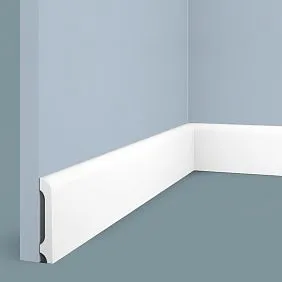
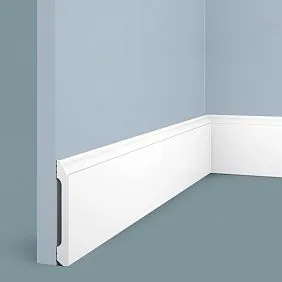
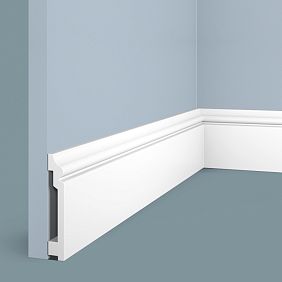
Our factory also produces:
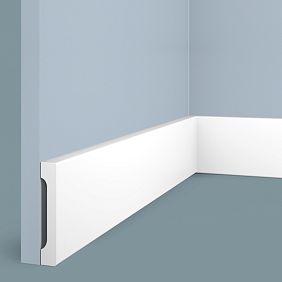
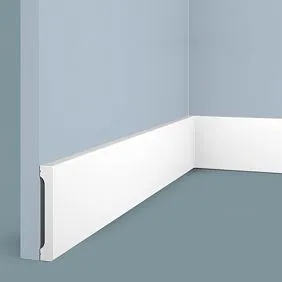
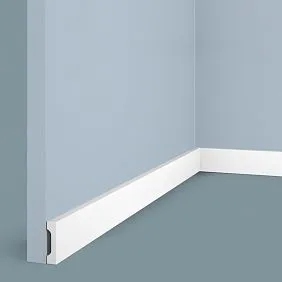
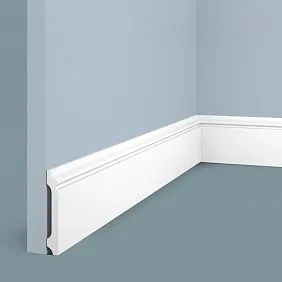

2.1 Architectural Functions
A wide skirting board turns separate wall and floor planes into a unified ensemble. In rooms with high ceilings (from 3 m), a narrow skirting board disappears in proportion, whereas a wide plank serves as a "wainscoting," giving walls a more classic, "homey" texture.
Get Consultation
2.2 Play of Light and Shadow
Natural wood has relief that emphasizes side lighting: lights along the wall create soft shadows, enhancing the sense of depth. When choosing a wide model, pay attention to profiles with a slight bevel or grooves — they add dynamism and highlight the wood texture.
2.3 Styles and Combinations
● Classic and Neoclassic. Solid oak or beech in natural tones, refined profiles with grooves and soft curves.
● Scandinavian style. Wide skirting board made of pine or birch, painted in matte white, emphasizing minimalism.
● Loft and Industrial. Dark oak or wenge with rectangular cross-section, without decorative elements.
● Eclecticism and Modern. Combine a wide skirting board with decorative lighting and bright wall panels.
3. Functional Advantages
3.1 Mechanical Protection
A wide wooden plank withstands impacts from furniture and household appliances, bearing the main part of the load. Due to its thickness of 18 mm to 24 mm, it prevents cracks and chips on walls and edges of flooring.
3.2 Thermal and Sound Insulation
Wood has low thermal conductivity and good sound-absorbing properties. A wide skirting board creates an additional "barrier" zone, reducing noise levels from footsteps and operating household appliances.
3.3 Concealing Utilities
In deep wide profiles, it is convenient to hide power, TV, and internet cables, leaving them accessible for maintenance without damaging the wall.
3.4 Gap Compensation
Wooden finishes are subject to seasonal expansion and contraction. A wide skirting board conceals a technological gap of at least 10 mm, necessary for the free "breathing" of boards and laminate.
4. Material Selection: Solid Wood, Veneer, or MDF
When purchasing a wide skirting board, the material is decisive:
|
Material |
Pros |
Cons |
|
Solid wood (oak, beech, ash) |
1. Absolute naturalness, durability. 2. Ability to be sanded and restored multiple times. 3. High wear resistance. |
1. Highest cost. 2. Requires strict humidity control (40–60%). 3. Requires expansion gaps. |
|
MDF with veneer |
1. Geometric stability. 2. Rich palette of veneer shades. 3. Price 30–40% lower than solid wood. |
1. Veneer is susceptible to chipping. 2. Local restoration is impossible — entire strip must be replaced. |
|
Combined profile (solid wood + MDF) |
1. Natural appearance at lower cost. 2. Increased moisture resistance. 3. Minimal 'play' in dimensions. |
1. Complex installation. 2. Full replacement required if surface panel is damaged. |
Tip: If budget is limited and you live in an apartment with central heating, prefer veneered or combined profiles. For a house in a climate-controlled environment, choose solid wood.
5. Sizes and profile: how to avoid mistakes
5.1 Typical widths
● 80–100 mm — universal option for ceilings up to 2.8 m.
● 100–120 mm — for rooms with ceilings 2.8–3.2 m.
● 120–150 mm and above — ideal for high and large halls, living rooms with ceilings over 3.2 m.
5.2 Depth and thickness
● Depth (projection from wall) — affects contact area with floor and protective properties, usually 15–24 mm.
● Thickness (from wall to surface) — 18 to 30 mm; the thicker, the stronger, but harder to install in narrow gaps.
5.3 Profile
● Straight — minimalist, suitable for modern styles.
● With bevel — universal, smooths corners and adds softness.
● With grooves — creates a classic pattern, visually 'breaking' the width.
● With a recess for lighting — allows embedding an LED strip.
5.4 How to choose based on interior style
● For strict lofts and high-tech — straight profile without decorative elements.
● For classic and neoclassical — with grooves and bevels.
● For Scandinavian minimalism — wide white lacquered skirting board with simple bevel.
● For art deco and glamorous interiors — solid wood with expressive grain pattern and deep lacquer.
6. Calculating the required amount
Accurate measurement guarantees no shortage or leftover material:
- Measure the room's perimeter along the inner corner.
- Subtract door and window openings deeper than 2 cm.
- Add a 10% reserve for cutting angles, defects, and errors.
- Find out the length of the package from the selected manufacturer — usually 2.4 m, 2.5 m, or 2.7 m.
- Divide the total length by the package length and round up.
Example:
Perimeter 25 m – openings 1.2 m = 23.8 m → with 10% reserve = 26.18 m → package length 2.5 m → 26.18 ÷ 2.5 ≈ 10.47 → 11 packages.
7. Installation features of a wide skirting board
Installing a wide skirting board requires more attention than a standard one:
- Surface preparation.
Remove the old skirting board, clean up any remaining adhesive, and level walls if deviation exceeds 5 mm over 2 m.
- Marking.
Mark a straight line around the perimeter using painter’s tape or string. For wide boards, precise alignment is crucial.
- Dry fitting.
Lay out all segments, check joints and corners, and make necessary cuts.
- Choosing fasteners.
○ Hidden clips and guides — best option for wide models, maintains ventilation.
○ Liquid nails — provide rigid fixation, but make removal more difficult.
○ Decorative-headed screws — almost match in reliability, but leave micro-holes.
- Edge treatment.
After cutting, always treat the ends with lacquer or oil to prevent moisture absorption.
- Final finishing.
Protect the surface with an anti-static agent and wipe with a soft cloth.
Lifehack: for precise corner cuts, use a miter saw with an adjustable bevel — this allows you to join even non-standard angles without unnecessary gaps.
8. Care and extending service life
Wide wooden skirting requires regular but simple maintenance:
● Daily cleaning. Use a soft dry or slightly damp cloth, without abrasives and aggressive chemicals.
● Apply protective treatments. Every 3–6 months, apply varnish or oil as recommended by the manufacturer to restore the original sheen.
● Check fasteners. Inspect clips and mounting points annually, tighten screws, and replace clips if necessary.
● Climate control. Maintain humidity at 40–60% and temperature at +18…+24°C — this will extend the service life of solid wood and veneer.
9. Design techniques with wide skirting
- Contrasting frame. A dark wide skirting on a light floor accentuates room boundaries and visually lifts the walls.
- Monochromatic solution. Skirting in the same tone as the floor or walls "disappears" into the interior, creating a seamless effect.
- Lighting. Integrated LED strip in the skirting niche creates a soft background under the wall and a "floating" floor effect.
- Combination. Use solid wood wide skirting in the living room, and veneered or combined profiles in hallways and bathrooms to save budget.
- Transitions. When there are floor level changes (steps, platforms), wide skirting serves as a stylish "barrier" and conceals technical joints.
10. Criteria for choosing a reliable seller
When searching for a company wherewide wooden baseboardPay attention to:
● Certificates and standards. GOST, E0/E1 formaldehyde certificates, moisture resistance tests.
● Reviews and portfolio. Real photos of completed projects, recommendations from professional builders.
● Showroom and samples. Opportunity to take home veneer strips or demo panels to evaluate color under different lighting.
● Guarantees and service. Production timelines, return conditions, option to order installation from the manufacturer.
● Transparent pricing. Detailed price list: cost of skirting, corners, clips, installation, and delivery without hidden fees.
11. Where to buy affordably
11.1 Specialized stores
Advantage — in-person sample viewing and designer consultations, but prices may be 10–20% higher than market rates.
11.2 Online stores
Wide assortment, promotions and discounts, delivery across Russia; always order veneer test samples before large orders.
11.3 Construction material hypermarkets
Economy option: self-pickup and low price, but limited selection of wood species and profiles, minimal customer support.
Recommendation: combine the convenience of online ordering with the option to receive free samples — this will allow you towide wooden baseboard confirm that the color and wood grain match your interior.
Frequently Asked Questions
- Can a wide skirting board be painted any color?
Yes, if the MDF skirting board is paintable or the solid wood has been primed. For solid wood, it is better to use oil or acrylic varnishes that preserve the wood grain.
- How to install skirting board on a 'warm floor'?
If the profile is designed for temperatures up to +27°C and can withstand heating, installation is performed according to the standard scheme with compensatory gaps.
- What tools are needed for self-installation?
Painting tape, level, measuring tape, circular saw, clips or liquid nails, self-tapping screws and caps, protective gloves.
- How to account for wall irregularities?
For height differences up to 5–7 mm, use leveling mounting clips and special overlays; larger differences require spackling or installation of flexible skirting board.
- Should gaps be left under the skirting board?
Yes, at least 10 mm to compensate for floor expansion. A wide skirting board will cover this gap, but it must be maintained when laying laminate or parquet flooring.
Conclusion
a wide wooden skirting board is not just a decorative profile element, but an important part of the interior, combining protective and decorative functions. It emphasizes style, hides architectural flaws, and ensures the longevity of the floor covering. When choosing, consider ceiling height, climate conditions, load, and room style. And to avoid risks and get full service from measurement to installation,wide wooden baseboard it is better to choose from reputable suppliers with quality guarantees and professional support at every stage. Let every centimeter in your home speak of attention to detail and love for natural materials!