Article Contents:
- Sandroik philosophy: more than decoration
- Psychology of architectural form perception
- Variety of styles: from classic to futurism
- Classic solutions: time-tested beauty
- Modern minimalist aesthetics
- Regional architectural traditions
- Material science: the foundation of durability and beauty
- Natural stone: the benchmark of prestige and longevity
- Wood: living beauty and traditional craftsmanship
- Polyurethane: Revolution in Architectural Decoration
- Sandroik design: the art of precise calculations
- Proportional relationships
- Structural Solutions
- Integration with facade systems
- Technological aspects of production
- Production of wooden elements
- Casting of polyurethane elements
- Quality control at all stages
- Installation: the final stage
- Preparatory work
- Fastening technology
- Finishing
- Operation and maintenance
- Periodic inspection and diagnostics
- Cleaning and maintenance
- Repair and Restoration
- Economic Aspects: Investment in Beauty and Prestige
- Factors Forming Value
- Economic efficiency calculation
- Conclusion
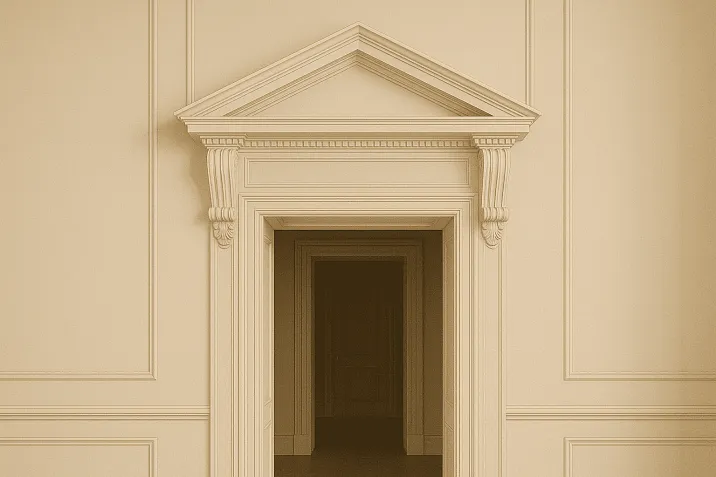
The entrance door is the first impression of the house, its business card, and a reflection of the owner's character. But what transforms an ordinary doorway into a majestic portal worthy of a palace? The answer lies in one architectural detail — Sash Rail for Door— which can radically change the perception of the entire building facade.
Imagine: two identical houses stand side by side. One has a simple door in a solid wall, the other has the same opening, but the elegant sandriks above it transform the entrance into a work of architectural art. What is the secret of such a transformation? How can one detail so radically change the appearance of a building?
The secret lies in understanding that architecture is a language of forms, and each element carries a specific message. Sash Rail for Door — it is not merely a decorative overlay, but an architectural statement about status, taste, and understanding of beauty. It creates hierarchy in the facade composition, highlights the main entrance, and gives the building a sense of scale and grandeur.



Sandroik philosophy: more than decoration
Many mistakenly consider sandriks to be purely decorative elements, forgetting their deep functional basis. In reality, a properly designed Sundial above the door performs multiple practical tasks, each contributing to the comfort and longevity of the entire structure.
The first and primary function is protective. The projecting cornice of the sandrik creates a shaded area above the entrance, protecting the door from direct rain and snow. In regions with harsh climates, this function is critically important — it prevents the door panel from getting wet, ice formation on the threshold, and water ingress into the lock mechanism.
The second function is compositional. The sandrik creates a horizontal dominance in the vertical plane of the wall, which is psychologically perceived as stability and reliability. It sets the scale of the entire entrance group, making it proportional to the human figure, creating a sense of hospitality and security.
The third function is status-related. Since ancient times, the sandrik has served as a marker of the owner's social status. The richer the decoration, the more complex the profile, the higher the quality of execution — the higher the status of the house. This tradition remains alive today, although modern interpretations may be more restrained and minimalist.




Psychology of architectural form perception
Why does the human eye respond positively to architectural details? Modern neuroarchitecture provides a scientifically grounded answer. Our brain evolved in a natural environment, where horizontal elements — tree branches, rock overhangs — indicated protection and shelter.
door frame trim With a sandrik, these ancient instincts are activated, creating a sense of safety and comfort even before a person steps over the threshold. Proper proportions evoke a sense of harmony, quality execution — trust, and thoughtful details — respect for craftsmanship.
The color scheme of the sandrak also plays an important psychological role. Light shades are associated with purity and openness, dark shades with solidity and reliability, contrasting shades with dynamism and modernity. An experienced designer always takes into account these nuances when selecting the finish coating.
Our factory also produces:


Variety of styles: from classic to futurism
The modern market offers door sardines in the most diverse stylistic interpretations. The choice of a specific solution depends on the architectural style of the building, the owner's personal preferences, budget constraints, and regional climatic conditions.
Get Consultation
Classic solutions: time-tested beauty
The classical style remains the benchmark of architectural harmony. Sandrok cornice In classical execution, it is based on the canons of ancient architecture, where each detail has its own significance and place within the overall composition.
The proportions of the classical sandrak conform to the mathematical laws of the golden section. The overall height is approximately one-fifth to one-seventh of the door opening width. The architrave occupies one-third of the height, the frieze — half, the cornice — the remaining part. These ratios have been developed over millennia of architectural practice and are perceived as naturally harmonious.
The decorative content of the classical sandrak is restrained and noble. Main motifs — plant ornaments (acanthus leaves, palmettes, rosettes), geometric patterns (meander, braided pattern, beads), architectural elements (modillions, dentils, fluting). All these details have symbolic significance and create a certain atmosphere.
Modern minimalist aesthetics
Modern architecture offers a radically different approach to interpreting the sandrak. Here, the importance lies not in ornate decoration, but in perfect proportions, purity of lines, and nobility of materials. Door Frame Installation In a minimalist style, it may be a simple horizontal band without any decoration.
But this apparent simplicity is deceptive. Behind it lies meticulous work on proportions, thoughtful selection of materials, flawless execution quality. The slightest inaccuracy in minimalist design becomes noticeable and destroys the entire composition.
Materials for modern sandraks can be the most diverse: metal, glass, composites, natural stone. It is important that they harmonize with the overall style of the building and emphasize its architectural concept.
Regional architectural traditions
Russia is a country with the richest architectural traditions, which are reflected in the interpretation of sandraks. Russian classicism, Moscow baroque, Petersburg Empire, provincial modernism — each direction has its own features in solving entrance groups.
Northern regions tend toward more massive, solid forms with increased cornice overhang for snow protection. Southern regions prefer light, delicate structures with rich decoration. Coastal areas use materials resistant to salty air and high humidity.
Modern interpretations of regional styles allow preserving cultural identity while using advanced materials and technologies. Decorative door frame trim may include ethnic motifs executed in modern materials.
Materials science: the foundation of durability and beauty
Choosing a material for manufacturing the sandrak is a key decision that determines not only the appearance, but also the durability, maintenance cost, repair and modernization possibilities. Each material has its advantages and limitations, which must be considered during design.
Natural stone: the benchmark of prestige and durability
Stone remains the unrivaled material for creating status architectural elements. Limestone, sandstone, marble, granite — each type has its own character, its own aesthetics, its own technical characteristics. SANDRIK buy Made of natural stone — this is an investment for decades of flawless service.
Limestone is a classic material of European architecture. It is easily worked, allows creating delicate details, and over time acquires a noble patina. The main drawback — sensitivity to acid rain, which limits its application in industrial regions.
Sandstone has a warm, cozy color and interesting natural texture. It is more resistant to atmospheric influences than limestone, but requires proper orientation of layers during installation. Improperly installed sandstone may delaminate and break down.
Marble is the king among decorative stones. It allows creating details of jewel-like precision, has a rich palette of colors and patterns. But marble is fussy in use — it fears frost, acids, certain types of pollution. Its application requires professional consultation and special care.
Granite is practically eternal, but difficult to process and expensive to produce. It is ideal for regions with harsh climates, where other materials quickly deteriorate. Modern technologies allow creating complex profiled details from granite, but their cost remains high.
Wood: living beauty and traditional technologies
Wood — a material with a thousand-year history of use in architecture. Sandrok moldings Made from quality wood, they create a unique, warm atmosphere that no artificial material can provide.
The choice of wood species is determined by climatic conditions, stylistic requirements, and budget constraints. Oak is the benchmark for strength and durability, but requires professional drying and treatment. Beech does not fall short of oak in mechanical properties, but has a lighter, pinkish hue.
Coniferous species — pine, spruce, larch — are more affordable and easier to process. Larch is especially valued for its natural resistance to rot and moisture. It is ideal for outdoor use in variable humidity conditions.
Modern protective compositions allow significantly extending the service life of wooden elements. Antiseptics protect against biological damage, hydrophobic impregnations — from moisture, UV filters — from fading. A properly treated and regularly maintained wooden sash can serve for decades.
Polyurethane: Revolution in Architectural Decoration
The emergence of high-quality polyurethane has been a true revolution in architectural decoration production. This material combines the best qualities of natural materials with the advantages of modern technologies. Cornice elements Polyurethane can reproduce the finest details of wood or stone carving.
Modern polyurethane compositions possess a unique set of properties: high strength, elasticity, UV resistance, frost resistance, ease of processing and installation. They do not rot, do not attract insects, and require no complex maintenance.
The production technology of polyurethane elements is based on casting into silicone molds. This allows creating items of complex shapes with perfect dimensional and surface quality repeatability. One mold can produce thousands of identical parts, making polyurethane sashes economically attractive.
The main advantage of polyurethane is the ability to create lightweight, large-sized elements. This is especially important during the reconstruction of historical buildings, where additional load on load-bearing structures is unacceptable.
Sash design: the art of precise calculations
Creating a harmonious sash begins long before manufacturing — with careful design, taking into account numerous factors: building architectural style, opening dimensions, climatic conditions, client preferences, budget constraints.
Proportional Relationships
The foundation of any architectural element — correct proportions. Buy a Door Sondrik With disrupted proportions — money down the drain; such an element not only fails to adorn the facade but may damage it.
The total width of the sash should exceed the door opening width by 10-20% on each side. This creates visual continuity with adjacent wall sections and provides better protection against oblique rain. A sash that is too wide looks bulky, while one that is too narrow appears insignificant.
The height of the sash is determined by the opening width and the building’s architectural style. For classical styles, it is 1/5–1/7 of the opening width; for modern styles, it may be significantly less. The eave overhang must be sufficient for effective rain protection — at least 80–100 mm.
Internal proportions of sash elements are also critically important. The architrave, frieze, and cornice must relate to each other in specific proportions developed over centuries of architectural practice. Violating these proportions immediately becomes apparent and creates a sense of disharmony.
Constructive solutions
The sash must be not only beautiful but also reliable. The constructive solution is determined by the material of manufacture, element dimensions, method of wall attachment, and climatic loads.
Lightweight polyurethane sashes can be primarily attached using adhesive with additional mechanical fixation at several points. Heavy stone elements require a robust anchor system distributing the load over a larger wall area.
Special attention is paid to junction nodes where the sash meets the wall. Here, a watertight joint must be ensured to prevent moisture ingress into the structure. Modern sealants and sealing tapes allow creating a reliable barrier while preserving the possibility of thermal deformation.
The sash’s drainage system is another important design aspect. Water flowing down the cornice must be directed away from the wall, avoiding streaks and not reaching facade elements below the sash. This is achieved through proper cornice profiling and installation of drip edges.
Integration with facade systems
Modern buildings often use complex facade systems — ventilated facades, insulation systems, composite panels. Sash Rail for Door It must harmoniously integrate with these systems without compromising their functionality.
When designing a sash for a ventilated facade, the air gap between the cladding and the wall must be considered. Attachment must be to the load-bearing wall through the cladding, requiring special long anchors.
Insulation systems add additional wall thickness, which must be considered when determining sash dimensions. Thermal bridges at attachment points must be minimized using thermal breaks or special fasteners.
Technological aspects of production
The quality of the finished sash is established during production. Modern technologies allow creating high-quality products, but only under strict adherence to technological regulations and continuous quality control.
Production of wooden elements
Manufacturing wooden sashes begins with raw material preparation. The wood must be dried to a moisture content of 8–12% and conditioned under stable conditions to relieve internal stresses. Stock is selected without knots, cracks, or other defects that could affect the final product’s quality.
Mechanical processing is performed on high-precision CNC equipment. This ensures perfect profile repeatability and minimal dimensional tolerances. Milling complex profiles requires specialized tools and high operator skill.
Gluing large-sized elements from individual laminates is performed using water-resistant adhesive under pressure. This technology eliminates deformation and cracking of finished products, ensuring dimensional stability throughout the entire service life.
Finishing includes grinding, priming, and application of protective-decorative coatings. Each stage requires careful adherence to technology and intermediate quality control. Finished items are packaged in protective film to prevent damage during transportation.
Injection of polyurethane elements
Production of polyurethane sandwicks — a high-tech process requiring precise adherence to multiple parameters. The quality of the finished product depends on the quality of raw materials, accuracy of component dosing, stability of temperature regime, and mold quality.
Modern polyurethane systems are two-component mixtures mixed directly before pouring into molds. The ratio of components must be maintained with precision to the fraction of a percent, ensured by automatic dosing systems.
Molds are made from high-quality silicone capable of reproducing the finest details of the master model. The service life of a quality mold is several thousand cycles, making production economically efficient even for complex items.
Polymerization occurs at room temperature or with heating, depending on the type of polyurethane system. Curing time ranges from several minutes to several hours. Finished items are removed from molds and subjected to quality control.
Quality control at all stages
The quality control system must cover all stages of the production process — from incoming raw material inspection to acceptance of finished products. Only a comprehensive approach guarantees consistently high quality of manufactured items.
Incoming raw material inspection includes checking quality certificates, selective testing of key characteristics, and visual inspection for external defects. Materials not meeting requirements are not allowed into production.
Intermediate control during production allows timely detection of deviations from technological regulations and implementation of corrective measures. Temperature regimes, humidity, geometric dimensions, and surface quality are monitored.
Final acceptance of finished items includes a full set of tests according to technical specifications. Dimensions, profile, surface quality, and strength characteristics are checked. Items failing control are rejected or sent for rework.
Installation and mounting: final stage
Even the highest quality sandwick can be ruined by improper installation. Installation requires highly skilled personnel, specialized tools, quality fasteners, and strict adherence to technological operational sequence.
Preparatory Work
Installation begins with careful preparation of the base. The wall surface must be flat, strong, and free of dust, dirt, and remnants of old coatings. Irregularities exceeding 5 mm must be leveled using plaster or putty compounds.
Position marking of the sandwick is performed using a laser level or water level. Horizontal alignment is critically important — even minor deviations will be noticeable and spoil the appearance of the entire facade.
Corner decorative elements Require especially careful marking and fitting. Joints must be perfectly aligned without gaps or misalignments. Elements may be trimmed on-site if necessary.
Technology of mounting
The method of attaching the sandwick depends on its material, size, weight, and type of wall. Lightweight polyurethane elements are primarily attached using polyurethane adhesive with additional mechanical fixation using self-tapping screws at several points.
Heavy stone or large wooden sandwicks require a robust anchor system. Anchors must penetrate load-bearing walls to a depth of at least 80–100 mm and distribute load over a sufficient wall area.
Special attention is paid to sealing joints and junctions. All connections must be carefully sealed with elastic sealants compatible with construction materials. Paintable Molding Allows hiding minor irregularities and installation defects.
Final Finishing
After installation, the sandwick requires finishing, which not only gives it a finished appearance but also provides protection against atmospheric influences. Surface preparation includes sealing joints, grinding, and priming.
Choice of finish coating depends on the sandwick material and requirements for appearance. Wooden elements may be coated with varnishes, stains, or paints. Polyurethane elements can be coated with any type of paint after appropriate priming.
Quality of finishing is critically important for the appearance and longevity of the sandwick. Poorly prepared surfaces, low-quality materials, or violation of application technology may nullify all previous efforts.
Operation and maintenance
Proper operation and timely maintenance significantly extend the service life of the sandwick and preserve its original appearance. Maintenance schedule depends on the material of manufacture, climatic conditions, and intensity of use.
Periodic inspection and diagnostics
Regular inspection allows timely detection of emerging problems and implementation of preventive measures. Inspection should be conducted no less than twice a year — in spring after the end of the winter period and in autumn before its start.
Primary objects of control are the condition of the finish coating, integrity of sealing joints, reliability of element fastening, absence of deformations and damage. Special attention is paid to junctions with walls — problems often arise here.
and frames create a home atmosphere, making it truly cozy and individual. This is an investment in beauty, which pays off every day through aesthetic pleasure from admiring the beautiful. Require more careful inspection due to complex shapes and greater number of hard-to-reach areas. Accumulation of dirt and moisture in recesses may lead to accelerated material degradation.
Cleaning and maintenance
Regular cleaning not only maintains the attractive appearance of the sandwick but also prevents accumulation of contaminants that may damage the material. Cleaning methods depend on the type of contamination and material of manufacture.
Common contaminants — dust, dirt, rain marks — are removed with a soft brush and soapy solution. Use of abrasive materials and aggressive chemical compounds is prohibited, as they may damage the finish coating.
Complex contaminants — salt efflorescences, biological damage, corrosion traces — require the use of specialized cleaners. The choice of a specific composition must consider compatibility with sandrik material and safety for humans and the environment.
Repair and Restoration
Minor damages — scratches, chips, scuffs — can be repaired locally without dismantling the entire element. Special repair compositions exist for each material, allowing restoration of the original surface appearance.
Serious damages — cracks, large fragment breakage, detachment — may require partial or full replacement of elements. Modern technologies allow manufacturing an exact replica of the damaged part based on preserved fragments.
Preventive renewal of the finish prolongs the lifespan of sandrik and maintains its attractive appearance. The renewal frequency depends on the material and quality of the original coating — from 3–5 years for wooden elements to 15–20 years for polyurethane.
Economic Aspects: Investment in Beauty and Prestige
Installation of quality sandrik is an investment that pays off through increased attractiveness and property value. A properly selected and professionally installed Sash Rail for Door can increase the market value of a home by an amount significantly exceeding the cost of its purchase and installation.
Factors forming value
The cost of sandrik consists of several components: materials, manufacturing, delivery, installation, and finishing. Each of these factors may vary widely depending on specific project requirements.
Material is the main cost component. Natural stone is several times more expensive than polyurethane, but can last for centuries. Premium wood species cost more than coniferous, but have a more noble appearance and better performance characteristics.
Manufacturing complexity also affects the price. Simple profiles are cheaper than complex ones, standard sizes are cheaper than custom ones. Mass production is more economical than individual manufacturing, but may not always meet specific project requirements.
Economic Efficiency Calculation
When selecting sandrik, consider not only initial costs but also the cost of ownership over the entire service life. Cheap, low-quality items may prove costly in the long run due to high maintenance expenses and premature replacement.
Quality sandrik made from durable materials requires minimal operating expenses. Polyurethane elements practically require no maintenance throughout their service life. Stone elements can last for centuries without noticeable changes in appearance.
The prestige of the material and quality of execution influence the perception of the entire building. This is especially important for commercial real estate, where appearance directly affects business success. A solid sandrik creates a positive first impression for clients and partners.
Conclusion
The world of architectural decoration is constantly evolving, offering new materials, technologies, and design solutions. However, core principles remain unchanged — harmony of proportions, quality of execution, and alignment with functional purpose. Sash Rail for Door — it is not merely a decorative element, but an opportunity to express individuality, highlight status, and create a unique architectural image.
The choice of a specific solution depends on multiple factors — building architectural style, climatic conditions, personal preferences, budget constraints. However, in any case, do not compromise on material quality and professional execution. A good sandrik will delight the eye and serve for decades, while a poor one may ruin the entire facade appearance.
STAVROS Company has been a recognized leader in creating high-quality architectural decoration for many years. Combining traditional technologies with modern materials, STAVROS masters create products that meet the highest standards of quality, durability, and aesthetic characteristics.
A wide range of ready-made solutions and the possibility of custom manufacturing allow us to meet the needs of the most discerning clients. From simple classic profiles to exclusive original works — STAVROS is ready to bring any architectural fantasies to life, creating beauty that outlives its creators.