Article Contents:
- Room proportions
- Lath panels as rhythm
- High baseboards as base
- Colors: milk, linen, oak
- Case estimate
- Conclusion: tradition in urban format
- Frequently Asked Questions

Can the spirit of a Russian house be brought back into a standard urban apartment without turning it into a museum exhibit? Can tradition be combined with modern comfort, wooden architecture with concrete walls, carving with minimalism? Answer: yes. And the key to this is the proper use of architectural elements that create an atmosphere without overloading the space.
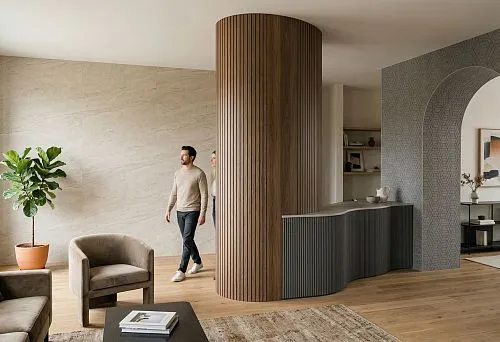
Wooden boards in interiorand high baseboards — this is not decoration, but the architectural foundation of the Russian style in an urban apartment. Laths create vertical and horizontal rhythm, reminiscent of log walls and beam ceilings of a traditional house. Baseboards form the base, ground the space, create a transition from floor to wall — that very 'belt' that holds the composition.
Modern Russian style in an apartment is a balance between history and relevance. It is the ability to take the essence of tradition — natural materials, proper proportions, honest construction — and adapt it to urban living conditions. Not izbas with a stove, but apartments with underfloor heating. Not carved shutters, but lath panels. Not benches and chests, but ergonomic furniture with elements of Russian decor.
In this article, we will show you how to create an interior in the Russian style in a regular apartment using lath panels and high baseboards. You will learn how to work with room proportions, which colors to choose, how to calculate the project estimate. This is a practical guide for those who want to live in a modern apartment with the soul of a traditional Russian house.


Room proportions
Before beginning the design, it is necessary to understand the space you will be working with. Modern apartments are very different: Stalin-era apartments with 3.2 m ceilings, Brezhnev-era apartments with 2.5 m, new constructions with 2.7 m. Floor plans also vary: from tiny studios to spacious three-room apartments. And each type of space requires its own approach to using laths and baseboards.
Ceiling height: the main parameter. The height of the ceiling determines how massive architectural elements can be. In a room with a 2.5 m ceiling, a high baseboard of 150 mm and frequent vertical laths will create a feeling of confinement, visually lowering the ceiling. In a room with a 3.2 m ceiling, on the contrary, a narrow baseboard of 80 mm and sparse laths will disappear, failing to create the desired effect.
Golden rule: the height of the baseboard should be approximately 1/18 — 1/20 of the ceiling height. For a 2.7 m ceiling, this gives 135-150 mm. For 3.0 m — 150-170 mm. For 2.5 m, it is better to limit to 120-140 mm. These proportions are perceived by the eye as harmonious, not oppressive, and not noticeable.
Distance between vertical laths also depends on ceiling height. At low ceilings, laths should be placed less frequently (spacing 40-60 cm) and made thinner (20-30 mm). This will create a light, airy pattern. At high ceilings, you can reduce the spacing to 30-40 cm and use thicker laths (40-50 mm) — this will emphasize verticality and make the room more slender.
Room size and shape. In small rooms (10-15 m²), the use of laths and baseboards should be measured. It is better to decorate one accent wall with a lath panel, while leaving the others smooth and light.Floor wooden skirtingaround the perimeter is mandatory — it creates completeness, but the color should be light, matching the walls or floor.
In large rooms (25-40 m²), you can afford a more intensive use of wooden elements. Lath panels on several walls, high contrasting baseboards, additional horizontal moldings at the height of the chair back or windowsill — all of this contributes to creating scale, filling the space, preventing it from feeling empty.
Room shape is also important. A narrow, elongated room (3×6 m) requires visual correction. Vertical laths on short walls will elongate them, making the room more square. Horizontal moldings on long walls, on the contrary, will break up the length. A dark baseboard and light walls will expand the space horizontally.
A square room offers more freedom. Here, symmetric compositions can be used: a lath panel on the wall behind the sofa or bed, framed by a baseboard and ceiling molding. Or four identical zones with lath decoration at the corners. Symmetry is characteristic of Russian style, creating a sense of order, stability, and correctness.
Lighting. Dark rooms (north-facing windows, ground floors) require light solutions. Laths and baseboards are better chosen in light tones — white, cream, light oak. Dark wood in poorly lit rooms will create a gloomy atmosphere. Light rooms (south-facing windows, upper floors) can handle darker tones — walnut, wenge, stained oak, which add depth and elegance.
Artificial lighting plays a key role. Laths work well with side lighting — it highlights their relief, creating shadow play. Hidden backlighting behind the lath panel (LED strip in the gap between laths and wall) creates a glowing wall effect, visually expanding the space. Under-baseboard lighting (LED strip in the gap between baseboard and floor) makes it appear to float, adding modernity to the traditional element.
Function of the room. The living room is a public zone where Russian style can be expressed most fully. Here, lath panels, high baseboards, moldings, carved elements are appropriate. The living room is where guests are received, and it should impress, telling the story of the owners.
The bedroom is a private zone, where restraint is needed. A lath headboard for the bed, a high baseboard matching the walls, minimal decor. The bedroom should calm, not excite. Light, natural wood tones, simple forms, absence of excessive ornamentation.
Kitchen and dining room — areas traditionally used for family gatherings. Russian style is especially appropriate here. Lath cladding of the lower part of walls (panels 100-120 cm high), protecting against dirt. High baseboard, resistant to wet cleaning. Natural wood, coated with oil or varnish, easy to clean.
Hallway — the first thing seen by visitors. Here, a balance between functionality and aesthetics is needed.Lath baseboardespecially good in the hallway — it combines the protective function of the baseboard with the decorative quality of the lath panel. Height 120-150 mm, vertical slots for ventilation and structural lightness.




Rafter Panels as Rhythm
Rhythm in interior — this is the repetition of elements at certain intervals, creating structure and organizing the perception of space. In Russian architecture, rhythm has always been important: rows of logs in a timber frame, ceiling beams, window openings on the facade — all of this created a clear, understandable structure. In a modern apartment, the role of rhythm-forming elements is taken by rafter panels.
Rafter boards are installed on the wall with a certain spacing. The spacing can be uniform (all intervals are equal) or rhythmic (alternating narrow and wide intervals). Uniform spacing of 40-50 cm creates a calm, meditative rhythm. Alternating — 30 cm + 60 cm + 30 cm — is more dynamic and expressive.
The thickness of the rafters affects the weight of the rhythm. Thin rafters 20×40 mm create a light, graphic pattern. Thick 40×60 mm — more substantial, architectural. For Russian style, the golden middle — rafters with a cross-section of 30×50 mm — is characteristic: they are expressive enough but do not overwhelm the space.
The height of the rafter panel can vary. A panel spanning the full height of the wall (from floor to ceiling) creates the maximum vertical effect. A panel 200-240 cm high (approximately at the level of the door opening) — a more traditional solution, typical for Russian interiors, where walls were divided into lower and upper sections. A low panel 100-120 cm (height of a chair back) — this is more of a protective cladding than a decorative element, but it also creates rhythm, albeit horizontal.
Horizontal Rhythm: Calmness and Stability. Horizontal rafters — less common, but no less interesting. They visually expand the space, making the room more elongated and calm. In Russian style, horizontal lines are associated with the crown of a timber frame, horizontal bands on facades, benches and shelves running along the walls.
The spacing of horizontal rafters is usually less than vertical ones — 15-30 cm vertically between rafter axes. This is because horizontal lines are perceived as more dynamic, and frequent spacing creates a rich, detailed pattern. Too sparse horizontal rafters (spacing over 40 cm) lose their impact — the wall is not perceived as raftered, but as a smooth surface with individual boards.
Horizontal rafter panels are good for elongated rooms, where you need to visually expand a short wall. They are also suitable for low rooms, where verticals may intensify the feeling of a heavy ceiling. Horizontal lines calm, ground, and make the space more lived-in.
Diagonal and Mixed Rhythm. A more complex option — diagonal rafters or a combination of vertical and horizontal. Diagonals create dynamism and movement, but require precise calculation and professional installation. In Russian style, diagonal elements appear in soffits (carved boards under the eaves), in latticed shutters, but are used less frequently in interiors.
Mixed rhythm — when vertical and horizontal rafters are combined on one wall — creates a complex, multi-level composition. For example, the lower part of the wall (100 cm from the floor) — horizontal rafters, the upper part — vertical. Or vice versa. Such a solution resembles lath panels, characteristic of Russian estate interiors.
Mixed rhythm — when vertical and horizontal boards are combined on one wall — creates a complex, multi-level composition. For example, the lower part of the wall (100 cm from the floor) — horizontal boards, the upper part — vertical. Or vice versa. This solution resembles lath panels, characteristic of Russian estate interiors.
Gaps and Openings. Rafter panel can be solid (rafters placed tightly together) or with gaps (spaces remain between rafters). Solid panel creates a sense of mass, enclosure, protection. Panel with gaps — lightness, transparency, play of light.
Through the gaps, the wall is visible, and this must be taken into account. The wall can be painted in a contrasting color (white rafters — dark wall or vice versa), can be finished with decorative plaster, patterned wallpaper, can have hidden backlighting. The interplay of background and rafters creates an additional layer of composition.
Functional Aspects of Rafter Panels. In addition to decorative roles, rafters can perform practical functions. Behind a rafter panel, you can hide wiring, wall irregularities, sound insulation. Shelves, hooks, holders can be installed between rafters. Rafter boards can serve as a base for mounting pictures, mirrors, and lamps.
In the hallway, a rafter panel 100-120 cm high protects the wall from dirt and serves as a base for coat hooks. In the bedroom, a rafter headboard — this is both decoration and practical protection of the wall from pillows. On the kitchen, horizontal rafters at the level of the backsplash create an interesting alternative to tiles (provided quality protection from moisture and grease).
In the hallway, a lath panel up to 100-120 cm protects the wall from dirt and serves as a base for hooks. In the bedroom, a lath headboard is both decoration and practical protection for the wall from pillows. On the kitchen, horizontal boards at the height of the backsplash create an interesting alternative to tiles (provided there is adequate protection from moisture and grease).
Materials and Finishes. For rafter panels in Russian style, light-colored wood species or light-toned finishes are preferred. Pine, spruce, birch — traditional options. Oak, beech — more expensive, but also more durable.
Finishes can vary: natural wood under oil (preserves texture), white enamel painting (modern cleanliness), gray toning (Scandinavian notes, close to Northern Russian aesthetics). It is important that the finish of the rafters harmonizes with baseboards and other wooden elements in the interior.
Our factory also produces:


High Baseboards as a Foundation
Baseboard — this is not just a strip covering the gap between the wall and floor. In Russian interior design, baseboard — this is an architectural element that creates the foundation, the base on which the entire wall composition is built. A high baseboard (120-180 mm) transforms the wall into an organized structure with a clear lower, middle, and upper section.
Why High Baseboards. In traditional Russian interiors, baseboards were high — 150-200 mm — because they served not only decorative but also protective functions. They protected the lower part of the wall from dirt during cleaning, from furniture impacts, from moisture. In a modern apartment, this function remains equally relevant.
Proportions and Profiles. The height of the baseboard should correspond to the ceiling height and room scale. For a standard apartment with 2.7 m ceilings, the optimal baseboard height is 120-150 mm. For high ceilings (3.0 m and above) — 150-180 mm. For low ceilings (2.5 m) it is better to limit to 100-120 mm.
The profile of the baseboard can be simple (rectangular cross-section) or complex (with moldings, protrusions, bevels). For Russian style, profiles with a slight rounding of the top edge are characteristic — this softens the transition from floor to wall, creating a more organic shape. A completely simple rectangular baseboard looks too minimalist and is not in tune with tradition.
The thickness of the baseboard is usually 15-25 mm. A thinner one will look fragile at a large height. A thicker one will protrude into space, interfering with furniture placement. 20 mm — optimal thickness, providing sufficient mass without causing problems.
The standard baseboard thickness is usually 15-25 mm. A thinner one will appear fragile at a large height. A thicker one will protrude into space, interfering with furniture placement. 20 mm is the optimal thickness, providing sufficient mass without causing problems.
Baseboard in the same color as the floor visually expands the floor, making it appear larger. The wall starts higher, and the room seems more spacious. This is a good option for small rooms. The color matches that of parquet, laminate, or tiles. For example, a floor of natural-toned oak — the baseboard is also oak, finished with the same oil.
Baseboard in the same color as the walls creates the effect of a single surface from floor to ceiling. The wall visually descends to the floor, and the space is perceived as higher. This works with light walls and light baseboards. A white baseboard on white walls — classic, never going out of fashion.
Contrasting baseboard — the most expressive option. A dark baseboard on light walls creates a clear boundary, graphic line, organizing the space. This is characteristic of Russian classicism, where dark wood (oak, walnut) was combined with white or pastel walls. A light baseboard on dark walls — a rarer solution, but also possible, especially if you want to soften the heaviness of dark colors.
Materials. For Russian style, a solid wood baseboard is preferred. This can be the same species used for rafter panels, doors, and window casings — creating material unity. Or contrasting species — for example, light pine rafters and dark oak baseboard.
Color Solutions. Baseboard can be in the same tone as the floor, the same as the walls, or contrasting. Each option creates its own effect.
Alternative to solid wood is MDF skirting, painted or veneered. MDF is cheaper, more stable (does not warp with humidity), easier to install. But it lacks the lively texture and warmth that natural wood provides. For authentic Russian style, solid wood is preferable.
Polyurethane skirting is unsuitable for Russian style. It looks artificial and has no connection to the tradition of natural materials. Even if painted to resemble wood, the difference is visible and perceptible.
Installation and joints. High skirting requires precise installation. Corners must be mitered at 45 degrees and fit tightly without gaps. Joints along the length (if the wall is longer than the standard plank) must be angled and inconspicuous. Fastening — concealed, using adhesive or recessed screws, flush and spackled.
The junction of skirting to door casing requires special attention. The skirting must fit tightly against the casing. If the casing is thinner than the skirting, a bevel (45-degree cut) is made to smoothly reduce the thickness. If the skirting is thinner than the casing, a decorative rose can be used to cover the joint.
Skirting with cable channel. Practical note: there are always wires in any apartment, and hiding them in skirting is a sensible solution. There are skirtings with cable channels, where space for wiring is available on the back or inside the profile.
For Russian style, the cable channel should be inconspicuous. The best option is when the channel is located on the back of the skirting (between the skirting and the wall). Externally, such skirting is indistinguishable from ordinary wood. The channel cover should be made of the same material and finish as the skirting.
Skirting as part of a system. High skirting does not exist independently. It works in conjunction with other horizontal elements: ceiling cornice, wall moldings, door casings. All these elements must be coordinated in style, material, and color.
Classic scheme: skirting and casings made of the same material and color. The ceiling cornice — also made of the same material, but may be slightly lighter or darker, creating a subtle gradient from floor to ceiling. Wall moldings (if present) — following the same logic. This creates a system, a frame, within which the interior unfolds.
Get Consultation
Colors: milk, linen, oak
Color in Russian interiors — not bright paints of Khokhloma and Gzhel (though they also have their place). It is primarily the colors of natural materials: wood, linen, wool, stone. This is a natural palette that creates calmness, coziness, and a connection to nature. In modern apartments, this palette is adapted, but its essence is preserved.
Milk: warm white. Pure cold white (like Antarctica White) is not characteristic of Russian style. Traditionally, warm white shades — milk, cream, ivory — were used. This is the color of whitewash applied to stoves and walls, the color of linen fabrics bleached by the sun.
In modern interiors, milk white is an ideal base for walls. It is bright, spacious, yet not sterile or hospital-like. It pairs well with wood of any shade, textiles, and metal. Against milk-colored walls, wooden planks and skirting stand out particularly expressively.
Milk white can be varied: slightly more yellow undertone — becomes cream, almost beige. Slightly more gray — becomes pearl, more modern and restrained. These nuances are important: they create depth, preventing white from appearing flat.
Linen: natural beige. Linen is the color of unbleached linen fabric, beige with a slight gray or green undertone. It is very Russian, the color of traditional clothing and household textiles. In interiors, the linen shade creates a soft, warm atmosphere.
Linen color is good for bedroom walls, where calmness is needed. For textiles — curtains, throws, decorative cushions. For stained wooden elements — planks, skirting, if you want to move away from white but remain within a light palette.
Linen pairs well with natural-toned wood (pine, birch, light oak), with white, and warm gray. It creates a cozy, enveloping atmosphere characteristic of traditional Russian homes, where everything was soft, warm, and inviting.
Oak: noble wood. Oak is not one color, but a whole spectrum from light golden to nearly black stained. Oak shades — the foundation of the color palette in Russian interiors. This is the color of floors, furniture, wooden panels, skirting.
Light oak (natural oak) — golden-beige with pronounced texture — ideal for floors and light furniture. It creates a warm, sunny atmosphere and works well in poorly lit rooms.
Medium oak — brown with reddish or gray undertone — classic for skirting, casings, furniture. It is dark enough to create contrast with light walls, but not too dark to avoid appearing gloomy.
Dark oak (dark oak, wenge) — deep brown-black — for accents, to create drama. Dark skirting on light walls, dark planks on a white background — this creates graphic contrast, clarity, character. But dark wood should not be overused, otherwise the interior becomes heavy.
Gray: modern interpretation. Gray is not a traditional color for Russian style, but in modern interpretation it is appropriate. Warm gray (greige — a mix of gray and beige) pairs well with natural wood, creating a more restrained, Scandinavian atmosphere, close to Northern Russian aesthetics.
Gray walls, light oak planks and skirting, linen textiles — this is modern Russian style without excessive ornamentation, but preserving the essentials: natural materials, proper proportions, cozy atmosphere.
Accent colors. Russian style allows bright accents, but in limited quantities. Red, green, blue — colors of folk painting — may appear in textiles (cushions, rugs), ceramics (tableware, tiles), and small decorative items. But walls, floors, large furniture should remain in natural, restrained tones.
Color combination principles. For a harmonious Russian-style interior, the 60-30-10 rule works: 60% — main color (usually light, milk, or linen for walls), 30% — secondary (natural wood tones for floors, furniture, planks), 10% — accents (textiles, decor, possibly bright colors).
Avoiding clutter is important. Russian interiors — calmness, solidity. Too many colors create chaos. Better to choose 2-3 main shades and build the entire composition around them, varying their saturation and lightness.
Case estimate
Theory without practice — only half understanding. Let’s examine a specific example: decorating a 20 m² (4×5 m) living room with 2.7 m ceilings in Russian style using plank panels and high skirting. We’ll calculate materials, labor, and obtain a realistic project estimate.
Initial data. The room is rectangular, one window 1.5×1.5 m on the short wall, door 0.9×2.0 m on the long wall. Walls are plastered and painted in neutral beige. Floor — laminate under oak. Ceiling — white, suspended. Task: create an accent wall behind the sofa with vertical planks, install high skirting around the perimeter, paint everything milk white.
Accent wall with planks. Wall size 4×2.7 m = 10.8 m². Planks are vertical, section 30×50 mm (visible width 30 mm, thickness 50 mm from wall). Distance between plank axes 40 cm. On a 4 m wall, 4÷0.4 = 10 planks fit. Height of each plank 2.7 m. Total: 10 planks × 2.7 m = 27 linear meters.
Planks from pine, cost approximately 350 rubles/meter (for 30×50 mm section, planed, dry). 27 m × 350 rubles = 9450 rubles.
To mount the boards, a subframe is needed: horizontal 40×40 mm boards on which the boards will be mounted. Three horizontal boards (top, middle, bottom) at 4 m each = 12 m.p. Cost approximately 150 rubles/m.p. 12 m.p. × 150 rubles = 1800 rubles.
Fasteners (self-tapping screws, dowels) — approximately 500 rubles. Primer for the wall under the boards — 300 rubles. Paint (white acrylic enamel for wood) for 27 m.p. boards — approximately 1.5 liters, cost 800 rubles/liter = 1200 rubles.
Total materials for accent wall: 9450 + 1800 + 500 + 300 + 1200 = 13250 rubles.
High baseboards. Room perimeter (4+5)×2 = 18 m minus door width 0.9 m = 17.1 m. Wooden baseboard 140 mm high, pine or birch, for painting. Cost of a quality baseboard of this height — approximately 900 rubles/m.p.
17.1 m.p. × 900 rubles = 15390 rubles.
Fasteners, glue, filler for grooves — 800 rubles. Paint for baseboards (same white enamel) — approximately 1 liter = 800 rubles.
Total materials for baseboards: 15390 + 800 + 800 = 16990 rubles.
Additional materials. Primer for baseboards — 400 rubles. Sandpaper for sanding before painting — 300 rubles. Acrylic sealant for joints — 400 rubles. Painter’s tape, protective film for floor and furniture — 500 rubles.
Total additional materials: 1600 rubles.
Work. Installation of subframe and boards — approximately 1200 rubles/m² accent wall. 10.8 m² × 1200 = 12960 rubles. Painting boards (2 coats) — 500 rubles/m². 10.8 m² × 500 = 5400 rubles.
Installation of baseboards — 400 rubles/m.p. 17.1 m.p. × 400 = 6840 rubles. Painting baseboards (2 coats) — 200 rubles/m.p. 17.1 m.p. × 200 = 3420 rubles.
Total work: 12960 + 5400 + 6840 + 3420 = 28620 rubles.
Total estimate.
-
Materials for accent wall: 13250 rubles
-
Materials for baseboards: 16990 rubles
-
Additional materials: 1600 rubles
-
Total materials: 31840 rubles
-
Work: 28620 rubles
TOTAL project: 60460 rubles
This is a realistic estimate for a 20 m² living room of medium level (not budget, but not premium). If more expensive materials are used (oak instead of pine, oil instead of paint, complex profiled baseboards), the cost may increase by 1.5-2 times. If done yourself — saving on labor will be approximately 30000 rubles, but will require time and skills.
Budget optimization options. Use MDF baseboards instead of solid wood (saving 30-40%). Paint yourself (saving 8820 rubles on painting). Reduce the height of the lath panel from full wall to 200 cm (saving on materials and labor approximately 20%). Use pre-primed boards that do not require additional preparation before painting.
What is included in the cost. It is important to understand: this estimate is only for boards and baseboards. Additional costs include: wall preparation (if leveling is required), painting other walls (if color changes), furniture, textiles, lighting, decor. Full Russian-style room decoration will require a budget 2-3 times higher.
Conclusion: tradition in urban format
Russian style in a modern apartment is not an attempt to recreate a hut or a palace. It is a way to fill urban space with warmth, coziness, and connection to tradition characteristic of a Russian home. Lath panels and high baseboards — simple yet powerful tools — create this connection without requiring radical apartment renovation.
The rhythm of vertical or horizontal boards organizes space, creates structure, reminds of wooden architecture. High baseboards form a foundation, ground the interior, making it substantial. Natural colors — milk, linen, oak — create a calm, natural palette, in which it is pleasant to live.
It is not expensive, not complicated, but requires understanding of proportions, sense of measure, respect for materials. You cannot simply buy boards and nail them to the wall. You need to plan where they will be, what size, spacing, color. You need to integrate them with baseboards, doors, furniture into a unified system. And then the apartment will acquire character, individuality, soul.
Company STAVROS has been creating wooden items for interiors in Russian style for 23 years. We produce boards of all cross-sections and lengths, baseboards from 80 to 200 mm high, moldings, door casings, carved elements — everything needed to decorate an apartment in accordance with tradition.
Our production works exclusively with high-quality kiln-dried wood (moisture content 8-10%), which guarantees dimensional stability and prevents warping. We offer items ready for painting (primed, prepared for final finish) and factory-finished items (painted, stained, oiled).
STAVROS can manufacture elements to custom sizes: non-standard plinth heights, special board cross-sections, unique profiles. We work with designers and private clients, helping to realize Russian-style interior projects across Russia.
We have a large warehouse program — standard items are shipped the same day as ordered. We adhere to production timelines for custom-made items. We deliver from 1 piece across Russia. Our clients include over 150 positive reviews, a 5.0 rating, and thousands of completed projects.
By choosing STAVROS, you are not just getting materials — you are partnering with a creator of interiors that will delight with beauty, serve for decades, and pass on cultural heritage to future generations.
Frequently asked questions
Can wooden board panels be used in a small room?
Yes, but in moderation. Accent one wall (behind the bed, sofa, or TV), leaving the rest light and smooth. Use narrow boards (20-30 mm) with wide spacing (50-60 cm) and light colors (white, milk). This creates rhythm without overwhelming the space.
What is the optimal plinth height for an apartment with 2.7 m ceilings?
The optimum is 120-150 mm. A 140 mm plinth is the ideal golden middle: tall enough to create an architectural effect, but not overly bulky for standard ceiling height. A plinth under 100 mm will look insignificant, while over 160 mm may visually lower the ceiling.
Is it necessary to match the color of boards and plinths?
Desirable but not mandatory. The ideal option is boards and plinths of the same color (white, milk, or natural wood with oil). This creates unity. But contrast is also possible: white boards with oak plinths or vice versa. The key is to make it a deliberate choice, not a random mismatch.
How much does it cost to install boards and plinths in one room?
For a 15-20 m² room with one accent board wall and high plinths around the perimeter — from 40,000 to 80,000 rubles including materials and labor (mid-range price segment). More expensive if using solid oak, complex profiles, or hand finishing. Cheaper if using MDF, DIY installation, or standard sizes.
Can boards and plinths be installed by oneself?
Yes, with basic skills and tools (circular saw, drill, screwdriver, level). Installing boards on a frame is no more difficult than installing paneling. Plinths require precision in cutting 45-degree angles — here practice is needed. Painting is accessible to anyone. But if unsure, it’s better to hire professionals — mistakes are more expensive to fix.
How to care for wooden boards and plinths?
Painted with enamel: wipe with a damp cloth, wash with a mild soap solution if needed. Reapply paint every 5-7 years in worn areas. Oiled: wipe with dry or slightly damp cloth, reapply oil every 2-3 years (clean, lightly sand, apply fresh layer). Avoid abrasive cleaners and stiff brushes.
Which wood species are best for boards and plinths in an apartment?
Spruce — optimal price-to-quality ratio, paints well, holds shape. Birch — denser than spruce, less resin, excellent for painting. Oak — most durable and beautiful, but expensive; ideal for plinths, while boards can use more affordable species. All species must be kiln-dried (moisture content 8-12%).
Is special wall preparation needed for board panels?
Not necessarily perfectly flat walls — boards are mounted on a frame that levels the surface. But the wall must be strong (not crumbling), primed, free of mold and moisture. If planning a gap between boards, the wall behind must be properly finished (painted, plastered) — it will be visible.
Can Russian style be combined with other styles?
Yes, modern Russian style combines well with Scandinavian (shared love of wood, light tones, natural materials), minimalism (simple forms, restrained palette), and eco-style (naturalness, eco-friendliness). The key is not to mix everything indiscriminately, but to take the best from each style and create a harmonious synthesis.
Where is best to use board panels in an apartment?
Living room — wall behind the sofa or TV. Bedroom — headboard. Entryway — accent wall opposite the door or storage zone. Kitchen-dining — dining area. Office — wall behind the desk. Anywhere an accent, structure, or connection to natural materials is needed.